Table of Contents
- SEO Landing Pages vs PPC Landing Pages
- How to Structure a Landing Page So It Can Rank and Convert
- Best Practices for Landing Page SEO
- Technical SEO Requirements for Landing Pages
- FAQ
Landing page SEO is the process of helping a conversion-focused page rank in search without turning it into a bloated blog post that no longer converts.
That balance is where most teams struggle. They either build a page that is clean and persuasive but too thin to rank, or they keep adding SEO content until the page stops feeling like a landing page at all.
The stronger approach is simpler than most teams expect. Start by deciding whether the page should rank in the first place, then build the page around one clear intent, one clear offer, and enough supporting content to remove the questions that stop both search engines and users from trusting it.
This guide explains what landing page SEO actually means, when a landing page should be indexed, how SEO landing pages differ from PPC pages, and what changes usually improve rankings without hurting conversion performance.
sbb-itb-bf47c9b
Landing Page SEO Quick Answer
If you need the short version, a landing page is most likely to rank when:
- the search results already include product, service, or landing pages
- the page targets one clear intent instead of several unrelated ones
- the title tag, H1, and first-screen copy match the query naturally
- the page answers the obvious questions people need before taking action
- the page is indexable, fast, mobile-friendly, and internally linked
- the content below the fold supports the decision instead of padding word count
If those conditions are not true, the page may be better as a PPC page, campaign page, or support page rather than an SEO-first landing page.
What Is Landing Page SEO?
Landing page SEO is the practice of optimizing a page designed to drive one primary action so it can also earn qualified organic traffic.
That definition matters because a landing page has a different job than a typical blog article. A blog post often exists to educate broadly. A landing page usually exists to move the visitor toward a specific next step such as starting a trial, requesting a demo, booking a consultation, joining a waitlist, or signing up for a product.
So the goal is not to make the page longer for the sake of SEO. The goal is to make the page clearer, more useful, and easier to understand for both search engines and visitors with commercial or evaluation intent.
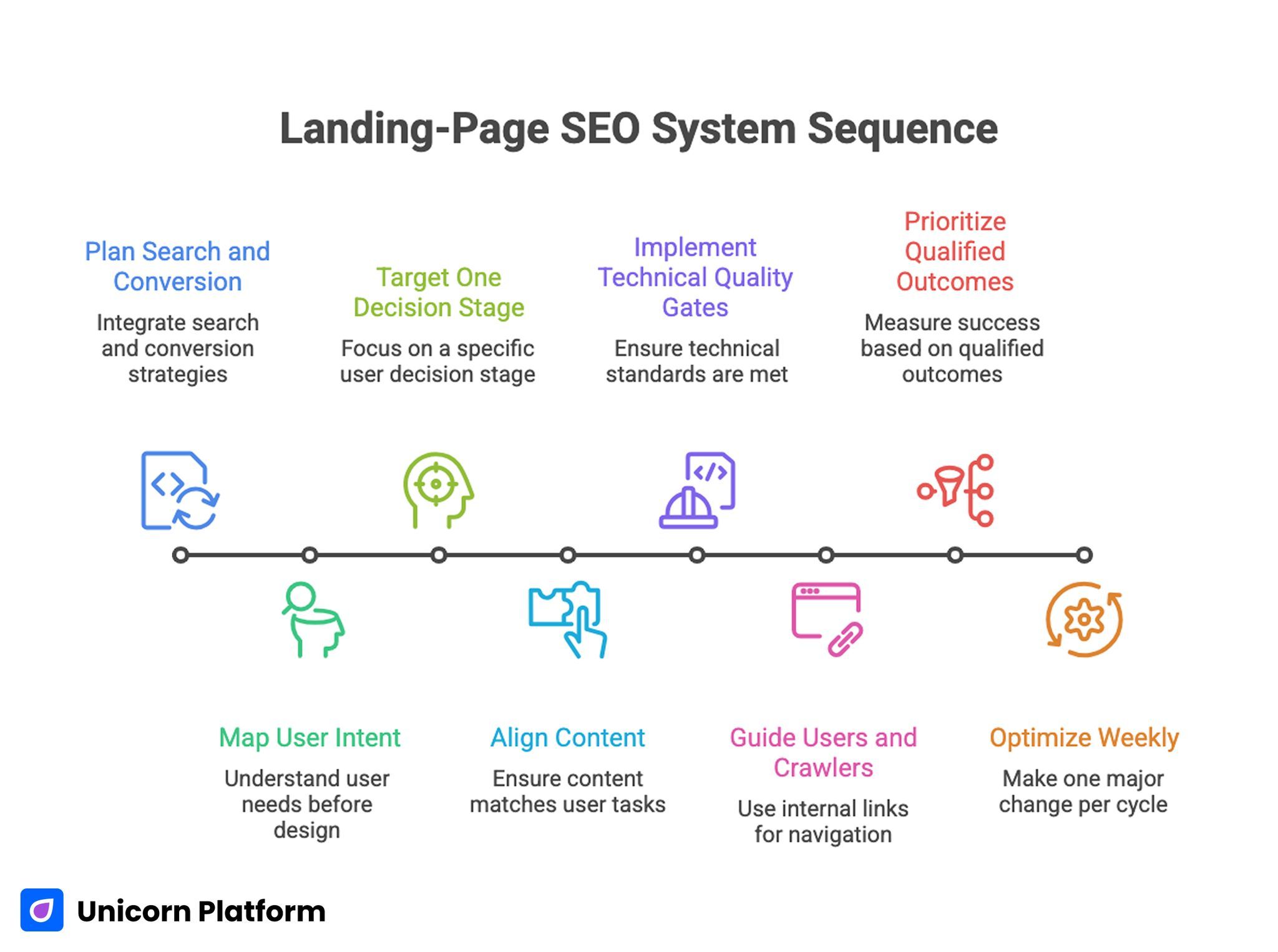
Landing-Page SEO System Sequence
Can Landing Pages Rank in Google?
Yes, landing pages can rank in Google, but only when the search intent fits the page type.
That is the first check to make before you optimize anything. Search the target keyword and look closely at page one:
- If you mostly see blog posts, long guides, and glossary-style educational content, a pure landing page may struggle.
- If you see product pages, service pages, signup pages, comparison pages, or location pages, a landing page has a much better chance.
This is why intent fit matters more than generic SEO advice. The question is not "Can a landing page rank?" The real question is "Should this query be answered by a landing page?"
SEO Landing Pages vs PPC Landing Pages
Many teams mix these two page types together, which creates messy decisions.
An SEO landing page is usually built for repeatable organic demand. It needs to be indexable, internally linked, and strong enough to answer the main questions behind a search query.
A PPC landing page is usually built for tighter message match and faster testing. It may be shorter, more isolated from site navigation, and more aggressive about pushing one action because the traffic source is already controlled.
There is some overlap, but they should not be treated as identical templates.
SEO landing pages usually need:
- search-intent alignment
- indexable URLs
- supporting copy below the fold
- internal links
- technical clarity for crawling and canonicalization
- a broader trust and objection-handling layer
PPC landing pages usually prioritize:
- immediate message match with the ad
- reduced navigation and fewer distractions
- shorter copy where appropriate
- faster testing cycles
- campaign-specific variants
Hybrid pages can work, but only when one dominant intent stays clear. If the page is trying to serve every channel equally, it often becomes weaker for all of them.
Should a Landing Page Be Indexed?
Not every landing page should be indexed.
Use a simple decision rule:
Index the page when:
- the keyword has repeatable search demand
- the page matches the type of result already ranking
- the offer is stable enough to support ongoing traffic
- the page can answer the main evaluation questions without becoming confusing
Consider noindex when:
- the page is a temporary campaign asset
- the messaging is too narrow or ad-specific for organic intent
- you are testing many close variants that could create duplication issues
- the page does not provide enough standalone value for search visitors
This one decision prevents a lot of wasted work. Teams often spend weeks optimizing pages that were never good SEO candidates to begin with.
How to Choose the Right Keyword for a Landing Page
The best landing page keywords usually sit close to an action or evaluation moment.
That does not always mean high purchase intent, but it does usually mean the searcher wants something more focused than a generic informational article.
Strong landing-page targets often include:
- product or service category terms
- use-case terms
- audience-specific terms
- comparison or alternatives terms
- solution-oriented problem terms
Weak targets are often very broad informational queries where users mainly want education, definitions, or news rather than a solution page.
Before writing the page, map the keyword to one primary intent:
- Learn
- Compare
- Validate
- Act
A landing page can support more than one of these, but it should clearly favor one. That choice should shape the headline, section order, proof blocks, and CTA language.
How to Structure a Landing Page So It Can Rank and Convert
The strongest SEO landing pages are usually built in a predictable order. They answer the biggest questions first, then add depth only where users need it.
1. First-screen clarity
The hero should explain:
- what the offer is
- who it is for
- why it matters
- what to do next
This section should match the promise implied by the title tag and search snippet. If the page title suggests one thing and the hero says something else, users bounce and trust drops quickly.
2. Core value and mechanism
After the hero, explain how the offer works in real terms. This is where many landing pages stay too vague. Search visitors often need one layer of explanation before they are ready to act.
3. Proof and trust
Add the strongest evidence near the first real decision point. That can include customer proof, product proof, process clarity, timelines, guarantees, or fit boundaries.
4. Supporting SEO depth below the fold
This is where landing page SEO usually succeeds or fails. The page needs enough depth to answer obvious questions, but not so much filler that the page loses focus.
Useful below-the-fold sections often include:
- what the solution includes
- how the process works
- who it is best for
- what makes it different
- implementation expectations
- FAQ
5. One clear primary CTA path
A landing page can include repeated CTA placements, but the action itself should stay clear. Too many competing paths weaken both conversion and message consistency.
If your team is standardizing section order across different offers, this landing page structure guide is a useful companion for planning page flow before writing.
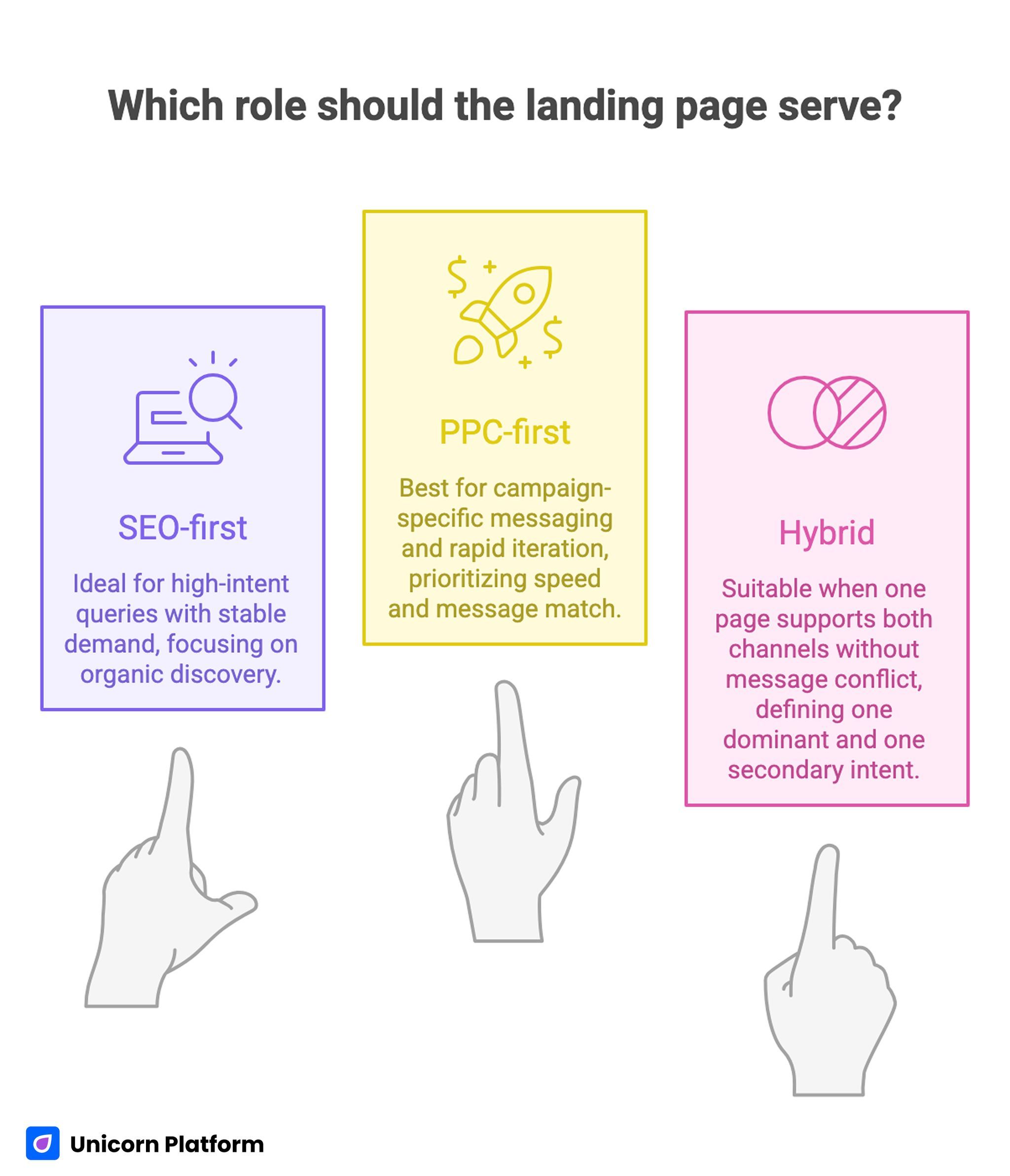
Which Role should the Landing Page Serve?
Best Practices for Landing Page SEO
The best practices that matter most are usually simpler than advanced SEO checklists suggest.
Match the title tag and H1 to the real page purpose
Keep the page focused on one clear search theme. Do not write a clever title that hides the actual intent of the page.
Put the main query in natural language near the top
The first screen should make topical relevance obvious, but it should still sound like normal human writing.
Expand only where decision friction exists
Do not add sections just to increase word count. Add sections where users need more confidence to continue.
Use H2s as decision checkpoints
Headings should help users scan for answers, not just help you insert keywords.
Improve snippet clarity, not clickbait
Good metadata improves the match between the search result and the page. Overpromising may help CTR in the short term, but it often hurts engagement quality.
Add internal links that help the reader move deeper
The best internal links feel like the natural next step, not an SEO patch added at the end.
Keep the page technically simple
If the page is slow, unstable, or confusing to crawl, strong copy alone will not save it.
Three Landing Page SEO Examples and Patterns
These examples are patterns, not templates you should copy blindly.
1. SaaS feature or product landing page
This pattern works when users are already searching for a specific solution category or capability.
The page usually needs:
- a direct category or use-case headline
- a clear explanation of the mechanism
- screenshots or product proof
- trust markers near the CTA
- FAQ about setup, fit, or pricing
Why it ranks: the query often has commercial intent and Google already shows product or solution pages.
2. Service landing page
This pattern works for agency, consulting, or local-service terms where people want to evaluate fit fast.
The page usually needs:
- strong audience and outcome framing
- service scope clarity
- trust proof and past work
- process explanation
- location or niche relevance where applicable
Why it ranks: searchers are often evaluating providers, not looking for a long informational article.
3. Lead magnet or signup landing page with SEO support
This pattern works when the page offers something concrete and the searcher is close to a signup action.
The page usually needs:
- a clear promise
- what users get immediately
- who it is for
- how signup works
- proof that the resource is worth claiming
Why it ranks: the query supports action, but users still need enough context to trust the page before converting.
If you are diagnosing why visitors scroll but do not commit, this guide on user behavior signals in landing pages can help identify the sections that need stronger clarity or proof.
Technical SEO Requirements for Landing Pages
Landing pages do not need a complicated technical stack, but they do need clean execution.
The basics to check first
- the page is indexable if it is meant to rank
- canonical tags point to the correct URL
- mobile rendering is stable
- the page loads quickly enough for real users
- forms and CTA modules work without delay
- the URL is short and readable
Technical issues that often block performance
- duplicate page variants
- accidental noindex or canonical mistakes
- heavy scripts that delay interactivity
- oversized images above the fold
- layout shifts near the form or CTA
- weak mobile spacing and readability
Performance matters because it affects both SEO and conversion
Slow pages do not just rank worse over time. They also lose more users before the value proposition is fully understood.
If the page is meant to drive signups or leads, performance should be treated as a launch gate, not as a cleanup task for later.
Teams working on cross-device consistency can use this responsive landing-page workflow to keep hierarchy and CTA visibility stable across screen sizes.
Internal Linking for Landing Page SEO
Internal links are one of the simplest ways to strengthen a landing page, and they are often underused.
The goal is not to add links everywhere. The goal is to give both crawlers and users a clearer path through related topics.
Good internal links usually do one of three jobs:
- move users from education to evaluation
- move users from a category page to a more specific page
- support trust by linking to a helpful proof or process page
Weak internal links usually have the opposite effect. They distract from the action, feel generic, or send users to pages that do not match the moment they are in.
Plan internal links at outline stage when possible. It is much easier to place them naturally there than to force them in after the page is already written.
Landing Page SEO Checklist
Use this checklist before publishing or reworking a page:
- Confirm that page-one results for the target keyword include landing-page-style results.
- Confirm the page has one dominant intent and one primary CTA.
- Rewrite the title tag and H1 so they match the actual page purpose.
- Make the first screen clear on audience, offer, and next step.
- Add one section that explains how the offer works in practical terms.
- Add one proof section near the first real commitment point.
- Expand below-the-fold content only where users need more confidence.
- Check indexing, canonical, and mobile rendering.
- Compress heavy images and reduce scripts that slow interaction.
- Add internal links that support the reader's next likely question.
- Review the page on mobile before release.
-
Track one primary performance metric and one guardrail metric after publishing.
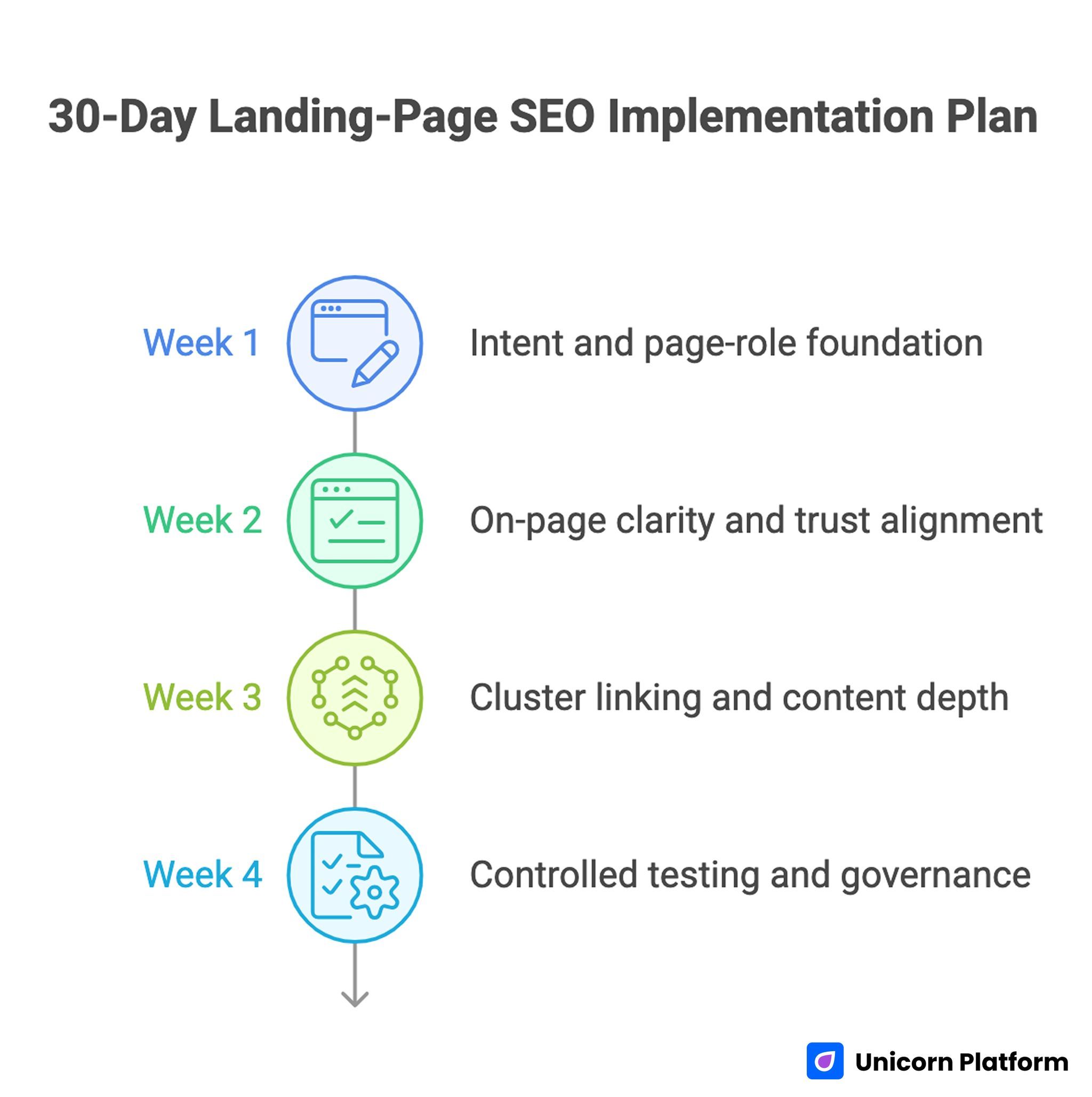
30-Day Landing-Page SEO Implementation Plan
Common Reasons Landing Pages Do Not Rank
Most weak landing pages miss in one of four ways.
The page is targeting the wrong query type
If the SERP is dominated by informational articles, a conversion-first page may not be the right format.
The page is too thin
Some pages explain the offer, but not enough to satisfy search intent or reduce user uncertainty.
The page is too broad
Trying to target too many keywords or too many audiences at once makes the page less relevant for everyone.
The page has technical or structural friction
Even a well-written page can underperform if it is slow, poorly linked, or inconsistent between search snippet and page experience.
Measuring Whether Landing Page SEO Is Actually Working
Rankings matter, but they are not enough on their own.
The best measurement model looks at three layers:
- Discovery: impressions, clicks, average position, CTR
- Decision quality: engagement, CTA interaction, form-start behavior
- Business outcome: qualified leads, trials, demos, or other meaningful conversions
This prevents a common mistake: celebrating traffic growth while the page brings in the wrong audience or lower-quality conversions.
If your team is tying page changes back to business goals, this optimization strategy framework is useful for connecting page-level changes to broader performance decisions.
FAQ: Landing Page SEO in 2026
What is landing page SEO?
Landing page SEO is the process of helping a conversion-focused page rank for the right search queries without weakening its ability to drive a clear next action.
Can a landing page rank in Google?
Yes, if the search intent fits a landing-page-style result and the page provides enough useful depth, technical quality, and relevance.
Should every landing page be indexed?
No. Some pages should rank, while others should remain campaign-specific or temporary. Indexing should depend on intent, demand, and page role.
How much content should an SEO landing page have?
There is no fixed word count. The page needs enough content to answer the user's key questions and support the decision, but not so much that it becomes unfocused.
What is the difference between an SEO landing page and a PPC landing page?
An SEO landing page is built to earn ongoing organic traffic and usually needs more supporting context. A PPC landing page is built for tighter campaign message match and often works with less depth.
Are blog posts better than landing pages for SEO?
Sometimes. If the query is mainly informational, a blog post may be a better fit. If the query has evaluation or action intent, a landing page may be stronger.
Do internal links help landing pages rank?
Yes. Good internal links improve crawl discovery, topical context, and user flow when they are placed naturally and support the reader's next question.
What should I fix first on a weak landing page?
Start with intent fit, title and H1 alignment, first-screen clarity, and technical basics. Those fixes usually matter more than chasing secondary SEO tweaks too early.
Final Takeaway
Landing page SEO works best when you stop treating rankings and conversions as separate systems.
The strongest pages are clear about the query they serve, clear about the action they want, and clear about the proof users need before taking that action. When that foundation is in place, SEO becomes much easier because the page is genuinely more useful.
In Unicorn Platform, that usually means building one focused page, indexing it intentionally, supporting it with the right internal links, and improving it in controlled iterations instead of stuffing it with generic SEO content.