Table of Contents
- How to Compare HIPAA-Compliant Website Builders With a Weighted Model
- Common Failure Modes and Corrective Actions
- 30-Day Execution Plan
- FAQ
Healthcare organizations rarely struggle to publish web pages. The real challenge is keeping growth work reliable while sensitive workflows move through forms, integrations, and team handoffs. A site can look polished and still create operational stress when data boundaries are vague and release ownership is weak.
That is why platform selection in healthcare should be treated as an operations decision, not a template decision. The right platform helps your team publish quickly, route requests clearly, and maintain trust when page content changes every week. The wrong platform can force constant rework, even when your marketing team is doing everything right.
A safe and effective build process starts before any design work. You need explicit scope, explicit responsibilities, and explicit criteria for what must be true before launch. When those pieces are missing, teams often discover risk only after traffic starts flowing through live pages.
This guide gives a full framework you can use in 2026 to evaluate options, structure intake paths, manage governance, and run day-to-day publishing without losing quality. The focus is practical implementation for real healthcare teams with limited time and real delivery pressure.
sbb-itb-bf47c9b
Key Takeaways
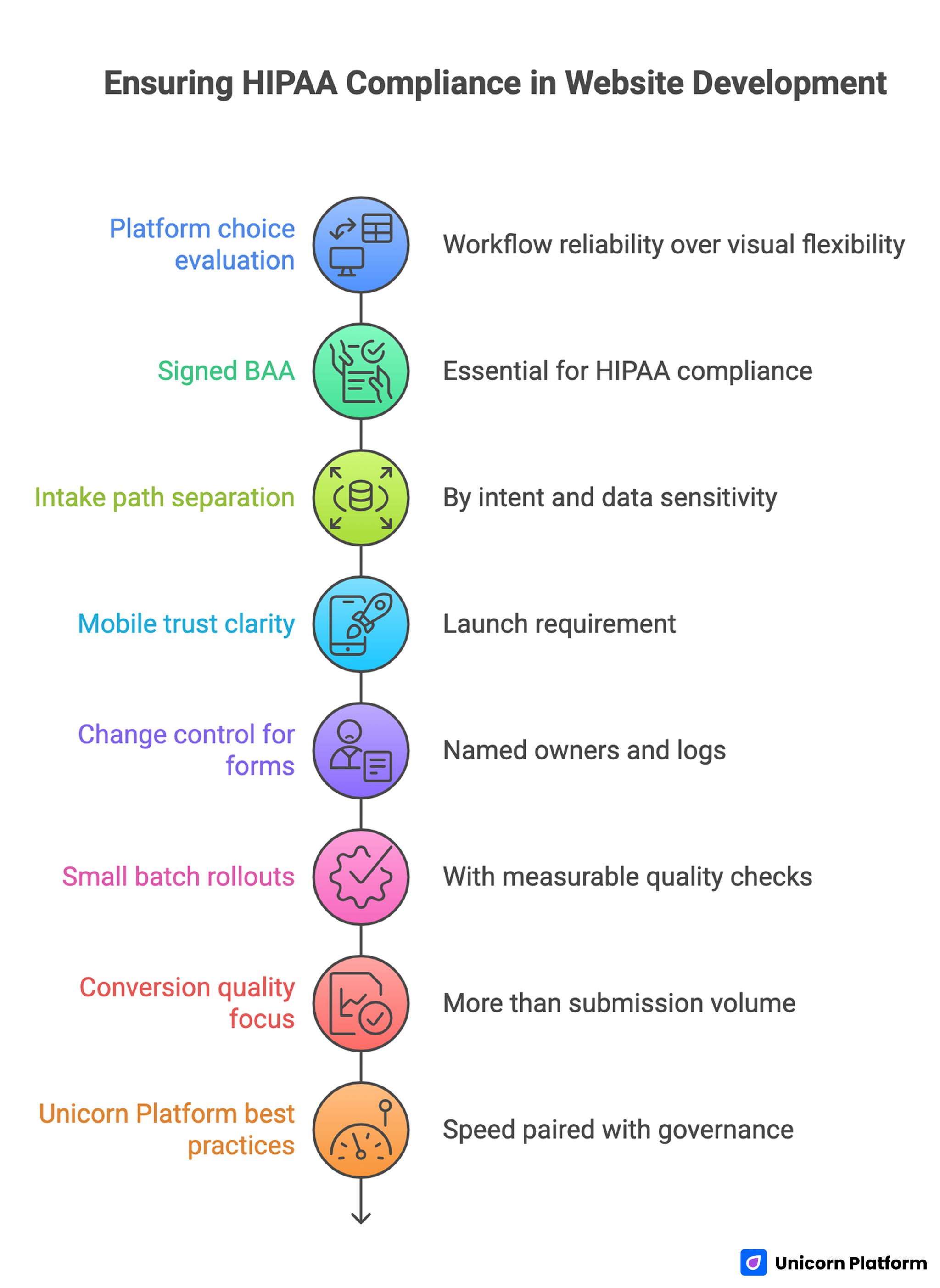
Ensuring HIPPA Compliance in Website Development
- Platform choice should be evaluated by workflow reliability, not visual flexibility alone.
- A signed BAA is essential, but operational controls decide daily risk.
- Intake paths should be separated by intent and data sensitivity.
- Mobile trust clarity is a launch requirement, not an optional polish step.
- Change control for forms and routing should have named owners and logs.
- Rollouts should happen in small batches with measurable quality checks.
- Conversion quality matters more than raw submission volume.
- Unicorn Platform works best when publishing speed is paired with governance discipline.
Why Healthcare Platform Decisions Break Down
Most healthcare website projects fail in predictable ways. Teams begin with design speed, then add intake forms, then attach scheduling and automation tools, and only later discover that responsibilities are unclear across the workflow. At that point, even simple edits create uncertainty around routing and review.
Another common issue is role confusion. Marketing teams own content velocity, operations teams own patient communication quality, and compliance stakeholders own policy boundaries. If no shared model connects these groups, the website becomes a patchwork of local decisions instead of a controlled system.
Many organizations also underestimate release risk. Small content edits can affect page hierarchy, trust context near forms, or field guidance that influences what users submit. Without a release checklist for high-impact sections, routine updates can quietly degrade both trust and operational quality.
The cost is rarely visible on day one. It appears over time as lower-quality inquiries, inconsistent follow-up expectations, and higher support load to correct avoidable confusion. Fixing this late is expensive, which is why selection discipline at the beginning matters so much.
What Compliance Means in Daily Website Operations
Compliance is often interpreted as a legal checkbox, but website performance depends on operational behavior after launch. Your team needs controls that work under normal deadlines, staff changes, and campaign pressure. If controls only work in ideal conditions, they are not reliable controls.
Research shows that HIPAA compliance in practice requires not only signed agreements but also strict controls over publishing processes and data integrations (HHS HIPAA Guidance). Without such operational standards, the risk of errors and data breaches remains high
A practical model has three layers. The legal layer defines obligations and agreements. The technical layer defines configuration and integration behavior. The operational layer defines who can change what, who reviews it, and how the team validates outcomes after release.
These layers should be aligned before migration starts. When they are aligned, teams can publish quickly without guessing whether a workflow change is safe. When they are disconnected, speed and trust pull in opposite directions.
Shared Responsibility Must Be Written, Not Assumed
Every healthcare website stack includes shared responsibility between your organization and external vendors. You need a written map of those boundaries in plain language that non-legal stakeholders can actually use during implementation.
This map should identify where data enters, which tools process it, where it is routed, and which role approves meaningful changes. If a step has no owner, that step becomes a hidden risk point. Hidden ownership gaps are one of the most frequent sources of post-launch instability.
A BAA Is Foundational, Not Sufficient
A BAA should be treated as a baseline requirement, not the final milestone. It sets contractual boundaries, but it does not automatically enforce quality in forms, workflows, or release process.
Teams still need strict configuration standards, integration review discipline, and recurring checks after updates. The strongest healthcare web programs combine contract clarity with operating discipline. That combination supports both trust and performance.
How to Compare HIPAA-Compliant Website Builders With a Weighted Model
Comparing tools by feature lists alone is not enough for healthcare organizations. You need a weighted model tied to your operating reality, otherwise decisions drift toward surface-level demos and short-term convenience.
Start with seven criteria and assign weights based on real business pressure. If your team publishes frequently, velocity and governance may carry more weight. If your workflows are integration-heavy, routing reliability and change control may carry more weight.
Use this scoring model as your first pass:
- Agreement and responsibility clarity.
- Intake and form control depth.
- Integration safety and routing predictability.
- Role permissions and approval design.
- Mobile trust readability near action points.
- QA and rollback readiness.
- Long-term maintainability for your actual team size.
After scoring, run a live pilot on one high-intent journey. A pilot reveals daily operational friction that scoring tables often miss. You are not validating marketing claims in this stage; you are validating publishing behavior under real conditions.
Capability Validation Questions You Should Ask Every Vendor
Vendor conversations should be scenario-based. Ask how workflows behave during urgent edits, staff handoffs, and release corrections. Those moments reveal whether controls are durable or only nominal.
Use direct questions that force implementation detail:
- Which workflow edits require elevated permissions?
- How is rollback handled when a form release breaks routing?
- How are failed submissions detected and surfaced?
- How are routing changes documented and reviewed?
- What support path exists for urgent workflow incidents?
Clear answers here often predict long-term stability better than long feature demonstrations. If answers stay vague, require a controlled pilot before final commitment.
Non-Negotiable Baseline for Healthcare Website Launches
Before full rollout, every team should define a minimum acceptable baseline and treat it as a launch gate. This keeps high-pressure release decisions from skipping critical controls.
Your baseline should cover agreement status, form behavior, integration boundaries, mobile trust clarity, and ownership model for high-impact edits. If one baseline item is uncertain, launch risk rises quickly because teams compensate with assumptions instead of controls.
A useful baseline checklist includes:
- Clear agreement path and implementation contacts.
- Explicit intake form rules by intent type.
- Reviewed routing logic for every high-intent form.
- Role-based editing permissions for critical paths.
- Release checklist with named approvers.
- Rollback steps tested before production push.
- Post-release verification within 24 to 48 hours.
Launch quality improves when this checklist is short, specific, and mandatory. Teams can move fast with strict gates if responsibilities stay clear.
Architecture Blueprint for Trust and Conversion
Healthcare pages should be structured around user decisions, not internal org charts. Users need to understand fit, safety, process, and next step in a clean sequence. When that sequence is broken, submissions become noisier and staff workload rises.
A practical architecture follows four stages. First, clarify who the page is for and what outcome it supports. Second, add trust context and credential clarity near the first action cue. Third, explain process timing and communication expectations. Fourth, present an action path that matches user readiness.
This model improves both confidence and submission quality because users are not forced to infer critical details. The page answers real questions in the order people naturally ask them.
When you need deeper design guidance for trust-forward structure decisions, this reference on healthcare web design standards is useful for aligning credibility and conversion flow in the same framework.
After your structure is set, keep section jobs explicit. One section should not try to do five jobs at once. Clarity by section is one of the easiest ways to reduce rewrite cycles and protect consistency across editors.
Form and Intake Strategy by Intent Tier
Most operational risk on healthcare websites sits inside intake mechanics. A single generic form for every use case usually creates overcollection, ambiguous submissions, and difficult triage. The better approach is intent-tiered intake.
Separate low-sensitivity contact requests from scheduling workflows and from deeper intake needs. Each path should have field logic, routing rules, and response expectations matched to that intent. This separation improves staff efficiency and reduces user confusion.
Field language also matters. Users should understand why each field exists and what happens after they submit. If intent and response timing are unclear, completion quality drops even when completion rate looks acceptable. User trust directly impacts form completion quality and patient engagement. According to Nielsen Norman Group, transparent processes and clear instructions improve conversion and reduce errors when filling out forms NNG Healthcare
Keep high-intent form zones short and directive. Add concise safety and communication cues beside the action area, not only in policy pages that users may never open.
Content Standards That Keep Quality Stable
Publishing velocity can hide quality drift when teams lack shared writing standards. In healthcare, that drift appears as vague scope claims, unclear next-step guidance, and inconsistent trust messaging between similar pages.
A strong content standard should define five things for every high-intent page: audience fit statement, scope boundary, process expectation, response timeline, and action instruction. These elements reduce ambiguity for users and reduce rerouting for staff.
You should also define claim rules. Avoid broad promises that imply guaranteed outcomes or guaranteed timelines unless those statements are fully supported by operations. Precise language builds trust faster than inflated language.
When teams revise content regularly, standards prevent section-by-section erosion over time. The page stays coherent even when multiple contributors are publishing in parallel.
If your team is rebuilding care-focused conversion sections, this guide on medical landing page best practices can help tighten flow from first screen to form without adding unnecessary complexity.
Governance and Change Control Model
Governance should be simple, visible, and repeatable. Complex governance documents are often ignored during real release pressure, while clear lightweight rules are actually used.
A practical model assigns three owners for every high-impact release. A content owner confirms clarity and intent alignment. A workflow owner confirms form and routing behavior. A QA owner confirms mobile behavior, event integrity, and rollback readiness.
Every material change should pass through a short pre-release checklist and a short post-release check. This does not slow teams down when the process is standardized. It speeds teams up because avoidable regressions drop significantly.
Change logs should capture only meaningful workflow edits, not every typo fix. Focus on form behavior, routing logic, trust messaging near action zones, and integration changes that can alter downstream handling.
Migration Plan From Existing Website Stack
Most organizations should avoid full replacement in one wave. A phased migration lowers risk, preserves measurement clarity, and gives teams room to improve standards as they scale.
Start with inventory and segmentation. Classify pages by business importance, intake sensitivity, and traffic impact. This helps you choose a migration order that protects critical workflows first.
Then run a pilot rebuild on one high-value page type. Keep the pilot focused on architecture, routing, and QA behavior, not cosmetic redesign. The objective is operational proof, not visual novelty.
After pilot validation, roll out in controlled batches with named release owners. Track results after each batch before moving to the next. This cadence reduces incident scope and improves confidence across stakeholders.
Procurement Packet and Acceptance Criteria
Selection meetings get more productive when every option is reviewed through the same document set. Without that structure, discussion drifts into isolated feature demos and subjective preferences that are hard to compare. A procurement packet keeps technical, operational, and leadership stakeholders aligned on the same evidence.
Build one shared packet with five sections. Start with workflow scope, including which journeys involve sensitive intake behavior and which teams own those journeys. Add risk boundaries, including what cannot be changed without approval and what must be validated before release.
Next, define proof requirements for vendors and internal reviewers. Ask for concrete implementation responses around permissions, routing safety, rollback steps, and issue escalation paths. The goal is to measure execution maturity, not presentation quality.
When evaluating HIPAA-compliant website builders, this packet helps your team keep decisions tied to real operations. It also creates a durable record that can be reused during annual review cycles, which is important when team members or priorities change.
End the packet with explicit acceptance criteria. Each criterion should be written as a pass or fail statement that can be validated in a pilot environment. If a requirement cannot be validated directly, convert it into a pilot task before final approval.
Practical acceptance criteria usually include:
- Form routing behaves predictably across standard and error states.
- Role permissions prevent unauthorized workflow edits.
- Rollback can be executed quickly with named ownership.
- Mobile trust cues remain visible in high-intent sections.
- Post-release verification can be completed in one short checklist.
Teams that use this structure usually make cleaner decisions and launch with fewer surprises. The packet keeps procurement grounded in implementation reality and reduces expensive ambiguity after contract decisions are made.
Common Failure Modes and Corrective Actions
Healthcare teams can avoid most website setbacks by preparing for recurring failure modes before launch. The patterns are consistent across small clinics and larger organizations.
Failure Mode 1: Design quality without workflow quality
Teams invest in visual polish but skip routing tests and ownership rules. The page looks strong, yet intake reliability remains weak.
Correction: require workflow validation and release owner signoff as launch gates. Visual quality should never replace operational validation.
Failure Mode 2: One form for every intent
Users with different needs submit through the same pathway, which increases triage noise and slows response quality.
Correction: separate intake by intent tier and define response rules for each path. This improves signal quality and reduces manual rerouting.
Failure Mode 3: Trust details appear too late
Users reach action zones before they see credential, process, or communication clarity. Confidence drops at the moment of decision.
Correction: move trust cues closer to first-screen context and high-intent interactions. Sequencing matters more than adding extra copy volume.
Failure Mode 4: Untracked workflow edits
Routine content updates alter form logic or routing behavior, and teams notice only after support issues increase.
Correction: maintain a focused change log and enforce post-release checks on high-impact edits. Fast detection prevents compounding damage.
Failure Mode 5: Desktop-only QA assumptions
Pages look acceptable on desktop previews, but mobile form completion and trust readability are weaker under real use.
Correction: treat real-device mobile QA as mandatory for all high-intent releases. Launch should wait until mobile behavior is verified.
30-Day Execution Plan
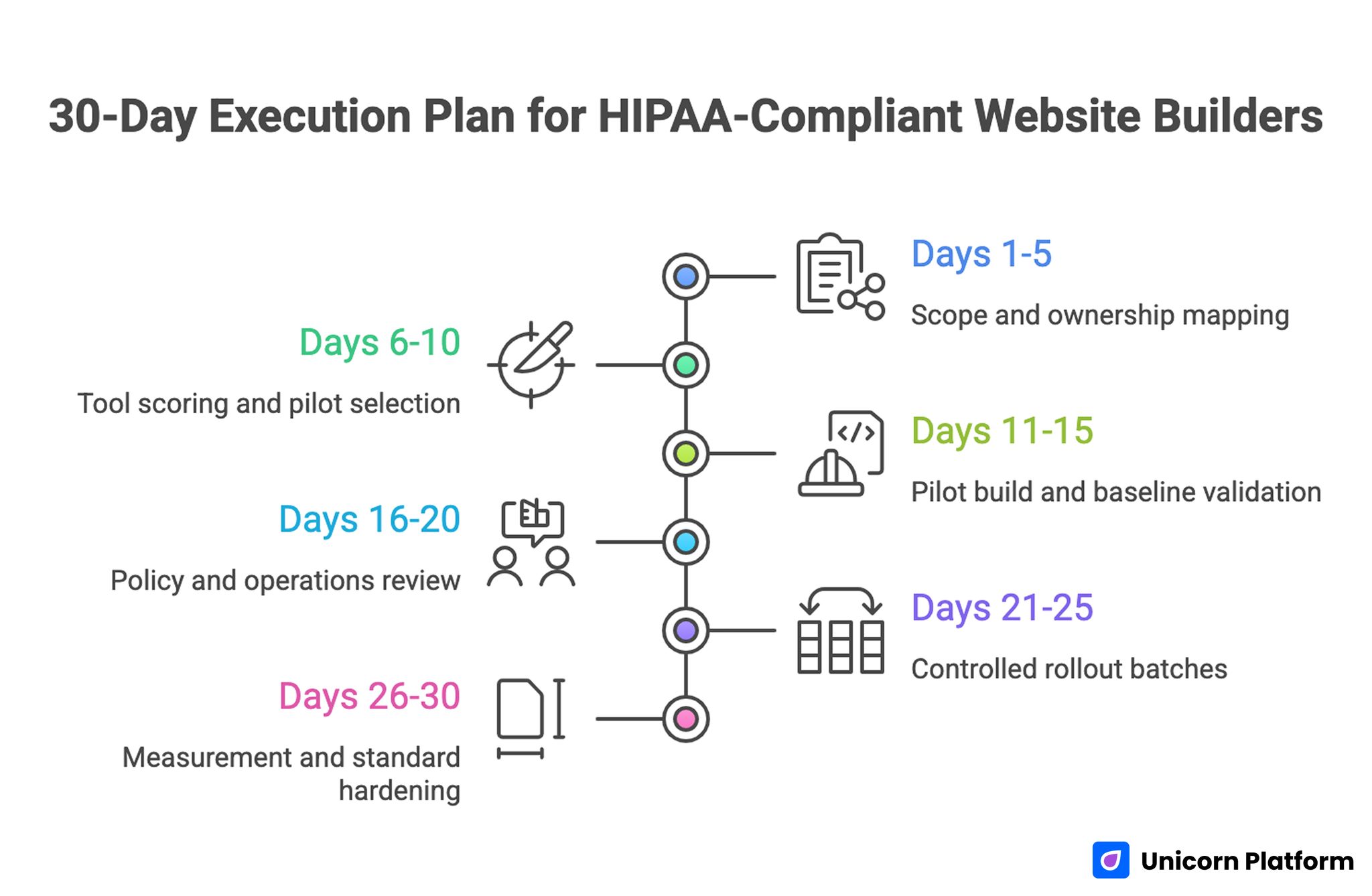
30-Day Execution Plan for HIPPA-Compliant Website Builders
Days 1-5: Scope and ownership mapping
Map all sensitive workflows, identify vendor touchpoints, and assign owners for content, workflow, and QA responsibilities. Build a one-page responsibility matrix that teams can reference during every release.
Days 6-10: Tool scoring and pilot selection
Apply weighted scoring to your shortlist and select one high-intent journey for a live pilot. Define acceptance criteria before building so the pilot has objective pass or fail conditions.
Days 11-15: Pilot build and baseline validation
Build the pilot page with intent-tiered form design, clear trust sequencing, and explicit response expectations. Run baseline checks for routing, mobile readability, and rollback behavior before any public traffic.
Days 16-20: Policy and operations review
Review the pilot with operations and support stakeholders, not only page editors. Capture confusion points and update standards where real workflow gaps appear.
Days 21-25: Controlled rollout batches
Expand to priority pages in small batches and hold a short review after each release wave. Use the same checklist for every batch to keep quality decisions consistent.
Days 26-30: Measurement and standard hardening
Analyze completion quality, response consistency, and reroute patterns by intake type. Convert lessons from the first month into clear defaults for future pages and workflows.
Running This System in Unicorn Platform
Unicorn Platform can support this model well when teams define standards first and build from reusable section logic. Publishing speed becomes a strategic advantage only when high-impact changes are governed with clear ownership.
Use reusable blocks for fit clarity, trust cues, process explanation, and action prompts. Then enforce release checks for form behavior and mobile readability before publishing. This gives teams a fast workflow without sacrificing consistency.
When product-style pages and service-style pages coexist, this guide on healthcare product page structure is a practical reference for keeping intent boundaries clear and avoiding mixed-message layouts.
The core principle is simple: fast publishing with strict operational discipline. That combination usually outperforms slow, highly customized workflows that cannot be maintained by the real team you have.
FAQ: HIPAA-Compliant Website Builders
Are HIPAA-compliant website builders enough on their own?
No. HIPAA-compliant website builders provide infrastructure and controls, but outcomes still depend on your configuration, governance, and release discipline. The platform can support safe operations, but your process determines whether those controls are used consistently.
How many HIPAA-compliant website builders should we shortlist?
Three is a practical number for most teams. It is enough to compare meaningful differences without overwhelming reviews or delaying pilot execution.
What is the first sign that our website workflow needs restructuring?
A common early signal is rising support noise after routine page updates. If small edits repeatedly create routing confusion or unclear submissions, your workflow model likely needs clearer standards and ownership.
Should we choose one platform for every healthcare use case?
Most organizations should start with one core platform and add complexity only when justified by clear business needs. Excessive tool spread often increases handoff friction and reduces quality control.
How much should we collect in a first-step intake form?
Collect only what is needed for safe routing and useful follow-up. Extra detail can be captured later after intent is confirmed and trust is established.
How often should we review high-intent pages?
Monthly operational reviews are a strong baseline for most teams, with tighter cadence during major campaigns or migration periods. Consistent review rhythm prevents silent quality drift.
Can a small clinic run this process without a large technical team?
Yes. Small teams can run this model effectively if ownership is explicit and checklists stay focused. Process clarity often matters more than headcount.
How do we avoid overpromising in healthcare website copy?
Use specific scope language, realistic timelines, and clear suitability boundaries. Readers trust precise communication more than broad claims that cannot be reliably delivered.
What metrics should leadership watch after launch?
Track submission quality by intent tier, response-time consistency, reroute rate, and mobile completion quality. These metrics expose real operational health better than volume-only dashboards.
Is a full migration always necessary?
No. Many teams can improve outcomes through phased rebuilds and stricter governance on current systems before full replacement. Controlled progression usually reduces disruption and improves learning quality.
How do we keep standards from being ignored under deadlines?
Keep standards short, assign owners, and make release gates binary. Teams follow rules that are clear and repeatable under pressure.
Final Takeaway
Healthcare website performance depends on the quality of your operating system, not only the quality of your page design. If your team can define scope clearly, separate intake by intent, govern high-impact edits, and validate releases with discipline, growth and trust can improve together.
The strongest results come from combining a reliable process with tooling that supports fast iteration. That is how healthcare teams can publish confidently, protect user trust, and improve conversion quality without creating long-term operational debt.
