Table of Contents
- Why Search-Focused Landing Pages Underperform
- On-Page Architecture That Supports Both Ranking and Conversion
- 30-Day Implementation Plan
- Common Failure Modes and Direct Fixes
- FAQ
Most teams can publish a landing page quickly. Fewer teams can publish one that earns stable search traffic and still converts qualified visitors at a healthy rate. That gap is where most growth programs lose efficiency.
A high-performing page needs two systems working together. It needs strong search relevance so the right users can discover it, and it needs strong decision flow so those users can act with confidence. If either system is weak, performance becomes unstable.
Many pages fail because optimization work is done in silos. One team focuses on rankings, another focuses on conversion design, and no one owns the full journey from query intent to post-submit quality. The result is traffic without value or conversion without discovery.
This guide gives a complete execution model for building and improving search-ready landing pages in Unicorn Platform. The focus is practical: clear decisions, repeatable workflows, and measurable outcomes.
sbb-itb-bf47c9b
Key Takeaways
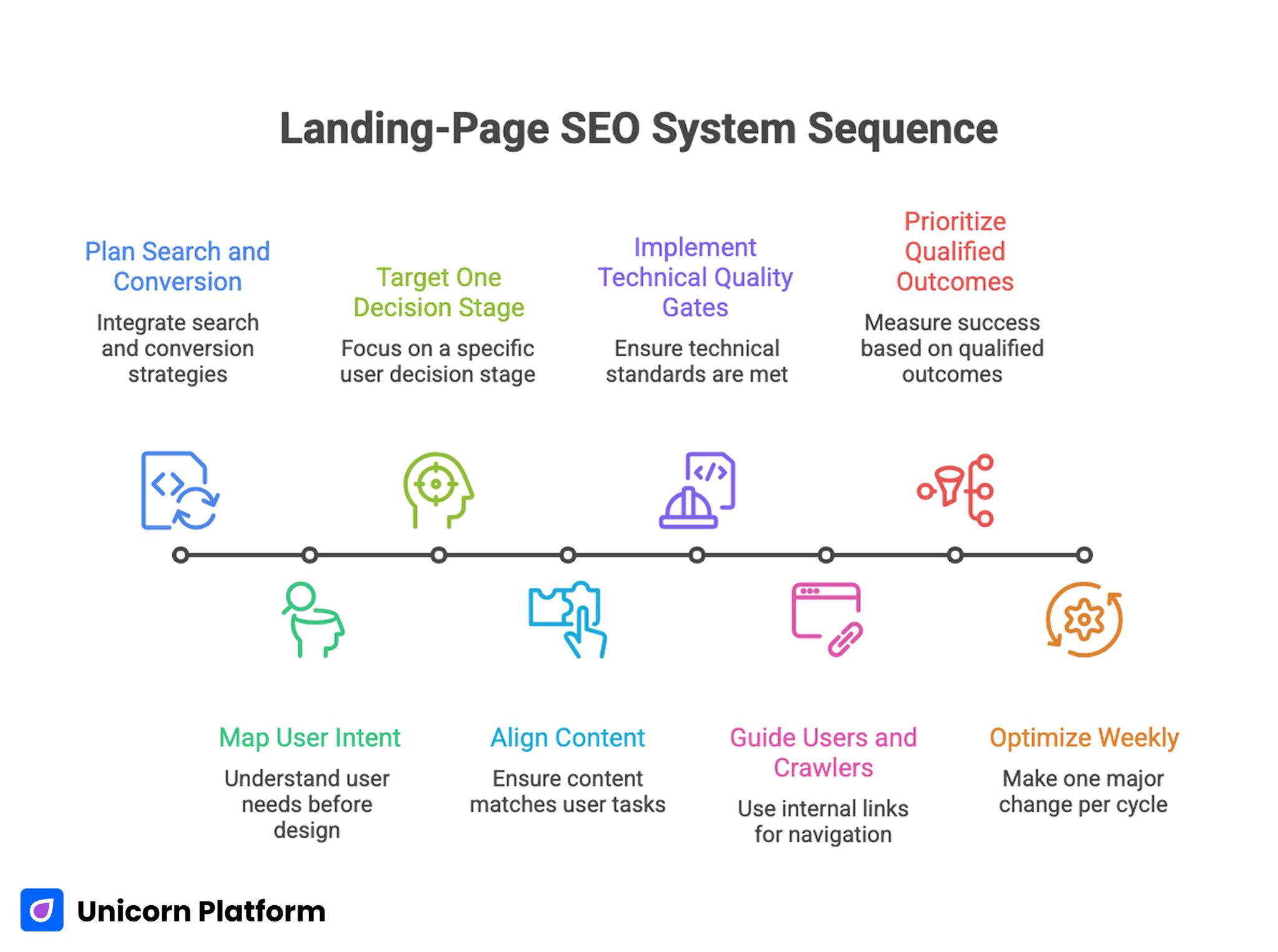
Landing-Page SEO System Sequence
- Search performance and conversion performance should be planned as one system.
- Intent mapping should happen before copywriting or visual design starts.
- One page should target one dominant decision stage for cleaner signals.
- Titles, headings, and body copy should align to user tasks, not keyword repetition.
- Technical quality gates should be mandatory before traffic scaling.
- Internal links should guide users and crawlers through clear topic relationships.
- Measurement should prioritize qualified outcomes, not volume alone.
- Weekly optimization works best when one major variable changes per cycle.
Why Search-Focused Landing Pages Underperform
Underperformance usually begins with intent mismatch. The page targets broad terms, but the offer is narrow and decision-stage specific. Users arrive with the wrong expectations, engagement drops, and quality metrics decline.
The second issue is structure mismatch. Teams build pages that look polished but do not answer critical search-driven questions in the right order. Visitors scroll, scan, and leave because the page does not reduce uncertainty quickly enough.
The third issue is weak technical hygiene. Slow load speed, render delays, indexing conflicts, and inconsistent metadata can block visibility even when copy quality is high. Search engines need clear signals, and users need fast interaction.
A final issue is fragmented ownership. Without one operating model, teams ship isolated improvements that conflict with each other. Ranking movement and conversion movement become hard to interpret, so optimization slows down.
How Landing-Page SEO Differs From Classic Blog SEO
Editorial articles and landing pages serve different user intents. A blog post can satisfy broad informational curiosity. A landing page usually supports a narrower action path where user intent is closer to evaluation or decision.
Because intent is narrower, page construction needs tighter message discipline. The first screen must clarify who the offer is for, what outcome users can expect, and what action to take next. Long detours reduce both engagement quality and conversion confidence.
A landing page also carries higher route responsibility. It does not just inform. It qualifies, persuades, and hands users into a defined workflow. That means trust, evidence, and expectation language must be integrated earlier than in most editorial content.
Search visibility still matters, but keyword presence alone is not enough. Relevance comes from full-page coherence: title intent, section intent, evidence quality, internal connections, and post-click experience.
Choose the Right Role: SEO Page, PPC Page, or Hybrid
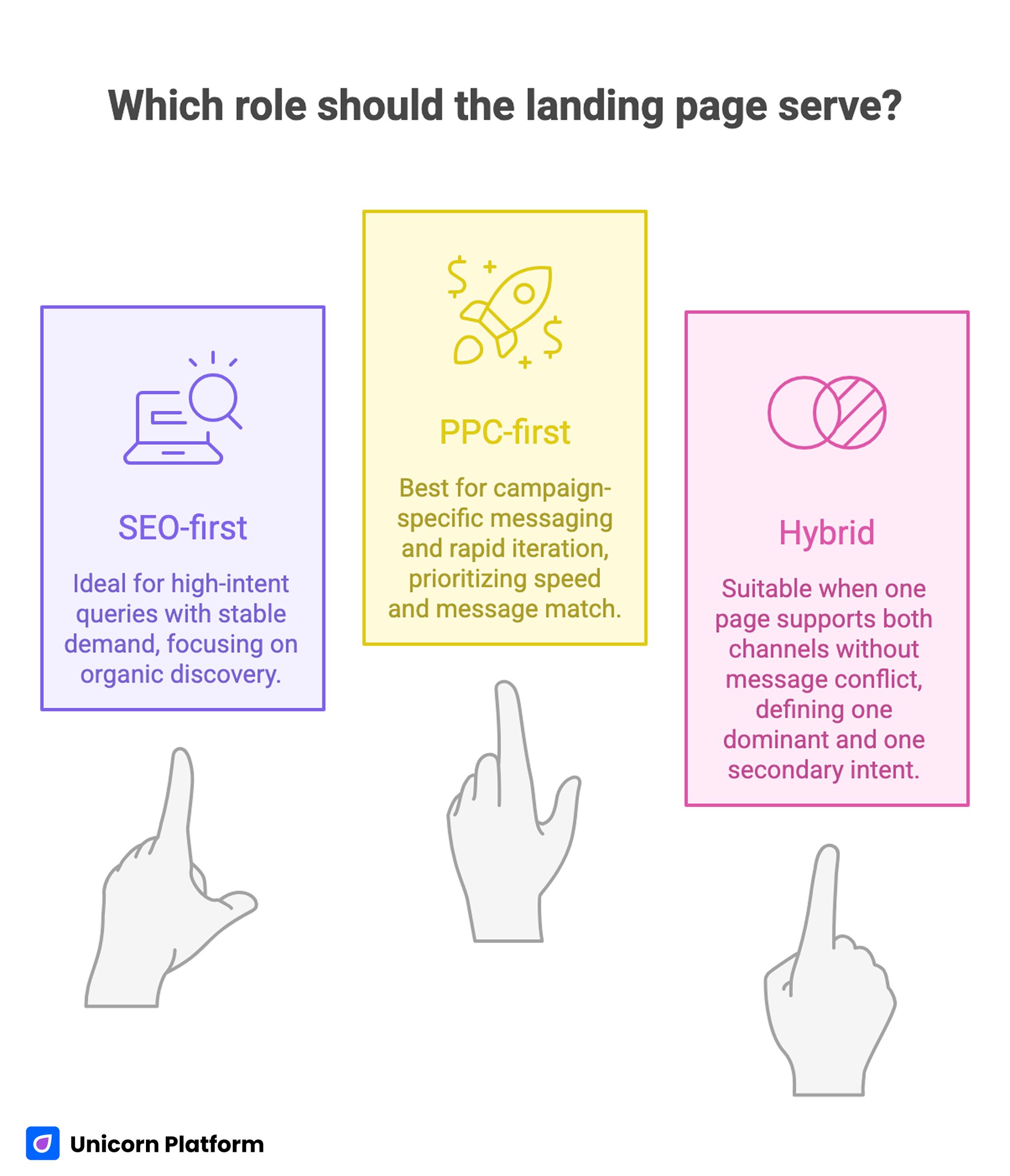
Choose Between SEO, PPC, or Hybrid Landing Page Roles for Optimal Traffic and Conversions
Not every landing page should be optimized for organic discovery. Some pages are built for tightly controlled paid campaigns where speed and message match matter more than indexability. Others are strong candidates for sustained organic traffic.
Use a role decision model before build:
- SEO-first page: useful for repeatable high-intent queries with stable demand.
- PPC-first page: useful for campaign-specific messaging and rapid iteration.
- Hybrid page: useful when one page can support both channel strategies without creating message conflict.
Role clarity prevents technical confusion. It determines whether pages should be indexed, how internal links should be structured, and how copy depth should be prioritized.
If a page must serve both channels, define one dominant intent and one secondary intent. Avoid equal-priority narratives, because mixed priority usually weakens ranking consistency and conversion quality.
Intent Mapping Before You Write a Single Section
High-quality pages begin with intent modeling, not design presets. Teams should map queries into decision tasks before drafting headlines or section order.
A practical mapping framework includes four intent types:
- Learn: users need conceptual clarity before evaluating options.
- Compare: users need differentiation and tradeoff visibility.
- Validate: users need evidence and risk reduction.
- Act: users are ready for a concrete next step.
Each landing page should prioritize one primary task and one supporting task. This makes section priorities clearer and reduces copy conflicts.
Intent-to-Section Blueprint
Map each section to a specific decision job:
- Hero: fit clarity and outcome framing.
- Mechanism: how the solution works in real terms.
- Proof: confidence support for likely objections.
- Action: one primary conversion route.
- Continuity: what happens after submit or click.
This blueprint improves both relevance and conversion because it mirrors how users actually decide. It also gives teams cleaner test logic when iterating.
When your team needs a reusable framework for section sequence, this landing page structure guide helps standardize decision flow across multiple page types.
Keyword and Topic Modeling Without Over-Optimization
Keyword work should define scope, not dictate awkward writing. Search engines interpret topic depth, semantic relevance, and behavior quality across the page, so forced repetition is usually counterproductive.
Build a topic model around one primary theme and a set of supporting subtopics. Supporting subtopics should reflect genuine questions users ask before action, such as implementation effort, expected timeline, proof quality, and fit boundaries.
Use this process:
- Identify one primary search theme tied to business objective.
- Group related modifiers by intent stage.
- Map each cluster to a section with a clear job.
- Validate that headings read naturally for humans first.
Heading language should be explicit and useful. A heading that sounds like a real question or decision point typically performs better than a heading that only mirrors a phrase pattern.
Practical Metadata Standards
Metadata should improve result clarity, not manipulate clicks with vague promises. Keep title tags specific, outcome-oriented, and aligned with page content.
Use concise meta descriptions that explain practical value and expected next step. If metadata promises one thing and the page delivers another, engagement signals degrade quickly.
URL structure should stay readable and stable. Short, descriptive slugs are easier to maintain and easier for users to trust in search previews.
Content Depth Planning by Decision Stage
Depth requirements change by intent stage. Some pages need concise clarity and quick action. Other pages need fuller explanation before users are ready to move. Writing all pages to one fixed depth standard usually produces either thin content or unnecessary bulk.
Use intent stage to set depth requirements before drafting:
- Early-stage intent: define problem, fit boundaries, and practical outcomes.
- Mid-stage intent: explain mechanism, tradeoffs, and implementation effort.
- Late-stage intent: clarify proof, process details, and next-step expectations.
This model helps teams avoid writing pages that are long but unhelpful. It also improves query coverage because each section exists for a defined decision job, not because a template demands it.
Depth Signals That Indicate a Section Is Too Thin
A section is usually too thin when it introduces a claim but does not explain how that claim becomes real in operations. Another common sign is when users repeatedly ask the same question in follow-up because the page never addressed it clearly.
Use these signals to detect weak areas:
- High click-through from search with low meaningful engagement.
- Strong scroll depth but low form-start rate near decision sections.
- Repeated support objections tied to the same missing detail.
- Frequent internal debates over wording in the same section.
When these patterns appear, expand the specific section that carries the missing decision context. Avoid broad expansion across the whole page unless intent scope truly changed.
On-Page Architecture That Supports Both Ranking and Conversion
On-page quality is not just about placing terms in headings. It is about building a coherent narrative that reduces uncertainty in the order users experience it.
Start with a first screen that clarifies audience and value. Follow with mechanism and proof sections that answer likely objections. Then provide one dominant action route with clear expectation language.
Section-level clarity matters more than visual complexity. A simple page with well-defined section jobs often outperforms a visually dense page with mixed messages.
H1, H2, and Body Alignment Rules
- Keep one clear H1 focused on page purpose.
- Use H2 headings as decision checkpoints, not decorative labels.
- Use H3 headings to break down implementation details.
- Keep paragraph openings specific and operational.
- Place conversion actions where user confidence is highest.
This hierarchy helps crawlers parse topical structure while helping users scan quickly.
When teams are diagnosing behavior drop-offs across sections, this guide on user behavior signals in landing pages can help prioritize structural fixes with stronger downstream impact.
Technical Quality Gates Before You Scale Traffic
Technical reliability is a ranking and conversion requirement, not a separate phase. Slow render times and unstable layouts reduce user trust and can weaken visibility.
Define technical launch gates before the page goes live at scale:
- Core layout content loads quickly on common mobile devices.
- Main CTA and form elements are interactive without delay.
- Indexing directives match channel strategy.
- Canonical and URL rules prevent duplicate-signal conflicts.
- Structured data is valid where relevant and accurate.
A page that fails these gates should not be promoted aggressively, even if copy is strong.
Crawl and Index Management
Crawlability must be intentional. Pages created for short campaign experiments may not belong in long-term index coverage. Pages tied to repeatable intent usually do.
Use explicit rules for index decisions. Align robots directives, canonical tags, and internal linking with the page role you defined earlier.
Avoid creating many thin near-duplicate pages for minor variants. Consolidation usually produces stronger authority and clearer performance signals.
Performance and Mobile Execution
Search and conversion both depend on usable speed. First-content readability, interaction stability, and input responsiveness should be monitored continuously.
Prioritize fixes in this order:
- Remove heavy above-the-fold assets with low decision value.
- Simplify scripts that delay interaction on mobile.
- Compress and size images to actual display needs.
- Reduce layout shifts near forms and CTA zones.
These steps improve both user experience and ranking resilience under real-world traffic conditions.
Teams improving cross-device consistency can also use this responsive landing-page workflow to keep section hierarchy and action clarity stable across breakpoints.
Governance and Update Discipline in Unicorn Platform
Strong pages degrade when editing is unstructured. Small changes in copy or layout can shift user expectations, alter internal link logic, or reduce trust near action points. A lightweight governance model prevents this drift without slowing delivery speed.
Use a three-owner model for ongoing updates:
- Message owner: protects promise clarity and intent alignment.
- Workflow owner: protects form logic, routing, and confirmation behavior.
- QA owner: protects technical quality, mobile reliability, and release checks.
Every meaningful change should answer three questions before publishing. What user decision does this change improve, what metric should move, and what guardrail should remain stable. This keeps optimization work measurable instead of subjective.
Release Checklist for Recurring Edits
- Confirm the first-screen message still matches search snippet intent.
- Confirm trust blocks remain near the primary commitment points.
- Confirm internal links still route to the correct depth pages.
- Confirm conversion tracking and form routing still behave as expected.
- Confirm mobile rendering and interaction quality remain stable.
A short checklist like this reduces regression risk during high-velocity publishing cycles.
Conversion Design That Preserves Search Intent
A page can rank and still fail commercially if conversion logic is unclear. Strong conversion design should continue the intent users expressed in search, not force a generic funnel path.
Start by aligning offer language to the query mindset. If users search for tactical guidance, the page should not open with abstract brand messaging. If users search with high purchase intent, the page should not bury action behind long informational blocks.
Use friction intentionally. Remove unnecessary form fields early, but keep enough qualification detail to protect downstream quality. Friction is useful only when it improves routing decisions.
Trust, Proof, and Objection Handling
Proof should answer concrete doubts in context. Generic praise and logo walls are weak when users need practical evidence.
Place trust elements near commitment points, not only in isolated sections at the bottom. Users decide at moments of uncertainty, so trust support should appear where uncertainty appears.
Common objections to handle directly include timeline risk, implementation effort, fit boundaries, and expected support level.
If your team is aligning page optimization with funnel quality metrics, this optimization strategy framework is useful for connecting section changes to business outcomes.
Internal Linking Strategy for Topic Authority
Internal linking should connect user decisions, not just pages. A useful link should give the reader the exact next layer of depth they need at that point in the journey.
Build links around topic clusters that reflect real intent paths. Informational pages should route to evaluation pages. Evaluation pages should route to implementation pages. Conversion pages should route to trust and operational detail where needed.
Anchor text should be descriptive and natural. Avoid repetitive anchor patterns that look automated or detached from paragraph context.
A strong internal network also improves crawl discovery and reduces orphan-page risk. Over time, this supports more stable visibility across related landing-page topics.
Measurement Model: Rankings, Quality, and Revenue Signals
Measuring only impressions or only submissions creates blind spots. Effective optimization needs a balanced metric stack covering visibility, engagement quality, conversion quality, and downstream outcomes.
Use a three-layer model:
- Discovery layer: impressions, click-through rate, average position by intent cluster.
- Decision layer: engagement depth, section interaction, form-start behavior.
- Outcome layer: qualified conversions, pipeline quality, follow-up readiness.
Each optimization cycle should define one primary metric and one guardrail metric. This prevents local improvements that damage broader performance.
Recommended Dashboard Cadence
- Daily: technical stability and major traffic anomalies.
- Weekly: intent-cluster ranking shifts and conversion-quality trends.
- Monthly: page-role performance and cluster-level authority growth.
Cadence discipline keeps teams from reacting to noise while still catching real issues early.
30-Day Implementation Plan
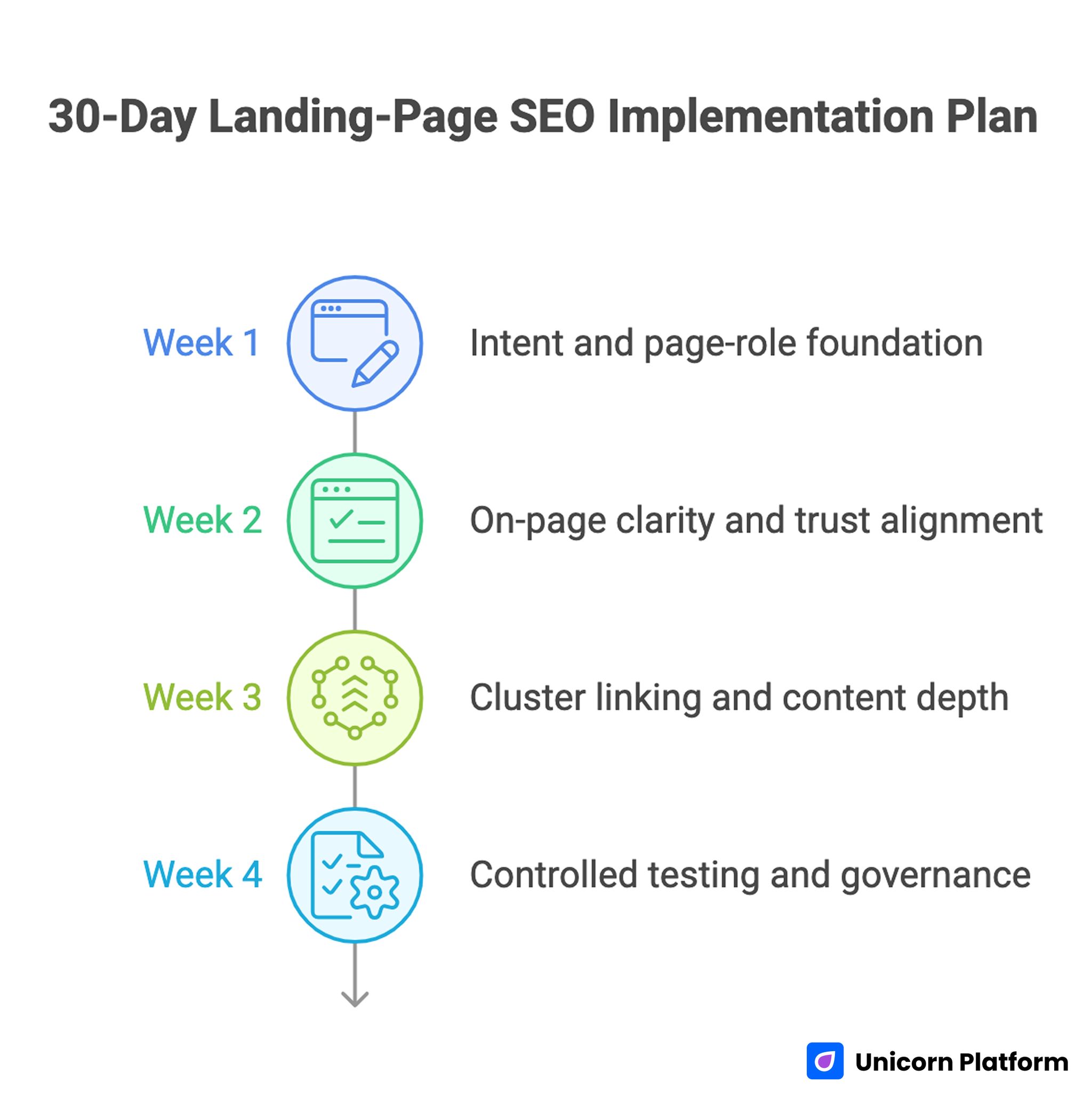
30-Day Landing-Page SEO Implementation Plan
A practical 30-day cycle helps teams improve quality without creating uncontrolled changes. It also creates a shared operating rhythm, so design, SEO, and growth teams can make decisions on the same evidence instead of reacting to isolated data points.
Week 1: Intent and page-role foundation
Define page role, primary intent, and conversion objective. Build or revise section blueprint and publish baseline metadata.
Run a full technical preflight on indexing, canonicalization, and mobile interaction stability before traffic scaling.
Week 2: On-page clarity and trust alignment
Refine first-screen fit language, proof placement, and action hierarchy. Keep one dominant conversion path and reduce competing routes.
Validate message consistency from search preview to headline to confirmation state. Consistency reduces avoidable drop-off.
Week 3: Cluster linking and content depth
Strengthen internal links based on user decision paths and topic adjacency. Expand thin sections with concrete implementation detail where users hesitate most.
Review query coverage for missing high-intent subtopics and patch with focused section updates, not random expansion.
Week 4: Controlled testing and governance
Run one significant test on headline framing, section order, or action module. Keep all other variables stable for clear attribution.
Document results, keep winning changes, and archive weak variants. Then finalize a maintenance checklist for future updates.
Common Failure Modes and Direct Fixes
Failure mode 1: Ranking copy and conversion copy are disconnected
Pages rank for broad relevance but convert poorly because the offer path is unclear. Rebuild section jobs around one dominant intent and one action route so users can move from search entry to commitment without narrative friction.
Failure mode 2: Keyword placement drives writing decisions
Copy becomes repetitive and unnatural, reducing trust and readability. Use topic clusters and decision-focused headings instead of phrase repetition, then validate readability with manual review before publishing.
Failure mode 3: Technical quality is checked too late
Teams discover index or performance problems only after traffic expansion. Enforce technical launch gates before campaign scale and block promotion until critical checks pass.
Failure mode 4: Internal links are added as a final patch
Links feel forced, user flow is weak, and crawl pathways stay shallow. Plan cluster links during outline stage and place them where users naturally need deeper context.
Failure mode 5: Success is defined by top-line volume
Form completions rise while qualified outcomes stay flat. Pair visibility and conversion metrics with quality guardrails so optimization decisions reflect real business value.
Failure mode 6: Too many simultaneous experiments
Teams cannot identify which change produced movement. Change one major variable per cycle and document keep-or-revert decisions to preserve clear attribution.
FAQ: Landing-Page SEO in 2026
How is SEO for landing pages different from regular blog SEO?
Landing pages typically target narrower decision intent and must guide users toward a clear next action. Blog content usually supports broader discovery and education goals with less direct conversion responsibility.
Should every landing page be indexed?
No. Indexing should match page role. Pages built for repeatable organic demand are strong index candidates, while short-lived campaign pages may be better kept out of index coverage.
What is the ideal word count for a search-ready landing page?
There is no universal number. Depth should match intent complexity, objection load, and decision risk for that audience. Useful clarity beats arbitrary length targets.
Can one page serve both paid traffic and organic traffic?
Yes, but only when one dominant intent is clearly prioritized and message consistency is maintained. If intent diverges heavily, separate variants usually perform better.
How many keywords should one landing page target?
Focus on one primary theme with related semantic support. Trying to force many unrelated terms into one page usually weakens relevance and clarity.
What technical checks matter most before launch?
Mobile speed, interaction stability, indexing directives, canonical integrity, and reliable form behavior are the highest-priority checks.
Do internal links affect landing-page performance?
Yes. Strong internal links improve crawl discovery, topic context, and user path continuity when links are placed naturally in relevant sections.
How often should landing pages be updated?
A weekly review with controlled updates is usually effective. High-frequency unstructured edits often create noise and degrade consistency.
What is a good first metric to monitor after publishing?
Start with intent-aligned click-through and early engagement behavior, then move to qualified conversion quality once initial data stabilizes.
Can Unicorn Platform support this optimization workflow end to end?
Yes. Unicorn Platform supports fast publishing and iteration, and outcomes improve most when teams pair that speed with strict intent mapping, technical QA, and disciplined measurement.
Final Takeaway
Landing-page SEO works best when search relevance and conversion design are built as one operational system. Teams that align intent mapping, structure, technical quality, and measurement usually outperform teams that optimize these pieces separately.
With disciplined execution in Unicorn Platform, landing pages can become durable assets that attract qualified demand and convert it into measurable business outcomes. That durability is what compounds results across quarters instead of isolated campaign bursts.

