Table of Contents
- Why CRM Campaign Pages Underperform Even With Strong Traffic
- 30-60-90 Day Execution Plan
- Common Failure Patterns and Practical Fixes
- FAQ
Most CRM campaign pages fail for one reason: they ask for commitment before they earn confidence. Traffic arrives with real intent, but users still need fast answers about fit, implementation effort, and expected outcomes.
In 2026, high-performing teams design conversion routes as operational systems, not as isolated marketing assets. They align message hierarchy, proof timing, form friction, and handoff quality so each step prepares the next.
Unicorn Platform is strong for this workflow because it supports rapid iteration without forcing teams into unstable redesign cycles. Speed matters only when each revision follows a clear decision model.
When qualification quality is inconsistent, the first place to tighten is conversion structure. The framework in the beginner's guide to creating lead generation landing page is useful for mapping commitment level to the right offer depth.
sbb-itb-bf47c9b
Quick Takeaways
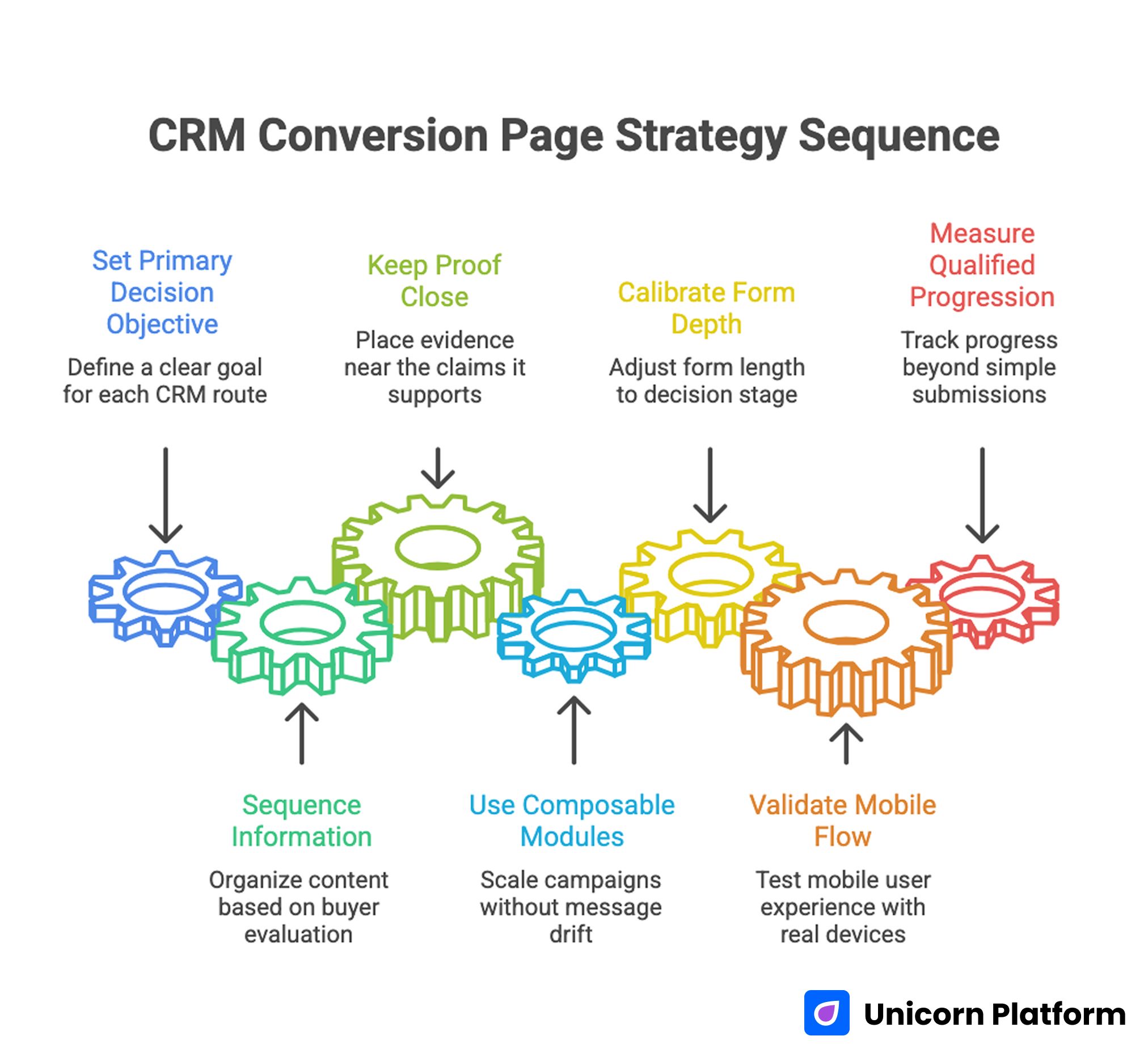
CRM Conversion Page Strategy Sequence
- Set one primary decision objective for each CRM route.
- Sequence information to reduce risk in the order buyers evaluate it.
- Keep proof close to the claim it validates.
- Use composable modules to scale campaigns without message drift.
- Calibrate form depth to decision stage, not to traffic volume goals.
- Validate mobile flow with real-device completion tests.
- Measure qualified progression, not only submissions.
Why CRM Campaign Pages Underperform Even With Strong Traffic
Many teams interpret weak pipeline outcomes as a channel problem, then increase spend or broaden targeting. In practice, the larger leak often appears after the click, where the page does not resolve decision risk fast enough.
Three issues repeat across SaaS and RevOps programs. Positioning is broad, CTA sequencing is premature, and implementation context is incomplete. These gaps create low-fit submissions that burden sales teams and inflate apparent conversion success.
Define One Commercial Objective Per Route
A single page cannot optimize equally for trial starts, enterprise consultations, partner inquiries, and webinar registrations. Mixed objectives produce mixed hierarchy, which lowers clarity and makes testing results harder to interpret.
Define one dominant objective and one support action. A discovery-stage route might prioritize educational signup, while an evaluation-stage route might prioritize implementation-fit consultation.
This decision creates cleaner analytics and clearer editorial choices. Teams can assess whether content supports one outcome instead of juggling competing priorities.
First-Screen Architecture for High-Intent Visitors
The first screen should answer four questions quickly: who this route is for, what operational problem it solves, why the claim is credible, and what action is expected now. Missing any of these elements increases bounce from qualified users.
A practical first-screen stack is concise. Start with audience-fit framing, add a concrete operational outcome, show one contextual trust signal, and present a single dominant CTA.
Creative headlines are useful only when they improve comprehension. Precision usually wins in CRM demand environments where decision speed is high and patience is low.
Composable Page Systems: Scale Without Losing Consistency
Composable architecture allows teams to assemble routes from validated modules instead of rebuilding pages from scratch. This reduces production friction while keeping trust and hierarchy patterns stable across campaigns.
Core modules can include audience-fit hero blocks, mechanism sections, proof cards, implementation notes, and stage-specific CTA clusters. Each module keeps a defined purpose and quality standard.
This approach works well when template quality is governed centrally. For teams that need reusable structure, these CRM landing page templates that convert can inform module-level standardization without flattening route specificity.
Audience Mapping Across Revenue Roles
Revenue leadership, RevOps owners, marketing operators, and technical stakeholders evaluate value through different risks. One narrative cannot carry all of them with equal depth and still remain clear.
Map each route to a dominant buyer role and decision stage. Secondary roles can be supported through focused sub-sections rather than by overloading the opening narrative.
Role-aware mapping improves both conversion quality and follow-up efficiency. Sales conversations start closer to concrete constraints because users already saw relevant context on-page.
Message Hierarchy That Reduces Qualification Noise
A dependable sequence is relevance, mechanism, proof, implementation clarity, and commitment. This order mirrors real evaluation behavior and keeps visitors moving with less uncertainty.
Relevance establishes scope quickly. Mechanism explains how outcomes are produced. Proof validates claims with context. Implementation clarity reduces perceived adoption risk, and commitment framing sets expectations for the next step.
When this hierarchy is stable, experimentation becomes cleaner. Teams can adjust one section at a time and isolate impact faster.
Evidence Design: Context Beats Volume
Large logo walls and vague testimonials can create familiarity, but they rarely close decision gaps by themselves. Buyers need proof that matches the exact claim they are evaluating.
Place evidence near decision points and include context such as team type, timeline, and measurable outcome conditions. This format builds credibility because users can map results to their own environment.
Operational evidence is especially important in CRM programs. If the page claims faster routing, better attribution, or cleaner handoff, show the process details that make those outcomes plausible. Practical guidance from Winning by Design also highlights that revenue teams should tie proof directly to measurable operational outcomes, showing how specific process improvements impact pipeline velocity and deal quality.
Offer and CTA Calibration by Stage
Early-stage routes should not demand high-friction commitments too quickly. Evaluation-stage routes, on the other hand, should not hide implementation and commercial expectations behind generic CTAs.
Use stage-aligned CTA framing. Educational routes can use low-friction signup paths, while solution-fit routes should guide users toward consultation actions with clear scope.
Secondary CTAs can exist, but they should support the same decision path rather than introduce a competing journey.
Form Strategy: Protect Sales Capacity With Better Inputs
High form volume with low fit creates false confidence in marketing dashboards and inefficiency in sales execution. Form strategy should prioritize useful qualification signals over raw submission count.
For lightweight offers, short forms are usually enough. For evaluation and decision routes, include a few fields that improve routing and call readiness, then explain why each field is requested.
Transparency in form design improves completion quality. Users provide better context when they understand how the information will be used. Research from Hotjar supports this approach, showing that reducing unnecessary form fields while clearly explaining value exchange can significantly improve both completion rates and lead quality.
Integration Clarity for Salesforce-Centric Workflows
Implementation uncertainty is one of the biggest blockers to conversion on CRM routes. If setup scope is unclear, even interested prospects postpone action.
Add concise integration context directly on-page. Show supported environments, data handoff expectations, and practical setup milestones with realistic timelines.
This does not require technical overload. Short, structured integration modules are enough to reduce perceived risk and improve meeting quality.
Navigation and Visual Discipline on Conversion Routes
High-intent routes need focus, not browsing complexity. Minimal navigation reduces escape paths and keeps attention on decision-critical sections.
Visual systems should reinforce hierarchy through spacing, contrast, and typography consistency. Decorative complexity that does not improve understanding usually harms performance.
Motion can help when it guides attention around proof and action blocks. It should remain lightweight and performance-safe on typical business devices.
Mobile Standards That Preserve Conversion Quality
A meaningful share of B2B evaluation starts on mobile, even when final commitment happens on desktop. If mobile flow is unclear, qualified users leak early and rarely return.
Validate first-screen comprehension, tap-target usability, and form completion on real devices. Static visual checks are not enough for route quality.
When teams need broader inspiration for structure choices, reviewing 7 best SaaS landing page examples to boost your conversion rates can help compare section flow patterns while preserving your own editorial voice.
SEO and AI Retrieval Readiness for CRM Routes
Search visibility and AI retrieval quality both depend on clarity and completeness, not on repetitive keyword loading. Pages that resolve intent with practical depth are more likely to rank and to be cited by answer systems.
Use natural language around operations, implementation, and outcomes. Support the primary topic with related entities such as routing logic, attribution integrity, onboarding effort, and response SLAs.
Content depth should serve decision quality first. Better retrieval performance usually follows when the page is genuinely useful to high-intent readers.
Source-to-Page Continuity
Ad copy, outbound messages, and page narrative should describe the same promise with consistent scope. Message mismatch creates immediate trust loss and lower-fit submissions.
Create source-aware variants that preserve shared architecture while adjusting framing for each acquisition stream. This keeps experimentation fast without forcing full rewrites.
Continuity should extend beyond the form. Post-submit confirmation and first response messaging need to match the same promise language.
Measurement Framework Linked to Pipeline Quality
Top-of-funnel metrics are necessary but insufficient. Strong governance includes qualified meeting rate, attendance quality, progression to opportunity, and downstream close influence by route.
Instrument section-level behavior around decision points: CTA interactions, proof engagement, and form-step completion quality. These signals identify where confidence is built or lost.
Cross-functional review should happen on a fixed cadence. Shared interpretation between marketing, RevOps, and sales prevents local optimizations that damage broader outcomes.
30-60-90 Day Execution Plan
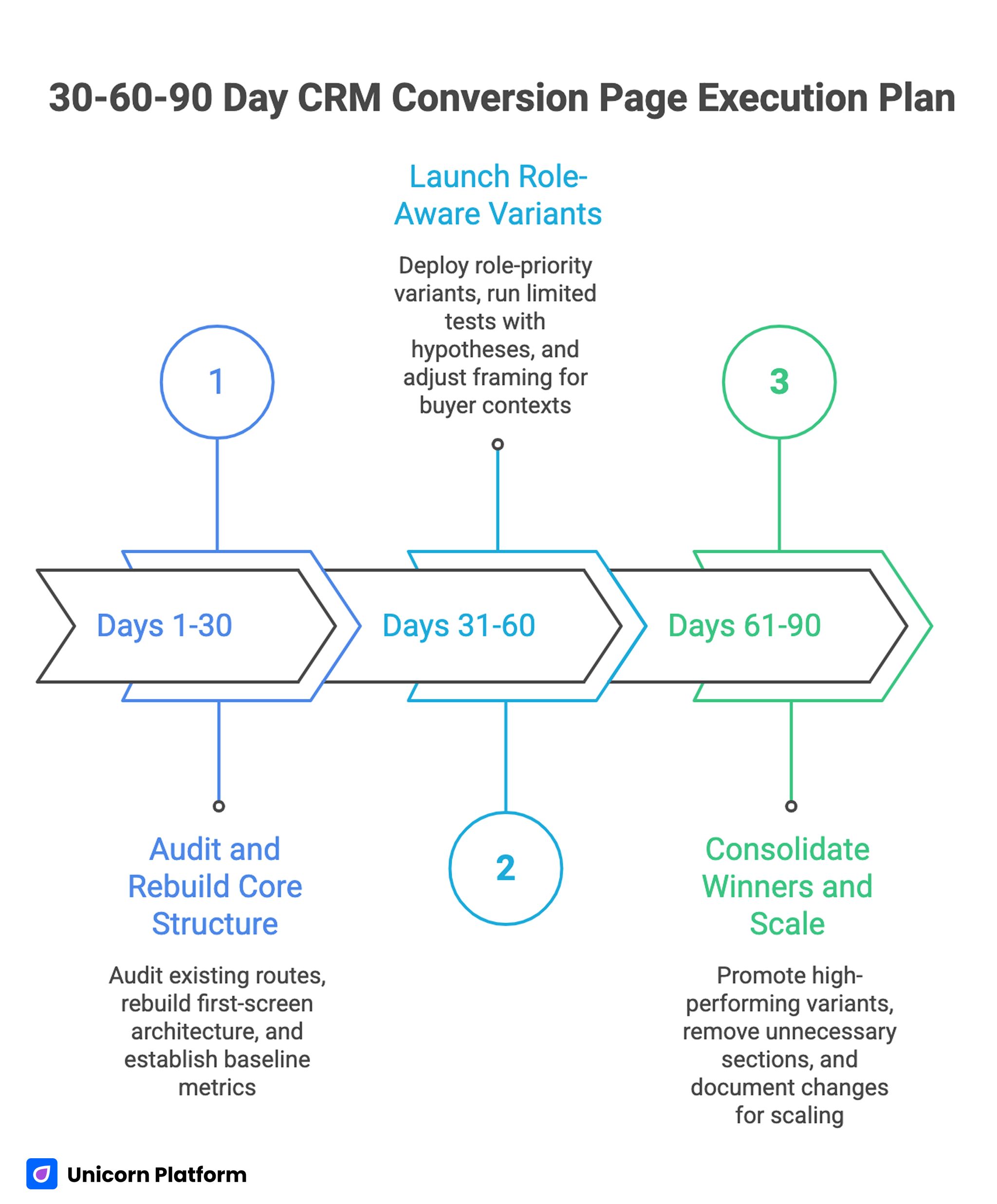
30-60-90 Day CRM Conversion Page Execution Plan
Days 1-30: Audit and Rebuild Core Structure
Audit existing routes for positioning ambiguity, weak proof timing, and premature CTA asks. Rebuild first-screen architecture and commitment sequence around one objective per route.
Create baseline metrics for submission quality, meeting readiness, and follow-up efficiency. Baseline discipline is essential for reliable optimization decisions later.
Days 31-60: Launch Role-Aware Variants
Deploy role-priority variants on a shared module system. Adjust opening framing, proof examples, and implementation language for each dominant buyer context.
Run a limited test set with explicit hypotheses. Restrained testing improves attribution and avoids conflicting edits.
Days 61-90: Consolidate Winners and Scale
Promote high-performing variants into governed templates. Remove sections that add length without measurable qualification benefit.
Document what changed, why it changed, and what result followed. This operating memory helps teams scale without repeating weak patterns.
Governance Model for Multi-Team Publishing
Performance decays when editing ownership is unclear. A sustainable model assigns clear owners for positioning, evidence quality, measurement interpretation, and final QA.
Weekly reviews should focus on anomalies and handoff issues. Monthly reviews should evaluate structural relevance. Quarterly reviews should reassess architecture against market and product changes.
Governance is practical in Unicorn Platform when module ownership and update rules are explicit. Teams can ship quickly while protecting message integrity.
Common Failure Patterns and Practical Fixes
Failure: Broad Claims With No Operational Scope
Visitors see vague promises and cannot judge fit. Rewrite key sections with audience context, workflow relevance, and expected outcome conditions.
Failure: Proof Detached From Claims
Evidence exists but appears too late or without scenario context. Move proof adjacent to major claims and include baseline conditions.
Failure: Form Volume Optimization at the Expense of Fit
Submission count rises while sales quality drops. Add stage-appropriate qualification fields and simplify low-value form elements.
Failure: Source and Page Narrative Drift
Campaign promises do not match route language. Align acquisition messaging, on-page scope, and first-response framing.
Failure: Weak Mobile Completion
Qualified users abandon before commitment due to interaction friction. Improve mobile readability, field sequencing, and CTA persistence.
Failure: Testing Without Decision Discipline
Too many concurrent edits hide what worked. Limit each cycle to a few controlled experiments with explicit success criteria.
Editorial and Technical QA Layer Before Traffic Scaling
A strong conversion route can still fail if pre-publish checks are inconsistent. Editorial QA should verify that each section has one clear purpose, claim wording is specific, and proof appears close to the statement it supports. Technical QA should confirm performance stability, structured heading flow, link integrity, form event tracking, and complete mobile-path validation from first screen to confirmation state.
A useful release checklist includes scope alignment, CTA clarity, form routing accuracy, and response-hand-off readiness. When these checks are standardized, teams avoid last-minute edits that weaken hierarchy or introduce conflicting messages. This layer also protects experimentation quality because each launched variant starts from the same baseline standard instead of a different quality threshold.
FAQ: Salesforce-Focused CRM Conversion Pages in 2026
1) How long should a CRM conversion route be?
Length should match decision complexity, not arbitrary content targets. Keep enough detail to resolve fit, credibility, and implementation concerns for the intended stage.
2) Should every route include pricing detail?
Commercial clarity is essential, but full price tables are not always required. Readers still need enough context to understand whether the next step is realistic for their team.
3) What is the fastest way to improve lead quality?
Clarify audience scope and commitment expectations first. Those two adjustments usually improve routing quality before deeper redesign work.
4) How many variants should a team run at once?
Run only as many variants as your governance model can evaluate properly. A smaller, disciplined test set usually outperforms broad fragmentation.
5) Which trust elements matter most?
Contextual results tied to operational conditions are usually strongest. Generic trust badges help, but they should support, not replace, claim-specific evidence.
6) How often should pages be reviewed?
Weekly anomaly checks and monthly structural audits are a practical minimum. Strategic architecture should be reassessed quarterly with cross-functional input.
7) Can composable modules hurt originality?
They do not when module purpose is fixed and narrative detail remains route-specific. Composable systems improve consistency while leaving room for audience-specific differentiation.
8) What should be measured first if tracking is limited?
Start with qualified meeting rate by source and route. Then extend into attendance quality and opportunity progression once the baseline is stable.
Final Takeaway
The strongest Salesforce-focused CRM routes do not win through visual novelty alone. They win through disciplined structure, contextual proof, composable execution, and measured iteration tied to pipeline quality.
When teams use Unicorn Platform with that operating discipline, they can launch faster and still improve qualification outcomes over time. Speed and rigor stop competing once architecture, governance, and QA are aligned.

