Table of Contents
- Conversion Architecture for Property Campaign Funnels
- 30-Day Execution Plan
- Common Mistakes and Practical Fixes
- FAQ
Real-estate teams usually have enough demand signals. Buyers and sellers arrive from paid ads, organic search, referral traffic, and local partnerships. The bigger problem appears after the click, when visitors land on a campaign page and cannot quickly decide whether they should continue.
That hesitation rarely comes from a lack of listings. It comes from uncertainty. People need immediate clarity on fit, timeline, pricing context, and who they will speak with next. If those answers are delayed, motivated prospects postpone action and low-intent visitors fill forms without real readiness.
Strong property campaign pages fix this by reducing decision friction in a deliberate order. They confirm relevance first, credibility second, process clarity third, and only then ask for commitment. When that sequence is consistent, lead quality improves and paid acquisition becomes more efficient.
This guide gives an execution framework for 2026. It covers architecture, messaging, proof placement, no-code operations, mobile performance, analytics, and weekly optimization routines that teams can run in Unicorn Platform.
sbb-itb-bf47c9b
Quick Strategic Takeaways
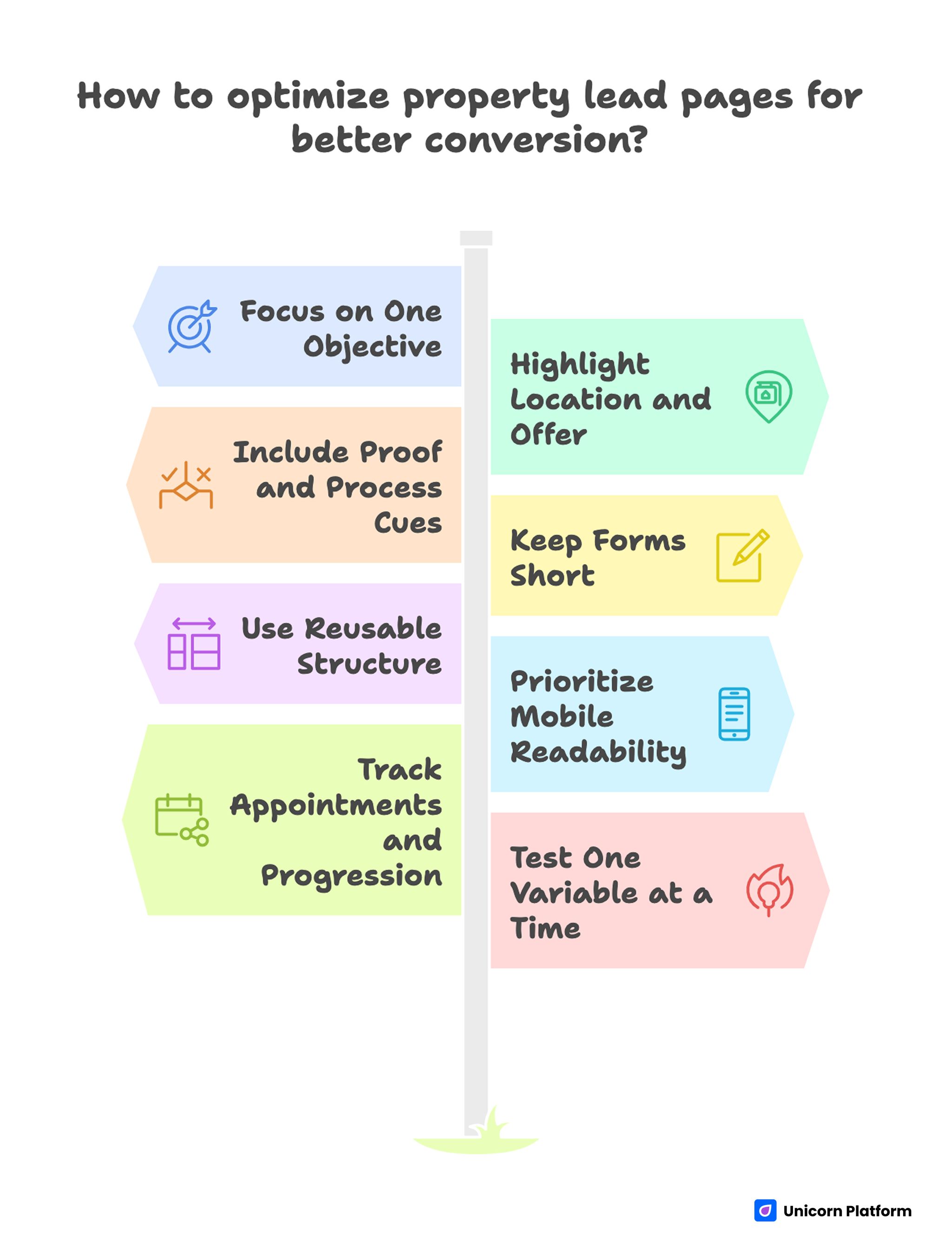
Quick Strategic Takeaways for Optimizing Property Lead Pages in 2026
- Build each campaign around one primary conversion objective.
- Lead with location and offer clarity instead of generic agency language.
- Place proof and process cues near commitment points.
- Keep first-step forms short, then qualify deeper after intent is confirmed.
- Use one reusable structure and adapt variants by district and audience type.
- Make mobile readability and interaction speed hard release gates.
- Track accepted appointments and downstream progression, not just form volume.
- Run one major variable per test cycle to preserve attribution quality.
Why Property Pages Leak Leads Even in High-Demand Markets
Many pages underperform despite strong market interest because they ask users to work too hard for basic answers. Research from the National Association of Realtors shows that a majority of home buyers start their real estate journey online and expect immediate access to practical information about properties, pricing, and agent contact. When campaign pages fail to provide this clarity quickly, motivated prospects drop off or delay inquiries, even in strong markets. Visitors arrive expecting practical context and instead see broad value statements that do not resolve immediate uncertainty.
Another frequent issue is objective overload. One page tries to support buyer consultations, seller valuations, rental inquiries, and investor leads with equal emphasis. When every action appears equally important, no path feels clear.
A third issue is misplaced trust content. Credibility details are often hidden in generic testimonial sections far below the first action opportunities. In housing decisions, trust is not decorative; it is required to move forward.
A better standard is straightforward. Every section should remove one specific doubt and guide the user toward the next clear step.
Start With Intent Mapping Before Editing Design
Before choosing templates or visuals, define the page objective in one sentence. Examples include first-time buyer consultations, listing valuation requests, or district-specific open-house demand.
Then define audience state. Early-stage visitors need orientation and confidence. Warmer visitors need speed, practical details, and low-friction scheduling.
A useful mapping model includes three questions: who this offer is best for, what outcome they should expect, and what constraints apply before booking. This model helps users self-select quickly and improves downstream conversation quality.
When teams run multiple segments across the same campaign budget, the structure in this real-estate conversion framework can help keep intent and messaging aligned from the start.
Intent mapping also improves internal coordination. Sales, operations, and marketing can evaluate one conversion path together instead of debating isolated text edits.
Conversion Architecture for Property Campaign Funnels
A durable 2026 architecture for property lead funnels uses seven modules. The sequence stays consistent while content varies by market and audience.
- first-screen offer with location qualifier
- concise fit and scope summary
- local proof block with context-rich credibility
- process timeline showing what happens after inquiry
- objection-handling FAQ from real buyer and seller questions
- primary action path with minimal first-step friction
- secondary fallback contact route for urgent or atypical cases
This order reflects how users evaluate real-estate risk. They confirm relevance, validate trust, check process, and then decide whether to share details.
Using Unicorn Platform, teams can clone this structure across campaigns and adapt only the variables that matter: neighborhood framing, proof context, and CTA language. This keeps campaign production fast while preserving interaction consistency for returning visitors.
First-Screen Blueprint for Faster Qualification
The first screen should answer four things in seconds: what is offered, where it applies, who it is designed for, and what the next step is. Behavioural data from Google shows that real estate-related searches have increased significantly on mobile devices, and users expect concise, actionable information within seconds of landing on a page. Prioritizing clear first-screen qualifiers aligns with this trend by reducing friction where search intent is highest. If any of these details are unclear, users delay or leave.
A practical first-screen formula combines service promise, local qualifier, and concrete action. Location and timeline cues usually outperform broad promotional claims in this category.
CTA labels should match visitor stage. Early-stage users respond to consultative actions, while warmer users respond better to direct scheduling prompts. Consistent wording across the page prevents confusion about commitment level.
The objective is not clever phrasing. The objective is immediate decision clarity, so every headline should help users self-qualify quickly.
Offer and Inventory Context Without Overload
Visitors need enough context to judge relevance quickly, but they do not need every detail before first action. A compact snapshot section works better than dense listing walls for most campaign objectives.
Highlight a small set of representative inventory signals, pricing ranges, or service scope details tied to the campaign goal. Keep this section scan-friendly and avoid long narrative blocks.
For seller-focused campaigns, show market-positioning context and typical preparation flow. For buyer-focused campaigns, show neighborhood fit cues and financing-related decision factors in plain language.
If your team is also improving broader brand-level UX for property audiences, the patterns in this real-estate website design guide are useful for aligning campaign pages with trust expectations.
Context should support action, not distract from it. Every item in this section should justify its presence by reducing uncertainty.
Local Trust Design That Moves Decisions Forward
Trust signals are most effective when they appear exactly where users hesitate. Placing credibility content only in lower sections misses the moment when confidence is needed most.
A high-impact trust stack combines transaction relevance, local expertise proof, and process reliability. Transaction relevance includes recent outcomes in comparable contexts. Local expertise proof includes district familiarity and property-type depth. Process reliability includes response expectations and communication standards.
General testimonials without situational detail are weaker than short, specific proof tied to user concerns. People trust evidence that maps to their own decision context.
Trust modules should be refreshed regularly. Outdated references or stale metrics reduce credibility and can increase support friction.
Process Clarity: What Happens After the Form
Many campaign pages lose qualified visitors because the post-submit process is unclear. People hesitate when they do not know who responds, how fast, and what information will be requested next.
Add a process timeline near the primary action section. Keep it short and concrete. Users should understand the immediate next steps without guessing.
A strong process timeline usually covers response window, consultation format, expected preparation, and follow-up options. This transparency increases completion and lowers no-show behavior.
For commercial and mixed-use campaigns where stakeholder groups are broader, the structure in this commercial property no-code guide can help shape clearer process paths.
Process clarity protects both conversion and operations. Better expectation-setting means cleaner handoffs and fewer back-and-forth cycles.
Form Strategy: Balance Volume With Qualification Quality
Form design often swings too far in one of two directions. Teams either ask too little and collect weak leads, or ask too much and suppress legitimate demand.
A staged model usually performs best. The first step should capture only commitment-critical information. Secondary qualification can happen after initial intent is confirmed.
Field labels must be explicit and error states should explain corrective action directly. Ambiguous feedback slows completion, especially on mobile.
Review form fields monthly with sales input. If a field consistently adds friction without improving qualification outcomes, relocate or remove it.
Blog-to-Lead Route for Organic Demand
Paid acquisition is valuable, but long-term pipeline quality improves when educational demand is connected to conversion paths. Buyers and sellers research deeply before speaking with an agent.
Build topical guides around neighborhood comparisons, transaction timing, financing readiness, and process planning. Then route readers to campaign pages through contextual prompts aligned with their stage.
This blog-to-lead route works best when educational pages and conversion pages share language, proof standards, and expectations. Consistency improves trust and reduces sharp context switching.
For broader funnel capture design, this lead-generation landing workflow provides a useful reference for connecting informational content to qualification-focused actions.
The target outcome is not longer session time. The target outcome is better-informed, higher-fit prospects entering consultations.
No-Code Operations for Faster Campaign Iteration
Market conditions in property categories can shift quickly. Slow publishing workflows create missed windows and stale messaging.
No-code operations allow teams to update headlines, proof, forms, and local context without waiting for full development cycles. Speed matters, but only when structure stays disciplined.
In Unicorn Platform, teams can standardize core modules and permit controlled local customization. This governance model balances consistency with neighborhood relevance.
Weekly iteration should focus on one significant variable. Small, controlled changes produce clearer evidence than broad redesigns with unclear attribution.
Mobile Performance Standards for 2026
A large share of property discovery starts on mobile devices. If mobile readability, tap flow, or form behavior is weak, qualified demand drops before trust can be established.
Set mandatory mobile checks before every major release. Validate first-screen clarity, CTA visibility, field usability, and backup contact availability on real devices.
Performance should be measured by action readiness, not visual completeness alone. Users should be able to begin inquiry flow before non-critical assets finish loading.
Mobile regressions should be treated as release blockers. In high-CPC markets, small interaction failures can erase campaign profitability.
Measurement Model: Optimize for Revenue Signals
Top-funnel form volume is an incomplete metric. Strong optimization requires stage-based measurement tied to commercial outcomes.
Track four levels: engagement behavior, inquiry starts and submits, accepted-appointment rate, and downstream deal progression. This model exposes where quality drops between marketing and sales.
Each test should include one primary quality metric and one diagnostic metric. That structure keeps decisions clear and prevents overreaction to noisy secondary signals.
Weekly reporting should document hypothesis, deployed change, observed outcome, and next action. Documentation is what turns activity into compounding performance.
Scenario Playbooks by Audience Type
Different real-estate audiences evaluate risk in different ways. Running one universal narrative for every segment often reduces relevance and creates low-fit submissions. A practical solution is to keep one structural framework and customize section emphasis by audience state.
First-time buyers usually need educational confidence before they are ready to schedule. These pages should emphasize financing readiness, timeline expectations, and neighborhood fit language that reduces intimidation. Trust modules should feature guidance-oriented outcomes rather than investment jargon.
Move-up buyers typically care about sequencing and coordination risk. They often need clarity on parallel buying and selling timelines, short-term housing scenarios, and negotiation strategy under current market conditions. Campaign pages for this segment should place process timelines and consultation structure near the first action button.
Investor audiences usually evaluate speed, clarity, and opportunity quality. They respond better to structured market context, expected yield assumptions, and quick screening pathways than to broad lifestyle messaging. Pages targeting this segment should prioritize concise qualification forms and objective local performance signals.
Seller audiences are often sensitive to confidence and control. They want transparency around pricing strategy, marketing approach, and communication cadence before they commit to a conversation. For this segment, proof modules should highlight recent local outcomes and process reliability rather than generic agency claims.
Luxury clients often expect higher-touch service cues and stronger privacy assurances. Their decision process can be slower, but confidence thresholds are higher. Pages serving this segment should include explicit service boundaries, response standards, and trust indicators matched to high-value transactions.
When these audience variants are built from a shared template, teams can compare performance without losing structural consistency. This model makes optimization cleaner because differences in outcome can be traced to message emphasis rather than complete page redesigns.
30-Day Execution Plan
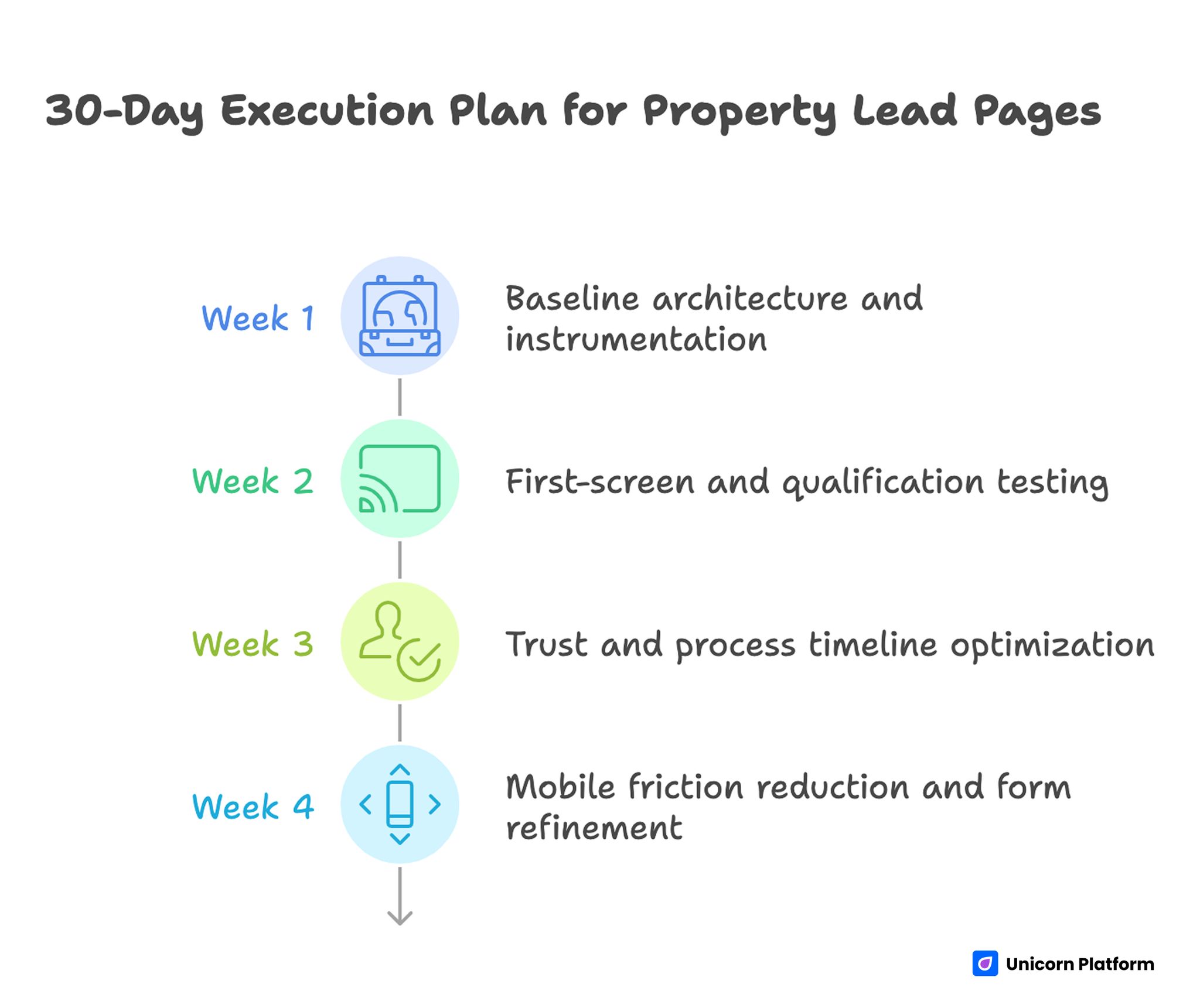
30-Day Execution Plan for Property Lead Pages
Week 1: baseline architecture and instrumentation
Publish one campaign using the seven-module structure and verify tracking across key stage transitions. Confirm that lead routing and response workflows are functioning as expected.
Capture baseline metrics for inquiry completion, accepted appointment rate, and support objections. These benchmarks anchor all future decisions.
Week 2: first-screen and qualification testing
Run one test focused on location qualifier clarity and one test focused on fit criteria placement. Keep other variables stable.
Evaluate outcomes using accepted-appointment quality rather than raw submit volume. Scaling should follow quality, not curiosity clicks.
Week 3: trust and process timeline optimization
Move proof and process modules closer to action sections where hesitation is highest. Test for improvements in submit quality and booking follow-through.
Refresh FAQs using current sales and support objections. Objection handling should reflect present market conditions.
Week 4: mobile friction reduction and form refinement
Audit primary flows on real devices and remove non-essential first-step fields. Improve input guidance and fallback contact pathways.
Conclude with a concise keep-change-next memo so the next cycle starts with explicit priorities and clear ownership. This document should also state which test is intentionally deferred and why.
90-Day Scaling Model
Scale only after baseline quality is stable. Expanding traffic to inconsistent funnels increases operational load and lowers close efficiency.
Days 1-30 should stabilize structure and measurement discipline. Days 31-60 should expand district and audience variants with controlled hypotheses. Days 61-90 should consolidate winning modules into reusable templates and retire weak versions.
This model keeps teams fast without sacrificing consistency. It also improves onboarding for new contributors because decisions are documented and reusable blocks are standardized.
Common Mistakes and Practical Fixes
Mistake 1: multi-objective pages with conflicting CTAs
Fix by assigning one primary objective and routing secondary intents through clearly labeled alternatives. Clear priority reduces hesitation and improves funnel attribution.
Mistake 2: generic hero messaging with no location context
Fix by adding practical local qualifiers and explicit audience fit cues in the first screen. Visitors should recognize relevance before they need to scroll.
Mistake 3: trust content detached from decision points
Fix by placing local proof and process reassurance near key action modules. Confidence cues are most useful where users make commitment decisions.
Mistake 4: unclear post-submit process
Fix by adding a short timeline that explains who responds, when, and what happens next. Process visibility lowers abandonment and improves appointment readiness.
Mistake 5: oversized first-step forms
Fix by collecting essential data first and staging deeper qualification after initial intent. A lighter first step usually preserves volume while improving quality.
Mistake 6: mobile checks treated as late-stage polish
Fix by making mobile readability and interaction testing mandatory before launch approval. Teams should verify these checks on real devices instead of emulator-only testing.
Mistake 7: high-volume testing without attribution control
Fix by running one major variable per cycle with explicit hypotheses and measurable outcomes. Controlled scope keeps decisions clear and repeatable.
Mistake 8: no standardized learning loop
Fix by maintaining weekly decision logs and updating reusable modules based on evidence. This habit turns short-term tests into long-term operating advantages.
Pre-Publish QA Checklist
Before each release, run a short QA pass covering clarity, trust, process transparency, and performance readiness. Keep this checklist in the publishing workflow so execution remains consistent during fast campaign cycles.
Checklist items: Use this list as a release gate so quality checks are applied consistently across high-tempo campaign updates. The checklist should be completed before handoff to paid media or sales follow-up teams.
- first-screen offer and local qualifier are immediately clear
- primary action aligns with campaign intent
- trust and process cues appear near commitment sections
- first-step form requests only essential data
- fallback contact path is visible for urgent users
- mobile readability and interaction checks pass on real devices
- speed performance supports fast first action
- tracking confirms stage-level funnel measurement
Teams that enforce this checklist usually reduce rework and improve appointment quality consistency. It also shortens post-launch correction cycles for sales and operations teams.
FAQ: Property Lead Page Strategy for 2026
How many goals should one property campaign page have?
One primary goal is usually best. Secondary goals can exist, but they should not compete visually with the main conversion path.
What is more important than total form submissions?
Accepted-appointment quality and downstream progression are more important because they reflect revenue impact, not just activity volume. Top-funnel growth without qualification quality can create expensive pipeline noise.
Where should trust content appear?
Trust content should appear near major decision points, especially around forms and scheduling actions where hesitation is highest. Placement has as much influence as the proof itself.
Should every campaign use long forms for better qualification?
Usually no. Short first-step forms followed by staged qualification often produce better completion and comparable quality.
How often should local proof blocks be updated?
Monthly is a practical baseline, with faster updates when market conditions or inventory context changes significantly. Outdated local proof weakens confidence quickly in competitive neighborhoods.
Do district variants really improve performance?
Yes, when they reflect real differences in audience intent and local context while keeping core structure consistent. Variants should be grounded in real behavior signals, not superficial copy swaps.
What is a sustainable testing cadence for lean teams?
One major variable per week is usually sustainable and provides clearer attribution than high-volume simultaneous experiments. This cadence also makes stakeholder review more practical.
How can teams reduce low-fit inquiries quickly?
Move fit criteria and process expectations higher on the page so users can self-select before submitting. Early self-selection protects team capacity and improves close potential.
Should educational content and conversion pages stay separate?
They should be connected. Educational content should route readers to intent-matched conversion paths with clear next steps.
What keeps conversion performance improving over time?
Consistent architecture, stage-based measurement, and documented weekly decisions are what create durable improvement. Without this discipline, short-term wins tend to decay after campaign turnover.
Final Takeaway
Property campaign performance in 2026 depends on fast clarity, local credibility, and disciplined iteration. Teams win when pages reduce uncertainty at the right moment and guide users into confident next steps.
Unicorn Platform supports this by combining no-code publishing speed with reusable conversion structure. When trust design, process clarity, and analytics discipline work together, lead quality improves predictably across markets and campaigns.