Table of Contents
- What Every NFT Website Needs
- Best NFT Website Examples and Patterns
- Community and Conversion Paths
- Why Unicorn Platform Works Well for NFT Websites
- Common Mistakes NFT Websites Make
- FAQ
An NFT website should do more than look interesting. It should help visitors understand the project, trust the team, join the community, and know exactly what to do next.
That is where many NFT sites fall short. They lead with visuals, but not clarity. Or they show a roadmap, a gallery, and a Discord link without ever making the project feel credible enough to explore further.
The strongest NFT websites usually do something simpler. They explain what the project is, show the collection or concept clearly, make the community path obvious, and reduce uncertainty around timing, trust, and next steps.
This guide explains what an NFT website should include, which page patterns work best, how to structure the site, and how to build one quickly with Unicorn Platform if you want a no-code setup that is easy to launch and update.
sbb-itb-bf47c9b
NFT Website Quick Answer
If you need the short version, a good NFT website usually needs:
- a clear hero section that explains the project quickly
- a collection or artwork showcase
- a roadmap or progress section
- a team or credibility section
- FAQ
- a community CTA such as Discord, X, or waitlist
- a clear mint, allowlist, or next-step path
The best NFT websites feel like a mix of product page, community page, and launch page. They need visual energy, but they also need trust and structure.
What Is an NFT Website?
An NFT website is a landing page or small website built to present an NFT project, collection, creator brand, or Web3 experience.
Depending on the project, the site may help people:
- discover the collection
- understand the concept
- join the community
- follow a launch timeline
- get on an allowlist
- find mint information
- learn about the team and roadmap
That means the website often plays two roles at once. It is both a visual showcase and a conversion page.
Some projects need a simple launch page. Others need a broader site with FAQ, roadmap, community links, and multiple sections for trust and updates. The right version depends on the size of the project and how much context people need before they take action.
What Every NFT Website Needs
Not every NFT project needs the same structure, but most strong NFT sites include a similar set of core elements.
1. A clear hero section
The hero should tell visitors:
- what the project is
- who it is for
- why it matters
- what to do next
This is where many NFT sites rely too much on style and too little on explanation. Visuals can pull people in, but the hero still needs to orient them fast.
2. A collection or visual showcase
NFT projects need visual proof. That can be sample assets, hero artwork, previews, or a gallery that helps people understand the collection.
The goal is not to dump every image onto the page. It is to give people a fast sense of the project’s style and value.
3. A roadmap or project progress section
Roadmaps still matter because they help visitors understand whether the project feels active, serious, and directional.
This section does not need hype language. It just needs to explain what the team is building, what has already happened, and what comes next.
4. A team or credibility section
This can be a founder block, creator introduction, advisor section, partner section, or simply a more transparent explanation of who is behind the project.
Trust is especially important when the project asks people to join early, mint, or commit attention before everything is live.
5. A community path
Most NFT projects are not only selling assets. They are building audience, community, and attention loops.
That is why many strong sites highlight:
- Discord
- X
- email waitlist
- community updates
- allowlist path
6. FAQ
FAQ helps remove hesitation near the decision point. It is one of the easiest ways to clarify mint timing, pricing, community expectations, roadmap questions, and technical basics.
7. One clear next step
The next step might be:
- join Discord
- join a waitlist
- mint
- learn more
- follow updates
The important thing is clarity. Too many competing next steps weaken the page.
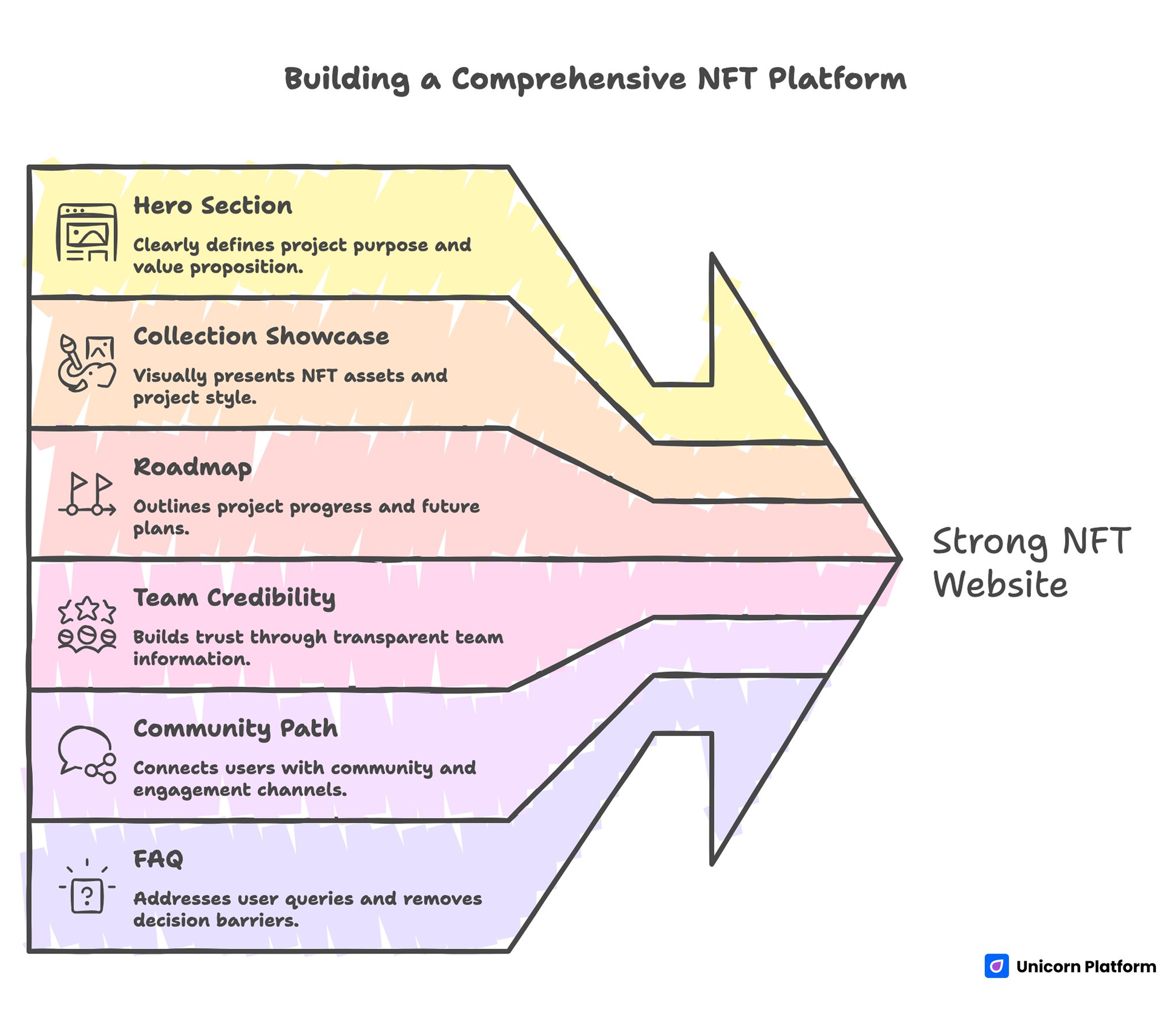
Building a Comprehensive NFT Platform
Best NFT Website Examples and Patterns
The strongest NFT websites usually fall into a few recognizable patterns.
1. The collection-first showcase page
This pattern works when the artwork or collection itself is the main attraction.
It usually includes:
- strong hero art
- visual grid or carousel
- short concept explanation
- mint or community CTA
This works best when the art is the clearest selling point and the project does not need a lot of operational explanation.
2. The roadmap-led project page
This pattern works when the audience needs to understand the long-term vision, not just the look of the collection.
It usually includes:
- project summary
- roadmap
- founder or team section
- FAQ
- community CTA
This is often a stronger fit for utility-driven projects, community ecosystems, or projects with a longer launch cycle.
3. The community-first launch page
This works when the main goal is to grow attention and membership before or around launch.
It usually includes:
- clear value proposition
- Discord or X CTA
- allowlist or email capture
- launch timeline
- community proof
This is useful when minting is not the only or immediate goal.
4. The creator or brand page
Some NFT websites work more like creator or studio sites than traditional collection pages.
They often need:
- a stronger brand story
- selected work
- press, partnerships, or credibility
- links to marketplaces and community channels
This pattern is useful when the project is closely tied to a creator identity.
5. The mint-ready action page
This works best when the project is close to or already in its main launch window.
It usually includes:
- launch timing
- price or access information
- wallet or mint guidance
- FAQ
- trust and scam-avoidance clarity
This pattern needs the strongest operational clarity because visitors are closer to a meaningful action.
Recommended NFT Website Structure
If you want a simple blueprint, this order works well for many projects:
- Hero
- Collection preview
- Project concept or story
- Roadmap
- Team or credibility block
- Community CTA
- FAQ
- Final action section
That order works because it moves from interest to understanding to trust to action.
You do not need every section to be long. In fact, many NFT sites work better when each section has one clear job instead of trying to explain everything at once.
If you want help planning that section order before you build, this landing page structure guide is useful for shaping the page flow.
What Should an NFT Website Include Above the Fold?
The first screen matters a lot because NFT visitors often make a quick decision about whether the project feels serious, confusing, or worth exploring.
Above the fold, aim to include:
- project name
- short explanation
- one visual anchor
- one clear CTA
Optional but often useful:
- launch timing
- social proof or community size if it is meaningful and current
- one short trust cue
What to avoid above the fold:
- too many links
- vague slogans without context
- giant walls of copy
- too many CTAs competing with each other
Roadmap, Team, and FAQ: Why They Matter So Much
In many NFT projects, these three sections do a lot of the trust work.
Roadmap reduces uncertainty
It gives visitors a reason to believe the project is moving somewhere, not just appearing briefly for hype.
Team introduces accountability
Even a simple creator section can help the project feel more real.
FAQ removes the final friction
FAQ is where people often look for:
- mint date
- price
- blockchain details
- community access
- allowlist questions
- utility or roadmap clarifications
Those sections do not need to be inflated. They just need to answer the questions that stop people from taking the next step.
Community and Conversion Paths
Many NFT websites are trying to do more than drive direct mint traffic.
They may be optimizing for:
- Discord members
- allowlist signups
- newsletter signups
- X follows
- launch attention
That means your CTA should match the real stage of the project.
Early-stage project
Use community and waitlist CTAs.
Mid-stage project
Use roadmap plus community plus allowlist logic.
Launch-stage project
Use mint clarity plus FAQ plus trust signals.
The page should reflect where the project actually is, not where the team wishes it was.
NFT Website Builder vs Custom Website
Some projects need a fully custom site, but many do not.
Use a builder when:
- the team wants to launch quickly
- the site mostly needs strong sections, visuals, embeds, and CTA flow
- the project expects frequent content updates
- non-developers need to update the page
Consider custom work when:
- the site needs unusual interactions or animations
- the product includes custom on-site functionality beyond a marketing page
- the team has the resources and time for heavier implementation
For many NFT projects, the real question is not whether the site can be more custom. It is whether the extra complexity actually improves the project enough to justify slower launch and slower edits.
Why Unicorn Platform Works Well for NFT Websites
Unicorn Platform is a strong fit for NFT websites because the current page-building workflow already maps well to what many NFT projects need:
- visual sections
- gallery blocks
- roadmap blocks
- team sections
- FAQ
- embeds
- fast publishing
That makes it useful for teams that want to move quickly without building everything from scratch.
Where it fits best
- NFT launch pages
- creator-led collection pages
- roadmap and community pages
- waitlist or allowlist pages
- simple no-code project sites
Why it is practical
NFT projects often need to update visuals, timelines, copy, and links quickly. A no-code builder helps with that because the page does not become dependent on a developer for every change.
How To Build an NFT Website in Unicorn Platform
A simple workflow looks like this:
- Start with one goal: mint, waitlist, community, or project explanation.
- Build the hero around one clear project promise.
- Add a collection preview or artwork showcase.
- Add roadmap and team sections early if trust is important.
- Add FAQ before the final CTA.
- Embed Discord or add another community path if that is part of the project strategy.
- Keep the next step clear and easy to find.
The biggest advantage of this approach is speed. You can get the page live quickly, then keep improving it as the project evolves.
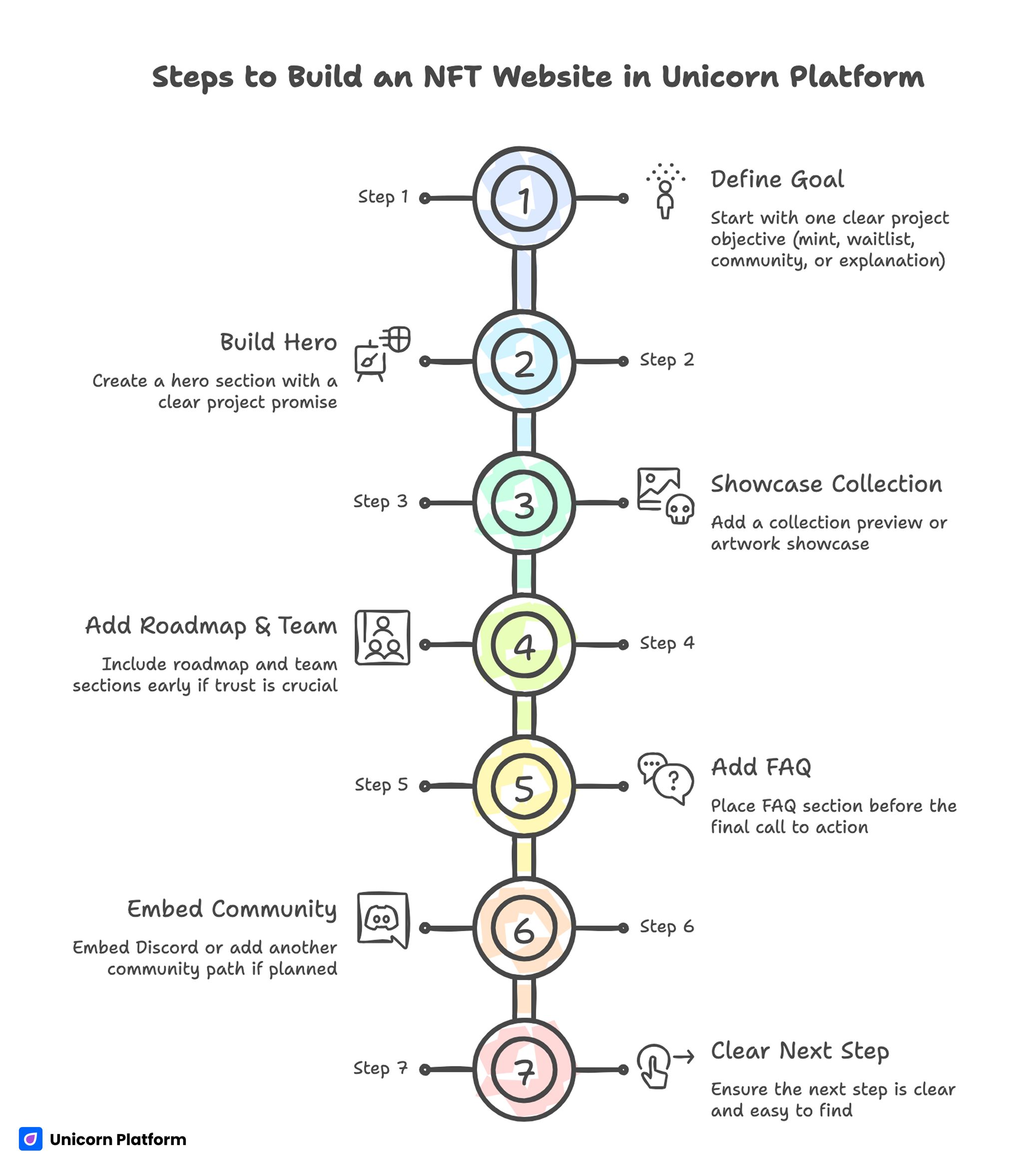
Steps to Build an NFT Website in Unicorn Platform
NFT Website Launch Checklist
Use this before publishing:
- Confirm the hero explains the project clearly.
- Confirm the main CTA matches the actual stage of the project.
- Add a visual preview of the collection or concept.
- Add roadmap or progress context if it matters to the project.
- Add team or credibility context if trust needs support.
- Add FAQ for the most common launch questions.
- Add community links and make sure they work.
- Check the mobile version carefully.
- Remove weak or generic hype language.
- Make sure the final CTA is visible and easy to understand.
Common Mistakes NFT Websites Make
Mistake 1: Strong visuals, weak explanation
The artwork looks good, but the visitor still does not know what the project is or why it matters.
Mistake 2: Too much hype, not enough clarity
The copy sounds energetic but does not reduce uncertainty.
Mistake 3: No obvious trust layer
If the site asks people to care, join, or mint without enough credibility context, hesitation grows quickly.
Mistake 4: Too many competing CTAs
Join Discord, follow on X, mint now, read the roadmap, join the waitlist. If everything is urgent, nothing feels clear.
Mistake 5: Roadmap without context
A roadmap helps only if visitors understand what the project is trying to become.
Mistake 6: Bad mobile experience
Many NFT sites rely heavily on visual design, which makes mobile clarity even more important.
FAQ: NFT Website Builder in 2026
What should an NFT website include?
Most NFT websites should include a clear hero, a collection showcase, roadmap or project context, trust or team section, FAQ, community path, and one clear CTA.
What is the best NFT website builder?
The best NFT website builder depends on the project, but the strongest choice is usually the one that lets your team launch quickly, update easily, and present visuals, roadmap, and community clearly.
Do I need a mint page on my NFT website?
Not always. Some projects need a direct mint path, while others mainly need a community, waitlist, or launch-information page first.
Should an NFT website have a roadmap?
Usually yes, if the roadmap helps visitors understand the future of the project. It should be specific enough to build trust, not just fill space.
Is Discord still important for NFT websites?
For many projects, yes. Community is still a major part of how NFT audiences evaluate whether a project feels active and real.
Should I show the team on an NFT website?
If trust is an issue, a team or creator section often helps a lot. The right level of detail depends on the project.
How long should an NFT website be?
Long enough to explain the project, build trust, and support the next step. It does not need to be long for its own sake.
Can I build an NFT website without coding?
Yes. Many NFT websites can be built effectively with a no-code builder as long as the site mainly needs strong sections, visuals, embeds, and fast updates.
What makes an NFT website convert better?
Clear explanation, strong visuals, visible trust cues, a well-placed FAQ, and one clear next step usually matter more than decorative complexity.
Final Takeaway
The best NFT websites are not just visually interesting. They help visitors understand the project quickly, trust it enough to continue, and know what action to take next.
For most teams, that means building a site with clear structure, strong visuals, roadmap and trust context, and a simple community or launch path. If Unicorn Platform helps you launch and update that faster, it is doing the real job well.


