Table of Contents
- Core Page Architecture for Waitlist Conversion
- Common Mistakes and Practical Fixes
- 30-Day Implementation Plan
- FAQ
Most teams can launch a waitlist page quickly. Fewer teams can launch one that attracts people who actually activate later. That gap is where early momentum is won or lost.
A waitlist is not just a collection form. It is a decision surface that sets expectations about value, timeline, and trust before the product is fully available. If those expectations are vague, signup volume can rise while launch readiness gets worse.
The strongest teams treat waitlist performance as an operating system. They align message hierarchy, proof placement, form design, post-signup communication, and weekly optimization rules from the beginning. This approach improves both conversion rate and conversion quality.
This guide gives a full framework for teams that need reliable pre-launch demand, not vanity numbers. It is built for practical execution in Unicorn Platform, where speed matters but structure matters more.
sbb-itb-bf47c9b
Key Takeaways
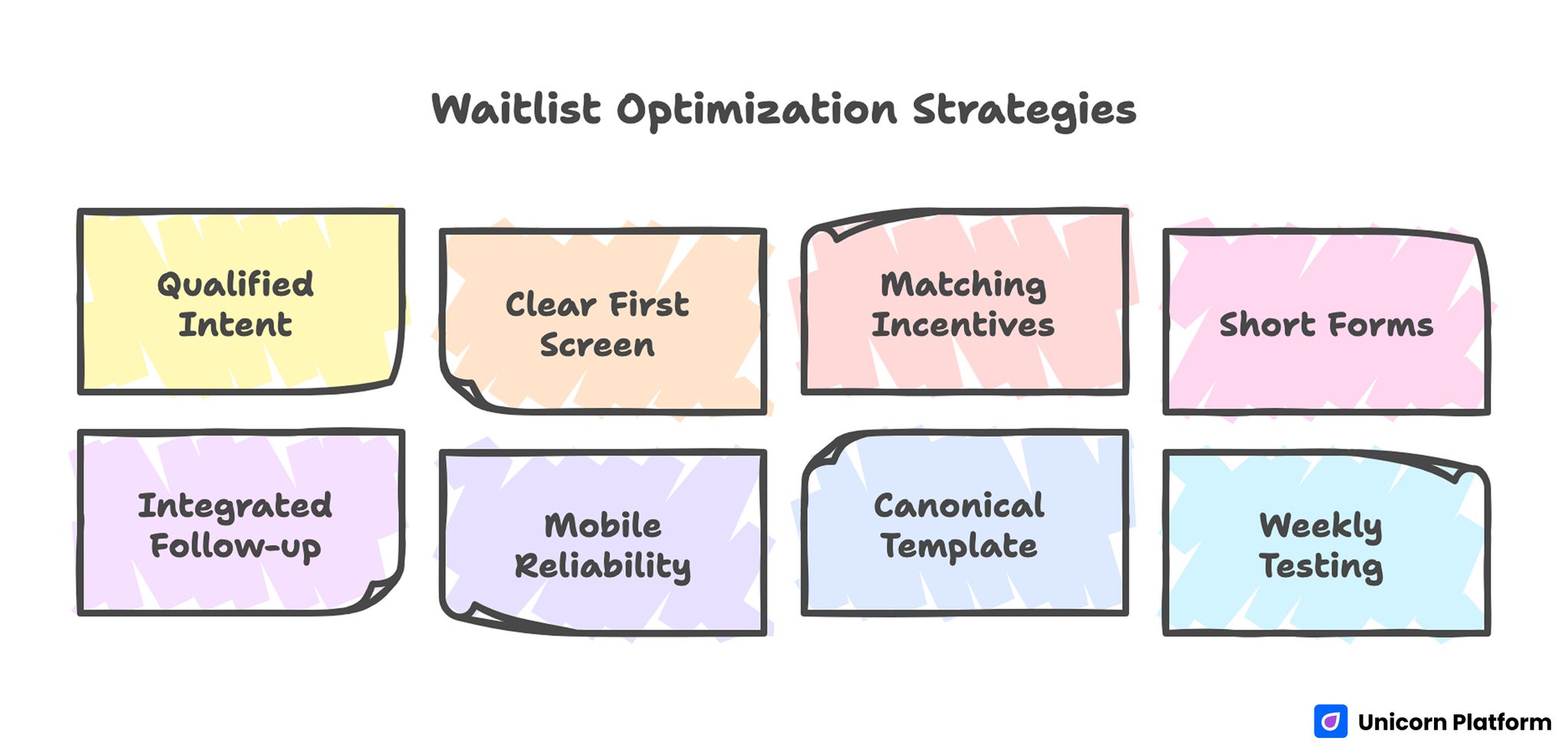
Waitlist Optimization Strategies
- Waitlist performance should be measured by qualified intent, not raw submissions.
- The first screen must clarify audience, value, and next step within seconds.
- Incentives should match user motivation and product stage.
- Forms should be short at first touch, then enriched after signup.
- Confirmation and follow-up are part of conversion quality, not separate tasks.
- Mobile readability and interaction reliability should be treated as launch gates.
- One canonical template with controlled variants usually outperforms fragmented page systems.
- Weekly testing works best when one major variable is changed per cycle.
Why Waitlist Pages Underperform Even With Good Traffic
Most underperforming pages fail before users reach the form. The headline promises something broad, the subheadline adds another promise, and the first call to action appears before users understand what they will get or when they will get it. People hesitate because the offer is still abstract.
Another common issue is mixed intent in one page flow. Teams combine launch news, feature previews, founder story, and referral incentives without a clear narrative order. Visitors cannot identify the primary decision, so attention diffuses and trust weakens.
The third issue appears after form submission. Users sign up, but confirmation language is generic and follow-up timing is unclear. Without structured continuity, many signups decay before launch day.
This is why waitlist conversion should be treated as end-to-end behavior, not as a single form event. The quality of the first interaction and the quality of post-signup handling are tightly connected.
Data shows that well‑optimized waitlist landing pages can convert 20–40 % of visitors into signups, significantly outperforming traditional landing pages when value, simplicity, and clarity are prioritized.
The Decision Sequence That Improves Waitlist Quality
Users usually make early-access decisions in a predictable order. They ask whether the offer is relevant, whether the value is concrete, whether the team is credible, whether the next step is low-friction, and what happens after signup. Pages that respect this sequence usually convert better and produce stronger downstream engagement.
Use this five-stage flow:
- Fit: who this is for right now.
- Value: what practical gain comes from joining early.
- Confidence: why users should trust this team and timeline.
- Action: what to do now with minimal friction.
- Continuity: what users should expect immediately after signup.
When this order is reversed, conversion quality drops quickly. Asking for email first and explanation later may produce more casual signups, but it usually hurts activation and list health.
Analyses of more than 500 SaaS launches indicate that waitlist pages convert about 2.7× better than traditional landing pages, likely because “join waitlist” feels like a low‑commitment, exclusive step that leverages psychological triggers like scarcity and social proof.
Core Page Architecture for Waitlist Conversion
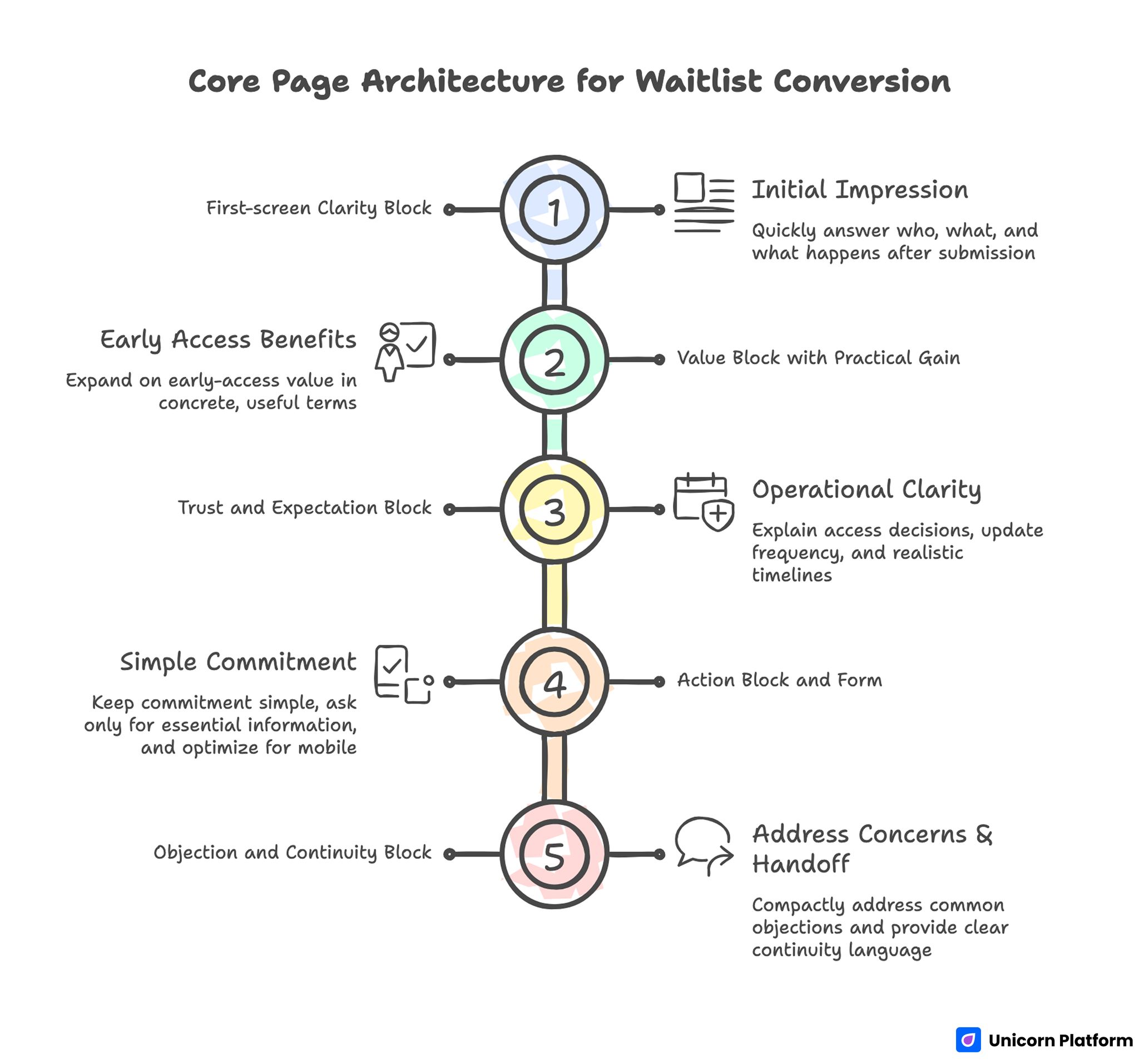
Core Page Architecture for Waitlist Conversion
A high-performing waitlist page should not feel complex, but it should be structurally deliberate. Every section needs one clear job, and section order should reduce uncertainty rather than adding more choices.
1) First-screen clarity block
The first screen should answer three questions quickly: who is this for, what specific value is offered, and what happens after submission. If any of these answers is unclear, users postpone action.
Use concise language that names the audience and near-term outcome. Outcome-led wording generally performs better than category-led wording because users decide based on concrete change, not product labels.
2) Value block with practical gain
The second block should expand the early-access value in concrete terms. Explain what people receive before general availability and why that is useful now.
Avoid stacking many incentives in one section. One clear value path usually outperforms a crowded list of perks that compete with each other.
3) Trust and expectation block
Trust on a waitlist page comes from operational clarity, not only from logos. Users want to know how access decisions are made, how often updates are sent, and what timeline range is realistic.
When expectations are transparent, signup quality usually improves because the page attracts users who align with the process rather than users who click out of curiosity.
4) Action block and form
The action section should keep commitment simple. Ask only for information needed to route the next step, then gather additional details in follow-up communication.
This is also where mobile interaction matters most. Form labels, helper text, and button clarity should be tested on real devices because small friction points can reduce qualified conversions at scale.
5) Objection and continuity block
A compact objection section near the form often performs better than a long FAQ wall. Address the most likely concerns: timeline uncertainty, eligibility, and communication frequency.
Then close with clear continuity language so users know what happens right after submission. This handoff clarity is one of the strongest predictors of first-week engagement quality.
If you want a deeper framework for section order and conversion logic, this landing page structure guide is useful when standardizing sequence across campaign variants.
Copy Patterns That Help Users Join a Waitlist
Strong waitlist copy is specific, calm, and operational. It should reduce uncertainty instead of creating pressure. Overly dramatic wording can increase clicks but often harms long-term trust.
The most effective pattern is audience plus outcome plus timeline context. For example, instead of broad hype language, explain who benefits first and what near-term access or learning they gain.
Call-to-action wording should reflect concrete next steps. Generic labels like "Submit" or "Notify me" can underperform when the offer has more specific intent. Action copy should tell users what participation means in practical terms.
Button-adjacent helper text is also high leverage. Short lines about update cadence or access logic can reduce hesitation without adding visual clutter.
Incentive Design by Product Stage
Incentives are useful when they match user motivation and product maturity. A referral-based queue can work for consumer products with social sharing behavior, but it may add noise for workflow tools where users care more about functional readiness.
A practical incentive ladder looks like this:
- Baseline early updates with clear timeline communication.
- Priority onboarding or early feature access for highly aligned users.
- Limited referral advantage where network effects are meaningful.
The key is incentive clarity, not incentive complexity. If users cannot quickly understand what they gain and how access is determined, conversion quality usually declines.
Form Strategy: Capture Signal Without Killing Momentum
Waitlist forms often fail because teams ask for too much too early. First-touch forms should capture minimum routing signal, then use follow-up flows for deeper qualification.
For many products, a first-step form can include email and one intent field such as role or use case. This gives enough context to segment communication without creating excessive friction at the conversion moment.
After signup, use targeted follow-up questions tied to clear user benefit. People provide better quality information when they understand why it is requested and how it improves their onboarding path.
Confirmation and Follow-Up as Part of Conversion
Submission is not the finish line. It is the beginning of a trust contract. If confirmation is vague or delayed, intent drops fast.
A strong confirmation state should include acknowledgement, expected timing, and one simple next action. That next action might be selecting a use case, inviting a teammate, or choosing update preferences.
Follow-up should be predictable and useful. A short sequence with milestone updates and practical context usually preserves more intent than irregular promotional emails.
For a more detailed pre-launch communication and structure workflow, this effective waitlist landing page guide is useful when refining handoff quality from signup to activation.
Variant Strategy Without Operational Chaos
Different channels bring different expectations. Search visitors often want fast relevance confirmation. Social visitors may need stronger credibility cues. Referral visitors may require less education and faster action.
The safest approach is one canonical page architecture with controlled message variants. Keep structure stable and adjust only high-impact surfaces such as headline emphasis, proof order, and CTA framing.
This model improves test clarity and reduces maintenance load. Teams can compare outcomes cleanly without rebuilding page logic every week.
Mobile Reliability and Interaction QA
Waitlist traffic often comes from mobile contexts where users are distracted and time-limited. Desktop checks alone are not enough for conversion-critical pages.
Run real-device QA for heading readability, input ergonomics, error handling, and confirmation behavior. Pay close attention to keyboard interactions and button visibility during form completion.
Set mobile QA as a release gate for any change that affects hero messaging, form behavior, or call-to-action modules. This discipline prevents quiet regressions during rapid launch cycles.
Governance Model for Reliable Waitlist Operations
Waitlist programs usually degrade when ownership is unclear. One person edits headline copy, another changes form fields, and a third updates follow-up logic, but no single workflow defines how those changes should be reviewed before release. Even strong pages become unstable under that pattern.
A practical governance model assigns three clear roles. A content owner controls message consistency and expectation language. A workflow owner controls form logic, confirmation behavior, and segmentation rules. A QA owner validates mobile behavior, event tracking, and release readiness before traffic scaling.
This model should stay lightweight so teams actually use it. A short checklist is enough when it is mandatory for every high-impact update. Complex governance documents are usually ignored, while concise release gates are repeatable under deadline pressure.
A useful release checklist for waitlist programs includes:
- first-screen fit and value alignment check.
- form field and helper-text validation.
- confirmation and follow-up timing verification.
- mobile interaction pass on real devices.
- analytics event validation for source and segment tracking.
After release, run a quick 24 to 48 hour verification pass focused on quality indicators. Early checks catch routing and communication issues before they affect large traffic batches. This habit is one of the simplest ways to protect list quality during aggressive testing cycles.
Metrics That Predict Real Launch Readiness
Signup count is a useful indicator, but it is not enough to judge readiness. Teams should track quality-aware signals that connect pre-launch conversion with post-launch behavior.
Use a balanced metric set:
- Conversion rate by source and device.
- Confirmed signup quality by intent segment.
- First follow-up engagement rate.
- Referral quality or duplication rate, if referrals are used.
- Activation readiness signals before launch access opens.
Each test cycle should have one primary metric and one guardrail metric. This keeps decisions focused and prevents local wins that damage overall list quality.
Common Mistakes and Practical Fixes
Mistake 1: Vague first-screen promise
Pages open with broad launch excitement but no clear audience fit or near-term value. Users do not know whether the offer is relevant to them.
Fix by rewriting the first screen with explicit audience and outcome language. Keep one dominant action path and remove competing introduction messages.
Mistake 2: Incentive overload
Multiple incentives are listed without a clear hierarchy. Users cannot tell what actually matters.
Fix by selecting one primary incentive path per campaign stage. Add secondary perks only when they support the same decision.
Mistake 3: Heavy first-touch form
Teams request too much information before trust is established. Completion drops and mobile friction rises.
Fix by reducing required fields to minimum routing inputs. Move deeper qualification into post-signup interactions.
Mistake 4: Weak confirmation experience
Users submit successfully but receive unclear next-step guidance. Engagement decays within days.
Fix by adding immediate confirmation clarity and structured first-week communication. Align every message with one practical action.
Mistake 5: Testing too many variables at once
Headline, form, proof, and incentives are changed in one cycle, making outcomes impossible to interpret.
Fix by running one major variable test per cycle with predefined success criteria and rollback rules.
30-Day Implementation Plan
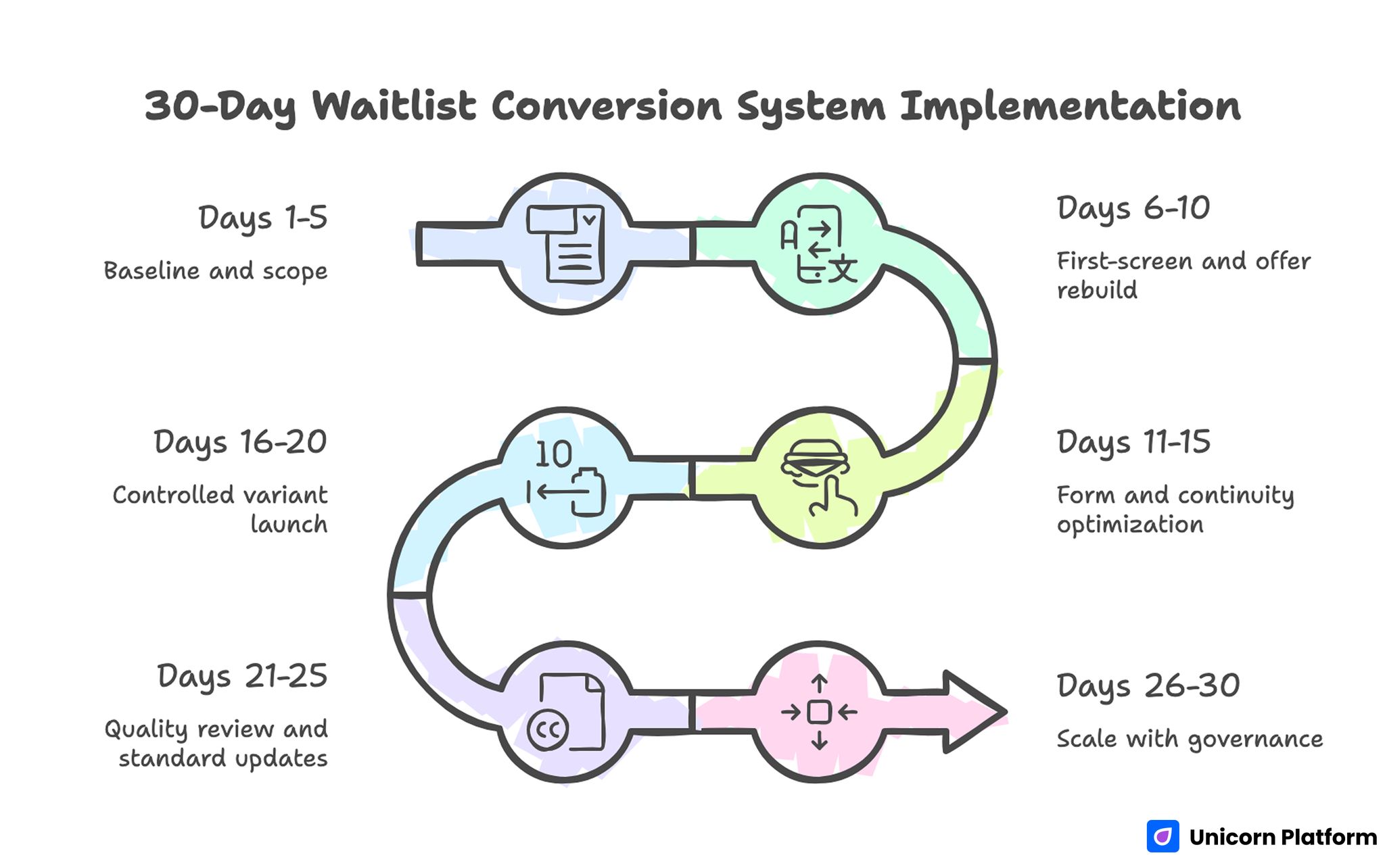
30-Day Waitlist Conversion System Implementation
Days 1-5: Baseline and scope
Audit current page sequence and identify the biggest uncertainty point before form submission. Define one primary metric and one guardrail metric for the next cycle.
Days 6-10: First-screen and offer rebuild
Rewrite first-screen fit and value language, then simplify incentive presentation to one clear path. Keep form and proof modules stable during this rewrite window.
Days 11-15: Form and continuity optimization
Reduce first-touch friction, clarify confirmation copy, and set a predictable first follow-up sequence. Validate end-to-end behavior on real mobile devices.
Days 16-20: Controlled variant launch
Create one source-specific variant using the same core architecture. Test only one major change, then compare primary and guardrail metrics.
Days 21-25: Quality review and standard updates
Review conversion quality by segment, not only totals. Promote winning blocks into template defaults and archive low-performing variants.
Days 26-30: Scale with governance
Expand proven patterns to adjacent campaigns with explicit ownership for copy, workflow, and QA. Keep release checklists short and mandatory so quality remains stable under traffic growth.
Running This System in Unicorn Platform
Unicorn Platform works best for waitlist programs when teams use reusable section modules and strict release rhythm. Fast editing is valuable only when structure and ownership are stable.
Use one template for fit-value-confidence-action sequence, then run controlled variants on message emphasis by source. This keeps testing clean and avoids operational sprawl.
If your program also includes coming-soon acquisition pages, this playbook on launching a startup site with free tools is useful for aligning pre-launch discovery with waitlist conversion and follow-up quality.
FAQ: How to Get Qualified Users to Join a Waitlist in 2026
How do we encourage users to join a waitlist without aggressive copy?
Focus on clarity over pressure. Explain who the offer is for, what users get, and what timeline to expect. Practical transparency usually builds stronger intent than urgency-heavy language.
What is the best first-step form size for waitlist campaigns?
Use the minimum fields required for routing and segmentation. Most teams perform better with one intent signal plus email, then deeper qualification after signup.
Should we use referral incentives from day one?
Use referrals only if they match your product dynamics and audience behavior. For many teams, clear value and reliable follow-up improve quality more than early referral complexity.
How often should waitlist pages be updated?
Weekly review cycles are a practical baseline during active campaigns. Update one major component at a time so performance impact is measurable.
Which metric matters most after conversion rate?
First follow-up engagement quality is usually the next critical metric. It shows whether users actually understand and value the post-signup relationship.
Do we need separate pages for each traffic channel?
Not at first. Start with one canonical structure and controlled message variants. Separate full pages only when channel behavior clearly justifies additional complexity.
How do we reduce low-intent signups?
Strengthen first-screen fit language, simplify incentives, and clarify what participation includes. Better expectation-setting typically filters low-intent traffic naturally.
Should we announce exact launch dates before they are certain?
Only when you can maintain confidence in delivery. If dates are still fluid, communicate milestone ranges and update cadence with clear honesty.
How can small teams run this process consistently?
Assign clear ownership for copy, workflow, and QA, and keep checklists short. Consistency in process usually matters more than team size.
What is the fastest high-impact fix for weak waitlist quality?
Rewrite first-screen fit and continuity messaging before changing everything else. That adjustment often improves both conversion quality and follow-up engagement quickly.
Final Takeaway
Strong waitlist performance comes from decision clarity and operational discipline, not from page hype. Teams that structure fit, value, trust, action, and continuity in one coherent flow usually build healthier early demand and better launch readiness.
When this system is paired with Unicorn Platform speed, teams can iterate quickly without losing consistency. That is how you grow a waitlist that converts into real activation instead of a list that only looks large in dashboards.

