Table of Contents
- The Core Conversion Architecture
- 30-Day Rollout Plan for Dealer Teams
- Scenario Playbooks
- Common Mistakes to Avoid
- FAQ
Most automotive teams do not struggle to get inventory online. They struggle to turn traffic into high-intent buyer conversations. Listings are visible, ad budgets are running, and users are landing on pages, but too many sessions end before a meaningful inquiry, booking, or financing conversation starts.
That gap usually comes from execution details rather than one major flaw. A visitor sees broad claims without proof, inventory results without useful filters, or forms that ask for commitment before trust is established. Each issue looks small on its own, but together they create hesitation and lower lead quality.
In 2026, buyers compare multiple options quickly across search, marketplaces, and social feeds. They do not need a polished brochure. They need a clear decision path: what makes this dealer reliable, which vehicles fit their budget and use case, and what happens after they submit an inquiry.
This guide is built for independent dealers, multi-location groups, and dealership marketing teams that want practical execution standards, not generic advice. The goal is to help you design a page system that improves qualified demand, strengthens trust, and supports sales outcomes.
sbb-itb-bf47c9b
Key Takeaways
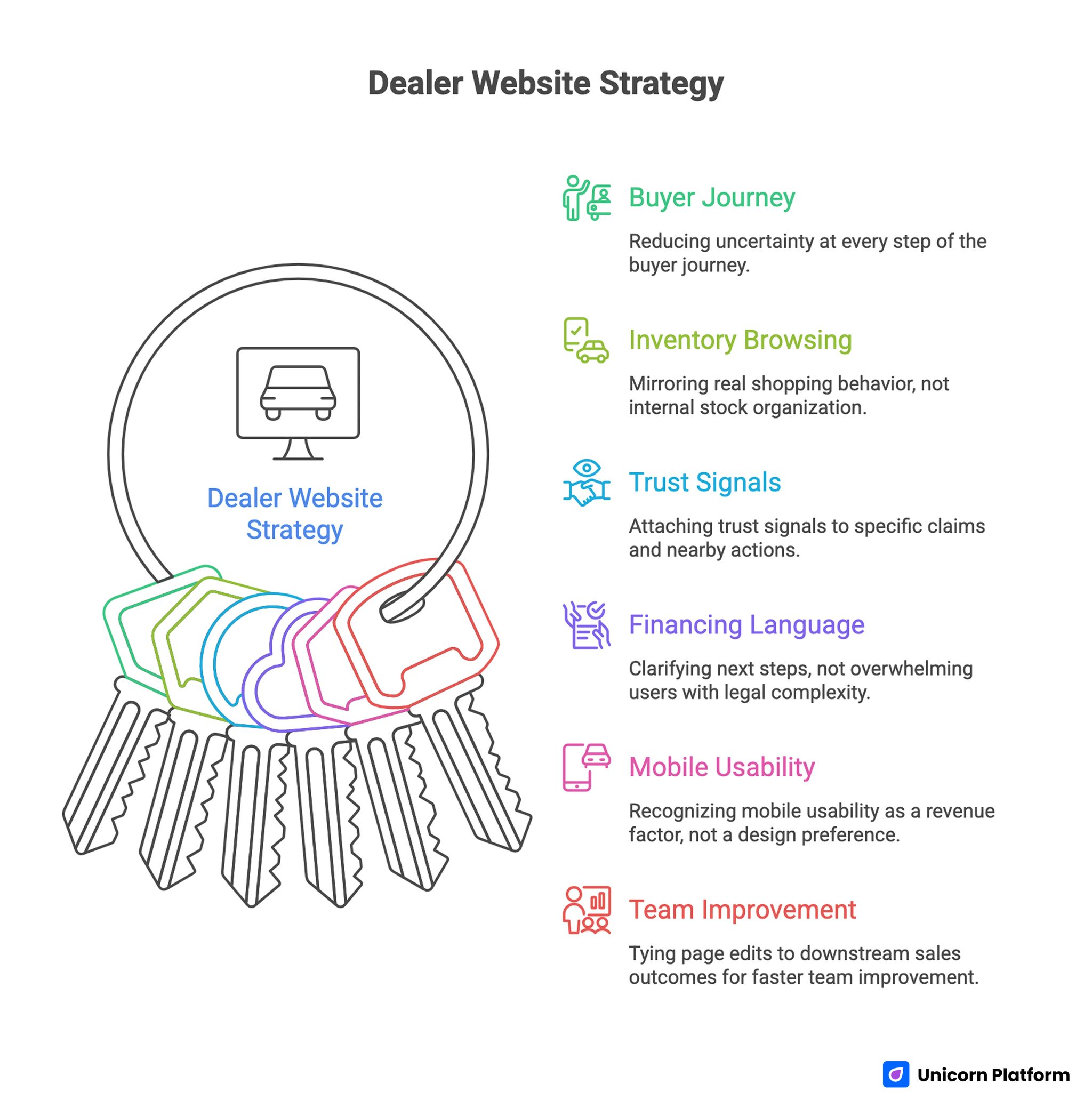
Dealer Website Strategy
- High-performing dealership pages reduce uncertainty at every step of the buyer journey.
- Inventory browsing should mirror real shopping behavior, not internal stock organization.
- Trust signals work best when attached to specific claims and nearby actions.
- Financing language must clarify next steps, not overwhelm users with legal complexity.
- Mobile usability is a revenue factor, not a design preference.
- Teams improve faster when page edits are tied to downstream sales outcomes.
Why Dealer Pages Lose Qualified Buyers
Many dealership pages ask for action before relevance is clear. A visitor clicks from a campaign about affordable SUVs and lands on a generic page with mixed messages, broad inventory blocks, and unclear financing pathways. Even if the inventory is strong, intent weakens when the page does not match the original promise.
Another common issue is catalog-first design. Users receive long lists of vehicles but limited help narrowing to what matters. Serious buyers typically filter by payment comfort, ownership risk, and practical fit, not by internal lot structure. Without decision-friendly filtering and comparison cues, high-intent sessions become browsing sessions.
Trust architecture is often underdeveloped as well. Pages display claims like "fully inspected" or "easy financing" without showing process details, response timelines, or credibility signals. Buyers in used-car markets evaluate risk heavily, so vague trust language underperforms even when pricing is competitive.
Finally, many teams optimize for lead volume alone. They celebrate more form submissions while sales teams report weaker appointment quality and lower show rates. If digital metrics are disconnected from real-world pipeline outcomes, page optimization becomes misleading.
What a Modern Dealer Page System Should Do
A modern dealership page system should do four jobs at once. It should attract the right visitor, help that visitor decide faster, reduce perceived risk, and capture enough context for effective follow-up. If one of those jobs fails, conversion quality declines.
This is why fast publishing matters only when paired with standards. Teams need a repeatable page model for campaign launches, seasonal inventory pushes, and financing offers. Consistency creates learning. Random page builds create noise.
A practical way to systemize page production is to start with structured templates, then adapt by campaign intent. This framework in the easiest way to create dealer landing pages and websites is a useful reference when building that baseline process.
The Core Conversion Architecture
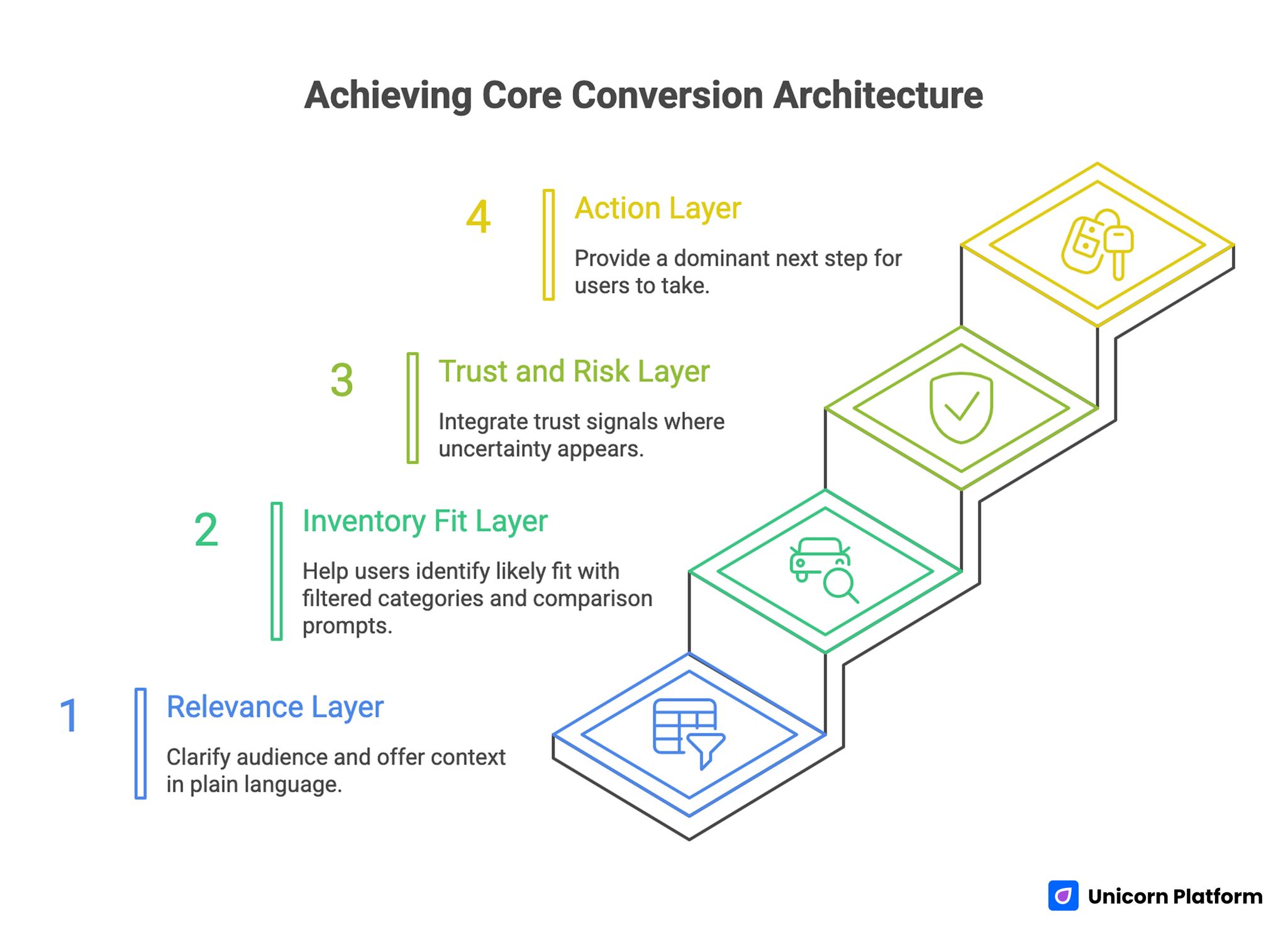
Achieving Core Conversion Architecture for Dealer Website Strategy
Strong dealership pages usually follow a predictable decision flow. The sequence can vary by campaign, but the logic remains similar.
1. Relevance Layer
The first screen should clarify audience and offer context in plain language. Users should know whether the page is for budget-focused buyers, family vehicle shoppers, first-time financing applicants, or trade-in decision makers. Specificity increases confidence quickly.
2. Inventory Fit Layer
After relevance is clear, the page should help users identify likely fit. This can be done with filtered categories, highlighted inventory cohorts, and practical comparison prompts. The objective is to reduce search fatigue and move users toward shortlisting.
3. Trust and Risk Layer
Trust should be integrated where uncertainty appears. Inspection standards, warranty terms, service history policies, and return conditions should be visible before high-commitment actions. Credibility works best when it is close to the claim it supports.
4. Action Layer
Every page needs one dominant next step. That step may be test-drive booking, financing pre-check, trade-in request, or speaking to an advisor. Supporting actions can exist, but visual hierarchy should make the primary route obvious.
Inventory UX That Supports Real Decision Behavior
Inventory experience is often treated as a technical module, but it is a conversion mechanism. Buyers are trying to answer practical questions quickly: can I afford this, is this condition acceptable, and can I trust this seller to guide me through purchase details.
Good filtering begins with buyer intent, not dealership taxonomy. High-value filters usually include budget range, estimated monthly payment, mileage bracket, body type, transmission, fuel preference, and ownership or accident context where available.
Comparison support is equally important. Users should be able to evaluate two or three suitable options without repeatedly returning to listing pages. Basic side-by-side cues on price, mileage, condition notes, and finance estimate can accelerate shortlisting.
Vehicle detail pages should also reduce ambiguity. Instead of dense specification walls, use scannable condition summaries, ownership highlights, and next-step context. The goal is to move the buyer from uncertainty to informed intent.
Trust Design: Turning Claims Into Belief
Used-car transactions carry perceived risk, so trust cannot be a separate "about us" exercise. It needs to be embedded in the decision flow. If you claim quality inspection, explain what inspection includes. If you claim fast financing support, explain response windows and required information.
Proof should be specific and relevant. A testimonial that says "great service" is weaker than one that references financing clarity, delivery reliability, or post-purchase support. Social proof works when it mirrors common objections.
Transparency around constraints is also powerful. If a financing option depends on lender criteria, say so clearly. If certain offers apply only to specific inventory groups, make that visible. Clarity can reduce raw lead volume but improve appointment quality significantly.
Operational trust should extend beyond page copy. Response timing, call quality, and follow-up consistency all influence whether digital leads become showroom outcomes. Marketing and sales teams need shared standards to preserve trust after form submission.
Financing Messaging That Improves Lead Quality
Financing content is one of the biggest conversion levers for dealer pages. Buyers are often less concerned with sticker price alone and more concerned with affordability confidence and approval path clarity. When financing language is vague, users hesitate or submit low-context inquiries.
A strong financing block answers practical questions: what inputs affect eligibility, what documentation is usually needed, and what happens after the first request. This gives visitors enough structure to take action without feeling trapped.
Payment estimates should be presented carefully. Use contextual language that sets expectations and avoids overpromising. Buyers respond better to clear ranges and assumptions than to overly precise numbers disconnected from their profile.
For teams launching financing-focused acquisition campaigns, this playbook on building a high-converting car dealership landing page is useful for aligning financing narrative with inquiry quality.
Mobile Experience as Revenue Infrastructure
Mobile behavior dominates many early dealership interactions, especially for local-intent traffic. If pages are slow, filtering controls are awkward, or forms are difficult to complete on small screens, high-intent users leave before the sales team has a chance to engage.
Mobile optimization should prioritize fast first-screen clarity, tap-friendly interaction zones, stable layout rendering, and clear progression from browse to inquire. Decorative complexity should never block critical decision content.
Media strategy needs balance. Rich photo sets and interactive assets can improve confidence, but they should not delay key content delivery. Load the most decision-relevant information first, then progressively enhance visuals.
Teams refining this workflow can use the guidance in build a responsive car dealer website in minutes as a practical baseline, then tune pages based on real device behavior and sales outcomes.
Lead Capture Strategy: Volume Without Noise
A common dealership mistake is treating every visitor as ready for the same action. In reality, users arrive at different readiness levels. Some want inventory details, some want affordability checks, and others are ready to book a visit.
Form design should match that intent stage. Early-stage inquiries should stay lightweight and ask for minimal friction data. Higher-intent flows can request more context if the value exchange is clear and the next step is well explained.
Confirmation states are part of conversion quality too. After submission, buyers should see response expectations, required preparation details, and clear contact channels. This reduces anxiety and improves response rates.
For campaign teams balancing top-funnel volume and qualified handoff, this lead generation landing page framework can help structure capture paths without adding unnecessary friction.
Content Strategy for Local Purchase Intent
Dealer SEO now rewards depth and utility more than thin location pages. Buyers searching locally often need specific guidance before they are ready to inquire. Useful supporting content can answer financing questions, comparison tradeoffs, and pre-purchase checklists.
A practical cluster can include pages such as: used SUV options for city driving, preparing documents for trade-in valuation, evaluating monthly ownership costs, and what to check during a test drive. These topics attract intent and support better on-page qualification.
Internal linking should follow user decision flow. Educational content can route to relevant inventory or inquiry pages, while conversion pages can route back to clarifying resources when users need more context.
The key is relevance, not publishing volume. A smaller set of useful pages with clear pathways often outperforms a large set of repetitive content.
Campaign Variant System for Dealership Teams
Most dealers run different campaign types throughout the year: seasonal offers, financing pushes, body-type promotions, and trade-in programs. Rebuilding from scratch for each launch wastes time and breaks learning continuity.
A better approach is modular variation. Keep one shared page backbone, then adapt sections by campaign objective. For example, a financing campaign can elevate affordability and approval guidance, while a family SUV campaign can elevate safety, space, and ownership reliability cues.
Variant discipline matters. If multiple sections are changed at once, interpretation becomes weak and teams cannot identify which edits improved outcomes. Limit each test cycle to one structural change and one messaging change.
Documentation closes the loop. Record hypothesis, edit scope, launch date, and observed effects on qualified metrics. Over time, this builds dealership-specific conversion intelligence that can guide future launches.
Measurement Model: From Clicks to Closed Deals
Page performance should be measured as a chain, not a single rate. Strong top-of-funnel click performance can still hide weak inquiry quality, poor appointment conversion, or low closing efficiency.
A practical measurement stack includes:
- Inquiry-to-qualified-lead rate.
- Qualified-lead to appointment-booked rate.
- Appointment-booked to show rate.
- Show rate to close rate by page path.
- Time-to-first-response after form submission.
This model helps teams locate friction accurately. If form conversion is high but show rates are weak, expectation mismatch is likely. If form conversion is weak but listing engagement is strong, CTA clarity or trust placement may be the bottleneck.
Sales feedback should be part of weekly page reviews. Marketing performance data without sales context often leads to superficial optimization and slower revenue improvement.
Governance and Operating Rhythm
Dealership growth improves when responsibilities are explicit. One owner should manage offer positioning, another should own compliance checks, and another should evaluate post-launch performance. Shared ownership without clear accountability usually slows iteration.
A practical weekly rhythm can include: reviewing one priority page, analyzing one underperforming funnel segment, shipping one focused improvement, and validating results with sales outcomes. Consistent cadence beats occasional redesign bursts.
Monthly reviews should focus on what to keep, what to retire, and what to test next. This avoids stale pages and prevents teams from repeating the same experiments.
Governance is especially important in regulated or finance-sensitive campaigns. Clear disclosure processes protect trust and reduce downstream correction work.
30-Day Rollout Plan for Dealer Teams
Week 1: Diagnose
Audit existing pages for relevance clarity, filter usability, trust placement, financing context, and mobile interaction quality. Identify one primary conversion leak to address first.
Week 2: Rebuild Core Flows
Create standardized templates for three main intents: inventory discovery, financing pre-check, and trade-in inquiry. Align CTA logic and confirmation steps across all three.
Week 3: Launch Controlled Variants
Deploy one campaign variant for a high-priority inventory segment. Test one structural edit and one copy edit while keeping measurement windows stable.
Week 4: Consolidate and Scale
Review results with both marketing analytics and sales outcome data. Promote successful changes into the default template and schedule the next test cycle.
Running this cadence monthly helps teams compound improvements instead of resetting progress with every new campaign.
Scenario Playbooks
Scenario 1: High Traffic, Low Appointment Quality
The dealer receives strong page traffic and plenty of form submissions, but appointment quality remains weak. In this pattern, page messaging usually overemphasizes broad offers and underexplains fit criteria, financing constraints, or vehicle condition standards. Users submit inquiries without enough context, and sales teams spend time qualifying low-intent leads. The fix is to strengthen fit language, add clear trust and eligibility cues before forms, and tighten confirmation messaging. This typically lowers noisy lead volume while increasing serious conversations.
Scenario 2: Strong Inventory, Weak Financing Conversion
Inventory engagement is healthy and users browse multiple listings, but financing inquiry rates lag. The underlying issue is often uncertainty about approval pathways and next steps. Buyers are interested but unsure whether they qualify, so they postpone action. Add a practical financing explainer near relevant listings, clarify expected documents, and show what happens after submission. When financing flow becomes predictable, inquiry confidence improves.
Scenario 3: Multi-Location Group With Inconsistent Performance
One location converts well while others underperform despite similar stock quality. This usually indicates inconsistent page standards, uneven trust framing, or different follow-up execution after form capture. Standardize core page architecture, align disclosure language, and compare response-time metrics across locations. Consistency in both page experience and follow-up discipline usually narrows the performance gap.
Common Mistakes to Avoid
Mistake 1: Treating inventory pages as static catalogs
Static grids without decision aids force users to do unnecessary work. Prioritize filters, comparison cues, and context that reduces search fatigue.
Mistake 2: Leading with price only
Price matters, but affordability confidence drives action. Pair pricing with financing context, ownership considerations, and practical next steps.
Mistake 3: Publishing trust claims without process detail
Trust language needs proof. Explain inspection standards, support timelines, and policy boundaries where decisions are being made.
Mistake 4: Designing for desktop while most discovery happens on mobile
Mobile friction quickly erodes high-intent traffic. Test critical flows on real devices and optimize interaction clarity first.
Mistake 5: Optimizing for form count instead of sales outcomes
Lead volume without quality can hide performance problems. Tie page decisions to appointment and close-stage metrics.
Mistake 6: Running frequent launches without documentation
Untracked experiments create repeated mistakes. Keep a simple log of what changed and how it affected qualified outcomes.
FAQ: Dealer Website Strategy in 2026
1. How much content should a dealer landing page include?
Use enough content to resolve major buyer objections before the primary action. Simpler campaigns can stay concise, while financing-sensitive or higher-risk inventory usually needs more trust and process detail.
2. Should inventory and financing be on the same page?
They can be connected, but each page should still have one dominant decision goal. When both goals compete equally, users hesitate and conversion quality drops.
3. What is the best primary CTA for used-car campaigns?
It depends on traffic intent. For early discovery, a low-friction action like checking availability may perform better. For high-intent campaigns, test-drive booking or financing pre-check can be stronger.
4. How often should dealership pages be refreshed?
High-traffic pages should be reviewed monthly, with faster updates after inventory shifts, pricing changes, or campaign launches that alter user expectations.
5. Which trust signals matter most for used vehicles?
Condition transparency, inspection standards, warranty details, response timing, and realistic financing guidance usually influence confidence more than generic brand claims.
6. Can no-code workflows support serious automotive growth operations?
Yes, if teams pair speed with strict standards for messaging, compliance, QA, and measurement. Fast publishing without controls usually increases noise.
7. What causes most drop-off between inquiry and appointment?
Expectation mismatch is a frequent cause. If users do not understand next steps, response timing, or qualification criteria, follow-through declines.
8. How should multi-location groups structure landing pages?
Keep a shared template system for consistency, then localize relevant trust details, inventory context, and contact pathways for each location.
9. Is long-form content useful for dealership SEO?
Yes, when it answers real purchase questions and connects naturally to conversion pages. Thin, repetitive location pages are less effective than practical guidance clusters.
10. What is the first improvement most dealers should test?
Start with first-screen clarity and trust placement near the primary CTA. That change often improves both conversion rate and lead quality quickly.
Final Takeaway
Winning dealership pages make buying decisions easier, safer, and faster for real people. Clear relevance, practical trust signals, financing transparency, and low-friction action design create the foundation. When teams combine that foundation with disciplined measurement and iteration, page performance improves in ways sales teams can feel, not just analytics dashboards.
The compounding advantage comes from consistency. Build standards once, test methodically, learn quickly, and apply proven patterns across every campaign and inventory path.
Related Blog Posts
- How to Build an Auto Repair Landing Page That Books More Jobs in 2026
- Travel Agency Website Strategy That Turns Visits Into Qualified Bookings
- Auto Repair Website Growth in 2026: A Practical Playbook for More Qualified Bookings
- Real Estate Sites in 2026: A Practical System for Trust, Lead Quality, and Faster Deal Progression
