Table of Contents
- Conversion Architecture for Financial CRM Funnels
- 30-Day Execution Plan
- Common Mistakes and Practical Fixes
- FAQ
Financial brands can generate traffic from search, ads, partner channels, and outbound programs. Traffic volume is rarely the hardest part. The challenge is converting that interest into leads that sales and operations teams can actually accept and close.
Most conversion leaks happen in the first seconds after a click. Prospects want immediate clarity about eligibility, process, timeline, and data handling. When those answers are delayed, people hesitate, compare alternatives, and postpone action.
High-performing financial landing pages work because they reduce uncertainty in a clear order. They show relevance first, trust second, process clarity third, and action flow throughout. That sequence improves lead quality while reducing low-fit submissions.
This guide provides a practical operating model for 2026. It covers architecture, message design, compliance-safe execution, trust placement, analytics, and scaling workflows that teams can run consistently in Unicorn Platform.
sbb-itb-bf47c9b
Quick Strategic Takeaways
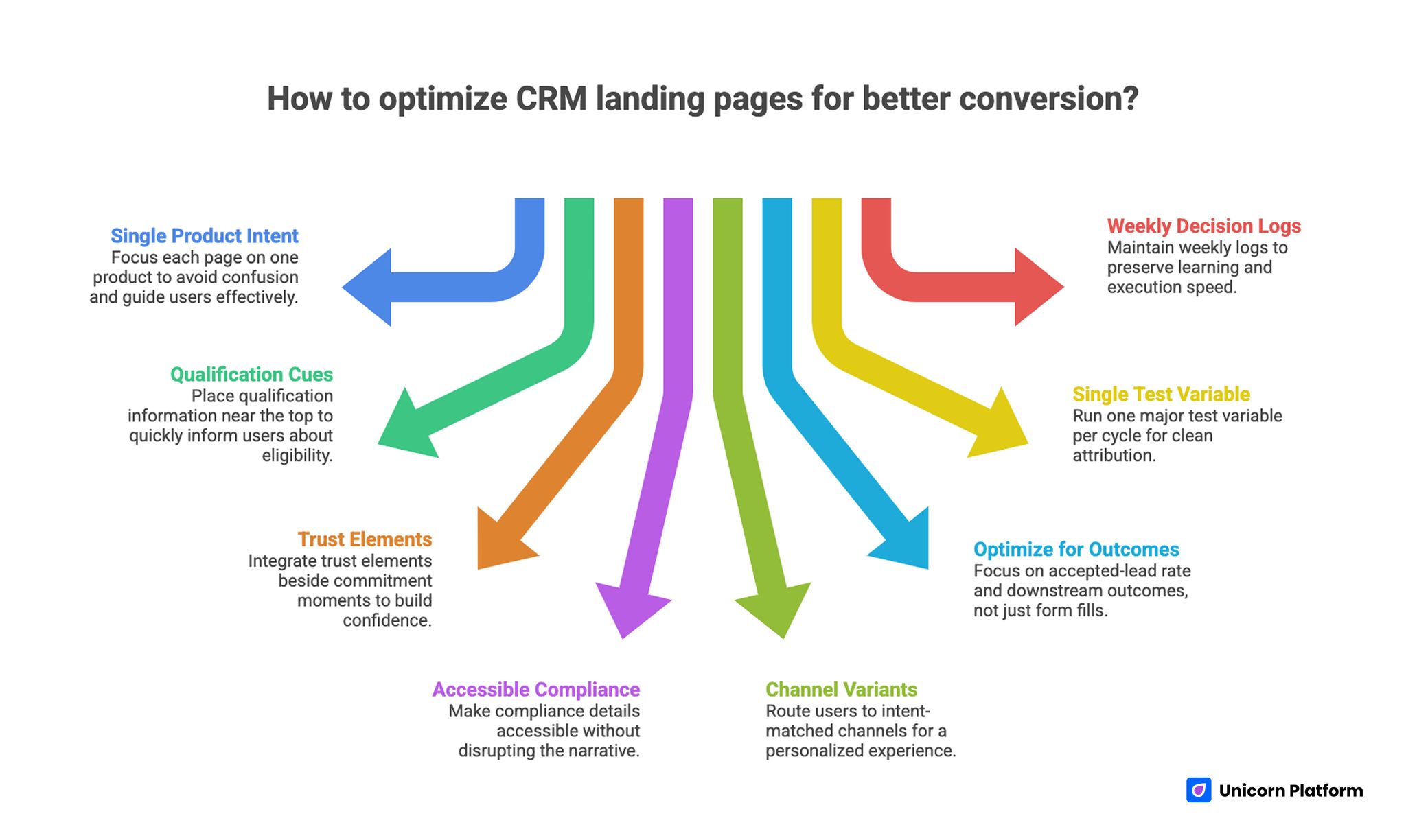
Quick Strategic Takeaways for Optimizing CRM Landing Pages
- Build each page for one product intent and one primary conversion action.
- Put qualification and process cues near the top of the page.
- Place trust elements beside commitment moments, not only in footer areas.
- Keep compliance detail accessible without breaking narrative flow.
- Route channels to intent-matched variants rather than one generic page.
- Optimize for accepted-lead rate and downstream outcomes, not just form fills.
- Run one major test variable per cycle for clean attribution.
- Maintain weekly decision logs to preserve learning and execution speed.
Why Financial Lead Pages Underperform
Underperforming pages usually fail in sequence rather than style. They open with broad positioning statements while prospects still need basic feasibility answers. In finance categories, unanswered feasibility questions create immediate drop-off.
Another common issue is mixed-offer clutter. A page tries to serve loans, cards, deposits, and business accounts at the same time. The result is ambiguous CTA flow and inconsistent intent matching.
A third issue is compliance treated as a final disclaimer block instead of part of the decision journey. Prospects evaluate risk continuously, so regulatory and policy reassurance must appear at relevant moments.
Strong performance comes from a simple rule. Every section should remove one specific hesitation and move users toward the next clear action.
Start With Intent and Qualification Mapping
Before selecting templates or components, define what the page should convert and who the ideal applicant is. Include qualification context such as profile fit, timeline expectation, and required documents.
Then define the anti-fit profile. This step improves conversion quality because it allows low-fit visitors to self-select early instead of submitting weak applications.
A practical mapping model uses three elements. State who this offer serves, what outcome they should expect, and what constraints apply before starting.
When teams need a broader multi-segment structure baseline, the workflow in this B2B landing page framework can help align page intent with funnel stages.
Clear mapping also simplifies internal alignment. Marketing, sales, and compliance teams can review one shared decision model instead of arguing over isolated copy edits.
Conversion Architecture for Financial CRM Funnels
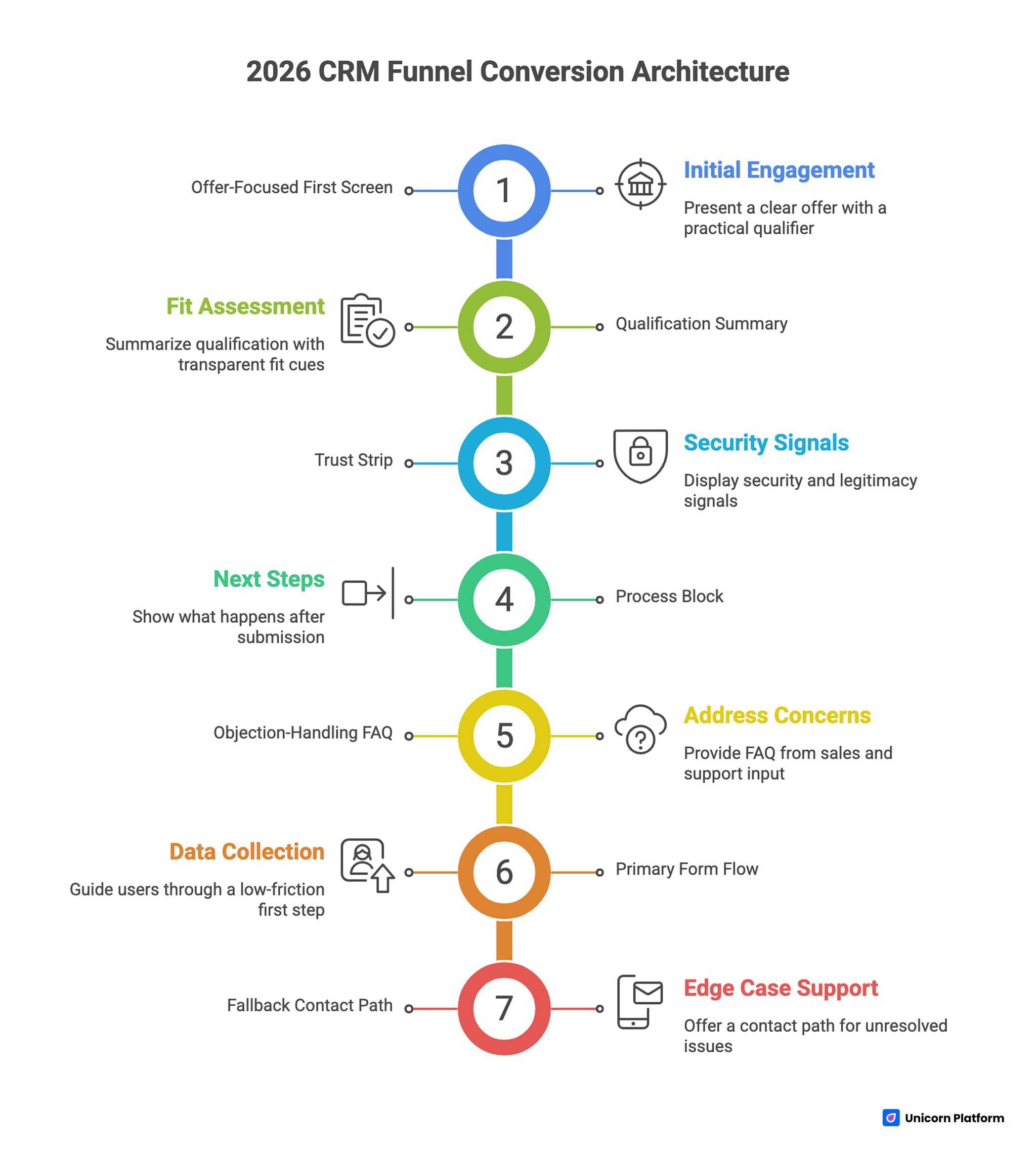
CRM Funnel Conversion Architecture
A strong 2026 architecture for CRM-integrated financial pages includes seven modules. This sequence is stable across products, while message details can vary by campaign.
- offer-focused first screen with practical qualifier
- qualification summary with transparent fit cues
- trust strip with security and legitimacy signals
- process block showing what happens after submission
- objection-handling FAQ from real sales and support input
- primary form flow with low-friction first step
- fallback contact path for unresolved edge cases
This order reflects prospect behavior in regulated categories. People validate fit and risk before sharing personal data.
In Unicorn Platform, teams can reuse this structure across campaigns and still customize by channel intent. Reusability increases speed without sacrificing clarity.
First-Screen Messaging for Risk-Sensitive Decisions
First-screen copy should answer four questions quickly. What is the offer, who is it for, how fast the initial result appears, and what the user should do now.
A useful first-screen formula combines offer plus qualifier plus action. Qualifiers should be practical, such as eligibility window, review timeline, or document scope.
CTA labels should match the prospect stage. High-intent channels benefit from direct next-step language, while exploratory traffic may convert better through a lighter first action.
Concrete language outperforms broad claims in finance. Specific statements reduce interpretation risk and improve confidence.
Trust Infrastructure That Improves Conversion Quality
Trust signals should sit near decision points, not only in static credibility sections. Prospects evaluate security, reliability, and legitimacy right before they share information. Trust and transparency are increasingly decisive factors in financial decision-making. According to global consumer research from PwC, customers consistently rank security, transparency, and clear communication among the most important criteria when choosing financial service providers. Landing pages that present these signals near commitment moments can significantly improve both confidence and lead quality.
A reliable trust stack contains three layers. The first layer is institutional trust such as licensing and security posture. The second layer is operational trust such as response standards and process transparency. The third layer is social proof with relevant outcomes.
Context quality is more important than quantity. A small set of recent, relevant trust signals near form sections often performs better than long generic testimonial blocks.
Trust components should be reviewed regularly. Outdated claims create friction and increase support burden.
For teams linking CRM capture directly to sales workflows, this Salesforce-focused landing page guide is useful for preserving handoff quality.
Compliance-Aware Narrative Design
Compliance constraints do not require low-clarity pages. They require layered communication that keeps main flow readable while making detailed disclosures easy to access.
A practical pattern is progressive disclosure. Keep primary claims concise and contextual, then provide expandable detail where users need policy specifics.
Place disclosure references where risk questions appear, not only at the bottom. When compliance detail is discoverable at decision moments, both trust and conversion quality improve.
In Unicorn Platform, teams can standardize disclosure modules and reuse them across product pages. Standardization reduces legal review overhead and improves publishing speed.
Form Strategy: Reduce Friction Without Lowering Fit
Many financial pages ask for too much information in the first step. Heavy initial forms lower completion while providing limited quality benefit.
Use staged data capture. Step one should collect commitment-critical information only. Secondary details can be captured after initial qualification.
Field labels should be explicit and error messaging should explain exactly how to recover. Ambiguous form errors are a frequent abandonment trigger on mobile.
For funnels that need top-of-funnel education before qualification, this lead generation landing page guide helps separate educational capture from application-intent capture.
Product-Specific Page Paths for Banking and Lending
Generic financial pages often attract broad but low-fit demand. Product-specific paths improve conversion quality by matching language and process detail to user intent.
Banking campaigns benefit from onboarding-time clarity, support availability, and account-type framing. Lending campaigns benefit from document expectations, approval-stage transparency, and timeline realism.
Segment pages should share a core structure but adapt proof and process modules by product type. This preserves brand consistency while increasing relevance.
Channel-specific variants are also useful. Paid search traffic usually needs faster qualification cues, while email traffic often needs shorter path-to-form execution.
Educational Layer for Founder and SMB Audiences
Financial conversion improves when pages provide useful education before demanding commitment. Founder and SMB audiences often need practical planning context before submitting a product inquiry.
An educational layer can include calculators, readiness checklists, and short operational frameworks. These assets improve trust and allow prospects to self-assess fit.
Route educational interactions to product pages through clear stage-based prompts. This keeps value delivery connected to commercial outcomes rather than creating isolated content traffic.
The goal is not longer sessions for their own sake. The goal is better-informed prospects entering the form flow with realistic expectations.
Mobile and Speed Standards for Financial Funnels
A large share of acquisition traffic begins on mobile devices. If first-screen clarity, form usability, or disclosure access is weak on small screens, qualified prospects drop early. Mobile access is now a primary gateway to financial services. Research published by the Federal Reserve highlights the growing reliance on smartphones for managing financial accounts and interacting with financial institutions. When landing pages fail to deliver clear mobile experiences, financial brands risk losing highly qualified prospects before they even begin the application process.
Set mandatory mobile checks before launch. Validate heading readability, CTA visibility, tap target spacing, field behavior, and disclosure accessibility on real devices.
Speed should be measured by action readiness, not only full visual load. Users should be able to start qualification without waiting for non-critical assets.
Performance regressions should trigger release holds. In high-cost acquisition channels, slow pages destroy campaign efficiency quickly.
Measurement Framework: Focus on Accepted-Lead Outcomes
A pure form-fill metric can mask serious funnel quality issues. Track progression from click to accepted lead to downstream conversion outcomes.
A practical model includes four stages. Stage one tracks engagement and CTA interactions. Stage two tracks form starts and completions. Stage three tracks accepted-lead rate. Stage four tracks sales progression and funded outcomes.
Each experiment should have one primary quality metric and one supporting diagnostic metric. This keeps attribution clear and decision-making defensible.
Weekly reporting should include hypothesis, change deployed, observed effect, and next action. Documentation prevents repeated mistakes and improves cross-team coordination.
30-Day Execution Plan
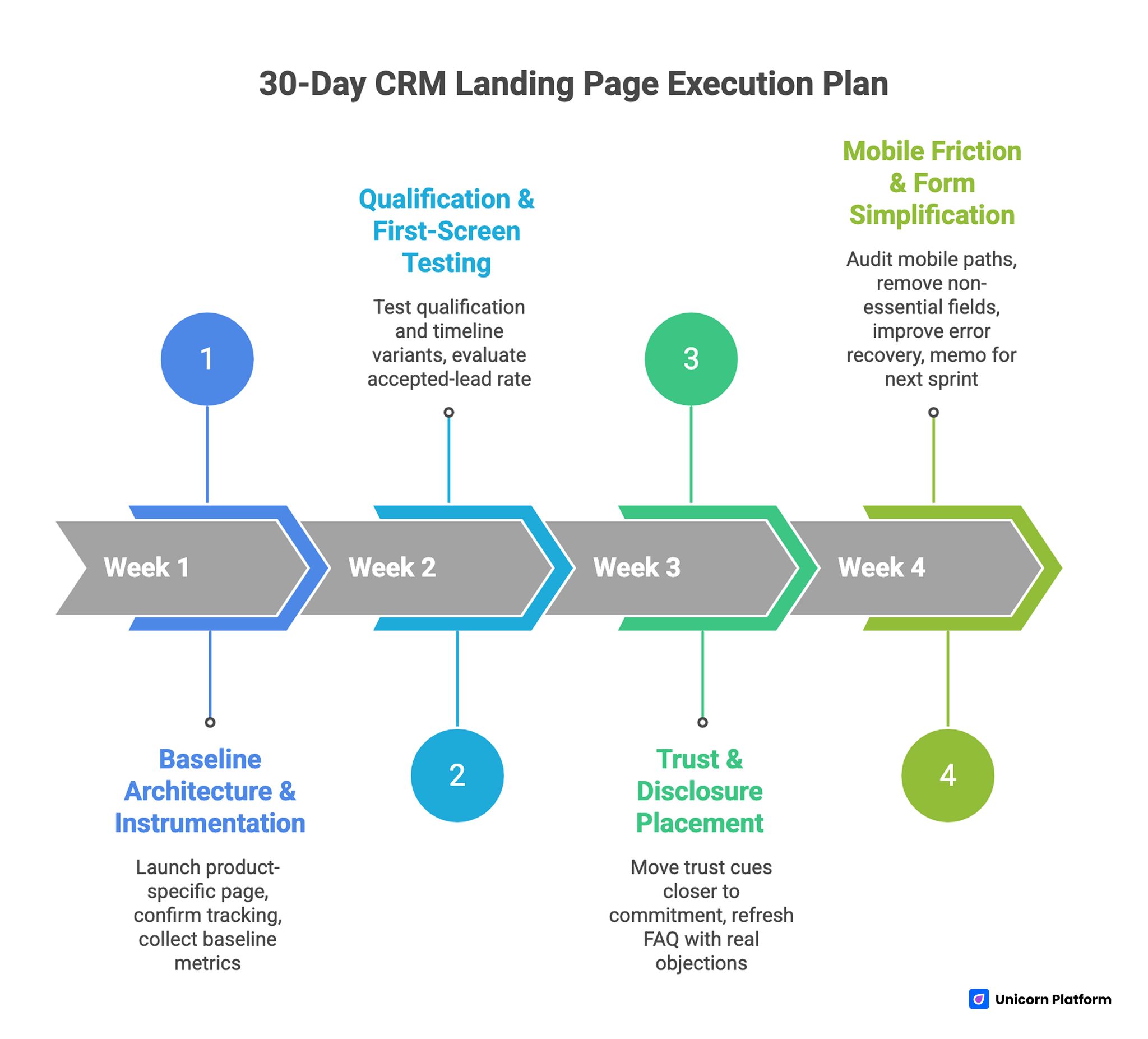
30-Day CRM Landing Page Execution Plan
Week 1: baseline architecture and instrumentation
Launch one product-specific page in Unicorn Platform using the seven-module structure. Confirm tracking for stage transitions from CTA click to accepted lead.
Collect baseline metrics for form completion, accepted-lead rate, and support objections. Baselines are required for reliable optimization.
Week 2: qualification and first-screen testing
Test one first-screen variant focused on qualification clarity and one focused on process timeline clarity. Keep other variables fixed for clean attribution.
Evaluate changes using accepted-lead rate, not clicks alone. Click gains without quality gains should not be scaled.
Week 3: trust and disclosure placement
Move trust and compliance cues closer to commitment points. Test whether contextual reassurance reduces abandonment in the form flow.
Refresh FAQ answers using real objections from support and sales calls. This keeps content aligned with current buyer concerns.
Week 4: mobile friction and form simplification
Audit critical paths on real devices and remove non-essential first-step fields. Improve recovery guidance for common input errors.
Close the month with a concise keep-change-next memo so the next cycle starts with clear priorities. This memo should include one explicit hypothesis for the following sprint.
90-Day Scaling Model
Scaling should follow stability. Expanding budget on unstable quality signals usually increases operational friction.
Days 1-30 stabilize structure and measurement discipline. Days 31-60 expand product and channel variants with controlled hypotheses. Days 61-90 consolidate winning modules into reusable templates and retire weak variants.
This model improves velocity while keeping compliance and conversion quality aligned. It also prevents teams from scaling weak variants too early.
For teams supporting enterprise and partner-driven acquisition, the same structure can be adapted without rebuilding from zero each cycle. That adaptability keeps operations stable while channel complexity grows.
Common Mistakes and Practical Fixes
Mistake 1: one page trying to cover every product line
Fix by assigning one primary product intent per page and routing adjacent intent through clearly marked alternatives. This improves user clarity and shortens qualification time.
Mistake 2: vague headline claims with no practical qualifiers
Fix by adding fit cues, timeline expectations, and process context to first-screen messaging. Prospects should understand feasibility before they evaluate supporting detail.
Mistake 3: trust blocks isolated away from commitment moments
Fix by placing trust and policy reassurance near forms and key CTA sections. Reassurance is most effective where users make commitment decisions.
Mistake 4: compliance detail only in dense footer sections
Fix by introducing progressive disclosure modules in relevant narrative sections. This keeps pages readable while still making legal detail immediately available.
Mistake 5: oversized first-step forms
Fix by capturing essential data first and staging secondary fields later in the flow. Lower first-step effort usually increases completion quality.
Mistake 6: optimization based only on top-funnel volume
Fix by prioritizing accepted-lead and downstream progression metrics in reporting. Quality-centric reporting reduces the risk of scaling low-fit demand.
Mistake 7: simultaneous high-volume testing
Fix by running one major variable per cycle with explicit hypotheses and documented outcomes. Controlled testing keeps attribution clean and decisions defensible.
Mistake 8: no standardized post-test learning loop
Fix by maintaining weekly decision logs and updating reusable modules based on measured performance. Repeated documentation creates compounding operational clarity.
Pre-Publish QA Checklist
Before release, run a short QA pass to confirm conversion clarity, compliance accessibility, and operational readiness. Keep the checklist visible in the publishing workflow so teams apply it consistently.
Checklist items: Apply these items as a release gate so quality checks stay consistent under campaign pressure. The list should be completed by both marketing and compliance owners before publication.
- first-screen offer and qualification cues are clear
- primary CTA aligns with the page objective
- trust and policy cues appear near commitment points
- process timeline is visible and easy to understand
- first-step form requests only essential data
- disclosure details are accessible without breaking flow
- mobile interaction and speed checks pass on real devices
- tracking events confirm stage-level funnel measurement
Teams that enforce this checklist usually reduce rework and improve accepted-lead consistency. The same routine also reduces compliance-review back-and-forth after launch.
FAQ: Build Financial Landing Pages
How many products should one financial landing page cover?
One primary product is usually best for clarity and conversion quality. Adjacent products can be linked as alternatives without sharing the main action path.
What matters more than total form fills?
Accepted-lead rate and downstream progression matter more because they reflect business value. Raw form volume can rise while sales efficiency declines.
Where should compliance content appear?
Compliance content should appear where related risk questions naturally arise. This keeps trust high without overwhelming every visitor with dense legal text.
Should we ask for full details in the first form step?
In most cases, no. Collect core qualification data first and request secondary details later to protect completion rate.
How often should trust content be refreshed?
Monthly review is a practical baseline for active campaigns. Refresh sooner when offers, policies, or product scope changes.
Do channel-specific variants really help?
Yes, because different traffic sources arrive with different context and urgency. Variant messaging improves fit when structure remains stable.
What is a sustainable testing cadence for lean teams?
One major variable per week is usually sustainable and produces cleaner attribution. Controlled cadence also makes stakeholder review simpler.
How can we reduce low-fit submissions quickly?
Move qualification cues and process requirements higher on the page. Early self-selection improves lead quality without heavy operational overhead.
Should educational content live on conversion pages?
Educational content should support conversion pages when it improves decision readiness. Keep it concise and route users back to clear action paths.
What keeps financial conversion performance improving over time?
Consistent structure, documented experiments, and cross-team alignment keep performance compounding. Without operational discipline, gains tend to decay between campaign cycles.
Final Takeaway
High-performing financial landing pages are systems for risk reduction and decision clarity, not just promotional surfaces. Clear qualification cues, contextual trust, process transparency, and disciplined testing are what transform clicks into accepted leads.
Unicorn Platform enables teams to apply this system quickly while preserving consistency across campaigns. When page architecture, compliance logic, and analytics discipline move together, lead quality improves predictably and sustainably.