Table of Contents
- The Conversion Spine Every Fast Page Needs
- Trust Architecture for Fast-Launch Teams
- 30-Day Improvement Plan
- FAQ
Speed matters in modern marketing operations. Campaign launches, product announcements, and testing cycles all depend on fast page publishing. The problem is that many fast pages are structurally weak, so teams get activity without reliable outcomes.
A page built in minutes can still perform well, but only if the team follows a stable operating model. Without one, design decisions become inconsistent, messaging gets diluted, and post-launch data becomes hard to interpret.
No-code tools remove production bottlenecks. They do not remove the need for editorial standards, conversion logic, and release governance. Teams that understand this distinction tend to outperform competitors that only optimize for publish speed.
Unicorn Platform is strong when used as a system, not a shortcut. The most consistent teams move quickly while preserving section structure, proof quality, and measurement discipline.
sbb-itb-bf47c9b
Quick Takeaways
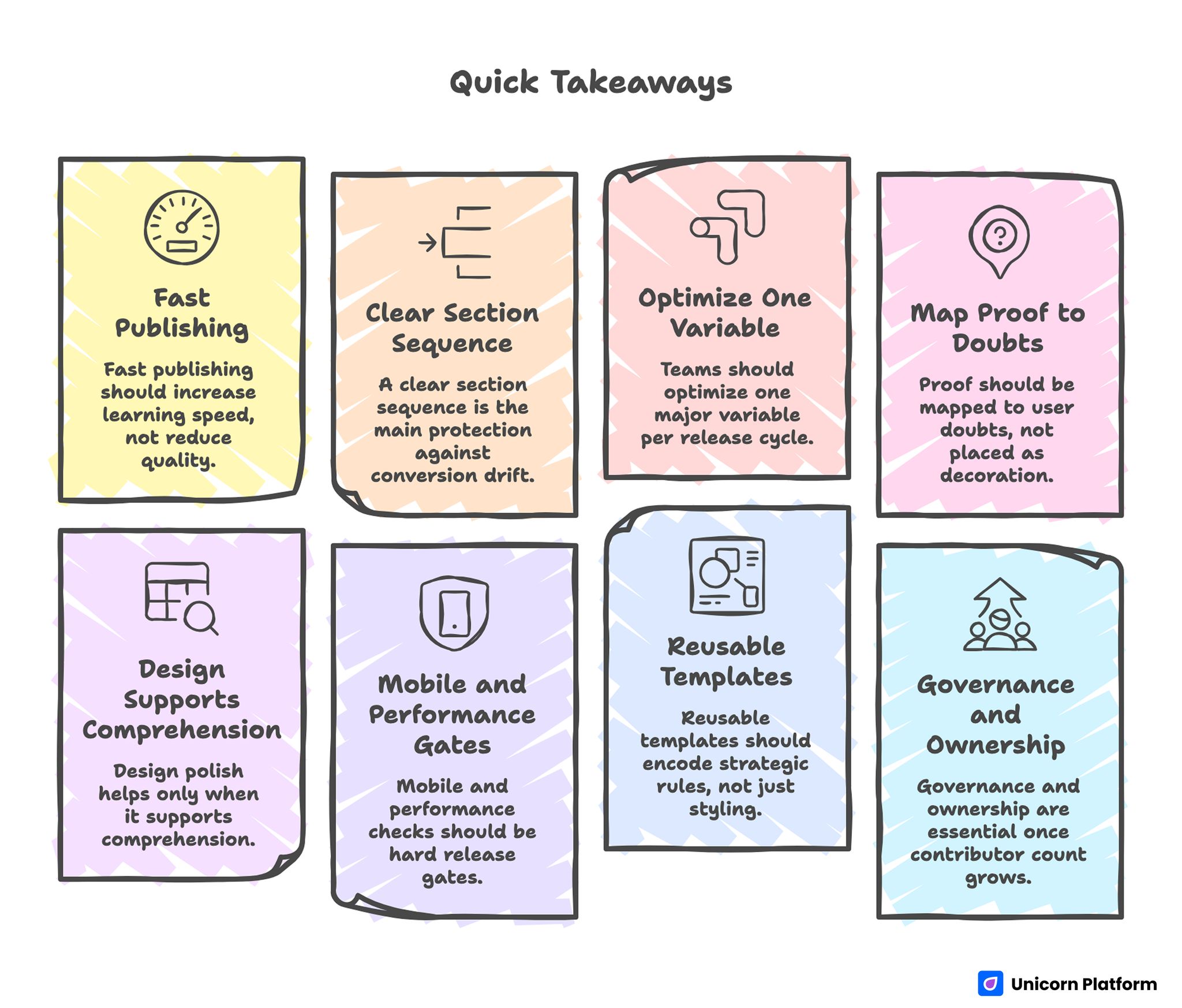
High-Performing Web Page Quick Takeaways for Conversion-Focused Design and Optimization Strategy
- Fast publishing should increase learning speed, not reduce quality.
- A clear section sequence is the main protection against conversion drift.
- Teams should optimize one major variable per release cycle.
- Proof should be mapped to user doubts, not placed as decoration.
- Design polish helps only when it supports comprehension.
- Mobile and performance checks should be hard release gates.
- Reusable templates should encode strategic rules, not just styling.
- Governance and ownership are essential once contributor count grows.
Why Rapid Page Production Usually Fails
Fast page workflows fail for predictable reasons. The first is vague first-screen communication. If users cannot quickly understand relevance and expected outcome, they leave before the page has a chance to persuade.
The second is CTA mismatch. Teams often use high-friction actions too early or soft actions too late. Both reduce conversion quality by creating misaligned intent.
The third is trust misplacement. Proof blocks are frequently grouped in one area at the bottom, while key claims above the fold remain unsupported. Users then carry unresolved doubts into action moments.
The fourth is weak review discipline. Multiple edits are shipped without a clear hypothesis, so outcome changes cannot be attributed to specific improvements.
A Better Mindset for Fast Web Page Creation
A useful mental model is to treat each page as a decision system. Users do not arrive to admire layout choices. They arrive to solve a problem, evaluate risk, and choose a next step.
When teams anchor their workflow in this model, speed becomes an advantage rather than a liability. Edits are judged by how well they improve decision clarity, not by visual novelty.
Start by defining the page objective in one sentence. Keep that sentence visible during copy, design, and QA reviews. This one habit reduces random edits more than most advanced optimization tactics.
If your team needs a practical baseline for getting an initial draft live with less friction, create your web presence with simple drag-and-drop is a useful reference. It helps teams move from rough concept to publishable structure without adding process overhead.
The Conversion Spine Every Fast Page Needs
High-velocity teams need one stable page sequence. Structure consistency makes edits safer and test results clearer.
1. Relevance
The page should quickly identify who it is for and what outcome it offers. Specificity beats broad messaging because it helps users self-qualify.
2. Mechanism
Explain how the offer works in clear operational language. Focus on the path from user intent to result, not on feature inventory.
3. Confidence
Support major claims with nearby evidence. Use relevant testimonials, concrete examples, and practical expectation setting.
4. Action
Guide visitors to one dominant next step with explicit outcome language. Secondary paths can exist, but they should not compete equally with the primary CTA.
This structure supports both speed and control. If your team is refining section order across multiple templates, a step-by-step guide to a high-converting landing page structure provides a deeper framework.
The 7-Stage Fast Build System
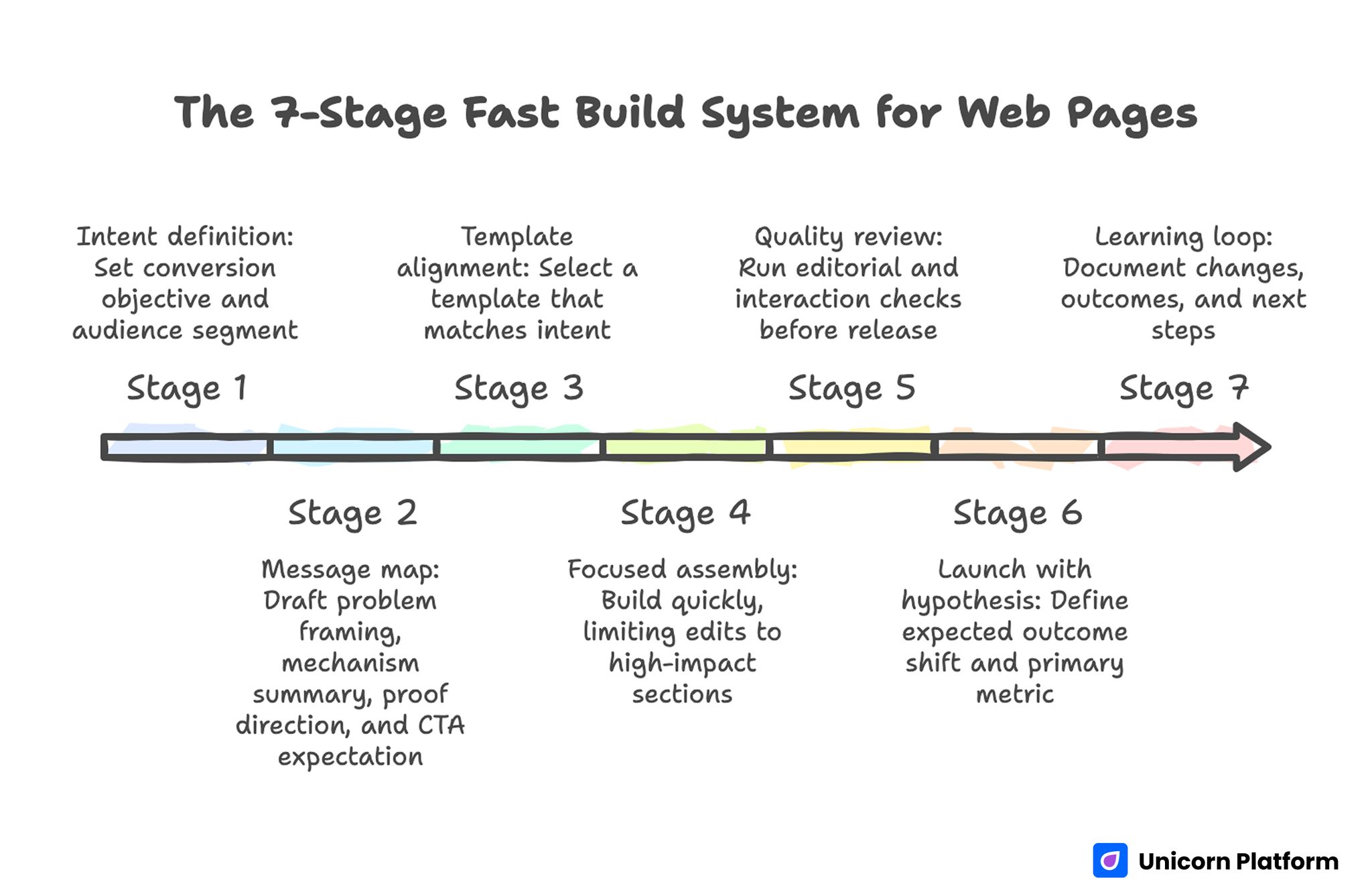
The 7-Stage Fast Build System for Web Pages
A rapid workflow works best when each stage has a clear deliverable. The seven-stage model below is designed for teams with frequent launch cycles.
Stage 1: Intent definition
Set one conversion objective and one audience segment. Avoid multi-intent pages unless there is strong evidence they improve outcomes.
Stage 2: Message map
Draft a short map with problem framing, mechanism summary, proof direction, and CTA expectation. This keeps the page strategically coherent during production.
Stage 3: Template alignment
Select a template that matches intent. Do not force one layout across unrelated objectives.
Stage 4: Focused assembly
Build quickly, but limit edits to high-impact sections first: hero, mechanism block, proof placement, and CTA path. This preserves speed while keeping the page decision flow intact.
Stage 5: Quality review
Run editorial and interaction checks before release. This includes clarity, trust, mobile behavior, and form flow.
Stage 6: Launch with hypothesis
Define one expected outcome shift and one primary metric before publishing. Clear expectations make post-launch interpretation significantly easier.
Stage 7: Learning loop
Document what changed, what happened, and what to test next. Keep this record lightweight and consistent.
Teams that follow this system usually ship faster over time because rework and confusion decline. It also helps new contributors align with existing standards faster.
Designing Fast Pages That Still Feel Premium
High-speed workflows often produce pages that feel generic. This is usually a system problem, not a design talent problem.
Start with a compact visual standard for each page family. Define spacing rhythm, heading scale, color usage, and button hierarchy. Consistency in these basics creates a stronger impression than random stylistic experiments.
Typography should support scan speed. Overly decorative styling can look impressive but reduce comprehension, especially on mobile devices.
Visual hierarchy should mirror decision hierarchy. The most important claim should receive the clearest emphasis, followed by mechanism and proof. Decorative elements should never compete with action pathways.
Motion can help guide attention, but it should be restrained. Use transitions to support flow, not to signal novelty.
Trust Architecture for Fast-Launch Teams
Trust needs to be engineered intentionally in quick production environments. Without a system, teams either underuse proof or overuse generic proof.
A practical trust model maps each major claim to one nearby confidence cue:
- claim about speed -> process clarity or timeline proof
- claim about outcomes -> context-rich examples
- claim about reliability -> support expectations and boundaries
Freshness matters as much as placement. Outdated testimonials, legacy screenshots, and vague success claims reduce credibility quickly.
A monthly proof audit is usually enough for active pages. For high-volume campaign teams, biweekly checks can be justified.
CTA and Form Strategy That Preserves Lead Quality
Fast page teams often optimize for click rate and submission volume. Those numbers are useful, but they can hide qualification problems.
Research from Baymard Institute shows that form usability and unnecessary input friction are among the most common causes of abandonment, especially when fields do not clearly support user intent or downstream processing.
CTA language should describe the real next step. Ambiguous labels produce low-fit actions and slower follow-up cycles.
Forms should use staged friction. Keep the first step light, but collect the minimum routing context needed for quality handoff.
Before adding or keeping any field, ask one question: does this change what happens next operationally? If not, remove it.
Form success should be evaluated by qualified progression, not completion rate alone. Higher volume is only useful when downstream fit remains healthy.
When teams are looking for practical experimentation ideas around action design, 10 actionable tips to supercharge your landing page can help prioritize test candidates. The main value is narrowing focus to changes with measurable impact.
Mobile and Performance Gates for Rapid Releases
Most fast pages are reviewed heavily on desktop and lightly on mobile. That is a costly mistake because mobile users often represent first-touch traffic.
Use a strict release gate with five checks:
- first-screen value clarity on common phone widths
- visible trust cue before deep scrolling
- tap target comfort for key interactions
- keyboard-safe form behavior
- stable rendering and load behavior on typical networks
These checks should be pass/fail. If one fails, release should pause until corrected.
Performance reviews should focus on decision moments. Delays near CTA and form interactions are usually more damaging than minor delays in low-priority sections.
If your team needs concrete small-screen implementation patterns, creating a high-converting mobile app landing page is a useful execution reference. Apply those patterns where they fit your own audience behavior and offer type.
Measurement Model for Fast Page Programs
Publishing speed creates data volume, but not always useful insight. Teams need a layered model to connect edits with business outcomes.
Use four measurement layers:
- clarity layer: engagement with first-screen and mechanism blocks
- interaction layer: progression through trust and action areas
- conversion layer: qualified submissions or bookings
- business layer: pipeline movement, revenue contribution, retention indicators
Each release should include one primary metric and one guardrail metric. Guardrails reduce false positives such as higher submissions with lower qualification.
Weekly review cadence is usually enough for active campaigns. Monthly strategic reviews can identify cross-page patterns and governance gaps.
Governance Rules That Keep Speed Sustainable
As teams grow, no-code page quality tends to decline unless ownership is explicit. Role clarity is the fastest way to prevent drift.
A practical ownership map includes:
- structure owner for narrative sequence integrity
- trust owner for proof quality and claim accuracy
- analytics owner for tracking hygiene and interpretation
- release owner for final QA and publish approval
One person can hold multiple roles in smaller teams. The important part is clear accountability.
Lightweight release notes should accompany major edits. Capture change intent, expected effect, observed effect, and next action.
For teams formalizing production handoffs and review stages, landing page development made simple can support standardization. It is especially useful for reducing variation across multiple editors.
30-Day Improvement Plan
Week 1: Stabilize structure
Audit top pages for relevance clarity, mechanism quality, proof placement, and CTA path clarity. Lock one control template for the highest-impact page family.
Week 2: Improve trust and action
Refresh outdated proof, tighten CTA wording, and simplify forms where routing quality is weak. Run mobile gate checks before each release.
Week 3: Run focused tests
Launch one major-variable test per page family. Track both conversion and qualification metrics to avoid vanity optimizations.
Week 4: Systematize winners
Retire weak patterns, expand validated components, and publish an updated internal standards note. This step protects gains from being lost in later cycles.
This one-month cycle should improve both performance and team confidence in interpretation. Teams also gain a clearer basis for prioritizing future experiments.
90-Day Operating Model
Month 1: Consistency first
Create stable structure, predictable trust standards, and reliable release checks. Avoid adding new complexity before these foundations are stable.
Month 2: Optimization depth
Test message clarity, mechanism framing, and CTA specificity with controlled variables. Keep each test focused so results remain actionable.
Month 3: Scaled execution
Roll out proven modules to related pages and formalize governance so new contributors can ship without lowering quality. This is where operational scale starts to feel predictable.
By day 90, success should appear as repeatable qualified outcomes, not isolated performance spikes. Consistency is a better indicator than occasional peaks.
Common Failure Patterns and Fixes
Pattern 1: Fast output, mixed conversion results
Cause is typically structural inconsistency across pages. Standardize section sequence and restrict major structural edits to approved templates.
Pattern 2: High clicks, weak lead quality
Cause is usually vague CTA expectations and underqualified forms. Clarify next-step language and add one routing-critical field.
Pattern 3: Strong desktop metrics, weak mobile results
Cause is compressed hierarchy and interaction friction on smaller screens. Prioritize first-screen readability and tap ergonomics.
Pattern 4: Frequent edits, limited learning
Cause is multi-variable changes with no clear hypothesis. Reduce test scope and maintain concise release notes.
Pattern 5: Team growth, quality drift
Cause is unclear ownership. Assign explicit decision rights for structure, proof, analytics, and release approval.
FAQ: How to Build a High-Performing Web Page Quickly
1. Can a page built quickly still convert at a high level?
Yes, if the team follows a clear structure, maps proof to user doubts, and enforces release quality gates. The process matters more than individual launch speed.
2. What should we optimize first on an underperforming fast page?
Start with first-screen relevance and CTA clarity. These usually influence both conversion volume and lead quality.
3. How many templates should a fast-moving team maintain?
Maintain only the set needed for distinct intent categories. Too many templates increase maintenance load and reduce consistency.
4. Should every campaign get a unique page design?
Not necessarily. Reuse strong structural modules and customize only where message fit or audience context requires change.
5. How often should proof blocks be updated?
Monthly is a practical default. Update sooner when offers, positioning, or customer outcomes change.
6. What is the biggest mobile mistake in rapid launches?
Assuming desktop clarity will hold on smaller screens. Mobile-specific review must happen before launch.
7. How do we avoid over-testing and confusion?
Limit each cycle to one major variable and keep measurement focused on one primary metric plus one guardrail. This protects learning quality as release volume increases.
8. Are long pages always better for competitive search visibility?
Not always. Depth helps when it improves intent coverage and decision support. Length without clarity can hurt outcomes.
9. What should we do when conversion goes up but lead quality drops?
Review CTA expectations, form routing questions, and proof relevance. Conversion gains are only useful when quality remains healthy.
10. How do we keep quality stable as more contributors join?
Use explicit ownership, template rules, and release gates. Process discipline scales better than style-only guidelines.
Final Takeaway
Fast web page publishing is valuable only when it improves validated learning and business outcomes. The strongest no-code teams pair speed with structure, trust discipline, and measurable optimization loops.
With Unicorn Platform, teams can launch quickly and still maintain a high editorial and conversion standard. That combination is what turns rapid publishing into a durable growth capability.
