Table of Contents
- Build an Information Architecture That Matches User Decisions
- Common Failure Modes and Practical Fixes
- 30-Day Launch and Stabilization Plan
- FAQ
Launching a token collection is not only a technical event. It is a decision experience for people who may be new to wallets, fees, and on-chain actions. If the site is unclear, users hesitate, make mistakes, or abandon the process before mint completion.
Most underperforming launches fail long before traffic runs out. They fail because the page sequence does not answer practical user questions in the right order. Visitors need to understand what they are buying, how minting works, what risks exist, and what happens after purchase.
A strong Web3 site should reduce uncertainty at every step. That requires precise content architecture, responsible pricing communication, visible security guidance, and a post-mint operations plan that is already documented before launch day.
sbb-itb-bf47c9b
Quick Summary
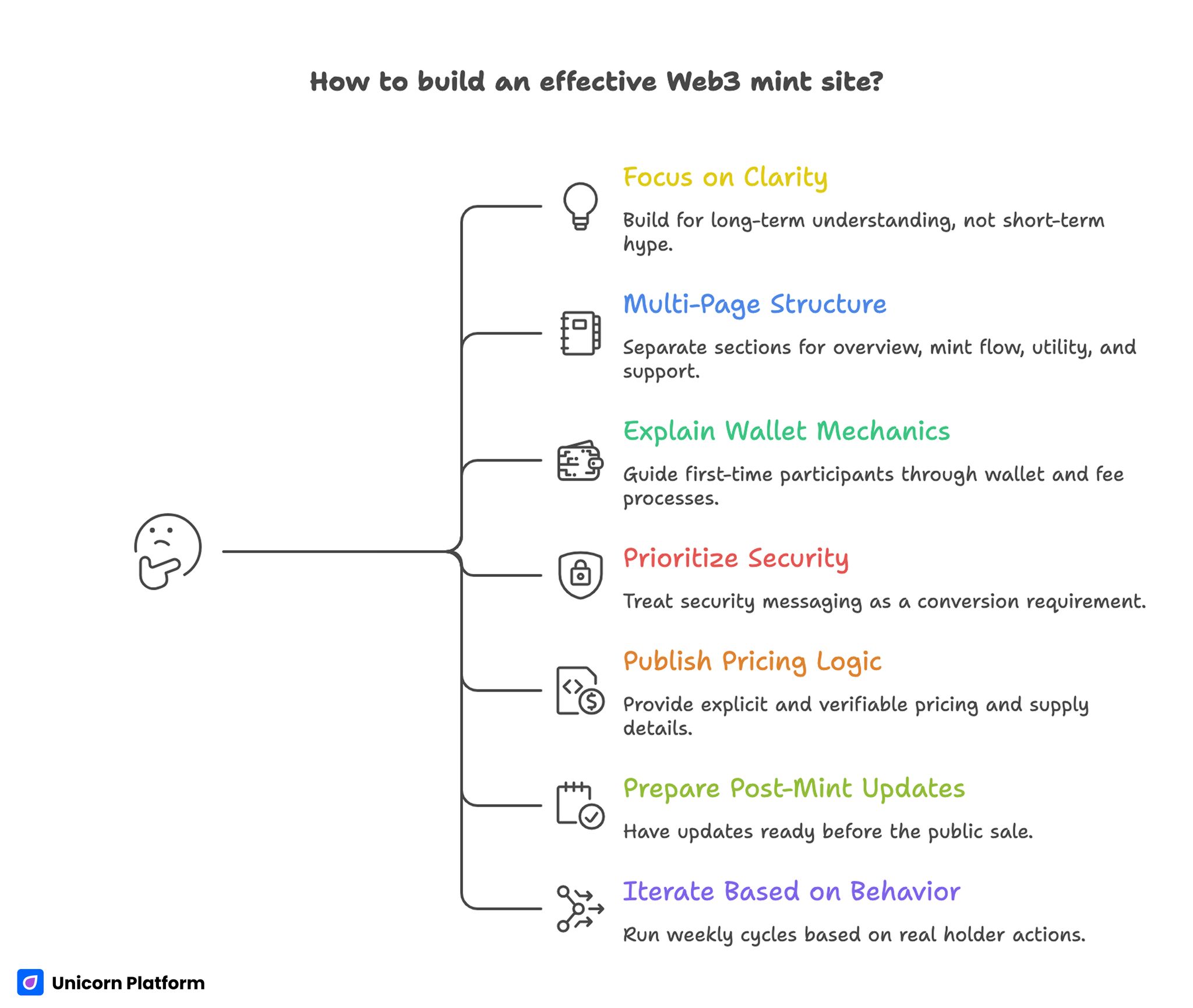
Quick Summary for Building An Effective Web3 Mint Site
- Build for decision clarity, not short-term hype.
- Use a multi-page structure that separates overview, mint flow, utility, and support.
- Explain wallet and fee mechanics for first-time participants.
- Treat security messaging as a conversion requirement, not a footer disclaimer.
- Publish pricing and supply logic in explicit, verifiable terms.
- Prepare post-mint updates before the public sale begins.
- Run weekly iteration cycles based on real holder behavior.
Start With Page Jobs, Not Visual Style
Every high-impact page needs one primary job. A launch overview page should frame value and audience fit. A mint process page should remove execution ambiguity. A roadmap page should reduce uncertainty about delivery expectations.
Problems begin when teams merge these jobs into one dense page with unclear section boundaries. Readers then scroll through mixed messages, see promises without implementation detail, and leave with unresolved concerns. Clarity drops even when design looks polished.
Define page jobs in one sentence each before writing copy. This decision helps your team cut low-value sections early and keeps every block accountable to a specific user outcome.
Build an Information Architecture That Matches User Decisions
Visitors evaluate risk in sequence. First they ask if the project is relevant. Then they evaluate credibility, execution mechanics, and downside exposure. A good architecture follows this path rather than internal org charts.
A practical structure for launch windows usually includes the blocks below. Each block should answer one decision question and prepare the user for the next action:
- Project overview and value proposition.
- Mint process with step-by-step actions.
- Supply, pricing, and phase rules.
- Utility and holder access model.
- Team transparency and delivery evidence.
- Security center and official-link policy.
- FAQ and support channels.
- Live updates area for launch-day status.
This structure can be adapted by project type, but the decision order should stay coherent. If pricing appears before users understand value or mechanics, conversion quality usually declines.
Educate New Participants Before Asking for On-Chain Actions
A large share of traffic in public launches includes first-time participants. They may understand digital collectibles at a high level but still struggle with practical steps such as wallet setup, network selection, gas estimation, and transaction confirmation.
Education should be concise and operational. Define terms in plain language, show what users will click, and explain common failure points before they occur. This reduces panic transactions and lowers support pressure during peak demand.
When you need a reference model for beginner-oriented onboarding, this article on introducing mint mechanics clearly is a useful baseline for turning technical concepts into user-ready instructions. It helps teams keep explanations practical without losing essential technical accuracy.
Short educational sections work best when they are embedded near action steps rather than isolated in a separate knowledge area. Users retain information better when guidance appears exactly where a decision is made.
Make the Mint Flow Explicit and Verifiable
A mint flow should read like an operations checklist, not marketing copy. Users need exact timing rules, eligibility criteria, wallet constraints, and transaction expectations. Ambiguity at this stage causes costly errors.
A robust flow section includes the details below. Missing any one of these can produce avoidable drop-off during high-traffic windows:
- supported wallets and unsupported wallets.
- chain/network requirements.
- allowlist and public phase differences.
- per-wallet mint limits.
- fee expectations and variance warning.
- confirmation behavior after submit.
- fallback actions for pending or failed transactions.
For practical walkthrough patterns, this guide on step-by-step mint execution is valuable for structuring actions in a way that helps both advanced and first-time users. Use it to align pre-mint preparation, in-wallet actions, and post-submit confirmation behavior.
Keep timestamps in one canonical timezone and provide local conversion guidance when possible. Time confusion is one of the most common causes of missed participation and unnecessary support tickets.
Communicate Pricing and Supply Logic Without Overpromising
Pricing communication often collapses trust faster than any other section. Users can tolerate uncertainty in market outcomes, but they do not tolerate hidden rules, unclear phase transitions, or inconsistent numbers across pages.
Publish all supply and price rules in one clear table that is easy to verify. Include total supply, phase-by-phase allocation, per-wallet caps, and pricing changes by phase. If any variable can change, describe the change conditions before launch.
Context around valuation should stay grounded. If you discuss market behavior, frame it as scenario analysis rather than expectation setting. This resource on price dynamics in collectible markets can help structure balanced context while avoiding speculative messaging.
The goal is to help users make informed decisions, not to maximize emotional urgency. Long-term trust is built when messaging remains stable under market volatility.
Security Messaging Is Part of Conversion Design
In Web3 environments, trust and security are inseparable. Many users have experienced phishing attempts, fake links, or impersonation scams. If your site does not provide strong safety guidance, users may assume higher risk even when your contract is legitimate.
Security sections should include the controls below. These safeguards should be visible in multiple high-intent areas:
- one official mint URL shown in multiple high-visibility locations
- a strict policy on direct messages and support impersonation
- wallet safety reminders before any transaction prompt
- a clear incident communication protocol
- a channel list for verified announcements
Security copy must be actionable, not generic. “Stay safe” is weak guidance. “Never mint from links sent in DMs; use only the URL shown in the official status banner” is operational guidance.
Build a Transaction UX That Reduces Mistakes
Transaction UX is often treated as a wallet problem, but your page structure strongly influences execution quality. Users need confirmation context before they sign and clear status feedback after submission.
Place confirmation guidance adjacent to the action button. Explain what appears in the wallet prompt, what fee variance is normal, and how long pending states may last under load. This prevents unnecessary retries and duplicate transactions.
A concise technical explainer can sit below the main CTA for users who want deeper detail. If you need additional structure for this layer, the mint operation reference provides useful patterns for handling action flow and post-click guidance.
After submission, show explicit next-step messages. Users should know whether they need to wait, refresh, or check a transaction link. Ambiguity after click is a major trust loss point.
Plan Post-Mint Operations Before Launch Day
Launch day is the beginning of reputation, not the finish line. Holders evaluate projects by consistency of delivery, communication quality, and issue resolution speed after initial sale.
A strong post-mint plan includes three visible elements. Publishing them before launch reduces confusion when real-time questions spike:
- an update cadence with named ownership.
- milestone tracking with status transparency.
- support pathways with response expectations.
When these are published early, community sentiment tends to remain more stable during inevitable delays or scope adjustments. Silence after mint creates uncertainty even when product work continues in the background.
Maintain an updates page as a living operational log. Structured updates are more credible than scattered social posts and reduce repeated questions from new holders.
Mobile Execution Quality Is Non-Negotiable
Many participants discover projects on mobile first, then decide whether to continue to wallet actions on the same device or later on desktop. If mobile clarity is poor, intent decays before conversion happens.
Run hard mobile release gates to keep action clarity intact on smaller screens. These checks should be mandatory for every launch revision:
- first viewport clearly states value and phase status.
- key rules are readable without dense paragraph blocks.
- action controls are tap-friendly under real-device conditions.
- warning and security messages remain visible before mint actions.
- support links and FAQ navigation are easy to access quickly.
Do not rely on desktop previews for launch readiness. Real devices expose spacing, interaction, and readability issues that simulations often miss.
Analytics and Decision Rhythm After Launch
Without a clear analytics model, teams misread launch outcomes. High page traffic can hide weak completion quality. Raw mint totals can hide poor holder retention signals.
Track a balanced set of metrics after each release. Reviewing them together gives better guidance than isolated vanity numbers:
- action-to-transaction completion rate
- failure and retry frequency by step
- FAQ and support-click concentration areas
- post-mint return visits to updates page
- downstream community participation signals
Use weekly reviews to convert metrics into concrete edits. If users repeatedly drop at one step, rewrite that section and improve guidance before changing unrelated elements.
Common Failure Modes and Practical Fixes
Failure: Hype-first hero, unclear utility
Symptoms include strong click-through from social channels with weak qualified participation. Users are curious but unsure what ownership provides.
Fix by rewriting the first screen around concrete holder outcomes and execution boundaries. Keep emotional tone secondary to operational clarity.
Failure: Process details hidden below long narrative sections
Symptoms include support spikes on launch day for basic questions about wallets, timing, and eligibility. Fix by moving process-critical instructions closer to primary actions and condensing non-essential narrative blocks.
Failure: Inconsistent rules across page sections
Symptoms include conflicting interpretations of price, supply, or phase timing. Fix by centralizing rules in one canonical table and referencing that table from all related sections.
Failure: Security guidance is generic
Symptoms include frequent questions about fake links, impersonation, or verification checks. Fix by replacing broad warnings with explicit do/don't instructions and official-channel references.
Failure: No post-mint transparency cadence
Symptoms include community uncertainty, repetitive support requests, and trust degradation after launch. Fix by publishing a scheduled update framework with owner names, delivery checkpoints, and incident communication rules.
30-Day Launch and Stabilization Plan
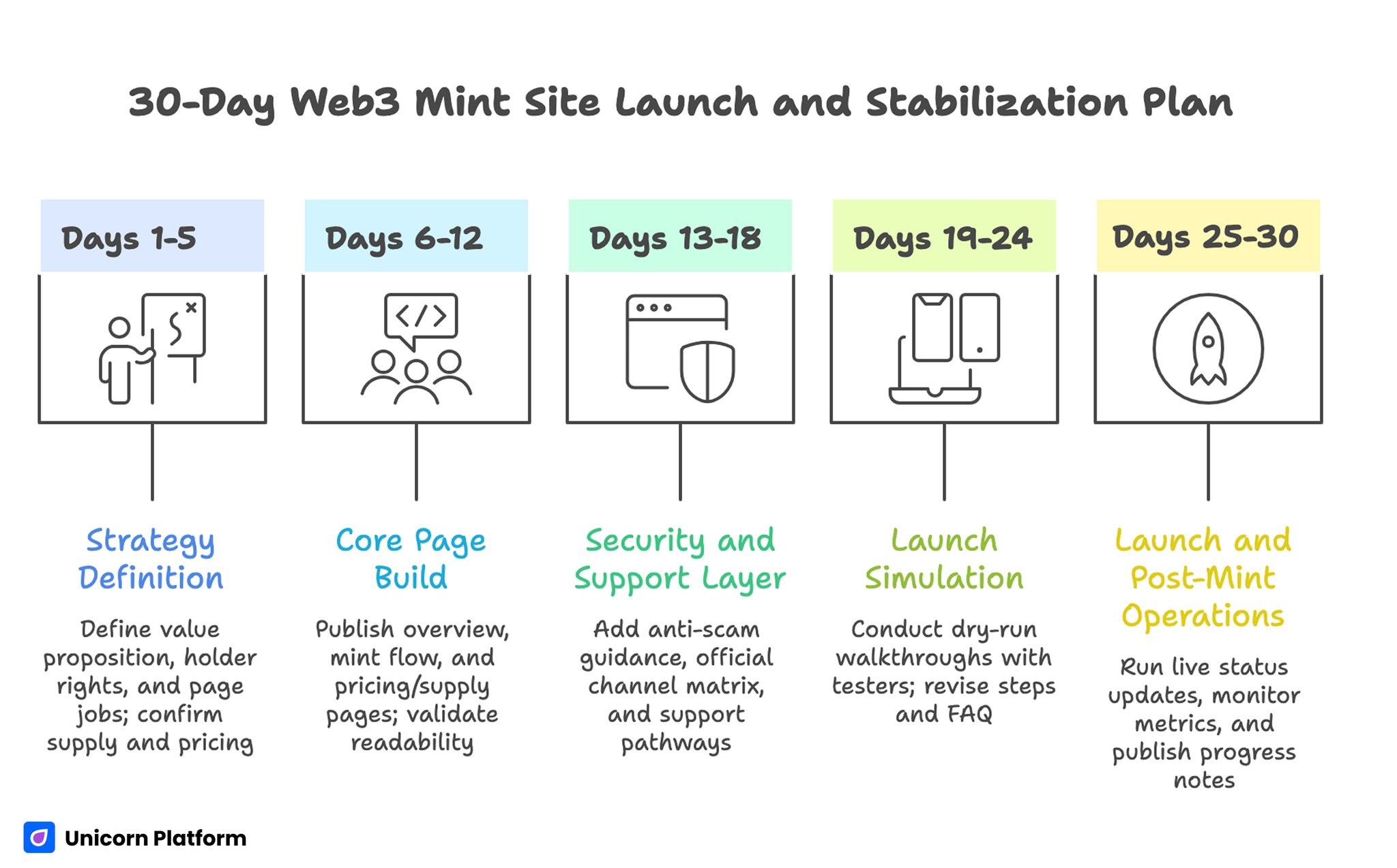
30-Day Web3 Mint Site Launch and Stabilization Plan
Days 1-5: Strategy definition
Define project value proposition, holder rights boundaries, and primary page jobs. Confirm supply and pricing policies with technical and legal stakeholders before copy production.
Days 6-12: Core page build
Publish overview, mint flow, and pricing/supply pages with consistent rule language. Validate readability and section hierarchy across desktop and mobile.
Days 13-18: Security and support layer
Add anti-scam guidance, official channel matrix, and support pathways. Run real-device checks for warning visibility and action flow clarity.
Days 19-24: Launch simulation
Conduct dry-run walkthroughs with internal and external testers. Capture confusion points and revise steps, labels, and FAQ entries before public mint.
Days 25-30: Launch and post-mint operations
Run live status updates, monitor flow metrics, and publish first post-mint progress notes. Document incidents and improvements for the next release cycle.
Governance Model for Small Teams
Smaller teams can execute reliably with clear role ownership even without large headcount. The key is explicit accountability for messaging, operations, and QA.
A practical ownership split keeps responsibility visible during fast launch cycles. Teams can adapt titles, but ownership boundaries should stay explicit:
- Content owner: clarity of value, rules, and FAQ language.
- Operations owner: launch windows, status updates, and incident notes.
- QA owner: mobile checks, link integrity, and analytics verification.
Keep one short release checklist and one change log for all updates. Reuse the same process each week so improvements compound and new contributors onboard faster.
FAQ: Web3 Mint Site Strategy in 2026
What is the most important section for first-time visitors?
The first-screen block and the mint process summary are usually the highest-impact sections. Visitors need fast relevance and clear next-step confidence before deeper reading.
Should launch sites use one page or multiple pages?
Multi-page structures generally perform better for complex launches because they separate decision contexts cleanly. One-page setups can work for small drops but often become overloaded.
How detailed should mint instructions be?
Instructions should be detailed enough to prevent common execution mistakes without overwhelming advanced users. Layer detail with collapsible FAQs or optional deep-dive links.
How do we handle price discussion responsibly?
Focus on verifiable supply and phase mechanics, then provide balanced market context. Avoid framing short-term price behavior as expected outcome.
Where should security warnings appear?
Place security guidance near all high-intent actions, not only in a footer. Users make safer choices when warnings are close to the transaction step.
What if the network is congested during launch?
Prepare a visible contingency section with pending-transaction guidance, retry boundaries, and official status channel links. Clear communication reduces panic behavior.
How often should post-mint updates be published?
Use a predictable cadence that matches delivery reality. Consistency matters more than frequency because holders evaluate reliability over time.
Which metric is most useful right after launch?
Action-to-completion rate by step is usually the fastest indicator of flow quality. It shows where users drop before conversion is finalized.
Can small teams run this model without full-time developers?
Yes. Small teams can run this process with no-code workflows if governance, QA, and operational ownership are clearly defined.
What creates long-term trust after mint day?
Transparent delivery communication, stable rule enforcement, and timely incident response are the strongest long-term trust drivers. These factors usually matter more than short-term secondary market excitement.
Final Takeaway
A strong Web3 launch site is an operational product, not a one-time promotion page. Clarity, verifiable rules, security visibility, and post-mint execution discipline are what sustain trust and performance.
Teams using Unicorn Platform can move quickly while keeping standards high by structuring page jobs clearly, validating mobile and transaction flows before release, and maintaining a visible delivery cadence after mint completion. That combination supports both immediate launch execution and durable holder confidence.