Table of Contents
- What "Free NFT" Usually Means
- Best Legit Ways to Get Free NFTs
- Scam Warning Signs You Should Not Ignore
- Common Mistakes People Make
- FAQ
You can still get free NFTs, but the best opportunities usually come through airdrops, community giveaways, allowlists, and free mints, not random promises on social media.
That distinction matters because "free" in Web3 is often misleading. Some NFTs are free to claim but still require network fees. Some giveaways are real but highly competitive. Some airdrops are rewards for earlier activity, not open invitations. And some offers that sound free are simply scams trying to get wallet approvals or seed phrases.
This guide is built to answer the practical question fast: where do free NFTs actually come from, what do you need to claim them, and how do you avoid wasting time or risking your wallet in the process.
sbb-itb-bf47c9b
Quick Answer
The most common legit ways to get free NFTs are:
- airdrops for early users or community members
- project giveaways run through official channels
- allowlists that include free or discounted mint access
- free mints where the NFT costs nothing but gas may still apply
- creator, partner, or event campaigns that distribute NFTs as rewards or access passes
The safest approach is simple:
- use a separate wallet for collecting and testing
- verify links through the project's official website and social channels
- expect gas fees on many chains even when the NFT itself is free
- never connect a wallet just because a reply, DM, or comment tells you to
- ignore any offer that asks for your seed phrase
What "Free NFT" Usually Means
A free NFT does not always mean zero cost from start to finish.
In practice, there are four common versions of "free":
1. Free mint
The NFT price is 0, but you may still pay gas fees to mint it onchain.
2. Airdrop
The NFT is sent to eligible wallets or made claimable after some earlier action, such as joining a beta, using a protocol, attending an event, or holding another asset.
3. Giveaway
A project selects winners from a community campaign, contest, or launch promotion.
4. Allowlist access
A project gives selected users early access to claim an NFT, sometimes free and sometimes at a lower mint price than the public sale.
That is why it helps to ask two separate questions every time:
- Is the NFT itself free?
- Are there still network, wallet, or eligibility costs involved?
If you keep those questions separate, the space becomes easier to navigate.
How Free NFTs Usually Work
Most free NFT opportunities follow the same pattern.
First, a project wants attention, early users, or community engagement. To create momentum, it offers limited NFT access through an airdrop, giveaway, or free mint. Then it sets some distribution rule. That rule might be first come, invite only, activity based, or winner based.
For the user, the process usually looks like this:
- find the opportunity through an official project channel
- confirm what kind of free NFT it is
- check whether you need a wallet, allowlist spot, or prior activity
- verify whether gas fees apply
- claim through the project's real website
- confirm the NFT appears in your wallet or marketplace profile
That sounds straightforward, but the risk usually appears between steps one and five. Fake links, fake mint pages, fake support accounts, and fake Discord moderators are common around NFT campaigns.
So the real skill is not only finding a free NFT. It is finding one safely.
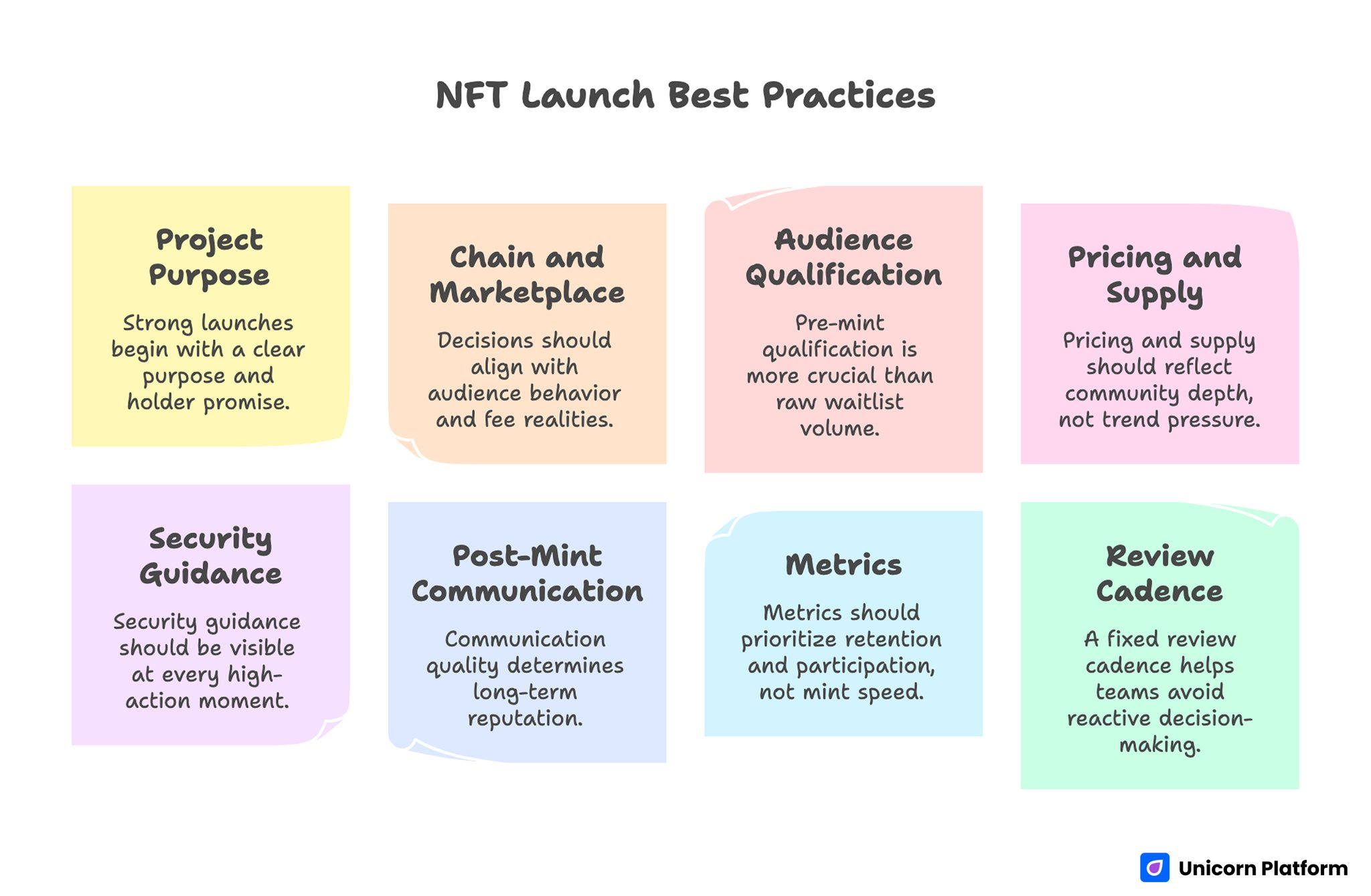
NFT Launch Best Practices
Best Legit Ways to Get Free NFTs
1. Join real airdrop campaigns
Airdrops are one of the most common ways people get free NFTs. Projects use them to reward early members, beta testers, event participants, partner communities, or holders of related assets.
The key thing to understand is that airdrops are usually tied to some prior action or membership. They are rarely random gifts from unknown accounts.
Good signs of a legit NFT airdrop
- the project has a real website and active social presence
- the airdrop rules are explained clearly
- eligibility is tied to a real action, event, wallet snapshot, or community role
- the claim page is linked from the official site, not only from replies or DMs
Be careful when
- the account promoting the drop was created recently
- the claim page is on a suspicious domain
- the offer sounds urgent without context
- the campaign asks you to sign broad wallet permissions you do not understand
2. Watch for official community giveaways
Giveaways are common around collection launches, partnerships, AMAs, event activations, and creator collaborations. A legitimate giveaway is usually announced on a project's website, Discord, X account, newsletter, or partner channel.
Giveaways often ask for simple actions such as:
- joining a Discord server
- following an official account
- sharing a launch post
- signing up for a waitlist
- attending a live event or online session
That does not automatically make them safe, but the structure is familiar and easy to verify.
The strongest giveaway opportunities usually come from projects that already have a product, a community, or a clear reason to distribute NFTs beyond hype.
3. Apply for allowlists
An allowlist gives selected users access to a mint before the public round. In some cases the allowlist mint is free. In other cases it is discounted or simply easier to access before demand spikes.
This matters because many people searching for free NFTs are really looking for the easiest low-risk path into a project before the public crowd arrives.
Ways projects usually allocate allowlist spots include:
- community participation
- early testing or feedback
- content creation
- event attendance
- partnerships with other communities
If you care about a specific project, watch its official channels early. Allowlists usually reward consistency more than speed.
4. Look for true free mints
A free mint is the most literal version of a free NFT: the mint price is 0. But that still does not mean the entire process is free.
On many chains, you may still pay gas fees. That is why people sometimes think they found a scam when the checkout page still shows a cost. In reality, the NFT price and the network fee are separate.
A true free mint can still be worth trying when:
- the project is real and transparent
- gas fees are reasonable for your budget
- the collection or access pass serves a clear purpose
- you understand whether you are minting art, utility, membership, or pure speculation
Do not assume every free mint is valuable. Some are simply growth campaigns with no real long-term use.
5. Join product, event, and community campaigns
Not every free NFT comes from a traditional profile-picture collection. Many are now tied to communities, creator launches, conferences, beta programs, learning cohorts, memberships, and online events.
In those cases, the NFT may act more like:
- proof of attendance
- digital access pass
- reward for participation
- founder badge
- collectible tied to a campaign
These can be easier to get than high-hype public launches because the project cares more about qualified participation than pure volume.
What You Need Before Claiming a Free NFT
Before you go hunting for opportunities, set up a clean system.
Use a separate wallet
A separate wallet is one of the best safety habits in NFTs. It reduces the damage if you connect to the wrong site or sign something risky.
A practical setup is:
- one main wallet for long-term assets
- one lighter "exploration" wallet for claims, experiments, and community participation
That way, you are not exposing your main wallet every time you test a new project.
Keep a little crypto for gas
Even if you are targeting free NFTs only, you may still need a small balance to cover gas. The exact amount varies by network conditions and chain.
It helps to think of free NFT opportunities in three buckets:
- truly free and no gas required
- free NFT but gas required
- free claim now, with later costs for movement or listing
If you do not understand which one you are dealing with, pause before connecting your wallet.
Check where the NFT will appear
Some NFTs show up in the wallet immediately. Others may appear first in a marketplace profile, in a hidden tab, or after manual token import depending on the wallet and chain.
That does not automatically mean something is wrong, but it does mean you should know what the project says the post-claim experience should look like.
Gas Fees: The Part People Miss Most
Gas fees are the most common reason people misunderstand the phrase "free NFT."
Gas is the network fee paid to process an onchain action. Even when the NFT itself costs nothing, the blockchain may still charge you for minting or claiming it.
That means a free NFT can still feel expensive if:
- the network is congested
- the chain normally has higher fees
- you are claiming during a peak launch window
A better decision rule is this:
- if the NFT is free but the gas is small and the opportunity is real, it may still make sense
- if the NFT is free but the gas is high and the project looks weak, skip it
Free does not automatically mean worth claiming.
Scam Warning Signs You Should Not Ignore
This is the most important part of the guide.
Free NFT campaigns attract attention, and attention attracts scammers. Many scams use the same emotional levers: urgency, exclusivity, confusion, and the promise of easy upside.
Major red flags
- someone sends you a mint or claim link through DM first
- the domain is slightly misspelled or uses odd subdomains
- the site pushes you to connect your wallet before explaining anything
- you are asked for your seed phrase, private key, or wallet backup words
- the claim rules are vague but the urgency is high
- comments are full of suspicious "it worked for me" replies from low-quality accounts
- the project has no credible website, no team context, and no clear reason for the NFT to exist
Safe habit to adopt
Always navigate from the project's official website or verified social profile. Do not trust screenshots, reposts, or random comment links.
If something feels rushed, confusing, or overly aggressive, skip it. Missing one NFT is cheaper than recovering a compromised wallet.
A Simple Checklist Before You Claim Anything
Use this checklist every time:
- Is this from the official website or a verified official channel?
- Do I understand whether this is an airdrop, giveaway, allowlist claim, or free mint?
- Do I understand whether gas fees apply?
- Am I using a separate wallet?
- Does the project explain what the NFT is for?
- Are the wallet permissions reasonable?
- Would I still trust this opportunity if there were no hype around it?
If the answer to two or three of those questions is "no" or "not sure," pause.
Practical Ways to Find Better Free NFT Opportunities
The internet is full of noise, so curation matters.
Better opportunities usually come from sources like:
- official project newsletters
- verified project websites
- Discord announcement channels
- launch calendars from known platforms
- creator communities with real moderation
- product or event pages with clear claim instructions
Worse opportunities usually come from:
- random reply threads
- cloned mint websites
- low-trust Telegram groups
- fake support messages
- anything that sounds like "instant claim, act now, no verification needed"
The goal is not to find the most opportunities. It is to find the cleanest ones.
Are Free NFTs Ever Actually Worth Anything?
Sometimes yes, often no, and that is a healthy expectation.
A free NFT can have value because:
- it becomes a collectible from a project that grows later
- it provides access, status, or membership utility
- it unlocks later rewards or ecosystem benefits
- it has social value inside a niche community
But many free NFTs are simply promotional assets. They may still be fun or useful, but they are not guaranteed to become valuable.
That is why the smartest way to approach free NFTs is not "how do I get rich from free mints?" It is "which opportunities are legit, low-risk, and interesting enough to explore?"
That mindset protects both your wallet and your time.
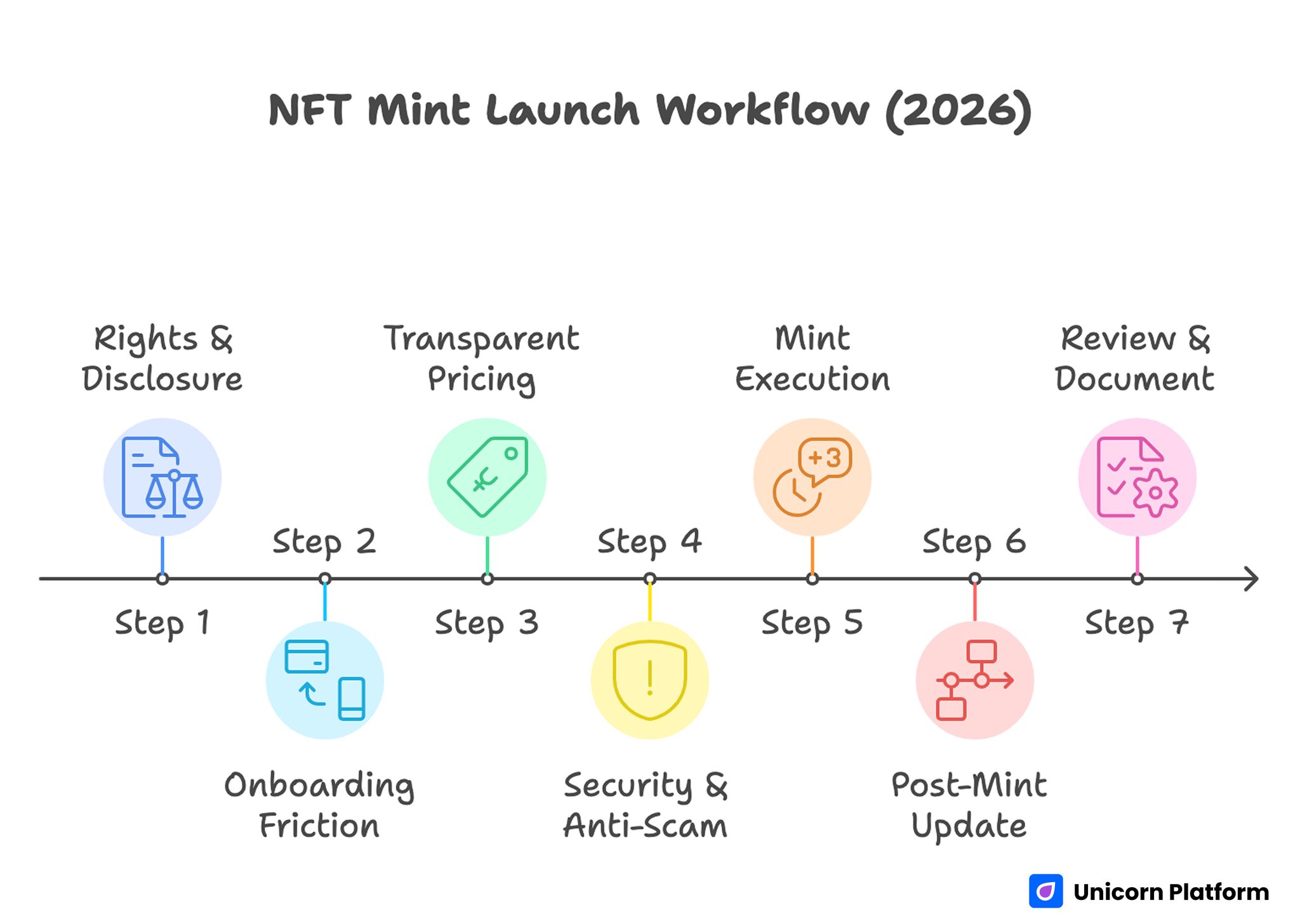
NFT Mint Launch Workflow in 2026
Common Mistakes People Make
Chasing every free mint
Volume is not a strategy. Claiming everything usually leads to clutter, confusion, and unnecessary risk.
Using a main wallet for random claims
This creates avoidable exposure. Keep experimentation separated.
Confusing free mint with zero total cost
Always check for gas and chain-specific costs.
Trusting social hype more than project quality
A loud community does not automatically mean a safe or useful project.
Ignoring utility and purpose
If you cannot tell what the NFT is for, that is already useful information.
How to Apply This in Unicorn Platform
If you run an NFT project, event campaign, or Web3 community, this article points to something many launches get wrong: people do not just need a claim link. They need clarity.
A simple landing page can reduce confusion fast by answering:
- what the NFT is
- who can claim it
- whether it is free or only the mint price is free
- whether gas fees apply
- which wallet actions are required
- what users get after claiming
That is exactly the kind of page Unicorn Platform is good for. You can build a clean claim explainer, allowlist signup page, campaign FAQ, or event-access landing page without adding unnecessary friction.
If you want a stronger trust baseline before publishing, this guide on cryptocurrency landing pages and trust signals is a useful companion for clarifying messaging, proof, and risk-reduction elements.
FAQ: How to Get Free NFTs
Can you really get NFTs for free?
Yes. Some NFTs are distributed through airdrops, giveaways, allowlists, and free mints. But "free" does not always mean zero total cost because gas fees may still apply.
What is the safest way to get free NFTs?
Use a separate wallet, verify links through official channels, and avoid any page that asks for your seed phrase or unclear wallet permissions.
Are free NFT airdrops legit?
Some are. Legit airdrops usually come from known projects, products, communities, or events and explain eligibility clearly.
Do free NFTs always require gas fees?
No. Some do, some do not. It depends on how the NFT is distributed and on which chain the claim happens.
What is the difference between a free mint and an airdrop?
A free mint usually means you initiate the onchain claim yourself. An airdrop usually means the NFT is distributed because you were already eligible through some earlier activity or membership.
Where do projects usually announce free NFT opportunities?
Usually on their official website, verified social channels, newsletters, Discord announcements, or partner communities.
Are giveaway NFTs worth anything?
Sometimes they are, but many are mainly promotional. It is better to focus on legitimacy and usefulness before thinking about resale value.
Do I need crypto in my wallet to claim free NFTs?
Often yes, at least for gas on some chains. Even if the NFT price is zero, the network may still charge a fee.
Can I claim free NFTs from my phone?
Sometimes yes, if your wallet and the claim flow support mobile use. But a rushed mobile flow can make verification harder, so extra caution helps.
Should beginners collect free NFTs?
Beginners can, but only if they move carefully. Start small, use a separate wallet, and treat safety as more important than speed.
Final Takeaway
The best way to get free NFTs is not to chase every hype cycle. It is to understand the real channels that distribute them, separate legit opportunities from scams, and use a setup that protects your wallet.
Airdrops, giveaways, allowlists, and free mints can all be real. But the people who do well in this space are usually not the fastest clickers. They are the most careful filters.
If you approach free NFT opportunities with that mindset, you will make fewer mistakes and get much more value from the ones you choose to claim.

