If you need a template for a hosting company site, the most important question is not whether the page looks technical. It is whether the structure makes your offer feel credible fast. Hosting buyers usually want to understand four things early: what kind of infrastructure or platform you provide, whether the service feels trustworthy, how support works, and whether the company looks mature enough to handle migration or growth.
That is where many generic SaaS templates fall short. They can look clean, but they often do not give enough room to explain platform breadth, support confidence, uptime promises, or operational trust. A strong hosting template should help a buyer understand the product surface, see why the platform is reliable, and feel guided toward a clear next step.
This Unicorn template does a meaningful part of that job well. It behaves more like a cloud-platform or managed-infrastructure company site than a cheap shared-hosting landing page. The live version includes Blog, Docs, and Support in the top navigation, product blocks for Apps, Mongo DB, Storage, Routing, and Marketplace, a trust layer around 99.99% uptime, and a migration-focused CTA near the bottom. That gives it a believable infrastructure-company feel.
The tradeoff is just as important: it does not include a real pricing table, plan comparison, or FAQ. So this page works best when the company sells trust, product breadth, and migration confidence first. It works less well when the site needs to close the sale through detailed package comparison on page one.
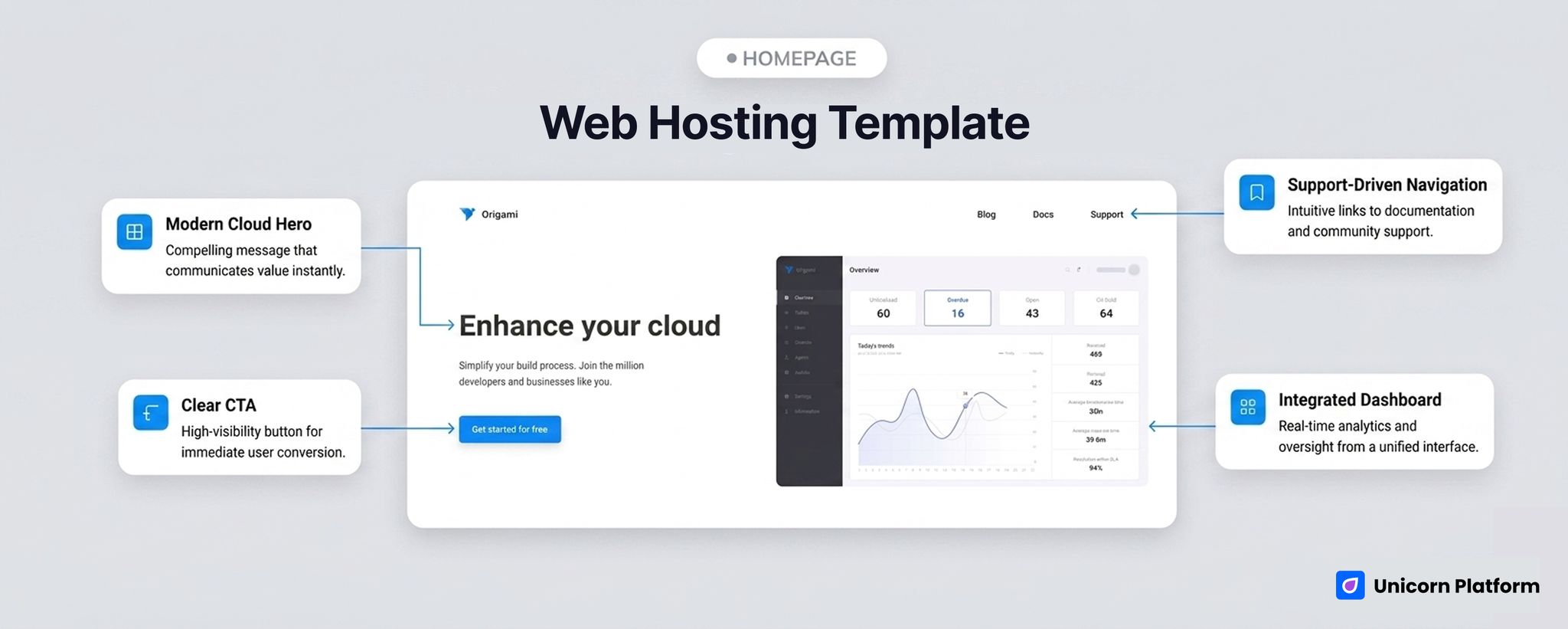
Web hosting company template showing a cloud-platform hero with Blog, Docs, and Support navigation
Quick Answer
This template is a strong fit if you want to launch:
- a cloud hosting brand
- a managed infrastructure company site
- a developer-focused platform homepage
- a migration-led hosting offer
- a technical service site that needs trust and product breadth
It is a weaker fit if you need:
- aggressive shared-hosting plan comparison
- budget hosting price-led sales
- a VPS or dedicated-server pricing matrix
- enterprise procurement detail on the first screen
- a documentation-heavy support portal in the main page itself
So the practical answer is simple: this template is strongest for cloud, managed hosting, or platform-style offers where trust and product explanation matter more than cheap-plan comparison. If your business depends on detailed pricing tiers or support-SLA depth right on the page, this template needs meaningful customization.
sbb-itb-bf47c9b
At a Glance: What This Template Does Well
Before going section by section, here is the practical read:
- it makes the brand feel like a real infrastructure company
-
it includes
Blog,Docs, andSupportcues in the top navigation - it shows product breadth well through cards and feature blocks
- it supports trust through uptime, data-protection, and migration language
- it gives technical buyers several different product angles to explore
The biggest gaps are also clear:
- no real pricing table
- no hosting plan comparison
- no FAQ section
- support is signaled well, but not explained deeply
That means the template is good at creating confidence and explaining product scope. It is weaker at helping a buyer compare exact plans or support levels immediately.
Who This Template Fits Best
This page is best for:
- founders launching a cloud or managed-hosting brand
- teams selling infrastructure, platform, or developer-oriented hosting services
- companies that want migration, trust, and product-breadth messaging to lead the site
- technical service brands that need a polished front end before they build deeper docs, pricing, or support layers
It is not the cleanest fit for hosting businesses that compete mainly on low-cost plan comparison. The live structure simply is not built around that sales motion.
How We Evaluated This Template
We evaluated this template like a hosting buyer would, not like a general design gallery browser.
The key questions were:
- does the page feel credible for a technical service company?
- does it show enough product depth to feel real?
- does it build trust around support, security, and uptime?
- does it make migration or adoption feel easier?
- where does it stop short for serious hosting comparison behavior?
Those are the right questions because hosting sites do not win only on looks. They win when the structure reduces doubt.
Template Walkthrough
Main Template Review
Web hosting company template with cloud hero, product cards, trust sections, and migration CTA
- Best for: cloud hosting startups, managed infrastructure services, developer-focused platform brands, and migration-led hosting offers
- Style: bright, modern, technical, startup-friendly, cloud-platform-oriented
- Strongest sections: top navigation, product card grid, feature breadth, trust section, migration CTA
- Pricing clarity: weak
- Trust/support strength: medium-high
- First customization priority: rewrite the hero and add real pricing or plan structure
- Main limitation: too broad and too light on pricing depth for traditional hosting comparison behavior
The hero gives the page a promising start, but it is not perfect. The heading Enhance your cloud is broad and brand-like rather than sharply commercial. That means the visual tone is useful, but the copy needs improvement before the page can sell a specific hosting offer well.
The supporting line underneath is more helpful. It speaks to developers and businesses and pairs that with a Get started for free CTA. That already tells us the template is better suited to a cloud platform, managed service, or infrastructure product than to a simple brochure site.
Hosting template hero with cloud-focused headline, developer-oriented subcopy, and get started CTA
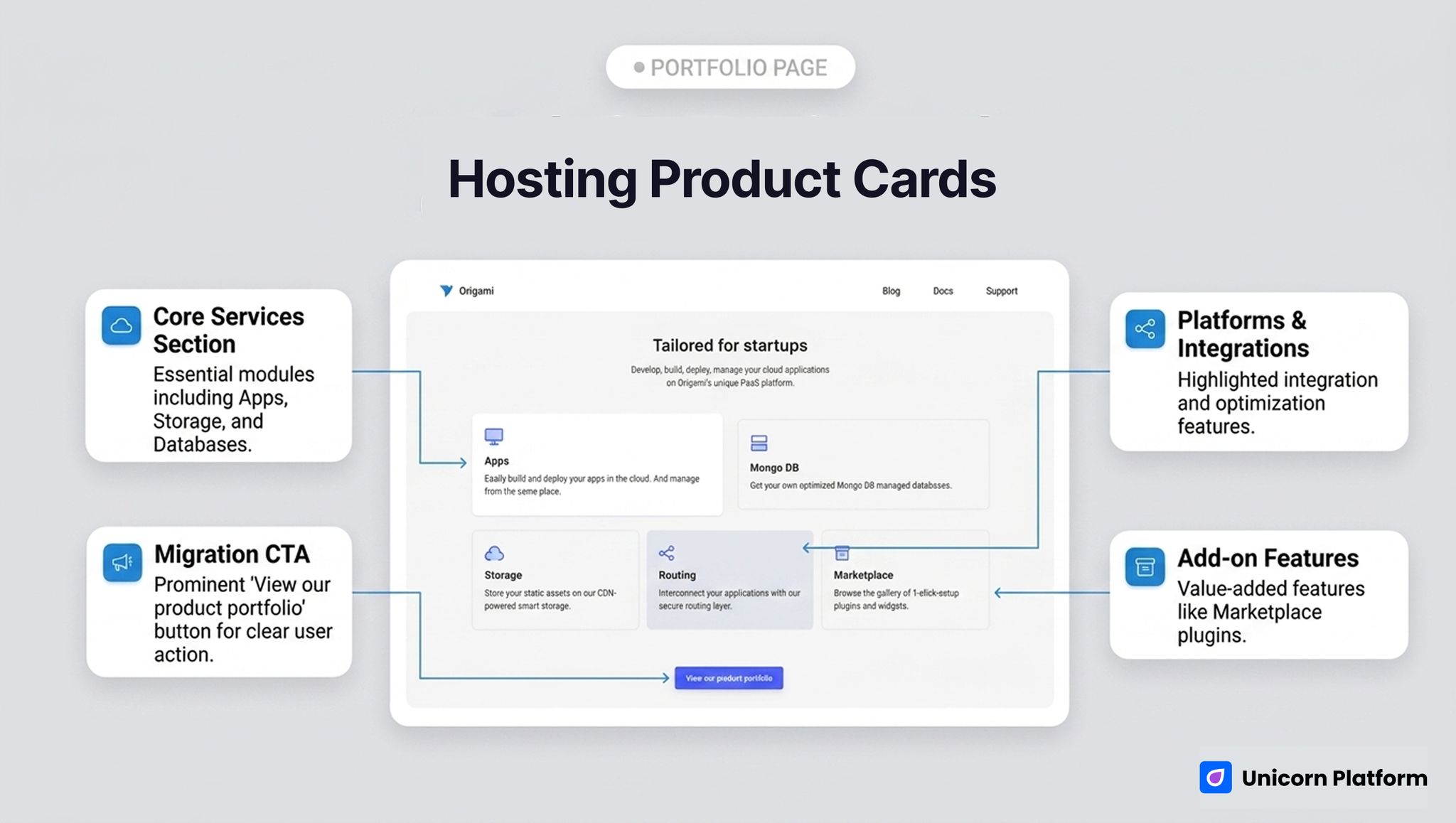
The next major strength is the early product block under Tailored for startups. Instead of stopping at generic benefit language, the page surfaces distinct product areas:
-
Apps -
Mongo DB -
Storage -
Routing -
Marketplace
That product-card structure matters a lot. It makes the brand feel operational, not vague. Buyers can quickly infer that the company supports deployment, data, storage, routing, and extensions or integrations. That is a much better signal than a hosting page that only says fast, secure, scalable with no concrete product surface.
Hosting product cards showing apps, Mongo DB, storage, routing, and marketplace categories
There is also an early testimonial block with a CEO quote. On its own, one testimonial is not enough to prove platform quality, but it still helps the page feel more lived-in and commercially believable than a page with no customer proof at all.
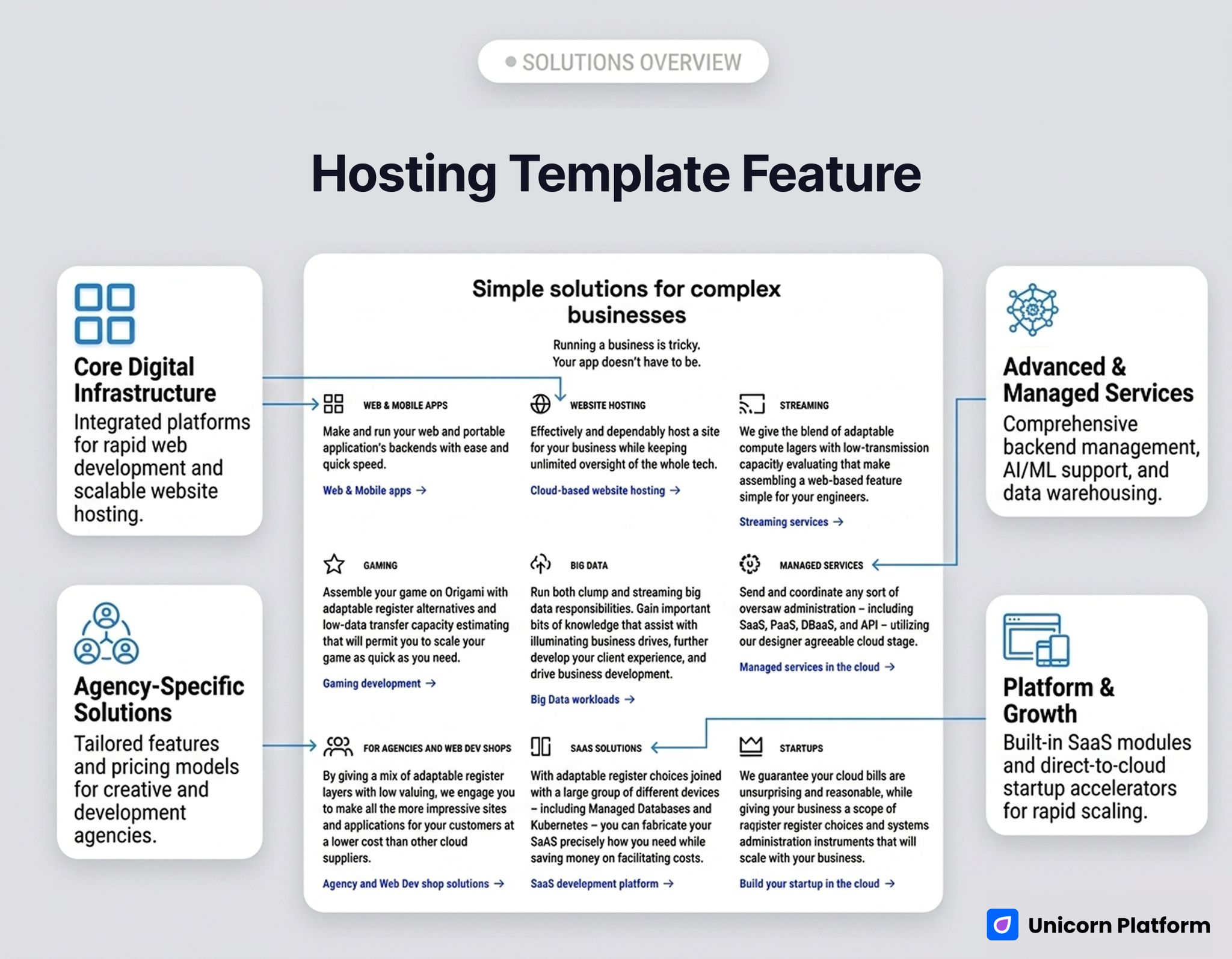
The broader features grid is another important part of the template. Under Simple solutions for complex businesses, the live page expands into use-case and workload categories such as:
-
Web & mobile apps -
Website hosting -
Streaming -
Gaming -
Big data -
Managed services -
For agencies and web dev shops -
SaaS Solutions -
Startups
This gives the site a useful sense of capability range. It helps the template work for businesses that want to say, we support multiple workloads and customer types, not just one product SKU. That is especially helpful for cloud-platform or managed-infrastructure companies that sell flexibility as part of the value proposition.
Hosting template feature grid covering website hosting, managed services, SaaS, startups, and other workloads
What This Template Is Best At
The strongest thing about this template is that it supports infrastructure-company trust without pretending to be a giant enterprise documentation site.
That shows up in a few different ways.
1. It signals support and maturity early
The top navigation includes Blog, Docs, and Support. Even before a visitor scrolls, the company appears to have education, documentation, and help pathways. On many hosting or platform sites, those cues matter because buyers want to know the company is not just a pretty front end.
One honest limitation: those cues are structural signals, not deep support proof by themselves. If the business actually needs onboarding detail, support channels, or SLA explanation, those still need to be built out.
2. It makes product breadth feel real
The Apps, Mongo DB, Storage, Routing, and Marketplace section is probably the most persuasive block on the page. It makes the company feel more like a working platform and less like a startup pitch deck.
For a hosting or infrastructure brand, that matters because buyers often want to see the product categories behind the promise.
3. It gives trust more than one angle
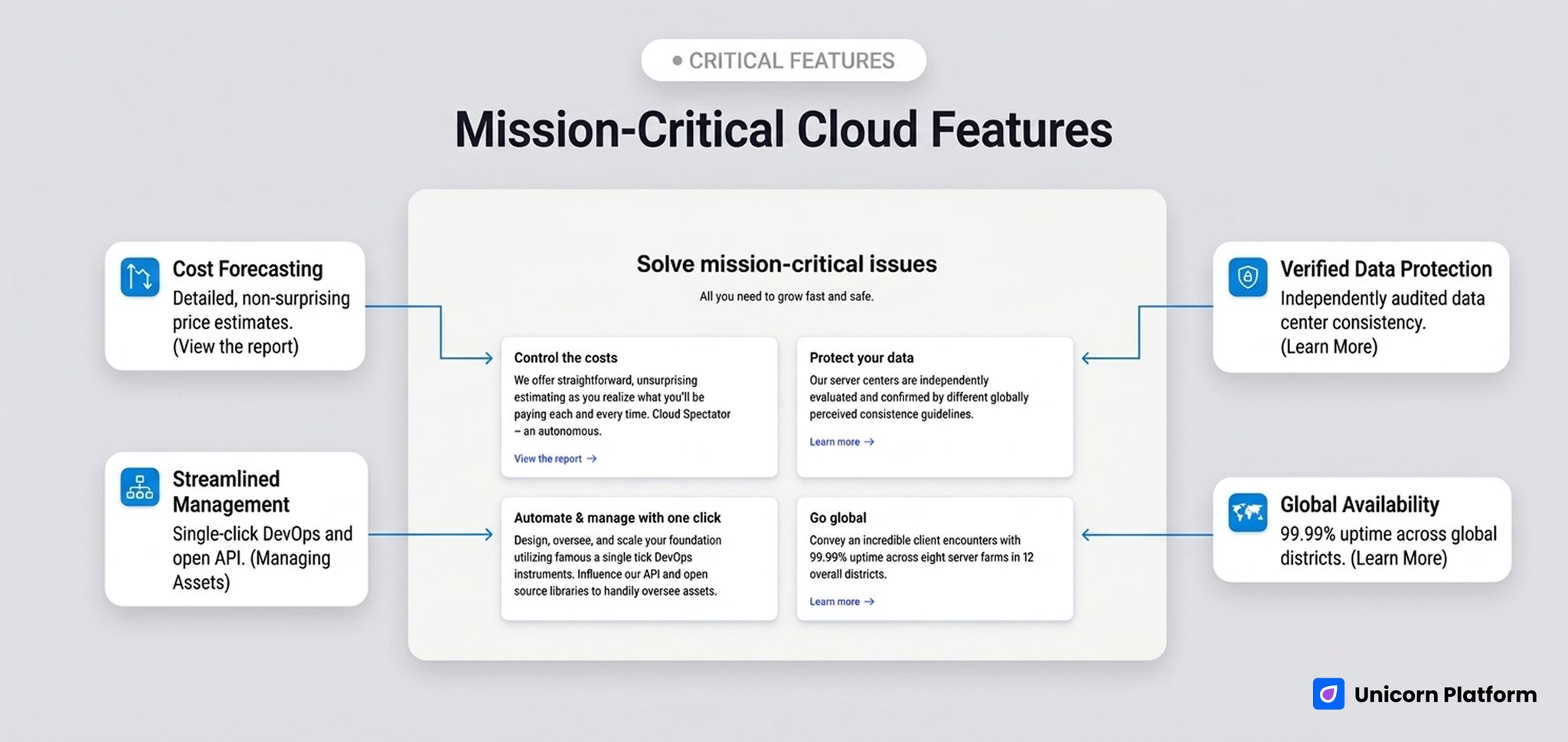
The later Solve mission-critical issues section is especially valuable. It covers:
-
Control the costs -
Protect your data -
Automate & manage with one click -
Go global
Those are the right trust themes for this type of site. The page also references independently evaluated data protection and 99.99% uptime across eight server farms in 12 overall districts, which gives the brand a more operational feel.
[SCREENSHOT_SLOT: Web Hosting Company / mission-critical trust section close-up] Alt: Hosting trust section covering cost control, data protection, one-click management, and global uptime Caption: This is the template’s strongest credibility block because it ties product claims to operational trust themes.
4. It supports migration messaging
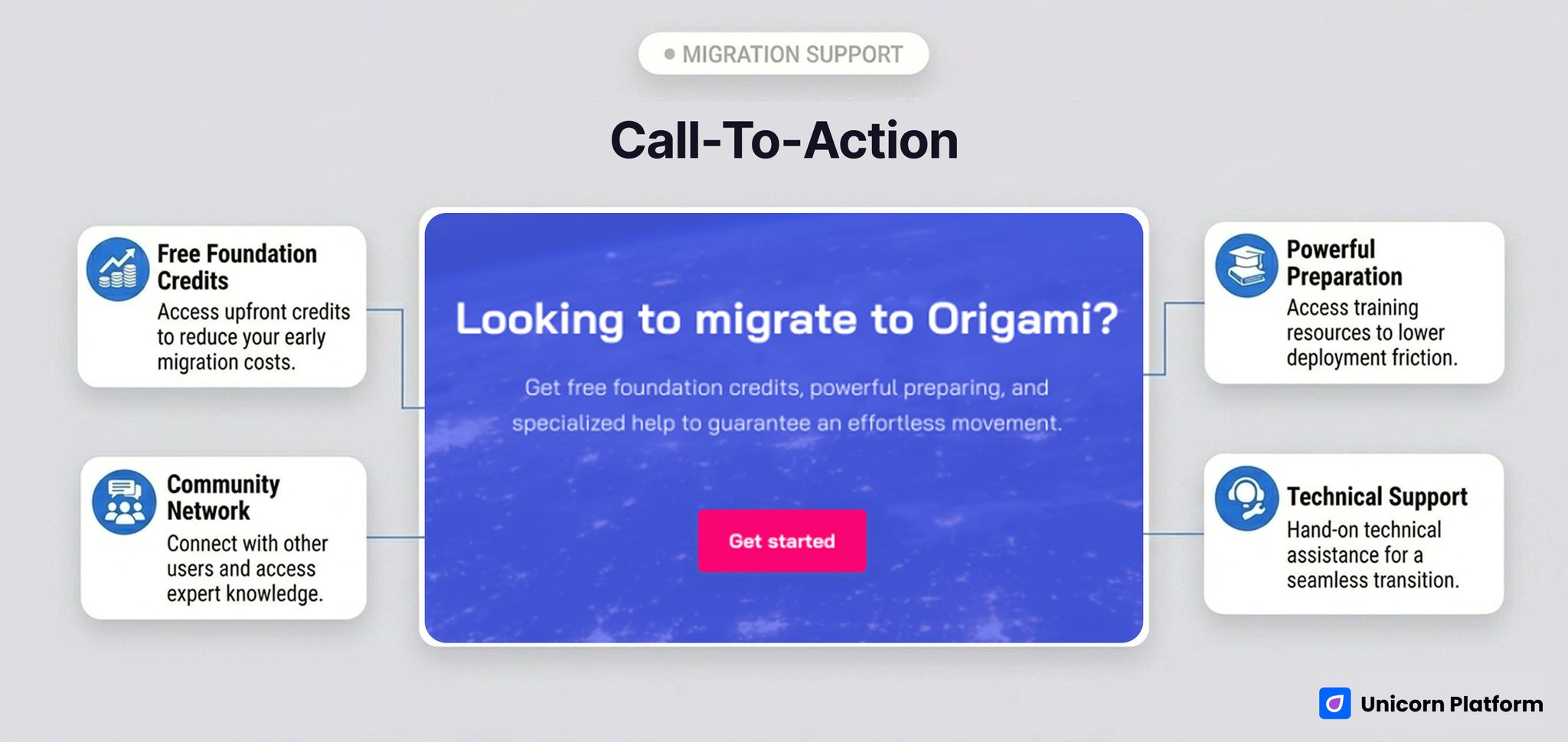
The bottom CTA section asks, Looking to migrate to Origami? and backs that up with free foundation credits, training, and technical help. That is a strong move for a hosting or cloud brand because migration is one of the highest-friction decisions in the category.
Many technical buyers worry less about the first signup and more about the cost of switching. A migration-focused CTA helps the site feel more commercially aware of that reality.
[SCREENSHOT_SLOT: Web Hosting Company / migration CTA close-up] Alt: Migration call to action offering free credits, training, and technical support Caption: The migration section is a smart commercial asset because it addresses one of the biggest objections in hosting and infrastructure sales.
Best Fit by Use Case
1. Hosting Startup
This is a strong fit if the startup is positioning itself around cloud simplicity, product range, and support confidence rather than low-cost plan competition. The startup angle is already visible in the live Tailored for startups section, so the structure aligns well.
2. Infrastructure Service
This may be the cleanest fit of all. The product cards, workload categories, support cues, and mission-critical trust block all help the page look credible for infrastructure or platform services.
3. Managed Hosting Offer
This is also a good fit, especially if the offer depends on guided migration, operations help, or technical support trust. The migration CTA and support-adjacent navigation give that story a good base.
4. Developer-Focused Service Company
The template works well here too because it speaks to developers, product breadth, and operational tooling. If the company needs to attract more technical buyers than casual consumers, this structure helps.
What To Customize First
If you use this template, start with the commercial logic before visual polish.
1. Rewrite the hero around the exact offer
Enhance your cloud is too vague for a competitive market. The first screen should tell the user whether you are selling:
- managed cloud hosting
- application hosting
- platform infrastructure
- developer hosting
- migration-led managed services
That clarity matters more than changing colors or icon style.
2. Add real pricing or plan structure
This is the biggest gap in the template.
If your business depends on plan comparison, the page should include:
- starter vs growth vs enterprise plan logic
- clear feature differences
- support-level differences
- usage or scaling cues
- migration or onboarding notes
Without that, the site feels credible but incomplete for buyers who compare vendors carefully.
3. Make support more specific
The page signals Docs and Support, which is good, but most hosting buyers will want more specificity. Add cues such as:
- onboarding help
- migration assistance
- response-time expectations
- support channels
- status or reliability resources
That is especially important if support quality is part of the brand promise.
4. Add deeper proof
The testimonial is useful, but the site would get stronger with:
- more customer proof
- named migration stories
- partner logos
- compliance or infrastructure trust badges
- clearer reliability evidence
5. Narrow the page by audience
Right now the feature grid covers many workloads. That flexibility is helpful, but the page will convert better if the company chooses a stronger audience emphasis, such as:
- startups
- SaaS teams
- agencies
- developers
- managed-service buyers
Specificity usually beats breadth in technical sales copy.
What Makes a Web Hosting Website Template Good
A good hosting template should do more than look modern.
It should help the buyer understand:
- what kind of hosting or infrastructure you actually provide
- how reliable the platform feels
- how support works
- how pricing is structured
- how migration or setup friction gets reduced
This template already handles the first two fairly well. It also gives a decent start on migration confidence. The biggest missing pieces are pricing clarity and deeper support detail.
That is why the page is promising, but not complete out of the box.
When This Template Is Not Enough
This template is probably not enough on its own if you need:
- deep multi-plan comparison
- reseller or partner hosting detail
- enterprise compliance-heavy positioning
- support-SLA detail on page one
- a strong knowledge-base or documentation experience inside the same page
In those cases, the template can still be a strong starting point, but the company needs to build more specific commercial and operational layers around it.
Why Build This in Unicorn Platform
If the goal is to launch a credible first version of a hosting or infrastructure brand quickly, Unicorn Platform is a useful fit because you can start with a polished technical-service layout and then reshape the copy around one exact offer.
It is especially useful when the main job is:
- clarifying the product story
- improving trust
- adding proof
- building a stronger first commercial layer fast
You can explore Unicorn Platform or review pricing if the goal is to launch the page without building the whole front end from scratch.
FAQ
Is this template good for a hosting startup?
Yes, especially if the startup sells cloud or managed infrastructure services and wants to look credible quickly. It is less effective if the company competes mainly on cheap shared-hosting plan comparison.
Does this template include hosting pricing tables?
No. That is one of the biggest weaknesses in the live structure. If pricing comparison is central to the sale, you should add a dedicated pricing block.
Is this more of a hosting template or a SaaS template?
It sits closer to a cloud-platform or hosting-company template than a generic SaaS page, because it includes support cues, infrastructure-style trust language, product categories, and migration messaging.
Can this template work for managed services?
Yes. In fact, managed services is one of the best fits because the page already supports trust, migration, and operational confidence better than strict price comparison.
What should I customize first before launch?
Start with the hero, pricing logic, support specificity, and deeper proof. Those changes matter more than surface styling.
Final CTA
If your company needs a web hosting website template that feels more like a real cloud or managed-infrastructure brand than a generic startup page, this Unicorn template is a strong starting point. Its best qualities are product breadth, trust structure, and migration-ready messaging.
Use it when your site needs to sell confidence first. Then strengthen it with sharper hero copy, real pricing structure, better support detail, and stronger proof before launch.

