Table of Contents
- Why Property Management Pages Underperform
- Use Trust Architecture That Matches Buyer Anxiety
- 30-60-90 Day Execution Plan
- Common Failure Patterns and Fixes
- FAQ
Property management prospects often arrive with high urgency and low trust. Owners worry about vacancy risk, maintenance reliability, reporting transparency, and compliance exposure. Tenants worry about response speed, communication quality, and process predictability. If a page does not resolve these concerns quickly, lead quality drops even when traffic volume looks strong.
Many teams still treat conversion pages like static brochures. They add service lists and contact forms but skip the structure needed for real decision support. The result is a flood of low-fit submissions, long qualification cycles, and inconsistent close rates.
The more effective model is operational. You segment intent, clarify scope, prove reliability, and route each audience to the right next action. This guide shows how to run that model in Unicorn Platform so your pages convert with less friction and better downstream quality.
sbb-itb-bf47c9b
Key Takeaways
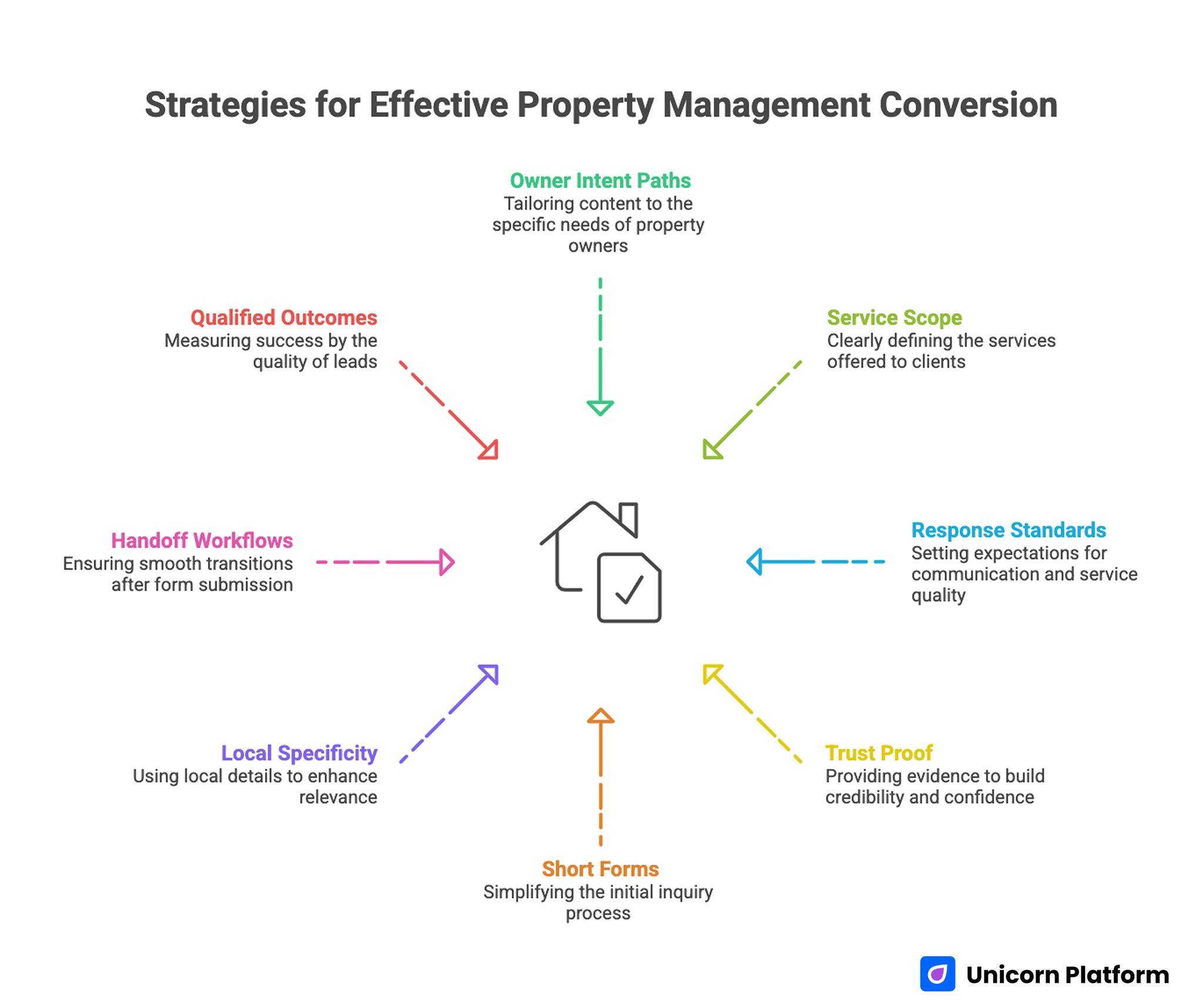
Strategies for Effective Property Management Conversion
- Separate owner and tenant intent paths before writing copy.
- Lead with service scope and response standards, not broad brand claims.
- Pair every major promise with contextual trust proof.
- Keep first-step forms short and route-based.
- Use local specificity to improve both relevance and conversion quality.
- Align page promises with real handoff workflows after submission.
- Track qualified outcomes, not only inquiry volume.
Why Property Management Pages Underperform
Most underperforming pages fail for three reasons. First, messaging is too generic. Claims like "full-service management" are common but unclear unless visitors can see what is actually included and how delivery works.
Second, trust signals are weak or delayed. Owners and tenants need process certainty before they act. If evidence appears late or lacks context, users hesitate.
Third, audience paths are mixed. Owner acquisition and tenant service inquiries have different decision criteria. Combining both in one undirected flow increases confusion and lowers conversion fit.
A fourth issue appears after form submission. Marketing pages may convert well on paper while operations teams receive incomplete context, which slows response quality and harms closing efficiency.
Define One Commercial Objective Per Cycle
Every optimization cycle should start with one commercial objective. Typical targets include higher qualified owner consultations, faster tenant issue-routing, reduced low-fit form volume, or improved lead-to-contract progression.
A clear objective keeps section priorities focused. It also helps teams decide what to test first: first-screen relevance, trust sequencing, offer clarity, or form friction.
Write objective statements with explicit quality signals. Example: improve qualified owner calls from local multifamily operators while lowering unserviceable requests. This framing connects page decisions to measurable business outcomes.
Without this discipline, teams often optimize for visible activity instead of revenue-quality improvements. That pattern usually increases workload without improving close rates.
Segment Intent Before Building the Page
Intent segmentation is the foundation of property management conversion design. Owners and tenants should not share the same primary journey because their questions, risks, and actions differ.
A practical segmentation model:
- Owner acquisition path focused on occupancy, reporting, and risk control.
- Tenant service path focused on responsiveness and process ease.
- Agent or partner referral path focused on handoff reliability and trust transfer.
Each path can use shared brand elements while changing service emphasis, proof type, and CTA wording. This keeps production efficient without forcing mixed-intent messaging.
Segmentation also improves operations because forms can route requests with better context from the start. Better routing context improves first-response quality and reduces avoidable handoff delays.
Build First-Screen Clarity for Local Decision Speed
The first screen should answer immediate local questions: what service is offered, where it is offered, who it is for, and what action to take next. If these answers are vague, high-intent visitors often leave before scrolling.
A reliable first-screen setup includes one audience-specific headline, one scope-focused subhead, one trust cue, and one dominant CTA. Keep language practical and avoid decorative slogans.
For teams refining layout sequence and conversion flow, this real estate landing page best practices guide is useful when auditing message hierarchy.
First-screen clarity should be validated on mobile first, since many local searches begin on smaller devices. Desktop polish is not enough when local-intent traffic evaluates pages on phones.
Clarify Service Scope With Operational Precision
Scope ambiguity creates low-fit leads and post-inquiry friction. Property management pages should define what is included, what is optional, and where boundaries exist.
Key scope elements to make explicit:
- Leasing and tenant placement responsibilities.
- Maintenance coordination model.
- Financial reporting cadence and depth.
- Compliance and documentation support.
- Emergency communication standards.
Scope language should match what teams can deliver consistently. Overpromising may increase short-term submissions while reducing close quality and long-term trust.
Strong scope sections also reduce repetitive qualification calls, which improves team efficiency. They also help sales teams focus on better-fit opportunities.
Use Trust Architecture That Matches Buyer Anxiety
Trust for property management decisions is built through evidence of process quality, not broad claims. Place proof near the concerns it addresses.
High-impact trust proof can include:
- Response-time standards with realistic windows.
- Process snapshots for maintenance and escalation handling.
- Contextual testimonials by property type.
- Reporting examples that demonstrate transparency.
- Compliance or vendor coordination reliability indicators.
Trust modules should be compact and specific. Unstructured testimonial walls usually underperform because buyers cannot map praise to their own risk concerns.
Trust architecture should also include boundaries. Clear statements about what you do not handle can improve qualification quality and confidence.
Separate Owner and Tenant Conversion Paths
Owner and tenant leads require different action flows. Owner paths usually involve consultation and qualification. Tenant paths usually require fast routing and clear service expectations.
A useful page strategy is dual entry with clear labels so visitors self-select quickly. This keeps one page usable while still preserving relevance for different intents:
- "I am a property owner" with consultation-oriented flow.
- "I am a tenant" with service-request or support flow.
Each path should have its own CTA hierarchy, proof emphasis, and form fields. Shared pages can still work if routing is immediate and obvious.
When structure clarity is needed at the brand level, this real estate website design framework can help align campaign pages with broader credibility patterns.
Build Route-Specific Form Logic
Long generic forms reduce conversion quality and delay response workflows. First-step forms should collect only data required for routing and initial qualification.
Owner-first-step fields might include:
- Property type.
- Location.
- Unit count range.
- Primary goal or pain point.
Tenant-first-step fields might include:
- Property identifier.
- Issue category.
- Urgency level.
- Preferred response channel.
Collect deeper context after route confirmation. This staged approach increases completion rates while preserving operational quality.
Confirmation messaging should state response timing and next steps clearly to reduce uncertainty. Clear post-submit expectations improve trust before the first follow-up interaction.
Add Financial Transparency for Owner Confidence
Owner leads convert better when fee structure and reporting expectations are understandable. Hidden pricing logic and unclear scope terms create hesitation before conversations begin.
You do not need full contract detail on first touch, but you should explain core pricing model, common variables, and where additional costs may appear. This balance keeps pages useful without overwhelming first-time prospects.
Useful transparency elements:
- Management fee framework.
- Leasing-related cost boundaries.
- Reporting frequency and format.
- Maintenance coordination fee logic where applicable.
Financial clarity improves lead readiness and reduces late-stage objection cycles. It also shortens discovery calls because core assumptions are already aligned.
Visualize Workflows to Increase Trust
Property management is operationally complex. Visual workflow summaries help prospects understand how services actually run.
Simple process visuals can show:
- New-property onboarding steps.
- Maintenance intake and escalation flow.
- Monthly reporting sequence.
- Tenant communication checkpoints.
This strategy borrows from no-code process-oriented page design patterns where workflow clarity drives confidence. The goal is comprehension, not decoration.
Keep visuals lightweight and labeled. Performance and readability should not be sacrificed for presentation style.
Use Local Specificity to Improve Relevance
Local trust signals often determine conversion outcomes in property services. Generic city-name swaps are usually weak and can reduce credibility.
Strong local relevance includes:
- Real service-area boundaries.
- Neighborhood-specific process nuances.
- Local vendor coordination context.
- Region-relevant policy or compliance references.
Pages should reflect how operations actually differ by market. This improves both search relevance and conversion fit.
If your team runs multiple local campaigns, use standardized templates with market-level adaptation points rather than independent one-off page builds. Template discipline improves QA consistency across neighborhoods and property types.
Align Acquisition Messaging With Operations Handoff
A conversion event is only useful if operations teams can follow through quickly with the right context. Poor handoff quality is a hidden conversion killer.
Design forms and confirmation flows so internal teams receive structured intent information. Clean intake structure at this step determines how fast operations can act:
- Audience path selected.
- Core request type.
- Urgency and timing indicators.
- Service area and property context.
This handoff clarity reduces first-response delays and improves lead experience immediately after submission. It also improves close probability by preserving context between marketing and operations.
For teams scaling campaigns quickly, patterns from high-converting real estate landing pages can help maintain consistency between marketing pages and operational workflows.
Measure Conversion Quality, Not Just Volume
Form volume is a weak success metric on its own. Property management teams need quality indicators tied to real business outcomes.
Useful weekly metrics:
- Qualified owner consultation rate.
- Tenant-route resolution initiation speed.
- Lead-to-meeting show rate by variant.
- Close progression from owner leads.
- Low-fit submission share.
Pair these with operational metrics such as response-time compliance and follow-up completion quality. This creates a clearer link between page design and service performance.
Variant decisions should prioritize quality lift even if total lead count stays flat. Better-fit demand typically outperforms high-volume low-fit demand over a full quarter.
Build a Channel and Campaign Variant System
Many teams route paid, referral, and organic traffic to one generic page. That often reduces message match and conversion quality.
A better approach is controlled variants:
- Paid search variant with direct problem-solution framing.
- Referral variant with trust transfer and social proof emphasis.
- Organic variant with deeper educational context and route clarity.
Each variant should maintain one core narrative and one dominant CTA path. Changes should focus on emphasis, not full structural reinvention.
Controlled variants help teams learn faster while avoiding brand inconsistency. They also make scale safer because proven modules can be reused predictably.
30-60-90 Day Execution Plan
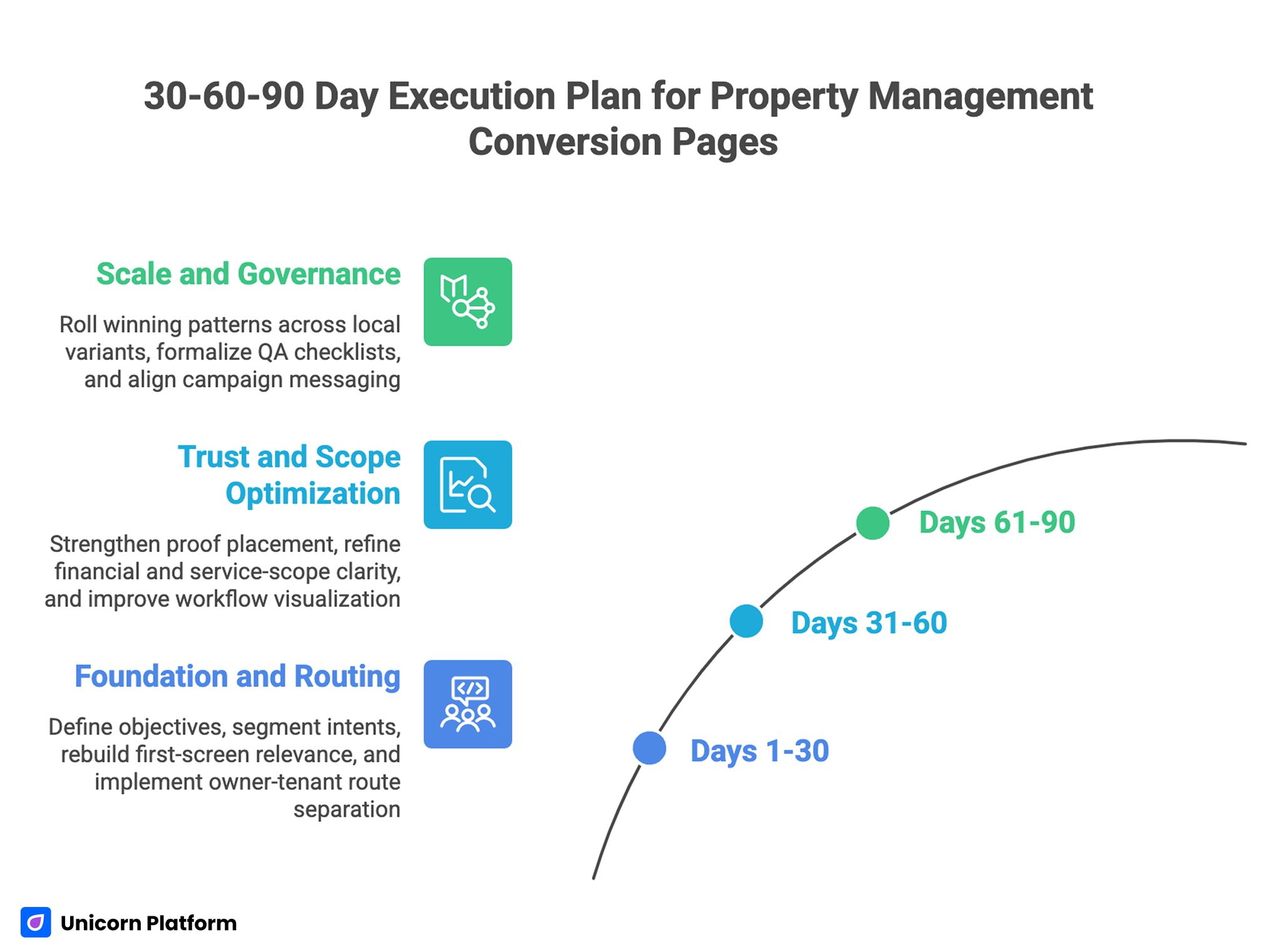
30-60-90 Day Execution Plan for Property Management Conversion Pages
Days 1-30: Foundation and Routing
Define objective, segment intents, rebuild first-screen relevance, and implement owner-tenant route separation. Simplify first-step forms and clarify response commitments so internal teams can respond with correct context.
By day 30, page behavior should show cleaner routing and fewer low-fit submissions. Teams should also see higher data quality in inquiry handoff records.
Days 31-60: Trust and Scope Optimization
Strengthen proof placement, refine financial and service-scope clarity, and improve workflow visualization for high-anxiety decision points. This phase should focus on reducing pre-call uncertainty and improving expectation alignment.
By day 60, qualified lead behavior and call quality should improve with lower pre-call confusion. Sales and operations should spend less time correcting scope assumptions.
Days 61-90: Scale and Governance
Roll winning patterns across local variants, formalize QA checklists, and align campaign messaging with operational handoff standards. Archive weak sections so complexity does not grow without value.
By day 90, teams should run a repeatable conversion system rather than isolated redesign efforts. Reporting should show quality gains, not only top-line inquiry movement.
Capacity and Compliance Communication
Property operations are capacity-constrained and policy-sensitive. Conversion pages should communicate these realities early so leads self-qualify on practical terms, not optimistic assumptions.
Capacity transparency should include realistic response windows by request type and season. During high-volume periods, clarify where turnaround may change and which channels receive priority handling.
Compliance transparency should state boundaries in plain language. Explain where your team handles requirements directly and where owner or legal involvement is needed. Clear boundaries increase trust and reduce late-stage friction.
A useful operational-clarity block can include:
- Service-hour and escalation windows.
- Documentation and reporting checkpoints.
- Vendor coordination boundaries.
- Emergency communication sequence.
- Issue ownership by request category.
These details improve both conversion quality and operational predictability. Prospects can assess fit before entering a sales conversation, which saves time for everyone involved.
Quarterly Scorecard for Lead Quality
Monthly optimizations keep pages moving, but quarterly scorecards reveal whether local wins are producing durable outcomes. Without scorecards, teams often misread temporary inquiry spikes as strategic progress.
A practical scorecard should blend four layers:
- Qualified lead outcomes.
- Conversion-behavior diagnostics.
- Response and handoff quality.
- Close progression and retention signals.
Qualified outcomes might include consultation qualification rate and disqualification reasons by variant. Behavior diagnostics can include route selection accuracy, form completion quality, and trust-section interaction patterns.
Response quality should track first-touch timing and context completeness. If marketing conversions rise but response quality drops, operational bottlenecks are likely limiting commercial impact.
Quarterly reviews should classify failures by friction type: relevance mismatch, trust gap, scope ambiguity, routing friction, or handoff quality issues. This classification sharpens next-quarter test priorities and prevents repeated mistakes.
Common Failure Patterns and Fixes
Failure: Mixed Audience Messaging
Owner and tenant concerns are blended, reducing relevance for both groups. Implement immediate route separation with intent-specific CTA flow and form logic so each audience receives the right context first.
Failure: High Form Volume, Weak Lead Quality
Pages attract submissions that do not match service scope or geography. Clarify boundaries and qualification cues before first submission so low-fit demand filters itself earlier.
Failure: Trust Signals Are Generic
Testimonials and claims do not address practical risk concerns. Use contextual proof tied to response standards, process reliability, and reporting clarity so trust is decision-relevant.
Failure: Pricing Questions Delay Conversion
Owner prospects hesitate because fee logic is unclear or implied. Add concise financial framework guidance with realistic scope context so comparison is easier.
Failure: Operational Handoff Is Incomplete
Marketing conversion happens, but response teams lack the context needed for quality follow-up. Structure route-aware form fields and confirmation flows that transfer clear intent signals.
Failure: Local Pages Feel Duplicated
Market variants look templated and low-credibility to local prospects. Add genuine market context, service boundaries, and location-relevant proof so pages feel operationally real.
Failure: Testing Without Learning
Teams launch frequent changes but cannot isolate cause and effect. Run one friction-type experiment stream at a time and document decisions with measurable success criteria.
FAQ: Property Management Conversion Pages in 2026
1) Should owner and tenant inquiries use the same page?
They can share one page only if routing is immediate and clearly separated. In most markets, route-specific paths convert and qualify better.
2) What should appear above the fold for owner acquisition?
Lead with audience fit, scope signal, local relevance, one trust cue, and one clear consultation action. This combination helps owners assess fit before they scroll deeper.
3) How much pricing detail should be shown initially?
Show enough to reduce uncertainty and set expectation quality. Full contract detail can come later, but core fee logic should be visible early.
4) What makes property-management proof convincing?
Proof is strongest when it includes context, process reliability, and measurable or operationally specific outcomes. Generic praise works best only when paired with concrete service evidence.
5) How can we reduce low-fit submissions quickly?
Clarify service boundaries, improve first-step qualification fields, and align CTA language with actual offer scope. Better self-selection typically improves close efficiency faster than more traffic.
6) How often should local variants be reviewed?
Review key variants monthly and update immediately when policies or service areas change. Fast updates prevent outdated claims from weakening trust.
7) Which metric should guide optimization first?
Start with qualified owner consultation rate, then layer response compliance and close progression for full quality view. This sequence keeps decisions tied to commercial outcomes.
8) Do visual workflows really increase conversion?
Yes, when they improve comprehension of service delivery and reduce uncertainty about what happens after submission. Visuals should explain process, not distract from it.
9) How do we maintain consistency across many locations?
Use a shared template system with local adaptation points and clear ownership for message and proof updates. Governance quality is what keeps multi-location performance stable.
10) What is the fastest high-impact change to make now?
Separate owner and tenant pathways with clear first-screen routing and route-specific form logic. This change usually improves relevance and handoff quality immediately.
Final Takeaway
Property management conversion quality improves when page structure reflects real buyer decisions and real operational workflows. Clear scope, contextual proof, route-specific actions, and reliable handoff logic create stronger outcomes than design refreshes alone.
Use this framework to turn landing pages into dependable growth infrastructure. The payoff is better-fit leads, faster response quality, and more predictable close performance.

