Table of Contents
- Step-by-Step Workflow for Effective Directory Submission
- Three High-Value Intent Tracks for Directory Traffic
- 30-Day Rollout Plan
- Common Failure Modes and Fixes
- FAQ
Directory submission is one of the most misunderstood SEO tactics in modern marketing. Some teams treat it as obsolete and ignore it completely, while others still run high-volume submission campaigns that produce weak traffic and questionable links. Both extremes usually lead to missed opportunity.
The useful version of directory strategy in 2026 is selective, quality-controlled, and tied to intent-matched destination pages. It is not about submitting everywhere. It is about choosing directories that real users actually browse, publishing accurate listings, and routing that traffic into pages designed to convert.
For no-code teams, this is practical because execution speed is high. You can update destination pages quickly, test messaging changes rapidly, and maintain listing consistency without waiting on long development cycles.
This guide gives you a complete system: how to decide where to submit, how to avoid low-quality directories, how to connect listings to no-code landing flows, and how to measure whether directory effort is producing qualified outcomes.
This selective strategy reflects modern search engine quality standards. Google explicitly states that large-scale link schemes and manipulative placements violate its spam policies, while contextually relevant, editorial links remain acceptable.
sbb-itb-bf47c9b
Key Takeaways
Directory Submission Takeaways for SEO Visibility and Authority Growth
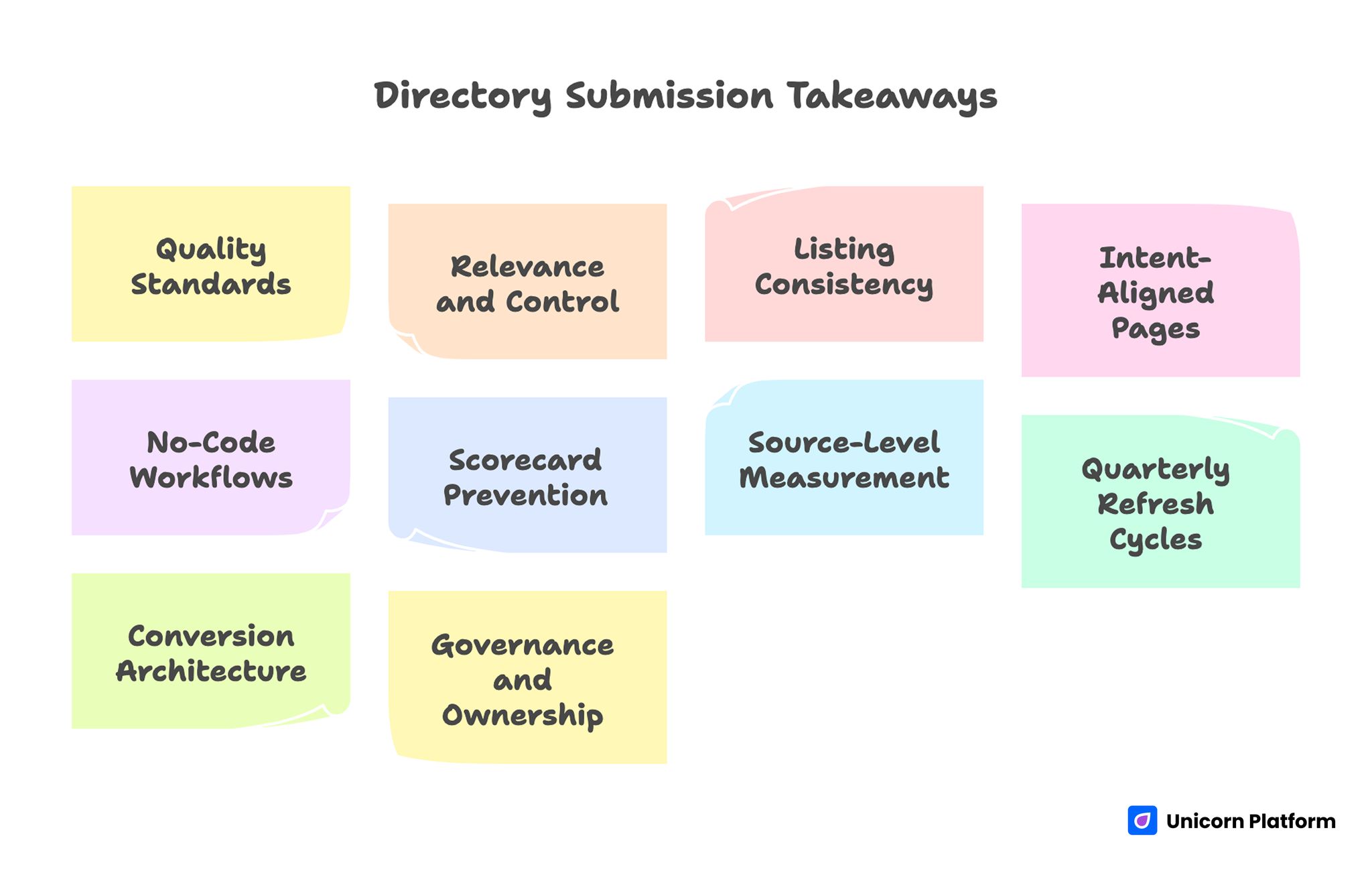
- Directory submissions still work when quality standards are strict.
- Relevance and editorial control matter more than listing volume.
- Listing consistency supports trust and citation accuracy.
- Directory traffic should always land on intent-aligned pages.
- No-code workflows help teams iterate destination pages quickly.
- One scorecard can prevent most low-value submissions.
- Source-level measurement is required to identify real winners.
- Quarterly refresh cycles keep listing signals current.
- Conversion architecture is the multiplier on referral visibility.
- Governance and ownership determine long-term success.
Why Directory Submissions Still Matter for No-Code Businesses
Search ecosystems are broader than classic search results pages. Buyers, founders, and evaluators still discover products through curated lists, niche directories, and category-driven resource hubs. In some markets, these directories act as validation layers before users click into a brand’s site.
A strong listing can improve discoverability, reinforce brand credibility, and produce targeted referral traffic. A weak listing strategy can consume time without creating meaningful growth. The difference is not whether you submit. The difference is how selective and structured your submission process is.
No-code teams are well positioned to use this channel effectively because they can adapt destination pages quickly when traffic behavior reveals mismatch. That speed advantage becomes real only when paired with discipline in directory quality and measurement.
What Directory Submission Should Not Be
Directory strategy should never be treated as a bulk link shortcut. Automated mass submissions, duplicate copy pasted listings, and random directory targeting are still common, and they still underperform.
Low-quality tactics fail for two reasons. First, they rarely produce useful referral traffic. Second, they dilute operational focus by making teams manage a large set of listings that do not support business objectives.
If your workflow does not include quality filters, destination-page alignment, and source-level tracking, directory activity is usually just busy work.
The Directory Quality Scorecard
Before submitting to any directory, run a quality review. A simple scorecard can save dozens of hours and keep your link profile cleaner.
Score each directory across these criteria:
- Topical relevance to your category
- Evidence of editorial review
- Category structure clarity
- Listing freshness and maintenance quality
- Spam density in nearby categories
- Real user activity signals
- Ease of updating listing data
- Clarity of outbound link behavior
Use a fixed threshold. If a directory does not reach that threshold, skip it immediately. High standards are easier to maintain than cleanup.
A practical scoring model is a weighted system instead of a flat checklist. For example, you can assign higher weight to topical relevance and editorial review because these factors shape both referral quality and long-term trust. Lower-weight factors can include profile edit convenience and listing aesthetics, which matter but should not overrule core quality signals.
Add a disqualification rule on top of weighted scoring. If you find obvious spam clusters, deceptive outbound behavior, or no clear category governance, mark the directory as ineligible regardless of score. This rule prevents teams from rationalizing weak candidates just because they look acceptable on a few surface metrics.
Keep scorecard notes brief but specific. Write one sentence explaining why each approved directory fits your audience, and one sentence describing the expected traffic intent. Those two notes make later analysis much easier because you can compare expected intent with actual behavior and decide quickly whether to keep or retire each listing source.
Directory Types and When to Use Each
Not all directories play the same role in your growth system. A clean strategy separates directory types so expectations stay realistic and performance analysis stays comparable.
Niche curated directories are usually your highest-priority targets. They often have stronger category intent, more relevant browsing behavior, and better audience fit than broad general lists. If your product serves a defined use case, these directories often produce the best qualified traffic even at lower absolute volume.
Broader business directories can still be useful for baseline discoverability and brand consistency. Their referral traffic quality varies, so they should sit behind niche options in your rollout sequence. Use them selectively when they show active maintenance and clear category structures.
Local and regional directories matter when your offer has geographic intent. Service businesses, agencies, consultants, and hybrid local-digital products can gain from listings that help users compare nearby options. If geography is not part of buyer intent, these directories should remain a low-priority test track.
Resource-list directories and startup roundups can support awareness for newer brands. Their value often depends on editorial standards and list freshness. Treat these as controlled experiments and evaluate them on engagement and conversion quality, not just click volume.
Step-by-Step Workflow for Effective Directory Submission
Step-by-Step Workflow for Effective Directory Submission and SEO Growth
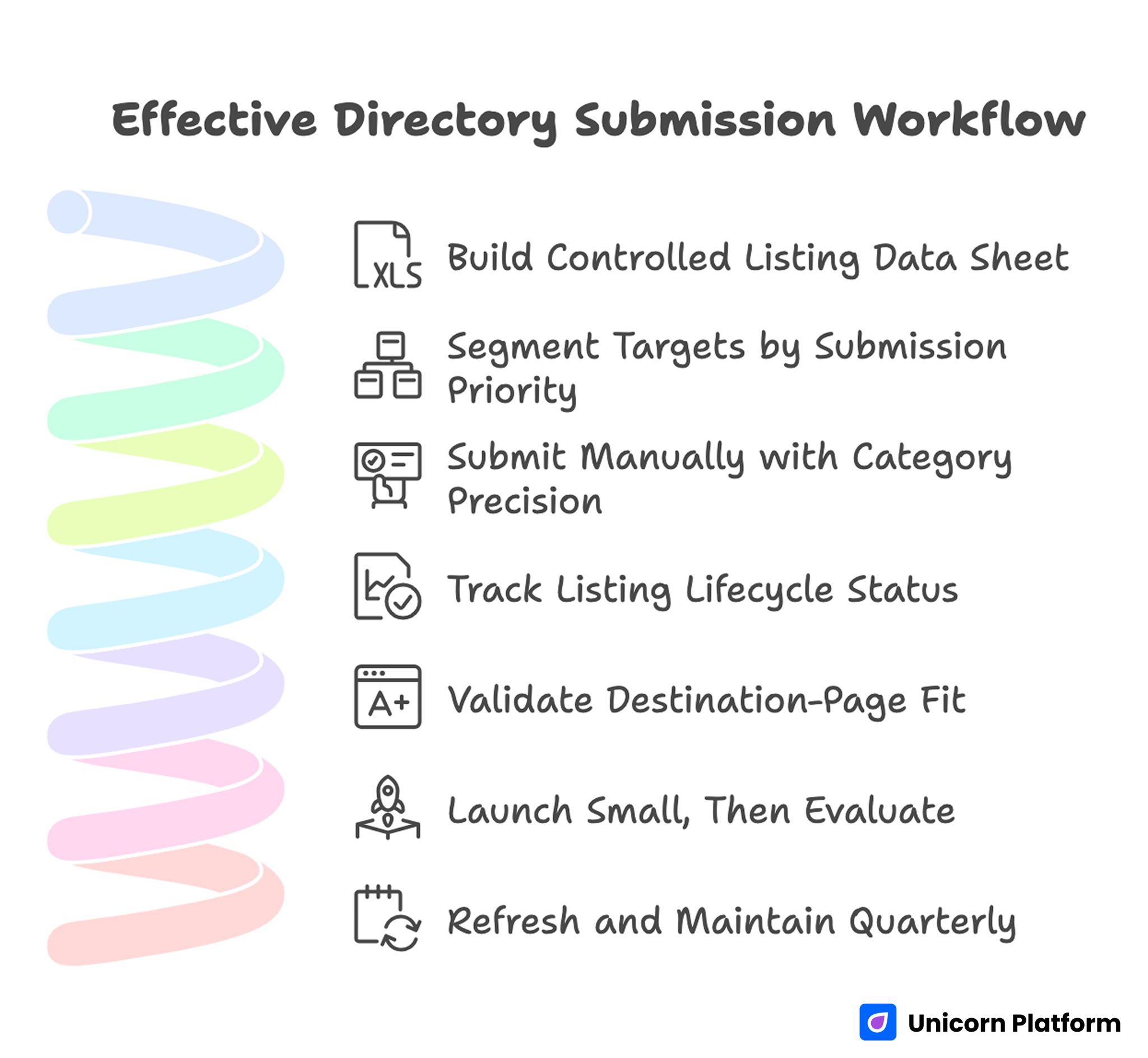
1. Build a controlled listing data sheet
Create a source-of-truth file with canonical brand details: official name format, primary URL, short description, long description, category tags, contact points, logo assets, and approved social references. This file should be version-controlled so updates are auditable.
Consistency matters because mismatched descriptions and links reduce credibility and complicate tracking. A controlled source sheet also lets multiple contributors work without introducing formatting drift.
2. Segment targets by submission priority
Organize target directories into tiers. Tier 1 should include highly relevant curated directories where your ideal audience is likely to browse. Tier 2 can include broader but still credible business directories. Tier 3 should be limited to controlled experiments.
Start with Tier 1 only and prove value before expanding. This prevents teams from overcommitting to low-impact directories during early rollout.
3. Submit manually with category precision
Manual submission is usually the right approach for quality control. It allows better category placement, stronger listing descriptions, and immediate review of how your profile appears among competitors.
Category accuracy is often the difference between visibility and invisibility. A great listing in the wrong category can perform like no listing at all.
4. Track listing lifecycle status
Track each listing from submission to approval to periodic refresh. Include status, listing URL, owner, last update date, next review date, and key notes on category positioning.
Lifecycle visibility keeps the strategy alive after launch. Without a status layer, listings go stale and performance confidence drops.
5. Validate destination-page fit before scale
Before submitting at volume, audit whether the target destination page matches the listing audience. If a directory focuses on ecommerce tools, sending users to a generic homepage usually weakens conversion.
Destination-page fit should be a pass/fail gate, not an optional improvement idea. Referral intent is fragile and decays fast when first-screen relevance is weak.
6. Launch small, then evaluate
Deploy a small first wave, then evaluate referral quality and conversion behavior. This controlled release makes it easier to detect which directory types produce qualified outcomes.
Use this phase to refine copy, category selection, and page alignment before broader rollout.
7. Refresh and maintain quarterly
Listings should be reviewed on a cadence. Offers change, positioning evolves, and stale descriptions can erode trust even when the underlying product is strong.
Quarterly refresh is a practical default for most teams. Faster-moving categories may require monthly checks.
Listing Copy Framework That Improves Approval and Click Quality
Many listing teams lose performance before the first click because directory copy is generic. A strong listing description should match category context, communicate concrete value, and make the next step feel obvious.
Use a four-part structure for each listing description. Start with audience fit, then define the core outcome, then add one proof signal, and end with a clear action path. This sequence helps scanners understand relevance quickly without reading long narrative blocks.
Keep short descriptions focused on the decision trigger, not your full product story. Most directories truncate early, so your first sentence should answer who the offer is for and why it is different in practical terms. Save operational detail for long descriptions or destination pages.
Create two or three approved copy variants mapped to directory type. A niche technical directory may need a capability-first angle, while a creator-focused directory may respond better to workflow simplicity and launch speed. Variant control improves fit without introducing brand inconsistency.
Do not overpromise in listing language. Directory users are often in comparison mode, so inflated claims reduce trust quickly when the destination page does not validate them. Clear, specific framing consistently outperforms hype wording over time.
No-Code Landing Pages as the Conversion Multiplier
Directory visibility creates opportunity, but destination-page quality determines business value. No-code teams can create a major advantage here by quickly shipping intent-matched pages and testing improvements in short cycles.
When users arrive from a listing, the top of the destination page should confirm category fit, practical value, and expected next step. If the first screen is generic or abstract, users often leave before exploring deeper proof.
A useful planning companion for this stage is data-driven SEO strategy planning, especially when you are mapping listing categories to high-value content and landing clusters.
Destination-Page Blueprint for Directory Visitors
Directory visitors usually arrive with partial context, not deep brand familiarity. Your destination page should reduce uncertainty quickly and guide the user from recognition to evaluation without forcing them to decode your offer.
The hero section should confirm category relevance in plain language. State what you offer, for whom, and what practical result users can expect. When this clarity is delayed, even high-intent referral traffic can drop before reaching proof or CTA sections.
Page architecture matters as much as message quality. If you need a deeper framework for sequencing sections from promise to proof to action, apply the structure principles from a step-by-step guide to a high-converting landing page structure.
Mobile behavior should be handled as a primary path, not a secondary audit step. Directory traffic frequently includes users comparing options on phones, which makes above-the-fold clarity and frictionless scrolling essential. For implementation detail, use the checklist from creating a high-converting mobile app landing page.
Trust blocks should appear close to decision points instead of being isolated at the end. Add concise credibility signals near claims, include risk-reduction details near CTAs, and answer major objections before users need to scroll for reassurance.
Behavior-based optimization should run continuously after launch. Track where readers pause, where they drop, and which CTA contexts produce action to prioritize your next edits. When planning those refinements, apply the workflow ideas in user behavior tips to optimize landing pages.
Keep routing logic explicit. If a directory targets course creators, send users to a course-focused page variant. If a directory targets ecommerce founders or portfolio buyers, route traffic to pages built for those intents rather than forcing one generic destination to serve every segment.
Three High-Value Intent Tracks for Directory Traffic
Three High-Value Intent Tracks Driving Qualified Directory Traffic
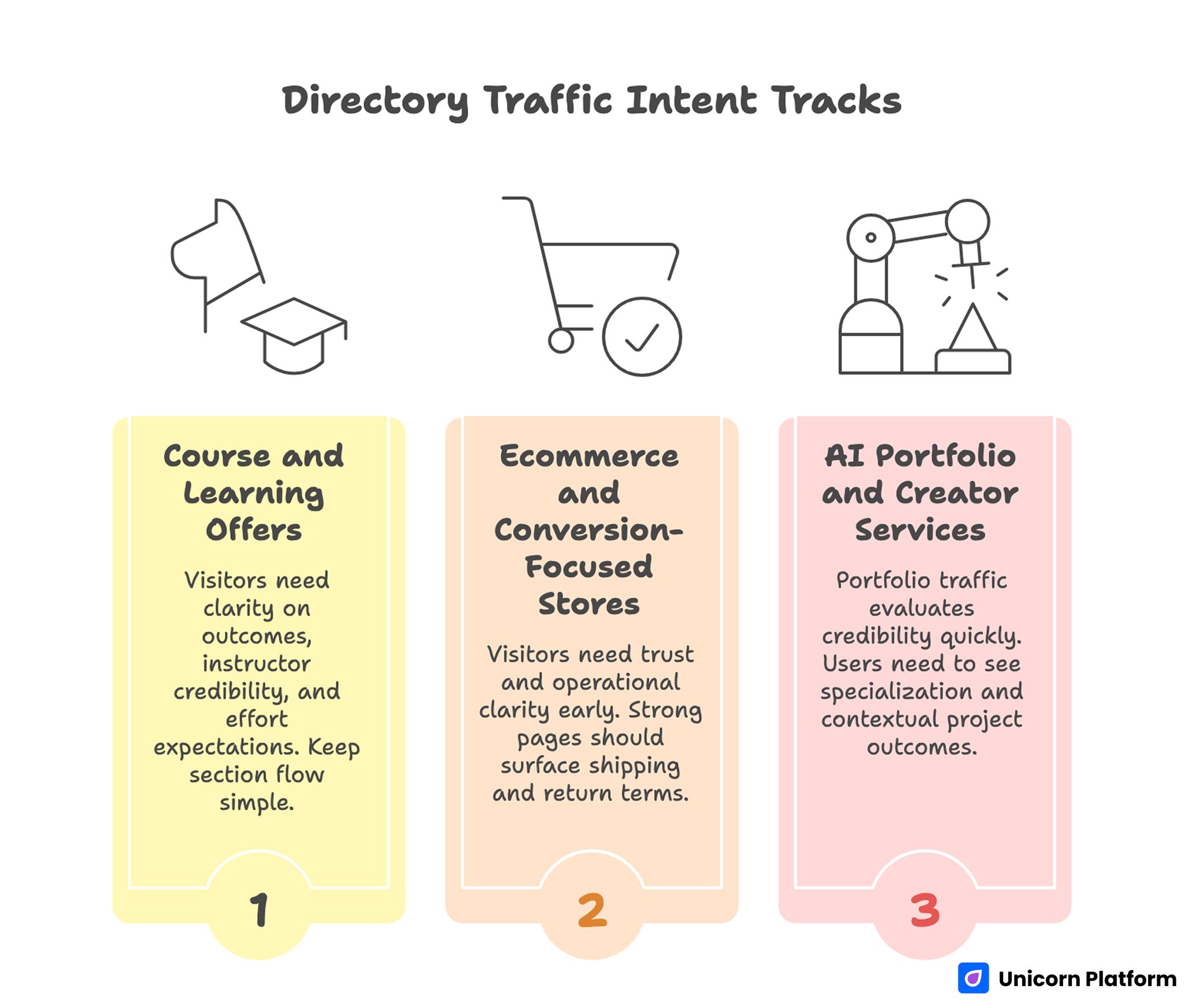
Track 1: Course and learning offers
Directory visitors interested in course solutions need fast clarity on outcomes, instructor credibility, and effort expectations. Course pages underperform when they prioritize feature lists over learner transformation.
Keep section flow simple: who it is for, what they gain, how delivery works, and what to do next. This flow helps both first-time evaluators and higher-intent users who are ready to enroll.
Track 2: Ecommerce and conversion-focused stores
Ecommerce-intent visitors need trust and operational clarity early. Strong pages should surface shipping and return terms, checkout confidence cues, and product-fit guidance near decision sections.
When conversion friction appears at policy or trust boundaries, traffic quality is often blamed incorrectly. In reality, destination-page clarity is usually the core issue.
Track 3: AI portfolio and creator services
Portfolio traffic evaluates credibility quickly. Users need to see specialization, contextual project outcomes, and a clear contact path without scrolling through noisy skill inventories.
Outcome-based case summaries consistently outperform generic tool lists. Clear proof structure is the fastest path to qualified inquiries.
Link Quality, Risk Control, and Practical Expectations
Directory links can be useful as part of a diversified profile, but they are not a replacement for core content quality or technical health. The goal is support and reinforcement, not dependency. If, on top of combining Unicorn and ListingBott, you also create quality content and buy backlinks with the best price, you will become unstoppable. With an SEO-friendly website, quality directory submissions, valuable content, and a natural link profile, you’ll have everything you need for success. Next, all that remains is to stay consistent with your optimization efforts.
Set realistic expectations with stakeholders. Directory submissions can improve discoverability and referral opportunity, but they should be measured as one layer in a broader acquisition system.
Teams that want stronger off-page context can benchmark quality practices against reliable external standards, including reviews of link-building service approaches. The key is adapting risk-managed practices, not copying tactics blindly.
Operating Model: Roles, Decisions, and Cadence
A lightweight operating model keeps this strategy sustainable. Assign one owner for listing quality, one owner for destination-page relevance, and one owner for analytics and reporting consistency.
In small teams, one person may cover multiple roles. The critical part is explicit ownership, because unclear ownership causes drift even when strategy starts well.
Use a simple decision log for every major update. Capture what changed, why it changed, and which metric should move. This habit increases decision quality and makes future optimization faster.
Measurement Framework That Separates Signal from Noise
Track directory performance in three layers so evaluation stays practical and objective.
1. Execution health
Track submission count, approval rate, listing freshness, and update coverage. These metrics confirm whether the operational process is working.
2. Traffic quality
Track source sessions, bounce behavior, scroll depth, and CTA interactions by directory source. These indicators reveal whether directory audiences match your intent assumptions.
3. Business impact
Track leads, purchases, assisted conversions, and downstream quality by source. This layer determines whether directory effort is creating meaningful value.
If volume rises while quality drops, reduce low-fit directories and tighten destination-page relevance. Growth that harms quality is not durable growth.
Attribution Setup for Clean Source-Level Reporting
Reliable attribution is what turns directory submission from activity into strategy. Without clean source tagging and consistent reporting windows, teams cannot separate useful directories from noisy ones.
Build a simple UTM policy and enforce it across all listings. Keep source names standardized, define one medium naming convention, and avoid ad hoc parameters that fragment reporting. Consistency is more important than complexity here.
Track performance in fixed review windows such as weekly operational checks and monthly quality reviews. Weekly checks catch execution issues like broken links or missing approvals. Monthly checks are better for judging traffic quality and conversion signals that need more data.
Use a dashboard that compares directories on both quantity and quality metrics. Include sessions, engaged sessions, CTA interactions, conversion rate, and assisted conversions by source. This side-by-side view prevents overinvestment in directories that look active but produce weak business outcomes.
Add decision rules to your reporting process. For example, keep expanding sources that sustain engagement and conversion quality, hold sources with mixed results for targeted fixes, and retire sources with repeated low-fit behavior after remediation attempts. Clear rules reduce subjective debate and speed up optimization cycles.
When results are unclear, audit the full path before judging the directory itself. Sometimes weak outcomes come from destination-page mismatch, slow first-screen comprehension, or missing trust signals rather than poor source intent.
Independent industry analysis consistently shows that backlinks remain one of the strongest ranking signals when they are earned naturally and placed in relevant contexts.
Automation Boundaries for No-Code Teams
Automation is useful for reminders, dashboards, and status tracking. It is risky when applied to editorial directory decisions or mass submissions.
Use automation for recurring operations. Keep human review for directory quality, category placement, and listing narrative quality.
A practical rule is to automate process, not judgment. This keeps speed high without sacrificing trust and relevance.
30-Day Rollout Plan
Week 1: Preparation and scoring
Build your source-of-truth listing data sheet and run the quality scorecard across target directories. Finalize Tier 1 candidates and define destination-page mapping before submission starts.
By the end of week one, you should have a ranked directory list, approved listing copy variations, and assigned owners.
Week 2: Controlled submission and alignment
Submit to Tier 1 directories manually and validate category placement quality. Ensure each listing routes to an intent-aligned page with clear first-screen relevance and trust cues.
Document approvals and listing URLs in one shared dashboard so progress remains visible.
Week 3: Behavior review and first optimization pass
Analyze source-level behavior and identify weak pages by source. Improve CTA context, trust placement, and objection handling where confidence breaks are visible.
Run one focused test per key page. Keep structural changes limited so learning remains interpretable.
Week 4: Scale decisions and governance
Expand selectively into Tier 2 only after Tier 1 quality signals are stable. Archive learnings into reusable page and listing standards.
Schedule quarterly refresh reviews and assign ongoing maintenance responsibility.
Common Failure Modes and Fixes
Failure mode 1: Volume-first submission
Teams submit to too many directories too quickly and lose quality control. Fix by enforcing score thresholds and reducing initial scope.
Failure mode 2: Generic listing language
Listings use broad copy that does not fit category context. Fix by tailoring descriptions to category intent while preserving brand consistency.
Failure mode 3: Weak destination-page match
Referral users land on pages that do not confirm intent quickly. Fix by routing each listing type to a relevant page variant.
Failure mode 4: Missing refresh cadence
Listings remain unchanged as offers evolve. Fix by introducing quarterly listing refresh and ownership checks.
Failure mode 5: No source-level attribution
Teams judge performance by aggregate traffic only. Fix by tracking referral behavior and outcomes by listing source.
Failure mode 6: Over-automation of editorial decisions
Automated submissions ignore quality differences and category fit. Fix by keeping editorial decisions manual and automating only operational tasks.
Failure mode 7: Trust signals placed too late
Users leave before reaching evidence blocks. Fix by moving credibility and risk-reduction signals closer to top claims and CTA zones.
FAQ: Directory Submission for No-Code SEO
Are directory submissions still useful in 2026?
Yes, but only when directories are relevant, curated, and connected to strong destination pages. Low-quality mass submission is still ineffective.
How many directories should we start with?
Start with a small, high-relevance set. A focused launch gives cleaner performance signals than broad low-quality coverage.
Should we automate submissions?
Automate reminders and reporting, not editorial selection and category decisions. Quality control should remain manual.
What should directory descriptions include?
Include audience fit, concrete value, and consistent brand details. Avoid vague marketing language that could describe any company.
How often should listings be updated?
Quarterly is a practical baseline. Update sooner when major offer, positioning, or URL changes happen.
Should all listings point to the homepage?
Usually no. Route listings to the page that best matches directory intent for stronger relevance and conversion.
What metrics matter first?
Track source traffic quality and conversion outcomes, not only listing count. Quantity without quality can hide strategy problems.
Can this work without a dedicated SEO specialist?
Yes. A clear scorecard, ownership model, and weekly review cadence are enough for most no-code teams.
How do we avoid low-quality directories quickly?
Use a hard threshold on relevance, editorial quality, and spam density. If a directory fails the threshold, skip it.
What is the fastest improvement for weak directory traffic?
Improve destination-page relevance and trust placement before increasing submission volume. Better page match usually creates the fastest lift.
Final Takeaway
Directory submission remains useful when it is treated as a quality channel, not a quantity tactic. The winning pattern is selective submission, intent-matched destination pages, and source-level measurement.
No-code teams can execute this exceptionally well because iteration speed is high. With Unicorn Platform, you can adapt page structure, proof, and CTA logic quickly as traffic behavior reveals where confidence breaks.
Run the system with discipline: score directories, submit selectively, route traffic intentionally, measure outcomes, and optimize in focused cycles. That is how directory SEO becomes a compounding growth layer instead of a one-time checklist item.