If you need a template for your agency site, the most important question is not whether the design looks impressive in a screenshot. It is whether the site helps the right type of client trust your team quickly. Agencies usually win work when three things are clear fast: what they do, what kind of outcomes they deliver, and why someone should contact them instead of opening three more tabs.
That is why generic agency pages often underperform. They look polished, but they blur service scope, proof, and next steps. A good agency template should do more than look premium. It should help the reader understand your offer, see proof, and move naturally toward contact or proposal action.
The two Unicorn templates in this article approach that job differently. Digital Agency Template is stronger for premium service positioning, polished portfolio framing, and priced or packaged offerings. No-code Agency is stronger for process clarity, team trust, testimonials, and explaining why the delivery model is different. That makes this a useful comparison instead of a fake one-template review.
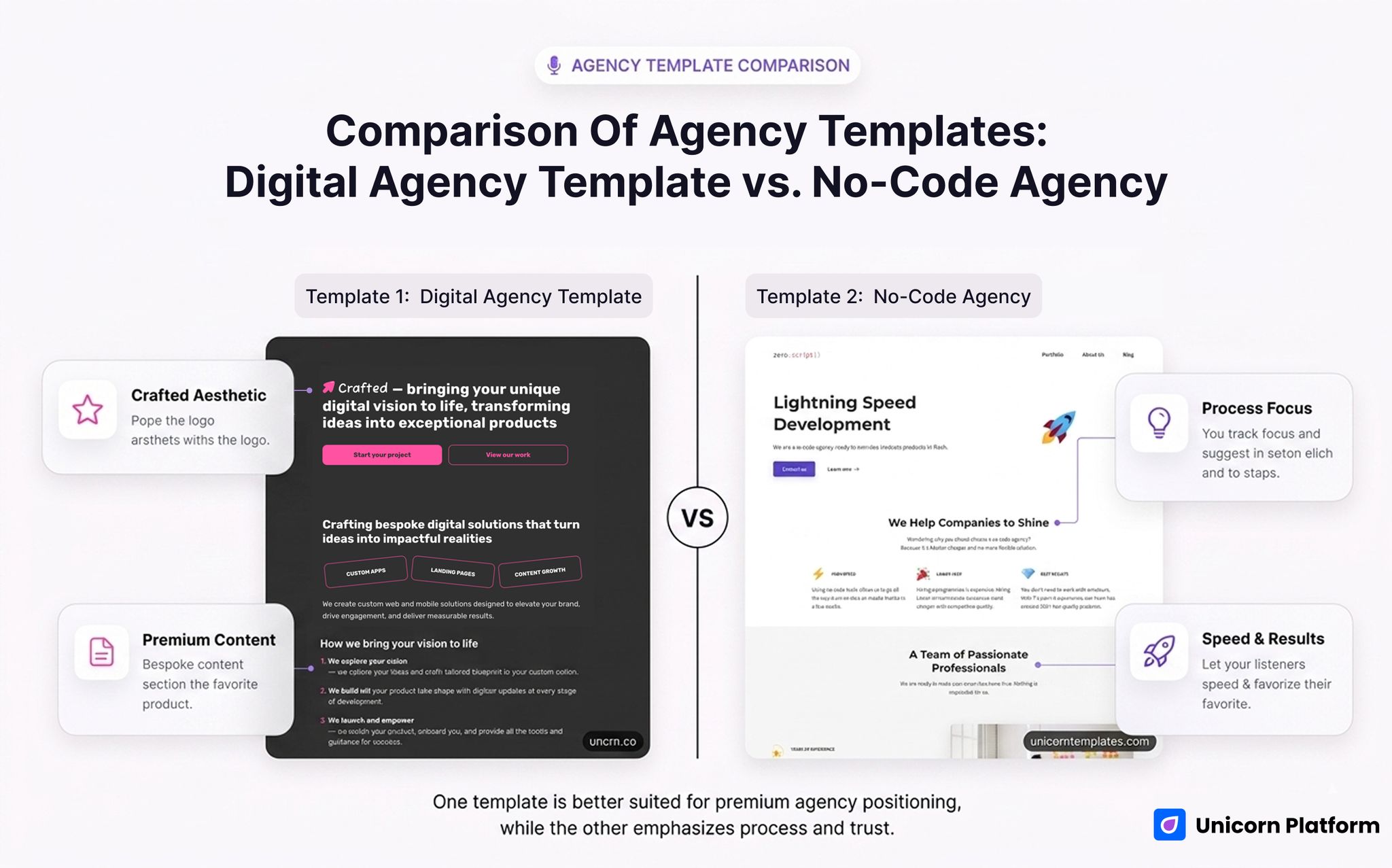
Two agency site templates showing a premium dark creative style and a process-led no-code style
Quick Answer
These agency templates are strong fits if you want to launch:
- a digital agency website
- a creative studio site
- a no-code agency homepage
- a service-led product studio page
- an agency portfolio and inquiry site
They are weaker fits if you need:
- a content-heavy agency blog-first site
- a complex SaaS product site
- a heavy self-serve lead-gen funnel
- a marketplace or directory product
The core decision is simple:
-
choose
Digital Agency Templateif your site needs to feel premium, portfolio-led, and offer-driven -
choose
No-code Agencyif your site needs to build trust through process, proof, and clearer service explanation
sbb-itb-bf47c9b
At a Glance: Which Template Is Better for What?
Before going deep, here is the practical split:
-
Digital Agency Templateis better for creative studios, design-led service firms, and agencies selling custom project packages. -
No-code Agencyis better for no-code agencies, faster-delivery studios, and teams that need to explain why their working model is attractive.
That difference matters because not every agency wins trust the same way.
Some agencies sell with:
- aesthetic confidence
- portfolio polish
- premium packaging
Others sell with:
- speed
- process clarity
- trust through transparency
- delivery logic
These two templates sit on opposite sides of that line in a helpful way.
Who This Page Is For
This page is best for:
- founders building a digital agency site from scratch
- creative studios rethinking their portfolio and inquiry structure
- no-code agencies that need a cleaner trust and process story
- consultants or small service teams choosing between premium positioning and clearer process framing
If your main question is which agency template should I start with?, this page is for you.
If your main question is how do I build a full inbound funnel for an agency?, the answer goes beyond template choice.
How We Evaluated These Agency Templates
We evaluated both templates like a service buyer would, not like a gallery browser.
The key questions were:
- does the template explain the offer clearly?
- does it create trust fast?
- does it show enough proof to justify contact?
- does it support a strong portfolio or work showcase?
- is the CTA path clear?
- what kind of agency does each template fit best?
That matters because agencies do not lose clients only because of weak visuals. They lose when the site does not make the next step feel easy or credible.
Template Review: Digital Agency Template
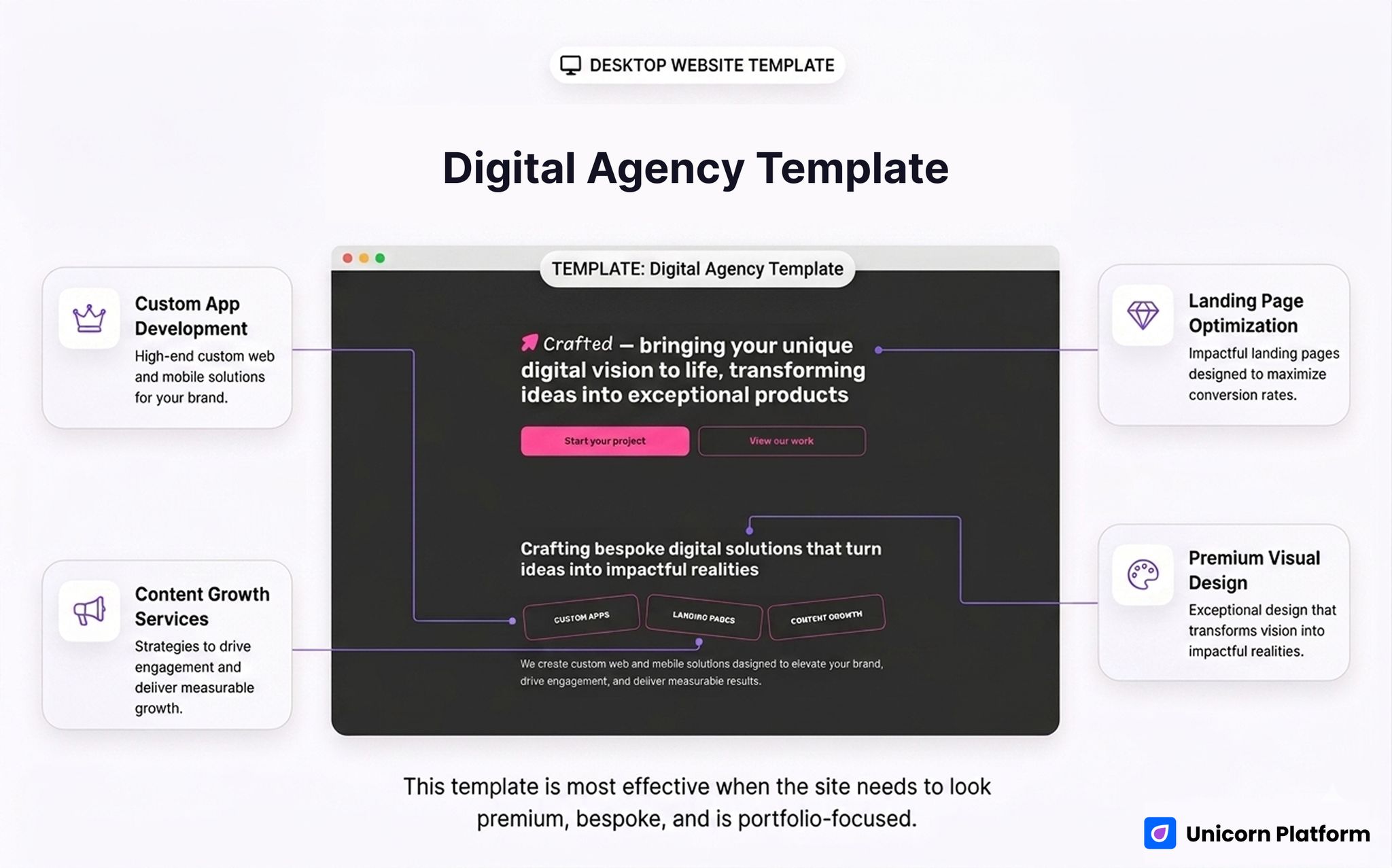
Dark agency site template with bold hero, portfolio calls to action, and premium service framing
- Best for: creative studios, design agencies, premium product teams, and custom-service firms
- Style: dark, bold, polished, premium, portfolio-forward
- Strongest sections: hero, services overview, work showcase, pricing, FAQ, about block
- CTA style: project-start and portfolio-view actions
- Proof style: work-driven trust with supporting about and FAQ content
- First customization priority: sharpen the offer so the premium feel maps to a specific agency niche
- Main limitation: weaker on transparent process explanation than the no-code option
The first big advantage of this template is confidence. The hero language feels ambitious and custom-service-oriented. Instead of generic agency filler, it leads with a clear promise around bespoke digital solutions. That makes it a better fit for agencies that want to feel premium rather than purely operational.
The second strength is how it balances service framing and portfolio direction. The main CTAs are Start your project and View our work, which is exactly what many agencies need. One CTA moves a buyer toward action. The other gives cautious buyers a proof path. That balance is stronger than a site that uses only one kind of CTA everywhere.
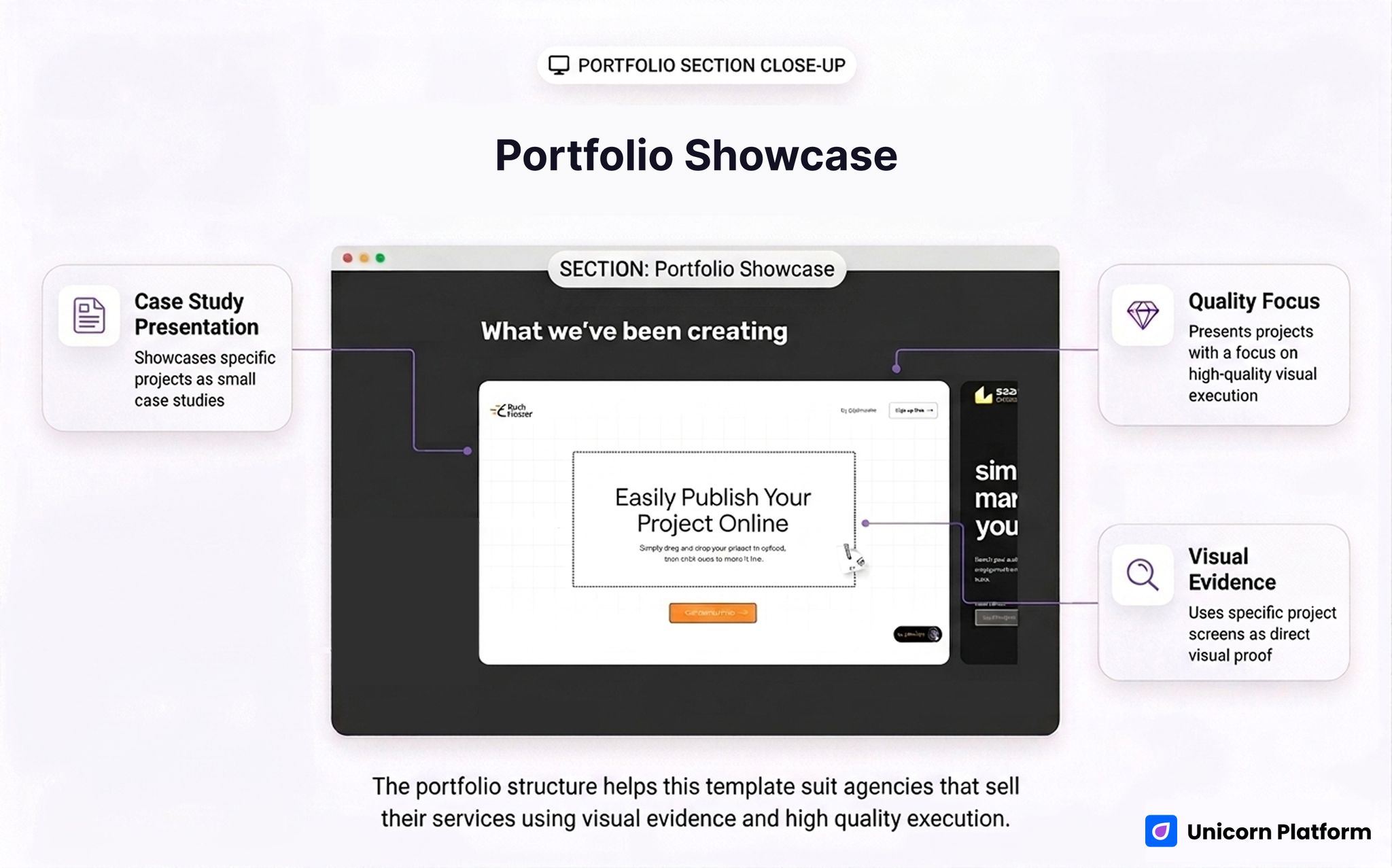
Portfolio section showing agency work categories and case-study style presentation
The portfolio layer is another major advantage. The page includes a section like What we’ve been creating and pushes into a broader work showcase. That is especially useful for creative agencies, design studios, and teams whose best selling asset is visible output.
The pricing section is also a differentiator. Many agency templates avoid packaged offers entirely, which can make the site feel vague. Here, there are clear package-style options like Starter and Premium. That does not mean every agency should show pricing, but it gives the template an advantage for firms that want to qualify leads earlier or signal project scope more clearly.
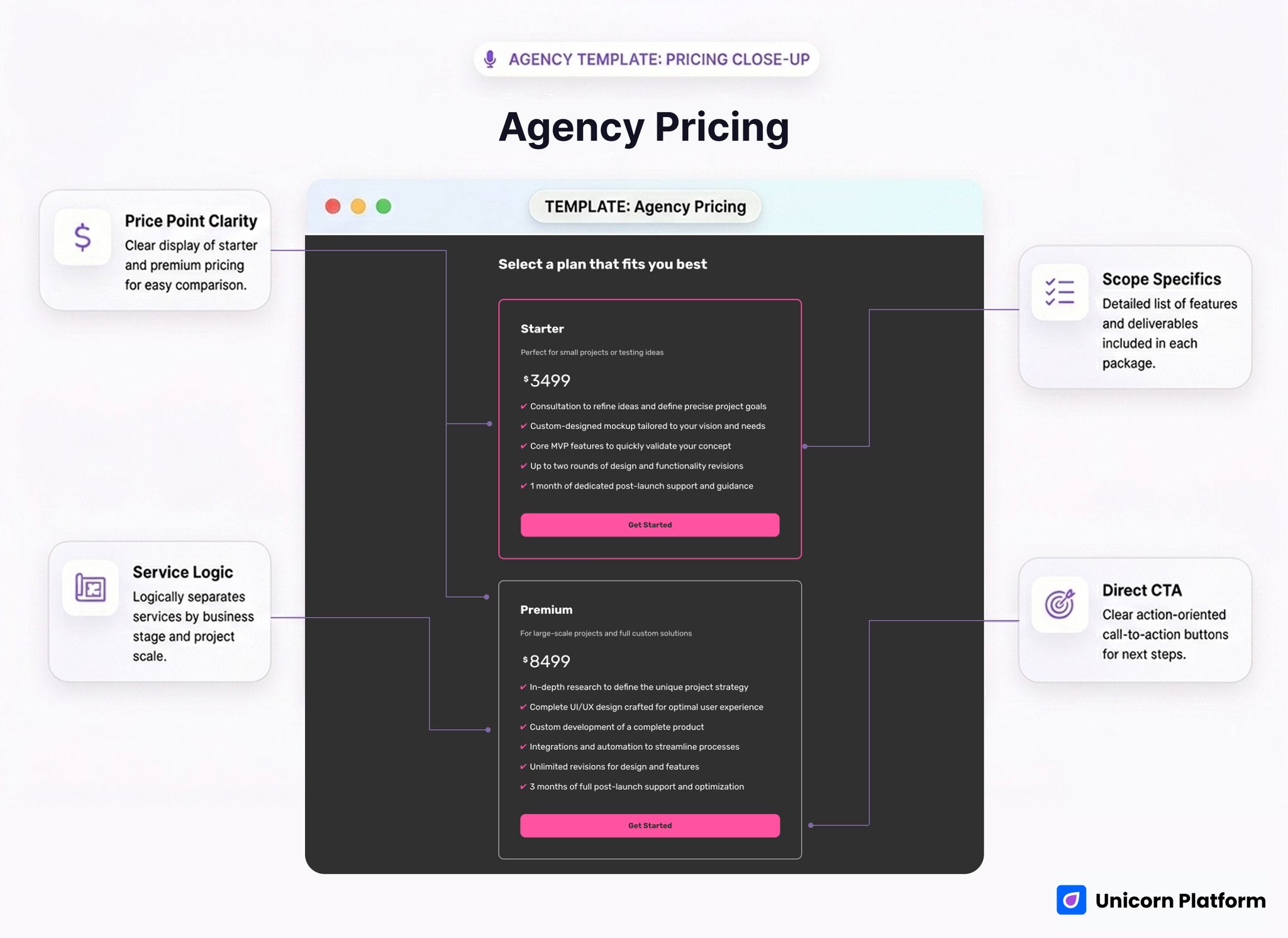
Agency pricing cards showing starter and premium packages with scope details
The tradeoff is that this template is less explicit about process trust than the no-code option. Buyers who need reassurance about delivery steps may still want more structure around how the project actually unfolds.
Template Review: No-code Agency
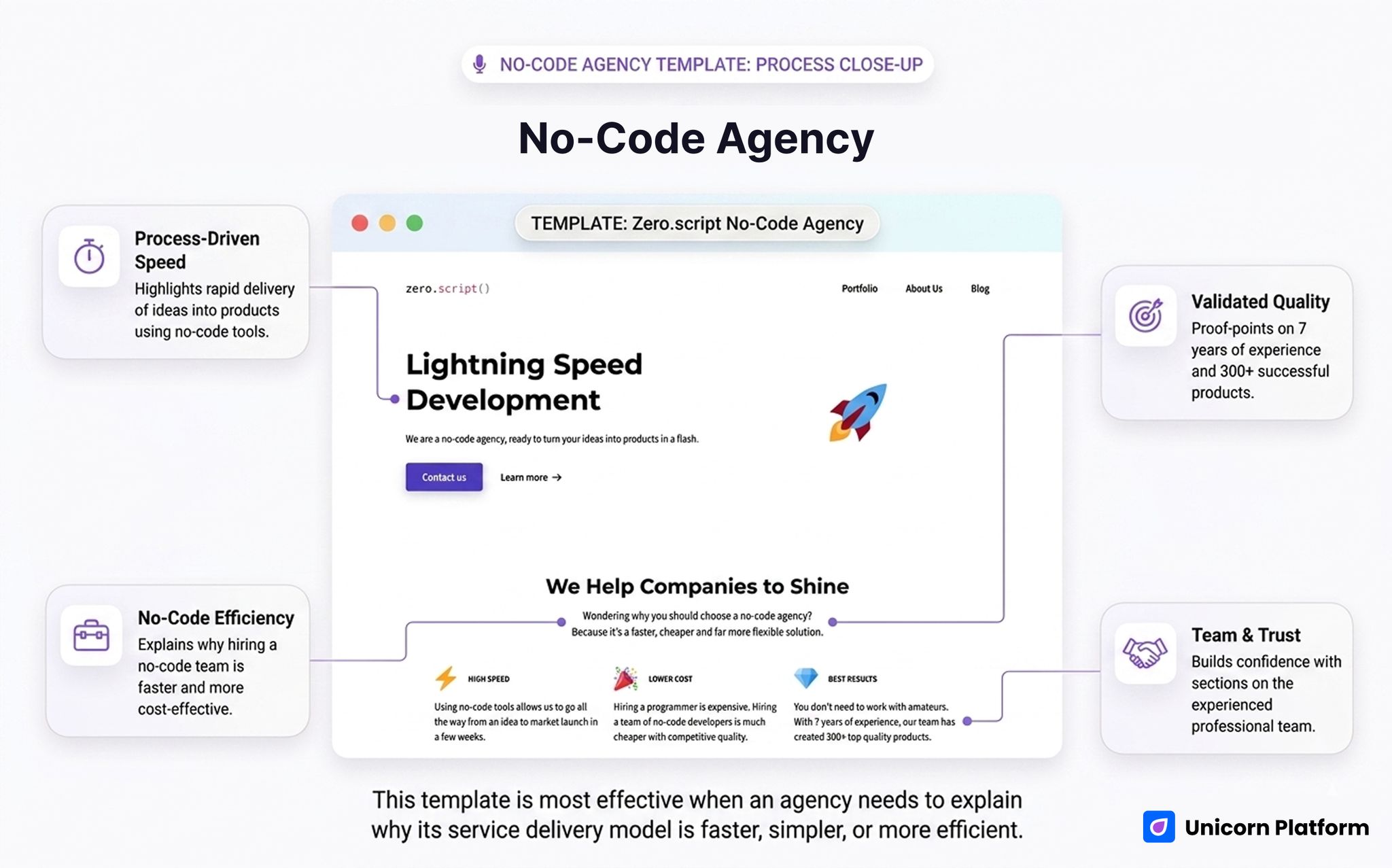
No-code agency website template with a process-driven hero, service proof, and team/trust sections
- Best for: no-code agencies, productized service teams, fast-delivery studios, and smaller service firms
- Style: bright, clear, process-led, trust-heavy
- Strongest sections: hero, benefit explanation, team block, process block, testimonials, portfolio categories
- CTA style: contact-first with supporting learn-more and portfolio actions
- Proof style: testimonials, experience claims, and operational clarity
- First customization priority: rewrite the no-code message around your actual value proposition and niche
- Main limitation: less premium and less offer-packaged than the darker agency option
The best thing about this template is that it explains itself well. The hero leads with Lightning Speed Development and immediately tells the user why the model matters. That is helpful for agencies that do not win because they look expensive or exclusive. They win because they are fast, flexible, or easier to work with.
The next strength is the proof sequence. Instead of relying only on a polished hero and portfolio, this template builds trust through:
- why the agency model matters
- the team behind the work
- a simple process section
- testimonials from clients
That makes it especially useful for agencies selling a new or unfamiliar delivery model. If your agency often has to explain why no-code, faster production, or leaner delivery is a good thing, this template does more of that work for you.
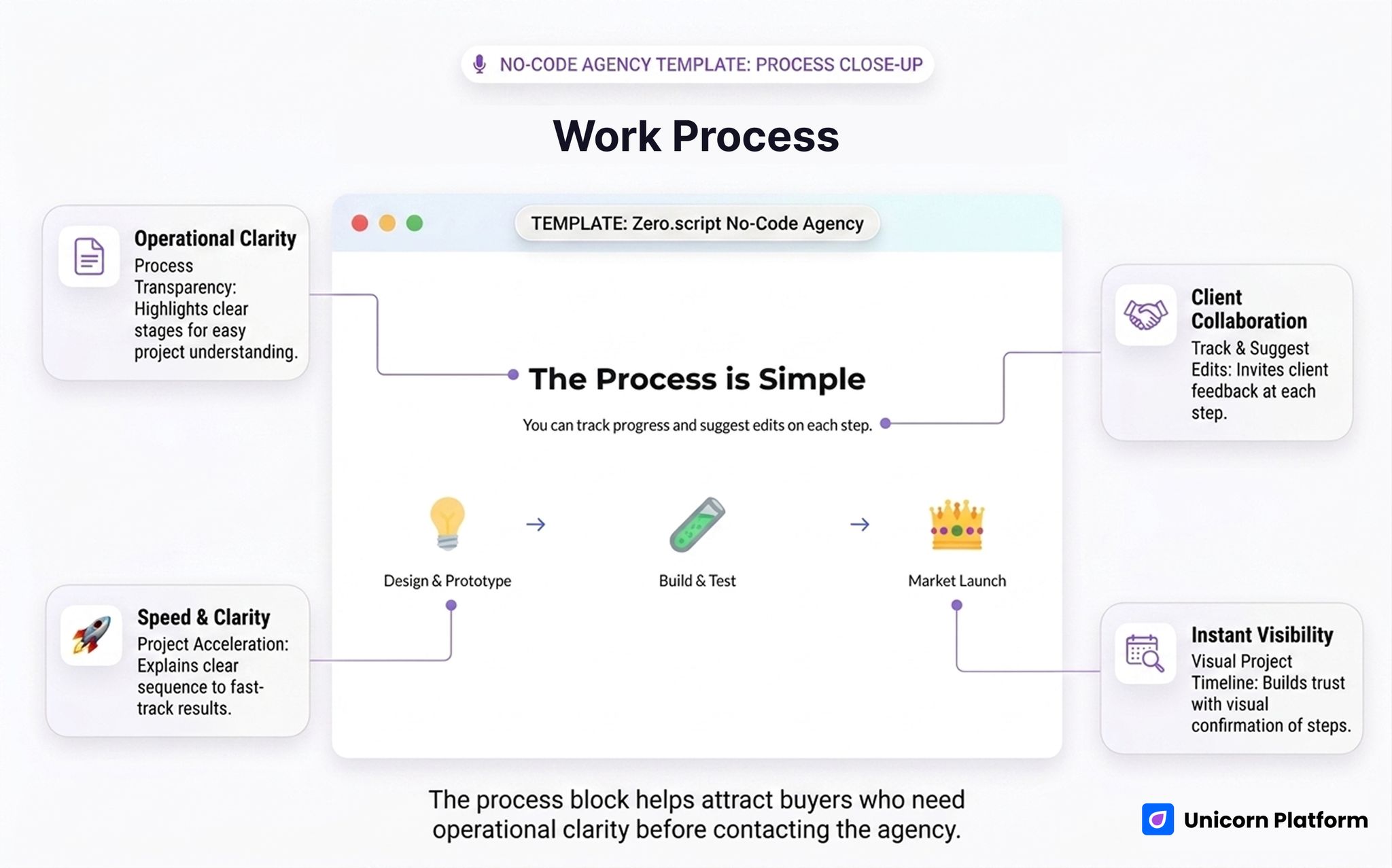
Agency process section explaining clear project steps and delivery flow
The testimonials section is another real advantage. Client quotes and founder/CEO attribution make the site feel more relational. For smaller agencies or newer firms, that kind of trust may matter more than a dramatic premium design system.
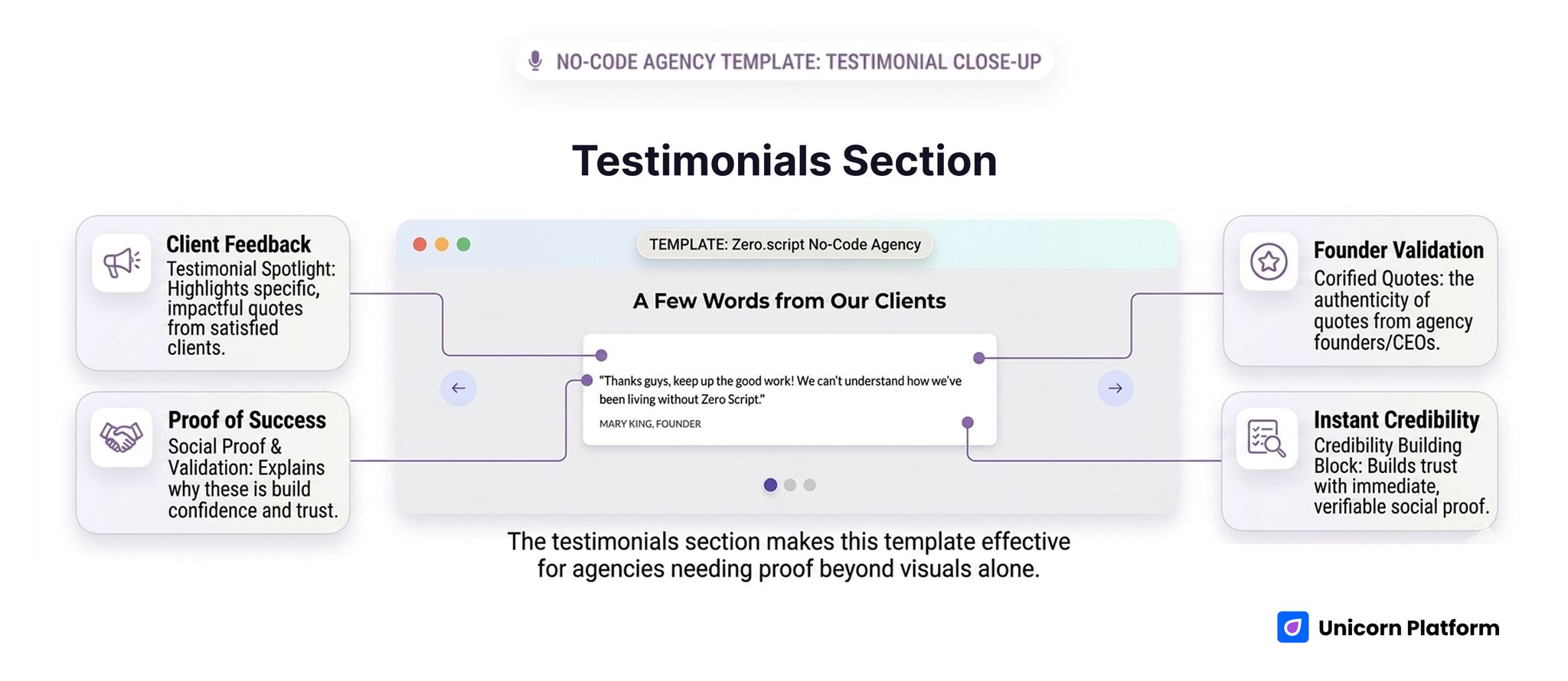
Testimonial slider showing founder and CEO quotes from agency clients
The main tradeoff is positioning. This template is clearer, but it feels less premium and less packaged than the darker digital-agency option. That is not a flaw. It just means the site works better for agencies selling approach and trust than for agencies selling status and aesthetic polish.
Side-by-Side Comparison
| Decision area | Digital Agency Template | No-code Agency |
|---|---|---|
| Premium first impression | Strong | Medium |
| Process explanation | Medium | Strong |
| Portfolio-led selling | Strong | Medium-high |
| Testimonial trust | Medium | Strong |
| Pricing/package clarity | Strong | Weak to medium |
| Team credibility | Medium | Strong |
| Creative-studio fit | Strong | Medium |
| No-code agency fit | Medium | Strong |
| Speed to launch | Strong | Strong |
Best Fit by Agency Type
Creative Agency
Digital Agency Template is the better fit. It looks more premium, supports stronger portfolio-led selling, and feels more natural for agencies that win through design quality, custom output, and polished presentation.
Web Design Studio
Again, Digital Agency Template usually wins here, especially if the studio needs strong work showcase and clearer package or offer framing.
No-code Agency
No-code Agency is the better fit. It explains speed, flexibility, and delivery logic more clearly. That matters because many no-code agencies still need to help buyers understand why their model is strong.
Consultant or Small Service Team
This depends on how the business sells. If the team sells through expertise and outcome confidence, Digital Agency Template can work well. If the team sells through accessibility, speed, and trust, No-code Agency is often safer.
What To Customize First
If you choose either template, start with the commercial logic before surface design.
1. Rewrite the niche-specific offer
Neither template should stay generic. The top section should tell the reader whether you are:
- a branding agency
- a web design studio
- a no-code product team
- a productized service agency
- a growth-focused creative partner
That specificity is more valuable than color changes.
2. Make proof match the agency model
Portfolio-led agencies should strengthen:
- case-study framing
- before/after outcome language
- visual depth
Process-led agencies should strengthen:
- delivery steps
- revision policy
- project scope expectations
- client proof
3. Fix the inquiry path
The CTA should match how you close work.
Examples:
- book a call
- request a proposal
- start a project
- view pricing first
If your CTA path is wrong, even a strong template will leak qualified leads.
4. Align the About section with the sales model
Some agencies need founder credibility. Others need team credibility. Others need operational confidence. Adjust the About content so it supports the real buying decision, not just the habit of having an About section.
5. Decide whether pricing belongs on the page
The darker agency template already includes strong pricing logic. That is useful if you want to qualify buyers early. But if your agency closes through custom scopes only, you may want to reframe that area into engagement models or starting points instead.
When These Templates Are the Wrong Fit
These templates are not ideal if your business needs:
- a content-heavy thought-leadership site first
- a product-led SaaS homepage
- a large multi-service corporate site
- a complex self-serve client portal
They are also less ideal if your agency depends on very detailed case studies with long-form storytelling and layered navigation. In that case, you may still use one of these as a base, but you will need more structure.
Why Build This in Unicorn Platform
If your goal is to launch an agency site quickly, Unicorn is useful because it gives you a strong structure without forcing you to design every section from zero. That matters most when the business already knows its offer and just needs a better way to present it clearly.
It is especially practical for smaller agencies, no-code teams, and service firms that want to move fast, test positioning, and tighten the inquiry flow before investing in something more custom.
If you want to explore the platform before choosing a template, start with the homepage or compare plans on pricing.
FAQ
Which template is better for a creative agency?
Digital Agency Template is usually better because it feels more premium and supports stronger portfolio-led selling.
Which template is better for a no-code agency?
No-code Agency is the stronger fit because it explains the delivery model, process, and trust story more clearly.
Do these templates support portfolios?
Yes. Both do, but in different ways. The darker agency template is more portfolio-forward, while the no-code template uses portfolio alongside process and testimonial trust.
Is the pricing section useful on an agency site?
It can be. The Digital Agency Template shows that pricing or packaged-scope framing can help qualify leads earlier. It is useful if your agency has repeatable offers or wants to reduce weak-fit inquiries.
Are testimonials stronger than portfolio visuals?
Not always. Portfolio visuals are often better for creative trust. Testimonials are often better for operational or delivery trust. The stronger choice depends on how your agency wins work.
What should I customize first after choosing one?
Start with the niche-specific offer, the CTA path, and the proof model. Those changes matter much more than small design adjustments.
Can these templates work for consultants?
Yes, especially if the consultant’s offer is service-led and project-based. The better choice depends on whether the consultant needs premium positioning or clearer process trust.
Are these full agency systems?
No. They are strong public-facing agency templates. They help with positioning, proof, and inquiry flow, but they are not client portals or full operating systems.
Final Takeaway
If you want a template that helps you present services clearly, build trust faster, and move visitors toward better inquiries, Unicorn gives you two genuinely different paths.
Choose Digital Agency Template if your agency sells through premium presentation, portfolio strength, and clearer package framing.
Choose No-code Agency if your agency sells through process trust, speed, and delivery clarity.
That difference is exactly why this comparison can attract more relevant organic traffic when it is positioned honestly.
The right template is not the prettier one. It is the one that matches how your agency actually wins clients.
