Table of Contents
- Positioning Framework for a High-Performing CRE Website
- Trust Architecture for Commercial Real Estate Websites
- 30-Day Launch Plan for a No-Code CRE Website
- Positioning Framework for a High-Performing CRE Website
- FAQ
Commercial real estate websites fail for predictable reasons. The message is often too generic, listing information is hard to scan, and inquiry flows collect either too little context or too much friction. The result is a familiar pattern: high traffic, low trust, and inconsistent lead quality.
The technical side is no longer the bottleneck. Today, teams can publish strong CRE websites without writing custom code, but tools alone do not create results. Performance comes from structure, positioning, and a disciplined operating model that connects page experience to pipeline outcomes.
This guide gives you that model. It focuses on how to build a custom commercial real estate website that feels credible to investors and tenants, supports SEO growth, and helps your team qualify opportunities faster.
sbb-itb-bf47c9b
Key Takeaways
Key Takeaways for Creating Custom Commercial Real Estate Websites Without Coding
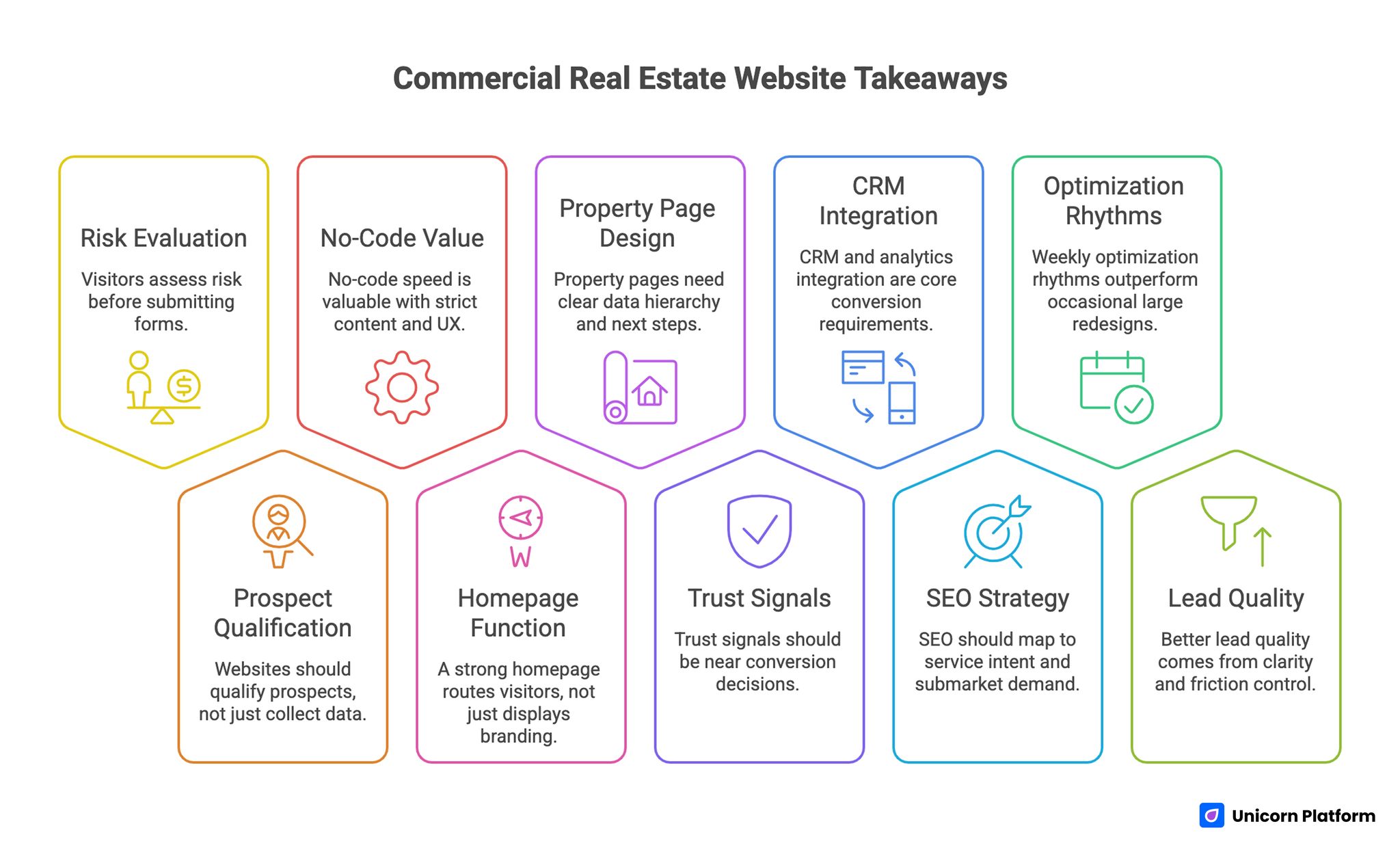
- Commercial real estate visitors evaluate risk before they submit a form.
- Your website should qualify prospects, not only collect contact data.
- No-code speed creates value when paired with strict content and UX standards.
- A strong homepage is a routing layer, not a brand vanity page.
- Property pages need clear data hierarchy and practical next steps.
- Trust signals should appear near conversion decisions, not hidden at the bottom.
- CRM and analytics integration are core conversion requirements.
- SEO should map to service intent and submarket demand, not broad volume terms.
- Weekly optimization rhythms outperform occasional large redesigns.
- Better lead quality usually comes from clarity and friction control, not more traffic.
Why Commercial Real Estate Websites Require a Different Approach
Commercial real estate decisions are rarely impulse actions. Buyers, tenants, landlords, and investors compare options using long evaluation cycles that include operational constraints, timing risk, and financial tradeoffs. A site built like a generic marketing page cannot support that decision behavior.
Most CRE users arrive with one of three intents. They want to evaluate available space, assess advisory credibility, or understand market conditions before outreach. If the first screen does not route them quickly to the right path, they leave or submit low-context inquiries that are hard to qualify.
This is why CRE websites should be treated as qualification systems. Every section should either reduce uncertainty, build confidence, or move users toward a clear next step.
Why No-Code Is a Strategic Advantage for CRE Teams
Commercial markets move quickly. Availability changes, incentive packages shift, and submarket narratives evolve with each quarter. If content updates depend on engineering queues, your site becomes stale and credibility drops.
No-code workflows give brokerage and marketing teams direct publishing control. That speed lets you update listings, change positioning, launch campaign pages, and test CTA logic without waiting on development handoffs. In CRE, update speed is not just operational convenience; it is a trust signal.
The advantage grows when teams standardize reusable components. Instead of rebuilding every page, you duplicate proven blocks for property cards, trust sections, and inquiry modules, then adapt only market-specific content.
Positioning Framework for a High-Performing CRE Website
Clear positioning improves every downstream metric from bounce rate to lead quality. Use a three-layer framework before you build pages.
Layer 1: Market thesis
Define exactly where you compete. This should include property type focus, geographic scope, and client profile. Broad statements like "full-service commercial real estate" do not help users self-qualify.
A sharper thesis might be tenant representation for growth-stage healthcare operators in suburban medical office corridors, or investment sales advisory for small-bay industrial assets in specific metros. Specificity improves trust and reduces mismatched inquiries.
Layer 2: Decision outcomes
State the outcomes your audience cares about in practical language. Tenants may care about occupancy timing and operating flexibility. Investors may focus on yield stability, tenant quality, and downside protection. Landlords may prioritize lease-up velocity and tenant fit.
When outcomes are explicit, users can quickly decide whether your process matches their objectives.
Layer 3: Proof logic
Proof should validate your stated outcomes. Use selected case summaries, role-specific testimonials, transaction context, and process clarity. Generic credibility claims are weak if they are not connected to audience-specific concerns.
A simple rule is claim followed by proof within one screen. This pattern reduces skepticism and helps users move through longer pages.
Information Architecture That Supports Both Search and Conversion
Building a High-Converting Commercial Real Estate Websites
A strong CRE website does not need dozens of pages at launch, but it needs the right page jobs. Start with a focused architecture and expand by demand signals.
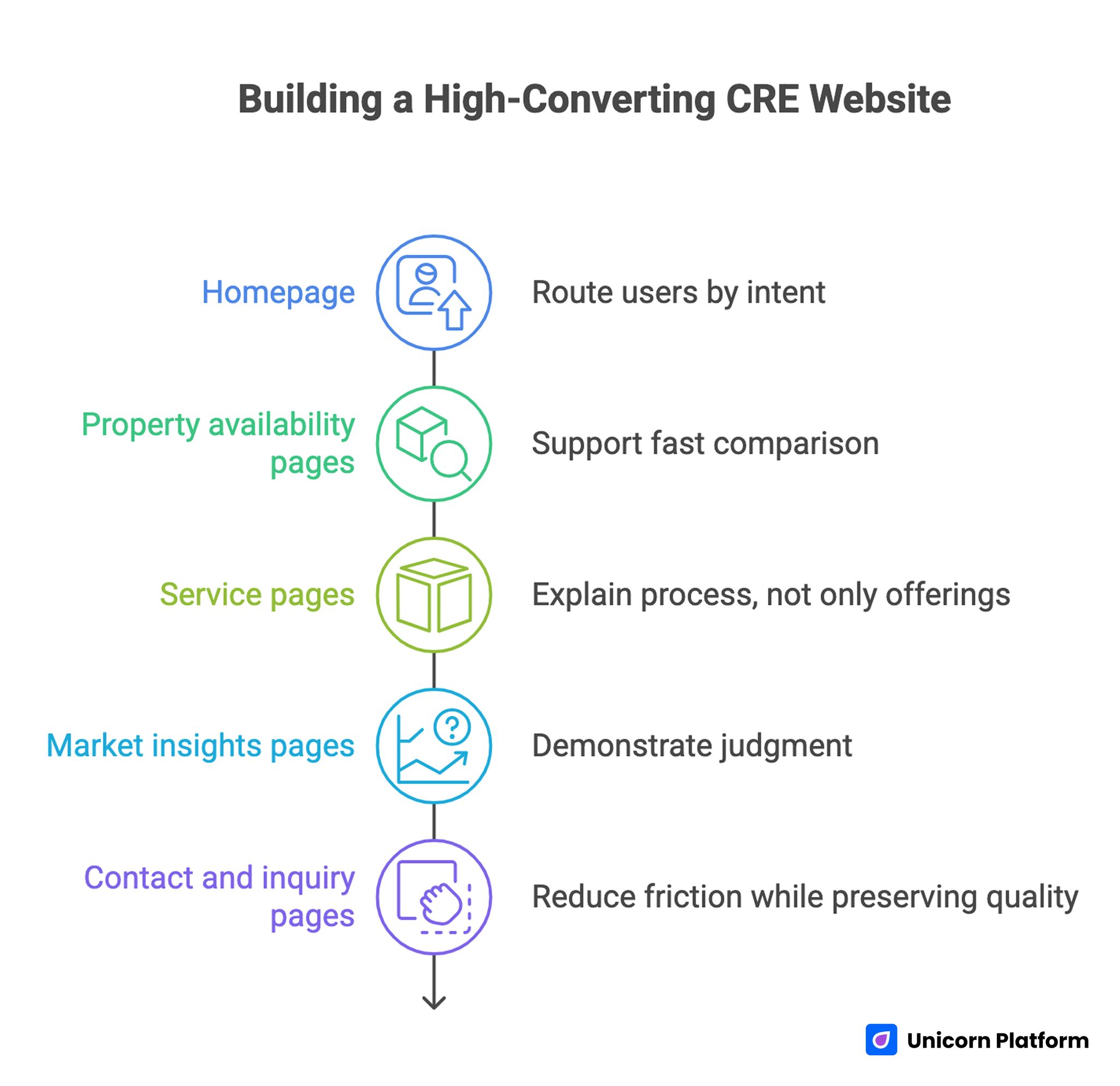
Homepage: route users by intent
The homepage should immediately segment visitors toward listings, services, and market insights. Treat it as an intent router. Keep messaging specific to your market thesis and avoid long brand narratives before users can find what they came for.
Property availability pages: support fast comparison
Availability pages should show key filters and data points early. Users should be able to compare size, status, location, and use-case fit without opening multiple pages blindly.
Service pages: explain process, not only offerings
Each major service deserves a dedicated page with clear scope, engagement model, and expected outcomes. If all services are compressed into one generic page, trust and SEO relevance both suffer.
For recurring operations-heavy offerings, building a dedicated service path similar to this custom property management landing page setup helps separate management intent from brokerage intent.
Market insights pages: demonstrate judgment
CRE decisions are information-heavy. Insight pages should provide concise analysis with practical implications, not abstract commentary. This content supports both authority and organic discovery.
Research from the Content Marketing Institute highlights that high‑quality, audience‑focused content significantly improves both user trust and organic visibility. Content that answers real business questions — such as market trends or transactional guidance — builds long‑term authority and supports better SEO outcomes.
Contact and inquiry pages: reduce friction while preserving quality
Contact flows should allow quick outreach while capturing enough context for triage. Short forms can work if follow-up sequencing is strong.
Property Page Blueprint for Better Lead Quality
Many teams underestimate how much conversion quality is determined on property-level pages. These pages should answer practical decision questions before users are forced into inquiry.
A strong property page sequence looks like this:
- Clear headline with property type and location context.
- Immediate key facts such as square footage, availability timing, and positioning.
- Visual proof including photos, plans, or mapped context.
- Fit-oriented narrative describing ideal tenant or investment profile.
- Friction-reducing CTA with role-specific language.
Each block should reduce one layer of uncertainty. Users should not need to hunt for baseline data before contacting your team.
Page copy should avoid inflated adjectives and focus on concrete value. Instead of saying "premium opportunity," explain what makes the opportunity practical in terms of accessibility, efficiency, tenant demand, or operational fit.
Lead Capture Architecture: Volume vs Quality Control
Lead generation in CRE is not a pure volume game. Unqualified submissions consume time and reduce response quality for high-intent prospects. Your website should optimize for both completion rate and qualification signal.
Use role-based entry points. Tenant, investor, and owner inquiries should not share the same generic form language. Role segmentation improves response relevance and allows faster routing to the right team.
Keep first-step forms short but purposeful. Ask only fields required for initial qualification, then collect depth in follow-up. Early over-collection reduces completion. Early under-collection creates triage chaos.
Add confidence copy near form actions. Clarify response timing, privacy handling, and what happens next. Small transparency cues can raise completion quality without changing form length.
For many teams, a two-path CTA model works well: immediate inquiry and scheduled consultation. This captures both high-urgency and high-consideration users without forcing one behavior pattern.
If you run campaign traffic, structure those pages using patterns from build high-converting real estate landing pages in minutes so message match remains strong from click to form.
Trust Architecture for Commercial Real Estate Websites
Trust Architecture for Commercial Real Estate Website Design
Trust in CRE is built through specificity, not decoration. Logos and awards can help, but they are weak without context tied to user concerns. According to research from Forrester, digital trust — built through transparent messaging, context‑based proof, and consistent UX — has a measurable impact on user decision confidence, especially in high‑consideration B2B categories such as commercial real estate.
Use trust in three layers.
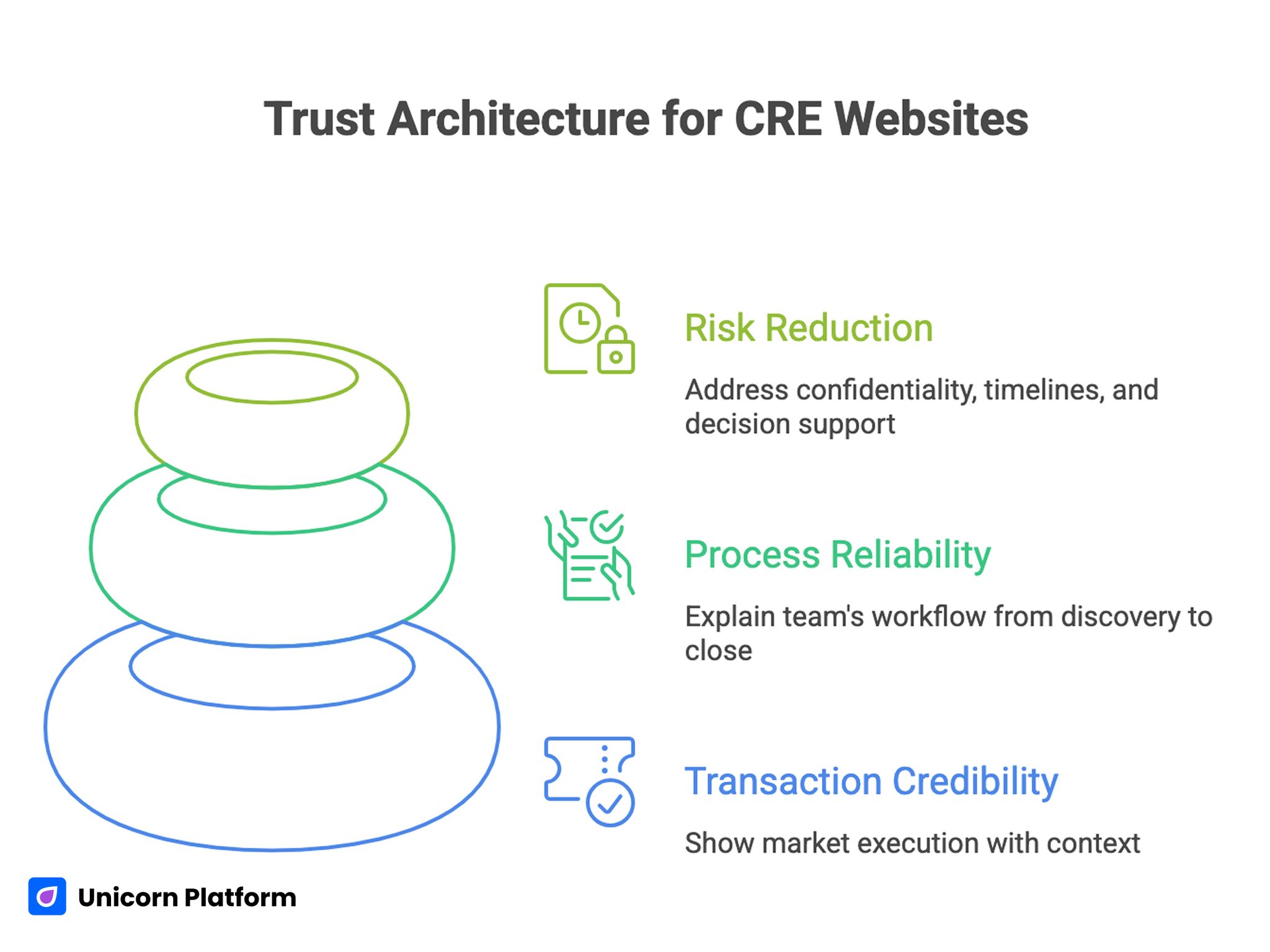
1. Transaction credibility
Show selected proof of market execution with clear context. Property type, market segment, and outcome relevance matter more than large unspecific numbers.
2. Process reliability
Explain how your team works from discovery to close. A transparent process reduces perceived operational risk and helps users predict engagement quality.
3. Risk reduction
Address practical concerns directly: confidentiality expectations, timeline communication, and decision support. Risk-reduction language near CTA zones often improves inquiry confidence.
Trust blocks should be distributed across the page journey. If all proof appears in one isolated section, many users never connect claims to evidence.
UI and UX Standards That Improve Performance
Design quality in CRE is less about visual novelty and more about readability under decision pressure. Users compare assets quickly and need structured information flows.
For teams refining baseline structure, the framework in real estate website design made simple is useful for aligning readability with conversion flow.
Typography should favor high readability and consistent hierarchy. Large headlines are useful when they stay concise. Body text should avoid dense walls and keep line length controlled for scan speed.
Navigation labels should be explicit. Terms like Listings, Services, Insights, and Contact usually outperform abstract menu labels because they match user intent directly.
Cards and data modules should follow one consistent template across pages. Consistency reduces cognitive load and helps repeat visitors evaluate new opportunities faster.
On mobile, focus on thumb-friendly interactions and prioritized content order. Many CRE users check opportunities during travel or between meetings, so mobile usability has direct pipeline impact.
SEO Model for Sustainable CRE Growth
SEO for commercial real estate should focus on intent depth, not only headline keyword volume. High-volume terms can attract noise if page content does not align with decision stage.
Start by mapping three query classes: service intent, property-type intent, and submarket intent. Build dedicated pages for each cluster instead of forcing one broad page to rank for everything.
Internal linking should follow decision flow. Service pages should connect to relevant insights. Insights should link to associated service or inquiry paths where appropriate.
Audit internal click paths monthly to confirm users can move from awareness content to service and inquiry pages without dead ends or repetitive loops.
Technical basics remain essential. Keep page speed tight, maintain clean metadata, and make sure key content blocks are crawlable and indexable.
Integration Stack: Website to Revenue Workflow
A CRE website should not end at form submission. It should trigger a clean operational flow that supports fast response and measurable outcomes.
At minimum, integrate four systems:
- CRM for lead routing, ownership, and lifecycle tracking.
- Analytics for source attribution and behavior diagnostics.
- Email automation for confirmation and next-step sequencing.
- Scheduling tools for consultation booking and timeline clarity.
Define service-level expectations for response time by inquiry type. Fast follow-up is a competitive edge in CRE, especially when prospects contact multiple firms in parallel.
Instrumentation should include key behavioral events. Track listing interactions, CTA clicks, form starts, form completions, and calendar bookings by source and page. Without this data, optimization decisions become guesswork.
Operating Model for Continuous Improvement
Website performance improves fastest when ownership is explicit. Assign one owner for content quality, one owner for analytics and reporting, and one owner for lead workflow integrity.
Run a weekly review with a simple structure:
- What changed in traffic quality by source?
- Where did users exit before inquiry?
- Which section edits are most likely to improve qualification?
- What one change will we ship this week?
This process keeps teams focused on high-impact improvements instead of scattered redesigns.
Document decisions and outcomes. Over time, this creates an internal playbook that reduces repeated mistakes and shortens onboarding for new team members.
30-Day Launch Plan for a No-Code CRE Website
Week 1: Strategy and architecture
Finalize market thesis, audience segments, and core page map. Write first-draft messaging for homepage, service pages, and inquiry paths before visual refinement starts.
By the end of week one, your team should have section-level purpose defined for each page and a list of proof assets still needed.
Week 2: Build and content population
Assemble pages in Unicorn Platform using standardized blocks for listings, proof, and CTAs. Add property data modules, trust context, and role-based inquiry flows.
Run internal content QA for clarity, consistency, and message fit by audience segment.
Week 3: Integrations and launch readiness
Connect CRM, analytics, and scheduling. Validate event tracking, destination routing, and notification workflows.
Test on real mobile devices and desktop to confirm readability, form behavior, and perceived load speed.
Week 4: Launch and first optimization cycle
Publish the initial version and monitor behavior by source. Prioritize fixes for high-drop sections and low-quality inquiry patterns.
Ship one focused improvement set rather than broad redesign. Early discipline improves learning speed.
Common Failure Modes and Practical Fixes
1. Generic positioning
Visitors cannot tell what segment you serve or why your team is different.
Fix: Rewrite headline and top sections around one clear market thesis and one audience outcome.
2. Listing pages with weak data hierarchy
Users see visuals but miss key facts needed for evaluation.
Fix: Standardize property cards and detail pages with consistent fact order and visible status cues.
3. Form friction mismatch
Forms are either too long for first contact or too vague for qualification.
Fix: Use short first-step forms with role-based fields and structured follow-up.
4. Isolated trust section
Proof exists but is disconnected from conversion decisions.
Fix: Place trust elements near claims and CTA zones throughout the page journey.
5. No source-level optimization
Teams evaluate only aggregate lead count and miss channel-level quality differences.
Fix: Track behavior and conversion by source, then tune pages for segment-specific intent.
6. Slow update cycles
Content lags behind market changes, reducing credibility.
Fix: Assign clear owners and run weekly update windows with predefined QA checks.
7. One-time launch mentality
Teams publish once and treat the site as finished.
Fix: Operate the website as a recurring optimization program with documented experiments.
Content System for CRE Authority and Deal Flow Support
High-performing CRE websites usually pair transaction pages with a structured insight layer. This content should not be random blog activity. It should support active decisions your audience is already making, while strengthening long-tail visibility for the markets and asset classes you serve.
Build content in three recurring streams. First, submarket intelligence updates that explain inventory shifts, leasing patterns, pricing pressure, and practical implications for tenants or investors. Second, execution guides that help users navigate real processes such as site selection, underwriting checks, or lease negotiation preparation. Third, short commentary pieces tied to current market events that affect timing and risk.
Each content stream should have a clear conversion bridge. A market update can route to a consultation CTA for strategy discussions. A process guide can route to a service page for users who need support now. An event commentary can route to a focused contact path for fast-moving opportunities.
Maintain editorial standards that keep content decision-focused. Use concrete data points where available, avoid jargon-heavy narratives, and close each piece with one practical next step for the reader. Content that feels actionable tends to perform better for both engagement depth and qualified follow-up.
Plan publication cadence based on operational capacity. A smaller team that publishes one strong insight per week with consistent quality can outperform a team that publishes higher volume with weak relevance. Consistency and trust are more valuable than volume bursts in CRE.
Track content impact beyond pageviews. Monitor assisted inquiries, returning visitor behavior, and service-page click-through rates from insight articles. This reveals which topics are actually moving users toward high-intent actions.
90-Day Optimization Roadmap After Initial Launch
Most CRE websites improve meaningfully within the first 90 days when optimization is structured. The goal is not to test everything at once. The goal is to run sequenced improvements that isolate impact and build a reliable operating baseline.
Days 1 to 30 should focus on instrumentation and friction discovery. Validate tracking for all critical interactions, then identify where users leave before inquiry. Common early friction points include weak first-screen positioning, unclear property data hierarchy, and generic CTA language.
Days 31 to 60 should focus on message and trust refinement. Test audience-specific headline variants, tighten service-page value framing, and move proof blocks closer to conversion points. This phase often produces the largest gain in inquiry quality because it reduces uncertainty before form actions.
Days 61 to 90 should focus on scaling what works. Expand high-performing page patterns to additional submarkets or service segments, and retire low-performing layouts that repeatedly underdeliver. Standardize winning modules so new pages launch with proven structure by default.
Keep the experiment queue short and explicit. Prioritize no more than two active tests per cycle, define success metrics before launch, and document both wins and non-wins. This discipline prevents optimization drift and helps teams build institutional knowledge faster.
Use monthly leadership summaries to align marketing and brokerage teams on outcomes. Report not just total leads, but qualified lead ratio, response speed, and deal-stage progression by source segment. Shared visibility improves decision quality across content, design, and sales follow-up.
FAQ: Creating Commercial Real Estate Websites Without Coding
Can a no-code CRE website look as credible as a custom-built site?
Yes. Credibility comes from clear positioning, consistent design standards, and strong proof architecture, not from whether code was hand-written.
How many pages do we need at launch?
Most teams can start effectively with a focused set: homepage, listings or availability, key service pages, insights, and a role-aware contact path.
What should appear above the fold on the homepage?
Show market focus, audience fit, and one clear next step. The first screen should help users self-qualify immediately.
How do we improve lead quality without hurting conversion rate?
Use role-based forms, better CTA specificity, and clearer expectation copy near inquiry actions. Qualification quality usually improves when uncertainty drops.
Should we publish market insights even if traffic is low at first?
Yes. Insight content builds authority and supports long-term search visibility, especially for submarket and decision-stage queries.
What is the best CTA language for CRE pages?
Use intent-specific language such as Request Availability, Discuss Investment Criteria, or Book a Tenant Advisory Call instead of generic Contact Us.
How often should we update listings and service content?
Update high-impact pages as soon as facts change, and run a full content quality review at least monthly.
Which metrics matter most in the first month?
Track source quality, listing interaction depth, form start-to-completion ratio, and qualified inquiry rate by segment.
Do we need separate pages for different submarkets?
If submarkets differ meaningfully in buyer concerns, inventory, or process expectations, separate pages usually improve both SEO relevance and conversion clarity.
What is the fastest performance fix for an underperforming CRE website?
Tighten first-screen positioning and improve property-page data clarity before redesigning visual style. Those changes often produce the quickest quality gains.
Final Takeaway
You can create custom commercial real estate websites without coding and still produce premium user experience, strong search performance, and better-qualified inquiries. The key is not visual complexity. The key is disciplined structure: clear positioning, trust-driven page flow, and measurable conversion operations.
Use Unicorn Platform to move quickly, but treat the website as a continuously optimized business asset. When your team updates fast, measures cleanly, and improves in weekly cycles, digital performance compounds across both lead volume and lead quality.