Table of Contents
- The Five-Section Architecture That Converts
- 30-Day Execution Plan
- Common Failure Modes and Practical Fixes
- FAQ
A personal professional website is still one of the highest-leverage assets for long-term brand growth. Social platforms can create visibility, but your site is where people decide whether your work is credible, relevant, and worth a conversation.
Many professionals publish a site once and leave it untouched for months. The design may look polished, yet inquiries stay weak because positioning is broad, proof is generic, and the next step is unclear.
A strong personal site does not need heavy complexity. It needs a clear first screen, trust signals placed near decision points, and one conversion path aligned with your current business objective.
This guide shows how to build that system with practical structure and repeatable no-code workflows. The target is not raw traffic alone. The target is better-fit opportunities, faster trust, and a personal brand that compounds over time.
If you are still choosing tooling, this personal website builders for beginners guide helps compare options before you commit to a workflow.
sbb-itb-bf47c9b
Quick Strategic Takeaways
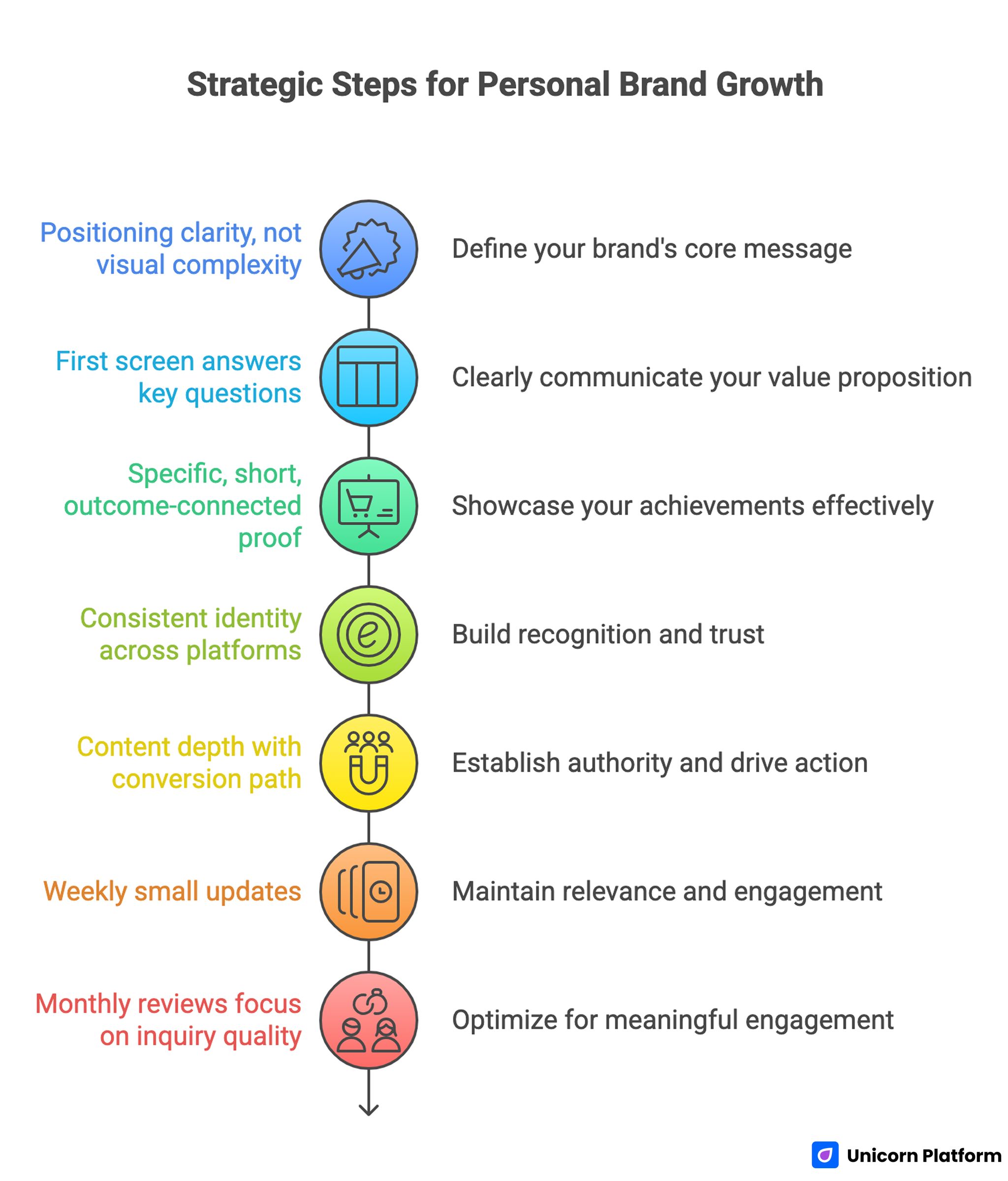
Strategic Steps for Personal Brand Growth
- Personal brand growth starts with positioning clarity, not visual complexity.
- Your first screen should answer who you help, what outcome you create, and why people should trust you.
- Proof works best when it is specific, short, and connected to outcomes.
- Consistent identity across website and social channels improves recognition and trust.
- Content depth builds authority only when paired with an intentional conversion path.
- Weekly small updates outperform occasional full redesign cycles.
- Monthly reviews should focus on inquiry quality, not page views alone.
Reference for the importance of clear positioning and structure: HubSpot: How to Build a Personal Brand
Why Personal Professional Websites Still Drive Real Growth
In 2026, audience trust is fragmented across many channels. A website gives you one controlled environment where narrative, credibility, and action flow can be intentionally aligned.
That control matters because most opportunities begin with fast evaluation. Recruiters, clients, collaborators, and media partners usually decide in minutes whether to continue based on your positioning, proof quality, and contact clarity.
A personal website also compounds better than social content alone. Strong pages keep working through referrals, direct visits, branded search, and repeat readers who return when they need your expertise.
Compounding gets stronger when your site is treated as a living system with documented iteration, rather than as a static online resume.
Start With One Objective and One Priority Audience
Before editing sections, define one primary objective for the current website version. Without this choice, pages become broad and conversion quality drops because every block tries to serve conflicting goals.
Typical primary objectives include consulting inquiries, hiring visibility, speaking opportunities, partnership leads, or newsletter growth. Pick one objective and one priority audience for each update cycle.
Secondary outcomes can still happen, but the core page flow should be optimized for a single primary decision. Additional guidance: Entrepreneur: How to Define Your Website Goals
The Five-Section Architecture That Converts
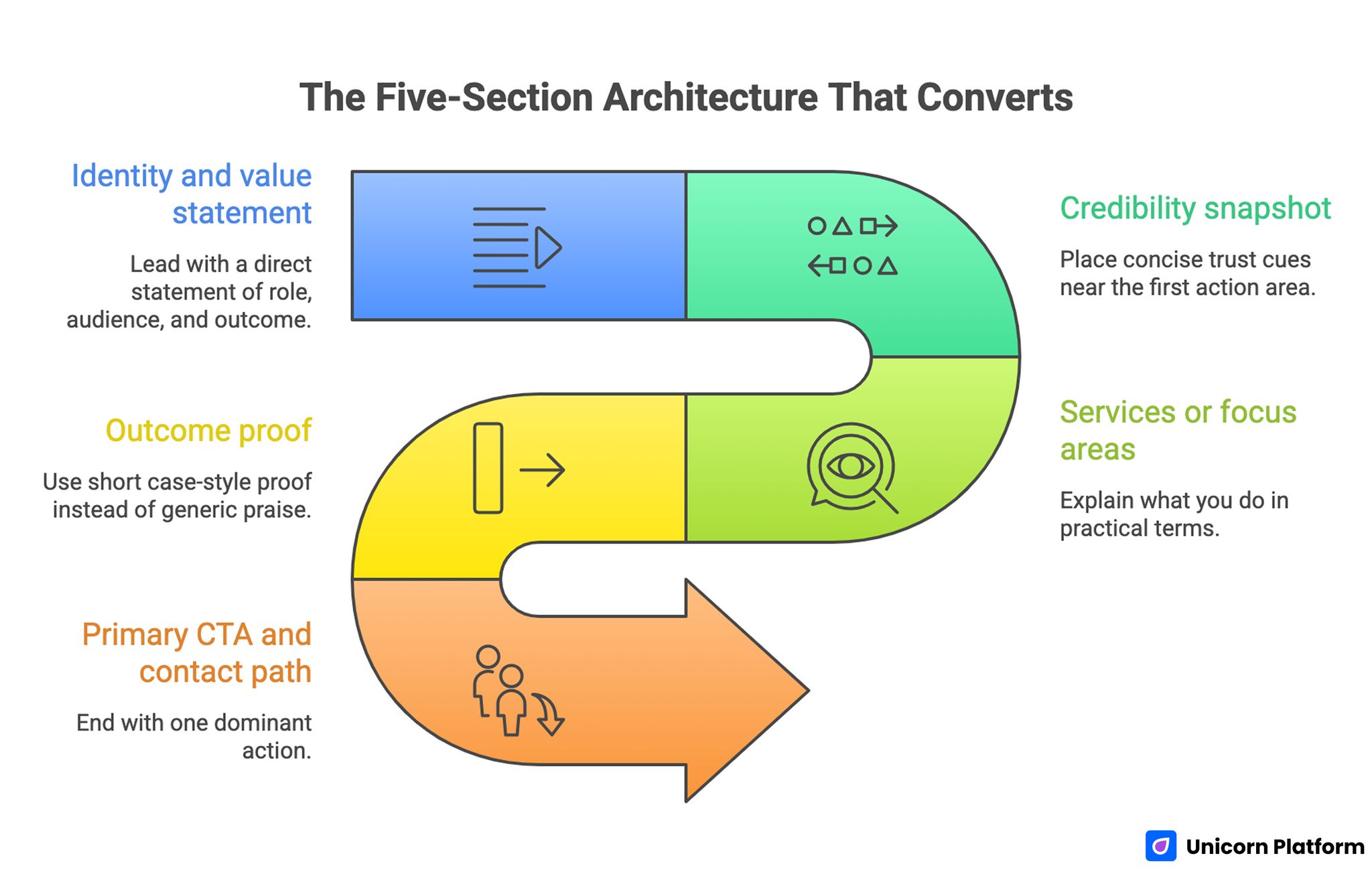
The Five-Section Architecture that Converts
High-performing personal sites use different visual styles, but decision logic is usually similar. A clear section order reduces friction and helps visitors self-qualify quickly.
1. Identity and value statement
Lead with a direct statement of role, audience, and outcome. Avoid broad claims that could describe dozens of professionals in your category.
Specific first-screen language improves relevance fast. The right visitors immediately recognize fit, and the wrong visitors exit early without wasting your time.
2. Credibility snapshot
Place concise trust cues near the first action area. Show selected achievements, short social proof, or role-relevant outcomes that support your core claim.
Early trust reduces hesitation before readers evaluate details. It is usually more effective than hiding all proof in a long section near the bottom.
3. Services or focus areas
Explain what you do in practical terms. Scope clarity should cover audience fit, what is included, expected timeline, and realistic outcomes.
Clear scope improves inquiry quality because visitors understand boundaries before they contact you.
4. Outcome proof
Use short case-style proof instead of generic praise. Strong proof usually includes a starting situation, what you changed, and what improved.
Keep proof scannable with tight formatting. Readability itself is part of perceived professionalism for busy decision-makers.
5. Primary CTA and contact path
End with one dominant action. Explain what happens after submission so visitors know expected response time and next steps.
For professionals who prefer a leaner flow, this one-page personal website framework can simplify structure without losing conversion logic.
Reputation Monitoring Fundamentals Most People Ignore
A website is your main brand hub, but your reputation is shaped across the wider web. That is why monitoring should be part of your monthly brand routine.
Run a branded self-search at least once a month and note what appears on page one. Check whether top results support your current positioning or send mixed signals.
Set alerts for your name, brand name, and core expertise terms. This lets you react quickly to mentions, requests, and stale references that can affect trust.
Claim consistent usernames and profile handles across your active channels, even if some profiles are lightweight. Consistency reduces confusion and strengthens recognition when people move between search results and social pages.
Keep a simple reputation log with three columns: issue, impact, and next action. Over time, this creates a practical cleanup and improvement queue instead of random reactions.
Build a Cross-Channel Identity System
Brand consistency is not about identical wording everywhere. It is about maintaining a stable professional identity while adapting depth to each channel.
Use one short positioning sentence across your homepage, LinkedIn headline, speaker bio, and email signature. Channel-specific copy can expand details, but the core message should stay stable.
A complete identity system usually includes profile image standards, a short and long bio, expertise tags, proof snippets, and response-time expectations for inquiries. These assets save time and prevent quality drift when you publish quickly.
If your current foundation is scattered, this practical walkthrough on building your best personal website with easy tips can help tighten baseline structure before advanced optimization.
Content Formats That Build Personal Authority
Publishing more content is not the goal. Publishing high-signal content that matches your positioning is what builds authority and attracts relevant opportunities.
Use a balanced mix of these eight formats:
- Educational explainers: teach a narrow concept your audience struggles with.
- Point-of-view posts: take a clear stance and explain tradeoffs.
- How-to tutorials: break workflows into concrete steps readers can apply.
- Behind-the-scenes breakdowns: show process decisions and why they mattered.
- Story-based lessons: share turning points with practical takeaways.
- Community response content: answer recurring questions from real conversations.
- Outcome reflections: summarize what worked, what failed, and what changed.
- Testimonial context posts: connect client feedback to specific methods and results.
This mix builds authority faster than repetitive generic tips because it proves depth, perspective, and execution ability.
Build a Weekly Content Engine Without Burnout
A sustainable content engine should support your website, not compete with it. The easiest approach is to build from one core weekly insight and repurpose it intentionally.
Start with one high-quality article section on your site, then adapt it into a short LinkedIn post, a visual summary, and one quick response in a relevant community thread. This keeps your message consistent while expanding reach.
Weekly rhythm matters more than volume spikes. A steady cadence trains your audience to expect useful ideas and improves your confidence in on-brand publishing.
When your homepage positioning and your content topics align, each channel reinforces the same brand signal instead of creating noise.
Engagement and Collaboration Flywheel
Authority is not only built by publishing. It is also built by participating in conversations where your target audience already spends time.
Join relevant communities, answer specific questions, and contribute practical perspective without hard selling. Consistent useful participation creates trust before people even visit your website.
Collaboration also accelerates brand growth when done with intent. Guest contributions, interview exchanges, and co-created resources can introduce your work to aligned audiences that already trust the host.
The key is quality match. Partner with people whose audience overlaps your positioning and whose standards support your long-term brand direction.
SEO That Supports Positioning, Not Just Traffic
SEO works best for personal brands when it reflects your real expertise. Broad topic coverage with vague positioning usually increases low-fit traffic and weak inquiries.
Prioritize descriptive titles, clear heading hierarchy, and internal links between service pages and insight content. This improves discoverability while helping readers navigate toward high-intent actions.
Service-led professionals often benefit from clearer page paths, and this personal services website guide is useful when mapping proof and CTA flow across multiple offers.
Also optimize profile-level SEO basics: clean page titles, consistent name format, and concise metadata that reflects your actual specialty.
CTA Design and Contact Quality Controls
CTA clarity has a direct impact on lead quality. Ambiguous next steps create hesitation for high-fit visitors and attract low-intent submissions.
Choose one primary CTA for each page version, such as booking a discovery call or requesting a scoped proposal. Keep secondary actions visible but clearly lower priority.
Form design should capture enough context without creating friction. For most personal professional sites, a short form with intent selection and a brief context field is enough.
After submission, confirmation copy should explain next steps and timing. Predictability improves trust and reduces drop-off between inquiry and conversation.
Build and Iterate in Unicorn Platform
Using Unicorn Platform effectively is less about templates and more about iteration discipline. The platform gives you speed, but outcomes depend on how clearly you prioritize each update.
Start by documenting your current objective, priority audience, and baseline metrics. Then build or refine the section sequence so message, proof, and action flow are aligned.
Replace generic wording with audience-specific copy and add proof where hesitation usually appears. Validate mobile readability and form behavior before promoting the updated page.
For first-screen clarity patterns, this personal landing page guide offers strong examples of how structure and trust cues work together.
30-Day Execution Plan
Week 1: Baseline and reliability
Publish your core page structure and run an end-to-end QA check for links, forms, and mobile rendering. Capture baseline metrics for CTA clicks, form completions, and qualified inquiry share.
Week 2: Positioning and consistency
Test one hero variation and tighten scope language in your services or expertise block. Align homepage wording with your LinkedIn headline and email signature for consistent identity.
Week 3: Proof and content depth
Upgrade testimonials using context and outcomes, then publish one authority piece that supports your core service narrative. Place proof near decision points instead of clustering it in one section.
Week 4: CTA and lead-quality refinement
Test one CTA variant and one form-field variant, then compare inquiry quality by source. Keep changes small and measurable so you can attribute impact accurately.
90-Day Compounding Plan
Days 1-30: Foundation stabilization
Fix structural issues, sharpen first-screen messaging, and clean up inconsistent brand signals across active channels. The goal is a clear baseline that can be improved predictably.
Days 31-60: Authority expansion
Publish consistent high-signal content using your weekly engine and pursue one relevant collaboration. This period should increase recognition for your core expertise, not broaden into unrelated topics.
Days 61-90: Conversion optimization
Refine CTA pathways, add one segment-specific section for your highest-value audience, and simplify low-performing blocks. By this point, your site should produce clearer inquiry patterns and better fit conversations.
Common Failure Modes and Practical Fixes
Vague first-screen language
Problem: visitors cannot quickly tell what you do or who you help. Fix: rewrite the hero using audience, method, and outcome in one direct statement.
Generic social proof
Problem: testimonials sound positive but do not reduce decision risk. Fix: request proof with context, action, and result framing.
Inconsistent identity across channels
Problem: website, LinkedIn, and bios describe different value propositions. Fix: define one canonical positioning sentence and apply it consistently.
Linking strategy with no decision logic
Problem: readers jump between pages without a clear next step. Fix: connect insights to service actions and service pages back to relevant supporting content.
Static website with no update cadence
Problem: stale proof and outdated offers reduce trust over time. Fix: run weekly light updates and one monthly strategic review.
Measuring traffic instead of opportunity quality
Problem: metrics look healthy while business outcomes stay flat. Fix: track qualified inquiry share, close relevance, and source-level fit.
FAQ: Personal Professional Website Growth
What makes a personal professional website effective in 2026?
Clarity, credibility, and conversion flow are the core drivers. Visual polish matters, but trust and action clarity determine whether opportunities convert.
How many sections should a homepage have?
Five core sections are enough for most professionals: identity, credibility, service focus, proof, and CTA. Add sections only when they solve a real decision need.
Should I focus on design or messaging first?
Messaging first is usually the right sequence. Strong design cannot compensate for unclear value or weak proof.
How often should I update my personal website?
A weekly light update plus a monthly strategic review is a practical baseline. Consistency beats occasional large redesign efforts.
What proof elements improve decisions fastest?
Role-specific testimonials, concise outcomes, and process transparency usually have the strongest impact. Generic praise without context rarely changes behavior.
Can I include multiple offers on one page?
Yes, but one offer path should remain primary. Supporting offers should be clearly secondary so the page keeps a focused decision flow.
How important is SEO for personal professional websites?
SEO is important because it supports discovery and trust validation. Practical fundamentals are enough at first if your positioning is clear and consistent.
Do I need to be active on every social platform?
No, selective consistency is better than scattered activity. Choose channels where your audience is active and where you can sustain quality participation.
What is the fastest way to improve inquiry quality?
Tighten first-screen specificity, improve proof context, and simplify CTA hierarchy. Those three moves usually produce noticeable gains quickly.
What is the biggest long-term mistake?
Treating the site as a one-time project is the most common failure. Personal brand websites perform best when they are updated as a living growth system.
Final Takeaway
A personal professional website should work as a trust and opportunity engine, not as a static profile page. Clear positioning, specific proof, and deliberate conversion flow are what create durable brand growth.
With Unicorn Platform, you can launch quickly and improve continuously without technical drag. Focused updates, structured QA, and consistent cross-channel identity will make your site more persuasive and more useful every month.