Table of Contents
- Stage-Based Criteria for Startup Builder Selection
- 30-Day Launch Plan for a New Startup Site Program
- Common Mistakes and Fast Fixes
- FAQ
Most startup websites underperform for an operational reason, not a visual reason. Teams pick a builder, publish quickly, and then struggle to update messaging, maintain consistency, or connect page experiments to revenue outcomes.
The right platform should do more than help you ship a homepage. It should support repeated launch cycles, clean testing, and reliable handoffs across founders, marketers, and product teams.
This guide is a practical decision system for 2026: how to evaluate builders for startup reality, how to structure pages for conversion, and how to run weekly improvements without technical bottlenecks. The goal is to help teams ship faster while protecting quality as campaigns scale.
sbb-itb-bf47c9b
Quick Strategic Takeaways
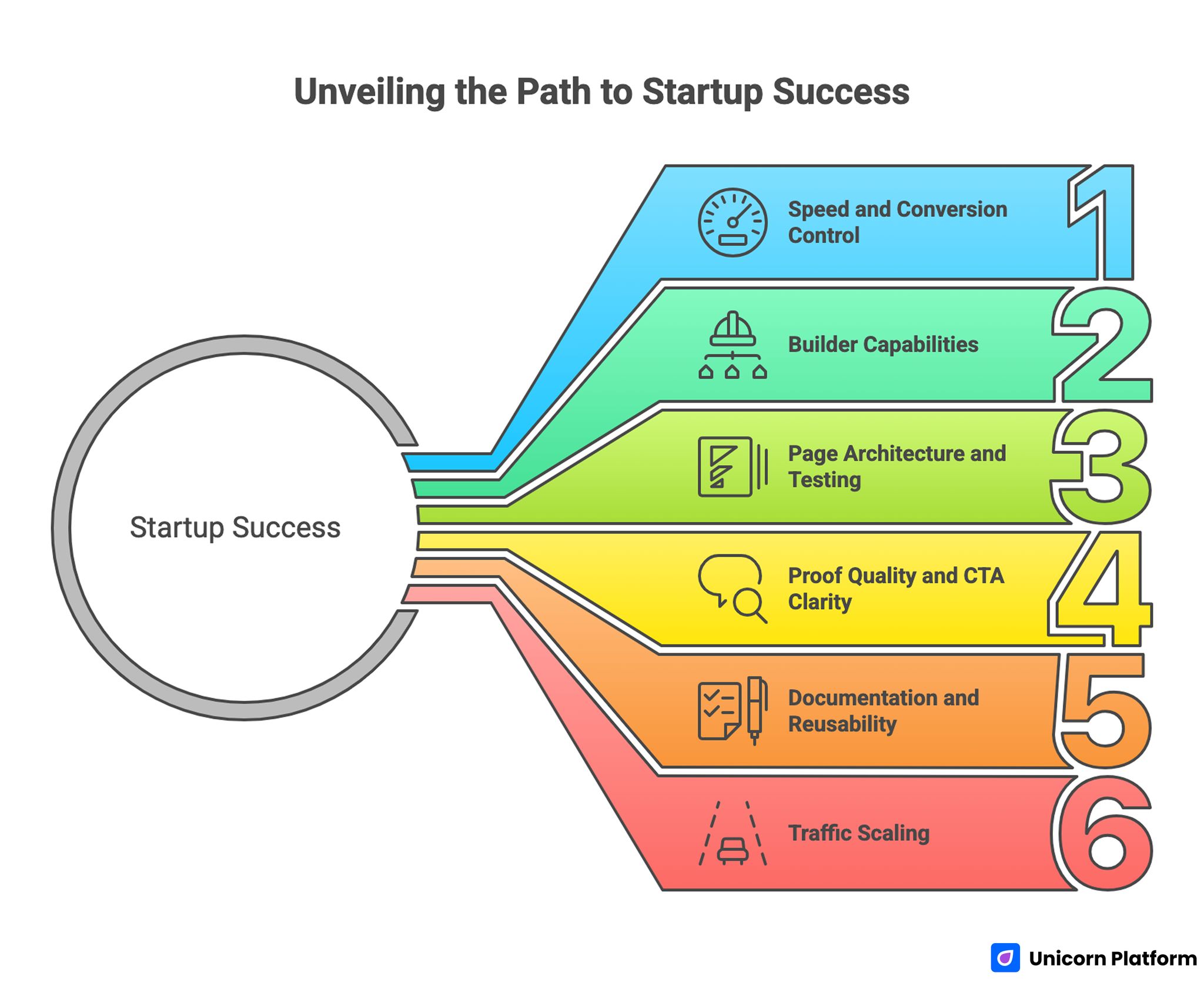
Unveiling the Path to Startup Success
- Choose for operating speed and conversion control, not only visual flexibility.
- Match builder capabilities to startup stage and team composition.
- Use one stable page architecture and test one major variable per week.
- Treat proof quality and CTA clarity as primary conversion levers.
- Document tests so winners become reusable standards.
- Scale traffic only after message quality and downstream lead signals stabilize.
Why Startup Teams Pick the Wrong Builder
Early-stage teams often evaluate builders as design tools, while the real need is a growth system. A beautiful editor can still create performance problems if publishing is slow, templates break consistency, or analytics wiring is fragile.
Three failure patterns appear repeatedly. First, teams optimize for launch-day aesthetics and ignore weekly iteration speed. Second, they choose tools that require technical handoffs for simple content changes. Third, they run experiments without clear governance, so insights do not compound.
A better approach starts with one question: will this platform still support your execution model six months from now when campaigns, channels, and offers diversify? If the answer is uncertain, short-term launch speed can become long-term rework.
Stage-Based Criteria for Startup Builder Selection
The best choice depends on growth stage. A pre-seed team validating one offer has different constraints than a funded team managing multiple demand channels.
Pre-seed and MVP stage
At this stage, speed and clarity matter most. You need to publish in days, test message-market fit quickly, and avoid engineering dependency for basic campaign updates.
Key requirements include fast template deployment, simple component editing, clean mobile output, and low-friction form setup. If your team cannot ship revisions weekly, learning loops slow down and acquisition costs rise.
Early growth stage
Once you run multiple channels, structure becomes more important than raw speed. You need variant control, cleaner analytics separation, and predictable QA before each launch.
Look for modular sections, repeatable component libraries, and easy page duplication by segment. This keeps brand consistency high while allowing message variation by audience intent.
Scale stage
At scale, operational governance matters as much as page design. Teams need role clarity, controlled publishing permissions, and a stable process for proof updates, legal reviews, and experiment logging.
A scalable builder should reduce coordination overhead, not increase it. If each update requires cross-team rework, your launch velocity will collapse as traffic volume grows.
The Startup Builder Scorecard (What to Evaluate)
Use a weighted scorecard before final selection. Founders often compare by features alone, but execution quality usually depends on fewer, higher-impact factors.
Recommended scoring categories are easier to apply when weights are fixed before product demos. That keeps comparison objective and reduces bias toward presentation polish.
- 25%: launch and edit speed for non-technical users
- 20%: conversion architecture control (sections, CTAs, forms)
- 20%: mobile performance and readability defaults
- 15%: analytics and tracking reliability
- 10%: collaboration workflow and publishing governance
- 10%: long-term maintainability and total operating cost
This model keeps the decision focused on outcomes that affect pipeline quality. It also prevents teams from overvaluing visual novelty that does not improve conversion behavior.
Conversion-First Page Architecture for Startup Campaigns
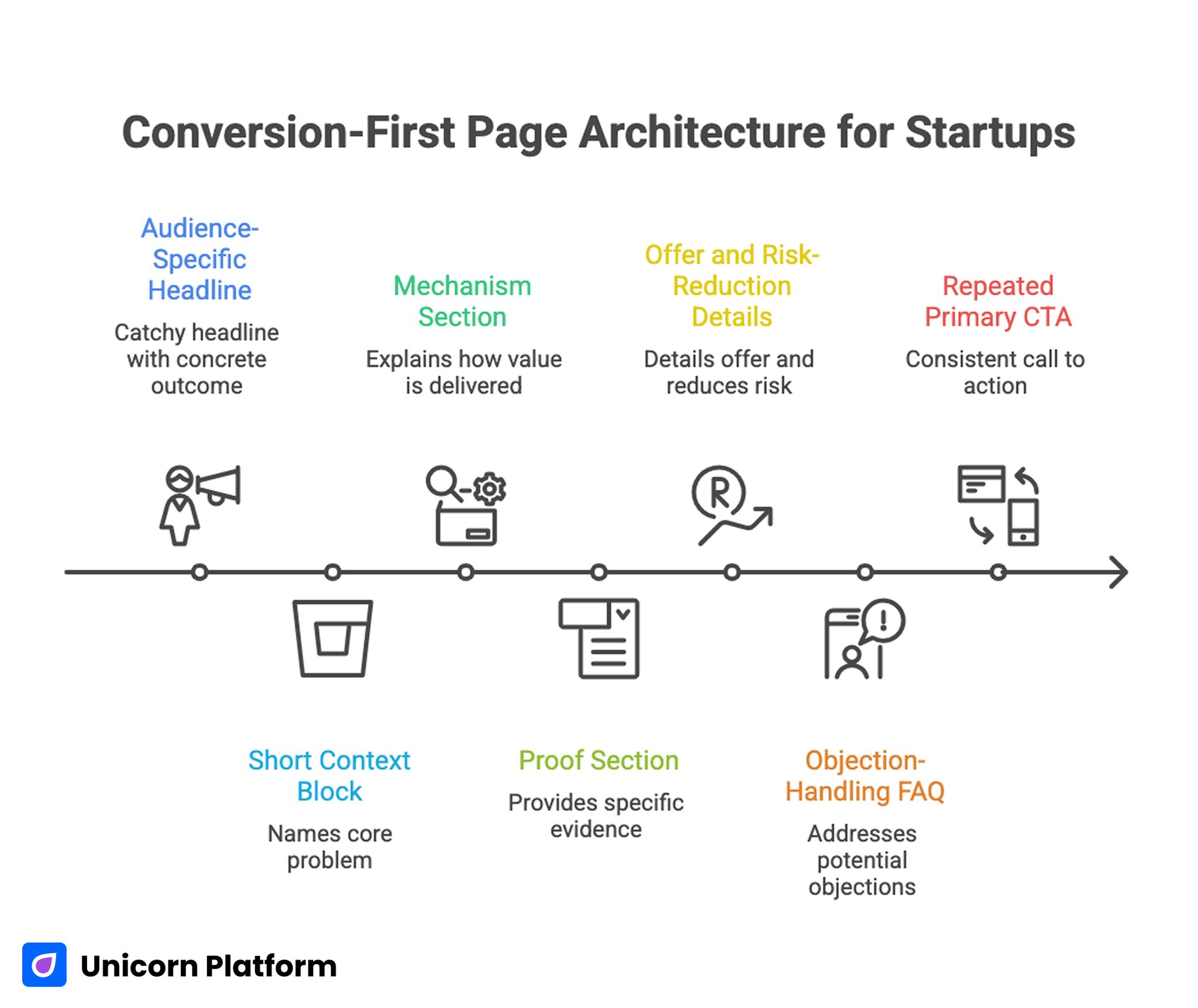
Conversion-First Page Architecture for Startup
A startup page should answer one decision sequence: what this is, why it matters now, why users should trust it, and what to do next. If this sequence breaks, users bounce even when traffic quality is high.
Industry benchmarks support the importance of structured landing pages. According to research summarized by WordStream, average landing page conversion rates across industries often fall between 2% and 5%, which means small improvements in page clarity and structure can significantly impact overall growth.
Use a practical section framework as a baseline before testing variants. Consistent architecture makes changes easier to evaluate.
- audience-specific headline with concrete outcome
- short context block that names core problem
- mechanism section that explains how value is delivered
- proof section with specific evidence
- offer and risk-reduction details
- objection-handling FAQ
- repeated primary CTA with consistent language
This structure works because it mirrors how buyers reduce uncertainty. It also creates clear test points when conversion plateaus.
For teams refining top-of-funnel structure, this walkthrough on high-converting startup launch pages is useful for aligning page flow with acquisition intent.
Messaging Standards That Improve Qualified Conversions
Most weak startup copy is generic, not wrong. It sounds acceptable but fails to clarify who the product is for, how outcomes are produced, and why action should happen now.
Use three editorial rules on every page update. First, claims must include mechanism, not only benefit language. Second, CTA labels must describe the next step clearly. Third, every major claim should have nearby evidence.
- Weak line: "Grow faster with our platform."
- Stronger line: "Launch campaign pages in one day, test one variable weekly, and route qualified leads to sales with cleaner source attribution."
This shift increases clarity and naturally improves lead quality because unfit users self-filter earlier. It also shortens sales conversations by reducing expectation mismatch.
Proof Design: Evidence That Carries the Decision
Trust is one of the highest-leverage conversion variables for startup pages. Many teams add testimonials, but presentation quality and context determine whether proof actually changes behavior.
Trust signals also have measurable impact on decision-making. Research from the BrightLocal Local Consumer Review Survey shows that most users read online reviews before trusting a business, highlighting why testimonials and proof elements play a critical role in conversion-focused startup pages.
Build a layered proof stack so users can validate claims without searching for context across the page. Each layer should answer a different trust concern.
- short customer quote with role and use-case context
- measurable outcome signal where available
- process transparency block (implementation, timeline, constraints)
- credibility asset (founder expertise, partner validation, or case snippet)
Order matters. Put the strongest relevant proof near the first major CTA and reinforce with a secondary proof element near final decision points.
When teams need to improve structural clarity quickly, this practical guide on simple landing-page design for startups helps reduce noise without reducing depth.
Form Design and Lead Quality Management
Conversion does not end at form completion. If form design attracts low-intent leads, sales cycles become slower and acquisition efficiency declines.
Use a two-step qualification model. Keep first-touch forms short to protect completion rates, then collect deeper context after confirmation. This balances conversion volume and downstream quality.
A practical first-step form asks for only what is needed to route the next action. Additional fields should appear only when they improve follow-up quality.
- name
- work email
- role or team type
- primary goal category
Deeper details such as budget window, stack complexity, or implementation timeline can appear in follow-up sequences. This design prevents early friction while preserving qualification control.
Channel-Specific Page Variants Without Design Drift
As soon as a startup runs paid, outbound, and partnership traffic together, one generic page usually underperforms. Different sources arrive with different context depth and urgency.
Create source-aware variants that share the same design system but adjust narrative order and proof emphasis. Cold paid traffic often needs stronger context and risk reduction. Warm newsletter traffic usually needs faster action pathways.
Variant logic should be documented before launch. Without this, teams create ad-hoc page differences that are hard to compare and maintain.
For prelaunch and early-demand funnels, this article on effective waitlist landing-page strategy is useful when mapping variant intent to follow-up flow.
Mobile Performance and UX as Growth Multipliers
Startup traffic is increasingly mobile-first, especially from social and founder-led channels. Weak mobile readability can erase otherwise strong copy and proof.
Run a recurring mobile QA routine before every significant traffic push. Small friction points are easier to fix early than after acquisition costs rise.
- verify first-screen headline clarity
- keep primary CTA visible early
- test tap targets across common devices
- compress media and monitor load behavior
- validate form completion flow end to end
Mobile QA should be part of every release gate, not an occasional cleanup task. Small usability breaks produce large conversion losses at scale.
30-Day Launch Plan for a New Startup Site Program
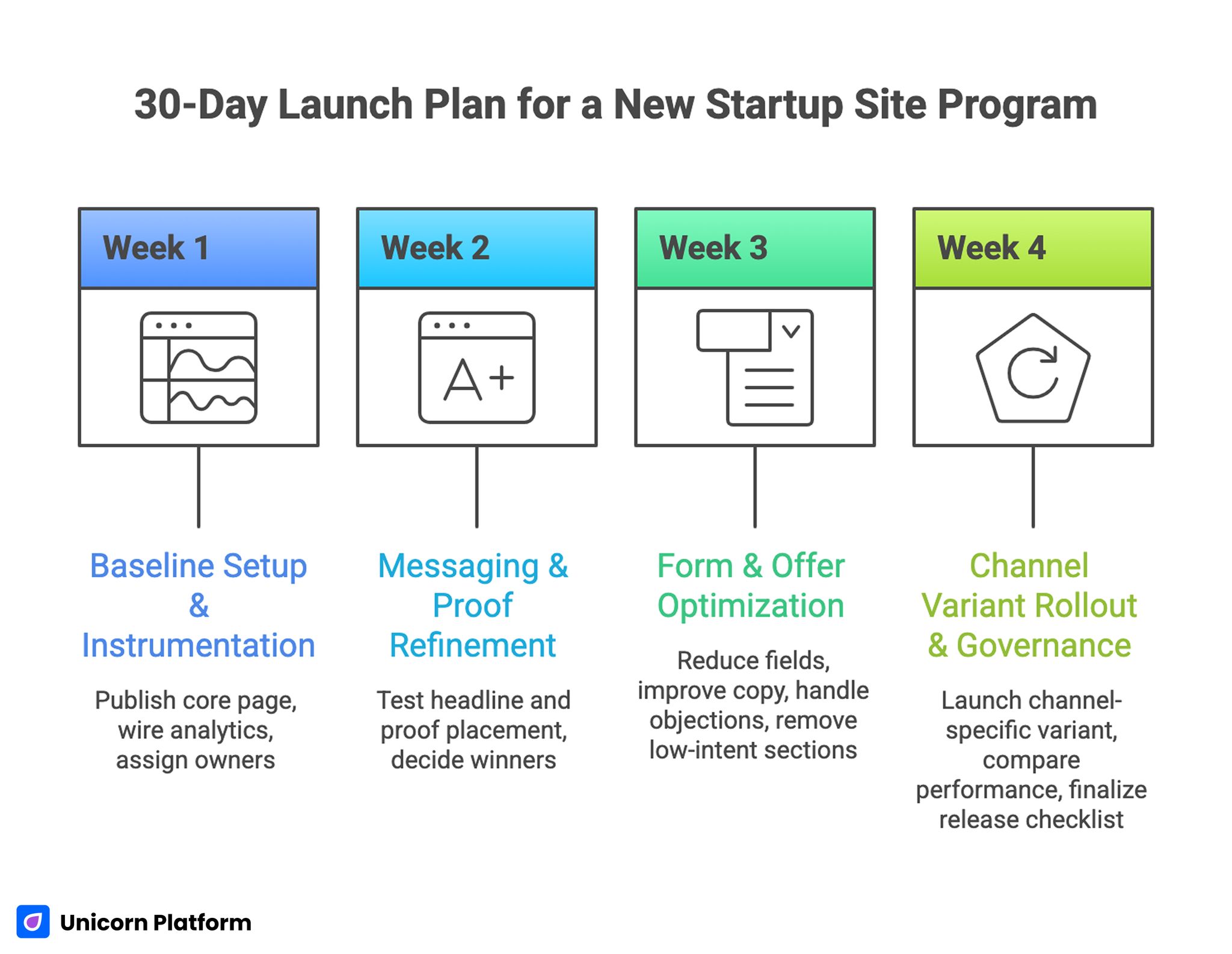
30-Day Launch Plan for a New Startup Site Program
Week 1: baseline setup and instrumentation
Publish one core page for one audience segment and wire analytics events for CTA clicks, form submissions, and confirmed downstream actions. Define one owner for messaging updates and one owner for measurement accuracy.
Week 2: messaging and proof refinement
Test one headline direction and one proof placement change while keeping layout stable. Decide winners using both conversion rate and lead quality indicators.
Week 3: form and offer optimization
Reduce unnecessary fields, improve risk-reduction copy, and update objection handling based on real inquiries. Remove sections that attract attention but do not improve intent quality.
Week 4: channel variant rollout and governance
Launch one channel-specific variant and compare performance against baseline. Finalize a release checklist so future updates are faster and less error-prone.
60-Day Operating Plan for Compounding Improvements
Days 1-15 should stabilize core page architecture and eliminate obvious friction. Days 16-30 should establish a clean experiment cadence with documented hypotheses and decisions.
Days 31-45 should focus on segment-specific proof and offer alignment by source. Days 46-60 should consolidate winning modules into a reusable template library with clear ownership.
This operating cadence turns one-off page edits into a compounding growth system. The objective is not constant redesign; it is predictable improvement through controlled iteration.
Cost and Risk Model: What Founders Should Watch
Builder cost is not only subscription price. Real cost includes team hours lost in handoffs, rework from inconsistent templates, and revenue leakage from broken measurement.
Track operational risk through five signals and review trends at least once per week. Changes in these indicators often appear before conversion declines are visible.
- average time from insight to published update
- number of blocked edits requiring technical support
- experiment completion rate per month
- percentage of pages with validated tracking
- variance in conversion quality across similar campaigns
When these signals degrade, the platform setup is usually the bottleneck, not campaign strategy. Fixing operations early protects acquisition efficiency and team focus.
Common Mistakes and Fast Fixes
Mistake 1: choosing by visual demos only
A polished demo does not guarantee campaign performance. Score platforms by launch speed, conversion control, and maintainability before final selection.
Mistake 2: forcing all traffic into one generic page
Mixed-intent users require different narrative depth. Build source-aware variants with shared structure to improve relevance without design drift.
Mistake 3: publishing without proof hierarchy
When claims are not supported near CTAs, users delay decisions. Add contextual evidence at first and final decision points.
Mistake 4: long first-touch forms
High friction lowers qualified volume and often hurts attribution quality. Keep first forms concise and gather detail in follow-up stages.
Mistake 5: no experiment governance
Without logs and owners, teams repeat weak tests and lose momentum. Document every major change and decision in a shared review routine.
Mistake 6: mobile QA treated as optional
If mobile flow breaks, acquisition economics degrade quickly. Add mobile checks to the mandatory release gate before traffic scaling.
FAQ: Best Website Builder for Startups
What matters most when selecting a builder for startups?
Operational speed with conversion control. If your team cannot publish and test quickly, strategic quality will not translate into outcomes.
Should early-stage teams prioritize templates or customization?
Start with stable templates and customize only high-impact sections. This preserves launch speed while still allowing clear differentiation.
How many page variants should a startup run initially?
Begin with one baseline and one high-value source variant. Too many variants early usually produce noisy data and weak conclusions.
Is full pricing transparency required on startup pages?
Not always, but some pricing orientation is usually necessary. Users need enough context to evaluate fit without unnecessary uncertainty.
What is a healthy weekly test cadence?
One major variable per week is a practical standard for most teams. It keeps attribution cleaner and reduces decision confusion.
How should teams measure page performance beyond conversion rate?
Include downstream indicators such as lead quality, sales acceptance, and activation trend. Raw conversions alone can be misleading.
Can non-technical teams run high-quality page programs?
Yes, if ownership and QA gates are clear. Process discipline matters more than team size.
When should a startup scale traffic to a page?
After message consistency, proof quality, and downstream lead signals remain stable for at least two weeks. That stability window reduces the risk of scaling temporary wins.
What is the fastest way to reduce launch friction?
Use a clear release checklist and remove optional steps that do not improve decision quality. Simpler release flows usually increase publishing speed without reducing standards.
How can founders avoid constant redesign cycles?
Keep architecture stable and optimize decision-critical sections through controlled experiments. Structured iteration outperforms frequent full rebuilds.
Final Takeaway
The best builder for startups is the one that supports fast publishing, clean testing, and sustainable quality control. Platform choice should be judged by operational outcomes, not feature volume.
Teams using Unicorn Platform can run this model effectively by combining reusable structures with weekly evidence-based updates. When process quality is high, startup websites stop being static assets and become reliable growth infrastructure.
For founders who need a fast operational baseline, this three-step startup site launch workflow is a practical way to align speed with conversion discipline.
