Table of Contents
- Why B2B-Lead-Generation Landing Pages Underperform
- Core Structure for High-Converting B2B-Lead-Generation Landing Pages
- 30-Day Execution Plan
- Common Failure Modes and Direct Fixes
- FAQ
Most demand teams do not struggle to generate traffic. They struggle to convert that traffic into qualified pipeline with predictable handoff quality. This is why many programs report rising form volume while sales teams still describe lead quality as inconsistent.
A conversion page for B2B demand capture is not just a form screen. It is a decision environment where buyers evaluate relevance, risk, expected outcomes, and implementation effort before committing to a next step. When that environment is weak, submission numbers can rise while opportunity quality stays flat.
Many underperforming programs focus on isolated page edits, such as CTA wording or button color, without fixing structural issues. The largest gains usually come from stronger decision sequencing, clearer qualification logic, and better post-submit continuity.
This guide provides a practical framework for building and scaling demand-capture pages in Unicorn Platform. The focus is operational: attract better-fit leads, route them cleanly, and improve downstream sales outcomes.
sbb-itb-bf47c9b
Key Takeaways
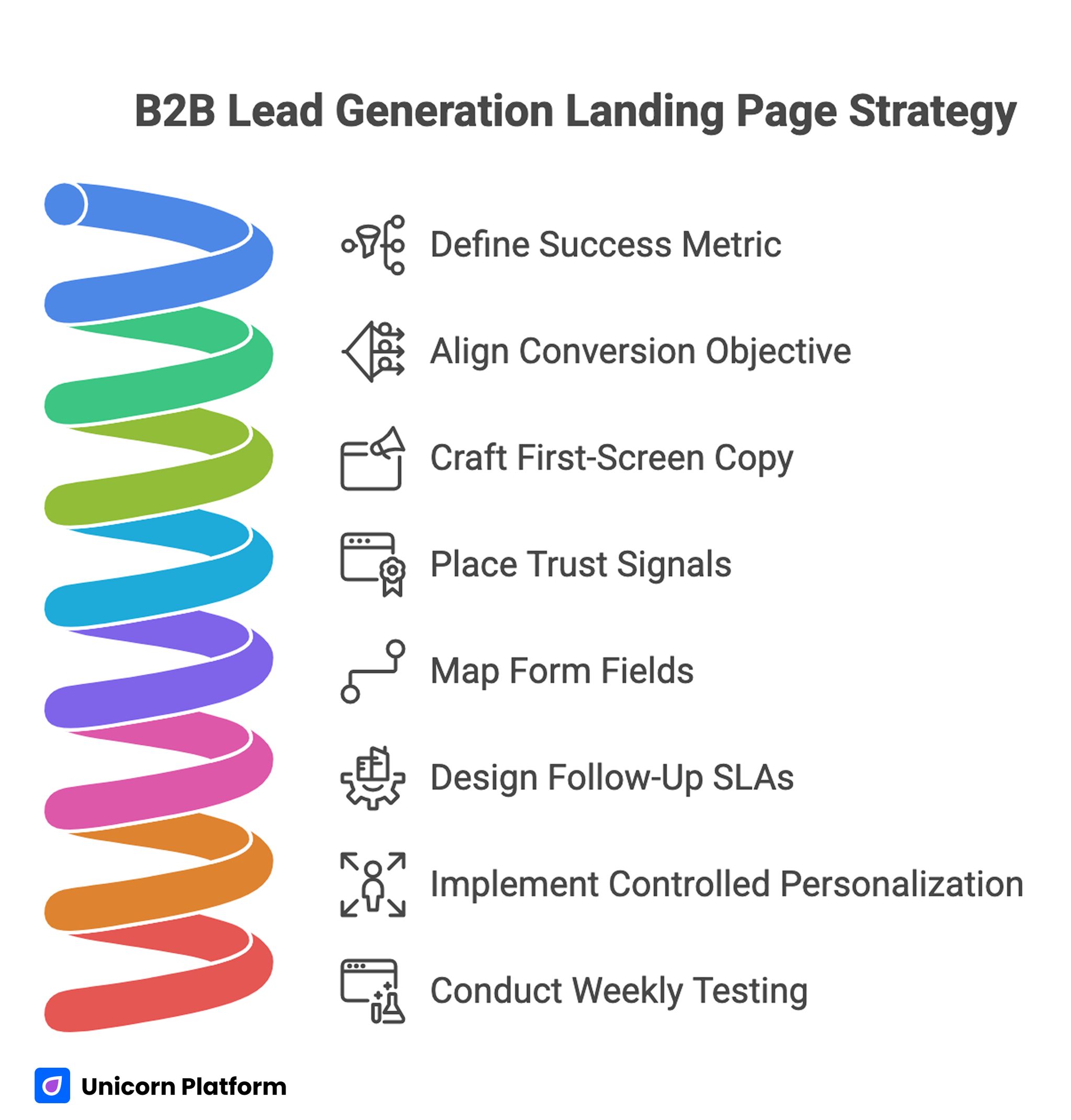
B2B Lead Generation Landing Page Strategy
- Pipeline quality is the primary success metric, not raw submission count.
- One page should support one dominant conversion objective per audience segment.
- First-screen copy should clarify fit, value, and next-step expectation quickly.
- Trust signals should be placed near commitment points, not isolated at the bottom.
- Form fields should map to real routing decisions, not internal curiosity.
- Follow-up and response SLAs should be designed as part of conversion architecture.
- Controlled personalization usually outperforms page fragmentation.
- Weekly testing should isolate one major variable for cleaner attribution.
Why B2B-Lead-Generation Landing Pages Underperform
Underperformance usually starts with relevance ambiguity. Visitors arrive from qualified channels but cannot quickly confirm whether the offer is for their role, use case, or urgency window. High-fit users hesitate while low-fit users sometimes convert out of curiosity.
The second issue is value blur. Many pages describe capabilities but fail to define what practical output the buyer receives after converting. Without a clear output, the form feels risky because effort is known but outcome is uncertain.
The third issue is trust timing. Credibility signals are often delayed until after the first major CTA. This sequencing asks for commitment before core objections are resolved.
The fourth issue is handoff mismatch. Marketing promise language and sales follow-up behavior are misaligned. Users submit with one expectation and receive a different experience, which reduces meeting quality and conversion velocity.
The final issue is metric bias. Teams optimize toward top-line submissions while acceptance rate, opportunity progression, and sales cycle quality quietly degrade.
Role of B2B-Lead-Generation Landing Pages in Modern Demand Systems
In modern B2B acquisition, these pages serve as routing infrastructure. They should qualify fit, establish trust, and channel users to the right next interaction with minimal ambiguity.
They are especially important when multiple channels feed one funnel. Paid search, content syndication, social distribution, and partner referrals can all carry different intent contexts. The page must normalize those contexts into one coherent decision flow.
When this routing role is clear, page optimization becomes more strategic. Teams can evaluate changes by business impact rather than by isolated engagement metrics.
A reliable page also reduces operational burden. Better context capture and clearer expectation setting can lower low-quality follow-up workload and improve speed-to-value for sales teams.
Start With One Objective and One Segment
Before writing or designing anything, define one primary objective for the variant. Common objectives include qualified consultation requests, demo applications, audit requests, or guided planning call bookings.
Then define one primary segment. A RevOps leader, growth manager, and IT stakeholder may all engage with a similar offer, but they rarely evaluate risk in the same way. Pages should prioritize one primary decision lens and support secondary lenses without diluting clarity.
If channel intent differs significantly, run source-aware variants while preserving a shared architecture. This balances relevance and governance.
Objective Alignment Checklist
- Is one conversion objective clearly dominant?
- Is audience context explicit in the first screen?
- Is the promised output concrete and verifiable?
- Is CTA wording aligned with decision readiness?
- Is one quality metric tied to this specific page role?
Teams that answer these questions early usually reduce revision cycles and improve experiment quality. They also create clearer ownership for post-launch decision-making.
Core Structure for High-Converting B2B-Lead-Generation Landing Pages
High-performing pages follow a practical sequence: fit, value, trust, qualification, and continuity. If this order is disrupted, users must infer missing context and conversion quality drops.
A practical structure includes:
- First-screen fit and outcome direction.
- Value mechanism and expected business relevance.
- Trust layer with proof mapped to common objections.
- Qualification-aware action module.
- Post-submit expectation and response timing clarity.
This structure supports both conversion rate and lead quality by reducing interpretation burden. It keeps the buyer journey easier to scan and easier to trust.
When your team needs a reusable structure model across campaigns, this landing page architecture guide is useful for defining section responsibilities before copy iteration. It is especially useful when several contributors are editing parallel variants.
Stable section jobs also improve governance. Teams can update proof, offers, or CTA context without creating structural drift.
First-Screen Messaging for Qualified Demand Capture
The first screen should answer three buyer questions immediately. Is this relevant to my context, what useful output do I get, and what happens after I submit.
A reliable pattern is role context plus practical outcome plus next-step expectation. This keeps messaging concrete and reduces low-fit conversions.
Avoid broad transformation claims without operational context. B2B users generally respond better to language that reflects constraints and process reality.
Helper microcopy near CTA buttons can materially reduce hesitation. Short lines about who responds, when response happens, and what the first interaction includes improve confidence without clutter.
First-Screen Rules
- Lead with user outcome rather than product category language.
- Keep claims bounded to realistic delivery scope.
- Clarify fit boundaries for faster self-qualification.
- Avoid multiple equal-priority CTAs above the fold.
- Make next-step outcome explicit in CTA wording.
Consistent execution of these rules improves both conversion and downstream meeting quality. Clear first-screen expectations usually reduce low-context handoffs.
Offer Design by Buyer Readiness
Offer type should match decision maturity. Not every visitor is ready for the same level of commitment.
A practical readiness model includes:
- Early-stage: diagnostic asset or structured benchmark.
- Mid-stage: guided planning or scoped assessment.
- Late-stage: direct consultation or implementation call.
Use one dominant offer per page variant. Secondary routes can exist for adjacent readiness states, but they should not compete equally with the primary objective.
Offer clarity should include expected output and timing. Buyers should understand what they receive and how quickly after conversion.
If you are aligning offer strategy with qualification quality, this lead generation page guide is useful for connecting offer type to routing outcomes. It helps teams standardize offer logic across campaigns without diluting conversion intent.
Value Proposition Design That Supports Pipeline Quality
A strong value proposition in B2B should combine operational relevance and risk clarity. It should explain what changes for the buyer and why the next step is worth time.
A useful value framework includes three layers: primary benefit, risk reduction, and practical implementation scope. This aligns well with how buying committees evaluate potential vendors.
Value statements should also define boundaries. Clarifying what the offer does not include can improve trust and reduce low-fit submissions.
Across multi-campaign programs, keep a canonical value framework and adapt emphasis by segment. This keeps narrative consistency while preserving relevance.
Trust Architecture for High-Intent B2B Traffic
Proof should resolve real objections, not just decorate the page. Generic logos and vague testimonials are less effective than contextual evidence tied to likely concerns.
Use proof formats such as role-specific outcomes, scenario-relevant examples, process transparency, and delivery model clarity. Keep them close to decision friction zones.
Trust cues should appear before and around form interactions. Waiting until the bottom of the page often means qualified users never see critical reassurance.
A good trust layer also includes expectation transparency. Buyers should know what happens after submit and what level of engagement is expected.
Trust Layer Checklist
- Do proof elements map to practical objections?
- Are trust cues near CTA and form sections?
- Are examples relevant to target segments?
- Is process transparency visible before commitment?
- Are security and compliance expectations addressed where needed?
A trust layer designed this way usually improves both completion confidence and post-submit alignment. Better trust structure also shortens first-call context building.
Qualification Strategy and Form Design
Form design should support routing decisions, not data collection habits. Every required field should justify its place by improving prioritization, segmentation, or follow-up quality.
Overly short forms can inflate low-quality volume. Overly long forms can suppress qualified intent. The solution is staged qualification.
First-touch forms should capture only routing-critical fields. Deeper context can be gathered in confirmation flows, qualification emails, or first-call preparation.
For many B2B programs, first-touch capture can include business email plus one high-signal qualifier such as role, company band, or urgency horizon. This keeps friction manageable while preserving useful routing context.
Form QA Checklist
- Does each required field affect next-step routing?
- Are validation states clear and recoverable?
- Is mobile form behavior reliable on real devices?
- Is submit flow stable across major browsers?
- Does confirmation explain next-step timing clearly?
Run this checklist before increasing paid distribution.
Buying Committee Mapping Without Page Fragmentation
B2B decisions often involve several stakeholders. A page that speaks only to one role can still convert, but qualification quality may suffer in downstream stages.
Use a layered messaging model rather than separate pages for every persona. Keep primary narrative focused on one segment and add targeted reassurance cues for secondary stakeholders.
A practical mapping model:
- Operational evaluator: workflow relevance and adoption clarity.
- Budget owner: business impact and priority fit.
- Technical reviewer: integration and feasibility confidence.
- Procurement/legal: process reliability and risk controls.
This can be implemented through concise role-aware cues in value, trust, and continuity sections without overwhelming the page. The goal is better stakeholder alignment, not longer copy.
CTA Mechanics and Conversion Flow
CTA performance depends on context and sequencing, not wording alone. Users convert when the action request appears after confidence is established.
Use one dominant CTA route for the primary objective. Secondary routes should support different readiness states and be visibly subordinate.
CTA labels should describe outcome rather than generic action. For example, "Request a scoped walkthrough" often sets better expectation than "Submit."
Placement should align with confidence progression. Include action opportunities after first-screen clarity, after trust reinforcement, and near the main form block.
Sales Handoff and Post-Submit Continuity
A conversion event is the start of operational delivery, not the finish line. Weak post-submit design is one of the fastest ways to lose high-intent demand.
Define a response model for each CTA path. At minimum, clarify routing ownership, response-time expectations, and fallback behavior during peak volume.
A practical handoff framework includes:
- Immediate confirmation with clear next-step timeline.
- Role-aware follow-up when live response is delayed.
- Routing escalation for high-priority qualification signals.
- Internal ownership clarity for first human response.
This model improves trust and reduces lead decay between submit and first interaction. It also gives sales teams cleaner context for early conversations.
Handoff quality should be reviewed weekly using response-time data, show-up rates, and early qualification confidence. This keeps post-submit operations connected to conversion strategy.
Mobile, Technical, and Performance Reliability
Even in B2B funnels, first interactions increasingly occur on mobile. If readability or form usability degrades on smaller screens, qualified intent is lost before desktop follow-up happens.
Prioritize first-screen clarity, form tap-target comfort, stable CTA visibility, and fast response for key interaction modules. Small mobile frictions can produce disproportionate quality loss.
Performance improvements should be tied to conversion-critical sections. Faster load is useful, but only when decision content remains visible and clear.
If your team is improving cross-device consistency, this responsive landing-page workflow helps keep hierarchy and action flow stable across breakpoints. It is useful when traffic spikes expose hidden mobile UX gaps.
Technical QA should include tracking integrity, form routing, and confirmation-state behavior on real devices. Emulator checks are useful, but real-device testing catches practical failures earlier.
Internal Linking and Topical Depth Strategy
Internal links should support user decision flow, not act as filler. Each link should provide the next layer of depth exactly where users need it.
For demand-capture programs, useful pathways often connect architecture guidance, optimization frameworks, and behavior insights. This supports both topical depth and better user navigation.
Anchor text should remain natural and section-relevant. Repetitive anchor patterns reduce editorial quality and can confuse navigation intent.
Plan link placement during outlining. This prevents link clustering and keeps the narrative coherent.
When teams need to align conversion work with commercial outcomes, this business-aligned optimization guide is useful for tying page changes to measurable growth priorities. Strategy alignment improves prioritization and reporting clarity.
Measurement Framework for B2B-Lead-Generation Landing Pages
Top-line submissions are insufficient for optimization decisions. Teams need a metric stack that reflects both conversion volume and outcome quality.
Use a three-layer model:
- Discovery: source quality and intent alignment.
- Decision: form start behavior, completion quality, objection-driven drop-off.
- Outcome: accepted pipeline progression and response readiness.
Each optimization cycle should define one primary metric and one guardrail metric. This prevents local gains from harming downstream outcomes.
Review Cadence
- Daily: technical failures, routing anomalies, and major performance drops.
- Weekly: source-level quality movement and form-quality trends.
- Monthly: segment-level pipeline contribution and handoff effectiveness.
Cadence discipline keeps teams focused on durable improvements. It also reduces reactive edits based on short-lived fluctuations.
If your team is diagnosing hesitation and drop-off behavior, this user behavior optimization guide is useful for prioritizing high-impact changes. Apply one major change per cycle to preserve attribution quality.
CRM Integration and Routing Hygiene
Lead quality often degrades after conversion because routing logic is inconsistent across channels and campaigns. If tracking fields, source tags, or ownership rules are misaligned, even strong page performance can produce weak sales outcomes.
Build routing hygiene into page design from day one. Define required parameters, map them to CRM fields, and validate that every conversion path sends complete context to the correct owner.
A practical routing model includes:
- Required source and campaign tags on every inbound URL.
- Standardized field mapping for role, urgency, and offer type.
- Assignment logic with explicit fallback owners.
- Alert rules for high-priority submissions.
This operational layer improves handoff speed and reduces manual cleanup. It also makes experiment analysis more reliable because attribution data stays consistent.
Lead Magnet Quality Standards
Many lead-capture programs depend on downloadable assets, but weak asset quality can inflate submissions without improving pipeline outcomes. A lead magnet should solve a meaningful decision problem for the target segment, not just collect contact data.
High-performing assets are practical, specific, and implementation-oriented. They should help buyers make a better decision quickly, which increases trust and improves the quality of follow-up conversations.
Use these quality standards:
- The asset addresses one concrete operational problem.
- The promised outcome is clear before form submission.
- The content includes usable next steps, not generic advice.
- The asset naturally leads to a relevant next action.
When lead magnets meet these standards, conversion quality usually improves even if top-line volume does not spike immediately.
Channel-Specific Message Match
Message mismatch between source and page is a common hidden friction point. Visitors who click from a highly specific ad or email and land on broad page copy often disengage quickly.
Maintain one canonical structure while tailoring first-screen framing and proof emphasis by source. This preserves governance while improving relevance for channel-specific intent.
A practical channel-match workflow:
- Map source promise language to first-screen value statement.
- Validate CTA wording against source-level readiness.
- Adapt proof examples to likely objections per channel.
- Confirm post-submit expectations remain consistent.
This approach improves conversion quality without creating unmanageable variant sprawl.
Launch-Week Operations and Change Control
Promotion spikes increase conversion opportunity and operational risk at the same time. Fast edits without controls can break routing, tracking, or message continuity when stakes are highest.
Use a lightweight readiness gate 48 to 72 hours before scaling traffic. Confirm source-message continuity, form and CTA stability, routing integrity, confirmation accuracy, and reminder trigger reliability.
Assign clear owners for messaging, conversion mechanics, and QA verification. Clear ownership reduces decision delays during incidents.
Incident prioritization should focus on conversion integrity first, then messaging regressions, then cosmetic issues. This protects business impact during high-volume windows.
30-Day Execution Plan
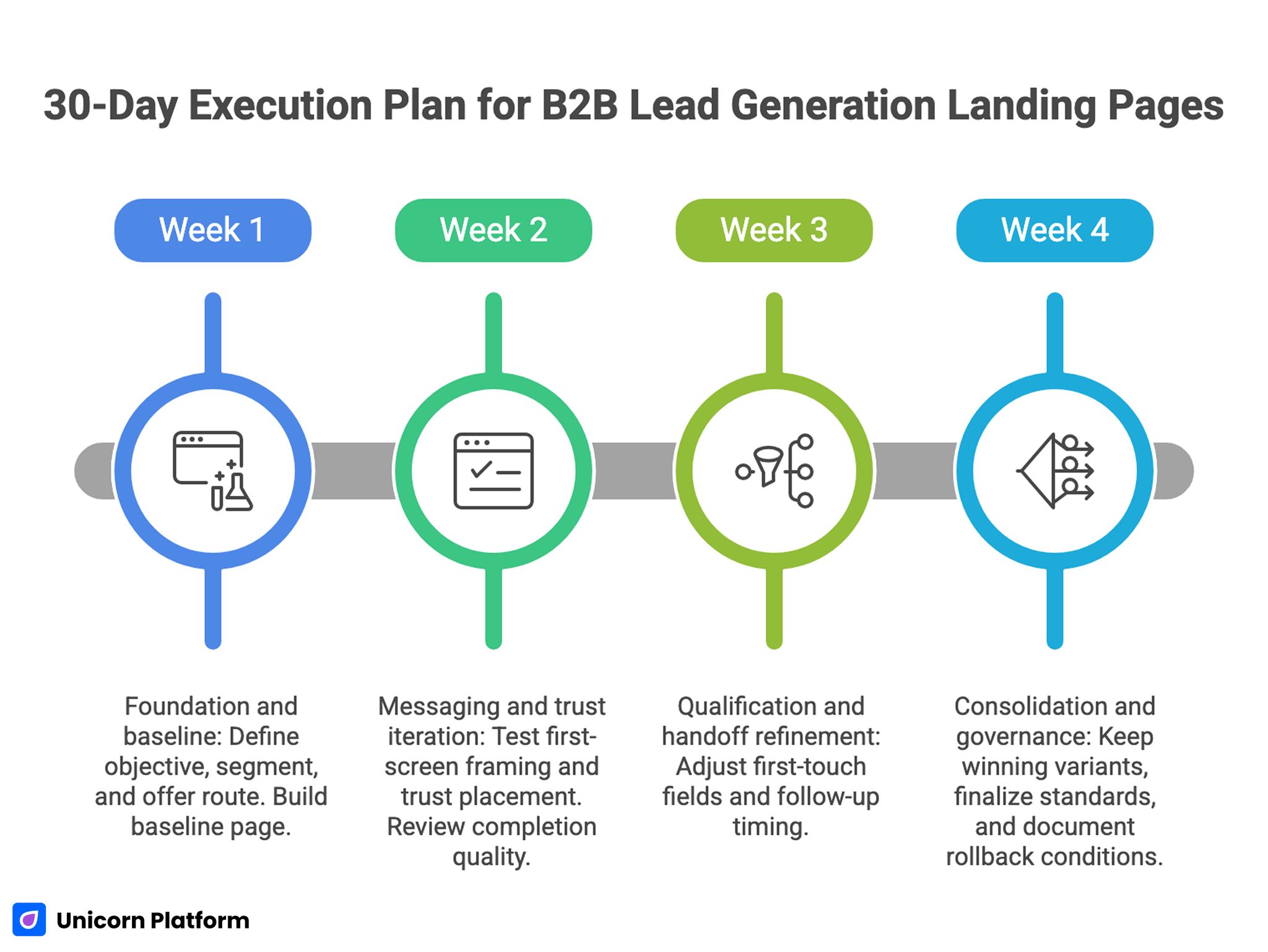
30-Day Execution Plan for B2B Lead Generation Landing Pages
A structured month-long cycle helps teams improve quickly without creating noisy change. It also creates clear ownership and documentation discipline.
Week 1: Foundation and baseline
Define objective, primary segment, and offer route. Build baseline page in Unicorn Platform with stable section jobs, form logic, and confirmation continuity.
Run device and browser QA before scaling distribution. Correcting issues early is usually cheaper than patching under active spend.
Week 2: Messaging and trust iteration
Test one first-screen framing change and one trust-placement change while keeping architecture stable. Controlled change is the fastest path to credible learning.
Review source-level completion quality and adjust objection handling near commitment points. Prioritize sections with the highest friction first.
Week 3: Qualification and handoff refinement
Adjust first-touch fields based on routing performance and downstream quality signals. Limit field changes per cycle so impact is measurable.
Refine follow-up timing and role-aware messaging using early response behavior. Keep follow-up copy operational and specific.
Week 4: Consolidation and governance
Keep winning variants, retire weak versions, and finalize maintenance standards for the next cycle. Archive decisions so future launches start from proven baselines.
Document rollback conditions and ownership for live updates. Clear authority reduces incident response time.
Common Failure Modes and Direct Fixes
Failure mode 1: Generic promise with weak role relevance
Buyers cannot quickly assess fit. Rewrite first-screen messaging around role context, practical outcome, and next-step expectation.
Failure mode 2: Form asks for too much too early
Completions drop before trust is established. Reduce first-touch fields and stage deeper qualification after initial conversion.
Failure mode 3: Proof is present but not decision-relevant
Visitors see testimonials but unresolved objections remain. Replace generic proof with contextual evidence tied to practical concerns.
Failure mode 4: CTA hierarchy is unclear
Multiple equal-priority actions create hesitation. Keep one dominant CTA and subordinate secondary routes.
Failure mode 5: Post-submit experience is generic
Lead intent decays after conversion. Improve confirmation and follow-up clarity with realistic timing and clear next steps.
Failure mode 6: Optimization is driven by volume-only metrics
Submission count rises while accepted opportunities stay flat. Pair conversion metrics with quality guardrails and outcome tracking.
FAQ: B2B-Lead-Generation Landing Pages in 2026
How are B2B-lead-generation landing pages different from general landing pages?
They usually need stronger qualification logic, deeper trust architecture, and clearer process expectations because buying risk and stakeholder complexity are higher. This makes structural clarity more important than cosmetic polish.
What should B2B-lead-generation landing pages include at minimum?
At minimum, include role-relevant value framing, practical outcome clarity, trust signals near action points, one primary CTA, and explicit post-submit expectations. That baseline supports confident first-stage decisions.
How many fields should a first-step B2B lead form have?
Use only fields that influence immediate routing decisions. Collect deeper context later unless strict early screening is required.
Should I remove navigation on demand-capture pages?
Often yes, if the page goal is focused conversion. Reduced navigation can improve decision clarity when tested against your audience behavior.
Where should trust and proof appear on the page?
Place them near commitment points where objections are most likely, especially around CTA and form sections. Proof is most effective when positioned at the exact decision moment.
How often should I run page tests?
A weekly cadence with one major variable per cycle is usually effective. Multi-variable rapid changes often reduce learning quality.
Can one page support both paid and organic demand?
Yes, when one dominant intent is preserved and message continuity remains strong from source click to confirmation state. If channel intent differs widely, separate variants are usually safer.
What metrics best reflect true page health?
Use a balanced stack: source quality, conversion quality, and downstream progression signals such as accepted opportunities and response readiness. This gives a clearer picture than volume metrics alone.
How do I improve lead quality without hurting conversion too much?
Use staged qualification, clearer first-screen fit language, and stronger trust placement near commitment points. Quality improves when users understand relevance and next steps before committing.
Can Unicorn Platform support this full workflow?
Yes. Unicorn Platform supports fast iteration, and performance improves when that speed is paired with strict structure, QA discipline, and quality-focused measurement.
Final Takeaway
Strong demand capture in B2B comes from system quality, not isolated edits. Teams that align objective clarity, decision architecture, qualification logic, and handoff operations consistently generate stronger pipeline outcomes.
When B2B-focused demand pages are treated as full decision systems, they become durable growth assets rather than short-lived campaign pages. That systems approach is what compounds results over time.