Table of Contents
- Confirmation Experience and Handoff Quality
- 30-Day Implementation Plan
- Common Failure Modes and Practical Fixes
- FAQ
A pre-launch waitlist can accelerate growth, reduce launch risk, and improve early product learning. It can also create false confidence when teams optimize for raw signup volume instead of signup quality. Large numbers look impressive, but they do not help if those users ignore onboarding messages, skip activation, or never become customers.
Most underperforming pre-launch pages fail for the same reason: weak decision design. Visitors are asked to submit contact details before they clearly understand fit, value, timeline, and post-signup expectations. That creates curiosity-driven submissions and weak downstream engagement.
Strong teams treat pre-launch conversion as an operating system. They align message clarity, trust signals, offer structure, qualification flow, and follow-up cadence from day one. When these components are coordinated, signup volume and signup quality improve together.
Unicorn Platform is effective in this stage because it allows fast updates while preserving a stable section architecture. Pre-launch strategy changes quickly, and teams need the ability to adapt messaging without rebuilding the entire page every week.
sbb-itb-bf47c9b
Quick Takeaways
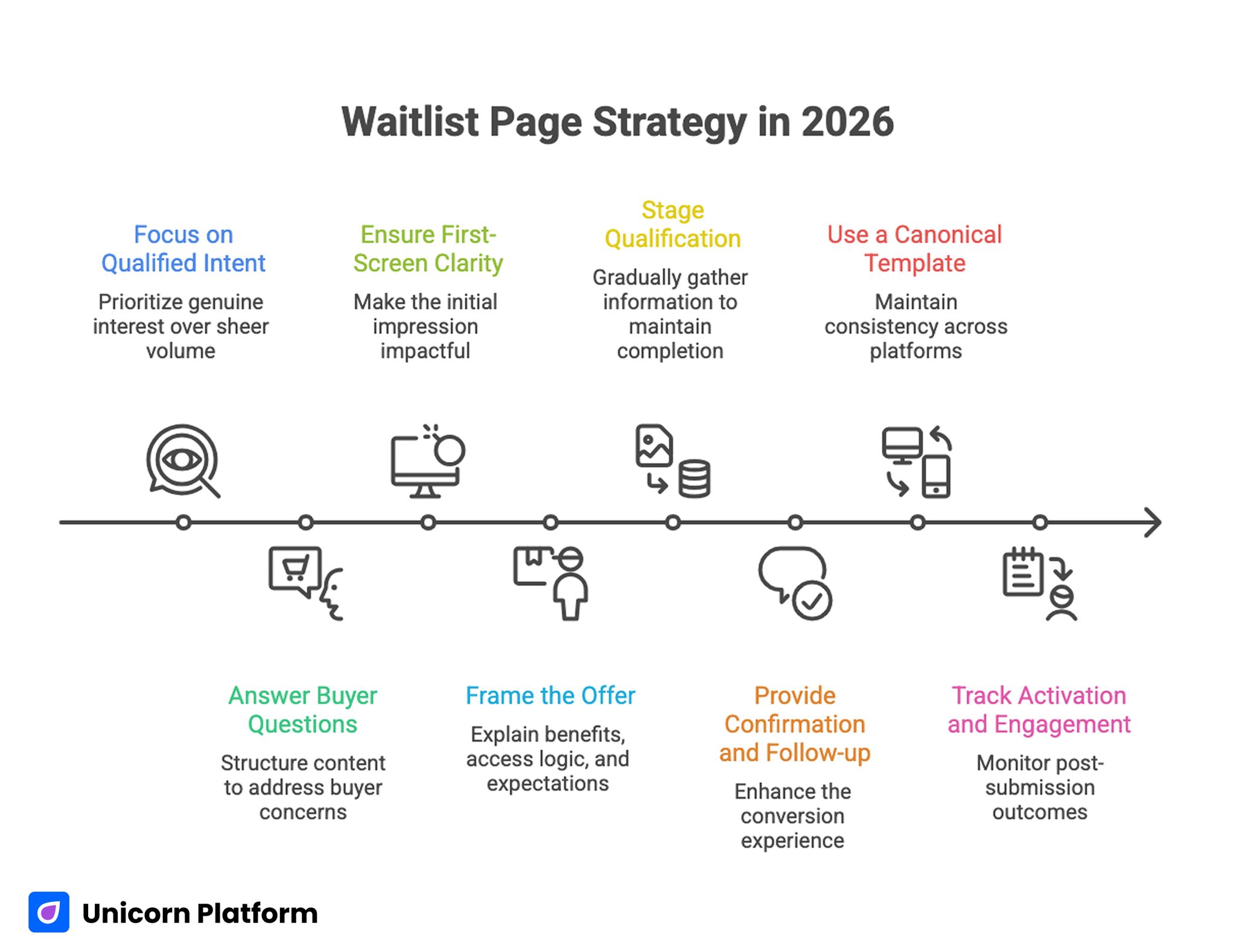
Waitlist Page Strategy in 2026
- Pre-launch success depends on qualified intent, not form volume alone.
- Every section should answer a buyer question in a defined sequence.
- First-screen clarity is the highest-leverage conversion lever.
- Offer framing should explain benefit, access logic, and next-step expectations.
- Qualification should be staged so completion stays high while signal quality improves.
- Confirmation and follow-up experience are part of conversion quality.
- One canonical template with source-specific variants usually outperforms many disconnected versions.
- Track activation and engagement outcomes, not only submissions.
Why Pre-Launch Signup Pages Usually Underperform
Most pages underperform because message priority is unclear. They blend mission statements, feature promises, generic urgency, and several equal-priority CTAs in one screen. Visitors do not know what matters most, so intent weakens before form interaction even begins. This distinction between quantity and quality of signups matters greatly in launch contexts. According to industry research on product launches, teams that optimise for qualified early sign‑ups rather than raw volume are significantly more likely to reach core revenue milestones after launch — because quality leads demonstrate stronger post‑signup engagement and higher conversion through onboarding and first use.
Another issue is missing expectation context. Users are often not told when they will hear from the team, what type of updates they will receive, or how beta access decisions will be made. Without clarity, users assume uncertainty and engagement drops.
Operational drift also contributes to decline. As launch plans evolve, copy and offers are edited repeatedly by multiple contributors. Without template governance, the page becomes inconsistent and trust signals conflict with each other.
The final issue is narrow measurement. Teams track submissions but ignore confirmation rates, welcome-message engagement, qualification distribution, and activation behavior. They celebrate growth while conversion quality erodes.
The Decision Sequence That Improves Signup Quality
A reliable decision sequence keeps pre-launch pages coherent under rapid iteration. The sequence has four stages: fit, value, confidence, and action.
Fit clarifies who the product is for right now. Value explains what early participants gain by joining before release. Confidence reduces uncertainty through transparent expectations and credible signals. Action makes commitment simple and context-aware.
If this order is reversed, friction grows. Asking for signups before explaining fit invites low-quality leads. Sharing broad value without timeline transparency reduces trust. Providing confidence signals too late means many users never see them.
Teams refining section flow can apply principles from this high-converting landing page structure guide to keep narrative sequence aligned with user decisions.
First-Screen Messaging: The Highest-Leverage Block
The first screen should resolve three questions quickly: is this for me, what benefit do I get, and what should I do next. If one of these answers is missing, submission quality usually declines.
Outcome-led language typically performs better than category-led language. Visitors care less about broad positioning claims and more about specific changes they can expect after joining early.
A practical first-screen structure is simple: audience signal, concrete value statement, timeline context, and one primary action. This gives enough certainty for qualified users to continue without overwhelming new visitors.
First-Screen Drafting Prompt
Use this internal prompt to improve clarity before publishing:
- Who should join now and why?
- What specific early-access value is offered?
- What happens immediately after signup?
- What should users expect before launch?
If a draft cannot answer these questions in one screen, revision is needed.
Offer Design for Better Signal Quality
A generic "join for updates" offer attracts broad curiosity but weak commitment. Stronger offers communicate a concrete reason to join early and a clear participation model.
Common high-performing offer components include priority onboarding access, controlled beta entry, roadmap feedback privileges, early implementation resources, and targeted launch incentives. The right mix depends on product stage and audience readiness.
Offer clarity is more important than offer complexity. Teams often add multiple incentives that sound attractive but blur expectation boundaries. One clear value path usually outperforms a crowded incentive stack.
Offer Ladder Model for Pre-Launch Campaigns
- Tier 1: baseline access and timeline updates.
- Tier 2: deeper educational resources or guided onboarding content.
- Tier 3: priority rollout opportunities for highly aligned users.
This ladder helps teams segment intent while preserving one coherent top-level narrative.
Expectation Management as a Trust Engine
Pre-launch interest decays quickly when communication timing is ambiguous. Users who do not know when to expect updates or how release sequencing works are less likely to stay engaged.
Expectation management should include update cadence, progress format, and access logic. Teams do not need perfect certainty, but they do need honest ranges and clear communication rules.
Trust improves when teams publish realistic timelines and explain possible changes transparently. Overpromising speed may increase short-term signups while damaging long-term credibility.
What to Communicate Before Submission
- Update frequency and channel.
- Likely milestones before wider release.
- How priority access is assigned.
- What actions users should take while waiting.
These details reduce uncertainty and improve downstream engagement behavior.
Qualification Without Excess Friction
Qualification is essential, but over-qualification at first touch can reduce completion sharply. The better approach is staged data capture: collect minimal routing fields first, then gather deeper context in follow-up interactions.
A practical first-step form often includes name, email, and one intent signal such as role, use case, or team context. This gives enough data for segmentation without overloading the first conversion event.
After signup, teams can use welcome flows and lightweight surveys to enrich profile depth. This keeps submission flow smooth while improving launch preparation quality.
When teams need broader patterns for form-to-funnel routing, this lead generation landing page guide is useful for balancing volume and qualification.
Confirmation Experience and Handoff Quality
Submission is not the endpoint of conversion. It is the beginning of a trust contract. If confirmation feels generic or delayed, user confidence drops immediately. Data from leading digital marketing benchmarks shows that welcome email open rates and initial engagement with onboarding notifications are strong predictors of long‑term activation and retention, meaning pre‑launch teams greatly benefit from sending well‑timed, expectation‑setting first messages rather than purely automated confirmations.
A strong confirmation experience includes explicit status acknowledgement, next communication expectation, and one low-friction action that reinforces intent. This can be a short onboarding preference choice, a resource link, or a roadmap subscription option.
Handoff quality also depends on timing. Immediate confirmation followed by a predictable first update maintains momentum. Long silence after signup creates doubt and increases list decay.
Source-Aware Variants Without Template Fragmentation
Traffic sources carry different context and motivation. Social visitors often need faster credibility cues. Referral visitors often need clearer fit confirmation. Community visitors may respond better to mission and participation framing.
The safest model is one canonical template with controlled source-level message variation. Modify headline emphasis, proof order, and CTA language while preserving structural sequence.
This approach keeps operations manageable and testing cleaner. Teams can learn which message emphasis works per source without introducing unnecessary design variables.
Trust Signals That Support Pre-Launch Decisions
Trust is not only social proof. It is a combination of evidence, transparency, and consistency. In early-stage contexts, teams may not have extensive customer proof, so operational clarity becomes more important.
Useful trust signals include founder or team credibility context, implementation readiness details, explicit support plans, and transparent rollout criteria. These signals show seriousness even before full-scale case studies exist.
Trust elements should be placed near conversion decisions, not isolated in distant sections. Users need confidence when they are deciding, not after they already hesitated.
Mobile Conversion and Interaction Reliability
Pre-launch traffic frequently comes from mobile contexts where users are scanning quickly between apps and communities. Small friction points can significantly reduce qualified submissions.
Mobile readiness should include readable first-screen hierarchy, clear input labels, predictable keyboard behavior, and comfortable CTA tapping zones. Real-device validation is essential because emulator passes can hide critical issues.
Teams should monitor mobile performance by source, not just aggregate mobile metrics. A single underperforming source can mask broader opportunity if metrics are blended.
Performance Strategy for Pre-Launch Windows
Fast loading matters, but decision speed matters more. Users need immediate access to meaning and action before heavy assets finish rendering.
Prioritize text clarity, visible CTA elements, and essential trust cues in early load order. Defer non-critical media to avoid delaying first meaningful interaction.
Performance should be monitored continuously through active campaigns. Creative changes made under launch pressure can introduce regressions even when page structure remains unchanged.
Analytics Model for Real Launch Readiness
Submission counts are leading indicators, not final outcomes. Teams should track a metric stack tied to pre-launch quality and post-launch behavior.
Layer one includes submission and confirmation behavior. Layer two includes welcome-message engagement and intent segmentation quality. Layer three includes activation readiness and early retention once access opens.
Each campaign needs one primary metric and one guardrail metric. For example, primary could be qualified confirmations, while guardrail could be first-update engagement rate. This prevents over-optimization toward low-quality volume.
Practical Metric Pairs
- Awareness push: primary metric is completed confirmations, guardrail is welcome-email open quality.
- Beta intake push: primary metric is qualified interest forms, guardrail is first-week activation participation.
- Referral push: primary metric is verified submissions, guardrail is duplicate or low-intent rate.
Metric discipline helps teams decide what to scale and what to retire.
Weekly Operating System for Pre-Launch Teams
A repeatable weekly system protects focus during fast launch cycles. Without structure, teams make frequent uncoordinated edits that degrade quality.
A practical cadence: Monday metrics and feedback review, Tuesday hypothesis selection, Wednesday controlled update, Thursday mobile and route QA, Friday decision and documentation.
One major variable per cycle is usually enough. If teams change headline, form structure, and proof sequencing at once, attribution quality declines.
Teams that need faster variation throughput can use AI landing page generator workflows for drafting speed, then apply strict QA before publish.
Scenario: Improving Launch Quality With Better Sequencing
A product team ran a pre-release campaign that generated strong submission volume but weak onboarding participation. The page used energetic messaging, but fit criteria and timeline expectations were vague.
Audit showed three issues. First, the opening section emphasized vision without user specificity. Second, incentive messaging was broad and did not clarify what early participants would actually receive. Third, the first follow-up message arrived too late and lacked clear next steps.
The team rebuilt the page in Unicorn Platform with a clear fit-value-confidence-action sequence. They simplified first-screen language, added explicit expectation blocks, and introduced immediate confirmation messaging.
Within five weeks, total submissions stayed stable, while qualified confirmations and first-touch engagement improved substantially. The biggest lift came from expectation clarity and faster post-submission continuity.
30-Day Implementation Plan
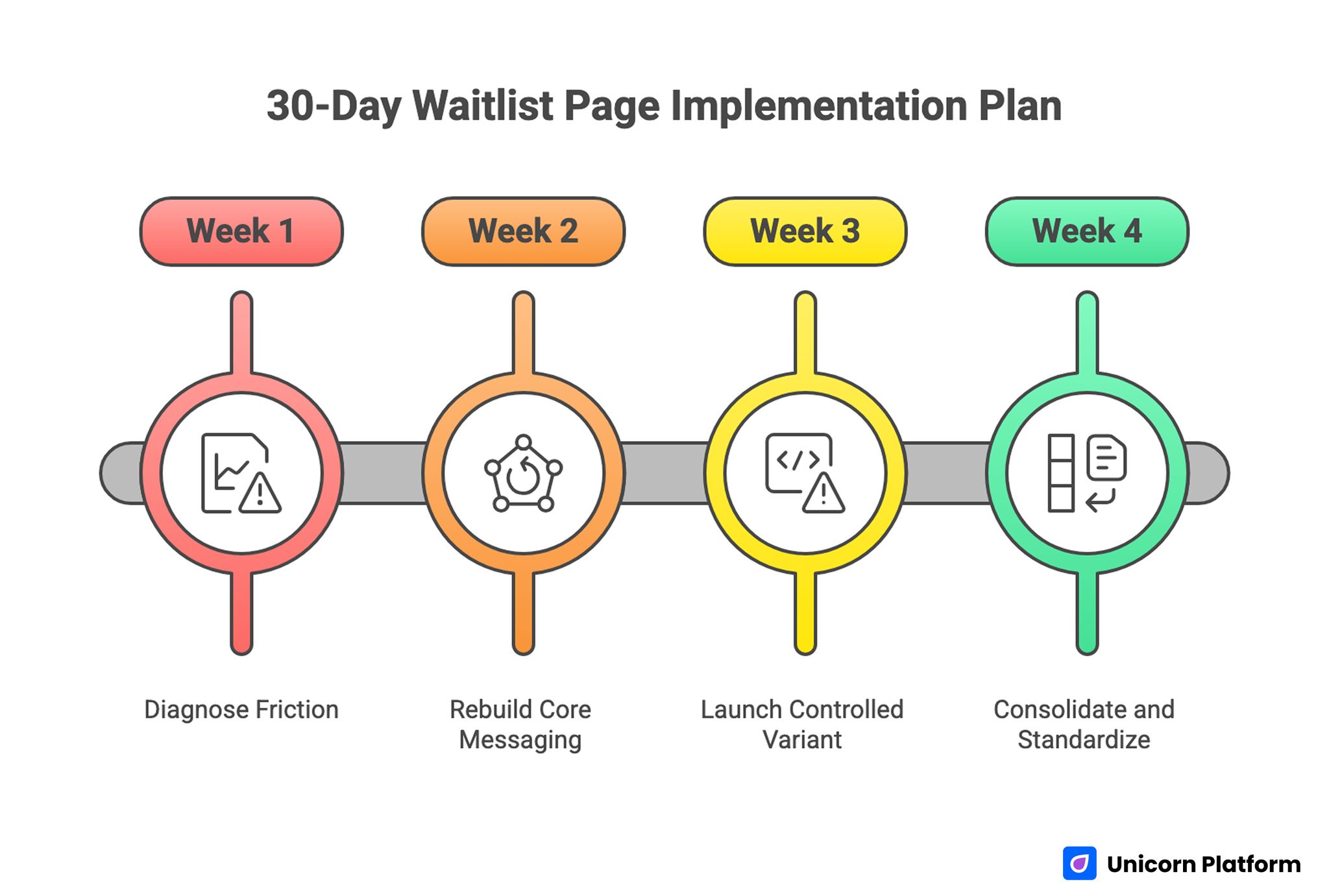
30-Day Waitlist Page Implementation Plan
Week 1: Diagnose Friction
Audit the existing page against the four decision stages. Identify the stage with the highest quality leakage based on engagement and confirmation behavior.
Map active CTAs and remove or demote conflicting routes. Define one primary metric and one guardrail metric before editing begins.
Week 2: Rebuild Core Messaging
Rewrite first-screen copy for audience fit and explicit early-access value. Add timeline and communication clarity in a compact trust block.
Keep the first-step form minimal while preserving one intent signal for segmentation. Validate interaction flow on mobile devices.
Week 3: Launch Controlled Variant
Create one source-specific message variant from the same template. Change only high-impact surfaces such as headline angle and proof order.
Run one test with predefined success and rollback criteria. Track both conversion and quality guardrails.
Week 4: Consolidate and Standardize
Promote validated improvements to the canonical template. Archive losing variants and document lessons in the decision log.
Schedule next-cycle freshness updates and confirm ownership lanes for messaging, trust content, and QA.
90-Day Scale Plan
Month 2: Expand Coverage by Intent Segment
Extend the canonical page system into segment-oriented variants for discovery-stage users, evaluation-stage users, and referral-driven users. Keep structure stable and adapt emphasis only where evidence supports change.
Introduce reusable modules for expectation blocks, trust signals, and confirmation cues so teams can launch faster without reducing quality.
Month 3: Operationalize Reliability
Formalize release gates for route integrity, mobile checks, measurement validation, and freshness review. Define rollback triggers tied to guardrail metrics.
At this stage, scale should come from repeatable execution and cleaner learning cycles, not from increasing page complexity.
Common Failure Modes and Practical Fixes
1) Vision-Heavy Opening Without Audience Fit
The page sounds ambitious but does not make user relevance obvious. Fix this by leading with clear fit criteria and concrete outcome language.
2) Generic Offer Framing
The offer invites signups but does not explain why joining early is valuable. Replace broad promises with specific participation benefits and access logic.
3) Missing Timeline Transparency
Users do not know when updates will arrive or how release sequencing works. Add expectation blocks with realistic timing and communication rules.
4) First-Step Form Overload
Too many fields reduce completion and frustrate mobile users. Move to staged qualification with one intent field at first submission.
5) Trust Signals Too Late in the Flow
Users reach decision points before seeing credibility cues. Reposition trust elements near primary actions.
6) Channel Mismatch
Different traffic sources see one unadapted message and underperform. Use source-aware variants while preserving one stable architecture.
7) Weak Confirmation Experience
Submission is accepted but next steps are unclear. Add immediate confirmation context and explicit first follow-up expectations.
8) Mobile Readability Gaps
Small-screen hierarchy and input behavior create hidden friction. Enforce real-device QA before every campaign push.
9) Metrics Focused on Volume Alone
Submission counts rise while engagement quality declines. Use layered metrics including confirmation, engagement, and activation readiness.
10) No Freshness Cadence
Copy and trust signals age out as launch plans evolve. Run scheduled updates and archive stale claims proactively.
Pre-Launch QA Checklist
Verify first-screen clarity for fit, value, and action. Confirm that each major section maps to a decision-stage job and does not duplicate intent.
Check offer precision, expectation transparency, form simplicity, and confirmation continuity. Ensure route logic supports one dominant conversion path.
Validate mobile interaction behavior on real devices and confirm all tracking events fire as expected. Require final sign-off from messaging and QA owners before scaling traffic.
FAQ: Waitlist Page Strategy
What should teams optimize first before launch?
Start with first-screen relevance and expectation clarity. These two areas usually drive the fastest quality improvements.
Is submission volume the best success metric?
No. Volume is a directional signal, but quality metrics such as confirmation and early engagement are better indicators.
How many fields should the first form include?
Keep initial forms minimal and include one intent signal. Collect deeper context after confirmation.
Should every source see the same message?
Usually no. Keep one template and adapt message emphasis by source intent.
How often should pre-launch copy be updated?
Run monthly freshness updates and additional revisions when launch timeline or offer logic changes.
What makes trust credible before public release?
Transparent expectations, clear rollout criteria, and operational consistency can be strong trust signals even without mature case studies.
How can teams reduce low-intent signups?
Improve fit clarity, specify early-access value, and require one lightweight intent signal in the first submission step.
What is the most common mobile mistake?
Assuming desktop readability translates automatically to small screens. Real-device testing is required.
When should a variant be rolled back?
Roll back when guardrail metrics decline materially and targeted fixes do not recover quality within the planned window.
What creates compounding pre-launch performance?
Stable structure, disciplined testing, transparent communication, and strong post-submission continuity.
Final Takeaway
Pre-launch conversion performance depends on qualification quality, expectation trust, and execution discipline. Pages that optimize only for volume create fragile launch pipelines and unpredictable activation outcomes.
Unicorn Platform supports a stronger model: fast iteration on stable architecture with measurable learning loops. Keep the sequence clear, keep the offer honest, and keep follow-up continuity strong so early demand turns into real product adoption.
Related Blog Posts
- How to Get Qualified Users to Join a Waitlist in 2026: A Practical Conversion System
- How to Launch a Startup Site for Free and Build Real Demand Before Product Release
- How to Build First-Promoter Startup Growth Before You Launch
- Dashboard Landing Pages for Startups: How to Simplify Complex Products and Improve Conversion

