Table of Contents
- Top 10 AI Websites by Real Use Case
- Common Mistakes When Choosing AI Websites
- Editorial Framework You Can Reuse Each Month
- FAQ
AI websites are easy to find and hard to evaluate. Most lists mix research labs, tool directories, and product pages without explaining which one helps with your current goal. That creates noise when founders and teams need clear choices.
A better approach is to pick AI websites by job-to-be-done. Some are best for model updates and technical direction. Others are better for production tooling, education, or finding ready-to-use apps.
This guide updates the original article with a stronger decision system you can actually use. You will get a practical top-10 list, a quality checklist, and a direct implementation workflow for Unicorn Platform content.
sbb-itb-bf47c9b
Key Takeaways
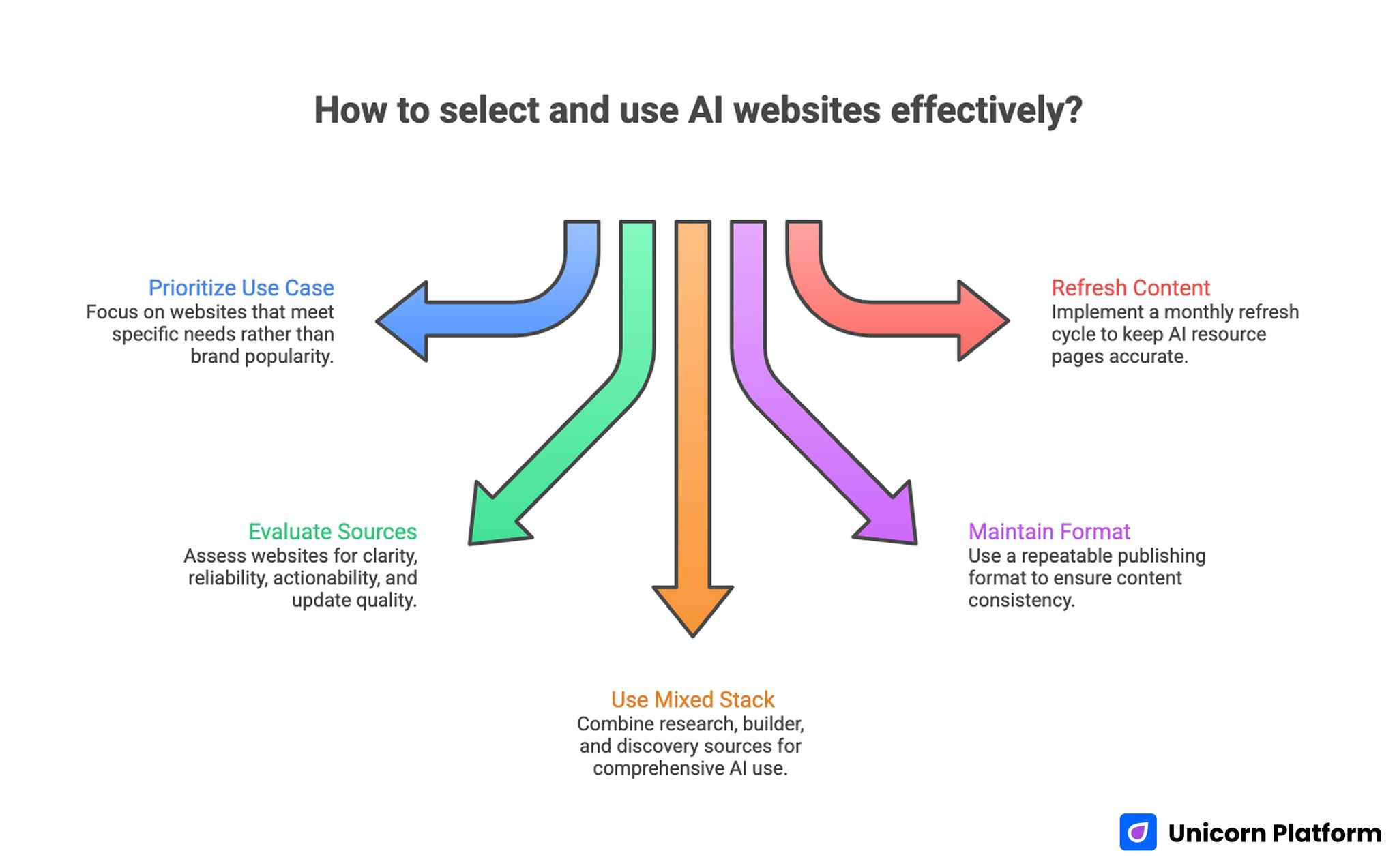
Process for Selecting and Using AI Websites Effectively
- Pick AI websites by use case first, not by brand popularity.
- Evaluate each source by clarity, reliability, actionability, and update quality.
- Use a mixed stack: research source, builder source, and discovery source.
- Keep one repeatable publishing format in Unicorn Platform to reduce content drift.
- Preserve a monthly refresh cycle so your AI resource pages stay accurate and useful.
What Makes an AI Website Actually Useful?
Strong AI websites share a few patterns, regardless of audience type. They explain value quickly, make navigation obvious, and help readers move from idea to action. They also publish in a consistent rhythm so you can trust that the information is current.
Design quality still matters because AI topics can feel complex. Clean structure, readable sections, and concrete examples reduce cognitive load and improve adoption. Teams should also favor websites that make limits and caveats visible, not hidden in fine print.
Use this quick scoring model before adding any site to your workflow:
- Purpose clarity: Can a first-time visitor understand the main use in under one minute?
- Learning support: Are there practical guides, examples, or onboarding paths?
- Technical depth: Does it support beginner and advanced readers with the right layers?
- Trust signals: Are releases, docs, and model notes transparent and easy to verify?
- Workflow fit: Can your team apply it in real business or product work this week?
Top 10 AI Websites by Real Use Case
The list below is structured for practical outcomes instead of hype. Each entry explains when to use it and why it matters for teams building content, products, or internal workflows.
1) OpenAI
OpenAI is a core source for model updates, developer APIs, and applied AI patterns. Product teams use it to track capability shifts and understand what can be shipped now versus later. Content teams use it to stay aligned with mainstream language-model behavior and terminology.
2) Hugging Face
Hugging Face is strong for model exploration, open-source tooling, and technical implementation paths. It works well when teams need flexibility, model comparisons, or custom deployment approaches. If your audience includes builders, this is one of the most useful reference ecosystems.
3) TensorFlow
TensorFlow remains valuable for structured machine-learning learning paths and production-oriented documentation. It is especially useful for teams that need stable educational resources for training and onboarding. Even non-ML specialists benefit from its clear breakdowns of lifecycle stages.
4) NVIDIA Developer and NVIDIA Blog
NVIDIA resources are useful when hardware, inference performance, or deployment efficiency matters. Teams researching AI infrastructure can use these sources to understand practical constraints early. This reduces planning errors when moving from prototypes to heavy workloads.
5) MIT AI Coverage and Berkeley AI Research Channels
University-backed sources are good for early signal detection and foundational direction. They are helpful when you want depth without pure vendor framing. For strategic content, they provide context that improves credibility and editorial balance.
6) Google AI and DeepMind Updates
These sources help teams follow long-horizon model research, safety direction, and product integration trends. They are useful for understanding where ecosystem standards may move next. For planning, they support better assumptions about what users may expect in future tools.
7) Analytics Vidhya and Towards Data Science
These publications are practical for tutorials, workflows, and case-style explanations. They help bridge the gap between abstract model talk and implementation decisions. Teams can use them as inspiration for article formats that teach, not just announce.
8) There’s An AI For That and Similar Discovery Hubs
Discovery hubs are useful for scanning the market quickly by task category. They are best used as a shortlist generator, not final truth. Validate each found tool with direct product docs before recommending it.
9) MarkTechPost and Similar Applied News Sources
Applied news sources are helpful for following fast-moving tooling and release narratives. They can surface ideas early for experiments and content updates. Use them carefully and pair them with primary docs for accuracy.
10) Unicorn Platform
Unicorn Platform matters because it turns AI insight into publishable assets quickly. Teams can draft, structure, and update educational pages without heavy development cycles. For startups, this is often the missing bridge between learning about AI and shipping clear AI content that converts.
How to Build Your AI Website Stack (Instead of Following One Source)
Most teams need a stack of sources, not a single destination. One source should cover research direction, one should cover implementation detail, and one should cover discovery. This structure gives better decisions than relying on one feed.
Use this simple stack model:
- Strategic layer: university labs and major research channels.
- Execution layer: technical docs and developer-focused tutorials.
- Discovery layer: tool directories and applied news roundups.
- Publishing layer: your own Unicorn Platform pages that convert learning into guidance.
The publishing layer is where many teams fail. They gather links but never translate them into structured, decision-ready content for users.
Common Mistakes When Choosing AI Websites
Following popularity without checking fit
Large brands are not always the best answer for your immediate workflow. A smaller specialist source may provide more actionable guidance for your exact problem. Pick by relevance to task, not by social visibility.
Mixing research and operations in one page
Readers need separation between theory updates and implementation playbooks. When both are merged without structure, pages become hard to use. Split sections by decision intent so the reader can move faster.
No update policy
AI pages decay quickly when ownership and cadence are undefined. Without routine updates, previously useful recommendations become stale and misleading. Assign one owner and one schedule for each high-traffic resource page.
Tool-first recommendations without context
Listing tools without scenario context creates low-trust content. Explain who should use each source, when to use it, and what to skip. Context is what makes a recommendation genuinely helpful.
Design and UX Signals to Borrow for Better AI Pages
The strongest AI websites tend to share UX patterns that improve comprehension:
- Fast orientation blocks near the top.
- Clear category labels for audience type and use case.
- Scannable summaries before deep technical sections.
- Strong visual hierarchy with consistent section rhythm.
- Mobile-friendly layout that keeps key actions visible.
If your team produces design-heavy content, your workflow quality also depends on hardware readiness. For teams selecting a computer for graphic design, stable performance can reduce delays when producing media-rich AI pages.
How to Apply This in Unicorn Platform
Start by creating one pillar page called "AI Websites Worth Following" and structure it by use case, not brand. Add a short "who this is for" section at the top so readers can self-segment quickly. This improves relevance and lowers bounce risk.
Next, create reusable section blocks in Unicorn Platform for each item in your top list. Keep block fields consistent: what it is, when to use it, who it helps, and risk notes. Standardized blocks make monthly updates faster and cleaner.
After that, add a "What changed this month" section near the top third of the page. This gives returning readers immediate value and signals freshness. Keep updates short and decision-oriented.
Finally, connect the roundup with one adjacent educational guide and one practical execution guide. For example, you can pair this resource with AI Generated Websites: Everything You Need to Know for concept context, then connect to AI Landing Pages: How to Optimize for Better Conversions for direct execution.
Editorial Framework You Can Reuse Each Month
A repeatable structure keeps this topic useful over time. Use the same publishing frame each month and update only what changed.
Section template
- Market shift summary (what changed and why it matters).
- Updated top list (ranked by practical usefulness).
- "Use this when" notes for each source.
- Known limitations and caveats.
- One implementation checklist for Unicorn Platform users.
Update cadence
- Weekly: collect changes and candidate sources.
- Monthly: refresh rankings and use-case notes.
- Quarterly: review the whole framework and remove weak entries.
Quality gate before publishing
- Every recommendation must include scenario context.
- Every external source must be mapped to a clear audience.
- Every section must answer "what should the reader do next?"
Example 30-Day Workflow for Teams
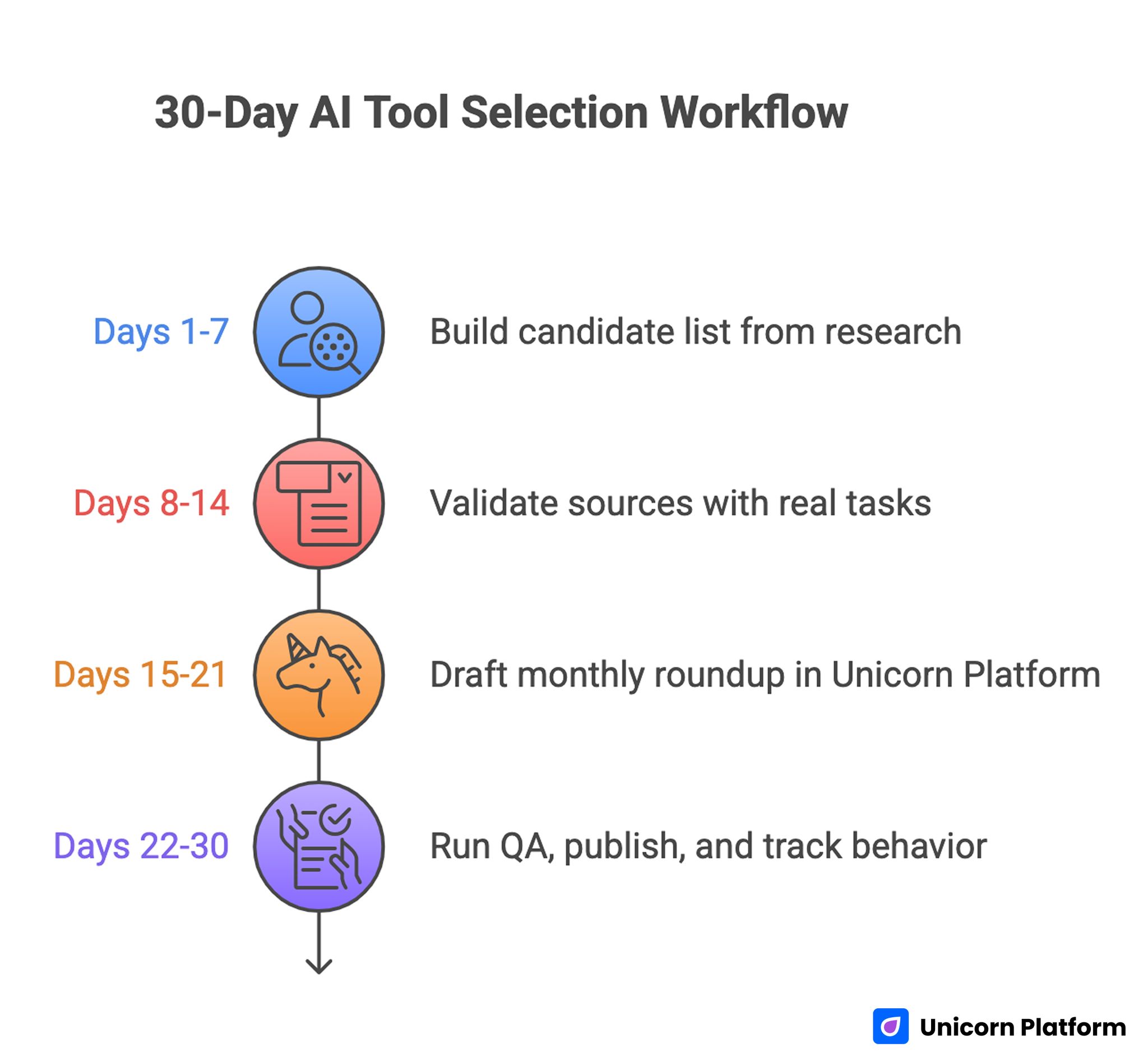
30-Day AI Tool Selection Workflow
Days 1-7: Build a candidate list from research, technical docs, and discovery hubs. Remove sources that do not provide practical implementation value. Keep a short rationale for each remaining source.
Days 8-14: Validate each source with one real task, such as drafting a launch page, designing an onboarding flow, or outlining a documentation update. Record what worked and what broke. Promote only sources that improved output quality.
Days 15-21: Draft the monthly roundup in Unicorn Platform using reusable blocks. Add one short decision snapshot near the top for fast readers. Keep deeper analysis lower on the page.
Days 22-30: Run editorial QA, refresh links, and publish with a changelog note. Track reader behavior and adjust next month’s ranking based on utility, not assumption.
Quick Audit Checklist Before You Publish
Use this short gate to confirm the page is helpful instead of generic:
- Each listed website includes a clear "best for" scenario.
- Every recommendation explains one risk or limitation.
- Readers can find the right section in under 20 seconds.
- At least one block tells users exactly what action to take next.
- Update notes are visible without scrolling to the end.
If any line above is missing, fix the structure before publishing. Small editorial adjustments here often improve trust more than adding another tool name.
FAQ: Top AI Websites to Watch
What is the best AI website overall?
There is no universal best option because goals differ. The right source depends on whether you need research signals, implementation guidance, or tool discovery.
Should startups follow many AI websites or just a few?
A focused stack is usually better. Start with three to five high-quality sources across strategy, execution, and discovery, then expand only when needed.
How often should this type of roundup be updated?
Monthly updates are a good default for fast-changing AI topics. Add quarterly deep reviews to remove outdated sections and improve structure.
Are AI tool directories enough for decision-making?
Directories are good for discovery but weak for final decisions. Always validate with official docs and real workflow tests.
How do I keep this useful for non-technical readers?
Use clear categories, short summaries, and scenario-based recommendations. Explain outcomes first, then include optional technical depth.
What should be removed from low-quality AI roundups?
Remove generic claims, unsupported hype, and tool lists without context. Keep only sources tied to real user tasks.
How many sources should appear in a top list?
Ten is a practical number for readability and depth balance. It is enough variety without overwhelming the reader.
Can Unicorn Platform handle regular updates for this topic?
Yes. Reusable blocks, simple section architecture, and a clear update cadence make routine refreshes manageable for small teams.
Should I include internal links in this kind of article?
Yes, but use them with intent. Link only to directly relevant pages that deepen understanding or support the next action.
What is the main success metric for this page type?
Track usefulness signals such as time on page, return visits, and downstream action from readers. Those indicators reflect real value better than raw traffic alone.
Final Takeaway
A useful AI websites article is not a static list. It is a maintained decision resource that helps readers choose the right source for the right task. If you publish it with a clear framework and steady updates in Unicorn Platform, it becomes a practical asset for both users and your content team.

