Table of Contents
- Why Signup Volume Often Hides Audience Quality Problems
- Section Blueprint: What Each Block Should Do
- Scenario Playbooks
- 30-Day Execution Plan
- FAQ
Growing a newsletter is not a simple matter of collecting more emails. Many teams hit the same wall: signup numbers rise, but engagement falls after the first send. Open rates decline, click depth weakens, and unsubscribes climb because the page promise and delivered content are misaligned.
The highest-performing programs treat acquisition pages as quality filters, not volume collectors. A strong page attracts readers who understand what they are subscribing to, why it matters, and what they should expect next. That clarity improves both conversion and retention because people opt in with realistic intent.
Unicorn Platform helps teams execute this model quickly by making page iteration, variant testing, and message updates operationally light. The speed benefit becomes meaningful when each iteration is tied to a clear quality objective.
sbb-itb-bf47c9b
Quick Takeaways
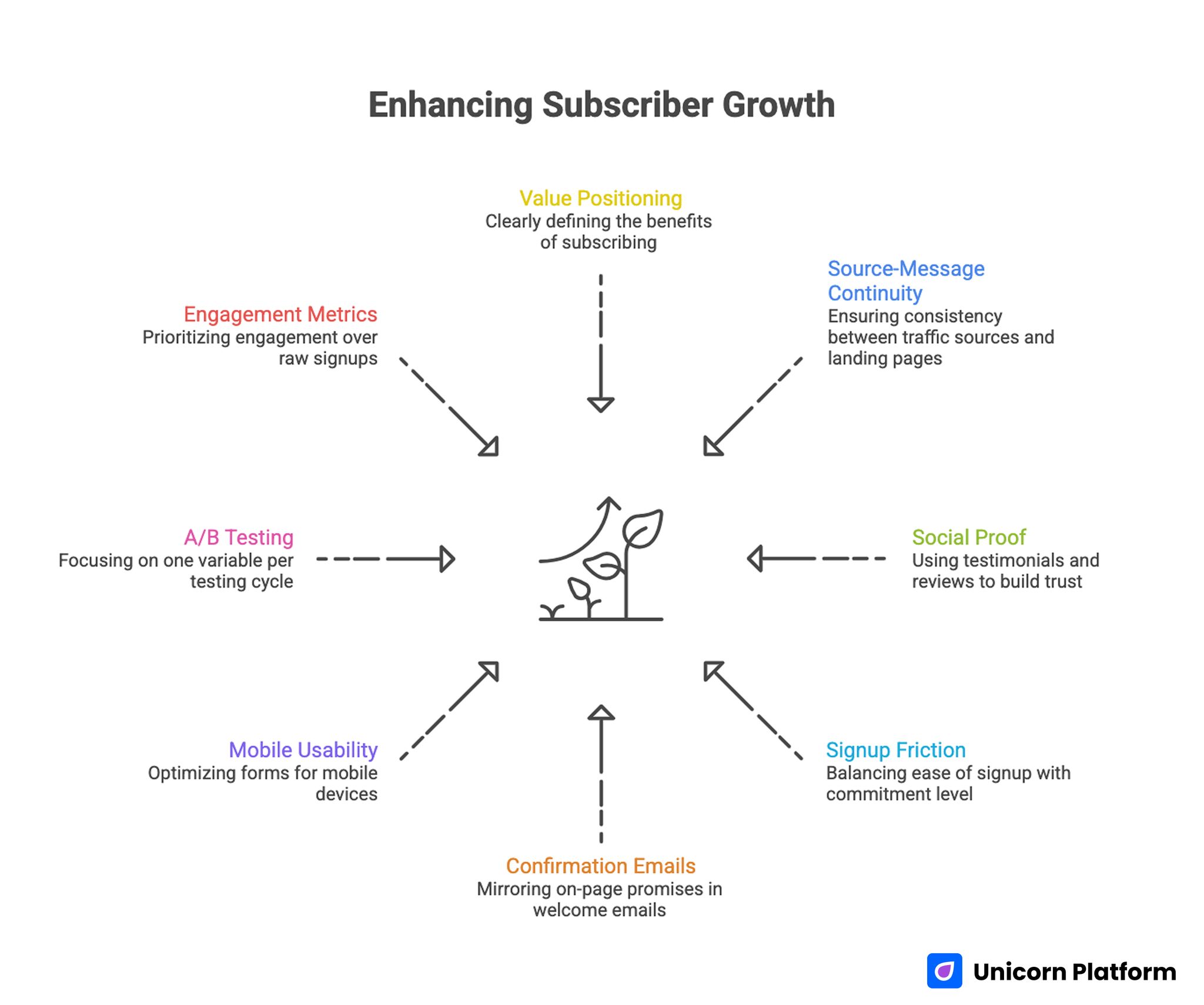
Enhancing Subscriber Growth
- Subscriber growth quality starts with clear value positioning before the form.
- Source-message continuity from traffic channel to page is a trust requirement.
- Social proof should reduce specific doubts, not decorate the page.
- Signup friction should match commitment level and offer depth.
- Confirmation and welcome emails must mirror on-page promises exactly.
- Mobile clarity and form usability should be release blockers.
- Testing should focus on one major variable per cycle.
- Engagement metrics should guide optimization more than raw signup count.
Why Signup Volume Often Hides Audience Quality Problems
Many teams evaluate success by total new subscribers, but this metric alone can be misleading. If readers subscribe with weak intent, they may never become active participants. That creates list bloat and reduces the efficiency of every future send.
A frequent cause is broad offer language that sounds attractive but lacks specific usefulness. Statements such as "weekly insights" feel safe, yet they do not help visitors self-qualify. Readers who expect one type of content and receive another often disengage quickly.
Another cause is misaligned channel traffic. A page can convert well for social curiosity clicks and perform poorly for search-driven intent. Without source-specific diagnostics, teams may improve signup volume while damaging long-term engagement.
Define the Subscriber Promise Before Designing the Page
A high-performing page begins with a precise promise. That promise should answer what readers get, how often they get it, and what practical result it helps them achieve. Precision helps the right readers opt in and the wrong readers opt out.
A useful promise framework includes four elements. Documenting each element before writing copy prevents the page from drifting into generic language.
- Topic boundary: the exact area of focus.
- Format expectation: what each issue contains.
- Cadence expectation: how often readers will hear from you.
- Outcome expectation: what readers can do with the content.
When this promise is clear, every downstream element becomes easier to optimize because the page has one coherent job. It also makes cross-channel testing cleaner because every variant is anchored to the same core offer.
The Core Conversion Sequence for Subscriber Pages
Effective subscriber pages usually follow a stable decision sequence. First, they confirm relevance quickly. Second, they explain why the content is useful now. Third, they reduce trust friction with evidence. Fourth, they present one straightforward signup action.
Sequence matters because visitors make rapid judgments. If trust cues are delayed or the offer remains vague near the form, decision confidence drops. The page may still convert some traffic, but subscriber quality usually suffers.
For teams that want a practical structure baseline before testing copy variants, this conversion-oriented page structure guide can help keep section roles clear during iteration. Use it to preserve narrative order while testing only one major change at a time.
Section Blueprint: What Each Block Should Do
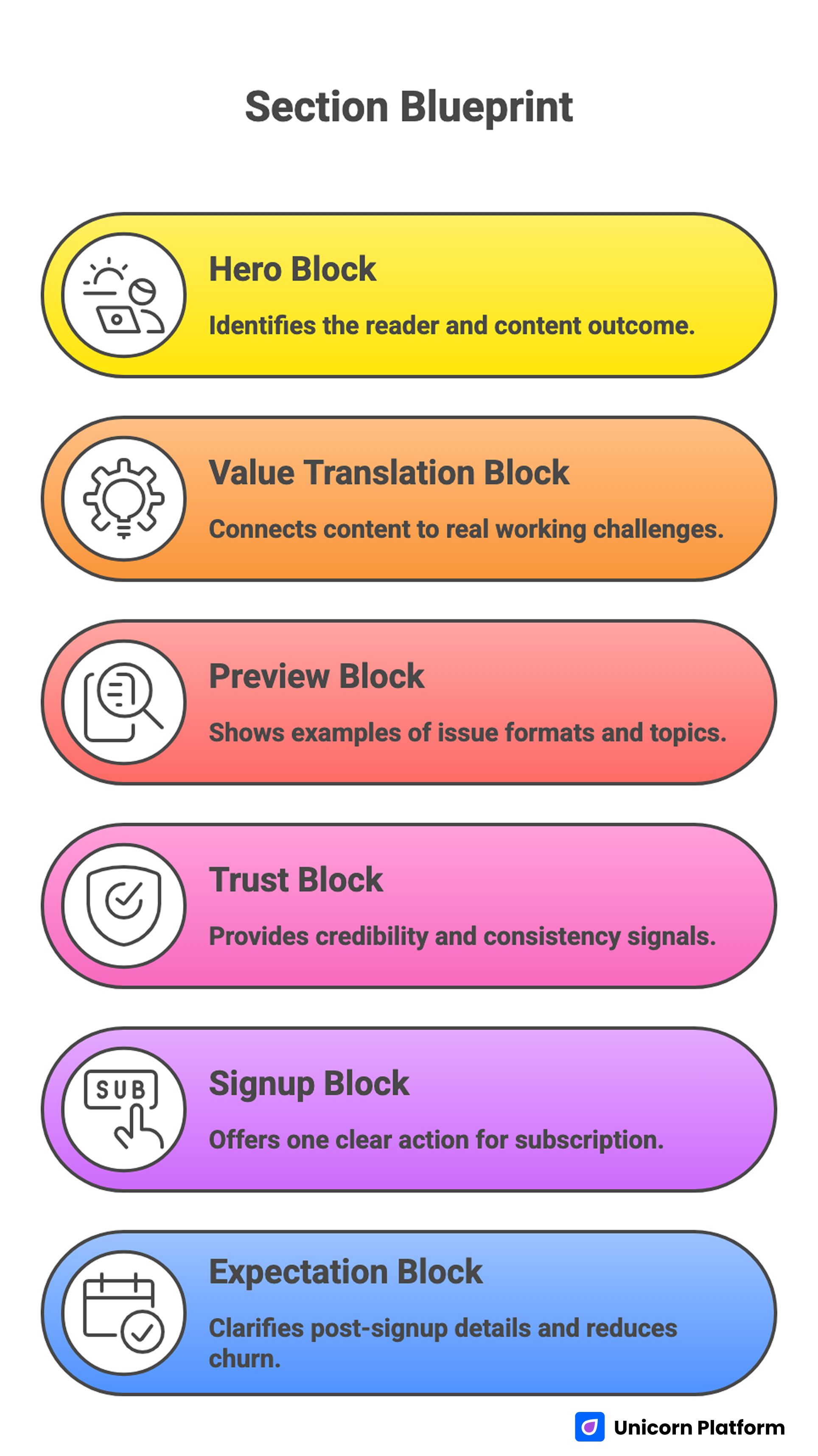
Section Blueprint
Hero block: immediate relevance and value
The hero should identify the intended reader and the primary content outcome in one screen. Keep the statement concrete and easy to scan. Readers should know within seconds whether this publication is built for their goals.
Value translation block: why this matters now
This section connects the content promise to real working challenges. It should explain why the publication saves time, reduces uncertainty, or improves execution quality.
Preview block: proof of editorial substance
Show examples of issue formats, topic depth, or recent editions. Previews reduce uncertainty better than abstract quality claims because readers can inspect the value before subscribing.
Trust block: credibility and consistency signals
Trust signals can include reader testimonials, growth context, sender transparency, and editorial process clarity. Prioritize relevance over volume so evidence matches the concerns your readers are likely to have.
Signup block: one clear action
The form and CTA should feel like the natural next step after value and trust are established. Keep the action language specific, and explain what happens immediately after submission.
Expectation block: post-signup confidence
A concise expectation block can reduce churn by clarifying first email timing, sender name, and delivery cadence. This simple section often improves welcome-sequence engagement quality.
Offer Specificity: The Highest-Leverage Conversion Variable
General claims attract broad curiosity but weak retention. Specific claims attract smaller yet stronger cohorts. In subscription businesses, strong cohorts outperform larger weak cohorts over time because engagement compounds.
Specificity should include topical boundaries and practical utility. Instead of promising generic industry updates, explain the decision support readers will receive. This framing helps visitors decide quickly and honestly whether the publication matches their needs.
Specificity also improves testing quality. Clear promises produce clearer feedback because metric movement reflects real fit rather than ambiguous interpretation.
Audience Fit Segmentation by Channel Intent
Different channels bring different intent states. Search traffic usually includes problem-aware readers who want depth and practical resolution. Social traffic often includes discovery-oriented readers who need faster orientation and proof before committing.
One universal page can work, but source-aware variants often perform better when acquisition scale grows. The key is to preserve a common brand promise while adjusting emphasis, examples, and CTA wording by channel context.
For teams using content-led growth programs, this content format planning guide helps map channel intent to page variants without fragmenting editorial consistency. This keeps acquisition experiments aligned with the editorial strategy that supports retention.
Trust Design: What Actually Reduces Subscription Friction
Trust on subscriber pages is less about logo density and more about predictability. Readers want confidence that the content will be useful, consistent, and aligned with the promise they saw before entering their email.
High-value trust assets include issue previews, editorial methodology notes, author identity clarity, and transparent cadence. These signals reduce uncertainty at the exact point where users decide whether to invite another sender into their inbox.
If you are early and lack large social proof, focus on process trust. Explain how topics are selected, how practical recommendations are verified, and how reader feedback shapes future issues.
Form Strategy for Quality, Not Just Completion
Single-field forms are often effective for newsletter acquisition, but the right setup depends on offer complexity. If segmentation is critical for downstream relevance, a second optional field can be useful when the reason is clear to readers.
CTA microcopy has meaningful impact. Action text should reinforce the value exchange rather than default to generic labels. Clarity improves both conversion quality and post-submit confidence.
Every additional field should pass one test: does it improve reader experience or downstream content relevance enough to justify friction? If the answer is unclear, remove the field.
Confirmation and Welcome Flow Alignment
The page promise and welcome emails must match exactly. If the signup experience promises tactical depth and the first emails deliver broad commentary, trust declines immediately and churn risk increases.
A practical welcome alignment sequence includes three messages. Email one delivers a concrete quick win. Email two reinforces the recurring content format. Email three invites preference feedback or reply, which improves engagement signals and future segmentation quality.
When teams need stronger post-signup conversion alignment, this lead generation page framework can help connect acquisition messaging with deeper funnel outcomes. It is particularly useful when newsletter signups also feed product education or sales-assist journeys.
Mobile Reliability and Performance Discipline
A large share of subscription traffic is mobile-first. Pages that feel clear on desktop can fail on phones because hierarchy collapses, forms become awkward, or trust details move too far below the fold.
Minimum mobile QA should include first-screen readability, tap-target spacing, form behavior with mobile keyboards, confirmation-state clarity, and load performance under average network conditions. Any critical failure should block launch.
Performance is especially important near conversion moments. Delays during form interaction can erase trust built by strong copy and proof.
Testing Framework for Durable Improvement
Rapid iteration tools can create random testing behavior if teams are not disciplined. Sustainable gains come from controlled tests with explicit hypotheses and clear decision criteria.
A practical cycle includes one major variable per test, one primary metric, and one quality guardrail. For example, if headline specificity is tested, avoid simultaneous form changes that distort interpretation.
Document each test in a shared log with hypothesis, change scope, observation window, and decision outcome. This creates institutional memory and reduces repeated low-value experiments.
Metrics That Matter More Than Raw Growth
Signup volume should be viewed as an early signal, not a final objective. Subscriber quality is better measured through engagement and retention indicators tied to source and page variant.
Core metrics for ongoing review should be tracked in one shared dashboard so decisions stay consistent across teams. This avoids local optimization that improves one metric while harming list health.
- day-7 open rate by source and page variant
- click depth across first three sends
- unsubscribe timing cohort analysis
- reply and interaction signals from onboarding emails
- spam complaint and deliverability stability
This metric stack helps teams detect quality drift early and adjust messaging before list health declines. It also improves planning because teams can see which channels produce durable cohorts rather than temporary spikes.
Scenario Playbooks
Scenario 1: High conversions with weak open rates
This usually indicates over-broad promises or low-fit traffic. Tighten offer specificity, refine source targeting, and adjust first-email alignment to match page language more closely.
Scenario 2: Strong opens but weak click-through behavior
Readers may understand the offer but not see practical usefulness in each issue. Improve preview framing on the page and strengthen action-oriented structure in early emails.
Scenario 3: Good engagement from one channel, weak from another
The issue is often message mismatch between channel framing and on-page expectations. Create channel-aware variants while preserving core publication identity.
Scenario 4: Growth spikes during campaigns, then decays
Campaign headlines may drive curiosity without fit. Add stronger qualification language and clearer expectation cues to reduce low-intent subscriptions.
Governance Model for Small and Growing Teams
Subscriber-page performance improves when ownership is explicit. One owner should control promise clarity, one should own proof and examples, and one should own QA and measurement review.
A practical governance rhythm can include weekly diagnostic checks, biweekly page edits for one major bottleneck, and monthly strategic review using cohort data. This keeps improvements steady without creating constant redesign churn.
Teams that maintain this cadence usually improve both conversion and engagement quality because page decisions remain evidence-based. Consistency in this rhythm is often the difference between compounding growth and repeated reset cycles.
Cohort Analysis and Promise Drift Detection
Cohort analysis is one of the fastest ways to catch promise drift between acquisition copy and delivered content. Instead of viewing list performance in aggregate, group subscribers by page variant, source, and signup date window. This reveals where quality is stable and where it decays after acquisition pushes.
A practical cohort review should compare day-1, day-7, and day-30 behavior for each acquisition path. If one cohort converts strongly but disengages quickly, the issue is usually expectation mismatch rather than deliverability or send frequency alone. If one cohort opens consistently but rarely clicks, content structure may need stronger action utility.
Use these findings to update page modules, not just email copy. For example, if a cohort consistently churns after the second issue, add clearer cadence and format previews near the form. If a cohort has high click depth, replicate that channel framing in additional variants and expand distribution deliberately.
Referral Loops and Archive Positioning
Healthy newsletter growth often accelerates when acquisition pages help current readers share with context. Generic share buttons can create low-fit traffic if they do not explain who the publication is for. Referral design works better when the page includes audience-fit language near sharing prompts.
Archive positioning matters for the same reason. A long undifferentiated archive can overwhelm new visitors, while a curated set of representative issues improves confidence quickly. Select three to five issue previews that reflect the core editorial promise and the practical outcomes subscribers can expect.
In Unicorn Platform, these modules can be refreshed on a monthly cadence without rebuilding the full page. Regular refresh keeps examples current and makes referral traffic more qualified because visitors see relevant value evidence before subscribing.
Deliverability-Safe Growth Practices
Subscriber quality and deliverability are tightly connected. When acquisition pages attract low-intent readers, complaint rates and inactive subscriber volume can increase, which can eventually reduce inbox placement. Growth quality should therefore include deliverability guardrails in every review cycle.
Practical safeguards include clear sender identity on-page, explicit cadence language, and immediate value delivery in the first email. These signals reduce surprise, which is one of the most common triggers for complaints and silent disengagement. If complaint clusters appear from one channel, pause expansion there and review promise alignment before reactivating spend.
Deliverability metrics should be monitored as early warning signals for page quality. Strong inbox placement is usually the byproduct of clear expectations and high-fit acquisition, not a separate technical project.
30-Day Execution Plan
Week 1: Promise audit and baseline setup
Review current acquisition pages and identify where promise clarity is weak. Set baseline metrics for conversion, day-7 open rate, and early unsubscribe behavior.
Week 2: Structural rebuild and preview enhancement
Update page sections to emphasize relevance, preview clarity, and trust timing. Keep form friction minimal and clarify post-submit expectations.
Week 3: Channel-aware variant rollout
Launch one primary page plus one source-aware variant. Track early engagement quality by source and compare against baseline.
Week 4: Quality-focused optimization
Refine the highest-impact section based on observed behavior. Document the change and prepare the next cycle with one controlled hypothesis.
90-Day Plan for Compounding Subscriber Quality
Month two should stabilize onboarding quality and ensure page-to-email alignment remains consistent across channels. Avoid broad visual redesigns unless data shows structural limitations.
Month three should formalize reusable modules, including proven offer statements, proof blocks, and CTA patterns by traffic source. This reduces contributor variance and improves production speed without sacrificing quality.
At ninety days, success should be evaluated by cohort health trends, not only topline list growth. Durable programs optimize for engagement depth and retention consistency.
FAQ: Subscriber Acquisition Pages in 2026
1. What is the most important element on a subscriber page?
Offer clarity is usually the strongest lever. If readers cannot quickly understand what they will receive and why it helps them, other improvements have limited impact.
2. Should I remove navigation from acquisition pages?
In most cases, reduced navigation improves focus. If navigation is included, it should not compete with the primary subscription action.
3. How many form fields should I use?
Use the minimum needed for immediate value delivery. Add fields only when they clearly improve downstream content relevance or routing quality.
4. How can I improve subscriber quality without lowering conversion too much?
Increase promise specificity and expectation clarity first. Better qualification often improves engagement while keeping healthy conversion rates.
5. What is a good conversion rate for this type of page?
There is no universal benchmark that applies to every audience and channel mix. Compare rates against your own source-specific baselines and evaluate quality alongside volume.
6. Should I create different pages for different channels?
When channel intent differs materially, source-aware variants usually help. Keep the core promise consistent while adapting framing and proof emphasis.
7. How often should I update page copy?
Run weekly diagnostics and monthly strategic refreshes. Update faster when cohort metrics show clear promise drift or source mismatch.
8. What proof works best when a list is still small?
Process transparency and strong previews are often best early trust assets. Explain editorial standards and show representative issue quality.
9. How do I connect page optimization with email performance?
Track engagement cohorts by page variant and source. Use this mapping to refine promise language and onboarding sequence alignment.
10. What causes recurring churn after signup?
Common causes include vague promises, mismatched welcome content, and low-fit acquisition channels. Fixing alignment across those three layers usually improves retention.
Final Takeaway
Subscriber growth quality is built through clear promises, trustworthy previews, and disciplined alignment between page messaging and onboarding delivery. Volume without fit creates unstable outcomes that are expensive to correct later.
With Unicorn Platform, teams can run this process quickly and repeatedly. The compounding advantage appears when each iteration improves not only signups, but also the quality of readers who stay engaged over time.

