Table of Contents
Resorts invest heavily in traffic through search, social, influencers, and partnerships. Yet many teams still struggle with direct booking quality because post-click pages do not reduce uncertainty fast enough.
A premium visual style alone is not enough. Travelers also need clear answers about fit, inclusions, timing, policy rules, and what happens after they submit a request.
When those answers are delayed, users compare options elsewhere or return to marketplace channels. That increases dependency on intermediaries and reduces margin.
This guide explains how resort teams can build a higher-converting booking page system in 2026 with Unicorn Platform. The focus is practical execution: structure, messaging, trust, mobile flow, and weekly improvement loops.
sbb-itb-bf47c9b
Quick Strategic Takeaways

Resort Booking Strategy
- Build each page around one booking objective and one traveler segment.
- Lead with fit and practical value, not only aspirational mood language.
- Place trust and policy clarity near commitment points.
- Use pricing orientation to improve self-qualification before inquiry.
- Keep first-step forms short, then collect deeper details later.
- Run mobile and accessibility checks as fixed release gates.
- Scale spend only after qualified booking signals stabilize.
Why Resort Pages Underperform Even With Strong Traffic
Most weak resort pages fail for operational reasons, not design budget limits. Teams publish quickly, but page logic does not match how people make travel decisions.
The most common issue is message mismatch. Ads promise a specific stay outcome, then landing content opens with broad brand storytelling that does not confirm offer fit.
The second issue is delayed trust. Travelers reach pricing and inquiry sections before seeing cancellation clarity, service credibility, or realistic inclusion scope.
The third issue is friction-heavy action flow. Long forms, unclear next steps, and weak mobile interaction reduce completion quality even when interest is high.
Fixing these three issues usually creates stronger booking performance before any major redesign project is needed.
Define Page Intent Before Writing Copy
Before choosing modules, define what this page must accomplish. A resort page cannot optimize equally for every audience and every goal.
Common primary goals include direct booking starts, consultation requests, package inquiries, and date-availability checks. Each page should have one dominant outcome and one low-friction fallback action.
Audience stage also matters. Cold users need orientation and trust first, while warmer users need faster decision support and cleaner commitment pathways.
This intent definition removes ambiguity in reviews and gives analytics a clear success model. It also reduces random edits that weaken consistency over time.
A Conversion-First Structure for Resort Pages

Resort Page Structure
A stable page structure allows faster optimization because teams can test copy and proof in controlled conditions. Without structure stability, every update changes too many variables.
A practical sequence for resort pages:
- traveler-fit headline and stay promise
- quick facts block (duration, transfer, inclusions)
- experience modules (rooms, dining, activities)
- trust evidence (reviews, credentials, service proof)
- policy and flexibility summary near action points
- FAQ for real booking objections
- one primary booking action plus one fallback path
This order mirrors traveler decision behavior. Users first need relevance, then confidence, then practical commitment clarity.
For teams that want to compare this approach with hotel-focused structures, this guide on high-converting hotel landing pages is a useful benchmark.
First-Screen Messaging for Faster Fit Recognition
The first screen should answer three questions in seconds: who this stay fits, what outcome is offered, and what action should happen next.
A broad line like “escape to paradise” can support tone, but it cannot carry conversion intent alone. A better approach includes route context, package type, and decision cue in concise language.
Example structure: audience cue + stay format + key inclusion + next step. This pattern improves immediate relevance without overloading the page.
When first-screen clarity improves, deeper sections usually perform better because visitors continue with clearer expectations.
Trust and Risk Clarity Near Booking Actions
Resort decisions include risk considerations around weather, transport timing, cancellation terms, and hidden cost fears. If risk clarity appears too late, qualified users hesitate.
A strong trust layer includes verified guest proof, operational credibility, and policy transparency. These elements should appear where users evaluate price and action, not only in distant footer areas.
Useful trust modules include:
- review highlights with context
- short service quality signals
- inclusion and exclusion clarity
- cancellation summary in plain language
- response-time expectations after form submission
This trust architecture improves booking confidence and reduces low-fit submissions.
For teams refining trust placement and booking flow reliability, this resource on tour operator website execution patterns can support implementation decisions.
Package and Pricing Orientation Without Overload
Travelers do not always need full pricing matrices on the top screen, but they need enough detail to self-qualify before committing.
A practical pricing orientation block includes starting range context, base package inclusions, common add-ons, and confirmation timing expectations.
Complete opacity usually increases inquiry volume while lowering quality. Orientation transparency often reduces support burden and improves downstream conversion efficiency.
Package positioning should also match traveler segment expectations. Family-focused offers need practical convenience detail, while premium wellness offers need program and credibility specificity.
CTA and Form Flow for Better Inquiry Quality
A resort page can include repeated CTA placements, but one primary action type should dominate. Competing actions fragment attention and reduce commitment clarity.
CTA language should describe real next steps, not generic intent. “Check 2026 Dates” or “Request Tailored Package” usually sets better expectations than broad labels.
First-step forms should capture routing essentials only. Additional qualification can be collected after confirmation, where user commitment is higher.
This staged form model protects completion rate while preserving lead-quality control. It also makes experimentation cleaner because each field has a clear decision role.
Mobile-First Booking Experience
Mobile is often the discovery and early evaluation channel for resort traffic. Industry research from Phocuswright shows that a large share of travel discovery and trip planning now happens on mobile devices, which makes mobile usability and booking flow performance critical for resort conversion outcomes. If first-screen readability, tap comfort, or form flow is weak, qualified visitors are lost early.
Run mobile checks before every major launch. Validate headline legibility, quick-facts visibility, CTA reachability, media load speed, and form usability on real devices.
Teams that postpone mobile QA usually pay for avoidable traffic waste during paid campaigns. Mobile reliability should be a publish requirement, not a post-launch task.
Accessibility as a Conversion Safeguard
Accessibility improvements usually strengthen overall UX quality, not only compliance posture. Clear focus states and reliable keyboard flow reduce interaction errors for many user types.
For booking-focused pages, readable form errors and predictable navigation are especially important. Small interaction failures can break otherwise qualified inquiries.
Include accessibility checks in weekly QA and keep results in your release log. Consistent checks catch regressions before they affect campaign quality.
Direct Booking Value Messaging vs OTA Dependence
Many resorts lose direct conversion because value communication is generic. Industry analysis published on Hospitality Net highlights that resorts increasingly focus on strengthening direct-booking strategies to reduce reliance on online travel agencies and improve revenue control. If direct booking is framed only as “best price,” users may still choose intermediaries for perceived convenience.
A stronger approach highlights direct-booking advantages with practical relevance: faster response, clearer upgrade options, better pre-arrival coordination, and cleaner policy communication.
These value points should appear near pricing and action sections where comparison decisions happen. Hiding them in secondary content weakens their commercial effect.
Segment Variants for Resort Audiences
One page can validate early assumptions, but multi-segment growth usually requires variants. Family, couples, remote workers, and wellness travelers evaluate different risk and value cues.
Use one stable architecture and swap segment-specific modules for message emphasis, proof order, and CTA framing. This keeps operations efficient while improving fit quality.
Document each variant hypothesis in advance. Clear hypotheses reduce random changes and improve confidence in outcomes.
Seasonal and Availability Strategy
Resort demand is seasonal, so message priorities should adapt without forcing full redesigns. Keep one evergreen structure and add seasonal availability modules as needed.
Useful seasonal updates include departure-window cues, climate expectations, event-based packages, and urgency signals tied to real inventory conditions.
Monthly seasonal reviews are usually enough for most teams. Unsupported urgency language should be removed quickly because it can damage trust.
Content-to-Booking Flow for Organic Traffic
Editorial content can support direct bookings when route planning and conversion pages are connected intentionally. Blog traffic without aligned next steps rarely compounds into qualified demand.
A practical flow uses discovery pages for planning questions, comparison pages for route choices, and conversion pages for booking actions. Internal links should appear at natural decision points.
This model improves topical authority while guiding users through a coherent journey. It also helps teams measure where users drop off before inquiry.
For teams shaping this journey around travel category intent, this guide on travel agency website systems provides useful structural references.
Weekly Optimization Loop for Resort Teams
Lean resort teams often need a workflow that stays practical during high-season pressure. One major test variable per week is usually the best balance between speed and clarity.
A simple loop:
- review section-level performance
- ship one controlled change
- monitor inquiry quality and drop-off patterns
- keep, refine, or revert with documented rationale
Over time, this creates a reusable playbook and reduces repeated mistakes.
30-Day Action Plan
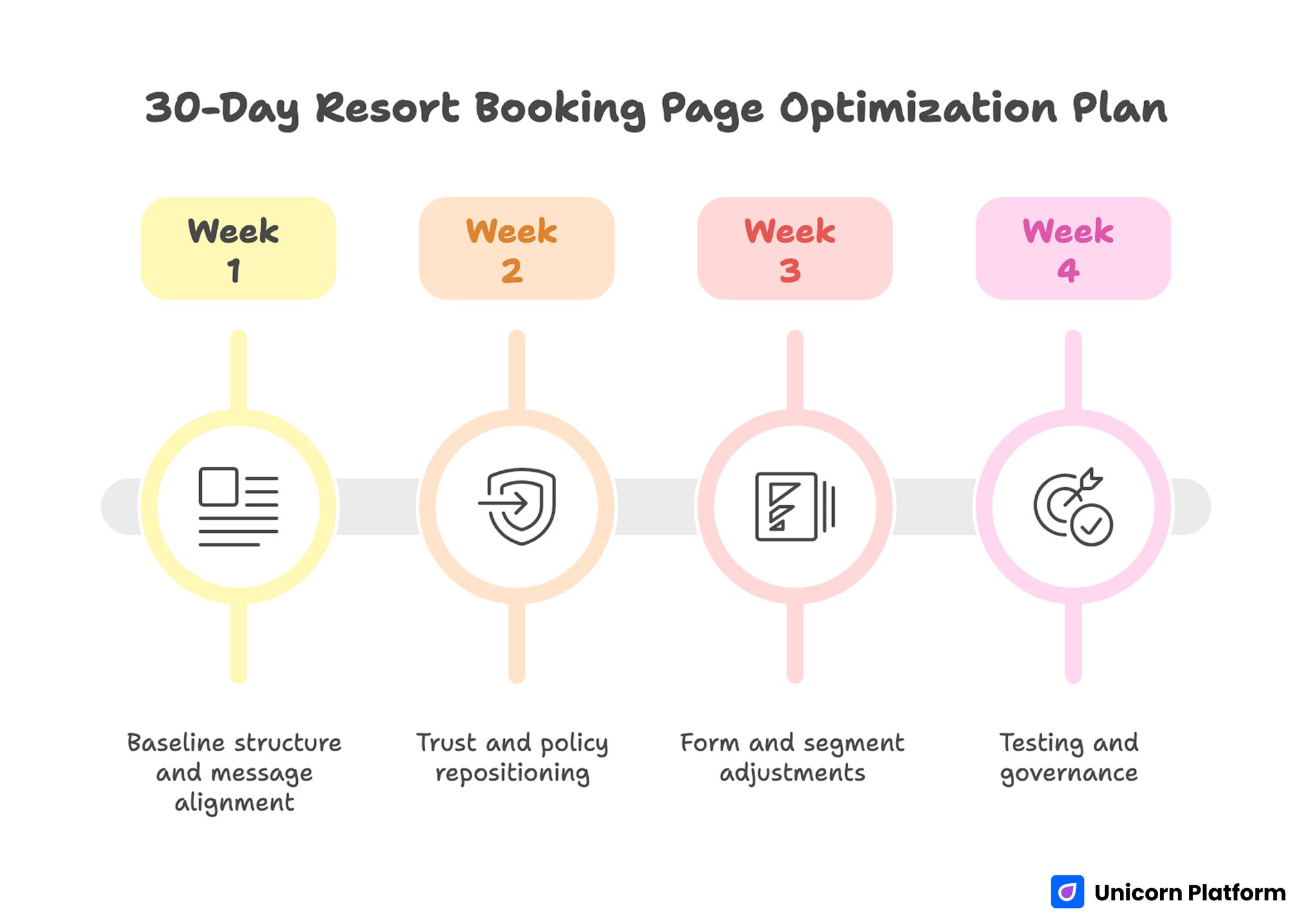
30-Day Resort Booking Page Optimization Plan
Week 1: baseline structure and message alignment
Audit top resort pages with one checklist. Standardize first-screen fit messaging, quick-facts placement, and primary CTA language.
Week 2: trust and policy repositioning
Move trust elements closer to pricing and action points. Improve cancellation and flexibility summaries using concise, scannable language.
Week 3: form and segment adjustments
Simplify first-step forms and launch one segment-specific variant with controlled module changes. Keep architecture stable for clean attribution.
Week 4: testing and governance
Run one headline and one CTA test on separate page sets. Review qualified inquiry trends by source and document decisions for next cycle.
This plan keeps execution realistic while producing measurable learning.
90-Day Scale Readiness Checklist
Before increasing budget, validate whether core quality signals are stable across major traffic sources and devices.
Review these categories:
- message-source fit
- trust and policy freshness
- pricing orientation clarity
- mobile form reliability
- qualified inquiry consistency
Delay scale when multiple categories are unstable. Foundation improvements usually outperform rushed budget expansion in ROI terms.
Governance and Ownership Model
Page quality declines quickly when ownership is unclear. A lightweight role model protects both speed and consistency.
Minimum ownership set:
- narrative owner for messaging and hierarchy
- accuracy owner for pricing and policy
- proof owner for trust assets and updates
- QA owner for mobile and accessibility checks
Role clarity reduces rework and keeps page behavior aligned with operational delivery standards.
Migration Strategy for Growing Resort Programs
As operations mature, teams may need to migrate from ad-hoc pages to standardized modules. Migration should protect both conversion behavior and analytics continuity.
A phased approach works best: baseline audit, template parity, tracking validation, staged traffic transfer, and legacy page cleanup. This prevents abrupt performance swings during transitions.
Good migration discipline also improves onboarding for new contributors because standards are visible and reproducible.
Common Mistakes and Fast Fixes
Mistake 1: one generic narrative for every audience
Fix by deploying segment-aware variants with shared architecture. This improves message fit while preserving maintainability.
Mistake 2: trust content too far from booking actions
Fix by moving reviews, policies, and service proof closer to pricing and CTA areas. Users need confidence at the moment of commitment.
Mistake 3: unclear inclusion and exclusion language
Fix by adding scannable package clarity blocks. Better transparency reduces low-fit inquiries.
Mistake 4: heavy first-step inquiry forms
Fix by collecting only routing essentials first, then adding deeper qualification later. This keeps completion rate healthier.
Mistake 5: mobile checks delayed until after launch
Fix by making mobile readability and form interaction mandatory pre-launch checks. Early QA prevents expensive traffic waste.
Mistake 6: scaling budget before quality stability
Fix by gating spend growth behind qualified inquiry consistency, not total form volume.
Mistake 7: undocumented optimization decisions
Fix by maintaining one shared weekly log with hypothesis, change, metric, and final decision.
FAQ: Resort Booking Page Playbook
How much detail should a resort booking page include?
Include enough practical detail to resolve key traveler risk questions without turning the page into a full operations manual.
What should we optimize first for faster gains?
Start with first-screen fit clarity and CTA wording. These two areas usually drive the fastest measurable impact.
Should pricing be visible on resort pages?
Yes, at least as orientation context. Even limited transparency improves self-qualification and trust.
How often should trust content be updated?
At least monthly, and sooner when offers, policies, or route conditions change.
Is mobile optimization still critical if desktop bookings are high?
Yes, because many users discover and evaluate offers on mobile before finalizing later.
How many variants should we run initially?
One baseline and one segment-specific variant is usually enough to start cleanly.
Which metric matters most after inquiry volume?
Qualified inquiry rate by source is usually the most useful secondary signal.
How often should small teams run tests?
One major variable per week is a practical cadence for most resort teams.
What reduces low-intent resort inquiries fastest?
Clear audience cues, practical inclusion detail, and stronger trust placement near action points.
What keeps resort page performance improving long-term?
Stable architecture, explicit ownership, disciplined tests, and consistent documentation.
Final Takeaway
A high-performing resort booking page is a structured decision system, not a static brand showcase. The strongest pages blend inspiration with practical trust and action clarity.
With Unicorn Platform, teams can run this system quickly through reusable modules and controlled weekly iteration. That discipline turns resort traffic into more predictable direct-booking quality over time.
For teams expanding premium route positioning and operational detail, this practical travel site design framework is a useful companion.