Table of Contents
- Why Real Estate Sites Underperform
- Build Intent-First Page Architecture
- 30-60-90 Day Implementation Plan
- Common Failure Patterns and Fixes
- FAQ
Most real estate teams do not fail because they lack traffic. They fail because their site structure does not help visitors make confident decisions quickly. Buyers, sellers, investors, and renters arrive with different risks in mind, yet many sites present one broad message and one generic form. The outcome is predictable: high visit volume, low-fit leads, and wasted follow-up effort.
A high-performing property site is a decision system, not just a digital brochure. Visitors should understand who the site is for, what process they can expect, why the team is credible, and what action to take next. If any of those pieces are unclear, conversion quality drops before a conversation even begins.
This guide gives a full execution model for agencies, brokerages, and property-focused teams using Unicorn Platform. The focus is practical: stronger conversion architecture, better qualification, and operational alignment from first click through first response.
sbb-itb-bf47c9b
Quick Takeaways
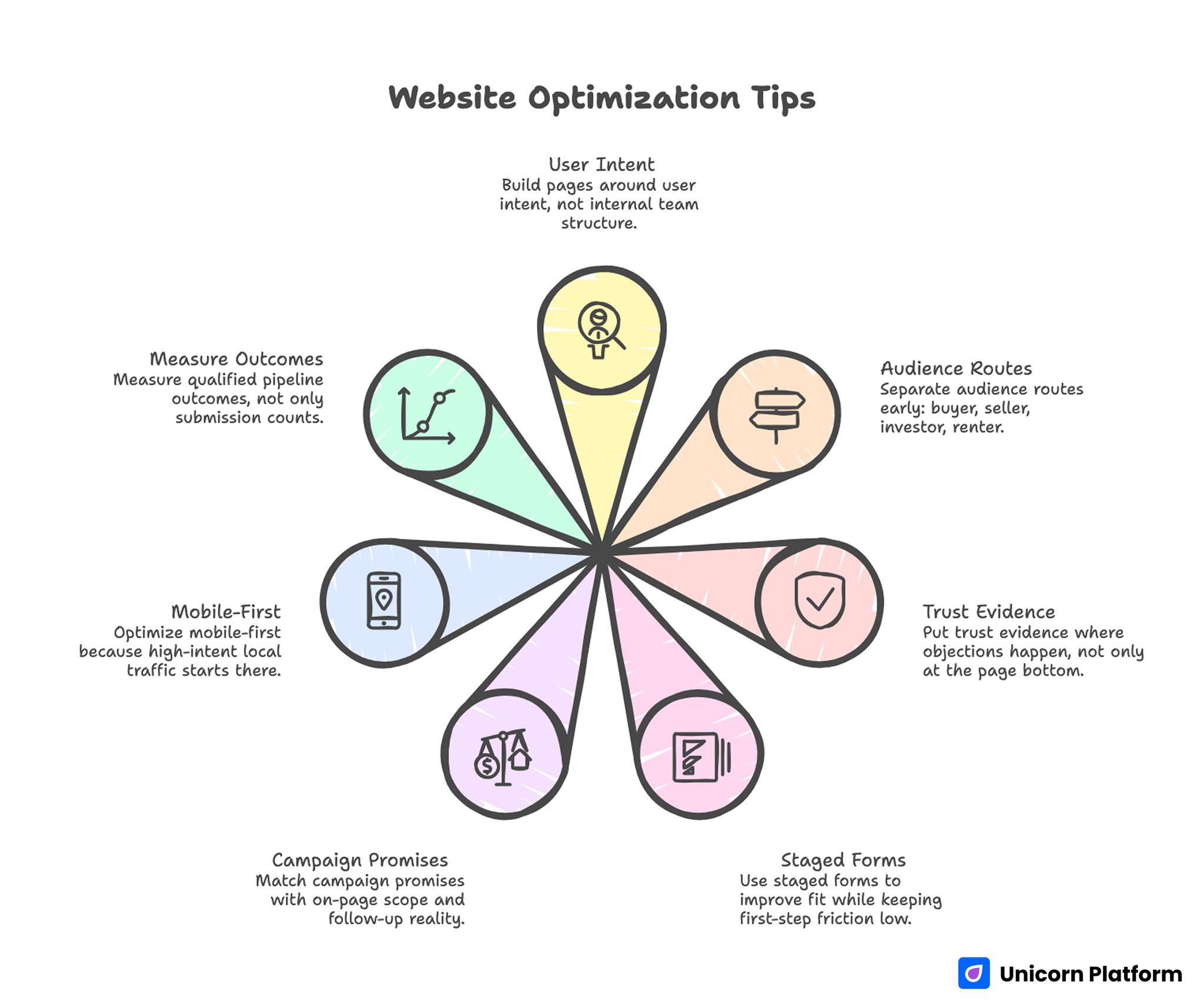
Website Optimization Tips
- Build pages around user intent, not internal team structure.
- Separate audience routes early: buyer, seller, investor, renter.
- Put trust evidence where objections happen, not only at the page bottom.
- Use staged forms to improve fit while keeping first-step friction low.
- Match campaign promises with on-page scope and follow-up reality.
- Optimize mobile-first because high-intent local traffic starts there.
- Measure qualified pipeline outcomes, not only submission counts.
Why Real Estate Sites Underperform
Underperformance usually begins with message ambiguity. Many pages use generic language like "local experts" or "full-service support" without clarifying what that means for a specific audience or neighborhood context. Visitors cannot confirm fit quickly, so they exit or submit low-context inquiries.
Another issue is timing of trust elements. Teams often hide proof behind long content blocks, while users evaluate credibility within the first minute. If confidence signals are delayed, high-intent users hesitate before taking action.
A third issue is conversion architecture mismatch. Pages that mix buyer and seller narratives in one undirected flow increase cognitive load. Each audience has different goals, questions, and risk filters. Mixed paths reduce action clarity.
The final issue appears after capture. Marketing reports form growth, but operations receives leads with insufficient context. Poor handoff quality slows response and lowers close probability.
Define Commercial Objective Before Design Decisions
Every optimization cycle should start with one primary business objective. For example: increase qualified seller consultations in target neighborhoods, improve buyer appointment show rates, or raise investor inquiry quality for mid-term assets.
A specific objective helps teams prioritize section order, CTA style, and proof selection. Without this anchor, pages become collections of ideas rather than conversion systems.
Objective statements should include quality signals, not just volume. "More leads" is too broad. "More qualified seller calls from owners ready to list within 90 days" is operationally useful.
This discipline also improves testing. Teams can evaluate whether page changes improved meaningful outcomes instead of debating surface-level engagement metrics.
Build Intent-First Page Architecture
Real estate users typically follow a decision sequence: relevance, confidence, process clarity, then action. Page structure should mirror that flow.
A practical architecture pattern:
- Intent-specific value framing.
- Local context and proof relevance.
- Process transparency and expectation setting.
- Route-specific action path.
This pattern keeps decisions simple without oversimplifying important details. Visitors can self-qualify while still seeing enough evidence to commit.
When teams need campaign-level conversion references for action-path sequencing, the framework in build high-converting real estate landing pages in minutes is useful for aligning sections with lead intent.
Separate Audience Routes Early
Buyer and seller behavior differs too much for a single generic flow. Investors and renters add further variation. A site should route these segments clearly within the first interaction, not after a long scroll.
A simple route model can include:
- "I want to buy" path with financing and neighborhood orientation.
- "I want to sell" path with valuation and timeline confidence.
- "I invest" path with yield and risk-focused framing.
- "I rent" path with availability and process speed cues.
Each route can share a brand foundation while changing message emphasis, proof type, and CTA action.
Route separation improves conversion quality because visitors immediately see content aligned with their current objective.
First-Screen Design for Local Trust
The first screen should answer five immediate questions: who the page is for, which area it covers, what outcome it supports, why the team is credible, and what to do next.
A reliable first-screen setup includes one focused headline, one practical subhead, one trust cue, and one primary action. Keep this section compact and readable on mobile.
Avoid hero sections that rely on broad emotional language without actionable context. In real estate, decision confidence comes from specificity: neighborhood relevance, process reliability, and clear next steps.
If your team is standardizing campaign-level trust cues, this real estate landing page best-practices reference helps validate what should appear early versus later.
Scope Clarity Beats Broad Claims
Visitors need to know exactly what service model they are entering. Ambiguous scope attracts mismatched inquiries and slows deal progression.
Scope sections should clarify:
- Service boundaries by audience route.
- Geographic coverage limits.
- Process responsibilities and handoff points.
- Communication cadence expectations.
Specific scope language helps users self-select and reduces low-fit submissions. It also lowers repetitive discovery calls where teams re-explain fundamentals that should have been clear before form submission.
Scope transparency is not a conversion risk. It is a qualification advantage.
Proof Systems That Reduce Risk Perception
Real estate decisions carry high perceived risk. Trust proof should be contextual, recent, and close to the claims it supports.
Effective proof formats include:
- Outcome snapshots tied to property type and location.
- Response-time reliability indicators.
- Process examples with timeline clarity.
- Client quotes that reference practical outcomes, not generic praise.
Proof placement matters as much as proof type. Put evidence near objections, such as valuation trust concerns or offer-negotiation confidence concerns.
A single testimonial carousel at the bottom rarely resolves early uncertainty.
Form Strategy for Better Lead Quality
Form design should balance conversion accessibility and qualification quality. Short forms boost volume but can reduce fit. Long forms can block good leads before intent is confirmed.
A staged model works well:
- Step 1 captures route intent, area focus, and timeline signal.
- Step 2 captures deeper qualification details after initial fit.
This structure improves context quality without overloading first-step interaction.
Route-specific forms are especially useful. Seller inquiries should not be asked the same initial questions as renter inquiries. Tailored intake fields improve downstream response quality and speed.
Mobile-First Execution Standards
A large share of real estate traffic arrives on mobile from search, social, and messaging links. If mobile flow is weak, conversion quality suffers even when desktop pages look polished.
Mobile essentials:
- Fast first-screen rendering.
- Clear CTA visibility without excessive scrolling.
- Form input comfort on touch screens.
- Stable layout with image and map loading.
- Readable copy hierarchy at small widths.
Desktop simulation is not enough. Test on real devices and average network conditions to expose actual friction points.
Mobile QA should be mandatory before campaign scaling.
Local SEO and Content Cluster Strategy
Local discoverability improves when site architecture reflects real neighborhood intent, not duplicated city templates. Search engines and users both reward specificity.
Build local clusters around real tasks:
- Neighborhood buying guides.
- Seller timeline explainers.
- Investor scenario breakdowns.
- Renter qualification and process guides.
Each cluster should connect to route-specific conversion pages through contextual internal links. This creates a discover-to-convert path that improves both ranking relevance and lead readiness.
For long-form authority pages that support trust before conversion, patterns from custom commercial real estate websites without coding can help teams structure deeper ecosystem content.
Visual Systems for Clarity, Not Ornament
Real estate is visually driven, but image-heavy pages can still underperform if visuals are not tied to decision context. Images should explain relevance, not just create atmosphere.
A practical visual system includes:
- Context visuals that establish area and property type fit.
- Process visuals that explain how the team operates.
- Comparison visuals near action points.
Every major visual block should have concise supporting copy that states why it matters. Unlabeled galleries increase cognitive load and slow decisions.
Performance still matters. Compress assets, lazy-load noncritical media, and protect first-screen speed.
Conversion and Operations Must Share One Logic
A page is only as strong as the workflow behind it. If follow-up teams receive weak context, even a high-converting page produces inconsistent outcomes.
Ensure form submissions pass structured context into operations:
- Audience route chosen.
- Area and property signals.
- Timeline and urgency indicators.
- Primary concern captured in plain language.
This handoff structure reduces qualification repetition and improves first-call relevance. It also allows better prioritization during high-demand windows.
For route-specific service flows tied to ongoing maintenance and communication, teams can cross-reference patterns in custom property management landing page workflows to keep promises aligned with operational capacity.
Source-Aware Variant Strategy
Traffic sources carry different expectations. Search users often want direct relevance and quick action. Social users may need stronger trust context before conversion.
A controlled variant system helps:
- Paid search variant with direct intent framing.
- Social variant with stronger proof and process clarity.
- Referral variant with authority transfer cues.
Keep core structure consistent while adjusting first-screen framing and proof emphasis. This preserves brand consistency and improves message match.
Variant sprawl is a risk. Use clear ownership and retire weak variants regularly.
Measurement Framework for Quality Outcomes
Submission count is not a sufficient KPI. Real estate teams need metrics that reflect commercial quality.
Priority metrics:
- Qualified inquiry rate by route and source.
- Appointment-booking rate from inquiries.
- Show-rate consistency by variant.
- Opportunity progression by page cluster.
- Low-fit disqualification rate.
Operational metrics should sit alongside marketing metrics. Response-time quality and context completeness often explain conversion variance better than click metrics alone.
Monthly review cadence should tie page changes to these outcomes explicitly.
Quarterly Scorecard for Durable Gains
Quarterly scorecards prevent short-term spikes from masking structural issues. They also help leadership and operators evaluate progress in one shared framework.
A practical scorecard includes:
- Acquisition quality by route.
- Conversion behavior by section and form stage.
- Response and handoff quality.
- Pipeline progression by source.
Review agenda:
- Revalidate audience assumptions.
- Compare top and bottom variants.
- Classify failures by friction type.
- Retire low-value modules.
- Set one primary experiment stream for the next quarter.
Failure classification should be specific: relevance mismatch, trust timing gap, qualification friction, or handoff breakdown. Better classification improves experiment quality in the next cycle.
30-60-90 Day Implementation Plan
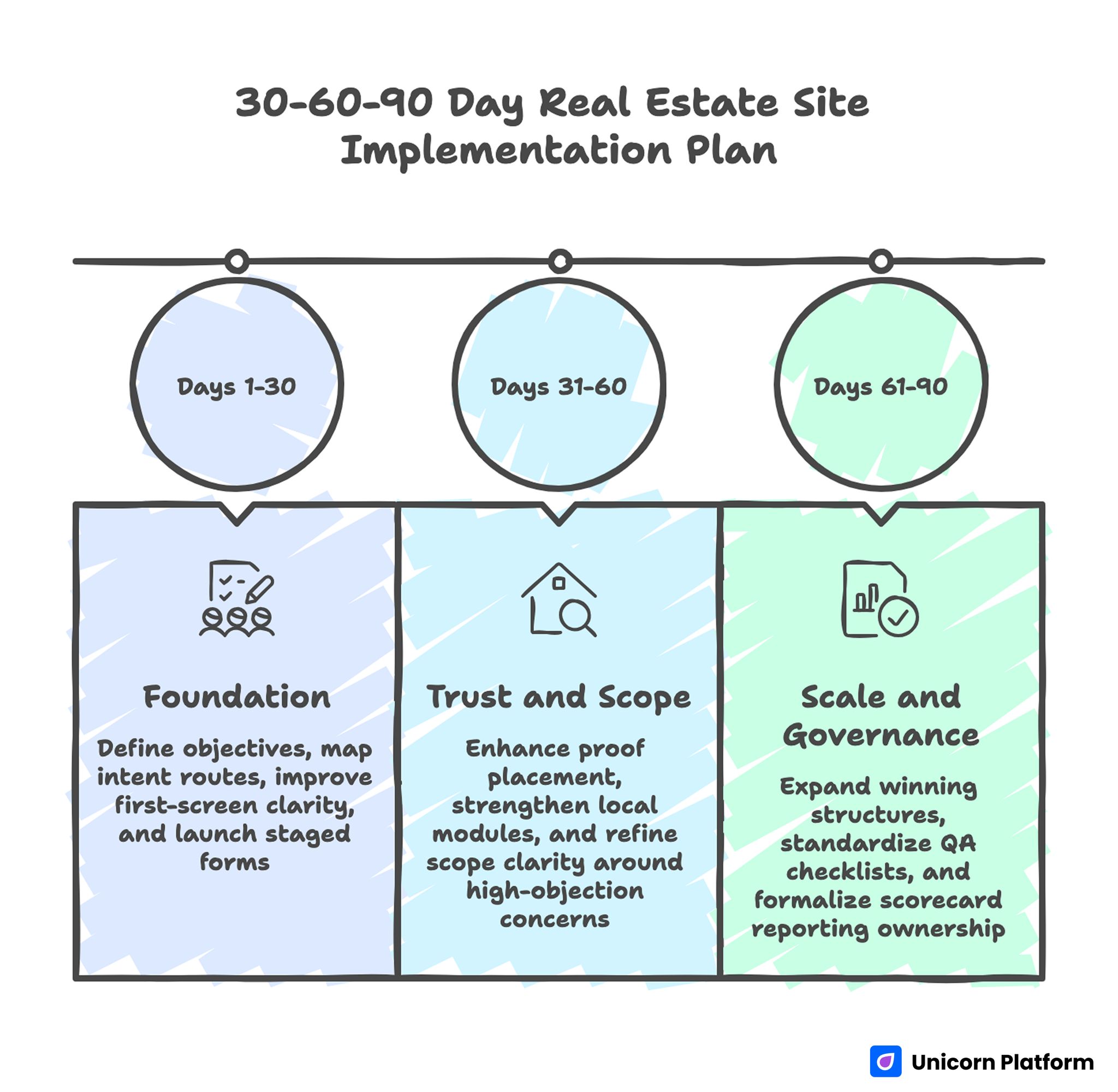
30-60-90 Day Real Estate Site Implementation Plan
Days 1-30: Foundation
Define objective, map intent routes, rebuild first-screen clarity, and launch staged forms with route-based context capture.
By day 30, the team should see cleaner route distribution and fewer low-fit submissions.
Days 31-60: Trust and Scope
Improve proof placement, strengthen local modules, and refine scope clarity around high-objection concerns.
By day 60, qualified appointment quality and first-call efficiency should improve.
Days 61-90: Scale and Governance
Expand winning structures across local clusters, standardize QA checklists, and formalize scorecard reporting ownership.
By day 90, the site should operate as a repeatable conversion system rather than isolated page experiments.
Cost, Template, and Customization Decisions
Most teams either overbuild too early or over-template too long. Both extremes hurt conversion performance. Overbuilding slows iteration and makes simple message changes expensive. Over-templating creates pages that look consistent but fail to reflect local and segment-specific intent.
A practical decision model starts with campaign maturity. Early campaigns usually need fast variants and clear learning loops, so reusable templates are the right base. As a route proves stable and high value, deeper customization can be layered where it increases confidence or qualification quality.
A balanced structure can look like this:
- Shared conversion backbone for all routes.
- Localized message modules by neighborhood or property segment.
- Segment-specific proof modules for buyer, seller, investor, or renter paths.
- Optional advanced components only for high-performing clusters.
This approach protects iteration speed while still allowing differentiation where it matters. It also keeps quality control manageable across a growing page portfolio.
Cost discipline should focus on commercial impact, not visual novelty. Ask whether a change improves qualified inquiry quality, response efficiency, or progression to appointment. If it does not influence one of those outcomes, it should remain lower priority.
A practical quarterly investment sequence:
- Fix message and route clarity issues first.
- Improve proof specificity and trust timing.
- Optimize form routing and handoff context.
- Invest in advanced components only after core flows perform.
Teams that follow this sequence usually see better conversion economics than teams that start with complex visual upgrades. The reason is simple: structural clarity tends to outperform cosmetic change in high-consideration categories.
Cost decisions should also include maintenance implications. A page system that cannot be updated quickly during market shifts becomes expensive even if initial build cost was low. Ongoing agility is part of true total cost.
Governance and QA for Multi-Agent Teams
As campaigns scale, governance becomes a conversion lever. Without clear ownership, message quality drifts, local claims become outdated, and response logic diverges across teams.
A lightweight governance model usually includes four owners:
- Messaging owner for intent and scope clarity.
- Proof owner for evidence freshness and relevance.
- Operations owner for handoff and response standards.
- QA owner for release checks and measurement integrity.
These roles can be distributed across small teams without adding bureaucracy. What matters is explicit accountability, not org size.
A dependable release checklist should verify:
- Route separation is still clear in first-screen blocks.
- Primary CTA is aligned with intent and source.
- Proof modules support nearby claims.
- Form fields capture enough context for response quality.
- Mobile flow and performance are acceptable on real devices.
Regular governance cadence can be simple:
- Weekly review for conversion and response anomalies.
- Monthly structural review for section-level changes.
- Quarterly strategy review for route priorities and investment choices.
This cadence keeps optimization continuous while preventing random redesign cycles.
Quality assurance should include transcript feedback from real follow-up conversations. If sales or leasing teams repeatedly hear the same confusion points, those points belong on-page near relevant decisions. This closes the gap between campaign messaging and operational reality.
Documentation is a key multiplier. A short experiment log with hypothesis, change scope, outcome, and decision prevents teams from repeating failed patterns and speeds onboarding for new contributors.
When governance and QA are stable, scaling local variants becomes much safer. Teams can launch faster without sacrificing trust consistency or lead quality.
Common Failure Patterns and Fixes
Failure: Generic Openers
Users cannot determine local fit quickly, so they leave. Rewrite first-screen sections with route-specific location relevance and clear next actions.
Failure: Mixed Route Content
Buyer, seller, and renter concerns are blended into one path. Separate routes earlier and align proof and CTA language to intent.
Failure: Delayed Trust Cues
Confidence signals appear too late to support action. Move contextual proof closer to first decision moments.
Failure: High Volume, Low Qualification
Submission volume grows while close quality declines. Introduce staged qualification and tighter scope language.
Failure: Campaign-Page Misalignment
Ad promises and on-page framing diverge. Use source-aware variants with consistent structural rules.
Failure: Weak Mobile Completion
High-intent users exit before form completion. Improve mobile readability, CTA visibility, and input flow reliability.
Failure: Testing Without Attribution
Teams ship many changes but cannot isolate impact. Run one friction stream at a time and document outcomes by variant.
FAQ: Real Estate Sites in 2026
1) Can one page support buyers and sellers effectively?
It can if route separation is immediate and clear. In most cases, dedicated route paths improve qualification quality.
2) What should appear first on a real estate conversion page?
Audience fit, local relevance, one trust cue, and one clear action should appear immediately. This sequence helps visitors confirm relevance before they evaluate details.
3) How detailed should first-step forms be?
First-step forms should capture only what is needed for routing and initial qualification. Deeper details can follow after fit confirmation.
4) Which trust elements matter most?
Contextual proof tied to process reliability and local outcomes is usually most persuasive. Generic endorsements work best as supporting elements, not as the primary trust layer.
5) How often should local pages be updated?
Review monthly and update immediately when service scope, market context, or process terms change. This prevents outdated promises from reducing inquiry quality.
6) What metric should drive optimization first?
Start with qualified inquiry rate by source and route. Then connect it to appointment and opportunity progression.
7) Are heavy visuals always better in real estate?
No. Visuals help when they improve decision clarity and load fast enough to preserve interaction flow.
8) What is the quickest fix for low-fit lead volume?
Clarify route separation, service boundaries, and first-step qualification fields. Small wording changes in these blocks can improve fit quickly.
9) How do we improve handoff quality fast?
Pass route-aware context from forms to response teams and define first-touch response standards. A structured handoff template usually improves speed and consistency.
10) What change often gives the fastest impact?
Rebuild first-screen relevance and route logic before deeper redesigns. This usually improves lead quality quickly.
Final Takeaway
Real estate site performance is driven by decision architecture. When relevance, trust timing, route separation, and handoff logic are aligned, conversion quality improves without relying on traffic inflation.
Use this framework to make optimization systematic and commercially useful. The result is better-fit conversations, faster follow-up quality, and stronger deal progression.
Related Blog Posts
- Create Custom Commercial Real Estate Websites Without Coding: A Practical 2026 Playbook
- Property Lead Page Strategy for 2026: From Listing Interest to Qualified Appointments
- Website Creation in 2026: A Practical 5-Step System for Fast Launches That Still Convert
- Real Estate Lead-Capture Pages in 2026: A Practical System for Higher-Quality Conversations