Table of Contents
- Why Real Estate Conversion Pages Underperform
- Visual Strategy: Clarity Over Decoration
- 30-60-90 Day Execution Plan
- Common Failure Patterns and Fixes
- FAQ
Real estate teams rarely struggle to get attention. They struggle to convert that attention into qualified conversations that can actually close. Ad clicks, social visits, and referral traffic can look healthy while sales teams still report weak lead quality and slow progression.
The issue is usually not traffic volume. The issue is page structure. Many real estate pages ask visitors for contact details before confirming location fit, property intent, budget alignment, or timeline readiness. This creates form volume but not reliable pipeline.
A high-performing conversion page should reduce uncertainty in the order prospects experience it. Users need immediate relevance, practical trust cues, and a clear next step that matches their readiness. This guide gives you a repeatable framework for doing that with Unicorn Platform.
sbb-itb-bf47c9b
Key Takeaways
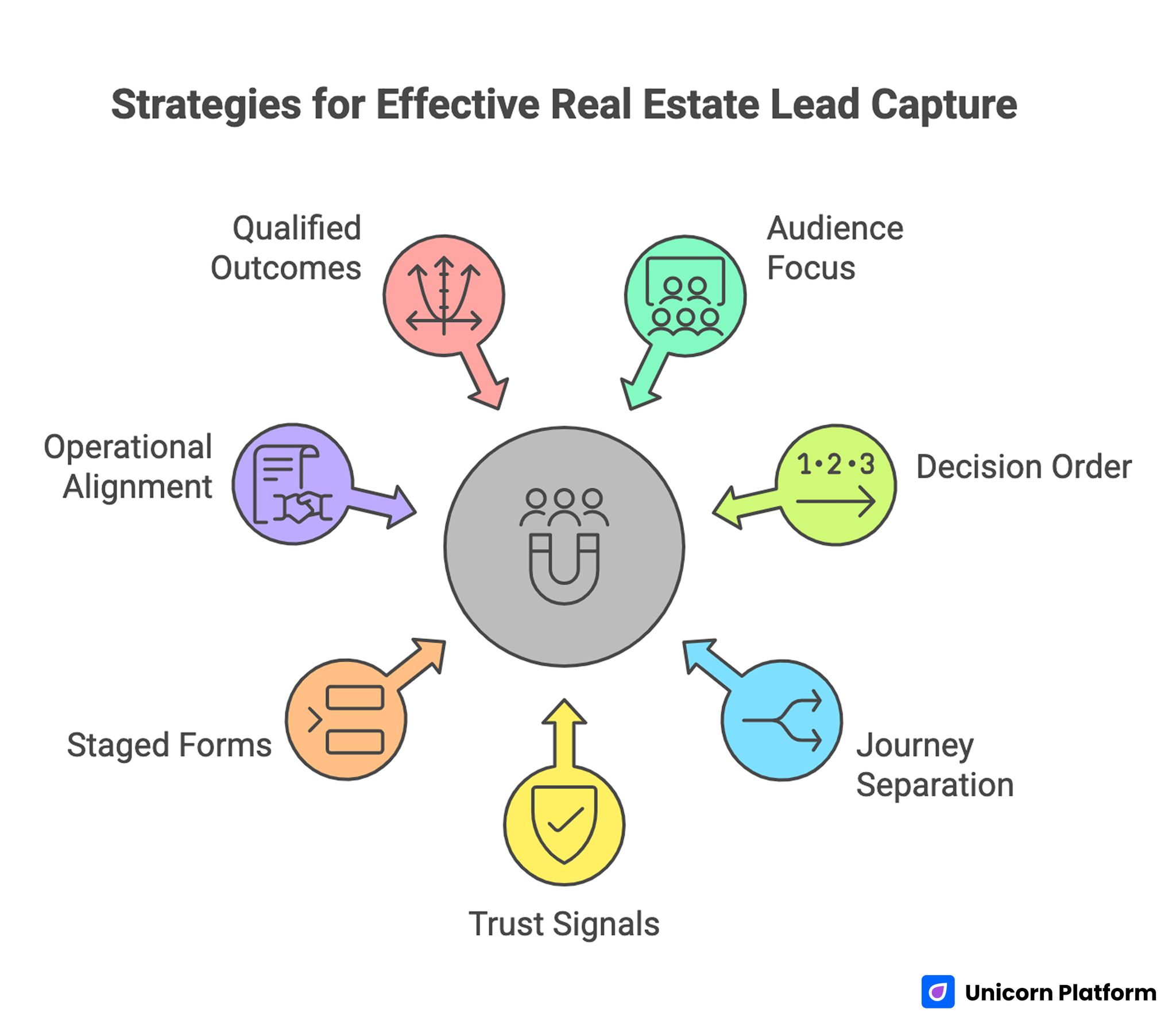
Strategies for Effective Real Estate Lead Capture
- Start each page with one audience and one conversion goal.
- Map section sequence to decision order, not internal marketing preferences.
- Separate buyer, seller, investor, and renter journeys as early as possible.
- Place trust signals near objections, not in one isolated block.
- Use staged forms to balance conversion rate and lead quality.
- Align page promises with operational follow-up workflows.
- Track qualified outcomes, not just submission counts.
Why Real Estate Conversion Pages Underperform
Underperformance usually comes from three root causes. First, messaging is generic. Headlines like "find your dream home" or "expert real estate solutions" can sound polished but fail to signal who the page is for and what specific value it delivers.
Second, trust appears too late. Visitors often must scroll through broad marketing copy before seeing proof of neighborhood expertise, process reliability, or response standards. By then, many high-intent users have already exited.
Third, action design is misaligned with readiness. Some pages push hard conversion actions too early, while others hide conversion paths behind long narrative blocks. Both patterns increase abandonment.
A fourth cause appears post-conversion. Marketing may report strong form submissions while agents receive incomplete context and spend excessive time requalifying. This disconnect turns apparent wins into operational inefficiency.
Set a Specific Commercial Objective Before Writing
Every page should begin with one commercial objective. Examples include higher qualified buyer consultations, stronger seller valuation requests, improved investor inquiry quality, or faster appointment-booking rates.
A single objective creates discipline. It determines what the first screen should emphasize, which proof matters most, and how the CTA should be framed.
Write objective statements with quality signals, not only volume targets. For example: increase qualified buyer appointments in target neighborhoods while reducing low-fit inquiries from outside service areas.
When teams skip this step, they often optimize for visible activity rather than real pipeline value.
Segment Audience Intent Early
One page cannot serve every real estate intent equally well. Buyers, sellers, renters, and investors ask different questions and evaluate different risks.
A practical segmentation model:
- Buyer path: location fit, financing confidence, and inventory quality.
- Seller path: valuation confidence, listing strategy, and timeline speed.
- Investor path: cash-flow logic, risk controls, and market data credibility.
- Renter path: availability, qualification process, and response speed.
Each path should have tailored framing, proof, and next action. Shared branding can stay consistent, but conversion logic must match intent.
Early segmentation improves both conversion quality and follow-up efficiency.
Design the First Screen for Immediate Local Relevance
The first screen has one job: help visitors decide whether continuing is worth their time. It should show audience fit, location context, value proposition, and action path quickly.
A reliable first-screen structure includes one intent-specific headline, one practical subhead, one trust cue, and one primary CTA. Keep copy concrete and avoid broad promotional language.
If your team is standardizing brand-level design cues for conversion pages, this reference on real estate website design fundamentals can help align visual consistency with campaign performance.
First-screen quality must be validated on mobile, since local real estate discovery heavily starts there.
Build Message Match by Traffic Source
Source-to-page alignment is a major conversion lever. Search traffic often arrives with explicit intent, while social traffic may need more context before commitment.
A source-aware approach can include:
- Search variants with direct neighborhood and property-type relevance.
- Social variants with stronger trust context and guided next steps.
- Referral variants with clearer proof transfer from partner credibility.
The structural backbone can stay constant while first-screen emphasis shifts by source. This keeps testing manageable and brand voice consistent.
Message mismatch is expensive. If campaign copy promises specific inventory or timeline outcomes that page content does not reflect, trust drops immediately.
Clarify Offer Scope in Plain Language
Real estate prospects need to know what is included and what happens next. Scope ambiguity creates low-fit inquiries and friction in early conversations.
For buyer-focused pages, scope might include home-search process, market guidance, financing coordination context, and viewing support standards. For seller pages, it might include valuation process, listing prep, marketing channels, and communication cadence.
Clear scope should appear before the primary form, not only in FAQ sections. Prospects make better decisions when service boundaries are visible early.
Scope clarity should also include what is outside your service model. Explicit boundaries improve lead quality and protect team time.
Place Trust Signals Where Objections Occur
Trust blocks perform best when they are positioned near concern points. A testimonial carousel at the bottom of the page cannot resolve objections encountered earlier in the scroll.
High-impact trust proof includes:
- Contextual client outcomes by property type and goal.
- Local-market credibility cues.
- Response-time standards with realistic commitments.
- Process transparency for key transaction stages.
Use concise proof modules linked to nearby claims. If you claim faster seller timelines, show a relevant outcome example near that claim.
Trust proof should be specific and current. Generic praise has lower conversion impact when prospects are making high-stakes decisions.
Use Staged Forms for Better Qualification
Form strategy should balance conversion accessibility and lead quality. Short forms increase submissions, but overly shallow intake can overload follow-up with low-fit demand.
A staged form model works well:
- First step captures essential routing and intent.
- Second step collects deeper qualification details after initial fit.
Buyer-first-step fields might include target area, budget range, timeline, and financing status. Seller-first-step fields might include property type, location, and timing goals.
Staged forms keep initial friction manageable while improving downstream qualification quality.
Add Process Transparency Before the CTA
Prospects want to know what happens after submission. If next steps are unclear, many users hesitate or submit low-quality requests.
Add a concise process block near conversion actions:
- How initial contact works.
- Response timeline expectations.
- What information is needed first.
- What the next milestone looks like.
This transparency reduces anxiety and improves inquiry intent quality.
When teams need a broader benchmark for process + CTA sequencing, this real estate landing page best-practices resource can support audit decisions.
Build Local Content Modules That Actually Differ
Local pages fail when they are cloned with city-name swaps. Prospects notice thin localization quickly, and conversion trust drops.
Useful local modules can include:
- Neighborhood-specific market notes.
- Typical buyer or seller scenarios for that area.
- Local service process details.
- Location-relevant proof and outcomes.
These modules should reflect real differences in market behavior, not only superficial label changes.
A template system with controlled local variation points helps teams scale quality without random page drift.
Optimize Mobile UX for Decision and Action
Mobile traffic in real estate is high-intent and time-sensitive. A weak mobile experience can erase expensive acquisition efforts.
Mobile priorities:
- Readable first-screen messaging.
- Clear CTA visibility at key scroll points.
- Fast-loading visual assets.
- Stable layout during media load.
- Easy form input and error handling.
Desktop previews are not enough. Real-device checks reveal friction patterns that affect actual conversion behavior.
Mobile QA should be mandatory before campaign scale.
Visual Strategy: Clarity Over Decoration
Visuals are central in real estate, but heavy galleries without narrative guidance often underperform. Images should support decisions, not distract from them.
A practical visual sequence can include:
- Market context visuals for relevance.
- Property or process visuals for confidence.
- Comparison or highlight visuals near action points.
Use concise captions that explain why each visual matters. Unlabeled imagery can increase cognitive load and reduce conversion momentum.
Performance matters as much as aesthetics. Prioritize compression, lazy loading, and ordering that protects first-screen speed.
Align Landing Promises With Sales Handoff
Conversion quality depends on what happens after the form, not just before it. If handoff context is weak, response quality declines and lead value falls.
Design forms and confirmation steps so sales teams receive structured context:
- Intent path selected.
- Location and property context.
- Timeline and readiness indicators.
- Primary objective or concern.
This structured handoff improves first-call quality and reduces repetitive qualification loops.
For broader ecosystem pages that support trust before conversion, teams can use custom commercial real estate website patterns to connect authority assets with campaign pages.
Measure What Predicts Closing Quality
Submission counts alone can hide problems. Strong measurement should connect page behavior to pipeline outcomes.
Useful metrics:
- Qualified inquiry rate by variant and source.
- Appointment-booking rate from submitted leads.
- Show-rate consistency by intent path.
- Lead-to-opportunity progression by local variant.
- Low-fit or disqualified lead share.
Pair these with response-time metrics. Fast, contextual follow-up often improves conversion more than marginal page-design tweaks.
The goal is predictable, high-fit pipeline, not vanity growth.
Operational Follow-Up Architecture
Landing performance is inseparable from follow-up quality. A strong page that hands off weak context still produces weak commercial outcomes because response teams start each conversation by recovering missing information.
Operational follow-up architecture should be designed at the same time as form structure. If routing fields and response playbooks are disconnected, even high-intent leads can cool before the first useful interaction.
A practical handoff package for every inbound inquiry can include:
- Audience path selected at submission.
- Priority location or neighborhood preference.
- Timeline and readiness indicators.
- Primary objective for contacting your team.
- Channel source and campaign context.
Response teams should receive this package directly in CRM views and notification workflows. Re-entering the same details manually slows response time and introduces avoidable errors.
Timing standards should also be explicit. Teams can define first-response SLAs by intent type, such as buyer consultation requests versus seller valuation requests. Clear internal targets make quality control measurable instead of subjective.
For real estate teams that split ownership across marketing coordinators, agents, and transaction staff, create a simple escalation matrix that answers three questions:
- Who responds first by inquiry type?
- What happens if response windows are missed?
- How is context preserved for secondary handoff?
This matrix is operationally simple but has outsized impact on close quality. It prevents leads from being bounced between roles without clear accountability.
Follow-up architecture should also include expectation messaging on thank-you states. If users know when they will hear back and what the first conversation covers, no-show risk usually declines.
Teams should review a sample of routed leads weekly to verify that promised page logic and operational behavior are still aligned. This quick QA check catches drift before it impacts conversion metrics at scale.
Quarterly Scorecard for Lead Quality and Pipeline Efficiency
Monthly page tweaks are useful for momentum, but quarterly scorecards are what reveal whether optimization is actually improving business outcomes. Without scorecards, teams can overvalue short-term submission spikes that do not convert downstream.
A useful scorecard combines four layers:
- Acquisition quality.
- Conversion behavior.
- Operational response quality.
- Pipeline progression.
Acquisition quality should track qualified inquiry share by source and intent path. This helps identify whether page changes are attracting better-fit prospects or merely increasing raw volume.
Conversion behavior should include first-screen progression, route selection quality, and form completion by segment. These signals explain why qualified volume rises or falls after structural changes.
Operational response quality should measure first-response timeliness, context completeness, and appointment-confirmation consistency. Strong page design can be neutralized quickly if this layer underperforms.
Pipeline progression should track show rate, consultation quality, and stage-to-stage movement for leads sourced from each major page variant. This layer connects page decisions to revenue outcomes.
A practical quarterly review agenda:
- Reconfirm target audience assumptions by segment.
- Evaluate top and bottom-performing variants by qualified progression.
- Classify losses by friction type.
- Retire low-value modules and scale winning structures.
- Define one major experiment stream for the next quarter.
Friction classification is particularly important. Instead of generic "underperformed" labels, use categories such as relevance mismatch, trust timing failure, qualification friction, or handoff quality breakdown. Better classification improves future test quality.
Set thresholds that trigger intervention before performance decay becomes expensive. For example, if qualified inquiry share drops below a defined baseline for two consecutive weeks, route that variant into immediate review.
Scorecard ownership should be explicit. One owner should manage data integrity, while channel and operations owners validate interpretation and next actions. Shared responsibility without clear ownership usually delays decisions.
Over time, this scorecard discipline turns conversion work into a predictable operating system rather than a cycle of reactive redesigns.
Teams that want to accelerate this model can add a quarterly replay review where sales and marketing jointly analyze ten won and ten lost conversations tied to page variants. This review should focus on where page expectations aligned or failed: location relevance, scope clarity, proof credibility, and response timing confidence. Converting those findings into one prioritized experiment stream each quarter keeps learning grounded in real buyer outcomes rather than dashboard interpretation alone.
30-60-90 Day Execution Plan
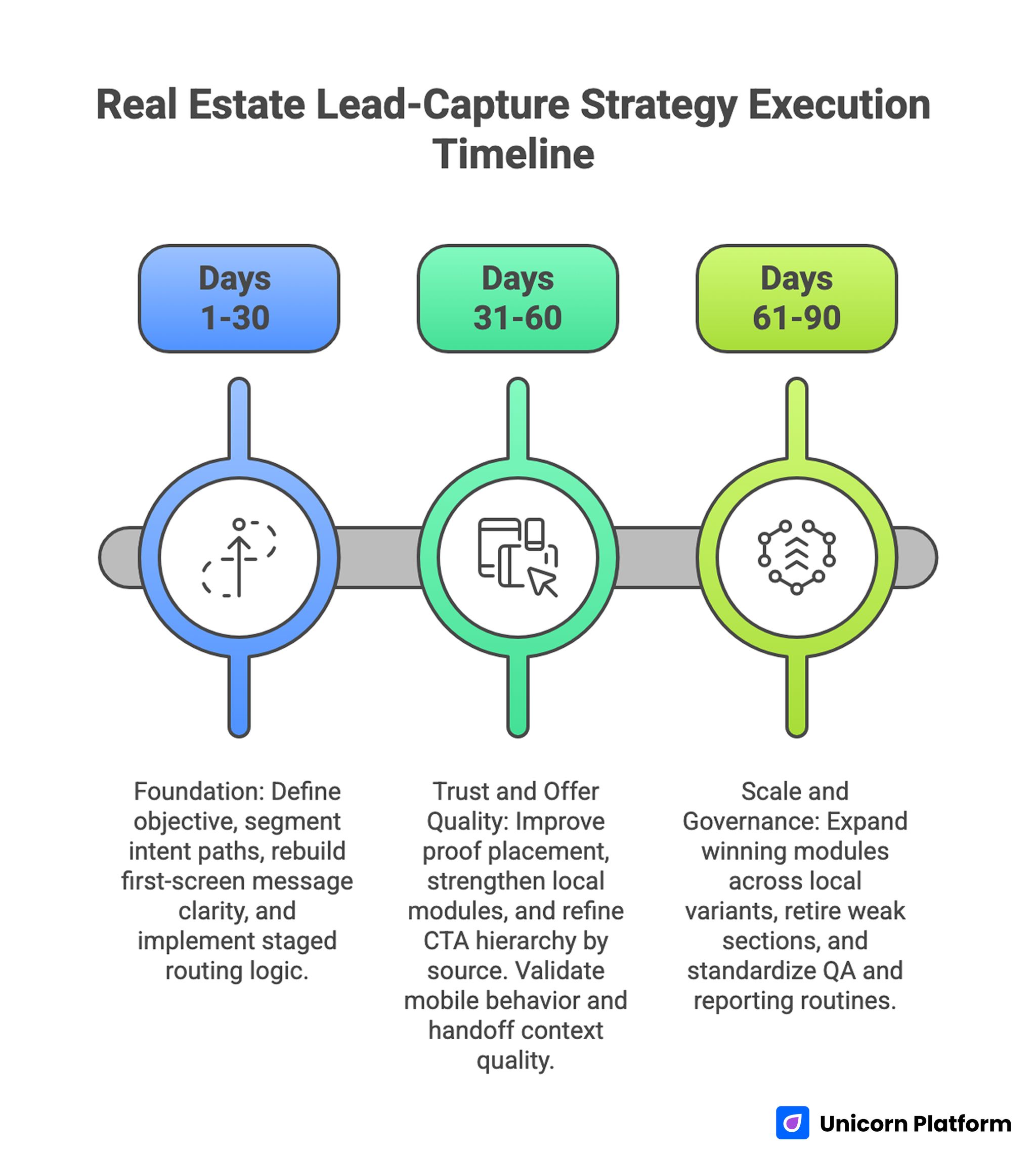
Real Estate Lead-Capture Strategy Execution Timeline
Days 1-30: Foundation
Define objective, segment intent paths, rebuild first-screen message clarity, and implement staged routing logic. Tighten scope and process transparency before scaling campaigns.
By day 30, you should see cleaner route selection and reduced low-fit submissions.
Days 31-60: Trust and Offer Quality
Improve proof placement, strengthen local modules, and refine CTA hierarchy by source. Validate mobile behavior and handoff context quality.
By day 60, qualified inquiry rates and appointment quality should improve.
Days 61-90: Scale and Governance
Expand winning modules across local variants, retire weak sections, and standardize QA and reporting routines.
By day 90, the team should run a repeatable conversion system instead of one-off redesign efforts.
Common Failure Patterns and Fixes
Failure: Generic First Screen
Visitors cannot quickly confirm local fit or audience relevance. Rewrite opening sections with specific location context, intent framing, and clear action direction.
Failure: Mixed Buyer and Seller Messaging
Prospects encounter conflicting paths and unclear priorities. Separate routes early and customize proof and CTA language by intent.
Failure: Weak Trust Timing
Proof appears too late to address early objections. Move contextual trust modules closer to first decision points.
Failure: High Volume, Low Qualification
Form submissions rise but close quality falls. Add staged qualification and clearer service boundaries to improve self-selection.
Failure: Campaign-to-Page Mismatch
Ad promises do not match on-page framing, reducing confidence quickly. Build source-aware variants with stable structural rules.
Failure: Mobile Drop-Off
High-intent mobile traffic exits before action. Improve first-screen readability, CTA visibility, and form usability on real devices.
Failure: No Learning Loop
Teams launch changes without isolated hypotheses. Test one friction type at a time and maintain an experiment log with outcomes.
FAQ: Real Estate Lead-Capture Pages in 2026
1) Should I use one page for buyers and sellers?
You can, but only if routing is immediate and clearly separated. In most markets, dedicated intent paths produce better qualification.
2) What should I prioritize above the fold?
Prioritize audience fit, local relevance, one trust cue, and one clear next action. This combination gives users enough confidence to continue.
3) How long should the first form be?
Keep it short and intent-focused. Collect deeper qualification details after initial fit confirmation.
4) What proof works best for real estate conversion?
Proof that ties outcomes to context works best. Include transaction or process details relevant to the prospect's decision.
5) How often should local pages be updated?
Review core sections monthly and update immediately when market, process, or service boundaries change.
6) Which metric should guide optimization first?
Start with qualified inquiry rate by source and variant. Then connect that signal to appointment and close progression.
7) Do visual-heavy pages always convert better?
Not necessarily. Visuals help only when they support decision clarity and do not slow performance.
8) How can I reduce low-fit leads quickly?
Clarify boundaries, segment intent paths, and improve first-step qualification logic. This usually improves follow-up efficiency fast.
9) What is the most common handoff problem?
Sales teams receive leads without enough context to prioritize or personalize response. Route-aware form inputs and confirmation logic fix much of this.
10) What is the fastest high-impact change?
Rebuild first-screen relevance and separate buyer/seller routes with clear action paths. That change usually improves quality more than cosmetic redesigns.
Teams can accelerate this lift by adding a short weekly response audit that compares real inquiry transcripts with on-page promises for each route. This habit keeps optimization grounded in buyer language and prevents drift between campaign messaging and first-call execution.
Final Takeaway
High-performing real estate conversion pages are built on relevance, trust timing, and qualification discipline. Teams that align message, proof, action flow, and operational handoff generate better-fit conversations with less wasted follow-up.
Use this framework to turn page optimization into a repeatable growth system. The outcome is stronger lead quality, faster response efficiency, and more predictable deal progression.