Table of Contents
- Why Most Pet Boarding Pages Underperform
- Design Trust Architecture Around Anxiety Points
- Common Mistakes and Fast Fixes
- 30-60-90 Day Execution Plan
- FAQ
Pet care decisions are emotional and operational at the same time. Owners want warmth, patience, and visible care standards, but they also want process reliability, policy clarity, and fast confirmation. A landing page that only looks friendly will underperform, and a page that only lists policies will feel cold. Strong conversion requires both trust and structure.
Many boarding businesses lose bookings because their page does not reduce uncertainty in the order owners experience it. Visitors land with urgent questions about safety, supervision, medication handling, and drop-off logistics. If those answers are hidden under generic copy or buried below weak navigation, visitors hesitate and abandon.
This guide provides a complete execution model for boarding and pet-sitting landing pages in Unicorn Platform. The goal is practical: improve qualified booking volume, reduce no-shows, and build repeat customer behavior through clearer message architecture, stronger proof, and better booking flow design.
sbb-itb-bf47c9b
Quick Takeaways
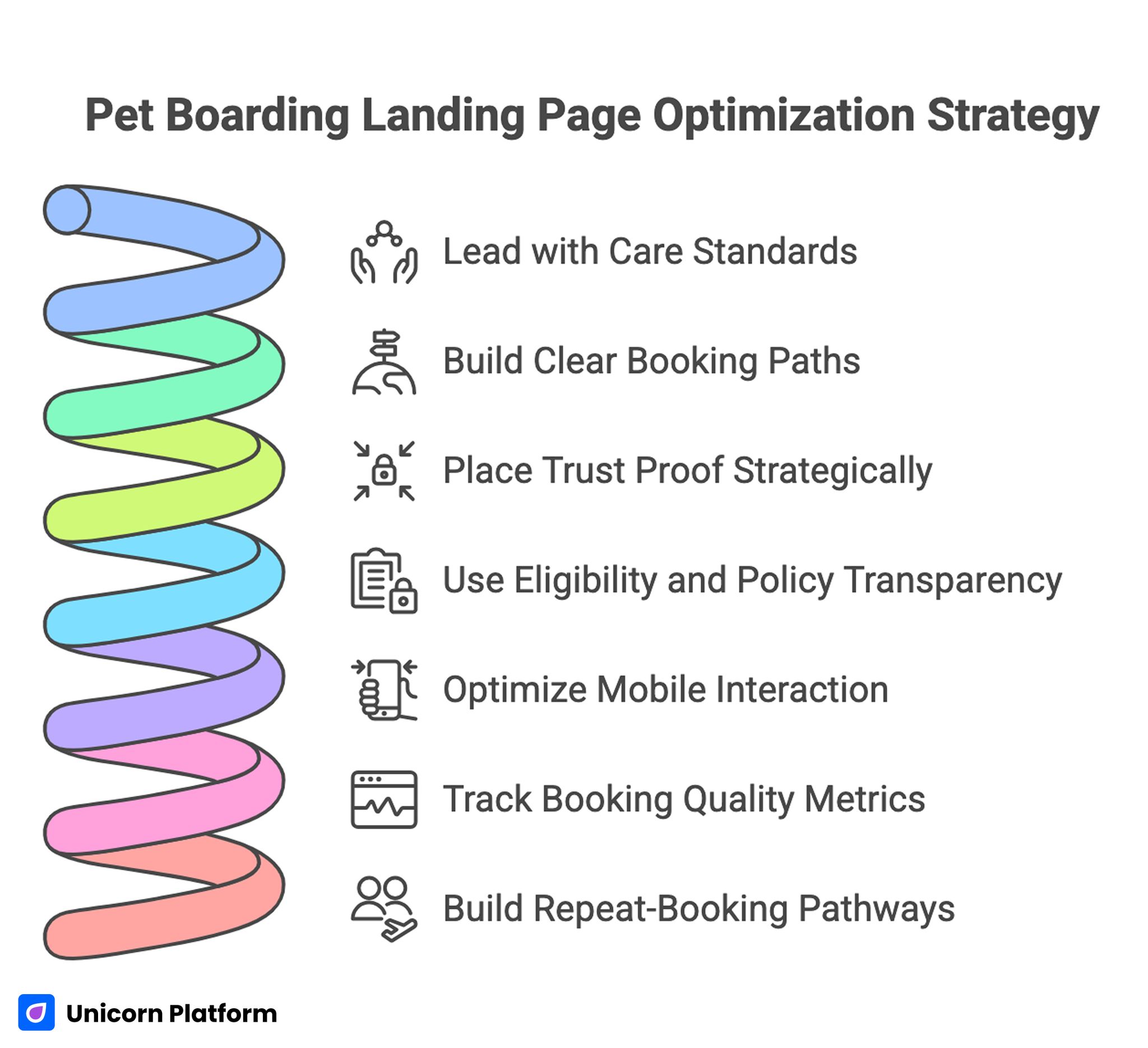
Pet Boarding Landing Page Optimization Strategy
- Lead with care standards and process clarity, not broad brand claims.
- Build one clear booking path per landing page intent.
- Place trust proof near high-anxiety moments, not only in a testimonial block.
- Use eligibility and policy transparency to improve lead quality.
- Optimize mobile interaction before scaling paid or local campaigns.
- Track booking quality metrics, not just form submissions.
- Build repeat-booking pathways directly into post-booking experience.
Why Most Pet Boarding Pages Underperform
Weak landing pages usually fail in three ways. First, they delay critical trust information. Owners often scroll through general service descriptions before finding safety protocols, supervision model, and emergency handling steps. By that point, many have already left.
Second, many pages mix too many visitor intents. First-time owners, frequent travelers, and special-needs pet owners all require different reassurance sequences. One generic page can appear relevant to everyone but convincing to no one.
Third, booking flow friction is underestimated. Long forms, unclear eligibility requirements, and vague response expectations increase abandonment. People are more likely to submit when they know exactly what happens after they click.
Improvement begins when teams treat the page as a decision system rather than a marketing brochure. This framing keeps every section tied to an owner decision that affects booking quality.
Start With One Commercial Objective
Before choosing layout blocks or writing headlines, define the primary objective for the next quarter. Examples include higher first-time booking conversion, improved repeat booking rate, lower no-show percentage, or better average booking duration.
A single objective creates focus. It helps decide what should appear in the first screen, what proof deserves priority, and which CTA should dominate. Without this focus, pages become crowded with equal-priority content that weakens action clarity.
Use a short objective statement with a measurable signal. For example: "Increase qualified first-time boarding requests from local owners of small-to-medium dogs while reducing ineligible submissions." That level of specificity makes optimization decisions more disciplined.
Segment Owner Intent Before Writing Copy
Pet service demand is not uniform. Owners arrive with different urgency, trust thresholds, and logistical constraints. Your landing page should reflect this reality.
A practical segmentation model for boarding pages:
- First-time boarding owners focused on safety and emotional reassurance.
- Frequent travelers focused on consistency, speed, and reliable communication.
- Owners of senior or medical-needs pets focused on protocol detail.
- Owners comparing multiple providers focused on proof and policy transparency.
You do not need separate websites for each segment. You need structured routing and message emphasis that helps each audience self-qualify quickly.
Segment-aware messaging also improves lead quality by reducing mismatched inquiries. It also helps staff handle fewer conversations that cannot convert operationally.
Build First-Screen Clarity That Answers Immediate Concerns
The first screen should resolve four questions without scrolling: what service is offered, where it is offered, why this provider is trustworthy, and what action to take next. If any of these are missing, conversion pressure increases downstream.
A strong hero section typically includes one clear service statement, one location or coverage signal, one trust cue, and one dominant action button. Keep the language practical and avoid decorative slogans that add ambiguity.
For teams refining booking-specific hierarchy, this reference on booking landing page examples is useful for validating first-screen structure and action clarity.
The hero section should also avoid CTA overload. One primary booking action and one lower-friction secondary option are usually enough.
Design Trust Architecture Around Anxiety Points
Pet owners evaluate trust in stages. Early trust is about safety and handling standards. Mid-stage trust is about consistency and communication. Late-stage trust is about policy fairness and booking reliability.
Your page should mirror these stages instead of grouping all trust content in one area. Place facility standards and supervision model early. Introduce testimonials and care outcomes near service details. Present policy clarity before form submission.
High-impact trust elements include:
- Supervision method and staff-to-pet context.
- Intake and behavior assessment process.
- Medication and emergency escalation protocol.
- Hygiene and playgroup safety standards.
- Owner update frequency and communication channels.
Trust claims should be concrete. Replace "we care deeply" with process-backed statements that owners can evaluate. Clear, process-driven trust communication is also emphasized in research from the American Veterinary Medical Association, which highlights that pet owners make care decisions based on visible standards, safety protocols, and communication transparency rather than emotional branding alone.
Make Service Scope and Eligibility Explicit
Boarding businesses often lose time and conversion quality when scope is unclear. Owners need to know what is included, what is optional, and what eligibility standards apply.
Clarify service boundaries in plain language:
- Boarding duration options.
- Check-in and check-out windows.
- Vaccination or health requirements.
- Behavior or socialization conditions.
- Breed/size or rooming constraints when relevant.
This transparency can reduce raw lead volume slightly while improving booking quality significantly. High-fit owners appreciate clear expectations, and low-fit inquiries self-filter earlier.
Service clarity should be visible before the main form, not hidden in FAQ footnotes. Owners should reach requirements and boundaries before they invest time entering details.
Structure Pricing Information for Confidence, Not Confusion
Price uncertainty is a major conversion blocker in pet services. You do not always need a full rate table in the hero section, but visitors need enough information to estimate fit.
A practical approach is to show base package context, what is included, and what commonly affects total cost. For add-ons, explain value and relevance, not only price labels.
Examples of useful pricing context:
- Base overnight boarding includes meals, supervised play, and standard updates.
- Medication support and one-on-one sessions are optional enhancements.
- Holiday periods have different capacity and pricing rules.
Pricing clarity should be paired with policy clarity. Deposits, cancellations, and date-change terms should be easy to understand before submission.
Build a Low-Friction Booking Workflow
A reliable booking funnel reduces cognitive load and operational back-and-forth. The best landing pages separate first-step qualification from detailed onboarding.
A practical four-step flow:
- Confirm fit with essential screening questions.
- Select preferred date range and service type.
- Submit critical pet details and contact information.
- Receive confirmation timeline and next checklist.
Avoid collecting every detail in the initial form. Long forms increase abandonment and often produce low-quality submissions. Capture key qualification signals first, then gather deeper details after preliminary approval.
If your team is refining reservation sequencing, the framework in a step-by-step blueprint for your reservation landing page can help tighten step logic and reduce drop-off.
Post-submit communication should include what happens next, when owners will hear back, and which documents or prep items are required. Clear response windows reduce anxiety and prevent duplicate follow-up messages.
Use Social Proof That Matches Real Scenarios
Generic testimonials are less persuasive in pet care because owners evaluate specific risks. Strong proof should describe context, challenge, and outcome.
Examples of stronger proof framing:
- Owner of an anxious rescue dog reports smoother adjustment after structured intro protocol.
- Family with senior pet highlights medication reliability and daily update consistency.
- Repeat traveler describes booking reliability during peak season.
Add lightweight case snapshots when possible. Even short before/after descriptions can improve confidence if they reflect real care situations.
Social proof works best when placed beside relevant claims. A testimonial about medication handling belongs near medical-care protocol, not in a generic carousel.
Design for Local Intent and Neighborhood Relevance
Boarding demand is local by nature. Your page should communicate location credibility clearly and specifically.
Include local relevance signals such as service area, pickup/drop-off options, neighborhood accessibility, and local customer context. If you serve multiple zones, create focused variants instead of one broad page with city names sprinkled everywhere.
A good local setup usually includes:
- Clear geographic coverage statement.
- Map or area list with realistic boundaries.
- Localized trust proof or repeat customer references.
- Transportation or convenience details when applicable.
Location specificity helps both search visibility and owner confidence. It also reduces inquiries from unsupported areas.
Use Visual Evidence Without Slowing Decision Flow
Pet owners respond strongly to visual cues, but media strategy must support conversion flow. High-quality photos and short operational videos can build confidence, while heavy, unstructured galleries can distract and slow performance.
Prioritize visuals that answer meaningful questions. Show supervised play areas, sleeping environments, check-in flow, and hygiene setup. Label visuals clearly so owners understand what they are seeing.
For businesses with strong physical space advantage, lightweight facility walkthrough patterns inspired by hotel landing page conversion setups can improve trust when implemented with performance discipline.
Load critical trust copy before large media blocks, especially on mobile connections. This order protects comprehension when bandwidth is limited.
Optimize for Mobile-First Booking Behavior
A significant share of pet service searches and booking requests happens on mobile devices. If your page only feels polished on desktop, you are likely losing demand.
Mobile QA should cover:
- First-screen message readability.
- Action-button visibility and tap comfort.
- Form field usability and error handling.
- Image loading behavior and layout stability.
- Response-time expectations near submission steps.
Test on real devices with average network conditions. Desktop emulation alone can miss friction patterns that matter for actual owners.
Mobile optimization should happen before scaling local ads or high-season campaigns. Acquiring additional traffic before fixing interaction friction usually increases wasted spend.
Connect Landing Pages to Daily Operations
Landing-page promises must match real service delivery. If page claims and on-site experience diverge, no-show risk and negative reviews increase.
Create an operations-to-page checklist that aligns with your actual workflow. Verify that booking windows, pickup hours, policy terms, and communication standards are current every time you update offers.
Operational alignment should include staff readiness. Team members handling calls and messages need the same language and expectations shown on the page.
When operational reality and page messaging stay synchronized, conversion quality improves and customer trust compounds over time. This alignment also reduces review risk caused by expectation gaps.
Build Repeat Booking Pathways
First bookings are expensive to acquire. Repeat bookings are where margin stability improves. Your landing and confirmation flow should support return behavior intentionally.
Useful repeat mechanisms include:
- Fast rebooking link in follow-up communication.
- Returning-customer preference capture.
- Policy-change reminders before high-demand periods.
- Loyalty or package options with clear terms.
Repeat pathways reduce friction for known customers and increase capacity planning accuracy. They also reduce dependence on constant new-lead acquisition.
A landing page should not end at first conversion. It should begin a reliable customer lifecycle.
Use Offer Variants for Boarding, Sitting, and Hybrid Models
Many pet businesses offer more than one service type. Trying to force boarding, sitting, and retail into one generic page usually weakens conversion for each intent.
A better method is to use one shared trust backbone with service-specific variants. Each variant keeps core brand standards while adapting scope, proof emphasis, and CTA flow.
Example variant structure:
- Boarding variant focused on facility standards and overnight care process.
- Sitting variant focused on in-home workflow and visit reliability.
- Hybrid variant for businesses offering both care services and related products.
Variant clarity helps owners find relevant information faster and improves operational fit after submission. It also makes campaign targeting cleaner when each ad points to the right service page.
Measurement Framework for Conversion Quality
Tracking page views and click-through rates is not enough in pet services. You need quality metrics tied to booking outcomes.
High-value weekly metrics:
- Inquiry-to-confirmed-booking rate.
- Ineligible or low-fit submission share.
- Confirmation response-time consistency.
- No-show and cancellation patterns.
- Repeat booking percentage.
Add behavior diagnostics to support these outcomes: form abandonment points, mobile drop-off sections, and interaction depth on trust modules. These supporting signals help explain why booking quality changes week to week.
A measurement hierarchy helps teams prioritize improvements that affect revenue quality, not just traffic volume. It prevents teams from overreacting to vanity metrics that do not improve bookings.
Common Mistakes and Fast Fixes
Mistake: Friendly Tone, Weak Trust Detail
Pages feel warm but do not explain care process.
Fix by adding concrete supervision, hygiene, and emergency protocols near the top of the page. Then align these statements with intake and staff training workflows so claims stay accurate.
Mistake: One Generic Page for Every Service
Mixed intents create confusion and low relevance.
Fix by creating service-specific variants with one dominant CTA per page. Keep secondary paths visible but clearly lower priority to preserve decision clarity.
Mistake: Long Initial Forms
High friction reduces submissions and frustrates users.
Fix by splitting qualification and full onboarding into separate steps. Owners complete the first action faster, while staff still collect complete records after preliminary fit.
Mistake: Pricing Ambiguity
Visitors hesitate because total expectations are unclear.
Fix by showing base inclusions, common modifiers, and policy terms in plain language. This reduces price-related surprise and lowers post-booking disputes.
Mistake: Desktop-Only QA
Mobile visitors encounter hidden friction.
Fix by validating real-device behavior and load performance before launch. Real-device testing reveals friction that desktop previews often miss.
Mistake: Weak Post-Submit Communication
Owners submit and remain uncertain about next steps.
Fix by confirming timeline, required documents, and follow-up process immediately. A structured confirmation message reduces uncertainty and improves trust after submission.
Mistake: No Repeat-Customer Strategy
Acquisition pressure stays high and retention underperforms.
Fix by adding rebooking shortcuts and returning-customer pathways. Returning owners should be able to act quickly without repeating first-time onboarding flow.
30-60-90 Day Execution Plan
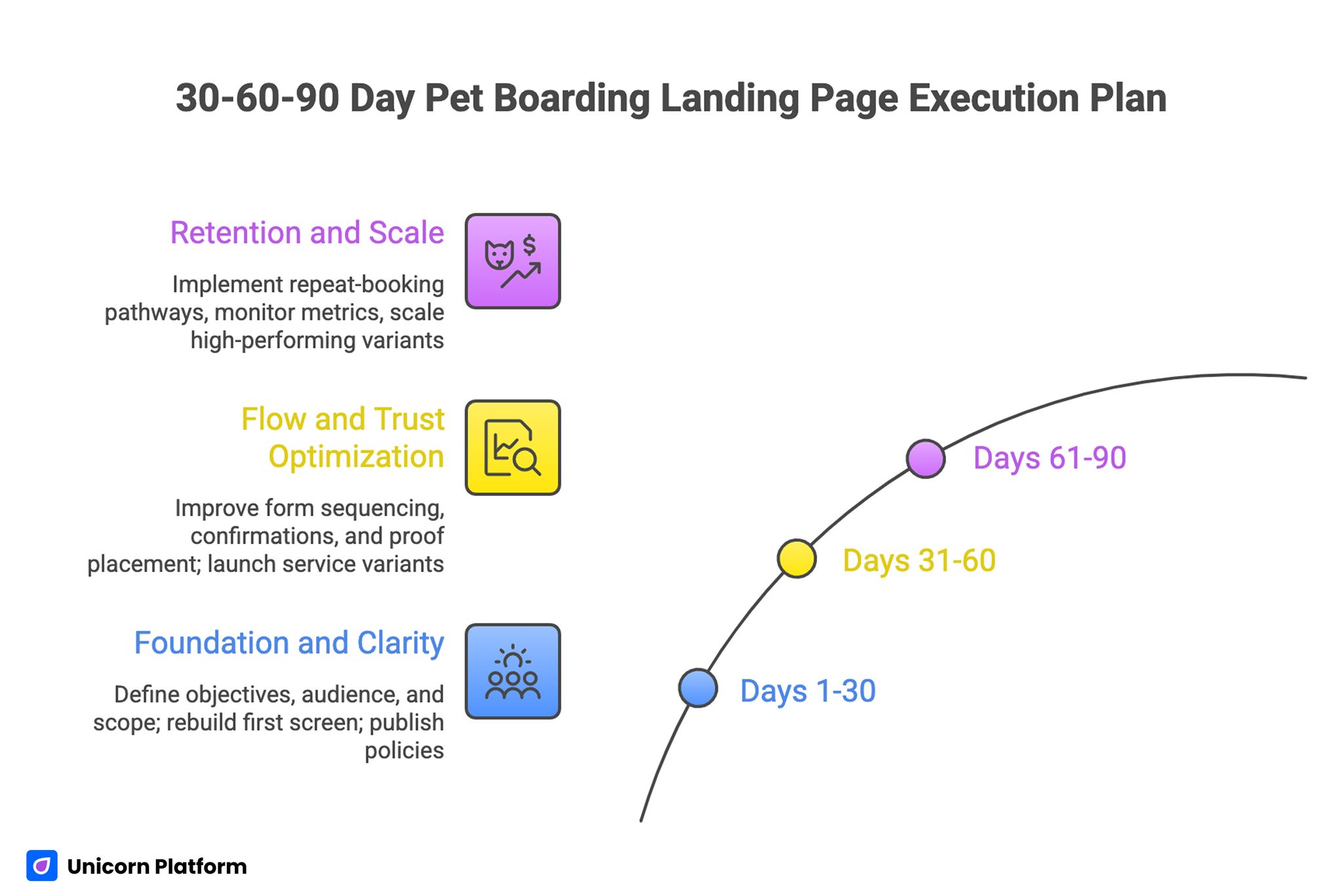
30-60-90 Day Pet Boarding Landing Page Execution Plan
Days 1-30: Foundation and Clarity
Define objective, audience segments, and service scope. Rebuild first screen for immediate trust and action clarity. Publish updated policy and eligibility sections before driving new traffic.
By day 30, owners should be able to evaluate fit and start booking without confusion. Early clarity at this stage determines how much of the following optimization cycle becomes incremental versus corrective.
Days 31-60: Flow and Trust Optimization
Improve form sequencing, confirmation messaging, and proof placement. Launch service-specific variants for high-volume intents such as boarding and sitting.
By day 60, inquiry quality should improve and support burden from repetitive pre-booking questions should decline. Teams should also see cleaner form data and fewer ineligible requests.
Days 61-90: Retention and Scale
Implement repeat-booking pathways, monitor quality metrics weekly, and scale highest-performing variants. Archive low-signal sections and update trust content based on real customer questions.
By day 90, your page system should support both acquisition and retention with measurable operational alignment. This is the point where landing-page improvements start compounding instead of resetting every season.
Special-Care Trust Modules for Higher-Need Pets
Standard trust blocks are not enough for every pet owner. If your business cares for senior pets, pets with medical routines, or pets with anxiety-related behavior constraints, you need specialized trust modules that address those situations directly.
A special-care trust module should explain eligibility, handling standards, and escalation pathways in straightforward language. Owners looking for this level of care often compare providers by protocol depth, not by visual style.
Useful module components include:
- Medication administration workflow and logging cadence.
- Senior-pet mobility accommodations and monitoring checks.
- Behavioral adaptation process for anxious pets.
- Emergency escalation path and communication timing.
- Pre-arrival consultation expectations and required records.
Place these modules near service-fit content, not deep in general FAQs. Owners with higher-need pets typically decide quickly based on whether they see operational competence early.
Protocol transparency should include what you do not support. Clear boundaries protect pet safety and improve lead quality by preventing unrealistic bookings. This can feel strict in the short term but usually improves trust and review quality over time.
For boarding businesses that support different pet profiles, consider segmented entry points such as "senior care boarding" or "medical routine support." Each entry can still use the same core page structure while surfacing different trust priorities.
A pre-booking checklist is especially helpful for special-care flows. Ask owners for critical inputs such as medication schedule, behavioral triggers, emergency contact preferences, and veterinary details before final confirmation. This creates better preparedness on day one and lowers operational risk.
Teams should also align special-care modules with staff training documentation. If one team member updates policy language but operational training lags behind, trust breaks at handoff points. Monthly cross-checks between page copy and internal procedures keep this risk low.
When special-care promises are accurate and visible, conversion quality improves because owners self-select based on real fit. Those customers are often highly loyal once trust is established.
Capacity Planning and Seasonal Conversion Strategy
Boarding demand is seasonal and operationally constrained. Landing pages should reflect this reality and guide owners toward available, realistic options rather than collecting unmanageable demand.
Capacity-aware messaging starts with transparent availability windows. Show peak dates, waitlist process, and response expectations clearly during high-demand periods. Hiding constraints may increase short-term submissions but usually harms customer experience and staff load.
A strong seasonal strategy uses page variants by demand period:
- Peak-season variant with early-booking prompts and deadline clarity.
- Shoulder-season variant with flexible packages and upsell options.
- Low-demand variant focused on trials, daycare cross-sell, or loyalty reactivation.
This approach helps align marketing pressure with operational capacity. It also prevents teams from running one static offer year-round when owner priorities shift across seasons.
Capacity planning should include intake thresholds. If staffing or room allocation approaches limit, landing pages can route marginal-fit requests to waitlist or alternative service paths. This protects service quality and reduces burnout during surges.
Revenue mix strategy is another overlooked lever. Many pet businesses rely on base boarding fees while underusing high-trust add-ons such as enhanced updates, one-on-one enrichment sessions, grooming bundles, or prep kits. Landing pages can introduce these options in context without feeling pushy.
Add-on design works best when tied to owner outcomes. For example, an anxiety-support add-on should explain how additional structure and communication reduce stress for both pet and owner. Outcome framing converts better than feature lists.
Operational dashboards should connect capacity and conversion signals:
- Daily available slots by service type.
- Inquiry volume by intent variant.
- Confirmation lag time during peak periods.
- No-show and cancellation patterns by season.
- Repeat customer share in high-demand weeks.
When teams review these signals weekly, they can adjust page emphasis quickly instead of waiting for monthly reports. Fast iteration during peak periods often has outsized revenue impact.
Capacity strategy also affects pricing communication. Seasonal pricing changes should be explained alongside service context and policy terms. Owners are more accepting of peak adjustments when expectations are clear and booking value is explicit.
Post-peak retention is equally important. After high-demand seasons, landing pages should include re-engagement offers and returning-customer shortcuts to sustain booking momentum. Otherwise, teams often experience severe demand swings that complicate staffing plans.
A mature seasonal system treats landing pages as operational control surfaces. They do not just capture demand; they shape demand quality to match what the team can deliver well.
FAQ: Pet Boarding Landing Pages in 2026
1) What should appear above the fold on a pet boarding landing page?
Include service clarity, location relevance, one trust cue, and one primary booking action. Owners should understand fit and next step immediately.
2) Should I show full pricing on the landing page?
You should show enough pricing context to reduce uncertainty. Base inclusion clarity and policy transparency are often more important than full line-item tables.
3) How long should the first booking form be?
Keep first-step forms short and qualification-focused. Collect deeper details after initial fit confirmation to reduce abandonment.
4) Do testimonials really matter in pet care?
Yes, especially when they describe specific scenarios such as medication support, behavioral adjustment, or communication reliability. Scenario detail helps owners compare providers using real risk criteria.
5) How can I reduce low-fit inquiries?
Clarify eligibility, scope boundaries, and policy terms early. Better self-qualification improves lead quality and operational efficiency.
6) Should boarding and sitting be on one page or separate pages?
Separate variants usually perform better because owner expectations and trust questions differ by service type. Variant-specific copy also improves campaign message match and booking quality.
7) What mobile issues hurt conversion the most?
Poor first-screen readability, hard-to-use forms, hidden CTA buttons, and slow media loading are common high-impact problems. These issues often appear together and amplify abandonment when left unresolved.
8) Which metrics indicate real improvement?
Focus on confirmed bookings, inquiry quality, no-show reduction, and repeat booking growth rather than traffic alone. Those metrics connect more directly to operational and financial outcomes.
9) How often should I update the landing page?
Review critical sections monthly and update immediately when policies, availability, or service terms change. Faster policy updates reduce confusion and improve staff efficiency.
10) What is the fastest improvement to make this week?
Strengthen your first-screen trust architecture and simplify the first booking step. Those changes often produce the clearest early gains.
Final Takeaway
High-converting pet service landing pages are built on confidence, clarity, and operational truth. When owners can quickly verify safety standards, understand service fit, and complete a simple booking path, conversion quality improves.
Use this framework to align message, trust proof, booking flow, and daily operations. That alignment is what turns seasonal traffic into dependable, repeat customer relationships.