Table of Contents
Niche marketplaces are appealing because they promise defensible growth in markets large platforms often ignore. The challenge is that two-sided businesses fail for reasons that are different from ordinary SaaS or ecommerce projects. Most teams underestimate coordination risk between supply quality, demand quality, and trust at the transaction layer.
The core question is not whether your concept sounds promising. The core question is whether your first narrow segment can repeatedly match the right buyers and suppliers with low friction and clear value. Until that loop works, scale efforts usually amplify noise instead of outcomes.
Unicorn Platform is useful in this context because teams can test side-specific messaging, onboarding flows, and launch sequences quickly without heavy engineering cycles. Speed matters most when it is used for controlled learning, not for publishing broad pages with vague promises.
sbb-itb-bf47c9b
Quick Takeaways
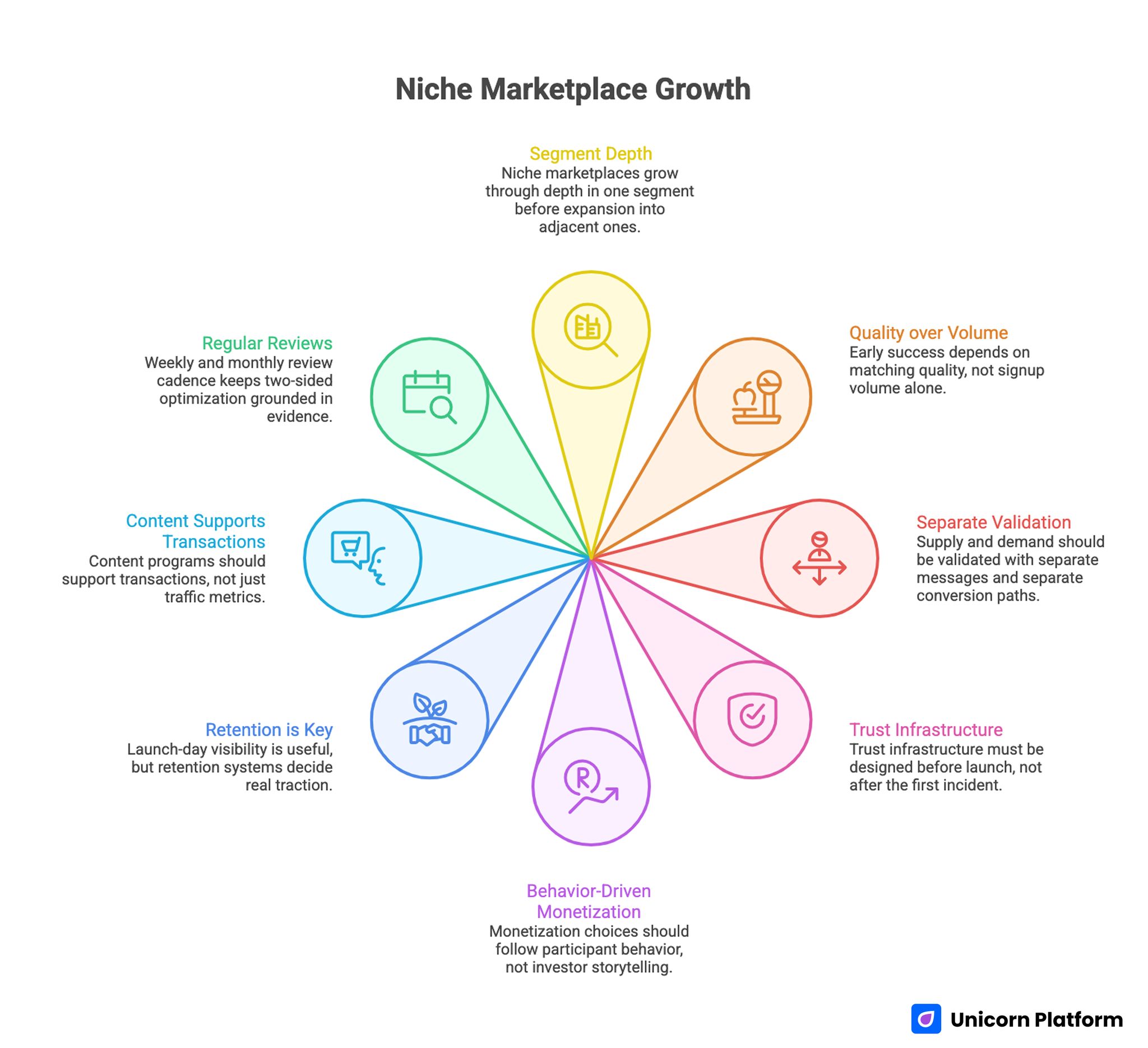
Niche Marketplace Growth
- Niche marketplaces grow through depth in one segment before expansion into adjacent ones.
- Early success depends on matching quality, not signup volume alone.
- Supply and demand should be validated with separate messages and separate conversion paths.
- Trust infrastructure must be designed before launch, not after the first incident.
- Monetization choices should follow participant behavior, not investor storytelling.
- Launch-day visibility is useful, but retention systems decide real traction.
- Content programs should support transactions, not just traffic metrics.
- Weekly and monthly review cadence keeps two-sided optimization grounded in evidence.
Why Early Marketplace Launches Break
Most failures come from over-broad positioning. Teams target large categories and assume volume will compensate for unclear fit. In practice, broad positioning weakens both sides at once because suppliers see uncertain demand quality and buyers see inconsistent supply reliability.
The second failure mode is metric illusion. Launches often report impressive traffic and signup counts, but activation and first-transaction rates remain weak. Without transaction confidence, signups behave like temporary curiosity rather than durable market behavior.
The third issue is missing trust design. Two-sided markets require stronger policy clarity than single-product businesses because both parties evaluate risk at each interaction. If dispute handling, verification signals, and expectation setting are unclear, trust collapses quickly after the first negative experience.
Pick a Narrow Wedge Before You Build Features
A niche marketplace usually wins by solving one painful workflow for one precise audience segment. The wedge should be narrow enough to produce repeatable matches and clear enough that users can self-qualify immediately.
Define wedge quality using three tests. First, the problem must be frequent enough to justify recurring engagement. Second, the market participants must already spend money or effort solving the problem poorly. Third, you must be able to explain your transaction advantage in one sentence.
This wedge discipline prevents a common mistake where teams build broad feature sets before proving one strong market loop. Product depth is valuable, but only after one segment demonstrates reliable matching behavior.
Validate Supply and Demand as Separate Systems
Two-sided validation should never rely on one blended landing page. Suppliers and buyers have different incentives, different concerns, and different conversion thresholds. Combining them too early hides signal quality.
Create separate paths with separate value propositions. Supplier-facing pages should emphasize lead quality, workflow clarity, and payout transparency. Buyer-facing pages should emphasize selection quality, reliability, and transaction confidence.
For teams running early pre-launch demand capture, this waitlist landing page playbook can support structured list-building while preserving side-specific qualification. It is most useful when supplier and buyer waitlists are managed with separate promises and separate onboarding expectations.
A Five-Stage Launch Framework That Reduces Waste
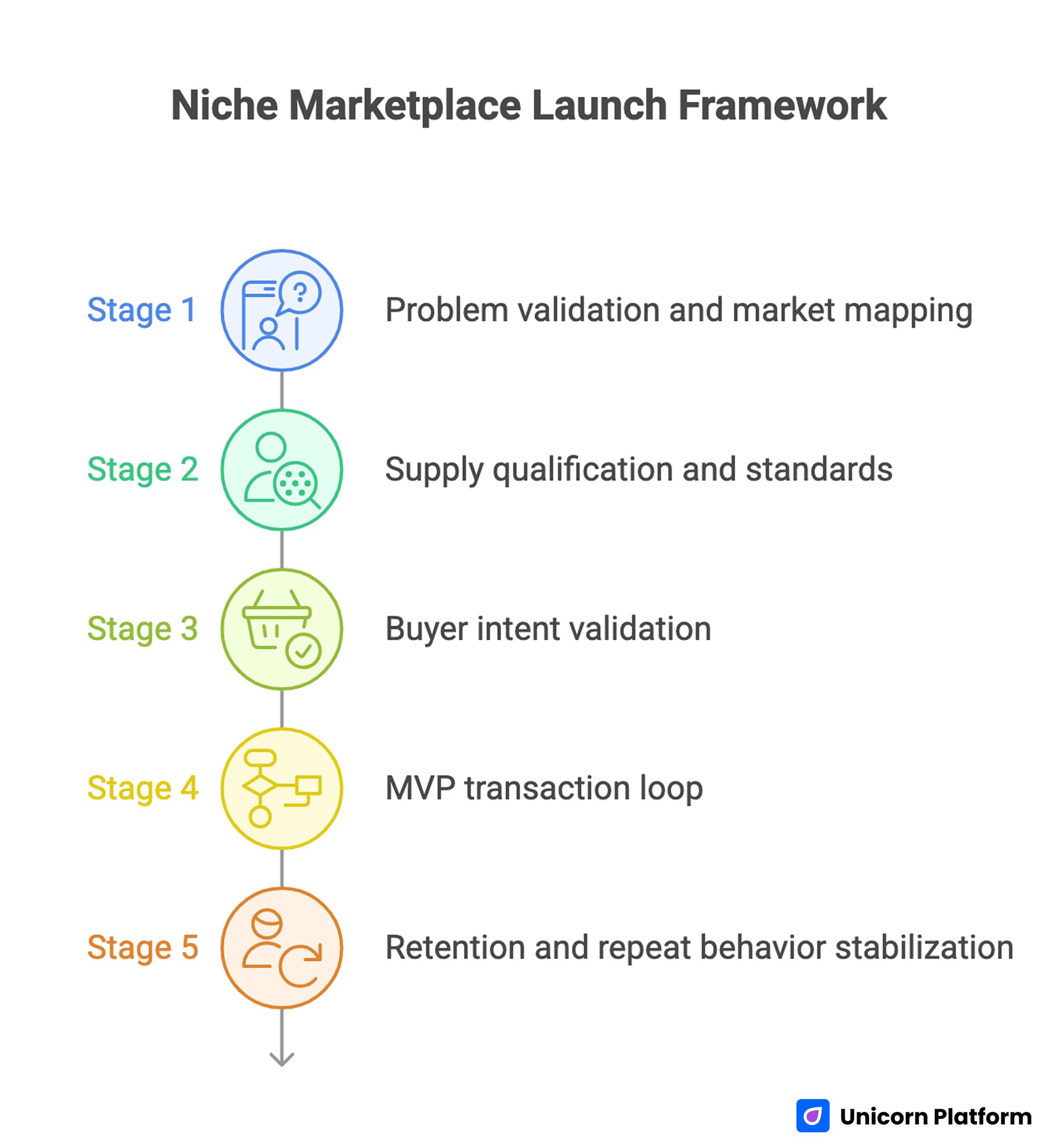
Niche Marketplace Launch Framework
Stage 1: Problem validation and market mapping
Interview both sides and map current workaround behavior. Focus on where time, money, or trust is being lost in existing workflows. This stage should produce a concrete statement of transaction friction and target audience boundaries.
Stage 2: Supply qualification and standards
Recruit a small, high-quality supplier cohort with explicit standards for responsiveness, profile completeness, and service reliability. Quality at this stage is more important than supplier volume because early buyer trust is fragile.
Stage 3: Buyer intent validation
Run controlled acquisition tests to confirm demand quality in your target segment. Evaluate not only signups, but engagement depth and readiness to transact under realistic conditions.
Stage 4: MVP transaction loop
Launch the minimum functional loop needed for discovery, confidence, and transaction completion. Avoid advanced feature expansion until first-transaction behavior is predictable.
Stage 5: Retention and repeat behavior stabilization
Track repeat usage and post-transaction satisfaction on both sides. Growth should be accelerated only after repeat behavior confirms marketplace value beyond first-use novelty.
Monetization Models: Choose for Behavior, Not Theory
Founders often select monetization based on what appears attractive in pitch materials. Sustainable monetization should instead reflect participant behavior and market sensitivity. Common models include take rate, subscription tiers, listing fees, lead fees, and hybrid structures.
A practical approach is to start with the least behavior-distorting option that can fund quality operations. Aggressive fee structures can increase short-term revenue while reducing supplier willingness and buyer trust. Early monetization should support liquidity, not tax it.
Review monetization quarterly against side-specific outcomes. If one side’s quality drops after pricing changes, revert quickly and isolate cause before introducing new complexity.
Build Trust Infrastructure Before Traffic Spikes
Marketplace trust is a system, not a widget. It includes profile quality controls, transparent policies, service expectations, dispute handling, and communication standards. Missing any one layer can damage both acquisition efficiency and retention.
Minimum trust stack for early launch should be explicit before campaign spend increases. Teams should document each element in clear owner terms so trust incidents can be handled without delay.
- identity and profile quality rules
- clear service and delivery expectations
- visible review and feedback logic
- transparent fee and payout language
- dispute-resolution and escalation path
Teams that codify this stack early usually recover faster from edge-case failures and maintain stronger repeat transaction behavior. It also lowers support load because participants understand policies before conflicts appear.
Onboarding Design for Both Sides
Supplier onboarding should optimize quality and readiness, not just completion rates. Require enough information to evaluate reliability and fit, but avoid unnecessary friction that discourages strong participants. Set response-time and quality expectations during onboarding, not after poor behavior appears.
Buyer onboarding should reduce first-transaction uncertainty. Explain matching logic, comparison criteria, timeline expectations, and next steps clearly. Confidence during first use often determines whether the platform earns repeat behavior.
If your team needs fast launch-ready onboarding pages, this startup landing page creation framework is useful for structuring supplier and buyer flows with consistent page logic. Use it to keep the first-touch experience clear while still collecting routing-critical qualification data.
Launch Strategy Beyond One-Day Visibility Events
High-visibility events can generate momentum, but single-day spikes rarely create durable marketplace health by themselves. Sustainable launch strategy combines pre-launch warming, launch-day conversion readiness, and post-launch retention activation.
A practical channel stack can include waitlist nurturing, niche-community partnerships, creator collaborations, email sequences, and targeted outreach to high-quality early suppliers. Each channel should be judged by activation and transaction quality, not raw click volume.
Launch visibility is best interpreted as an input rather than an outcome. The outcome that matters is how quickly high-fit participants complete meaningful transactions and return.
Content Flywheel for Marketplace Acquisition
Niche marketplaces can build defensible acquisition through a structured content system. The goal is to publish useful pages that match real transaction intent, then connect those pages to conversion paths for each side of the market.
A practical flywheel includes problem guides, category comparison pages, role-specific playbooks, and transaction-ready landing pages. Each content type should answer one stage of the decision journey and link naturally to the next step.
For teams prioritizing search-led growth opportunities, this data-driven SEO strategy reference can help identify where content depth and intent alignment can outperform larger generic domains. This keeps content planning tied to transaction intent instead of isolated traffic goals.
Metrics That Actually Predict Marketplace Health
Top-funnel metrics alone are weak predictors for two-sided systems. A marketplace can grow visitor counts while liquidity and satisfaction decline. Decision reviews should use layered metrics that connect acquisition to transaction quality.
Recommended metric hierarchy should be reviewed with both growth and operations stakeholders. Shared ownership prevents metric cherry-picking when results are mixed.
- side-specific activation rates
- first-transaction conversion rate
- time to first successful match
- repeat transaction behavior by segment
- dispute rate and resolution velocity
- support load per successful transaction
Pair every growth experiment with at least one quality guardrail metric. This prevents short-term gains that degrade long-term trust.
Liquidity Design and Matching Quality
Liquidity is the condition where both sides of the market can find acceptable matches within a predictable timeframe. Many early marketplaces mistake listing volume for liquidity, but volume without relevance creates browsing fatigue and weakens confidence. Real liquidity is about match quality, speed, and repeat usefulness.
A practical liquidity design model uses three control layers. First, improve supply relevance through clearer categories, onboarding filters, and profile standards. Second, improve demand relevance through better intent capture and comparison cues at first visit. Third, improve matching visibility with simple signals that explain why a listing or provider is shown to a particular user.
Track liquidity in weekly diagnostics with side-specific metrics, including median time-to-first-match, match acceptance rate, and drop-off before transaction confirmation. When one side improves while the other degrades, pause acquisition scaling and fix matching logic first. Sustainable growth depends on balanced improvements across both sides, not isolated wins in one funnel.
Incident Response and Trust Recovery Playbook
Trust incidents are inevitable in two-sided systems, so response quality must be designed before incidents occur. Typical failures include delayed fulfillment, quality disputes, payment confusion, and communication breakdowns between participants. Without a predefined playbook, response times drift and credibility declines quickly.
An effective trust recovery playbook includes incident classification, public and private communication templates, escalation ownership, and documented resolution timelines. Teams should define what can be handled through standard support and what requires leadership review. This keeps response behavior consistent under pressure and reduces ad hoc decisions that can worsen user sentiment.
Post-incident analysis should feed directly into product and page updates. If recurring issues come from unclear expectations, adjust onboarding and policy language immediately. If recurring issues come from weak quality filters, tighten supplier standards and transaction checks before scaling demand again.
Scenario Playbooks
Scenario 1: Strong signups, weak first transactions
This usually indicates confidence gaps between registration and commitment. Improve trust placement near transaction points, simplify matching steps, and clarify expectations before checkout or booking. Measure improvement through first-transaction rate and time-to-transaction.
Scenario 2: High supplier interest, low buyer retention
The likely issue is supply consistency or matching relevance. Tighten supplier standards, improve buyer-side filtering clarity, and surface confidence cues earlier in the flow. Evaluate changes using repeat buyer behavior and support friction signals.
Scenario 3: High buyer demand, fragile supplier reliability
This pattern requires supplier enablement before scaling demand. Add onboarding quality gates, set response SLAs, and provide performance feedback loops. Growth spend should be constrained until supplier-side reliability stabilizes.
Scenario 4: Launch buzz without durable engagement
Launch messaging may be strong, but value realization is weak after signup. Improve post-signup sequencing, highlight fastest path to first successful transaction, and reduce avoidable onboarding complexity. Success should be measured by repeat activity, not launch-week vanity metrics.
Operational Cadence and Decision Ownership
Two-sided systems degrade when review cadence is inconsistent. Establish a fixed rhythm with explicit ownership for growth, trust, supply quality, and buyer experience decisions.
A practical cadence should be scheduled in advance and owned by named roles. Calendar discipline is critical because two-sided issues compound quickly when reviews slip.
- weekly: funnel and transaction diagnostics by side
- biweekly: one priority bottleneck fix per side
- monthly: trust incidents, retention, and monetization review
- quarterly: wedge strength and expansion readiness assessment
This cadence keeps strategy grounded in participant behavior instead of reactive assumptions. It also creates a stable decision environment where teams can separate random noise from structural bottlenecks.
30-Day Execution Plan
Week 1: Segment clarity and baseline setup
Finalize your initial wedge, define side-specific value statements, and instrument baseline metrics for activation and transaction quality. Lock those metrics before launching major copy or onboarding experiments so outcomes remain comparable.
Week 2: Side-specific page and onboarding rollout
Launch separate supplier and buyer landing flows with clear trust and expectation modules. Validate mobile behavior and conversion steps before scaling traffic.
Week 3: Controlled acquisition and transaction testing
Run targeted acquisition tests for each side and monitor first-transaction behavior. Keep changes focused so test outcomes remain interpretable.
Week 4: Quality-focused iteration
Review bottlenecks, update trust and onboarding copy, and refine matching steps based on real participant behavior. Document what changed and why for the next cycle.
90-Day Plan for Sustainable Expansion
Month two should stabilize the first segment through predictable activation and repeat behavior. Expansion should wait until quality metrics remain healthy across multiple cycles.
Month three can test one adjacent category through controlled pilot pages and segmented onboarding. Keep core trust and matching standards constant while validating demand and supply reliability in the new segment.
At ninety days, assess whether expansion is justified by liquidity stability, repeat behavior, and support efficiency. Growth is healthy only when both sides improve together.
FAQ: Niche Marketplace Strategy
1. What is the biggest mistake first-time marketplace founders make?
Most first-time teams start too broad and treat signup volume as traction. Narrow wedge focus and transaction quality are far better predictors of long-term viability.
2. Should we prioritize supply or demand first?
It depends on category dynamics, but you should validate both with separate funnels. The right sequence is the one that produces reliable first transactions with minimal trust friction.
3. How many features should an MVP marketplace include?
Include only what is necessary for discovery, confidence, and transaction completion. Feature expansion should follow evidence from real usage patterns, not roadmap ambition.
4. How do we know if our trust layer is strong enough?
Monitor dispute rates, support friction, and repeat behavior after first transactions. If those signals deteriorate, trust design needs immediate refinement.
5. What metrics matter most in the first quarter?
Focus on activation by side, first-transaction rate, time-to-match, repeat activity, and dispute resolution quality. These metrics expose system health earlier than revenue alone.
6. Is a high-traffic launch event enough to validate demand?
No, traffic spikes only show interest at the top of the funnel. Demand is validated when high-fit users complete and repeat successful transactions.
7. How should we structure content for marketplace SEO?
Build intent clusters around participant tasks and transaction questions, then connect them to conversion pages. Content should guide decisions, not just attract impressions.
8. When should we expand into adjacent niches?
Expand only after the first niche shows stable liquidity, strong repeat behavior, and operational reliability. Premature expansion usually weakens trust and matching quality.
9. Can one landing page serve both sides of the marketplace?
For early-stage validation, separate pages are usually better. Side-specific paths produce cleaner signals and stronger qualification quality.
10. What keeps marketplace growth durable over time?
Durability comes from disciplined sequencing: narrow focus, strong trust design, side-specific optimization, and a consistent evidence-based review cadence. Teams that maintain this sequence usually outperform faster-moving competitors who skip validation and trust controls.
Final Takeaway
Niche marketplace success is not a launch moment. It is a repeating operating system built on focused segmentation, transaction trust, and side-specific optimization discipline.
With Unicorn Platform, teams can run this system faster and with less execution overhead. The advantage compounds when each cycle improves match quality, transaction reliability, and repeat behavior for both sides of the market.


