Table of Contents
Minting an NFT is technically easier than it used to be, but successful projects are harder to build than ever. Buyers now expect clear utility, realistic pricing, transparent communication, and reliable post-mint execution. Teams that skip these fundamentals can still launch, but they rarely build durable trust.
Most failed drops do not fail at smart-contract deployment. They fail at expectation design. If the project promise is vague, rights are unclear, or post-mint plans are weak, early excitement fades quickly and holder confidence breaks.
Unicorn Platform helps because it lets teams ship launch pages, documentation updates, and holder communication assets quickly without heavy development cycles. That speed is valuable when the team uses it for structured iteration rather than hype-driven copy changes.
sbb-itb-bf47c9b
Quick Takeaways
NFT Launch Best Practices
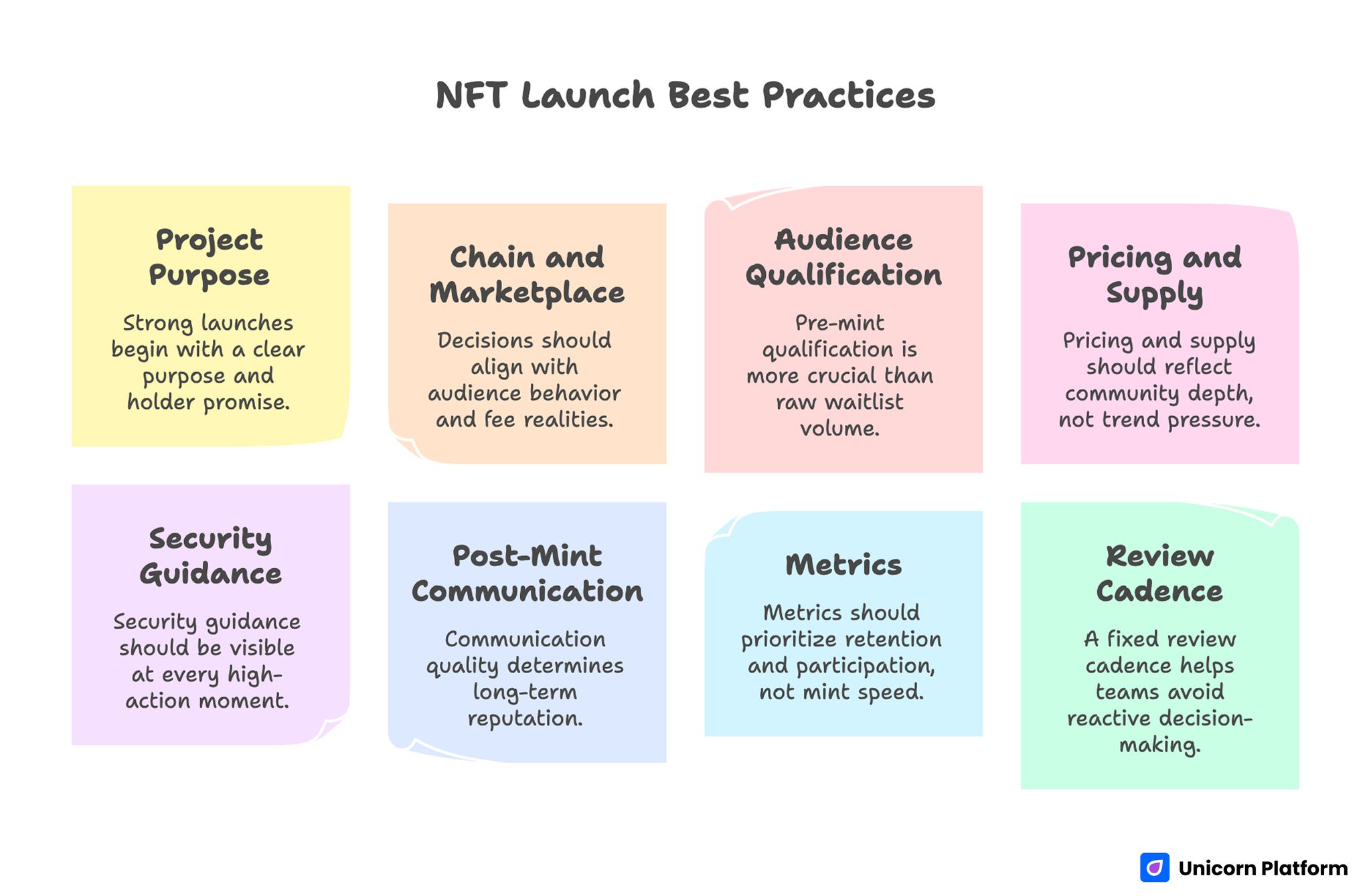
- Strong NFT launches start with a specific project purpose and holder promise.
- Chain and marketplace decisions should match audience behavior and fee realities.
- Pre-mint audience qualification is more important than raw waitlist volume.
- Pricing and supply should follow community depth, not trend pressure.
- Security guidance should be visible at every high-action moment.
- Post-mint communication quality determines long-term reputation.
- Metrics should prioritize retention and participation, not mint speed alone.
- A fixed review cadence helps teams avoid reactive decision-making.
Why NFT Projects Still Break After Launch
One common issue is value ambiguity. Teams describe vision and aesthetics but fail to define what holders actually receive and when. Without concrete expectations, communities fill the gaps with assumptions, and disappointment arrives quickly.
Another issue is audience mismatch. A project might attract speculative traffic that is interested in short-term price movement rather than participation in long-term utility. Data from Chainalysis shows that a significant share of NFT activity is driven by short-term trading behavior, which can create volatility in engagement and weaken long-term community stability. That can inflate mint-day activity while weakening post-launch engagement.
The third issue is operational under-planning. Teams prepare art and mint mechanics, but not support workflows, incident response, or update cadence. As soon as the first conflict or delay appears, trust declines because no clear response system exists.
Define Project Intent Before Any Technical Setup
Before selecting tooling, write a one-page intent brief. This brief should explain the core concept, holder value, roadmap boundaries, and what the project explicitly does not promise. Clear exclusions protect both team credibility and holder expectations.
A practical intent brief answers five questions. As explained by ConsenSys, NFTs are not just digital assets but programmable ownership structures, which makes clarity around rights, utility, and expectations essential before launch. Who is the project for, what specific value does ownership unlock, what timeline is realistic, what rights are granted, and what risks are openly acknowledged. If one answer is weak, fix it before launch planning.
For teams capturing early demand while refining project scope, this waitlist landing page framework helps structure qualification logic without overpromising outcomes. It is especially useful when supplier and collector cohorts need different expectations before mint day.
Chain, Wallet, and Mint Model Decisions
Technical choices shape buyer experience and project economics. Chain selection influences fees, buyer familiarity, speed, and marketplace visibility. Wallet onboarding friction can directly affect mint completion rates, especially for first-time participants.
Mint model decisions also matter. Gasless or lazy approaches can reduce entry friction, while fully on-chain approaches may support stronger provenance narratives depending on project goals. There is no universal best option, only better fit for the target audience.
Publish a short stack rationale in your launch documentation. Explaining why each choice was made improves trust and reduces repetitive support questions.
Build Two Pre-Launch Tracks: Education and Qualification
High-quality launches separate audience warming from audience qualification. Education content explains project context and helps new participants understand process steps. Qualification content clarifies who should join and what commitment profile makes sense.
Education track assets can include wallet setup guides, mint process walkthroughs, and security reminders. Qualification track assets can include eligibility rules, roadmap fit statements, and holder responsibility notes.
If your team is producing fast content updates with AI support, this AI landing page workflow can help keep explanations clear while preserving trust and consistency. Structured prompts reduce vague language that can otherwise create legal or community confusion.
Step-by-Step Mint Launch Workflow
NFT Mint Launch Workflow (2026)
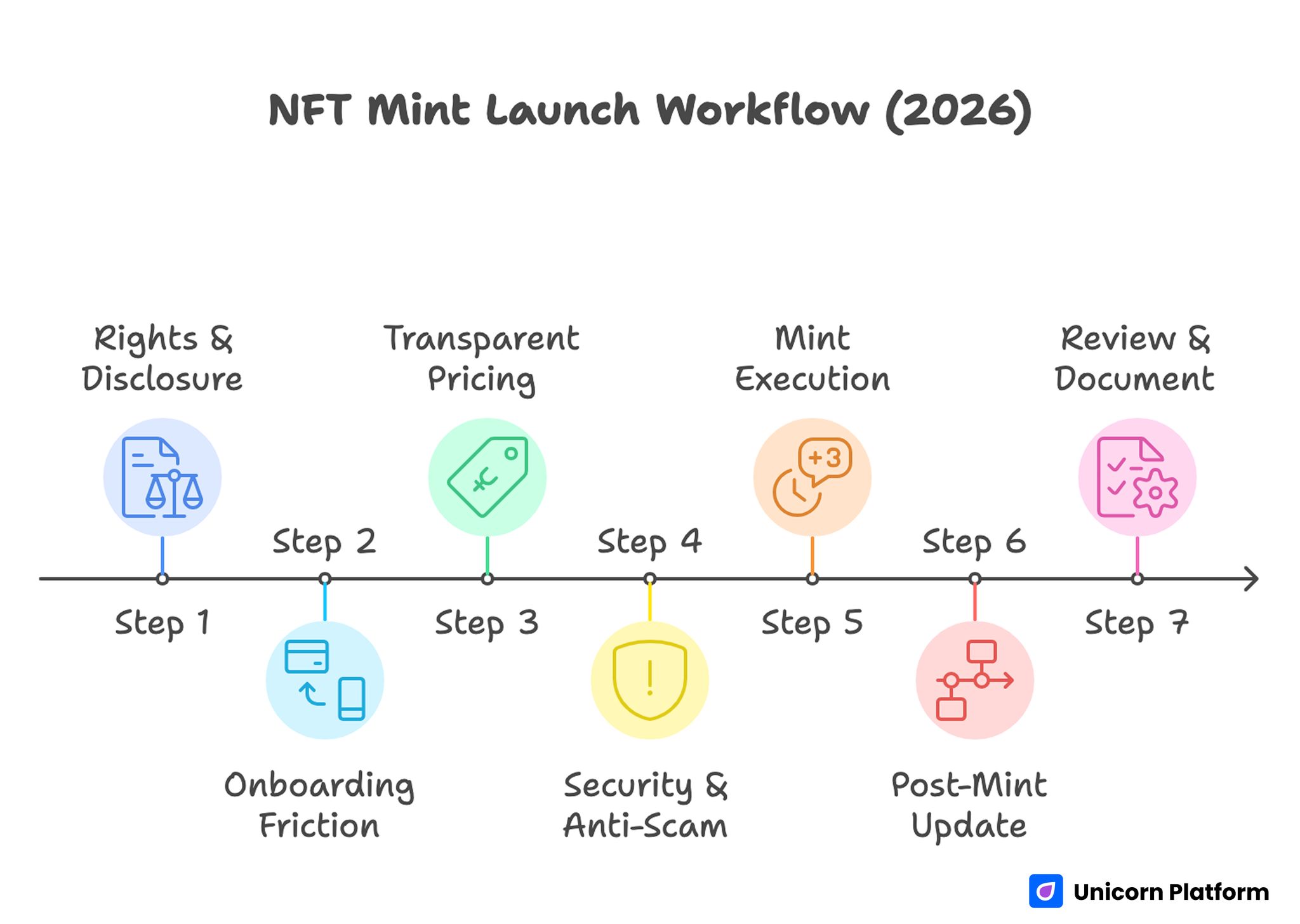
Step 1: Finalize rights and disclosure language
Define ownership rights clearly before marketing intensifies. State what buyers can do commercially, what remains restricted, and how metadata or utility updates will be communicated.
Step 2: Validate onboarding friction
Run internal and community dry runs for wallet connection and mint flow steps. Watch where users hesitate and simplify instructions before live traffic arrives.
Step 3: Publish transparent pricing logic
Explain supply size, wallet limits, mint price rationale, and any staged pricing mechanics. Transparency reduces backlash and helps buyers make informed decisions.
Step 4: Prepare security and anti-scam communication
Create one canonical source for official links and publish anti-phishing warnings in every high-intent channel. Repeat this guidance near countdown posts and mint reminders.
Step 5: Execute mint with live support coverage
During mint windows, provide real-time updates on status, known issues, and next steps. Active communication can prevent small technical issues from becoming trust incidents.
Step 6: Launch post-mint update cadence immediately
Do not wait days to resume communication. Share mint summary, holder onboarding steps, and short-term roadmap priorities within the first operating window after mint.
Step 7: Review outcomes and document fixes
Within one week, evaluate operational friction, support patterns, and holder participation behavior. Convert findings into public-facing improvements and internal process updates.
Pricing and Supply Discipline
Supply and price decisions influence perceived fairness and long-term community quality. Overly aggressive pricing may increase short-term revenue while lowering holder satisfaction and participation quality. Underpricing can attract opportunistic demand that exits quickly.
A balanced approach links supply to verified audience depth and utility delivery capacity. If the team cannot support promised experiences at higher scale, expanding supply creates quality risk.
Document pricing assumptions in plain language. Buyers are more likely to trust a project that explains its reasoning than one that uses scarcity rhetoric without context.
Trust Architecture for NFT Projects
Trust in NFT ecosystems depends on predictability. Holders need confidence that project statements, roadmap updates, and support behavior will stay consistent after initial sales pressure fades.
Minimum trust architecture includes rights clarity, roadmap realism, support responsiveness, and visible policy updates when conditions change. Consistency across these elements matters more than polished branding language.
Teams using Unicorn Platform can maintain this architecture with update modules and policy sections that are easy to revise as the project evolves. Operational agility is valuable only when updates are transparent and specific.
Security Communication as a Core Product Layer
Security is not a side note for web3 projects. Scam clones, fake links, and impersonation attempts can appear quickly around launch events. If security messaging is weak, even technically sound projects can lose community confidence.
Place security notices near every high-action moment, including whitelist announcements, mint countdowns, and support channels. Reinforce one-source-of-truth link policies and wallet hygiene reminders in plain language.
Security response should include a predefined incident path. If a threat emerges, publish verified updates immediately and direct users to official remediation guidance.
Post-Mint Operations: Where Reputation Is Actually Built
The first weeks after mint determine whether holders view the project as credible. This period should include predictable update cadence, transparent progress reporting, and fast responses to practical holder questions.
Projects lose trust when communication becomes irregular or overly promotional after sale completion. Holders want clear status on delivery, utility milestones, and decisions that affect their participation.
A useful operating model is weekly short updates plus monthly deep reviews. Short updates maintain confidence. Deep reviews show accountability and help the community understand strategic tradeoffs.
Community Quality Over Speculative Churn
Healthy communities reward participation, not only price commentary. Encourage discussion around creative development, utility testing, governance participation, or ecosystem contribution loops. This keeps engagement tied to project value creation.
Incentive systems should support this behavior. Contribution-based rewards usually produce stronger outcomes than random giveaways because they reinforce long-term alignment.
When incentives are used, define eligibility and timeline clearly. Ambiguity in reward mechanics often creates support burden and avoidable community friction.
Metrics That Signal Real Project Health
Mint speed and gross sales are incomplete indicators. Better project evaluation requires behavioral and operational metrics that reflect long-term trust.
Recommended metric stack should be reviewed by both growth and community operations leads. Shared review ownership prevents teams from chasing vanity outcomes that weaken long-term credibility.
- holder retention over rolling windows
- participation rate in utility or governance activities
- support ticket volume by incident category
- roadmap milestone completion reliability
- repeat engagement depth in official channels
- incident response time and resolution confidence
These metrics should be reviewed alongside market behavior, but not replaced by price-only narratives. Price movement can provide context, but it should not override trust and participation indicators.
Secondary Market and Holder Education
Secondary market behavior influences community psychology even when the team does not directly control pricing outcomes. If holders receive no guidance, discussions can become dominated by short-term speculation and misinformation. Clear education helps keep attention on project value and realistic expectations.
A practical holder-education module should explain liquidity realities, volatility risk, and the difference between utility milestones and price reactions. Publish this module before mint and keep it visible after launch so new participants can self-educate quickly. Teams that frame these dynamics clearly usually face fewer support escalations tied to panic behavior.
This module should also include responsible communication standards for official channels. Encourage evidence-based updates, avoid price guarantees, and reinforce that roadmap delivery is the core commitment. Consistent education protects project reputation during volatile periods and improves the quality of community discussion.
Scenario Playbooks
Scenario 1: Fast mint, weak post-launch activity
This usually indicates speculative mismatch. Reframe communication around near-term utility, publish clear participation paths, and remove ambiguous roadmap language that invites unrealistic expectations.
Scenario 2: Strong community interest, high support friction
The likely issue is onboarding complexity or unclear documentation. Simplify wallet and process guides, improve FAQ clarity, and add visible escalation paths for common problems.
Scenario 3: Roadmap delays trigger trust concerns
Delay itself is often manageable when communication is direct and specific. Publish updated timelines with dependency explanations and concrete interim deliverables.
Scenario 4: Incentive campaign drives low-fit traffic
Refocus rewards on contribution quality rather than claim volume. Tighten eligibility rules and prioritize participants showing sustained engagement behavior.
30-Day Launch Plan
Week 1: Intent and policy foundation
Finalize project intent, rights language, and core roadmap boundaries. Publish concise documentation that explains the value model and risk realities.
Week 2: Technical and onboarding readiness
Complete dry runs of wallet and mint flow, then refine onboarding content based on observed friction points. Capture these findings in a visible checklist so support and moderation teams can respond consistently during launch windows.
Week 3: Audience warmup and qualification
Run education content and qualification messaging in parallel. Build expectation alignment before mint traffic peaks.
Week 4: Mint and stabilization
Execute mint with live support, then immediately transition to post-mint communication cadence and incident monitoring. Fast transition from launch mode to operations mode prevents uncertainty from growing in the first critical days.
90-Day Stability Plan
Month two should prioritize reliability. Focus on support quality, milestone visibility, and participation loops that reinforce holder confidence.
Month three should evaluate expansion only if trust indicators are stable. Expansion without operational consistency usually harms long-term reputation.
At ninety days, the main objective is predictable trust behavior, not headline excitement. If trust and participation metrics are stable, expansion decisions can be made with much lower operational risk.
FAQ: NFT Minting in 2026
Do I need a large community before minting?
You need a qualified community, not necessarily a massive one. Early quality and trust consistency matter more than raw follower counts, especially when support resources are limited.
Should I prioritize low fees over audience fit?
Not automatically. Fee structure matters, but poor audience fit can cost more than transaction savings in long-term engagement quality. Prioritize environments where your target participants already transact with confidence.
Is lazy minting always better for beginners?
It can lower entry friction, but it is not universally better. Choose the model that best matches buyer expectations, project goals, and operational capacity in your specific niche.
What should be on the launch page at minimum?
Include project purpose, holder value, rights summary, pricing and supply clarity, security guidance, and post-mint expectation details. Missing one of these items usually increases support load and reduces buyer confidence.
How do I avoid overpricing a first drop?
Base pricing on verified audience depth, utility scope, and delivery capacity. Publish rationale to keep expectations aligned and reduce backlash during volatile market periods.
What if roadmap milestones change?
Update holders quickly with reasons, dependencies, and revised windows. Transparent communication is usually more important than perfect adherence, because uncertainty hurts trust faster than delay itself.
Are free mint incentives good for growth?
They can help if tied to clear participation goals. Untargeted incentives often attract low-fit demand and increase support burden across support and moderation channels.
Which metric matters most after mint day?
Holder retention paired with participation quality is usually a stronger health signal than short-term price movement. Use both metrics together to avoid false confidence during speculative spikes.
How often should project updates be published?
Use a predictable cadence, such as weekly short updates and monthly strategic reviews. Consistency reduces uncertainty and rumor-driven churn, especially in mixed-experience communities.
Can one page handle launch and post-mint communication?
It can for small projects, but separate modules for launch details and ongoing updates usually improve clarity as complexity grows. This separation also helps teams archive old launch information without confusing new holders.
Final Takeaway
Strong NFT projects in 2026 are built on clear promises, disciplined operations, and transparent trust design. Mint execution is only one stage in a longer system that must hold up under real community behavior.
With Unicorn Platform, teams can run this system faster while keeping communication quality high. The long-term advantage comes from consistent clarity, reliable delivery, and steady iteration based on real holder outcomes.