Table of Contents
- A Conversion Architecture for Med Spa Pages
- Treatment Page Design That Improves Consultation Fit
- 30-Day Launch Plan for Med Spa Teams
- Scenario Playbooks
- Common Mistakes and Fixes
- FAQ
Med spa demand has grown, but competition has matured just as fast. Most clinics now have polished branding, social content, and a basic booking flow. The difference between average and high-performing websites is no longer visual style alone. It is the ability to help visitors make confident decisions with clear expectations.
People exploring aesthetic and wellness services are often balancing excitement and hesitation at the same time. They want to improve how they look or feel, but they also worry about safety, suitability, downtime, and whether outcomes will match what was promised. A site that ignores these concerns may still generate traffic, yet it usually attracts lower-quality inquiries and weaker show rates.
That is why conversion strategy in this category should be trust-first. A strong site clarifies who each treatment is for, what the consultation process includes, what results are realistic, and what next steps look like. When those points are obvious, the booking decision becomes easier and the consultation conversation starts at a higher quality level.
This guide is designed for med spa and beauty wellness teams that want a repeatable operating model. It covers message architecture, treatment-page logic, trust systems, consultation funnel design, local discovery, and ongoing optimization tied to real appointment outcomes.
sbb-itb-bf47c9b
Key Takeaways
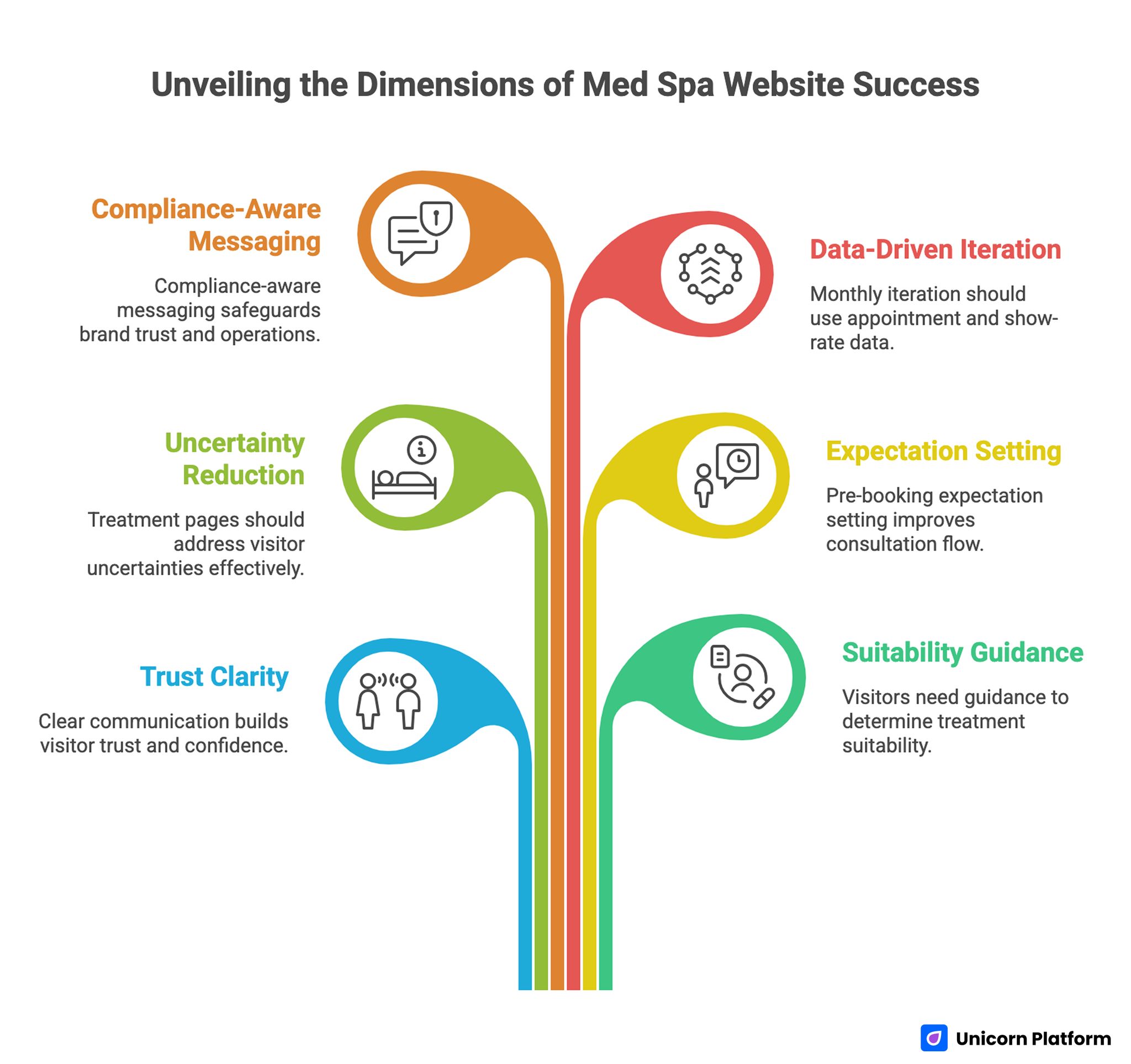
Unveiling the Dimensions of Med Spa Website Success
- Premium design helps, but trust clarity drives consultation quality.
- Visitors need suitability guidance before they need persuasive copy.
- Treatment pages should reduce uncertainty, not just showcase benefits.
- Consultation flow performance depends on pre-booking expectation setting.
- Compliance-aware messaging protects both brand trust and operations.
- Monthly iteration should use appointment and show-rate data, not only form volume.
Why Beautiful Med Spa Sites Still Underperform
Many clinics invest in elegant visuals and still struggle with conversion quality. The root problem is often message imbalance. Pages spend too much space on lifestyle positioning and too little on treatment process, practitioner authority, and practical decision context.
Another issue is that risk communication appears too late. Visitors in this market need early reassurance on who provides treatment, how suitability is assessed, what recovery expectations may look like, and when recommendations are finalized. If those points are hidden deep in the page, uncertainty blocks action.
Conversion friction is also common in booking pathways. Long forms, unclear service selection, and vague confirmation states increase abandonment. Even when users complete forms, many arrive underprepared because the site did not explain what consultation actually involves.
Finally, teams often optimize for inquiry volume alone. High form counts can hide low-fit leads, low show rates, and heavier front-desk clarification workload. Without downstream visibility, page decisions drift toward superficial growth.
What High-Trust Conversion Looks Like in Aesthetic Services
A high-performing med spa website does four jobs clearly. It helps users identify fit, evaluate credibility, understand process, and take one confident next step. If any of these jobs is weak, conversion quality suffers.
Fit clarity means users quickly understand whether a treatment path aligns with their needs. Credibility means users can verify expertise and standards without hunting for proof. Process clarity means they understand consultation flow, timeline signals, and realistic progression. Action clarity means booking is straightforward and expectations after submission are explicit.
Teams using Unicorn Platform can operationalize this through reusable modules rather than one-off page builds. That structure makes it easier to launch campaigns quickly while maintaining trust logic across services.
A Conversion Architecture for Med Spa Pages
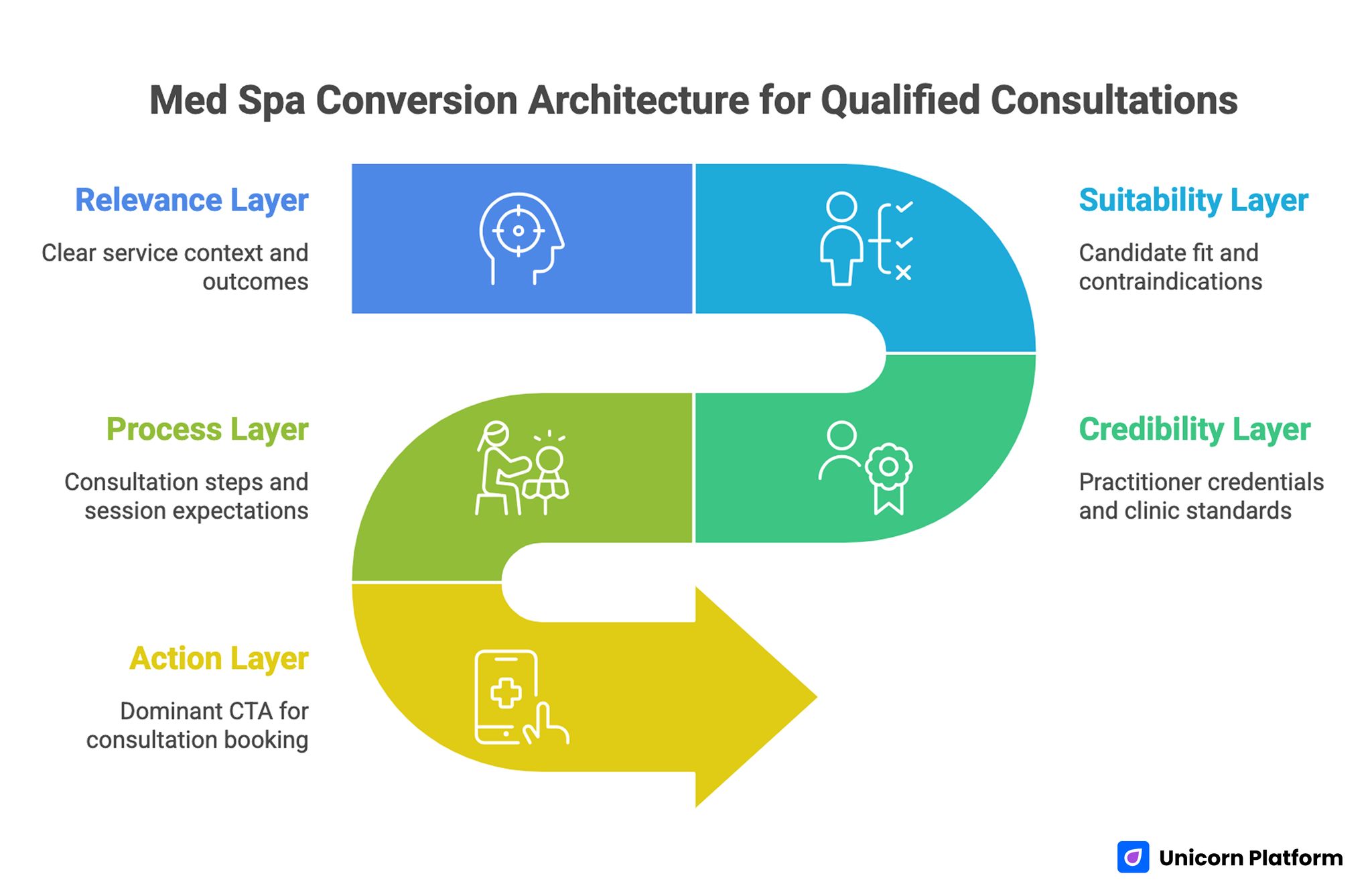
Med Spa Conversion Architecture for Qualified Consultations
A reliable page architecture reduces anxiety in stages. Visitors should never feel forced to decide before they have the information needed to decide responsibly.
1. Relevance Layer
Start with clear service context: who this page is for, what concern it addresses, and what kind of outcome it supports. Avoid broad claims that could apply to every service on your menu.
2. Suitability Layer
Introduce concise guidance on candidate fit, common contraindications, and why consultation exists before recommendations. This frames your process as responsible and personalized.
3. Credibility Layer
Provide practitioner credentials, treatment volume context where appropriate, and clinic standards in plain language. Trust should be visible before the booking CTA, not after it.
4. Process Layer
Explain consultation steps, session expectations, likely timeline range, and post-visit support. People convert more confidently when they know what happens next.
5. Action Layer
Use one dominant CTA tied to your primary objective, usually consultation booking. Secondary actions can exist, but they should support the same decision path.
For clinics improving consultation scheduling flow specifically, this reservation page blueprint is a useful implementation reference. Apply it to tighten handoff from service interest into confirmed appointment intent.
Messaging Strategy: Confidence Over Hype
In aesthetics and wellness, overly promotional language can create short-term clicks but long-term trust erosion. Strong messaging is direct, clear, and specific about service value without implying guaranteed universal outcomes.
A practical message formula is: concern context, treatment mechanism, consultation-led personalization, and realistic progression. This communicates both benefit and responsibility, which is exactly what high-intent visitors need.
Avoid extremes in tone. Clinical language with no warmth can feel impersonal, while purely lifestyle copy can feel evasive. Balanced messaging combines empathy with operational clarity.
Consistency across channels matters too. Ad text, social content, service pages, and booking forms should describe the same offer boundaries. If language shifts across steps, users question credibility.
Treatment Page Design That Improves Consultation Fit
Every treatment page should answer core decision questions in a predictable order. Users should quickly understand what the treatment addresses, how evaluation works, what outcomes are realistic, what recovery variables to consider, and how to start consultation.
This structure reduces low-fit inquiries because visitors can self-qualify before they submit. It also helps front-desk and coordinator teams because incoming leads arrive with clearer expectations.
A practical treatment page framework includes the elements below. Use it as a quality checklist during every service-page review cycle.
- Service purpose and candidate context.
- How consultation determines suitability.
- What the treatment process typically involves.
- Realistic timeline and aftercare considerations.
- Primary next step and response expectations.
Keep language specific and avoid universalized statements. Responsible clarity is more persuasive than exaggerated certainty in this category.
Practitioner and Clinic Credibility Signals
Credibility in med spa marketing is not one testimonial block. It is a layered system of signals that reduce perceived risk. Users want to know who is performing treatment, how decisions are made, and how safety is handled before and after appointments.
Useful credibility components include practitioner profiles, licensing and training context, treatment-specialization cues, and clinic process standards. These signals are strongest when placed near decision points. This approach aligns with guidance from the American Society of Plastic Surgeons, which emphasizes that patients evaluate provider qualifications, safety standards, and procedural transparency early in their decision-making process—not just at the consultation stage.
Client feedback works best when tied to concrete experiences such as consultation clarity, comfort during treatment, and post-care communication quality. Generic praise is less useful than experience-specific proof.
If your team wants additional guardrails for health-adjacent conversion pages, this guide on medical landing page best practices can help reinforce trust and structure. It is especially useful when campaigns expand quickly across multiple treatment categories.
Compliance-Aware Content Operations
This category requires disciplined wording. Even when legal review is handled elsewhere, content teams should use clear internal standards for claims, qualifiers, and suitability context.
A good operating rule is to separate what the treatment is designed to support from what consultation confirms for each individual. This keeps messaging informative without implying certainty beyond clinical judgment.
Introduce a mandatory review gate before launch. One owner validates treatment accuracy, one owner validates conversion clarity, and one owner validates compliance-sensitive language. This division reduces inconsistency during fast campaign cycles.
Version control is important as service menus evolve. If old claims remain on archived or low-traffic pages, trust risk and operational confusion increase. A monthly content audit prevents this drift.
Consultation Funnel Design and Show-Rate Protection
Most performance loss in med spa funnels happens after the form is submitted, not before. If users do not understand consultation purpose, duration, preparation, or next steps, no-show risk increases.
A strong consultation funnel has four components: intent-matched service page, clear consultation explainer, friction-balanced booking form, and confirmation page with preparation guidance. Keeping these steps explicit reduces both pre-booking confusion and post-booking no-shows.
Forms should collect enough information for routing and context, but not so much that early-stage visitors abandon. Additional detail can be captured through pre-visit communication once intent is established.
Confirmation messaging should set expectations explicitly: response timeframe, what to bring or avoid, and how to reschedule if needed. This step improves preparedness and reduces operational follow-up load.
For teams supporting related beauty service campaigns, this hair and skincare landing page guide can help keep cross-service consultation pathways consistent. Use it to align messaging so users moving between services experience the same level of clarity.
Offer and Pricing Communication Without Trust Loss
Visitors do not always require full pricing tables on first view, but they do require pricing logic that feels transparent. Unclear offer scope is one of the fastest ways to reduce trust in this category.
If you run introductory offers, define what is included, who qualifies, and where limits apply. Ambiguous promotions may increase form starts while lowering consultation quality and client satisfaction.
Package communication should focus on fit and progression, not only discount framing. Explain who each package is designed for and how sessions typically build toward goals.
Whenever pricing details vary by consultation outcome, say that clearly and early. Users are more comfortable with variable pricing when the reason is explained upfront.
Mobile Experience for Decision-Stage Users
A large share of med spa discovery happens on mobile, especially from social and local search channels. Mobile-first design should therefore prioritize confidence and action clarity, not just responsive layout.
First screens should provide specific relevance, one visible action path, and one trust anchor. Dense intro text or delayed proof often increases bounce from high-intent traffic.
Booking interactions need careful testing on real devices. Date pickers, service selectors, and form progression should be simple under thumb-driven use. Small UX issues at these points can significantly reduce completion.
Performance discipline matters. Heavy visual assets should never delay critical decision content or booking controls. A refined visual brand can coexist with fast, practical interaction.
Local Discovery and Organic Intent Strategy
Local visibility remains central for med spa growth. Users frequently search by concern plus location, then compare options quickly. Generic city-page duplication is less effective than concern-specific pages with real differentiation.
A better strategy is to build local intent clusters tied to practical questions. Examples include suitability considerations, pre-consultation preparation, treatment-comparison explainers, and aftercare expectations.
These pages should connect naturally to consultation pathways. Educational content builds trust, then transactional pages capture intent when users are ready.
Internal linking should follow user decisions, not arbitrary structure. Someone reading about suitability should be able to move directly into consultation planning without friction.
Editorial System for Consistent Quality at Speed
Fast publishing helps only when quality controls scale with speed. Clinics that rely on ad hoc updates usually end up with inconsistent tone, outdated details, and fragmented trust cues.
Build a documented editorial system with template sections, approved phrasing patterns, and review checkpoints. This allows teams to launch seasonal or service-specific pages quickly without sacrificing clarity.
A useful workflow includes brief definition, draft assembly from modules, treatment-accuracy review, conversion review, compliance-aware review, and launch QA. Each stage should have one owner and one clear pass condition.
Documenting decisions is essential. Keep a changelog with what changed, why it changed, and what happened to consultation quality metrics after launch.
Analytics Model: From Form Fill to Consultation Quality
Surface conversion metrics are necessary but incomplete. Med spa teams should track both form behavior and appointment quality signals to understand whether page changes create real business value.
A practical measurement stack can include the indicators below. Together they reveal whether page updates improve outcome quality, not just top-line activity.
- Consultation form start rate.
- Form completion rate.
- Qualification rate after first contact.
- Consultation show rate.
- Consultation-to-treatment conversion rate by page source.
- Average support touchpoints needed before visit.
This model reveals where friction lives. If form completion rises but show rate drops, expectation setting is likely weak. If form starts remain low despite strong traffic, relevance or trust placement may need revision.
Cross-team debriefs improve interpretation. Front desk and coordinators often detect repeated concerns before analytics trends become obvious. Their feedback should be integrated into monthly page updates.
Campaign Variant Strategy by Intent Stage
Not all visitors arrive with the same readiness. A single page can introduce your brand, but intent-specific variants usually perform better for serious growth programs.
Early-stage visitors need orientation and education. Mid-stage visitors need differentiation and proof. Decision-stage visitors need scheduling confidence and practical next-step clarity.
Use a shared structural template and vary messaging emphasis by stage. This preserves operational efficiency while improving relevance. Keep measurement consistent across variants so results remain comparable.
Do not change too many variables per test cycle. One structural edit and one message edit per variant is often enough to learn quickly without creating analytical noise.
30-Day Launch Plan for Med Spa Teams
Week 1: Diagnose Current Friction
Audit your highest-traffic service and consultation pages. Identify trust gaps, unclear suitability language, weak booking transitions, and mobile friction points. Choose one primary bottleneck per page.
Week 2: Build Core Templates
Create reusable page templates for core services and consultation pathways. Include standardized modules for practitioner proof, process clarity, and expectation-focused confirmation copy.
Week 3: Launch Intent Variants
Deploy updated pages for one or two high-priority services. Keep structural logic consistent, then vary relevance framing and trust emphasis by audience intent.
Week 4: Review and Consolidate
Analyze form behavior, qualification quality, and show-rate changes. Promote winning changes into default templates and schedule the next focused test cycle.
Running this cadence monthly creates compounding gains because each campaign improves both content quality and operational clarity. That consistency helps teams scale without recreating the same messaging mistakes.
Scenario Playbooks
Scenario 1: High Social Traffic, Weak Consultation Quality
A clinic attracts strong social traffic but receives many low-fit inquiries. Review shows that landing pages are visually strong yet vague on suitability and process. Users are curious enough to submit forms but not prepared for consultation realities. The fix is to introduce clear fit guidance, consultation expectations, and risk-aware language before CTA sections. This usually reduces noisy leads and improves consultation readiness.
Scenario 2: Good Form Completion, High No-Show Rate
A team improves form UX and sees more completed bookings, but show rates remain inconsistent. Confirmation messaging provides little practical guidance, and users are unsure what consultation involves. Updating confirmation pages with preparation details, timing clarity, and reschedule options typically improves attendance quality. Operationally, this also reduces coordinator follow-up burden.
Scenario 3: Fast Campaign Launches, Inconsistent Messaging
A med spa runs frequent seasonal promotions and launches quickly, but pages vary in tone and claims. Some campaigns overpromise while others under-explain process. Implementing a structured template system with review ownership stabilizes message quality. Over time, this improves both trust consistency and conversion predictability.
Common Mistakes and Fixes
Mistake 1: Leading with generic beauty language
Fix: Start with specific concern and treatment context so users can quickly assess relevance. Specificity reduces low-intent clicks and improves inquiry quality.
Mistake 2: Delaying suitability information
Fix: Place fit and consultation guidance early to reduce uncertainty before booking decisions. This helps visitors self-qualify before they enter forms.
Mistake 3: Hiding important offer limitations
Fix: Clarify offer scope, exclusions, and qualification criteria in plain language. Transparent terms protect both trust and front-desk efficiency.
Mistake 4: Treating compliance review as optional
Fix: Add mandatory pre-launch review for treatment accuracy and claim boundaries. A consistent review gate prevents risky wording from reaching paid traffic.
Mistake 5: Optimizing for form count only
Fix: Include show-rate and treatment-conversion metrics in every performance review. These signals expose quality gaps that form volume alone cannot reveal.
Mistake 6: Running campaign updates without documentation
Fix: Record every change and its downstream impact to build reusable growth knowledge. This documentation turns campaign activity into a practical optimization library.
FAQ: Med Spa Websites in 2026
1. How much detail should a med spa service page include?
Include enough detail to answer fit, process, and expectation questions before booking. A concise but complete page usually performs better than either sparse branding copy or dense technical text.
2. Should med spa pages show prices upfront?
Where possible, show clear pricing logic and offer scope early. Full final pricing can still depend on consultation, but users should understand how decisions are made.
3. What trust elements matter most for consultation conversion?
Practitioner credibility, process transparency, realistic expectation setting, and clear support pathways are usually the strongest conversion drivers. These signals reduce perceived risk before users commit to consultation.
4. How can we reduce no-shows after online booking?
Improve confirmation messaging with preparation guidance, timelines, and reschedule clarity. Many no-shows come from uncertainty, not lack of interest.
5. How often should pages be refreshed?
High-traffic pages should be reviewed monthly, with immediate updates for service, policy, or staffing changes that affect expectations. Fast updates prevent outdated information from damaging trust.
6. Can one template serve every treatment campaign?
One structural framework can, but message emphasis should vary by concern type and intent stage to preserve relevance. This keeps production efficient while improving user fit.
7. What role should educational content play?
Educational pages help users self-qualify, reduce anxiety, and improve consultation readiness. They also support local organic visibility when linked well.
8. Which metrics should guide optimization priorities?
Track inquiry quality, show rates, consultation outcomes, and operational follow-up burden, not just top-line form submissions. This broader view keeps optimization aligned with real clinic performance.
9. Is no-code suitable for medical-adjacent service marketing?
Yes, when teams pair speed with disciplined review, clear governance, and trustworthy messaging standards. Fast publishing works best when paired with strict quality controls.
10. What is the first improvement most clinics should test?
Test first-screen relevance and early trust placement near the first CTA. That combination often improves both conversion quality and booking confidence quickly.
Final Takeaway
High-performing med spa websites are built on confidence, not just aesthetics. When visitors can quickly evaluate fit, trust your process, and understand next steps, consultation quality improves and operational friction declines.
Teams that combine Unicorn Platform speed with structured content governance can scale campaigns without sacrificing trust. Over time, that consistency becomes a durable growth advantage in a highly competitive market.

