Table of Contents
- Free Stack Selection Without Hidden Complexity
- 30-Day Execution Plan
- Common Prelaunch Mistakes and Direct Fixes
- FAQ
Most founders can publish a page in one day. Fewer founders can publish a page that attracts the right users, qualifies demand, and creates launch momentum without burning time on rework.
That difference matters because prelaunch attention is fragile. If your first page is unclear, visitors leave and rarely return. If your first page is focused and credible, it becomes an early growth asset that keeps collecting leads while the product is still evolving.
A free launch setup can work extremely well when execution is disciplined. You do not need an expensive stack to validate demand. You need clear positioning, low-friction signup flow, trust signals, and a follow-up cadence that moves people from curiosity to intent.
This guide gives you that system end to end. It is built for teams that need practical execution rules rather than abstract launch advice.
sbb-itb-bf47c9b
Quick Strategic Takeaways
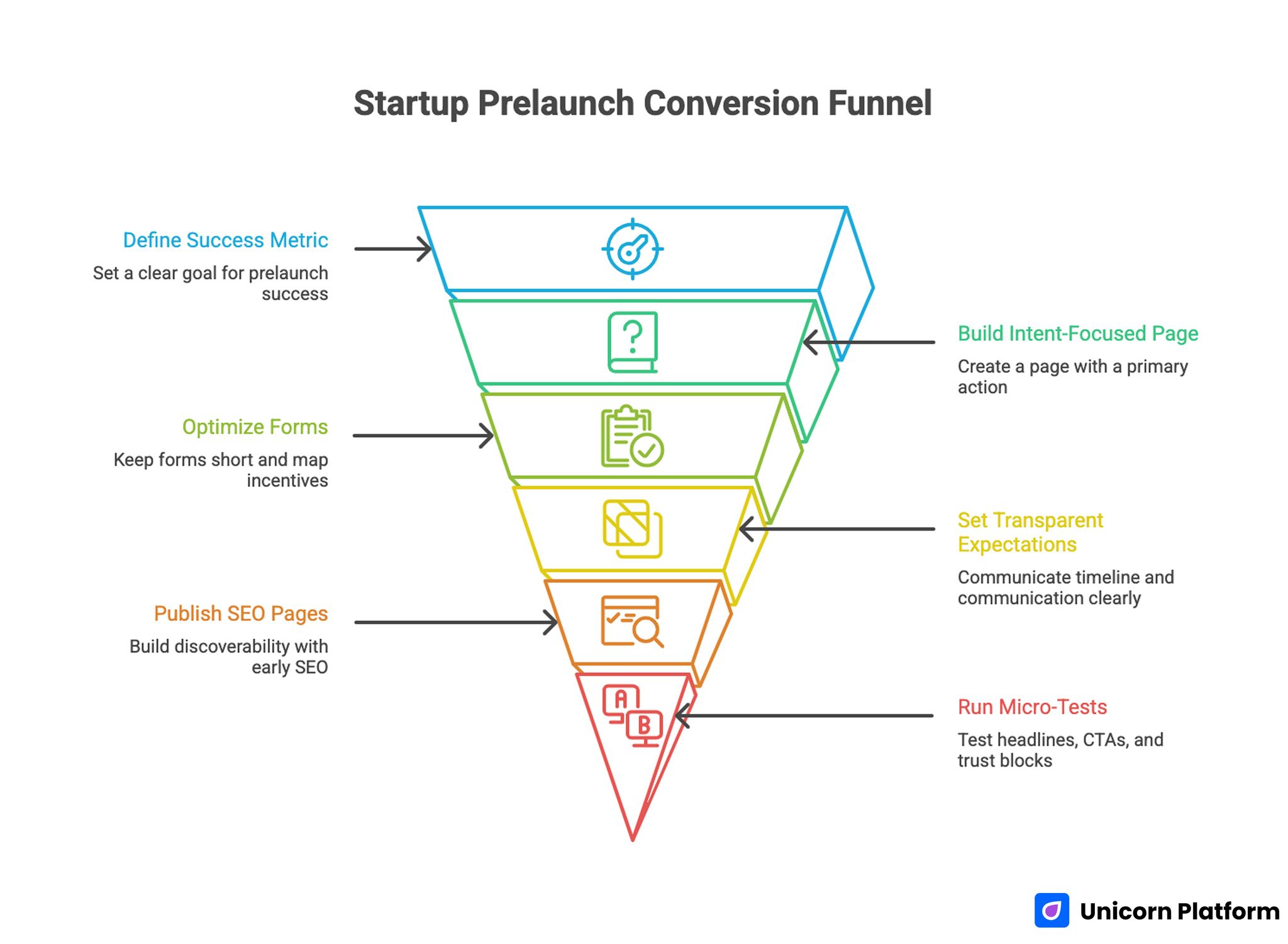
Startup Prelaunch Conversion Funnel
- Define one prelaunch success metric before publishing any page.
- Build one intent-focused coming-soon page with one primary action.
- Keep forms short and map incentives to audience type.
- Use transparent expectations for timeline and communication.
- Publish supporting SEO pages early to build prelaunch discoverability.
- Run weekly micro-tests on headline, CTA, and trust block placement.
- Measure lead quality, not just signup volume.
Why Most Free Prelaunch Pages Underperform
Underperformance usually comes from message ambiguity, not from tool limitations. Founders often write broad copy like "something exciting is coming" and assume traffic will self-qualify. In practice, vague pages attract low-intent signups and create weak launch lists.
A second issue is friction mismatch. Pages ask users for too much information before trust is established, or they offer no clear reason to join now. Both patterns lower completion and reduce list quality.
The third issue appears after signup. Teams collect emails but have no structured follow-up, so intent fades before launch. Without a communication system, even a good waitlist decays quickly.
Start With One Outcome and One Audience
Before writing copy, define the exact prelaunch outcome for this cycle. Useful outcomes include qualified waitlist signups, demo-interest submissions, referral-driven signups, or activation-ready beta users.
Then define one primary audience for the page. A founder-focused SaaS page should not sound like a consumer app launch, and a B2C app page should not read like enterprise procurement copy. Audience mismatch is one of the fastest ways to destroy conversion quality.
If the audience is mixed, run separate variants rather than one generic page. Cleaner intent targeting usually outperforms one-size messaging even at lower traffic volume.
Free Stack Selection Without Hidden Complexity
A free stack is useful only when it stays operationally simple. Many teams save money on tools and then lose time on integration friction, broken tracking, or slow editing workflows.
A practical free-stack baseline should include the tools below. Keep the stack as simple as possible so your team spends time on conversion quality, not tool maintenance.
- One page builder for fast publishing
- One analytics layer for event tracking
- One email tool for follow-up sequences
- One simple database or CRM sink for lead segmentation
If your team is comparing options, this guide on free website platforms for startups is useful for balancing speed, flexibility, and maintenance risk. Use the comparison to decide quickly, then move into execution and testing.
Coming-Soon Page Architecture That Converts
A strong prelaunch page should answer five questions quickly. Who is this for, what problem does it solve, why now, why trust this team, and what happens after signup.
Use a sequence like this. The section order matters because it mirrors how users evaluate trust before they act.
- Specific promise headline
- Short context block with urgency
- Product mechanism in plain language
- Credibility block with proof or founder context
- Simple signup action with clear expectation
- FAQ covering timeline and access details
This structure reduces decision effort and helps users choose quickly without feeling pushed. It also makes weekly optimization easier because each block has a clear purpose.
Messaging Framework for Early-Stage Trust
Good prelaunch messaging is specific and low-drama. It should sound like a team solving a real problem, not a brand trying to impress with hype.
A useful formula is: audience, problem, outcome, and near-term change. For example, explain who benefits first, then state what improves for them in the first release window.
Avoid overpromising on scope. Early users are usually more forgiving about limited features than about unclear or inflated promises.
Waitlist Incentive Design by Product Type
Incentives improve signups only when they match user motivation. Generic "join now" copy usually underperforms because it lacks a practical reason to act.
Useful incentive models include the options below. Select one primary model so users do not get mixed commitment signals.
- Priority access for workflow tools
- Referral-based queue advancement for consumer products
- Founding-member pricing for subscription offers
- Early feedback access for community-led products
Incentive language should be explicit about what users get and when they get it. Precision improves trust and reduces low-intent submissions.
Form Design for Quality, Not Volume
The fastest way to improve conversion is often reducing form friction. Ask only for fields required to route the next step effectively.
For many prelaunch pages, email plus one qualifying field is enough. Additional context can be collected after trust is established through follow-up messages.
If lead quality is weak, revise copy before adding more required fields. Heavier forms can reduce noise, but they also reduce momentum when message fit is the real issue.
SEO Prelaunch Strategy That Starts Early
Prelaunch SEO can create useful traffic before launch day if pages are structured around real user questions. The goal is to build qualified discovery, not vanity impressions.
Publish support pages around use cases, alternatives, setup concerns, and expected outcomes. Then connect those pages to your main waitlist action through deliberate internal links.
For teams creating early conversion pages with limited resources, this practical startup landing page creation workflow can help standardize structure and publishing speed. Standardization reduces error rates when multiple contributors edit the same prelaunch assets.
Waitlist Page Quality Standards
A waitlist page should be treated like a conversion page, not a temporary announcement. It needs clear action logic and measurable behavior tracking.
A practical quality checklist includes first-screen relevance, one dominant CTA, visible trust indicators, concise FAQ, and post-signup expectation clarity. If any of these are weak, improve them before increasing traffic.
For deeper optimization patterns in this stage, this guide to effective waitlist landing pages is useful for refining structure and follow-up flow. Apply one improvement at a time so the metric impact is clear.
Communication Sequence After Signup
Signup is not the finish line. It is the start of intent preservation.
Use a short follow-up sequence in the first two weeks. Keep the sequence simple and consistent so users know exactly what to expect.
- Welcome message with clear next-step expectations
- Progress update tied to one practical milestone
- Action prompt for referral, feedback, or onboarding readiness
Each message should carry one purpose and one action. Fragmented communication lowers trust and reduces activation on launch day.
Weekly Testing System
Run small controlled tests each week. Avoid changing many variables at once because noisy tests produce weak decisions.
Useful weekly tests include headline framing, CTA wording, trust block position, form field count, and incentive phrasing. Keep one major variable per experiment and document outcome clearly.
Testing speed matters, but decision discipline matters more. The point is to keep winners and retire weak sections consistently.
Metrics That Matter Before Launch
Top-line signup count is not enough. Teams should monitor quality indicators that predict activation and retention.
Track the indicators below. Review them by source and by week so quality changes are visible early.
- Signup conversion rate by source
- Qualified lead ratio from first follow-up response
- Referral participation rate
- Email open and click-through trend
- Launch-day activation intent signals
This framework helps avoid vanity growth and keeps the list aligned with real demand. It also protects your team from scaling acquisition before messaging quality is ready.
30-Day Execution Plan
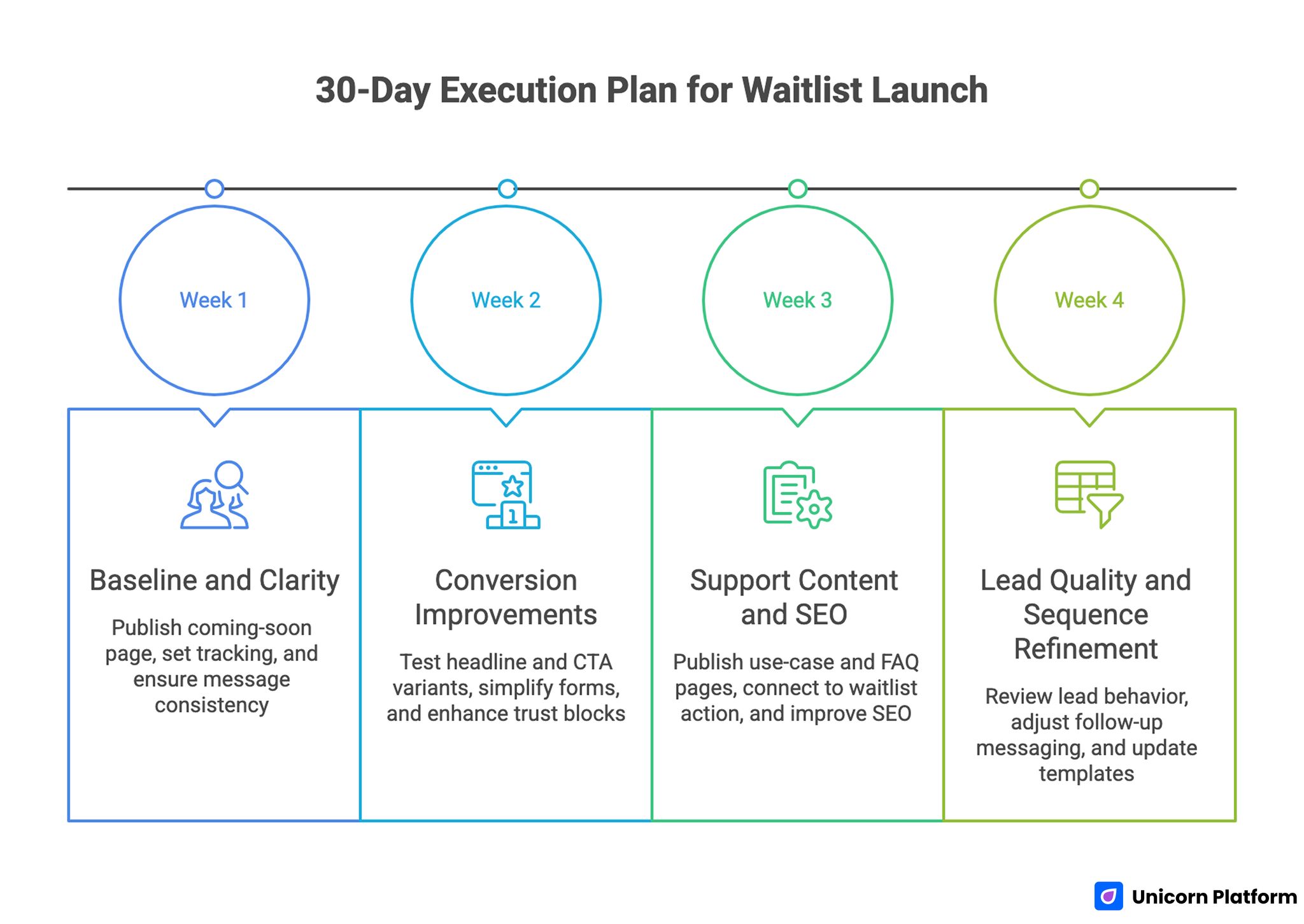
30-Day Execution Plan
Week 1: baseline and clarity
Publish one focused coming-soon page, set event tracking, and validate message consistency across source channels. Fix any message mismatch before increasing traffic.
Week 2: conversion improvements
Test one headline variant and one CTA variant, simplify form fields, and improve trust block clarity near the action module. Keep all other page elements stable during this test window.
Week 3: support content and SEO
Publish one use-case support page and one objection-focused FAQ page, then connect both to the main waitlist action. This improves prelaunch SEO depth and supports better lead qualification.
Week 4: lead quality and sequence refinement
Review qualified lead behavior, adjust follow-up messaging, and update templates with winning blocks for the next cycle. Archive weak sections so the next release starts from a stronger baseline.
This cadence creates progress without overloading small teams. It also creates cleaner documentation for future launches.
Launch-Week Readiness Checklist
The week before launch is where many teams lose quality under pressure. They push more traffic while small messaging and flow issues remain unresolved, which weakens activation and support efficiency.
Use a practical readiness checklist before scaling traffic:
- Confirm message consistency across ad preview, landing hero, and welcome email
- Validate form routing and lead tagging for source-level analysis
- Check thank-you page logic and first follow-up timing
- Update FAQ using real objections collected from waitlist replies
- Run one full mobile QA pass focused on CTA visibility and readability
A readiness gate like this prevents avoidable errors and keeps launch-day performance stable. It also improves cross-functional alignment because teams share one clear quality standard before going live.
After launch, keep a seven-day review cycle with one decision rule per metric. If signups rise but activation falls, tighten expectation-setting language. If form starts are strong but completions fall, reduce friction and simplify required fields.
This short cycle helps teams make practical corrections while momentum is still high. Over multiple launches, it becomes a reusable operating model rather than a one-off emergency process.
90-Day Scale Plan
Month one should stabilize page quality and measurement standards. Month two should expand source-specific variants while keeping core structure consistent. Month three should formalize governance for messaging updates, proof refresh, and experiment review.
Scale should follow evidence, not urgency. More variants without standards usually increase maintenance load and reduce clarity.
Cross-functional alignment becomes critical here. Growth, product, and support teams should agree on promise language and launch expectations before scaling acquisition.
Common Prelaunch Mistakes and Direct Fixes
Mistake 1: vague value proposition
Fix by naming audience, problem, and first release outcome in the first screen. Readers should understand fit within seconds.
Mistake 2: no reason to join now
Fix by adding a concrete time-sensitive incentive aligned to user motivation. Relevance matters more than incentive size.
Mistake 3: long signup form on first touch
Fix by reducing required fields and collecting deeper context after trust is established. Early friction reduction usually improves both volume and quality.
Mistake 4: weak trust communication
Fix by adding founder context, product constraints, and timeline transparency near CTA. Trust increases when uncertainty is acknowledged directly.
Mistake 5: traffic growth without follow-up system
Fix by implementing a short structured post-signup communication sequence. Consistent follow-up preserves intent before release.
Mistake 6: optimization without documentation
Fix by logging hypothesis, change, metric impact, and keep-or-revert decision every week. Documented experiments compound learning faster.
FAQ: How to Launch a Startup Site for Free
Can a startup launch page built with free tools really convert well?
Yes, if messaging and flow are strong. Conversion quality depends more on clarity and trust than on expensive tooling.
What is the minimum content needed on a coming-soon page?
At minimum, include clear promise, audience fit, reason to join now, trust cue, and one clean action. Everything else is optional.
Should we gate early access with a long qualification form?
Usually no. Start with low friction, then qualify through follow-up. Heavy forms early can reduce momentum and hurt list growth.
How many page variants should we run at once?
Start with one baseline and one variant per major source segment. Too many variants early can create noisy data and weak decisions.
What is the best prelaunch incentive?
The best incentive is tied to real user value, such as priority access, early pricing, or role-specific benefits. Generic incentives perform worse.
How soon should we start SEO for prelaunch?
Start as soon as positioning is clear enough to publish useful support pages. Early SEO gives you time to build qualified discovery before launch.
What follow-up message matters most?
The first welcome message is critical because it sets expectation and trust. It should be specific, short, and action-oriented.
Which metric should leadership monitor first?
Track qualified lead ratio, not raw signups. Quality signals are better predictors of launch performance.
How often should we update the page before launch?
Weekly updates are usually enough if each change is measured. High-frequency edits without tracking often reduce clarity.
How do we prevent prelaunch quality from drifting?
Use one shared template, documented QA checks, and a fixed weekly review cycle. Consistency protects quality as speed increases.
Final Takeaway
A free startup launch page can be a powerful growth asset when it is built as a conversion system rather than a placeholder. The strongest teams combine specific messaging, low-friction action flow, and disciplined iteration.
Use your coming-soon page to validate demand, collect qualified intent, and prepare launch-day activation with clear follow-up communication. When this system is run consistently, every week of prelaunch improves your odds of a stronger release.
With Unicorn Platform, teams can execute this approach quickly through reusable structure, fast updates, and practical experimentation without heavy technical bottlenecks. That speed advantage is most valuable when campaign windows are short.