Table of Contents
- The 7-Block Architecture for Free-First Startup Pages
- 30-Day Execution Plan
- Common Mistakes and Fast Fixes
- FAQ
Early-stage startups usually face the same pressure: ship the site quickly, show momentum, and start collecting demand. In that environment, free website tools are attractive because they remove initial cost barriers and reduce technical dependency.
The problem is not using free tools. The problem is launching without a system. Teams publish fast, then struggle with mixed messaging, weak proof, and unclear actions. Traffic arrives, but conversion quality stays inconsistent.
A free-first approach can perform well when execution is structured. You need clear page intent, a predictable section flow, reliable trust signals, and a weekly review cadence that turns updates into measurable gains.
This guide is a practical framework for startup teams in 2026. It explains how to choose a free-first operating model, how to build pages that convert, and how to scale without rebuilding everything from scratch.
sbb-itb-bf47c9b
Quick Strategic Takeaways
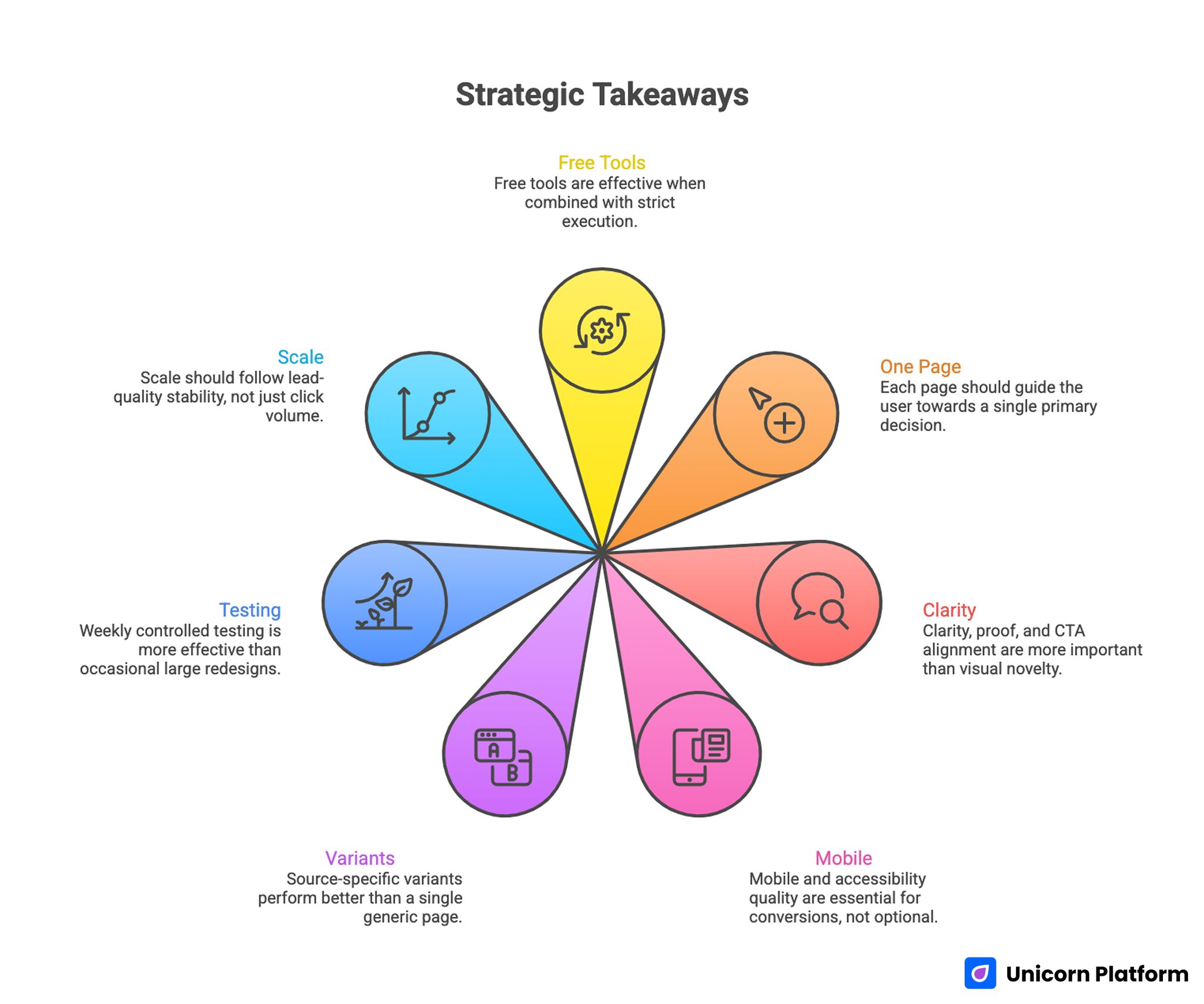
Strategic Takeaways for Launching Free-First Startup Websites Efficiently
- Free tools work when paired with strict execution standards.
- One page should drive one primary decision path.
- Clarity, proof, and CTA alignment matter more than visual novelty.
- Mobile and accessibility quality are conversion requirements, not optional polish.
- Source-specific variants outperform one generic page for all channels.
- Weekly controlled testing beats occasional large redesigns.
- Scale should follow lead-quality stability, not click volume.
Why Free-First Can Be a Strong Startup Strategy
Many founders assume free platforms are only for temporary pages. In practice, a free-first setup can be a strong operating choice if the team understands its real objective: speed of validated learning.
At early stage, your website is not a final brand artifact. It is a decision system for testing positioning, offers, and audience fit. If you can ship changes quickly and measure outcomes reliably, a free tool can outperform expensive stacks with slow publishing workflows.
The tradeoff is discipline. Without clear ownership and testing rules, teams create page sprawl, contradictory copy, and weak attribution. That is why process quality matters more than tool price in the first months.
Define the Page Job Before You Build
Most startup websites fail because they try to serve every objective at once. A single page cannot equally optimize for investor credibility, hiring, product education, and conversion.
Start each page with one explicit goal. Common primary goals include demo booking, trial signup, waitlist enrollment, or qualified inquiry submission. Every section should support that one outcome.
Then define audience stage. Cold visitors need context and trust before commitment. Warm visitors need faster action with less explanation. If audience stage is unclear, section priorities become random and conversion optimization becomes noisy.
This step sounds basic, but it removes most strategic confusion before design begins. It also prevents teams from rewriting entire pages after traffic has already started.
The 7-Block Architecture for Free-First Startup Pages
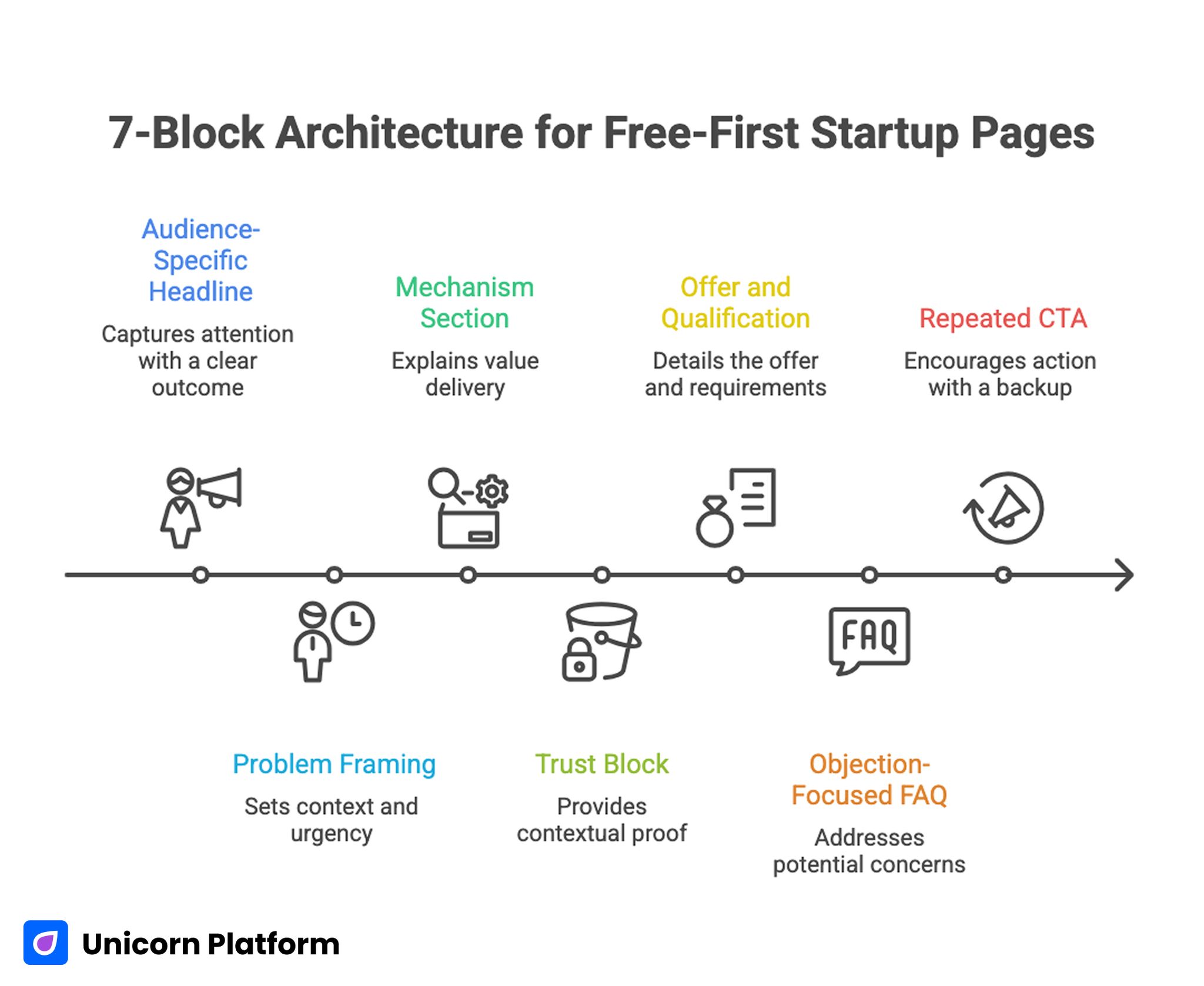
The 7-Block Architecture for Free-First Startup Pages
A stable architecture makes weekly testing easier and protects clarity as teams iterate. Use the following sequence as a baseline.
Research from Adobe’s UX team highlights that visual structure — including clear hierarchy and consistent section progression — reduces interpretation effort and improves user comprehension. Applying visual hierarchy principles ensures that users engage with the most relevant signals first, which supports stronger decision confidence on startup landing pages.
- audience-specific headline and concrete outcome
- short problem framing and urgency context
- mechanism section showing how value is delivered
- trust block with contextual proof
- offer and qualification details
- objection-focused FAQ
- repeated CTA with one low-friction backup action
This order mirrors how buyers reduce uncertainty. It also lets teams map drop-off points to specific section jobs.
For teams looking for a fast baseline template before custom optimization, this practical guide on startup landing page templates is useful.
Headline and Messaging Rules That Remove Friction
Weak startup copy is usually vague, not technically wrong. Broad claims create surface-level interest but low decision confidence.
Use three standards in every major section. First, claims must include mechanism, not only aspiration. Second, benefits should be tied to a realistic user scenario. Third, CTA copy should describe what happens after the click.
Compare the difference across clarity, credibility, and action readiness. The goal is to reduce interpretation work for the reader.
- weak: "We help startups grow faster."
- stronger: "Launch campaign pages in one day, test one variable each week, and improve qualified signup rates without waiting for engineering cycles."
The stronger version improves clarity and helps unfit traffic self-filter earlier, which protects downstream lead quality. It also improves sales handoff quality because user expectations are better aligned at first contact.
Proof Architecture: What to Show and Where to Place It
Trust is often treated as a visual section, but it should be treated as a decision accelerator. Proof should appear where hesitation is highest, not where there is extra space on the page.
Use layered proof by funnel stage. Early sections benefit from concise credibility signals and outcome indicators. Mid-page sections can include short case snapshots or role-specific testimonials. Final sections should reinforce implementation confidence and risk control.
Avoid generic testimonial walls. Context matters more than volume. A few specific proof items usually outperform many vague endorsements.
When teams want to improve early momentum and promoter quality in parallel, this first-promoter startup growth guide gives useful tactics for aligning page proof with acquisition channels.
CTA Strategy for Lean Teams
A high-performing page can contain multiple CTA placements, but it should contain one primary action type. Multiple competing actions reduce commitment and create noisy intent signals.
Cold channels often convert better with guided actions such as walkthrough requests. Warmer channels can support more direct actions such as trial or signup starts.
Keep CTA language consistent across the page. If headline promise and CTA action do not match, trust weakens even when the offer is strong.
Backup actions should be low-pressure and clearly secondary. The primary path must remain visually and semantically dominant.
Channel-to-Page Mapping
One generic page across all sources looks efficient, but conversion quality usually drops once channel intent diverges. Different sources arrive with different levels of trust, urgency, and product context.
Map each source to one page variant and one primary metric. This keeps the team focused on decision quality instead of vanity traffic movement.
- founder social posts: authority-first variant, metric = qualified CTA clicks
- community traffic: education-first variant, metric = form step completion
- outbound traffic: proof-first variant, metric = booked meetings
- partner referrals: trust-transfer variant, metric = lead-quality score
This model makes attribution cleaner and helps teams avoid optimizing for conflicting signals. It also speeds up weekly decision-making because test outcomes are easier to interpret.
Unicorn Platform workflows support this approach well because teams can duplicate stable base pages and adjust message order without breaking visual consistency. That balance of reuse and flexibility is critical for small teams with limited production bandwidth.
Mobile and Accessibility Quality Gates
Early-stage traffic is frequently mobile-heavy, especially from social and community distribution. If mobile readability or form flow is weak, acquisition efficiency falls quickly.
Accessibility is equally important for performance.
Baymard Institute’s mobile UX research shows that interaction issues such as poor tap target sizing, slow load times, and hidden focus states are common sources of mobile abandonment. Startups that systematically address these mobile pain points see measurable improvements in conversion and engagement across touchpoints. Broken keyboard flow, unclear focus states, and confusing error messages create invisible conversion loss.
Use a weekly release gate before major traffic pushes. A fixed checklist is easier to enforce than ad-hoc reviews.
- confirm first-screen readability on mobile
- verify CTA visibility without excessive scroll
- test form completion and error recovery
- validate keyboard order and focus indicators
- check page speed and media behavior on common devices
These checks are fast to run and cheaper than fixing avoidable conversion losses after scaling. They also reduce support noise by catching user-path issues before campaigns intensify.
Analytics Setup for the First 30 Days
Teams often run tests too early without measurement discipline. Start with a compact analytics model and enforce consistency before expanding experiments.
Define one primary metric per page objective and one secondary quality metric per test. Standardize event names and source tags so results are comparable across variants.
Track both top-funnel and downstream behavior. If click-through improves but qualified lead share drops, the test should not be considered a win.
Reliable analytics is the foundation for compounding page quality. Without it, teams usually overreact to short-term spikes and miss structural problems.
30-Day Execution Plan
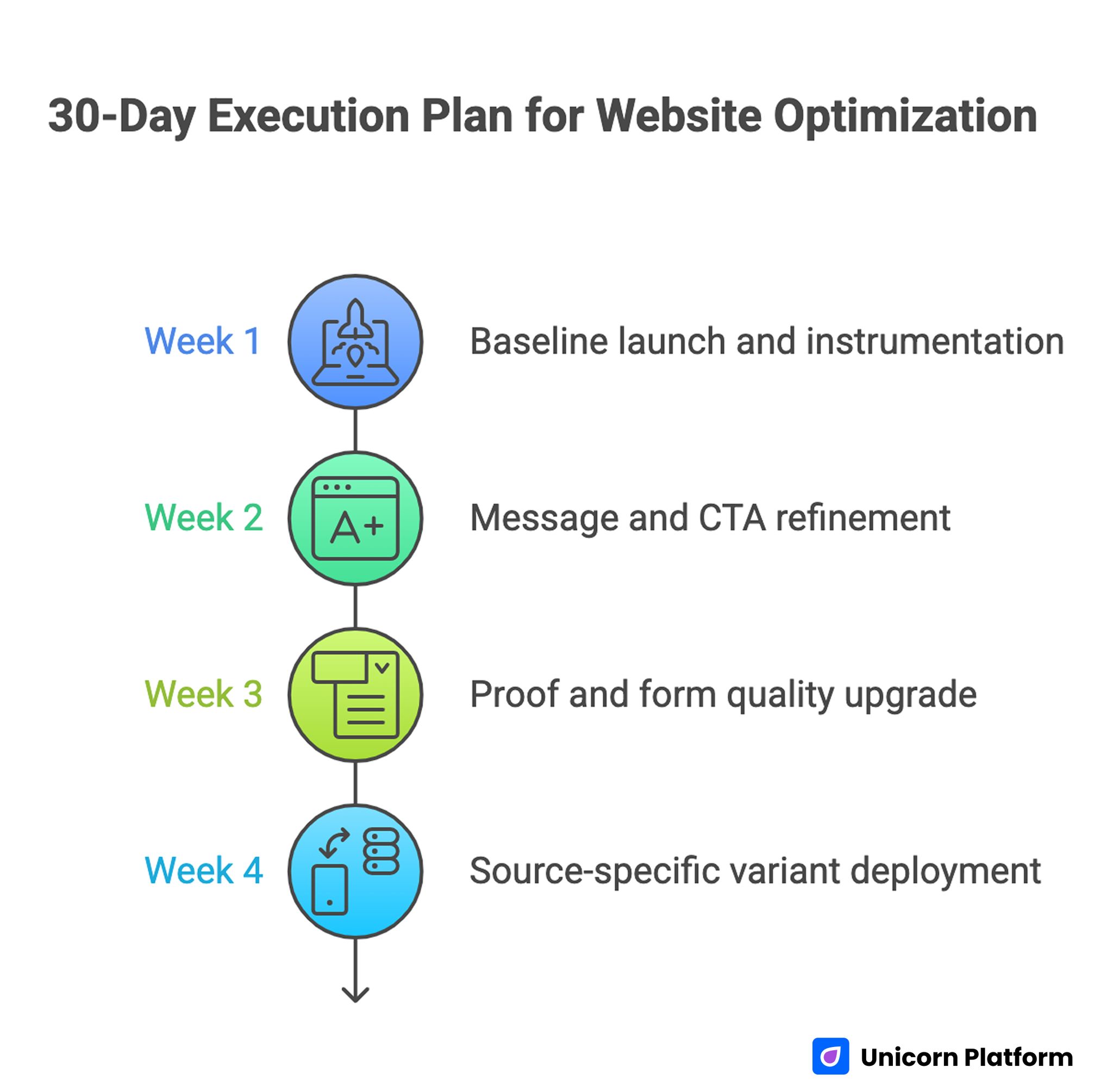
30-Day Execution Plan for Website Optimization
Week 1: baseline launch and instrumentation
Publish one focused page with one primary CTA and one trust module near the first decision point. Confirm event tracking for clicks, form submissions, and confirmed next-step actions.
Week 2: message and CTA refinement
Test one headline variation and one CTA wording variation while keeping all other major sections stable. Evaluate with conversion and lead-quality metrics, not click rate alone.
Week 3: proof and form quality upgrade
Refresh trust sections with contextual evidence, then simplify first-touch form fields and error states. Remove decorative blocks that do not improve decision confidence.
Week 4: source-specific variant deployment
Launch one channel-specific variant for the highest-volume source and compare against baseline. Record keep-or-revert decisions and update template standards accordingly.
This cadence gives meaningful learning without overwhelming lean teams. It keeps experimentation practical while protecting execution quality.
60-Day Compounding Model
Days 1-20 should stabilize architecture and remove obvious usability friction. Days 21-40 should run controlled tests on messaging and proof placement with fixed tracking standards.
Days 41-60 should consolidate winning sections into reusable modules and formalize ownership for copy quality, proof refreshes, and analytics QA. Consolidation is what turns isolated wins into a repeatable operating standard.
At this point, the team should operate from a repeatable system rather than ad-hoc edits. Repeatability is the main advantage of disciplined free-first execution.
90-Day Scale Readiness Model
Before increasing spend significantly, validate that conversion quality is stable across channels and devices. Scaling unstable pages usually increases costs faster than outcomes.
Use a readiness checklist and treat it as a release gate, not a suggestion list. Teams that skip this step often scale incomplete funnels.
- message-source match is consistent
- trust proof is fresh and relevant
- form flow is reliable on mobile and desktop
- lead quality is stable by source
- tracking definitions are accurate and unchanged
If multiple areas are unstable, pause scale and fix foundations first. Growth should amplify a strong system, not expose weak mechanics.
For teams optimizing page operations and sequencing in parallel, this dashboard landing page guide for startups is helpful for turning complex product stories into clearer conversion paths.
When to Upgrade Beyond Free Plans
Free-first does not mean free forever. A mature process includes clear upgrade triggers so decisions are based on operational needs rather than urgency.
The most useful upgrade signals are workflow constraints, not feature envy. If publishing delays are recurring, collaboration becomes fragile, or tracking reliability starts to degrade, an upgrade may improve outcomes more than additional copy edits.
Use a practical trigger model:
- recurring delays in publishing high-priority updates
- growing reliance on manual workarounds for forms or tracking
- difficulty maintaining consistent variants across channels
- increased QA failures during campaign launches
- team coordination friction that slows experiments
When one or two signals appear, run a short diagnostic and fix process issues first. When three or more signals persist for multiple review cycles, a platform upgrade is usually justified.
A phased upgrade approach reduces risk. Start with one high-impact funnel, verify tracking parity, and compare lead-quality trends against the current baseline before moving other pages.
This method protects momentum while preserving attribution clarity. It also prevents common migration mistakes where teams change layout, copy, and analytics at the same time and lose decision confidence.
Founder Decision Framework for Weekly Priorities
Founders often ask what to prioritize when everything appears important. A simple framework helps keep page work aligned with business outcomes.
Use this order each week:
- fix reliability blockers that hurt conversion flow
- improve first-screen clarity for the highest-volume source
- strengthen trust near the first major action point
- run one controlled test on a high-impact variable
- document outcomes and update reusable standards
This sequence keeps effort focused on decision-critical work. It also prevents teams from spending limited bandwidth on low-impact visual adjustments while core funnel issues remain unresolved.
Common Mistakes and Fast Fixes
Mistake 1: trying to serve every audience on one page
This creates message conflict and unclear CTA hierarchy. Build source-aware variants from one base template instead of forcing a universal narrative.
Mistake 2: using abstract claims without mechanism
Generic language increases ambiguity. Rewrite core claims so users understand how outcomes are produced.
Mistake 3: placing proof too late in the journey
If evidence appears after long explanation blocks, users often disengage early. Move proof close to the first major decision point.
Mistake 4: adding too many fields on first contact
Early friction reduces completions and can lower lead quality. Keep first-touch forms concise and qualify deeper in follow-up.
Mistake 5: skipping accessibility checks
Interaction issues silently reduce conversion. Add keyboard and form-state checks to mandatory QA.
Mistake 6: running multiple major experiments at once
Attribution becomes noisy and teams cannot learn clearly. Keep one major variable per test cycle.
Mistake 7: scaling traffic before lead-quality stability
High click volume can hide weak intent. Gate budget expansion behind downstream quality signals.
Practical Cross-Functional Workflow
Lean startup teams perform best with clear execution roles. You do not need a large process, but you need explicit ownership.
A practical split is shown below so roles stay clear even when the team is small. Clear ownership prevents hidden delays.
- marketing owner: hypothesis, copy, and variant planning
- product owner: feature accuracy and expectation control
- growth or founder owner: CTA priority, proof validation, and release approval
- publishing owner: deployment and experiment logging in Unicorn Platform
This model keeps launch velocity high while reducing approval bottlenecks. It also makes post-test accountability much easier.
FAQ: Free-First Startup Website Launches
Can a startup get serious results from free website tools?
Yes, if the team runs a disciplined operating model with clear architecture, measurement, and weekly iteration. Tool cost matters less than process discipline in early phases.
What should we optimize first on a new page?
Start with first-screen clarity and CTA alignment. These two areas usually drive the fastest measurable gains in most startup funnels.
Should we publish pricing on early startup pages?
You do not need full pricing tables, but you should include enough context to reduce uncertainty and qualify intent. Even minimal transparency improves trust compared with complete opacity.
How many variants should we run initially?
Begin with one baseline and one source-specific variant. Expand only after tracking and QA are stable so attribution quality stays high.
How often should proof sections be updated?
At least monthly, or sooner when offers, outcomes, or target segments change. Stale proof can quietly lower conversion even when traffic volume appears healthy.
Is accessibility really important for conversion?
Yes. Better keyboard flow, clearer labels, and stable form errors reduce friction for all users. These fixes often improve performance on mobile and low-bandwidth devices too.
What metric should we track beyond conversion rate?
Lead quality by source is usually the most important secondary signal for startup pages. It reveals whether optimization is improving pipeline value or just increasing low-intent volume.
How frequently should we test?
One major test per week is a practical cadence for most lean teams. This pace balances learning speed with implementation stability.
When should we scale paid traffic?
After message consistency, form reliability, and lead-quality signals remain stable through at least two review cycles. That stability window reduces the risk of scaling temporary wins.
What creates long-term page performance?
Stable templates, clear ownership, strict QA gates, and documented experiment decisions. Long-term gains come from consistent systems, not isolated creative updates.
Final Takeaway
A free-first launch strategy works when speed is paired with structure. The goal is not to publish quickly once. The goal is to publish quickly, learn clearly, and improve continuously.
With Unicorn Platform, startups can run this system through reusable sections, fast iteration cycles, and disciplined quality checks. When that process is in place, early website traffic becomes a reliable source of qualified growth instead of noisy activity.
If you need a practical reference for rapid page production before your first full optimization cycle, this startup landing page creation guide can help set a strong baseline.