Table of Contents
- The Best Free AI Website Builders
- Hidden Limits of Free AI Website Builders
- How to Choose the Right Builder
- FAQ
A free AI website builder can absolutely help you launch faster, but the word free hides a lot of important differences.
Some tools let you generate a site draft for free but make real publishing harder until you upgrade. Some let you publish on a branded subdomain but limit custom domains or deeper SEO control. Others are useful for a simple landing page, but not strong enough if you want a more polished business site or content-heavy project.
That is why the best free AI website builder is not the one with the flashiest demo. It is the one whose free starting point matches what you are actually trying to launch.
This guide compares the strongest options, including tools like Unicorn Platform, Wix, and newer AI-first builders such as the Neo AI website builder, explains what their free access really means, and shows what kind of site each tool is best for.
sbb-itb-bf47c9b
Quick Answer
If you want the short version:
- Unicorn Platform is one of the strongest free AI website builders for startup launches, waitlists, product pages, and simple business sites.
- Wix is a strong all-purpose choice if you want a mainstream builder with AI guidance and broad small-business features.
- WebWave is useful when you want a fast AI-generated start without a steep learning curve.
- Framer is a better fit when design quality matters more than the simplest setup.
- Dorik is a solid no-code option if you want a quick AI draft plus easy editing.
- Webflow is worth considering if you want AI help now but also care about longer-term structure.
The real decision comes down to this: do you need a free tool for testing an idea, publishing a lightweight site, or running a site seriously for the long term?
Quick Comparison Table
| Tool | Best for | Free starting point | Branding on free setup | Domain flexibility | SEO controls on free setup | Publishing reality |
| Unicorn Platform | startups, waitlists, landing pages | useful free start for fast launches | moderate platform presence depending on setup | stronger with upgrade | enough for a simple launch | best for fast product and campaign pages |
| Wix | general small-business sites | easy free start with AI assistance | visible branding on free tier | custom domain usually tied to paid setup | basic to decent for simple sites | good for testing and simple publishing |
| WebWave | beginners and simple brochure sites | easy AI generation and free editing start | branding tradeoffs on free use | stronger control after upgrade | basic enough for a simple launch | best for fast first versions |
| Framer | polished design-led landing pages | free start for drafts and experiments | free tier usually keeps platform constraints visible | production flexibility improves on paid | decent for launch pages | strongest when design matters most |
| Dorik | no-code users who want speed | fast AI draft and lightweight editor | some limitations remain on free use | better domain control on paid | practical for small sites | good for early landing pages and simple sites |
| Webflow | teams that want stronger structure | free start with AI support | free setup is more test-friendly than final-brand-friendly | stronger with paid publishing | better structural control than most | useful for serious builds, but not the simplest free option |
| Jimdo | very simple local-business or brochure sites | low-friction free setup | branding and free-tier limits are noticeable | stronger on paid | basic | fine for very simple online presence |
What “Free AI Website Builder” Actually Means
This phrase usually covers three different situations:
1. Free AI generation, but not fully free publishing
Some builders let you describe your business, generate a layout, and preview a site for free. That is helpful, but it does not automatically mean you can launch a serious production site without upgrading.
2. Free published site on a branded subdomain
Other tools let you publish for free, but the site may carry platform branding or use a builder-owned subdomain. That can be perfectly fine for testing ideas, side projects, portfolios, or temporary campaigns.
3. A genuinely useful free starting point for lightweight launches
A smaller group of tools is practical enough on the free tier to help you launch something real, especially if your goal is simple:
- a waitlist page
- a startup landing page
- a personal site
- a brochure-style business page
- a one-page campaign site
The key is to judge the free version by the actual launch goal, not by the marketing promise.
The Best Free AI Website Builders
1. Unicorn Platform
Unicorn Platform is one of the best free AI website builders for founders, marketers, and solo operators who want to launch something useful quickly. It is especially strong for:
- startup homepages
- product landing pages
- waitlists
- simple SaaS websites
- launch pages for directories, newsletters, or side projects
The biggest advantage is not just that it helps you generate content faster. It is that the overall workflow stays practical after the initial draft. Many AI builders look impressive during the first generation step, then become awkward once you need to keep editing, reposition messaging, and ship updates.
Why it stands out
- startup-friendly page patterns
- fast launch workflow
- simple editing model
- strong fit for product, SaaS, and launch pages
- useful when speed matters more than pixel-perfect design systems
Free-plan reality
The free starting point is useful if your goal is to get a site live quickly, test messaging, and iterate. If you later need stronger branding control, more advanced setup, or a more mature site stack, you may outgrow that free setup. But as a launch tool, it is one of the most practical options in this category.
2. Wix
Wix remains one of the strongest mainstream answers to this topic because it combines AI site generation with a broad all-purpose website builder. It is a good fit for:
- local business sites
- service businesses
- simple company websites
- portfolio sites
- users who want one platform for design, site editing, and business basics
Why it stands out
- broad feature coverage
- easy onboarding
- strong mainstream familiarity
- useful AI guidance for first drafts
Free-plan reality
Wix is easy to start with for free, but the main tradeoffs show up when you want a cleaner branded presence, a custom domain, or a more professional production setup. The free version is best understood as a strong way to test, learn, and build early.
3. WebWave
WebWave is a good option if you want a simpler AI-led path to a first website version. It is attractive for beginners because it emphasizes speed and approachability over complexity.
Best fit
- beginner-friendly site creation
- brochure sites
- early local-business pages
- quick first versions for people who do not want a deep builder
Why it stands out
- fast AI generation flow
- accessible editing experience
- good fit for users who want a fast start rather than a large website system
Free-plan reality
WebWave is useful when the immediate goal is to generate, edit, and validate a site concept. Once brand control and production polish matter more, the stronger long-term setup usually comes with upgrade decisions.
4. Framer
Framer is usually the stronger choice when visual quality is a top priority. It is especially good for:
- design-led landing pages
- startups that care about presentation quality
- teams that want more visual control than beginner-first builders usually offer
Why it stands out
- stronger visual polish
- good for modern landing pages
- appealing to design-conscious teams
- AI-assisted generation can produce a strong design starting point
Free-plan reality
Framer is excellent for testing and building high-quality drafts, but it is not the simplest forever-free option for every use case. It makes more sense when design quality is part of the product story and the team is comfortable with a more visual workflow.
5. Dorik
Dorik is a practical no-code choice for users who want a quick AI-generated first draft without a heavy learning curve. It sits in a useful middle ground between very simple builders and more complex systems.
Best fit
- landing pages
- small business websites
- side projects
- non-technical users who want a lightweight editor
Why it stands out
- quick draft generation
- simple editor
- good balance between speed and control
- easy to understand for non-technical teams
Free-plan reality
Dorik works well if your goal is to get a small site moving quickly. As needs grow toward stronger brand control, deeper structure, or richer site operations, the free version becomes less complete.
6. Webflow
Webflow is not the easiest free AI website builder, but it is one of the strongest if you care about the longer-term structure of the site. It is more attractive for:
- teams thinking beyond a single landing page
- structured marketing sites
- users who want stronger control later
- builders comfortable with a more advanced environment
Why it stands out
- stronger site structure than many lightweight builders
- better fit for teams that may grow into a larger marketing site
- useful bridge between AI generation and a more serious web workflow
Free-plan reality
Webflow is valuable as a serious starting environment, but the free setup is more helpful for building and evaluating than for staying forever on the free tier. It is best for teams that expect to grow into a fuller site operation.
7. Jimdo
Jimdo fits the lower-complexity end of the category. It is useful when the goal is not a complex marketing site, but a quick and simple online presence.
Best fit
- basic local-business sites
- solo service sites
- side projects
- users who want low-friction onboarding
Why it stands out
- simple setup
- low complexity
- good fit for a basic online presence
Free-plan reality
Jimdo works best when expectations are small and clarity matters more than flexibility. It is fine for a simple online presence, but not the strongest option if you want serious control, richer SEO structure, or more sophisticated growth pages.
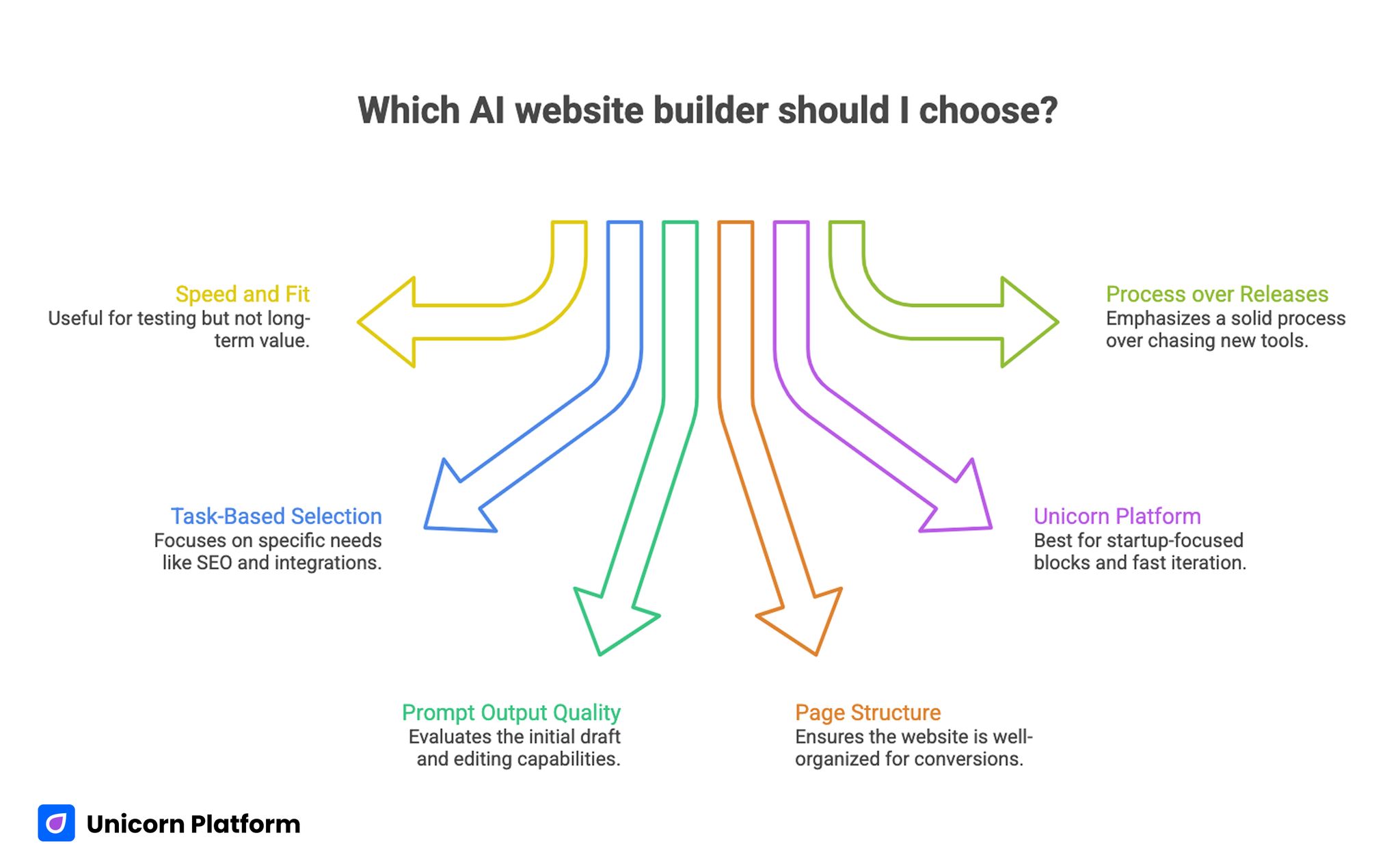
Which AI Website Builder should I Choose?
Best Free AI Website Builders by Use Case
Best for startup launches
If the goal is to launch a startup page fast, the strongest options are usually:
- Unicorn Platform
- Framer
- Dorik
These tools make the most sense when speed, simple editing, and fast publishing matter more than a large enterprise feature set.
Best for local business sites
If the goal is a basic business site with a familiar builder experience:
- Wix
- WebWave
- Jimdo
These are easier for non-technical owners who want a service page, contact section, and simple site structure without much setup friction.
Best for design-led landing pages
If visual quality matters more than the easiest setup:
- Framer
- Webflow
These are stronger when you want a sharper visual result and are willing to spend a bit more time refining the site.
Best for light no-code workflows
If you want a practical builder that is not too heavy:
- Unicorn Platform
- Dorik
- WebWave
These are usually the better answer when you want to move from prompt to published draft without overcomplicating the process.
What You Can Realistically Launch for Free
A free AI website builder is usually enough for:
- a waitlist page
- a one-page startup homepage
- a side-project landing page
- a basic service business site
- a simple personal website
- a campaign microsite
A free AI website builder is usually not enough for the long term if you need:
- strong domain control from day one
- deeper branding control
- advanced SEO architecture
- a content-heavy blog operation
- memberships or complex site logic
- a polished multi-page business site that must feel fully owned and highly customized
That does not make the free version bad. It just means the free version is best judged by launch usefulness, not by forever-free ambition.
Hidden Limits of Free AI Website Builders
This is the part many readers care about most.
Platform branding
A tool may be free, but the free version often keeps visible branding in the site experience. That may be acceptable for early tests, but not ideal if you want a professional production presence.
Subdomain limits
Many free builders are easiest to use on a builder-owned subdomain. That is fine for testing. It becomes less appealing if you want a stronger long-term brand.
Publishing restrictions
Some builders are generous during generation but more restrictive once you try to treat the site like a serious operating asset.
SEO limitations
A free AI website builder may let you set basic page titles and descriptions, but the broader SEO story can still be limited if your project depends on technical control, scaling content, or richer page architecture.
Design flexibility vs speed
The tools that launch the fastest are not always the tools that give you the most long-term flexibility.
That tradeoff is normal. The mistake is ignoring it until after the site is already live.
When a Free AI Website Builder Is Enough
A free AI builder is usually enough when:
- you are validating an idea
- you want a simple launch page
- you need something live this week
- you want to test messaging before investing more
- you are creating a low-risk first version of the site
In those cases, launch speed and editing simplicity matter more than maximum control.
When a Free AI Website Builder Is Not Enough
You will probably need more than the free setup when:
- the website is already an important revenue asset
- you need stronger brand ownership
- your SEO strategy depends on deeper structure
- your site is content-heavy
- you need more control over domains, integrations, or site governance
- the site has to feel fully polished, not just live
That is why the right question is not which free AI website builder is the most impressive?
It is:
Which free AI website builder is good enough for the next stage of my project?
How to Choose the Right Builder
A simple AI website builder strategy is to match your website goals with the right platform strengths. Instead of asking which builder is the best overall, ask which tool supports your current stage and future needs.
Choose Unicorn Platform if
- you are launching a startup, waitlist, directory, or product page
- you want the fastest route to a useful live site
- you care more about shipping than about a highly custom visual system
Choose Wix if
- you want an all-purpose builder
- you are building a small-business site
- you want a mainstream platform with broad coverage
Choose Framer if
- visual polish is a big part of the value
- you are building a modern landing page
- you want stronger design expression
Choose Dorik or WebWave if
- you want a simpler no-code builder
- you care about speed and easy editing
- you want an approachable AI-assisted start
Choose Webflow if
- you expect the site to become more sophisticated
- you want stronger long-term structure
-
your team is comfortable with a more advanced workflow
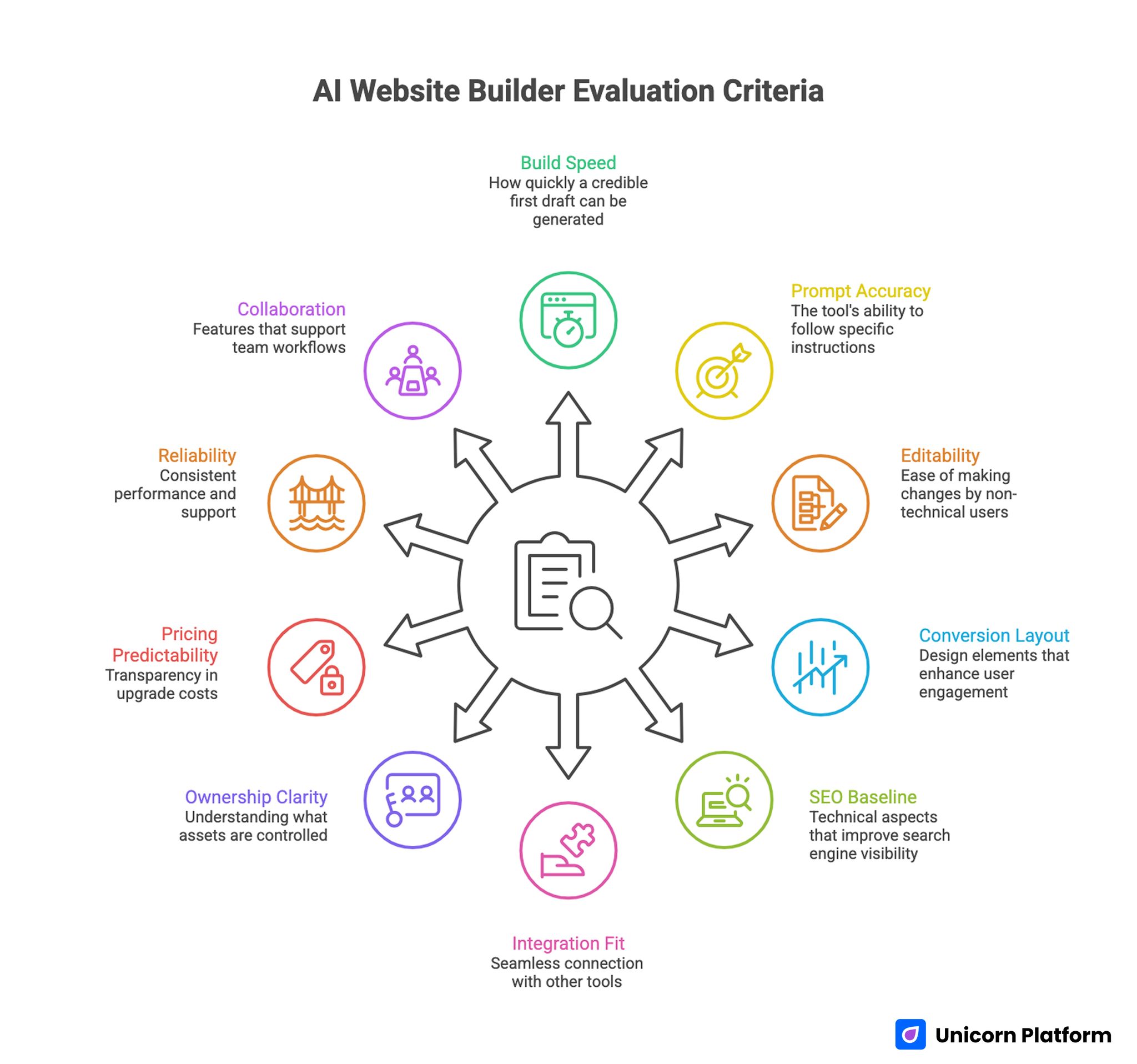
AI Website Builder Evaluation Criteria
How to Apply This in Unicorn Platform
If you decide to build in Unicorn Platform, the smartest way to use AI is not to ask for a perfect website in one prompt the smartest way to use AI is not to ask for a perfect website in one prompt. Instead, combine AI-assisted website creation with tools and workflows that help you build a ChatGPT website experience, improve user interactions, and create more personalized digital journeys.
Use AI to speed up the parts that usually slow teams down:
- homepage positioning
- section order
- CTA drafts
- feature explanations
- FAQ generation
- proof block ideas
Then use Unicorn Platform to turn those drafts into a real page quickly.
A practical workflow looks like this:
- define the site goal first
- choose the simplest page structure that can work
- generate and edit copy section by section
- publish a clean first version fast
- improve based on real feedback, not assumptions
If your project is more landing-page-heavy, this related guide can help too:
If you are evaluating broader free website options for a startup, this one is also relevant:
FAQ: Free AI Website Builder
Is there a truly free AI website builder?
There are tools with genuinely useful free starting points, but truly free can mean different things. Some let you generate and publish a basic site for free, while others let you generate for free but reserve stronger branding or domain control for paid plans.
What is the best free AI website builder for startups?
For startup launches, the best fit is usually a builder that makes it easy to ship a landing page fast and keep editing without friction. That is why tools like Unicorn Platform, Framer, and Dorik tend to make the most sense in this use case.
Can I publish a website for free with AI?
Yes, in many cases you can publish a basic site for free. The more important question is what kind of domain, branding, and control you get when you do.
Are free AI website builders good for SEO?
They can be good enough for simple launches and basic pages. They become less ideal when you need deeper site architecture, heavier content operations, or more advanced technical SEO control.
Which free AI website builder is easiest for beginners?
Wix, WebWave, and Jimdo are often easier for beginners because they reduce setup complexity and guide users through the process more directly.
Which free AI website builder is best for landing pages?
For landing pages, Unicorn Platform, Framer, and Dorik are usually stronger fits because they focus more naturally on launch pages and lighter web workflows.
Which free AI website builder is best for a small business?
For a small business that needs a basic site, Wix and WebWave are often easier choices. The right fit depends on whether you value simplicity, mainstream business tools, or faster launch speed.
Do free AI website builders let me use a custom domain?
That depends on the builder. In many cases, stronger custom-domain control is one of the features that moves behind a paid setup.
Should I choose the most powerful builder or the simplest one?
Choose the simplest builder that still supports the next real stage of your project. Over-buying complexity is just as costly as choosing a tool that is too limited.
Can I switch later if I outgrow the free plan?
Yes, but switching is easier when the first site is simple. That is another reason to treat the first free launch as validation, not as the final state of the entire website operation.
Final Takeaway
The best free AI website builder is the one that helps you launch the right kind of site without hiding the most important limits.
If you want the broadest mainstream option, Wix is a strong answer. If you want a more design-led route, Framer is compelling. If you want a fast and practical startup launch workflow, Unicorn Platform is one of the strongest choices in this category.
The real win is not finding a builder that looks impressive in a demo. It is finding one that lets you generate, edit, publish, and improve a real site without creating friction you only notice after launch.

