Table of Contents
- Architecture by Traffic Intent, Not by Design Trend
- 30-60-90 Day Implementation Plan
- Common Failure Modes and Practical Fixes
- FAQ
Most ecommerce teams can buy traffic. The hard part is converting that traffic into high-quality orders without burning margin. Shoppers click ads, open email promotions, and visit product campaigns every day, but many sessions end before checkout because the page does not answer practical buying questions quickly enough.
Strong ecommerce pages are not just visual assets. They are decision systems. A visitor should be able to understand relevance, trust product quality, evaluate value, and move to purchase without confusion. When page structure supports that sequence, conversion improves and support friction falls.
In Unicorn Platform, this works best when teams use repeatable campaign architecture instead of rebuilding from scratch each launch. Repetition at the structural level increases speed, while controlled variation at the message level protects performance learning.
sbb-itb-bf47c9b
Quick Takeaways
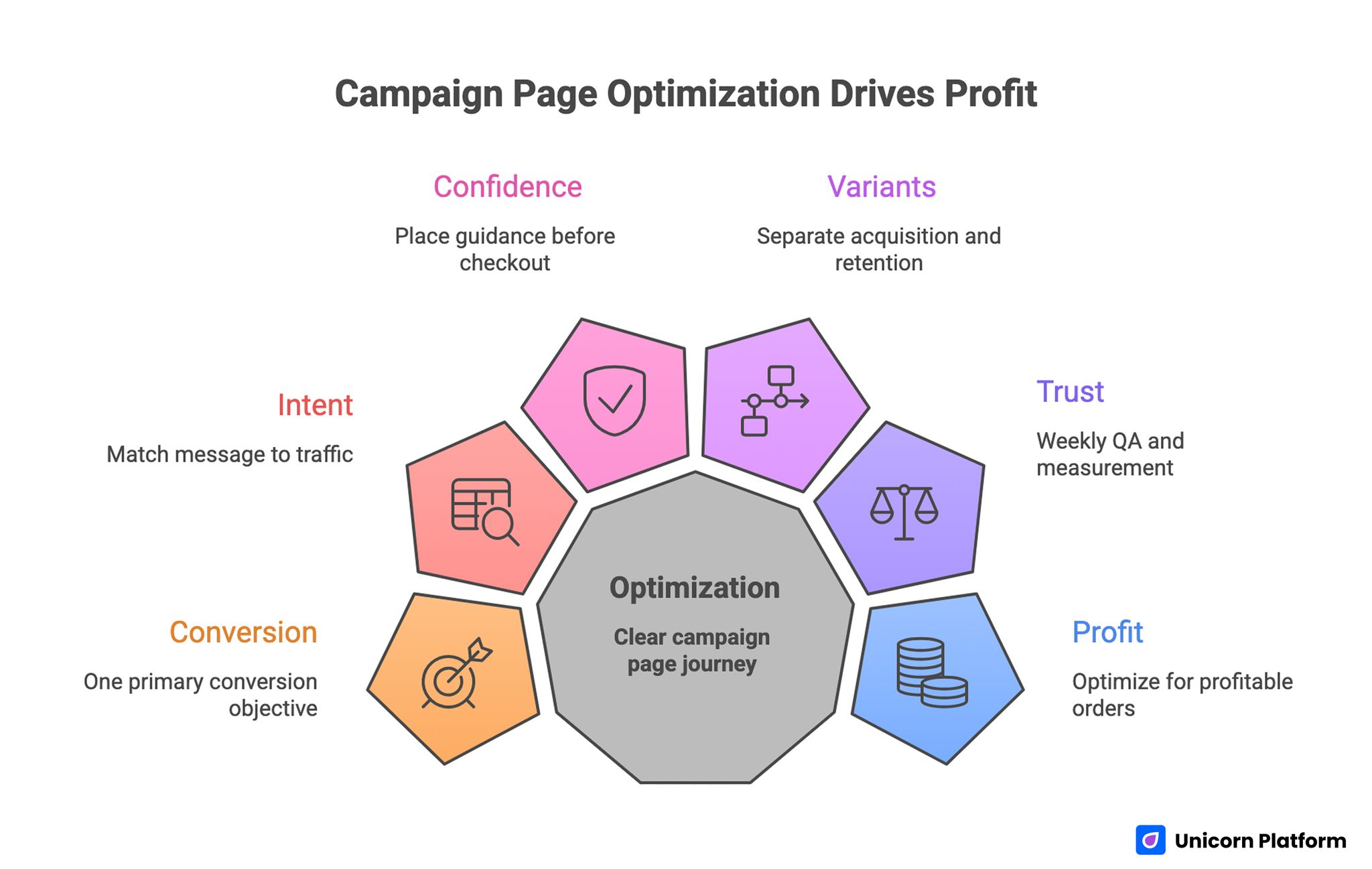
Campaign Page Optimization Drives Profit
- Treat each campaign page as one clear journey with one primary conversion objective.
- Match first-screen message to traffic source intent before showing deep detail.
- Place fit guidance, proof, and policy confidence before checkout pressure.
- Separate acquisition and retention variants while keeping one core framework.
- Use weekly QA and measurement loops so speed does not degrade trust.
- Optimize for completed profitable orders, not just clicks or add-to-cart volume.
Why Many Ecommerce Pages Underperform
Underperformance usually starts with mismatch. Ad promise says one thing, but the landing experience opens with generic brand statements or low-priority content. Users hesitate because they cannot find confirmation of what they clicked for.
A second issue is unclear value expression. Teams often rely on discount headlines without explaining practical value. When buyers cannot see why an offer is useful for their context, they browse and exit.
The third issue is trust placement. Shipping, returns, and quality reassurance are frequently hidden too late in the page. By the time users find them, many have already abandoned.
Shopper Decision Flow: What Must Happen in Order
Most buying sessions follow a predictable path. First, shoppers ask whether the page is relevant to their need. Second, they evaluate product confidence and brand reliability. Third, they compare value against alternatives. Fourth, they decide whether checkout feels low-risk enough to complete now.
Pages convert better when this order is respected. If you push urgency before trust, or push upsells before fit clarity, you create friction instead of momentum. High-converting pages feel simple because they remove uncertainty in sequence.
This sequencing is easier to maintain when teams define section jobs before design. If your team needs a clearer method for assigning section purpose, this guide on high-converting landing page structure can help standardize decision flow.
Architecture by Traffic Intent, Not by Design Trend
A common mistake is using one page shape for every channel because it is visually appealing. A better model is one core architecture with intent-based emphasis changes.
Cold Traffic Acquisition Pages
Cold audiences need orientation before persuasion. Lead with product category relevance, fast value summary, and confidence anchors. Keep first-screen complexity low, then reveal proof and product depth gradually.
Cold pages should prioritize reducing uncertainty. If users do not know who the product is for, what problem it solves, and what purchase risk looks like, conversion stalls.
Warm Retargeting Pages
Warm visitors already recognize the brand or product theme. They need less introductory context and more action support. Move purchase motivators, social proof, and policy reassurance higher.
Retargeting pages should remove remaining objections quickly. If a user has seen products before, your job is to resolve hesitation, not restart education from zero.
High-Intent Search Pages
Search traffic often arrives with specific expectations. Users want concrete details, not broad campaign storytelling. Surface product specificity, compatibility, and practical differentiation above generic narrative.
Search-oriented pages perform best when they behave like precise answers. Relevant detail should appear before decorative sections, and action paths should stay visible throughout the scroll.
First-Screen Rules That Lift Conversion Quality
The opening screen must do three things immediately: confirm fit, communicate value, and present one primary action. When these elements compete with too many visual priorities, early drop-off increases.
Use a headline that clarifies benefit in real usage terms, not brand-only language. Add a short supporting line that reduces a common purchase risk. Then provide one primary CTA and one optional supporting path.
Avoid hero overload. Multiple offers, multiple actions, and multiple visual focal points create indecision. First-screen clarity is one of the fastest optimization levers for ecommerce profitability. Recent data shows that ecommerce landing pages with single clear calls to action convert significantly better than those with multiple competing links — pages with just one primary CTA average around 13.5% conversions, while cluttered pages with many navigation options convert substantially less. This highlights why early focus and unambiguous action paths matter so much in profitable campaigns.
Offer Architecture and Merchandising Logic
Strong offers are easy to understand and easy to compare. Shoppers should know what they get, why it matters, and what tradeoff exists if they delay. Ambiguous promotional language weakens urgency and trust.
Use modular offer blocks in Unicorn Platform so teams can test value framing without rebuilding the full page. Typical modules include bundle value, threshold shipping incentive, first-order confidence offer, and limited-run timing with explicit constraints.
Offer testing should be systematic. Change one major variable at a time and hold other elements stable. This protects attribution quality and helps teams avoid false wins.
For product-driven campaigns, this high-converting product landing page guide is useful when refining message order from value statement to checkout action.
Product Proof System: Confidence Before Cart
Proof is where many ecommerce pages separate from competitors. High-performing proof does not mean more testimonials. It means better alignment between proof and buyer objections.
Build proof in layers. Start with outcome-focused social validation, then show product-detail evidence, then provide practical usage context. Different visitors trust different signal types, so layered proof supports broader decision confidence.
Fit and compatibility details should be explicit when relevant. For many categories, uncertainty around suitability is a larger blocker than price. Addressing it early improves both conversion and post-purchase satisfaction.
Policy Clarity as a Conversion Lever
Shipping and returns are often treated as compliance content, but in ecommerce they are conversion content. Hidden or vague policies increase hesitation and encourage comparison shopping on competitor tabs.
Place policy confidence where decisions happen. A concise reassurance row near key CTAs can outperform long policy pages hidden in footer links. Keep wording practical and specific.
If teams are reducing checkout abandonment tied to trust gaps, this framework on ecommerce conversion mistakes helps prioritize high-impact fixes first.
Checkout Handoff Design
A conversion page does not finish at the CTA click. The handoff from landing page to cart and checkout is where many campaigns quietly lose margin.
Keep handoff context consistent. Offer language, pricing logic, and policy promises should remain aligned across the landing page and checkout steps. Any mismatch creates doubt and drop-off. In fact, independent research from Baymard Institute highlights that checkout usability problems — especially inconsistent messaging and unclear next steps — are among the top reasons shoppers abandon carts, with friction during the handoff phase shown to significantly lower completion rates. Aligning landing page promises and checkout interactions reduces drop‑off and improves order quality.
Remove unnecessary branching in early checkout stages. Too many choices before commitment can reduce completion, especially on mobile. The best handoff paths feel direct and predictable.
Mobile-First Execution Standards
Mobile behavior should be treated as primary behavior for most ecommerce programs. If a page looks great on desktop but slows or fragments on mobile, paid efficiency declines quickly.
Prioritize fast visual orientation, thumb-friendly interactions, and stable CTA visibility. Users should reach meaningful action without hunting through dense sections or interface clutter.
Real-device testing is mandatory before launch. Emulators miss practical issues such as keyboard overlap, sticky-bar collisions, and delayed media rendering.
When auditing small-screen friction, these user behavior optimization tips are useful for diagnosing where engagement breaks before purchase intent forms.
Personalization Without Operational Chaos
Personalization can improve relevance, but excessive variation can destroy consistency and QA reliability. The right balance is controlled personalization on top of a stable core architecture.
Use shared template blocks for structure, then personalize only high-impact elements: headline emphasis, proof ordering, and offer framing. This preserves brand cohesion and keeps measurement comparable.
Define a variant matrix before launch. Segment by source, audience stage, and campaign objective. A documented matrix prevents random page proliferation and gives teams a clear testing roadmap.
Marketplace-to-Brand Journey Strategy
Many ecommerce brands rely on marketplaces for discovery but need stronger brand-owned conversion for margin and retention. This is a journey design problem, not a channel conflict problem.
Use marketplace traffic signals to shape brand-owned landing experiences. Visitors coming from third-party channels often need additional trust continuity and support clarity before direct checkout.
Build source-aware pathways in Unicorn Platform that acknowledge prior marketplace exposure while presenting brand-owned value clearly. This may include richer bundles, stronger education, or loyalty-based incentives.
For teams balancing channel diversification with owned conversion control, this guide to custom ecommerce page creation without coding can support faster campaign builds without sacrificing governance.
Measurement Model for Profitable Growth
Top-line conversion rate alone can hide quality issues. High-performing ecommerce teams track full-funnel economics, not only front-end actions.
A practical scorecard includes: session-to-cart progression, checkout start rate, completed-order rate, average order value, refund tendency, and repeat purchase signals by source. This reveals whether page changes are improving sustainable revenue or only short-term volume.
Set one primary metric per experiment and one guardrail metric to protect quality. For example, test checkout completion as primary and refund tendency as guardrail. This prevents winning tests that hurt downstream performance.
Weekly Optimization Rhythm
The fastest teams usually win because they ship and learn consistently, not because they run bigger one-time redesigns. Weekly optimization cadence keeps progress compounding.
A strong rhythm is simple. Monday: review last cycle metrics and support insights. Tuesday: pick one hypothesis. Wednesday: implement controlled variant. Thursday: QA and launch. Friday: monitor and document early signal quality.
This cadence works best when ownership is explicit across teams. Creative, merchandising, performance, and operations should each have defined responsibilities and acceptance criteria.
30-60-90 Day Implementation Plan
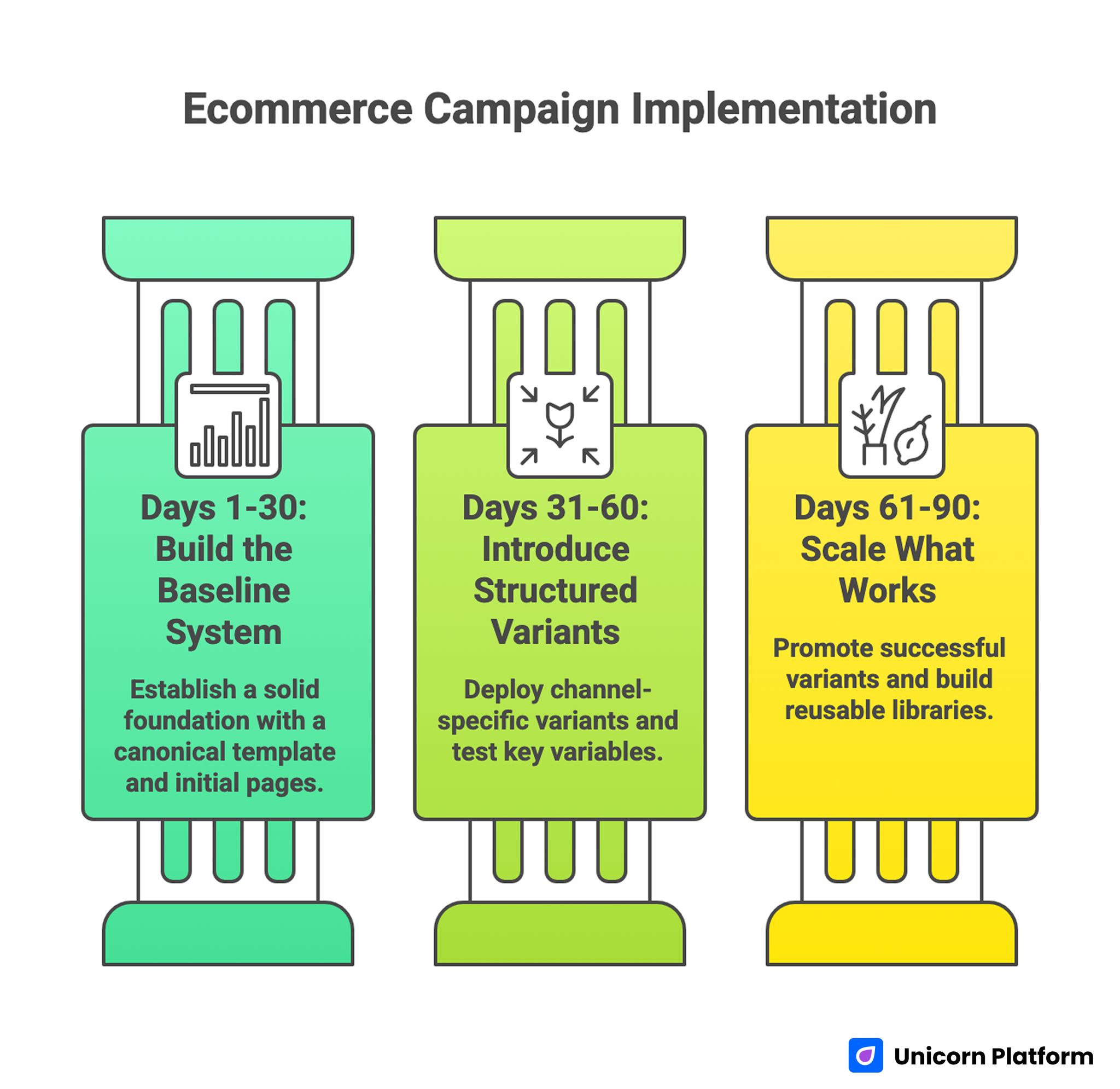
Ecommerce Campaign Implementation
Days 1-30: Build the Baseline System
Create one canonical campaign template in Unicorn Platform with defined section roles. Launch one acquisition page and one retention-oriented variant using the same structural foundation.
During this phase, focus on clarity and trust fundamentals: first-screen relevance, proof placement, policy visibility, and clean checkout handoff. Avoid excessive testing until baseline quality is stable.
Days 31-60: Introduce Structured Variants
Deploy channel-specific variants from the documented matrix. Test one major variable per cycle, such as offer framing, proof order, or CTA emphasis, while holding core structure constant.
Integrate support-team feedback into page updates. If the same objections appear in tickets or chats, surface answers earlier in the conversion path.
Days 61-90: Scale What Works
Promote repeat winners into template defaults. Expand campaign volume only after QA and measurement discipline are reliable across teams.
Build reusable libraries for proof, policy, and offer modules so future launches become faster and safer. Scaling should increase quality consistency, not just page count.
Common Failure Modes and Practical Fixes
1) Generic Entry Messaging
Problem: first-screen copy could fit any brand, so relevance is weak. Fix: rewrite hero around concrete buyer intent and immediate value context.
2) Delayed Trust Signals
Problem: policy and confidence cues appear too late. Fix: move concise reassurance blocks near early conversion actions.
3) Offer Ambiguity
Problem: users cannot quickly understand real value. Fix: clarify what is included, what is limited, and why timing matters.
4) Checkout Mismatch
Problem: landing promises differ from cart and checkout experience. Fix: align pricing, policy language, and expectation framing end-to-end.
5) Over-Personalization
Problem: too many variants create QA failures and noisy data. Fix: limit variation to high-impact elements within one shared structure.
6) Metric Myopia
Problem: teams optimize for clicks while order quality declines. Fix: monitor full-funnel performance with quality guardrails.
7) Inconsistent Ownership
Problem: updates ship without clear accountability. Fix: assign explicit owners for offer truth, proof freshness, and final QA.
Support-Driven Optimization: Turning Buyer Questions Into Conversion Gains
Many ecommerce teams rely only on analytics dashboards for optimization. Dashboards are useful, but they do not always explain why users hesitate. Support conversations, live chat transcripts, and return-request reasons usually reveal hesitation patterns faster than numeric trends alone.
Create a weekly process where the support team shares top recurring questions from pre-purchase and early post-purchase interactions. Common patterns often include sizing uncertainty, shipping-time interpretation, compatibility concerns, and misunderstanding of bundle value. Each pattern should be mapped to a specific page section where clarity can be improved.
For example, if users repeatedly ask whether delivery dates are guaranteed, the issue is usually unclear expectation language near checkout actions. If users ask whether product variants fit specific use cases, the issue is often missing fit guidance before cart intent. Addressing these directly on the page reduces both abandonment and support load.
This approach also helps prevent short-term conversion wins that create downstream friction. A campaign can improve immediate checkout completion while increasing refund risk if confidence language is too aggressive. Support-informed updates keep optimization aligned with long-term order quality, not only session-level conversion spikes.
Experiment Operations Model for Faster, Safer Learning
Experimentation fails when teams run too many changes at once or treat every campaign as a full redesign. A stable operating model makes testing faster and more reliable, especially when multiple teams contribute to one page program.
Use three experiment classes with clear scope. Class A tests change message hierarchy, such as hero framing or value articulation. Class B tests change risk-reduction placement, such as policy or proof position. Class C tests change offer mechanics, such as bundle framing or urgency expression. Restrict each cycle to one class so attribution remains clean.
Define launch criteria before implementation. Each test should have one primary success metric, one quality guardrail, and one minimum observation window. This prevents early bias from partial data and reduces the chance of adopting unstable winners.
Operationally, keep a shared experiment register in the team workflow. Every entry should include: hypothesis, audience segment, variant summary, primary metric, guardrail metric, result, and decision. This record prevents repeated low-impact tests and helps new team members understand historical learning quickly.
When tests are complete, promote winning elements into the canonical template only after validation across at least two campaign contexts. This reduces the risk of overfitting to one traffic source and creates stronger default architecture for future launches.
Editorial Governance for Multi-Channel Consistency
As campaign volume grows, message inconsistency becomes a hidden conversion tax. Paid ads, email copy, influencer scripts, and landing pages can drift apart even when each asset is strong in isolation. Users feel that mismatch as uncertainty, and conversion suffers.
Set a lightweight editorial governance layer that connects channel messaging to landing execution. Start each launch with a short message map: campaign promise, supporting proof theme, policy emphasis, and expected user action. Every channel asset should map back to the same promise and confidence model.
Before publishing, run a final consistency check across ad, page, and checkout language. Ensure core claims, pricing context, and policy framing are aligned. This check takes little time but prevents high-cost leakage caused by contradictory messaging in high-intent sessions.
Governance is not about limiting creative expression. It is about protecting trust across touchpoints so campaign performance compounds over time rather than resetting every launch.
Pre-Launch QA Checklist
Before release, verify that campaign promise, product availability, and price communication are aligned. Confirm shipping and return statements are accurate, visible, and consistent with checkout copy.
Run full mobile checks on real devices for first-screen clarity, CTA visibility, interaction stability, and checkout continuity. Validate that page speed and media behavior support action flow.
Check proof freshness and relevance. Remove outdated claims, low-context testimonials, or visual evidence that does not match current offer emphasis.
Review variant matrix integrity. Ensure source-targeted pages differ only where intended and that tracking setup can distinguish outcomes cleanly.
FAQ: Ecommerce Campaign Landing Pages
1) How much copy should an ecommerce campaign page include?
Use as much copy as needed to remove real purchase uncertainty. If each section resolves a distinct decision question, longer pages can outperform shorter ones.
2) Should every traffic source have its own page?
Not fully unique pages. Use one stable architecture and source-specific emphasis changes for message order, proof priority, and offer framing.
3) What should appear above the fold?
Immediate relevance, clear value, and one primary action. If those are unclear, most optimization efforts underperform.
4) Are discounts always the best conversion lever?
No. In many categories, confidence improvements around fit, policy, or quality proof outperform larger discounts.
5) How do we reduce checkout abandonment quickly?
Align landing and checkout messaging, simplify handoff steps, and surface policy confidence earlier in the journey.
6) What is the biggest mobile mistake?
Treating mobile as a resized desktop layout instead of a primary interaction environment with different behavior constraints.
7) How many experiments should run at once?
Run fewer, clearer experiments. One major variable per page cycle usually produces the best learning quality.
8) Which metrics matter most for long-term growth?
Completed profitable orders, average order value quality, and repeat purchase indicators by source are the most useful anchors.
9) How often should templates be updated?
Update after evidence, not by schedule alone. Promote repeat winners into template defaults and retire low-impact patterns.
10) Can no-code workflows support serious ecommerce scale?
Yes, if teams pair no-code speed with strict governance, QA discipline, and strong measurement practices.
Final Takeaway
Ecommerce campaign performance improves when page design is treated as an operating system, not a one-off creative task. Clear relevance, credible proof, practical policy confidence, and clean checkout handoff drive better order quality.
With Unicorn Platform, teams can move faster while maintaining structural discipline. Keep the framework stable, test intentionally, and feed real customer signals back into each launch cycle so performance compounds over time.
