Table of Contents
- Core Architecture for High-Performing Campaign Pages
- 30-Day Implementation Plan
- Common Failure Modes and Fixes
- FAQ
Nonprofits usually have a mission people care about. The problem is not interest. The problem is conversion reliability at the moment people are ready to contribute. Supporters click campaign links, read the page, and then pause when impact clarity is weak, payment confidence feels low, or the next step looks complicated.
A donation campaign page should therefore be treated as core fundraising infrastructure, not a temporary marketing asset. It needs clear decision flow, high trust visibility, and practical execution standards so teams can move fast without reducing quality.
In Unicorn Platform, this is practical because campaign pages can be launched and updated quickly while preserving structure. That combination matters when urgent appeals, seasonal drives, and recurring programs run in parallel.
sbb-itb-bf47c9b
Quick Takeaways
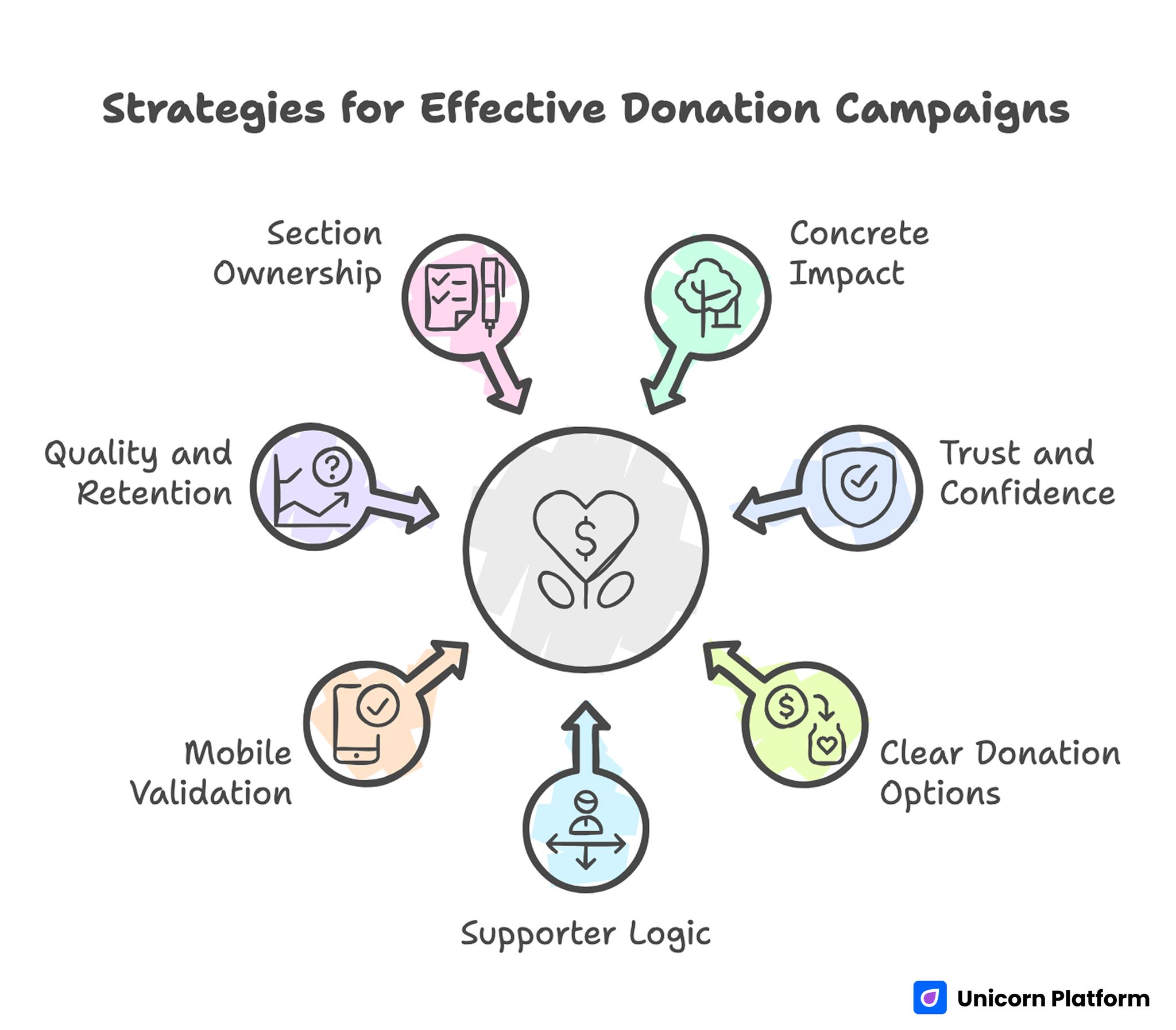
Strategies for Effective Donation Campaigns
- Lead with concrete impact before long narrative context.
- Show trust and payment confidence near action points, not only near footer blocks.
- Keep donation options clear and meaningful, with one obvious path to complete.
- Separate first-time supporter logic from recurring-supporter logic.
- Validate mobile action flow before each major campaign launch.
- Track completion quality and retention signals, not donation volume alone.
- Use section ownership and checklists so campaign speed does not create errors.
Why Nonprofit Donation Flows Leak Intent
Most donation journeys lose intent for predictable reasons. Pages often explain organization history before clarifying campaign impact. Donation choices are presented without clear outcome context. Payment experience introduces uncertainty exactly when a visitor is deciding whether to commit.
These leaks are usually small on their own. A vague headline, one unclear policy detail, and a long first-step form can each reduce confidence slightly. Together they create enough hesitation to lower completion significantly.
This friction matters even more as digital giving continues to grow. According to Giving USA, online donations have become a steadily increasing share of overall charitable giving, which means the reliability of digital donation pages now directly affects fundraising outcomes for many organizations. When campaign pages introduce hesitation at the moment of intent, a growing portion of potential support can be lost before completion.
Another common issue is mixed page purpose. A single page may try to recruit volunteers, collect newsletter signups, and drive gifts at the same time. Multiple primary goals dilute action clarity and reduce completion quality.
Donor Decision Sequence: The Structure That Works
Supporters typically move through four decisions. First: "Is this campaign specific and credible?" Second: "Will my gift create clear impact?" Third: "Can I donate safely and quickly?" Fourth: "Do I trust follow-through after payment?"
Page structure should follow this order. Impact and relevance should appear first. Trust and accountability should appear next. Donation mechanics should be simple and visible. Post-donation confidence should be reinforced before and after confirmation.
When this sequence is respected, conversion improves without aggressive tactics. Donors are not being pushed. They are being supported in making a confident decision.
Core Architecture for High-Performing Campaign Pages
A strong 2026 architecture includes: focused impact hero, clear need framing, trust evidence, donation options with outcome labels, practical FAQ, and final reassurance near payment action. This pattern works across emergency campaigns, recurring programs, and milestone drives.
Keep one primary objective per page. If the goal is gifts, optimize for gifts. Secondary actions can exist, but they should not compete with the main conversion path.
For teams standardizing section flow, this high-converting landing page structure guide is useful as a baseline for assigning one clear job to each block.
Impact Messaging That Converts Without Overstatement
Mission language is important, but impact language drives completion. Donors need practical understanding of what a contribution enables within real timelines and constraints.
Use outcome statements that connect amount to action. Instead of general appeals, provide simple impact references tied to your program model. This increases confidence and helps donors choose donation levels with less uncertainty.
Avoid exaggerated certainty. Credibility is stronger when impact framing is specific, realistic, and transparent about context.
Trust Design: Confidence Before Payment
Trust should be layered throughout the journey, not isolated in one section. Early trust can come from campaign specificity and transparent goals. Mid trust can come from recent impact evidence and accountability signals. Late trust should focus on payment safety and practical follow-up clarity.
Place trust cues near decisions, not only near the bottom. If a donor reaches payment action without reassurance, abandonment risk increases.
Use concise, relevant trust elements: fund allocation clarity, recency of impact evidence, and support access if questions arise.
Donation Option Design and Amount Framing
Donation options should be easy to compare and easy to act on. Too many options create friction. Too few options reduce flexibility and perceived fit.
A useful model is suggested amounts with clear impact labels plus optional custom value. Suggested tiers help donors decide faster when they are uncertain about appropriate gift size.
Amount framing should remain respectful and transparent. The purpose is to reduce hesitation, not pressure decisions.
Recurring Support Conversion Strategy
One-time giving and recurring giving require different messaging emphasis. First-time supporters usually need confidence in mission and execution. Returning supporters may prioritize convenience, continuity, and ongoing impact updates.
Recurring options should be visible but not confusing. Present monthly support as a practical way to sustain outcomes, with clear explanation of flexibility and cancellation transparency.
Use source-aware variants where needed. Audiences arriving from community newsletters may respond well to recurring-first framing, while emergency appeal traffic may convert better with one-time-first emphasis.
Storytelling Without Conversion Friction
Storytelling should create emotional connection and decision clarity together. Long narrative blocks without clear action transitions can reduce momentum.
Use concise narrative modules that answer: what is happening, why action matters now, and how support creates concrete change. Then guide users directly into donation options.
Keep visual storytelling aligned with campaign objective. Images and testimonials should reinforce impact understanding, not distract from the next step.
Mobile-First Donation Experience
A large share of nonprofit traffic arrives on mobile devices. If first-screen clarity is weak or payment actions are hard to reach, conversion loss happens quickly.
The importance of mobile optimization is reinforced by sector research. Data from the Blackbaud Institute shows that a significant portion of online donations now occurs on mobile devices, making streamlined payment flows and clear action buttons essential for completion. Campaign pages that ignore mobile interaction quality often see strong traffic but weaker donation completion rates.
Mobile checks should include tap-target comfort, readable amount options, fast interaction feedback, and stable transitions into payment flow. Real-device testing is required before major launch windows.
Do not assume responsive layout equals conversion readiness. Mobile donation reliability depends on interaction quality, not just visual fit.
For behavior-level refinement, these landing page optimization tips based on user behavior can help prioritize high-impact friction fixes.
Channel-to-Page Message Continuity
Campaign efficiency improves when source message and page message align tightly. If an ad promises immediate local impact but the page opens with broad organizational copy, trust drops.
Use message maps for each major source. Define source promise, first-screen reinforcement, primary trust block, and action wording. This prevents channel mismatch and lowers abandonment.
Keep one structural template while adjusting emphasis by source. This supports relevance without creating unmanageable page sprawl.
Search-Led Campaign Pages for Evergreen Support
Organic traffic can become a durable donor channel when page intent is specific and action clarity is strong. Broad mission pages rarely perform as well as focused campaign pages tied to clear donor questions.
A practical search-led model uses one intent per page, one campaign objective, and one clear donation path. Supporting content can expand context, but conversion logic should remain simple.
For teams building reusable page systems for nonprofit campaigns, this campaign template guide is useful for standardizing sections and ownership.
Rapid Launch Workflows for Time-Sensitive Appeals
Urgent campaigns require speed, but speed should not remove trust discipline. Build a rapid-launch checklist that locks non-negotiables: impact clarity, payment reliability, trust visibility, and mobile readiness.
Use reusable modules so teams can update campaign-specific content without reworking the full structure. This reduces production time while preserving quality.
A rapid workflow should always include post-launch review. Fast launches are valuable only when learning is captured and fed back into default templates.
For teams accelerating updates during short campaign windows, this AI-assisted campaign page workflow can support faster iteration with clearer structure controls.
Donor Segmentation for Better Completion Quality
Different supporters respond to different confidence signals. First-time donors often need trust depth and impact clarity. Returning donors may need quick completion and update continuity. Institutional donors usually need accountability detail and reporting confidence.
Segmented variants should not mean separate design systems. Use one shared architecture and adjust high-impact sections: headline emphasis, proof selection, and donation-option framing.
Segmentation should be tied to measurable outcomes. If a segment-specific variant increases completion but lowers recurring conversion, refine offer hierarchy before scaling.
Measurement Framework for Sustainable Growth
Donation totals alone do not reveal campaign quality. Teams should monitor completion rate, average gift by source, recurring conversion, and post-donation engagement signals.
Build a simple metrics tree. Top metric can be completed donations with quality weighting. Supporting metrics include payment-step progression and recurring selection behavior. Diagnostic metrics include section interaction and device-specific drop-off.
Set guardrail thresholds so short-term volume lifts do not hide quality decline. For example, if completion rises but recurring conversion falls sharply, review messaging and option hierarchy before full rollout.
Team Ownership Model
Fast-moving campaigns fail when ownership is unclear. Assign section-level owners: narrative owner, impact-data owner, donation-flow owner, and QA owner.
Define release sign-off sequence with clear authority. Campaign pages should not launch without confirmation of message accuracy, payment reliability, and mobile validation.
Ownership clarity improves speed because teams know who decides what. It also reduces error risk during urgent updates.
Sales, Support, and Donor Feedback Loop
Support conversations and donor questions often expose clarity gaps that analytics alone cannot explain. These signals should feed directly into page updates.
Create a weekly review where top recurring concerns are mapped to one actionable page change. If donors repeatedly ask where funds go, allocation clarity needs earlier placement. If they ask about recurring control, recurring explanations need stronger visibility.
This loop improves both conversion quality and donor trust over time.
30-Day Implementation Plan
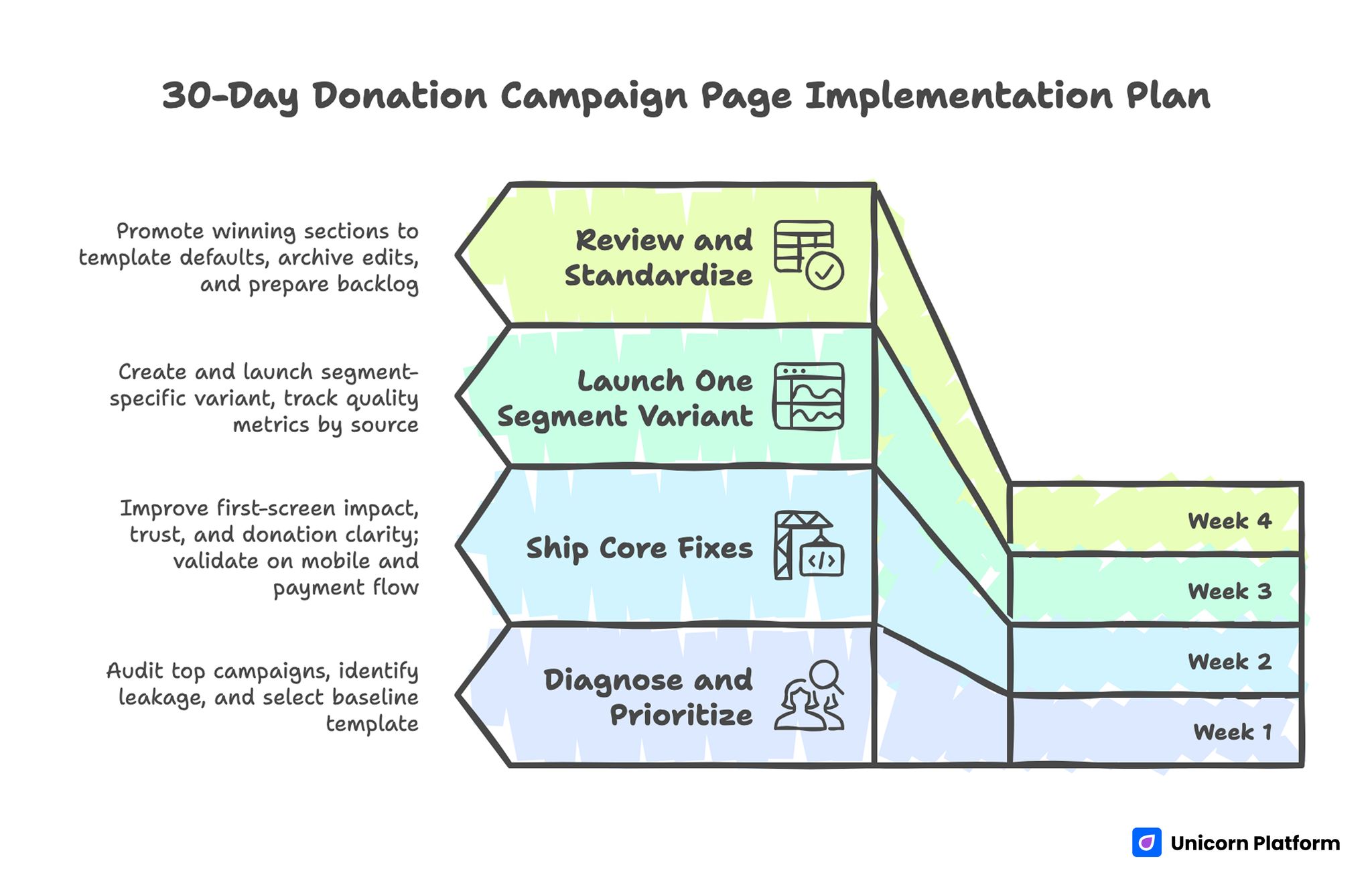
30-Day Donation Campaign Page Implementation Plan
Week 1: Diagnose and Prioritize
Audit top campaigns for stage leakage: impact clarity, trust confidence, or payment friction. Select one high-impact page as baseline template.
Week 2: Ship Core Fixes
Improve first-screen impact framing, trust placement, and donation option clarity. Run mobile and payment-flow validation before scaling traffic.
Week 3: Launch One Segment Variant
Create one segment-specific variant from the shared template. Change emphasis only where needed and track quality metrics by source.
Week 4: Review and Standardize
Promote winning sections into template defaults. Archive low-impact edits with rationale and prepare next-cycle backlog.
90-Day Scale Plan
Month 2: Expand Controlled Coverage
Add source-aware and donor-aware variants while preserving template governance. Continue weekly feedback mapping and one-variable test cadence.
Month 3: Institutionalize Reliability
Formalize governance artifacts: template standards, metric thresholds, ownership rules, and rollback triggers for underperforming variants.
At this stage, the goal is compounding quality. Teams should launch faster without sacrificing trust or completion reliability.
Campaign Risk Map and Rollback Rules
High-urgency nonprofit campaigns often move fast enough that small errors can remain live for too long. A practical risk map prevents this. List the top risks by stage: message mismatch, trust ambiguity, payment friction, and post-donation uncertainty. Assign one owner and one mitigation action to each risk before launch.
Define rollback triggers in advance so decisions are fast when performance drops. Useful triggers include sharp decline in completion rate, unusual failure spikes at payment step, or sudden reduction in recurring selection where recurring was expected to lead. Predefined thresholds remove debate during live campaigns.
Run phased rollouts for major page changes. Start with a controlled share of traffic, confirm signal quality, and only then expand. If a trigger is breached, revert immediately and document cause before relaunching. This protects donor confidence while preserving testing speed.
Keep a short incident log for every rollback event: what changed, what failed, what was reverted, and what standard was updated. Over time, this log turns urgent mistakes into reusable prevention rules and improves campaign reliability across the entire team.
Common Failure Modes and Fixes
1) Mission Story Before Impact Clarity
Problem: donors read but do not act. Fix: move concrete outcome framing and urgency context to the top.
2) Trust Signals Buried Too Late
Problem: uncertainty appears near payment steps. Fix: surface accountability and payment confidence near action blocks.
3) Overloaded Donation Choices
Problem: too many options increase decision friction. Fix: use concise suggested tiers with impact labels and custom fallback.
4) Same Message for All Donors
Problem: first-time and returning supporters receive identical framing. Fix: keep one structure and tailor emphasis by segment.
5) Mobile-Weak Payment Flow
Problem: high mobile drop-off despite good traffic. Fix: enforce real-device checks and simplify action path.
6) Channel Promise Mismatch
Problem: ad/email framing conflicts with page headline. Fix: use source-specific message maps and continuity checks.
7) No Ownership Standards
Problem: frequent updates introduce quality drift. Fix: assign explicit owners and required launch sign-offs.
8) Metric Tunnel Vision
Problem: donation volume rises while recurring quality falls. Fix: track completion quality, recurring conversion, and retention signals together.
9) Stale Proof and Outdated Data
Problem: trust declines when evidence looks old. Fix: run monthly freshness audit and prioritize high-visibility updates.
10) Missing Feedback Integration
Problem: recurring donor objections persist across campaigns. Fix: map support insights to weekly page improvements.
Pre-Launch QA Checklist
Before release, verify campaign promise, impact evidence, and donation-option labeling are aligned. Confirm trust and policy language is current and readable.
Validate full payment journey on real devices, including CTA visibility, amount selection, field clarity, and confirmation state behavior.
Check source-to-page continuity for active channels and confirm tracking integrity for completion and recurring metrics.
Require final sign-off from narrative owner, donation-flow owner, and QA owner before publishing.
FAQ: Donation Campaign Pages
What should we optimize first for better donations?
Start with impact clarity and trust placement near the first action block.
Should we prioritize one-time or recurring gifts?
Prioritize based on campaign objective and audience readiness, but keep both options clear.
How many suggested donation amounts are ideal?
Usually a small, meaningful set with one custom option is best for decision speed.
Do nonprofits need source-specific page variants?
Yes, when source expectations differ significantly, but keep one shared structure for governance.
What is the biggest mobile error?
Weak action visibility and unstable payment transitions on small screens.
How often should impact proof be refreshed?
Review high-visibility proof monthly and update based on recency and relevance.
Which metrics matter beyond total raised?
Track completion rate, recurring conversion, average gift quality, and post-donation engagement.
Can rapid campaign launches remain high quality?
Yes, if non-negotiable checklist rules are enforced before every release.
How do we reduce low-confidence abandonment?
Clarify impact outcomes, payment safety, and post-donation expectations earlier.
What creates compounding fundraising performance?
Stable templates, disciplined testing, clear ownership, and feedback-driven updates.
Final Takeaway
Nonprofit fundraising performance grows when donation pages are managed as systems, not isolated campaign assets. Clear impact, strong trust sequence, and low-friction action design create consistent completion gains.
With Unicorn Platform, teams can move quickly while keeping structure and governance intact. Keep the framework stable, adapt emphasis intentionally, and tie every change to donor-quality outcomes so growth compounds over time.