Table of Contents
- Core Architecture for Reliable Coming-Soon Pages
- Segment Patterns: Adapting Coming-Soon Pages by Business Model
- 30-Day Execution Plan for Coming-Soon Pages
- Common Failure Modes and Direct Fixes
- FAQ
Most teams can publish a prelaunch page in one afternoon. Far fewer teams can publish one that consistently brings in the right people, sets honest expectations, and supports a smoother launch week. That gap is where early growth momentum is usually won or lost.
A prelaunch asset is not only a design surface. It is an operating system for attention, trust, and intent capture before your product is fully available. If that system is unclear, signup volume might grow while conversion quality gets worse.
Strong teams treat this page as a structured conversion workflow. They align first-screen messaging, proof placement, form friction, follow-up cadence, and weekly optimization rules from day one. This approach creates measurable early demand without sacrificing credibility.
This guide gives a full framework for doing that in Unicorn Platform. It is designed for practical execution under real constraints, including small teams, limited time, and high launch pressure.
sbb-itb-bf47c9b
Key Takeaways
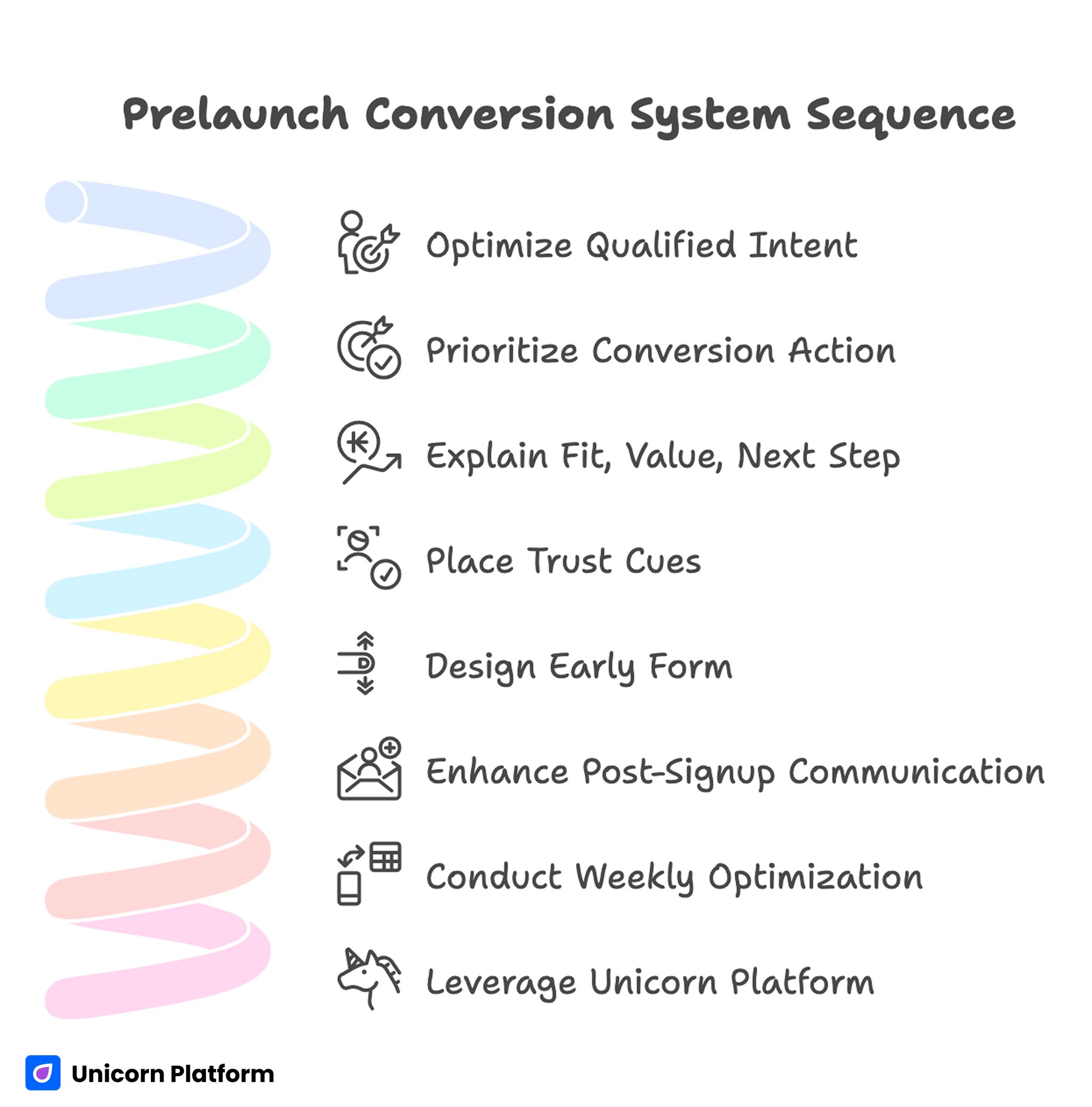
Prelaunch Conversion System Sequence
- A prelaunch page should optimize qualified intent, not raw signup count.
- One page should prioritize one primary conversion action per traffic segment.
- The first screen should explain fit, value, and next step within seconds.
- Trust cues should be placed near commitment points, not isolated at the end.
- Early form design should capture routing signal with minimal friction.
- Submission quality depends on post-signup communication, not only page copy.
- Weekly optimization works best when one major variable changes per cycle.
- Unicorn Platform helps teams ship quickly, but structure and QA still decide outcomes.
Why Prelaunch Pages Underperform Even With Good Traffic
Most underperformance starts with message ambiguity. Visitors arrive, read broad claims, and cannot tell whether the offer is relevant to their role or timeline. Unclear fit leads to hesitation among high-intent users and accidental signups from low-intent users.
The second issue is mixed priorities in one layout. Teams often combine launch announcement, feature narrative, pricing teaser, social feed, and founder note without a clear decision order. The page looks complete, but the visitor cannot identify the main action.
The third issue appears after form submission. Many teams capture emails but fail to communicate timing, access criteria, or next steps with enough precision. Interest decays quickly when users are unsure what happens after signup.
This is why prelaunch conversion should be managed as an end-to-end flow. The page, form, confirmation state, and follow-up sequence all influence final launch readiness.
What High-Performing Coming-Soon Pages Actually Do
High-performing coming-soon pages reduce uncertainty in a predictable sequence. They clarify audience fit, state practical value, provide confidence cues, and make one next action obvious. When this sequence is consistent, decision effort falls and conversion quality rises.
These pages also treat scope honestly. They do not promise a complete product experience before the team is ready. Instead, they explain what users can expect now, what is still in progress, and when updates are likely.
Another shared pattern is controlled focus. Instead of offering multiple equal-priority actions, strong pages maintain one primary route and one secondary path for a different readiness level. This improves both user clarity and analytics quality.
Finally, they preserve momentum after conversion. A user who signs up should immediately understand what comes next and why staying engaged is worthwhile. That continuity is one of the strongest predictors of launch-week activation quality.
Start With Conversion Objective, Not Visual Style
Template choice should come after objective clarity. Without objective definition, teams choose layouts by appearance and then retrofit conversion logic later. That workflow creates rework and weakens message consistency.
Define one primary objective for each page variant before copy or design starts. Common options include waitlist signups, beta access requests, launch reminders, or consultation interest. A page with one objective is easier to optimize than a page serving three priorities at once.
Then define one primary audience for the variant. A page targeting indie founders should not use the same promise sequence as a page targeting enterprise buyers. Audience clarity improves copy relevance, CTA wording, and proof selection.
If traffic intent is mixed, use separate variants by source or segment. Segment-specific variants usually outperform one generic page, even at lower traffic volume.
Objective Alignment Checklist
- Is one conversion action clearly primary?
- Is audience language specific to one user type?
- Does the first screen explain value in practical terms?
- Is the CTA aligned with readiness stage?
- Is there one measurable quality metric tied to this objective?
When these checks are clear before build, teams spend less time debating design details that do not affect decision quality.
Core Architecture for Reliable Coming-Soon Pages
A reliable page should answer the right questions in the right order. If section order forces users to hunt for critical context, completion quality drops regardless of traffic quality.
Use this architecture as a baseline:
- Fit and value in the first screen.
- Why-now context with a concrete benefit.
- Trust and credibility relevant to likely objections.
- Clear action module with low-friction form.
- Expectation and timeline clarity after commitment.
This sequence keeps cognitive load manageable and supports cleaner experimentation. Each section has one job, which makes performance diagnostics easier when conversion changes.
When your team needs a repeatable sequence model for multi-page launch programs, this high-converting landing page structure guide is useful for locking section responsibilities before detailed copy iteration.
A consistent structure also helps collaboration. Product, marketing, and design teams can review changes against shared section jobs rather than subjective style preferences.
First-Screen Messaging That Filters and Converts
The opening block should do more than attract attention. It should qualify intent quickly by naming audience, expected outcome, and near-term action in plain language. Visitors should know within seconds whether this offer is relevant.
A strong first-screen pattern is audience plus outcome plus timing context. For example, explain who gets value first and what early access enables in practical terms. This lowers uncertainty without relying on hype.
Avoid vague launch language such as "big update coming" without specific user impact. Curiosity copy can increase initial clicks, but it often reduces completion quality because users do not see clear value.
Use supporting microcopy near the CTA to clarify commitment level. Short lines about update cadence or access criteria can reduce hesitation with minimal visual cost.
Headline and Subheadline Rules
- Lead with user outcome, not internal product label.
- Keep claims bounded by current product reality.
- Avoid superlatives that cannot be supported on-page.
- Reinforce timeline expectations if availability is limited.
- Ensure CTA text describes what happens after click.
Teams that apply these rules consistently usually see cleaner lead quality and lower drop-off between first visit and signup completion.
Value Design: Give Users a Reason to Act Before Launch
Users rarely join early-access programs because a brand says "coming soon." They join when they can see a concrete advantage to early participation. That advantage should be explicit and easy to understand.
Design one primary value path for the page variant. You can offer priority access, early pricing, private beta seats, feature feedback influence, or launch reminders, but avoid stacking many incentives with equal prominence.
Each value path should include three details: what users get, when they get it, and how limited that access is. Clarity across these dimensions improves trust and reduces low-intent submissions.
If your launch strategy includes waitlist mechanics, this practical effective waitlist landing page guide helps align value framing with post-signup sequencing and qualification.
Value framing should also match product maturity. Early-stage teams should focus on learning benefits and priority onboarding, while later-stage teams can support more concrete access commitments.
Trust Design: Place Confidence Cues Where Doubt Appears
Trust elements are most useful when they appear near decision friction, not in a detached testimonial block at the bottom of the page. Visitors evaluate risk at commitment moments, so confidence cues should support those moments directly.
Practical trust assets include founder credibility, product progress evidence, usage context, security notes, roadmap transparency, and expected communication cadence. Use only assets that match real objections for your audience.
Proof quality matters more than proof volume. A few context-relevant signals usually outperform a long wall of generic statements.
Keep trust language precise. Instead of broad claims about being "the best," explain how your team handles onboarding, updates, and feedback during the prelaunch window.
Trust Placement Model
- Near first CTA: clarify legitimacy and expected process.
- Near form fields: reduce perceived risk of sharing contact data.
- Near confirmation area: explain what happens immediately after signup.
- In FAQ: answer objections around timing, access fairness, and communication frequency.
This placement model keeps confidence support tied to user decision flow.
Form Strategy for Higher-Quality Early Signups
Prelaunch forms often break performance because teams ask for too much, too early. Heavy first-touch forms can suppress momentum before users trust the process.
A better approach is staged qualification. Collect only what is required to route next steps on first touch, then gather deeper context through follow-up messages or onboarding screens.
For many launches, first-touch fields can stay minimal: email and one intent signal such as role, use case, or team size. This usually provides enough segmentation value without excessive conversion friction.
Then use follow-up sequences to capture richer data once commitment is established. Asking for deeper details later often improves data quality because users understand the purpose.
Form QA Checklist
- Are required fields tied to real routing decisions?
- Are labels and helper text clear on mobile?
- Is error handling visible and understandable?
- Does submit behavior work reliably on real devices?
- Does confirmation state set clear next-step expectations?
This checklist should be part of every release gate before traffic scaling.
Visual and Interaction Principles That Improve Conversion Quality
Design polish helps only when it supports comprehension. Strong prelaunch visuals guide attention to fit, value, and action. Weak visuals add style at the cost of clarity.
Prioritize readable hierarchy before decorative effects. Heading contrast, whitespace rhythm, and block sequencing should make scanning effortless on both desktop and mobile.
Use imagery to reinforce value context, not just aesthetics. Interface previews, real workflow visuals, or clear product states can reduce uncertainty faster than abstract illustrations.
Interaction behavior should stay predictable. CTA placement, form transitions, and confirmation feedback should not shift unexpectedly across breakpoints.
Visual QA Priorities Before Launch
- First-screen message remains readable at common mobile widths.
- Primary CTA stays visible without confusing alternatives.
- Form controls have comfortable tap targets and spacing.
- Trust modules remain near commitment points after responsive shifts.
- Performance remains stable under slower mobile connections.
When these fundamentals are stable, additional visual enhancements are more likely to help rather than distract.
Copy System for Coming-Soon Pages Without Hype or Vagueness
Prelaunch copy should sound confident, specific, and operational. It should not read like a teaser campaign with no delivery model behind it. Users join earlier when they understand exactly what participation means.
Use a repeatable copy sequence in each major block:
- User context and fit statement.
- Concrete outcome or benefit.
- Short mechanism explanation.
- Confidence cue tied to likely objection.
- Clear action statement.
This sequence keeps writing grounded in decision support instead of promotion.
Keep sentence structure varied but direct. Avoid repetitive transitions and keyword-heavy phrasing that feels artificial. Editorial quality matters because it signals product quality before launch.
Distribution and Source Match: Keep Promise Consistent Across Channels
A well-written page can still underperform when source message and on-page message are misaligned. Visitors coming from social, paid search, partnerships, or communities often carry different expectations.
Create channel-specific intros or variants when intent differs materially. The core structure can remain consistent, while the first-screen context and CTA framing adapt to source behavior.
Message match should be reviewed weekly. Compare ad or referral promise language against hero copy and confirmation copy. Any mismatch can lower both conversion and follow-up engagement.
Teams operating prelaunch programs on tight budgets can use this startup launch workflow with free tools to align acquisition channels with page clarity and lead-quality tracking.
Source alignment is especially important when you scale volume. Small message gaps that look harmless at low traffic can produce large quality losses at higher spend.
Post-Signup Continuity: Convert Interest Into Launch Readiness
Submitting a form should trigger a clear continuity sequence, not a dead end. If users do not understand what to expect after signup, intent weakens quickly.
A strong confirmation state includes acknowledgment, timeline guidance, and one optional next action. That next action might be selecting a use case, adding a teammate, or opting into update preferences.
Then follow with a short communication sequence. Keep cadence predictable and content practical. Users should feel momentum, not noise.
A useful baseline sequence is:
- Immediate confirmation with realistic expectations.
- Progress update tied to one meaningful milestone.
- Activation-oriented message before launch window.
This flow preserves trust while helping your team segment users by readiness and engagement.
Measurement Framework: Optimize for Quality, Not Vanity Volume
Top-line signups are useful, but they are incomplete. Prelaunch pages should be measured by quality indicators that predict real activation and retention. Benchmarks also show how much conversion performance can vary depending on page clarity and structure. Industry datasets indicate that the average landing page conversion rate across industries typically falls around 4–5%, while top-performing pages often exceed 10%, demonstrating how structured messaging and focused calls to action can dramatically influence results.
Use one primary quality metric and one guardrail metric per cycle. This avoids local optimizations that increase form volume while hurting downstream outcomes.
Recommended metric stack:
- Signup completion rate by source.
- Qualified intent ratio in early follow-up.
- Confirmation-to-open rate for first sequence message.
- Response quality by segment or use case.
- Launch-window activation intent indicators.
These metrics provide a clearer operational view than raw submission count alone.
Experiment Design Rules
- Change one major variable per test cycle.
- Run each test long enough to reduce noise.
- Document hypothesis, change, result, and keep-or-revert decision.
- Protect one guardrail metric while optimizing primary metric.
- Archive failed variants so weak patterns do not return.
Disciplined experimentation compounds learning faster than high-frequency, low-discipline testing. Research on landing page optimization shows that structured testing can significantly improve results over time. Studies of thousands of campaigns indicate that improvements such as clearer headlines, simplified forms, and stronger call-to-action placement can increase conversion rates by double-digit percentages during iterative optimization cycles.
If your team is diagnosing behavior gaps during optimization, this guide on user behavior patterns for landing pages can help prioritize fixes with higher impact on conversion quality.
Segment Patterns: Adapting Coming-Soon Pages by Business Model
Not every prelaunch audience evaluates risk in the same way. A B2B buyer assessing workflow impact has a different decision process from a consumer waiting for a product drop. The strongest teams keep one structural framework but adapt emphasis by business model.
This avoids two common mistakes. The first is copying a visual style from another industry without adapting the conversion logic. The second is forcing one generic narrative across segments with clearly different motivations.
SaaS and B2B product launches
For B2B launches, users usually care about workflow relevance, integration confidence, and rollout timing. A high-performing page should clarify who the product is for, what process improves first, and what happens after early-access signup.
Trust elements should highlight operational reliability, not only brand identity. Useful cues include short process diagrams, onboarding expectations, and boundaries around current feature scope. This reduces sales friction later because early signups arrive with more realistic expectations.
Form design in this segment should capture one useful qualification signal tied to handoff decisions. Role, team size, or current tool stack can work when used responsibly. Avoid extensive qualification fields until trust is established through follow-up.
Ecommerce and product-drop programs
Retail-oriented launches are often urgency-sensitive, but urgency should remain credible. Clear stock expectations, release windows, and delivery boundaries are more persuasive than vague scarcity language.
In this segment, visual hierarchy should support fast scanning and quick action. Product imagery, availability context, and one clear signup path usually outperform long explanatory blocks. That said, a short trust layer still matters, especially for new brands without broad recognition.
Signup intent can be segmented by preference rather than heavy profiling. Collecting interest category or region after initial commitment often improves campaign targeting without hurting top-of-funnel momentum.
Consumer apps and community-led products
Consumer app launches often benefit from social momentum, but social proof should be specific. It is better to show practical early-user signals and clear update cadence than generic popularity claims.
For this segment, the first screen should connect emotional value with immediate user benefit. Visitors should quickly understand why early access improves their day-to-day experience, not only why the product is "exciting."
Post-signup continuity is critical here. Short updates, feature previews, and clear participation prompts can maintain interest through longer prelaunch windows where attention naturally declines.
Service and agency prelaunch offers
Service teams launching a new offer or niche practice need authority clarity more than novelty. The page should show problem fit, method confidence, and what the first engagement step includes.
Proof in this context should be practical and close to the CTA. Framework snapshots, small implementation examples, or delivery process transparency can outperform broad testimonials because they reduce ambiguity about engagement quality.
Service pages also benefit from explicit scope boundaries. Defining who the offer is not for can improve lead quality and reduce low-fit inquiries before launch.
Implementation Workflow in Unicorn Platform
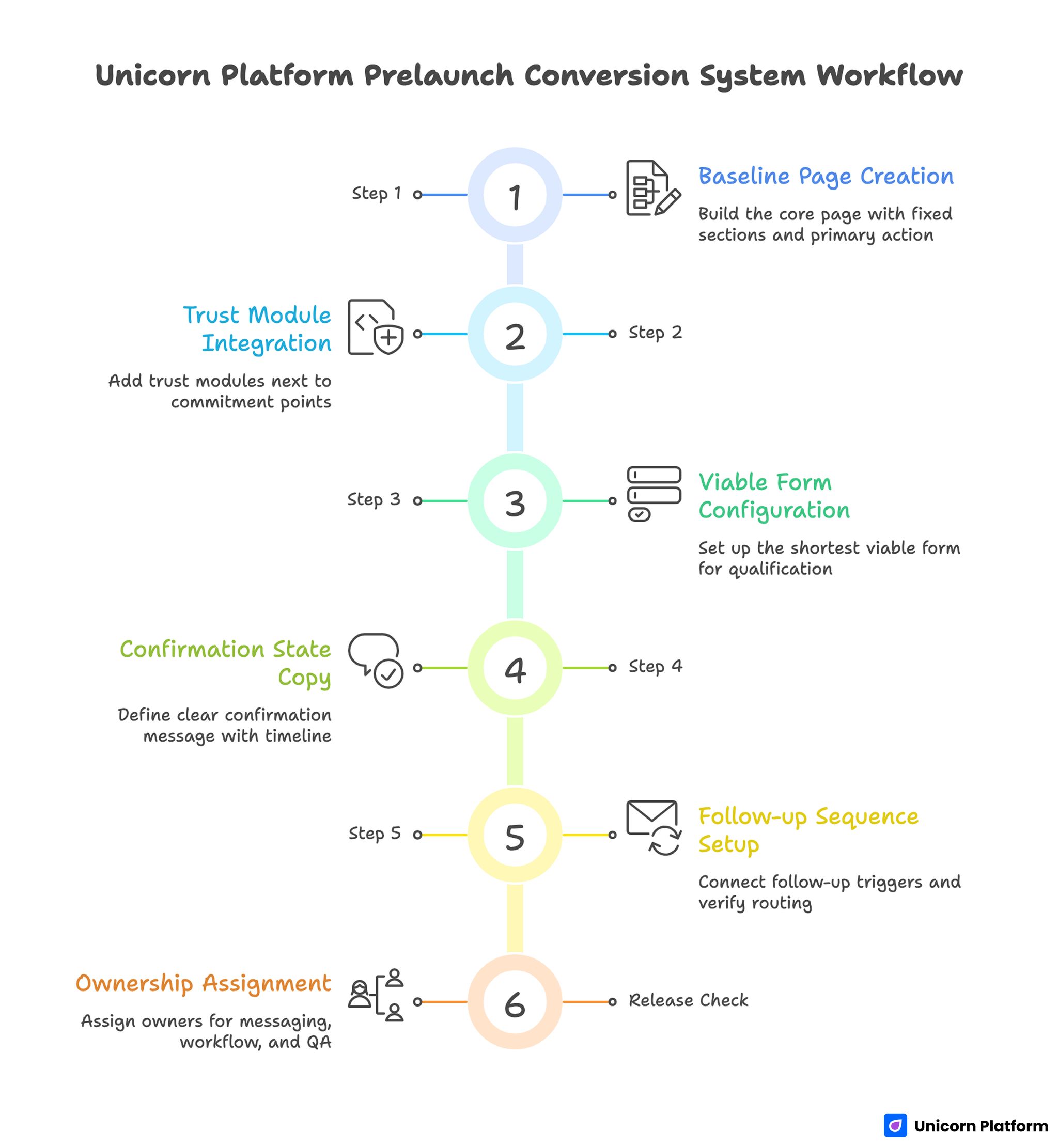
Unicorn Platform Prelaunch Conversion System Workflow
A good strategy still needs a practical publishing workflow. Unicorn Platform supports fast iteration, but teams get the best outcomes when template speed is paired with a defined build and QA sequence.
Start with one canonical page build rather than multiple parallel drafts. Establish section jobs, CTA hierarchy, and event plan first. Then customize copy and visual modules in a controlled pass so structural logic remains stable.
A practical implementation flow looks like this:
- Create the baseline page with fixed section order and one primary action.
- Add trust modules next to commitment points instead of isolating them at the bottom.
- Configure the shortest viable form for first-touch qualification.
- Define confirmation state copy with timeline and next-step clarity.
- Connect follow-up sequence triggers and verify routing before traffic scale.
After baseline setup, run a release check with clear ownership. Assign one owner for messaging accuracy, one for workflow reliability, and one for QA execution. This avoids silent regressions when multiple contributors edit the same page.
Editing standards that prevent quality drift
Prelaunch pages degrade when edits are made without section-level intent. Small wording changes can accidentally shift promise scope, trust context, or qualification quality. A lightweight edit policy helps maintain consistency under deadlines.
Use these standards for every update:
- Any hero update must be reviewed against source-message alignment.
- Any form update must be reviewed against routing and follow-up logic.
- Any CTA update must preserve one primary action hierarchy.
- Any trust-module update must stay tied to a specific objection.
- Any timeline claim must be validated by current delivery reality.
These checks are simple, but they reduce the most expensive launch-week errors.
Variant workflow for controlled experimentation
Variant testing should be structured around one baseline and one major variable. Launching many overlapping variants at once makes interpretation weak and slows useful decisions.
Keep section order constant and test one high-impact component per cycle, such as first-screen framing, CTA wording, or trust placement near form modules. This keeps outcome attribution clearer and accelerates iteration quality.
Document each variant with three fields: hypothesis, expected behavior change, and rollback condition. Teams that record these basics produce more reliable optimization over time.
Launch-Week Operations and Risk Controls
Launch week introduces noise that can hide quality regressions. Traffic spikes, rapid edits, and cross-team requests often create pressure to move fast without enough verification. A simple control framework protects conversion quality while preserving speed.
Launch week should be managed as an operations window, not only a marketing window. The page should have named owners, explicit decision rules, and preapproved rollback paths for high-risk changes.
Pre-launch readiness gate
Run a final readiness gate 48 to 72 hours before scaling promotion. This gate should confirm message consistency, routing reliability, and communication timing across all major entry points.
Checklist for the readiness gate:
- Ad or referral promise matches first-screen message.
- Primary CTA path works consistently on desktop and mobile.
- Form submissions route to the correct destination with clean tagging.
- Confirmation state reflects current timeline and access policy.
- Follow-up sequence sends on schedule with expected personalization.
If any item fails, fix before traffic expansion. Delayed scaling is usually cheaper than launching into preventable friction.
Incident playbook for the first seven days
Even strong teams encounter issues after go-live. What matters is response speed and clarity of ownership. A short incident playbook keeps changes focused when attention is high.
Use a three-tier response model:
- Severity 1: broken form submission, routing failure, or major CTA malfunction.
- Severity 2: message mismatch, inaccurate timeline copy, or trust-block regression.
- Severity 3: cosmetic issues without direct conversion impact.
For severity 1 and 2, pause nonessential experiments and restore baseline behavior first. Then diagnose root cause and record fix details so the same issue does not return in the next cycle.
Daily launch-week review rhythm
A short daily review improves decision quality under pressure. Keep it operational, not theoretical.
Review these signals every day:
- Completion rate by top traffic source.
- Qualified intent trend from new submissions.
- Form error rate and abandonment changes.
- Confirmation-to-follow-up engagement trend.
- Top objections from replies or support requests.
This routine helps teams catch drift early and keeps optimization tied to real user behavior.
30-Day Execution Plan for Coming-Soon Pages
A practical launch cycle should balance speed and quality control. The plan below works well for teams shipping with limited resources while maintaining editorial and conversion standards.
Week 1: Baseline build and measurement setup
Define objective, audience, and value path. Build one focused page in Unicorn Platform with event tracking, clear confirmation logic, and initial follow-up sequence.
Run a full device QA pass before traffic expansion. Confirm message clarity, form reliability, and response-state continuity.
Week 2: First conversion optimization cycle
Test one first-screen message variant and one CTA wording variant, but keep structure stable. Review completion quality by source, not only global averages.
Use findings to refine trust placement and helper text near commitment points. Avoid large structural edits until baseline signal is clear.
Week 3: Segmentation and source alignment
Create one additional variant for the most distinct source segment. Keep section order consistent and adapt only fit framing plus action context.
Update follow-up sequence for segment relevance. Short, targeted messaging usually improves engagement quality more than longer generic updates.
Week 4: Quality consolidation and launch readiness
Retain winning variants, remove weak ones, and standardize final templates for launch period. Review metric stack for quality stability across sources.
Finalize launch-week communication schedule and escalation rules for inbound volume spikes. This reduces operational stress during high-attention windows.
Common Failure Modes and Direct Fixes
Failure mode 1: Broad teaser messaging with no concrete value
Teams use curiosity language but never explain practical early-user benefits. This can generate clicks while suppressing qualified conversions.
Fix by rewriting the first screen around audience fit, concrete benefit, and realistic timeline context. Specificity improves both trust and self-qualification.
Failure mode 2: Too many competing CTAs
Pages present several equal-priority actions, so visitors hesitate or choose low-intent paths. Analytics become noisy because intent signals are fragmented.
Fix by defining one primary action and one secondary action for a different readiness state. Clear hierarchy improves user flow and measurement quality.
Failure mode 3: Heavy forms before trust is established
Teams ask for extensive details on first touch, reducing momentum and increasing abandonment. This often happens when internal routing needs are prioritized over user experience.
Fix by minimizing first-touch fields and shifting deeper qualification to follow-up steps. Maintain clarity about why additional details are requested later.
Failure mode 4: Isolated trust section far from CTA
Evidence appears in one block that users may never reach before decision points. As a result, commitment happens without confidence support.
Fix by distributing trust cues near first CTA, form area, and confirmation module. Trust should appear where uncertainty appears.
Failure mode 5: Weak post-signup communication
Users receive a generic thank-you and then silence. Intent fades before launch and list quality degrades.
Fix by deploying a short, predictable follow-up sequence with practical milestones and clear next steps. Continuity is part of conversion quality.
Failure mode 6: Optimization driven by vanity metrics
Teams celebrate higher form completions while qualified intent declines. The page appears to improve, but launch outcomes do not.
Fix by pairing conversion metrics with quality guardrails and reviewing source-level performance. Volume without quality is not sustainable growth.
FAQ: Coming-Soon Pages
How long should coming-soon pages stay live before launch?
Keep the page live long enough to gather reliable demand and qualification signals, not just raw traffic. For many teams, that means several weeks of measured iteration with clear follow-up cadence and quality review checkpoints.
What should coming-soon pages include at minimum?
At minimum, include audience fit, clear value, one primary action, trust support near commitment points, and explicit post-signup expectations. That baseline gives users enough context to make a confident decision.
Should coming-soon pages use countdown timers?
Use countdowns only when you can support a credible timeline and operational readiness. Artificial urgency can increase short-term clicks but often harms trust and long-term engagement quality.
How many form fields should a prelaunch page have?
Start with the minimum fields needed for routing and segmentation. Add deeper qualification later through follow-up steps once users understand the value and process.
Are coming-soon pages useful for SEO or only for paid traffic?
They can support both when built with clear intent and supporting content strategy. The page itself should remain focused, while related content captures broader discovery questions.
What is the best CTA for coming-soon pages?
The best CTA clearly describes the next outcome for the user, such as joining early access or receiving launch updates. Generic button text often underperforms because it hides commitment context.
How do I measure whether coming-soon pages are working?
Track both conversion volume and quality signals, including source-level completion rates, follow-up engagement, and qualified intent ratios. This gives a realistic view of launch readiness.
Should I create separate variants for different traffic sources?
Yes, when source intent differs meaningfully. Keep core structure stable, then adapt first-screen framing and CTA context for each segment to improve message match.
How often should I update my prelaunch page?
A weekly cycle is usually enough if each change is tracked and evaluated clearly. Frequent untracked edits create noise and make optimization decisions less reliable.
Can Unicorn Platform handle this full prelaunch workflow?
Yes, if the team pairs publishing speed with clear structure, QA discipline, and measured iteration. Unicorn Platform works best when page logic, form design, and follow-up operations are treated as one system.
Final Takeaway
Strong launch outcomes rarely come from a single creative idea. They come from disciplined execution of a clear prelaunch conversion system that respects user decisions and operational reality.
When coming-soon pages are built with objective clarity, structured messaging, low-friction capture, and reliable follow-up, they become a strategic growth asset instead of a placeholder. That is the standard worth building toward in every launch cycle.
Related Blog Posts
- Build Landing Pages Without Code, Unlock Conversion
- How to Get Qualified Users to Join a Waitlist in 2026: A Practical Conversion System
- How to Launch a Startup Site for Free and Build Real Demand Before Product Release
- Waitlist Page Strategy in 2026: How Teams Build Qualified Launch Demand, Not Vanity Signups
