Table of Contents
- Service Page vs Landing Page
- The Messaging Blocks Every Content Marketing Landing Page Needs
- Example Content Marketing Landing Page Layouts
- Common Mistakes on Agency Content Marketing Landing Pages
- FAQ
A content marketing landing page should make the offer clear, show proof quickly, and guide visitors toward one next step. That is what makes this topic different from a broader agency service page strategy discussion. People searching for a content marketing landing page usually want to understand what to put on the page, how to structure it, and what makes it convert.
That means the page needs to do more than talk about better-fit leads or funnel quality in the abstract. It needs to show the building blocks directly: message hierarchy, proof placement, CTA patterns, and example layouts that can be adapted for different agency offers.
This guide breaks down what strong content marketing landing pages include, when a service page should become a landing page, and which content blocks help agency offers feel easier to trust and act on.
sbb-itb-bf47c9b
Quick Answer
A strong content marketing landing page usually includes:
- one clear offer for one audience
- a headline that names the problem or result
- a short explanation of how the service works
- proof close to the main claims
- a CTA that matches buying intent
- an FAQ or objection-handling block near the bottom
The best pages do not try to explain every service the agency offers. They focus on one offer, one audience, and one next step.
What Makes a Content Marketing Landing Page Work
A content marketing landing page works when it helps the visitor answer three questions fast.
- Is this relevant to my problem?
- Can this agency actually do the work well?
- What should I do next if I am interested?
That sounds simple, but many agency pages fail because they answer those questions too late. They open with broad positioning language, long capability lists, or vague statements about growth. By the time the page explains the real offer, the visitor has already lost momentum.
The better pattern is much more direct. Lead with the audience and offer, then show the service mechanism, then add proof, then ask for one clear action.
Service Page vs Landing Page
This distinction matters because agencies often use the two formats interchangeably even though they do different jobs.
A service page is broader
A service page often exists to explain a capability in a more permanent way. It can cover scope, process, deliverables, fit, FAQs, and internal links to other parts of the site. Service pages are useful when someone is researching the agency more broadly.
A landing page is narrower
A landing page is usually built for one audience, one offer, or one traffic source. It should reduce choice and make the next step easier. That is why content marketing landing pages tend to perform better when they feel focused instead of encyclopedic.
When an agency should use a landing page instead of a service page
Use a landing page when:
- the offer is campaign-specific
- the page supports ads, outreach, or partnerships
- the audience has a very specific need
- you want one CTA to dominate the page
- the message needs stronger intent match than a general service page can provide
Use a broader service page when:
- the service is part of your long-term site structure
- the visitor may need more context before acting
- you want the page to support several internal journeys, not one campaign
For many agencies, the right system is both: one core service page and several landing pages built around different entry points.
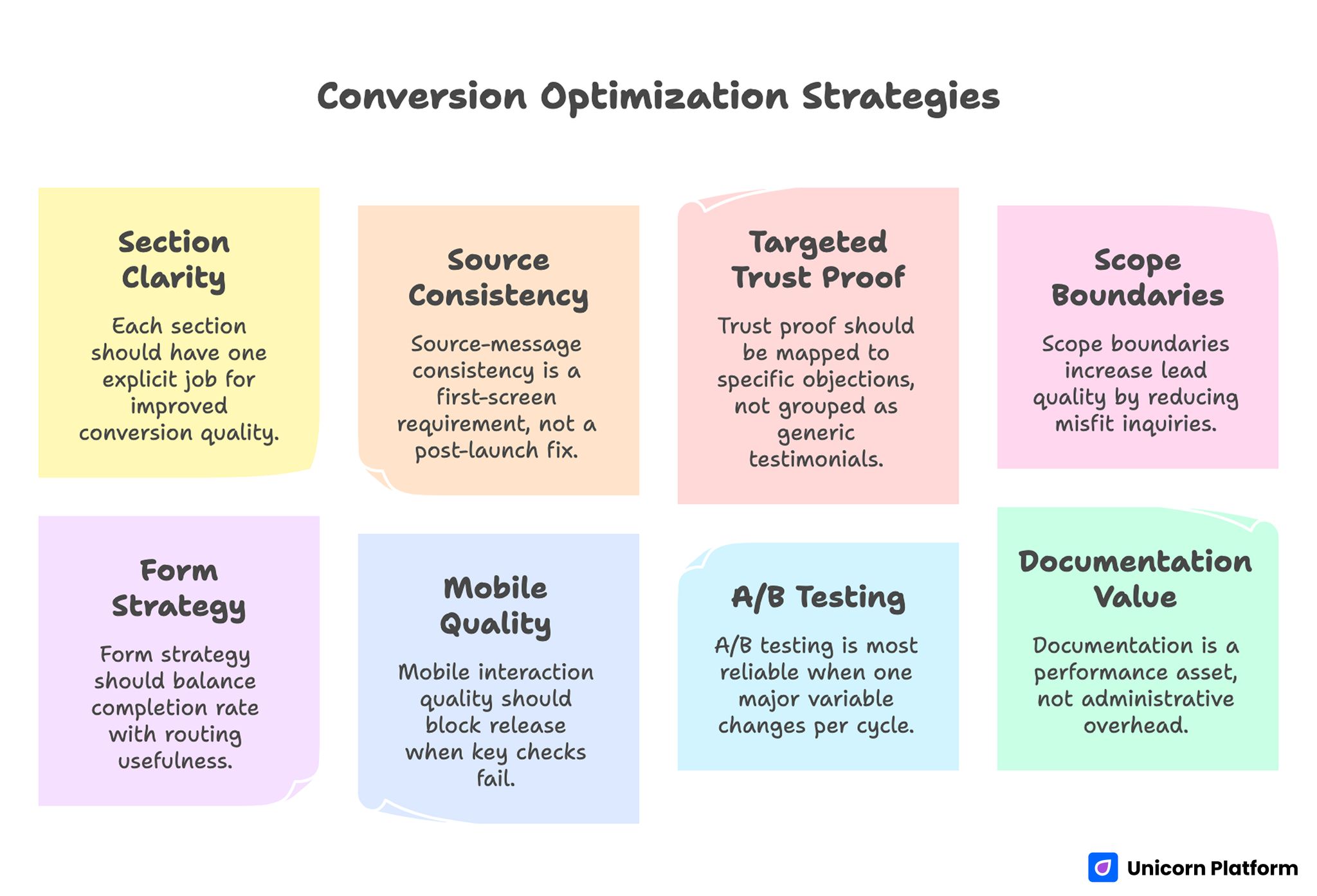
Conversion Optimization Strategies
The Messaging Blocks Every Content Marketing Landing Page Needs
The easiest way to improve a weak landing page is to stop thinking about it as one long document and start thinking about it as a series of message blocks.
1. The headline block
The headline should say what the offer is and why it matters. This is not the place for brand slogans or abstract growth language.
Weak direction:
- scale your authority with strategic content systems
Stronger direction:
- content marketing landing pages for SaaS teams that need more qualified demo requests
- content strategy and landing page copy for B2B brands launching a new offer
The stronger version gives the visitor a faster fit signal.
2. The context block
Right below the headline, explain what kind of company or team the offer is for and what friction it solves.
This block should answer things like:
- who is this service for?
- what is usually broken right now?
- what kind of result are we trying to improve?
3. The mechanism block
This is where you explain how the work happens. Keep it practical. Visitors should understand the approach without needing a call first.
A useful mechanism block might include:
- research and message alignment
- landing page structure and copy
- proof and CTA strategy
- handoff, design, or implementation support
4. The proof block
This is where many pages lose trust. Agencies often place a big testimonial slider or logo bar on the page and assume that is enough. It helps, but only if the proof supports the claim right next to it.
If you say the page improves lead quality, show a short case summary or quote that supports that exact claim. If you say the offer reduces launch friction, show an example of how quickly the team shipped.
5. The CTA block
The CTA block should match decision stage. Someone reading a content marketing landing page may not be ready for a long sales call, but they may be ready to request an audit, book a short discovery call, or send a brief.
Proof and Case-Study Sections That Help the Page Convert
Good proof is specific, relevant, and close to the claim it supports.
Put proof near moments of doubt
Visitors tend to hesitate at a few predictable points:
- after the headline, when they are deciding whether to keep reading
- after the method section, when they are deciding whether the agency seems credible
- before the CTA, when they are deciding whether to act now
Proof should appear around those moments.
Show the right kind of proof
For a content marketing landing page, the most useful proof types are usually:
- a short case-study summary
- a quote about clarity, speed, or results
- selected client logos if relevant to the audience
- a brief process snapshot showing how the engagement works
Keep case studies concise on the page itself
The landing page does not need to contain a full case study. It just needs enough context to make the claim believable.
A simple proof block can look like this:
- who the client was
- what was broken or unclear
- what changed on the page or offer
- what improved afterward
That is usually stronger than a generic testimonial about how great the team was to work with. Many agencies also strengthen credibility by showcasing curated agency portfolio sites that demonstrate real client work, design quality, and measurable outcomes. A well-organized portfolio gives potential clients a clearer picture of your experience than a simple gallery of completed projects because it connects each example to business goals, strategy, and results.
CTA Patterns That Fit Content Marketing Offers
Content marketing landing pages often underperform because their CTA is either too broad or too aggressive.
CTA pattern 1: discovery-first
Use this when the service is higher-ticket or strategy-heavy.
Examples:
- Book a discovery call
- Talk through your content funnel
- See if this offer fits your team
This works best when the page already includes enough proof to support a conversation.
CTA pattern 2: audit-first
Use this when the audience may want a lower-friction entry point.
Examples:
- Request a landing page review
- Get a content funnel audit
- Send your page for feedback
This pattern works well for colder traffic because it feels more concrete and less sales-heavy.
CTA pattern 3: brief-first
Use this when the audience is close to buying and needs a fast handoff path.
Examples:
- Send your project brief
- Tell us about your launch
- Start a content landing page project
This works best when the page clearly explains scope and next steps.
What to avoid
Avoid CTA language like:
- Learn more
- Get started
- Let's talk
These are not always wrong, but on their own they usually leave too much ambiguity.
Example Content Marketing Landing Page Layouts
The examples below are not brand-specific templates. They are reusable page shapes you can borrow depending on the type of agency offer.
Layout 1: Simple lead-generation landing page
Best for:
- content strategy retainers
- landing page copy services
- B2B lead-generation offers
Structure:
- headline with audience and result
- short context paragraph
- 3-step process section
- one case-study summary
- testimonial or logo strip
- CTA block
- FAQ
Why it works:
- it keeps the decision path simple and reduces distraction
Layout 2: Proof-heavy agency landing page
Best for:
- higher-ticket content engagements
- agencies selling to mature SaaS or B2B teams
- offers where trust and depth matter more than speed alone
Structure:
- headline and fit statement
- selected proof or flagship result
- approach section
- two short case-study blocks
- service scope and exclusions
- CTA
- FAQ
Why it works:
- it makes trust visible earlier and helps more serious buyers self-qualify
A digital agency website template is a good starting point here because it already gives you room for proof, offer clarity, and a strong next-step CTA.
Layout 3: Campaign-specific landing page
Best for:
- ad traffic
- partnership campaigns
- niche offers such as SEO content landing pages or launch pages for one vertical
Structure:
- exact message match from source
- pain and offer framing
- proof block
- service steps
- CTA
- objection-handling section
Why it works:
-
it removes extra navigation logic and keeps the visitor on one decision path
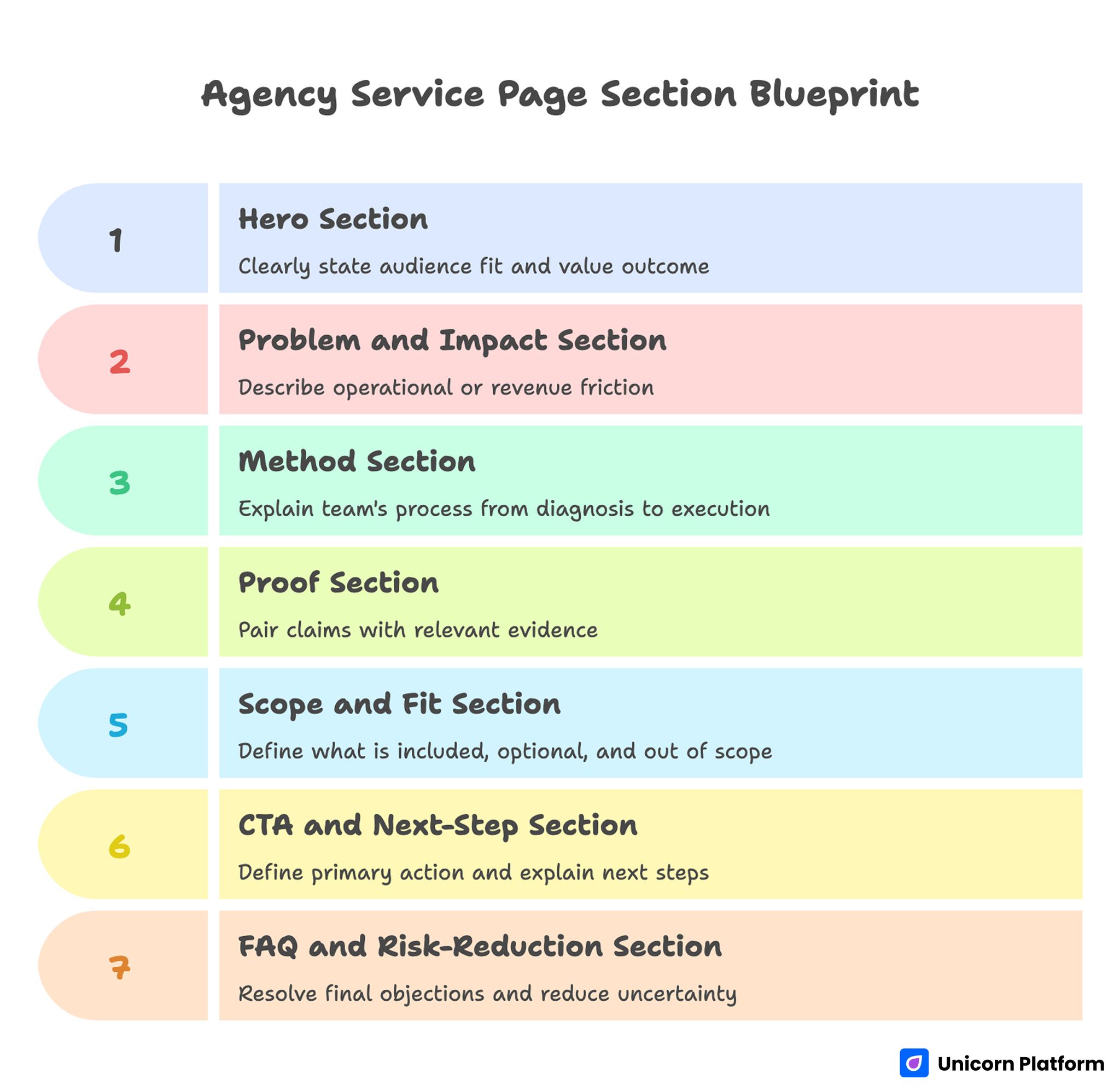
Agency Service Section Blueprint
Common Mistakes on Agency Content Marketing Landing Pages
Mistake 1: treating the page like a full agency website
Fix: focus the page on one offer, one audience, and one CTA.
Mistake 2: using broad agency language instead of landing-page language
Fix: say landing page plainly. Describe the structure, message, proof, and CTA work directly.
Mistake 3: putting proof too low on the page
Fix: move one strong proof element much closer to the top.
Mistake 4: explaining every possible capability
Fix: keep only the details that help the visitor decide whether this exact offer fits.
Mistake 5: making the CTA vague
Fix: use action language that tells the visitor what happens next.
A Practical Section Order to Start With
If you are rebuilding a content marketing landing page from scratch, this order is a strong starting point:
- headline and audience-fit statement
- short offer explanation
- proof or case-study summary
- process or method section
- scope and deliverables
- CTA block
- FAQ or objection handling
This order works because it moves from relevance to trust to action in a way most buyers can process quickly.
If you need more help with page sequencing, this guide on high-converting landing page structure is a useful companion because it breaks down the logic of section order more deeply.
How To Apply This in Unicorn Platform
Unicorn Platform works well for this kind of page because content marketing landing pages usually do not need a huge site architecture to succeed. They need clear sections, reusable blocks, and the ability to publish focused pages quickly.
A practical workflow inside Unicorn Platform looks like this:
- build one page for one offer
- keep the hero and CTA highly specific
- add one proof section early
- use a repeatable structure for process, scope, and FAQ
- duplicate the page when you need a variation for a new audience or campaign
If you are also refining responsive behavior, this guide on responsive landing pages can help you tighten mobile-first clarity before you drive more traffic.
FAQ: Agency Service Page Examples
What is a content marketing landing page?
It is a focused page built to promote a content-related offer, campaign, or service and move the visitor toward one clear next step.
What is the difference between a landing page and a service page?
A landing page is narrower and more action-focused. A service page is usually broader and supports more research-oriented browsing.
What should a content marketing landing page include?
At minimum: a clear offer, audience fit, proof, process summary, CTA, and objection-handling section.
How long should a content marketing landing page be?
It should be long enough to resolve the main doubts for a qualified visitor, but not so long that the message loses focus.
What is the best CTA for a content marketing landing page?
That depends on the offer, but discovery calls, audits, and brief requests usually work better than vague CTAs.
Should agencies use case studies on landing pages?
Yes, but they should be short and relevant. Landing pages benefit more from concise proof than from long case-study archives.
When should an agency build a separate landing page?
When the offer, audience, or traffic source is specific enough that a general service page feels too broad.
Can a landing page still support SEO?
Yes, if the page is structured clearly, matches the search intent, and offers useful content rather than thin promotional copy.
How many CTAs should a landing page have?
Usually one dominant action path works best, even if the button appears in several places.
Is Unicorn Platform a good fit for agency landing pages?
Yes, especially when the agency needs to launch or iterate focused offer pages quickly.
Final Takeaway
The best content marketing landing pages do not feel like miniature agency websites. They feel easier to understand. They show the offer quickly, support it with the right proof, and make the next action obvious.
If this page is going to recover performance, it has to win on clarity first. That means saying landing page early, showing real page structure, and reducing the abstract agency-conversion language that hid the original intent. Once that is fixed, the page has a much better chance of earning the right clicks.

