Table of Contents
- Why B2B-Landing Pages Underperform Even With Strong Traffic
- Start With One Page Objective and One Segment
- Offer Architecture by Buying Stage
- 30-Day Execution Plan
- Common Failure Modes and Direct Fixes
- FAQ
Most teams can launch a conversion page quickly. Fewer teams can launch one that consistently attracts the right accounts, qualifies intent, and moves buyers toward high-quality pipeline outcomes. That difference is where most B2B growth programs either scale efficiently or stall.
In B2B, a conversion page is not just a place to collect form fills. It is a decision environment for multiple stakeholders who are evaluating risk, expected outcomes, operational fit, and vendor credibility under time pressure. If that environment is unclear, lead volume may increase while sales quality declines.
Many underperforming programs treat page optimization as copy tuning only. They test headlines and button labels but ignore deeper architecture issues such as role-based relevance, objection sequencing, and post-submit continuity. The result is activity without consistent commercial progress.
This guide provides an end-to-end framework for building and improving B2B-focused pages in Unicorn Platform. The goal is practical execution: better-fit conversions, lower routing noise, and stronger downstream sales outcomes.
sbb-itb-bf47c9b
Key Takeaways
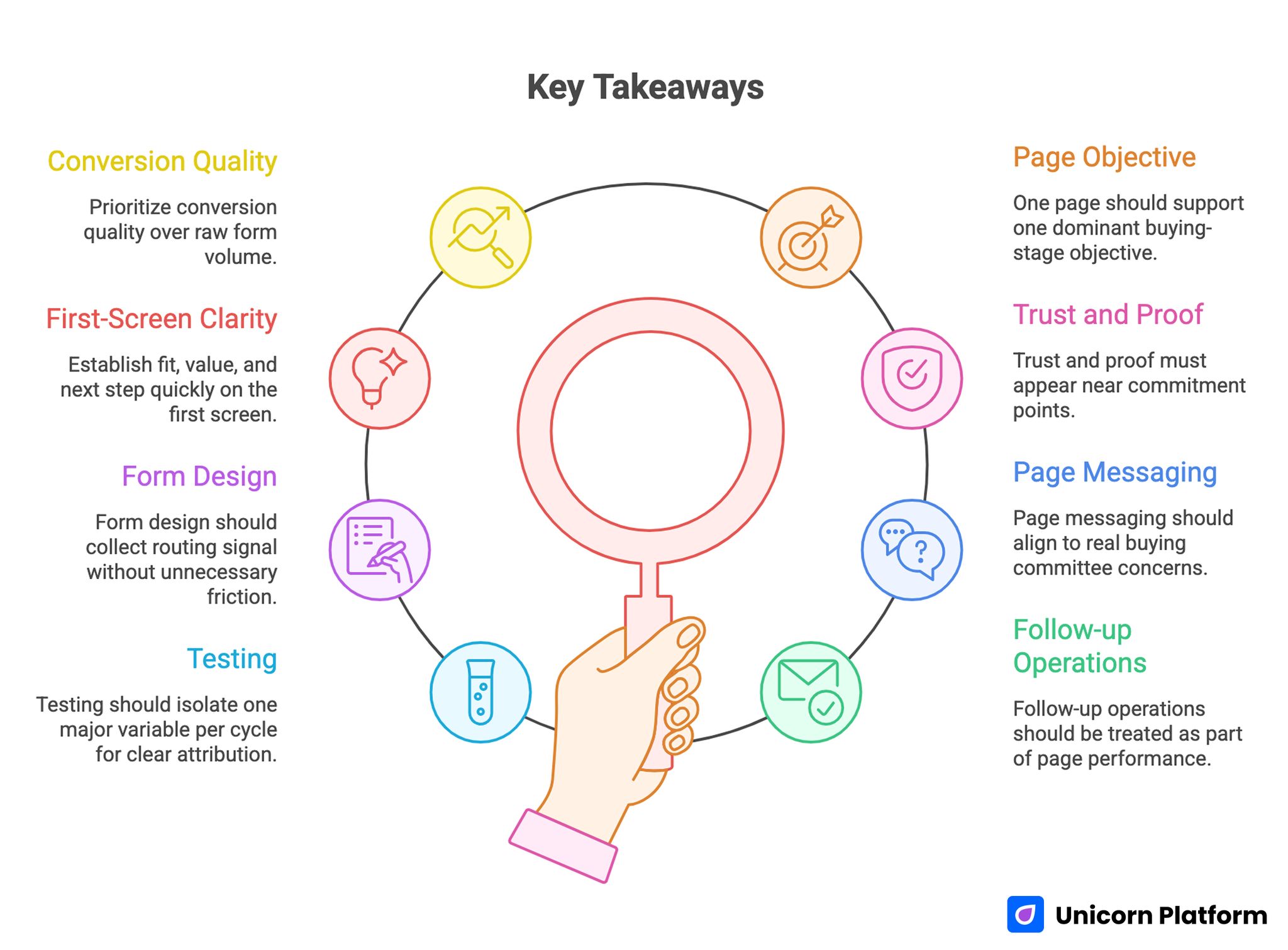
Key Takeaways Optimizing B2B Landing Pages
- Conversion quality should be prioritized over raw form volume.
- One page should support one dominant buying-stage objective.
- First-screen clarity should establish fit, value, and next step quickly.
- Trust and proof must appear near commitment points, not only in long testimonial blocks.
- Form design should collect routing signal without unnecessary first-touch friction.
- Page messaging should align to real buying committee concerns.
- Testing should isolate one major variable per cycle for clear attribution.
- Follow-up operations should be treated as part of page performance.
Why B2B-Landing Pages Underperform Even With Strong Traffic
The most common failure is intent mismatch. Teams drive traffic from high-intent channels, then route users to pages that are too broad, too brand-heavy, or too generic for practical decision-making. Qualified buyers leave because the page does not reduce uncertainty fast enough.
The second failure is structural conflict. A single page tries to educate, compare, qualify, and convert multiple audience types with equal priority. That usually creates competing narratives, unclear CTA hierarchy, and weak decision momentum.
The third failure is over-collection in first-touch forms. Teams ask for full qualification data before trust is established, then wonder why form starts are high and completions are weak. Heavy forms can protect quality, but only when demand maturity and page confidence justify the friction.
The final failure appears after submit. Confirmation and follow-up are often generic, so handoff clarity is lost right after conversion. Pipeline quality then looks weaker than expected, even when the page appears to perform well on top-line metrics.
B2B-Landing Pages vs B2C Conversion Pages
B2B conversion behavior is usually slower, more risk-aware, and more role-dependent than consumer behavior. A buyer may need internal alignment, technical validation, and budget confidence before taking the next step.
Because of that, clarity and trust sequence matter more than excitement language. B2B users rarely convert on novelty alone. They convert when expected outcome, implementation fit, and process confidence are clear.
A B2C-style urgency pattern can still work in limited cases, but it usually underperforms in longer sales cycles where risk and stakeholder coordination dominate decisions.
A useful rule is simple: B2B pages should optimize for confident commitments, not impulsive clicks.
Start With One Page Objective and One Segment
Before writing copy, define the single objective for the page variant. Typical objectives include qualified demo requests, discovery-call applications, lead magnet capture for specific ICP segments, or solution-fit consultations.
Then define one primary audience segment. A RevOps leader and an IT procurement manager may visit the same page, but they often evaluate value differently. If the page tries to serve all roles equally, it usually serves none well.
When channel intent differs significantly, create controlled source-aware variants while keeping one stable structural framework. This reduces message conflict and improves test interpretation.
Objective Alignment Checklist
- Is one conversion objective clearly primary?
- Is first-screen language role-relevant and specific?
- Is promised value practical and verifiable?
- Is CTA wording aligned with decision readiness?
- Is one quality metric tied to page success?
Teams that answer these questions before production usually reduce rewrite cycles and improve launch quality.
Core Conversion Architecture for B2B-Landing Pages
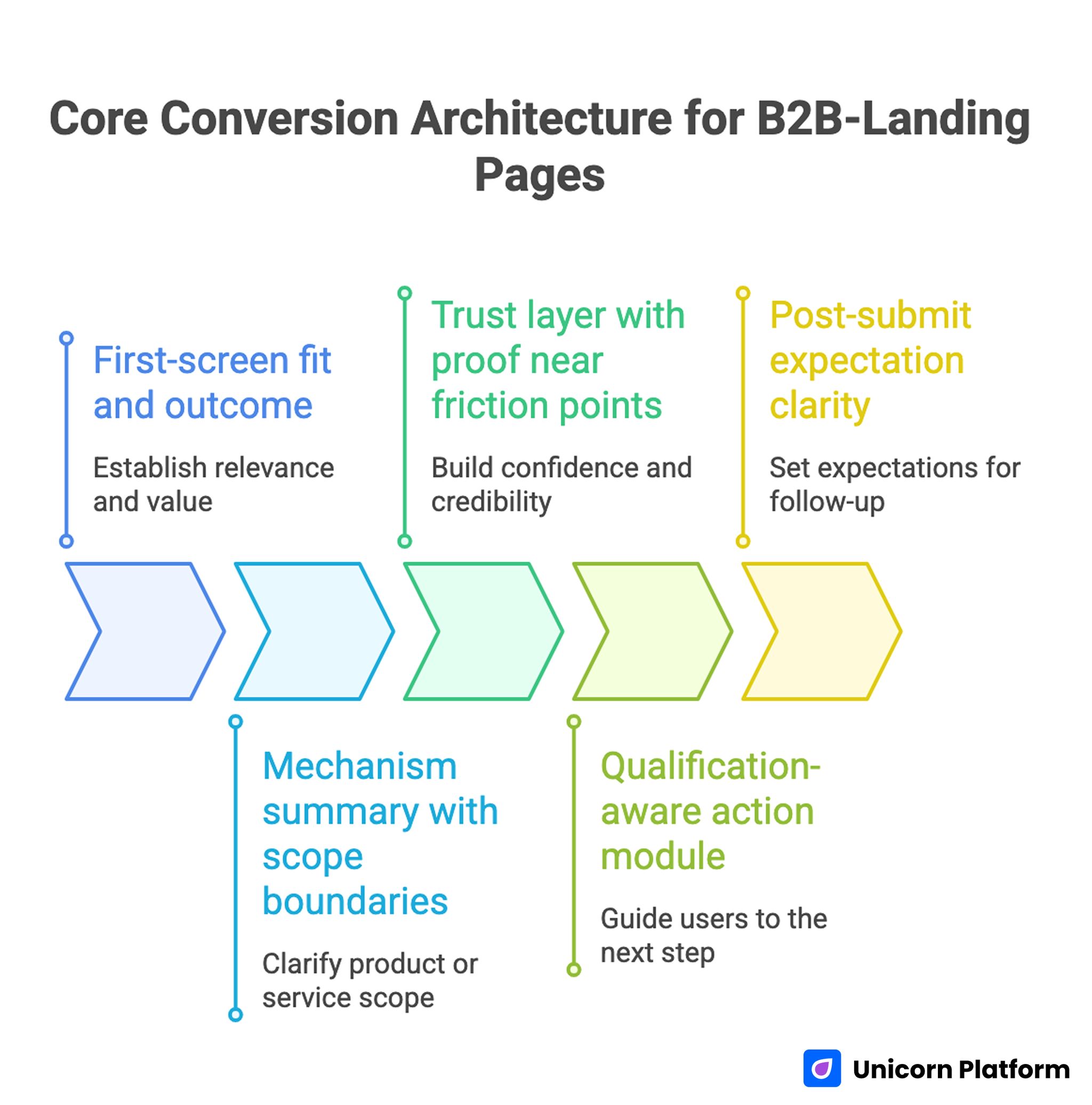
Core Conversion Architecture for B2B-Landing Pages
High-performing pages guide users through a deliberate sequence: fit, value, confidence, action, and continuity. If this order is broken, users are forced to infer missing context and conversion quality drops.
A practical structure includes:
- First-screen fit and outcome.
- Mechanism summary with scope boundaries.
- Trust layer with proof near friction points.
- Qualification-aware action module.
- Post-submit expectation clarity.
This sequence improves both conversion and sales handoff because each section has one job and supports the next decision.
If your team needs a reusable section logic model, this high-converting landing page structure guide is useful for defining clear section responsibilities before detailed copy writing.
Stable architecture also helps teams collaborate without producing drift. Design, content, and demand gen can update sections independently while preserving the same decision flow.
First-Screen Messaging for B2B Buying Confidence
The first screen should immediately answer three questions: is this relevant to my situation, what practical outcome is offered, and what happens if I take the next step. If one answer is missing, high-intent users often delay action.
A reliable opening formula is role + problem context + measurable outcome direction + next-step expectation. This keeps messaging grounded in buyer priorities rather than abstract brand claims.
Avoid broad statements like "transform your business" without context. B2B buyers respond better to practical language that reflects real constraints and expected implementation boundaries.
Small helper copy near CTA buttons can significantly reduce hesitation. Short lines about what the request includes, who responds, and expected response timing improve confidence without adding clutter.
First-Screen Quality Rules
- Lead with user outcome, not internal category labels.
- Keep claims constrained to realistic scope.
- Clarify who the offer is best suited for.
- Avoid multiple equal-priority CTAs above the fold.
- Make the CTA outcome explicit.
Consistent use of these rules improves self-qualification and reduces low-fit submissions. They also improve handoff quality because buyers arrive with clearer expectations.
Value Proposition Design for Complex Sales Cycles
Strong value propositions in B2B are concrete, decision-relevant, and segment-aware. They should explain what changes for the buyer and why this step is worth time right now.
A useful value structure has three parts: primary operational benefit, likely risk reduction, and expected time-to-first-value direction. This format aligns with how most buying committees evaluate short-term and long-term impact.
Value messaging should also define boundaries. Explaining what the offer does not include can improve trust and reduce misaligned conversations later.
Across multi-campaign programs, keep one canonical value framework and adapt only segment-specific emphasis per variant. This preserves consistency while allowing relevance.
Trust and Proof Placement That Reduces Buying Risk
Proof quality matters more than proof quantity. A wall of logos can look impressive but still fail to answer critical buyer concerns.
Use proof that resolves practical objections: implementation credibility, industry fit, measurable relevance, delivery consistency, and post-sale support confidence. Place these elements near moments where commitment friction is highest.
Social proof should be contextual, not decorative. A quote that addresses a concrete problem usually outperforms generic praise.
Trust cues should also include process clarity. Buyers need to understand what happens after submit, how qualification works, and what next interaction looks like.
Trust Layer Checklist
- Are proof elements directly tied to buyer concerns?
- Are trust cues positioned near CTA and form zones?
- Does proof represent target segment reality?
- Is process transparency included alongside claims?
- Are compliance or security expectations addressed where relevant?
A trust layer built this way improves both completion confidence and post-submit alignment. It also reduces the need for corrective sales conversations after initial conversion.
Form Strategy: Balance Qualification and Conversion Rate
Form strategy in B2B is a tradeoff design problem. Too little friction can produce low-quality demand. Too much friction can suppress high-fit opportunities.
The best approach is staged qualification. Collect minimum routing signal at first touch, then gather deeper data in the next step once confidence is established.
For many campaigns, first-touch capture can include business email and one qualifying field such as company size band, role, or timeline. Additional fields should be justified by real routing decisions.
When qualification requirements are higher, explain why information is requested. Transparent rationale often improves completion quality compared to silent high-friction forms.
Form QA Checklist
- Does each required field map to an operational decision?
- Are labels and validation messages clear on mobile and desktop?
- Is submit behavior consistent across major browsers?
- Are form errors recoverable without data loss?
- Does confirmation clearly state the next step?
Run this checklist before scale to prevent avoidable conversion loss. Small form issues can produce large efficiency problems when traffic increases.
CTA Design and Conversion Mechanics
CTA performance depends on context, not wording alone. Buyers convert when CTA placement matches confidence level and section narrative supports action.
Use one primary CTA route for the main objective. Secondary actions can exist for different readiness stages, but they should not compete equally with the primary path.
CTA text should describe outcome, not just action. Labels like "Request a walkthrough" usually provide better commitment clarity than generic labels like "Submit."
Placement should follow confidence progression. Anchor CTAs after value clarity, after key proof, and near the form decision point.
Personalization and Segment Relevance Without Fragmentation
Segment relevance is essential in B2B, but full page fragmentation creates maintenance risk and noisy analytics. A better approach is controlled personalization on top of stable architecture.
Keep section order fixed and adjust selected elements such as headline framing, example context, objection emphasis, and CTA supporting copy by source or segment.
This model improves message match while preserving test integrity. Teams can compare variants with fewer confounding changes.
Personalization should be evidence-based. If segment-level behavior does not differ meaningfully, maintain one canonical variant and focus on universal friction points.
Buying Committee Mapping for B2B-Landing Pages
Most B2B purchases involve more than one decision-maker, and each role evaluates risk differently. If your page speaks only to one persona, qualified opportunities can stall even when the primary contact converts.
A practical committee map usually includes at least four perspectives: operational user, budget owner, technical reviewer, and procurement or legal gatekeeper. They do not all need separate pages, but the page should provide enough signals for each role to confirm basic fit.
The operational user cares about practical workflow improvement and adoption friction. Budget owners care about business impact and confidence that priorities are aligned. Technical reviewers care about integration boundaries, security expectations, and implementation feasibility. Procurement and legal stakeholders care about process clarity and risk control.
You can address this without clutter by layering role-specific cues inside existing sections. Keep the headline and first-screen value universal for the primary segment, then add concise trust and process details where secondary stakeholders usually look for reassurance.
Role-Layer Design Model
- First-screen value: focused on primary operational outcome.
- Value section: includes economic impact language for budget holders.
- Trust section: includes technical and risk-reduction detail.
- Action section: clarifies what happens next for internal stakeholder alignment.
When this model is used consistently, sales teams usually receive better-prepared inbound conversations and fewer low-context requests.
Offer Architecture by Buying Stage
Offer design should match intent maturity. A high-intent comparison visitor may be ready for a guided evaluation call, while a mid-intent research visitor may still need a practical planning asset before committing to a conversation.
Use an offer ladder with one dominant route per page variant. This keeps CTA clarity high and reduces confusion around expected commitment level.
A useful ladder often looks like this:
- Early-stage offer: practical resource with clear implementation relevance.
- Mid-stage offer: structured assessment or short planning framework.
- Late-stage offer: scoped walkthrough or consultation with defined next step.
When offer maturity and visitor readiness are aligned, conversion quality usually improves faster than raw conversion rate alone. Sales handoff also becomes cleaner because expectations are set earlier.
If your team is refining conversion routes around qualification and handoff quality, this lead generation landing page guide can help align offer type with pipeline goals.
Offer clarity should include response expectations. If a visitor requests a call, they should know who responds, what preparation is needed, and what outcome the first interaction is designed to produce.
Sales Handoff Design and Post-Submit SLAs
Post-submit experience determines whether conversion momentum holds or collapses. Many programs lose quality after submit because routing ownership and response expectations are unclear.
Define a simple service model for every primary CTA path. At minimum, specify routing logic, response-time target, ownership role, and fallback process for overflow periods.
A practical SLA framework includes:
- Route high-intent submissions to named owners with clear response windows.
- Acknowledge every submission immediately with realistic next-step timing.
- Trigger segment-specific follow-up messages if live outreach is delayed.
- Escalate priority accounts when qualification signals exceed thresholds.
This framework reduces lead decay and improves trust in early interactions. It also gives marketing and sales teams a shared definition of conversion quality beyond form completion.
Handoff quality should be reviewed weekly with evidence, not opinion. Look at response times, first-call attendance, and early-stage qualification confidence to identify operational bottlenecks.
Mobile, Performance, and Technical Reliability
Even in B2B, a large share of first interactions happens on mobile devices. If page readability or form usability degrades on smaller screens, conversion quality suffers before desktop follow-up ever begins.
Prioritize first-screen clarity, tap-target spacing, stable CTA visibility, and quick form responsiveness. Visual complexity should never delay core decision content.
Performance and conversion should be monitored together. Fast rendering helps, but only when key content hierarchy is clear.
If your team is improving cross-device consistency, this responsive landing-page workflow is useful for keeping action hierarchy stable across breakpoints. This is especially important when campaigns drive large mobile-first traffic segments.
Technical release checks should include tracking integrity, form routing, and confirmation-state behavior on real devices. Emulator checks are useful, but real-device verification catches high-impact usability issues earlier.
Internal Linking and Topic Authority Strategy
Internal links should mirror buyer decision paths. They should guide users from broad evaluation context to deeper implementation detail at the exact point where clarity is needed.
For B2B conversion programs, useful pathways often connect architecture guidance, optimization methods, and demand-quality frameworks. This supports both user navigation and topic depth.
Anchor text should remain natural and context-specific. Repetitive anchor templates reduce editorial quality and can weaken reader trust.
Plan links during outline stage, not as a final patch. This prevents link clustering and keeps narrative flow intact.
When teams need a practical framework for aligning conversion work to commercial outcomes, this business-aligned optimization guide helps tie page changes to measurable growth priorities. Connecting page experiments to business objectives improves prioritization discipline.
Measurement Framework for B2B-Landing Pages
Measuring only form volume hides quality issues. High-performing teams track conversion quality signals that predict pipeline value and sales efficiency.
Use a three-layer model:
- Discovery layer: source quality and intent match.
- Decision layer: form starts, completion quality, and objection-driven drop-offs.
- Outcome layer: qualified pipeline progression and post-submit readiness.
Each cycle should define one primary metric and one guardrail metric. This keeps local optimizations from harming downstream performance.
Recommended Review Cadence
- Daily: technical health, routing issues, and major anomalies.
- Weekly: source-level conversion-quality movement.
- Monthly: segment-level pipeline contribution trends.
Cadence discipline helps teams separate signal from noise and protect decision quality. It also prevents reactive edits that weaken long-term learning.
If your team is diagnosing on-page hesitation patterns, this user behavior optimization guide is useful for prioritizing adjustments with stronger conversion impact. Apply one major adjustment per cycle to keep attribution clean.
Launch-Week Operations and Change Controls
Launch week and promotion spikes can create avoidable quality loss if change controls are weak. Teams often make fast edits under pressure that unintentionally break routing, tracking, or message continuity.
A lightweight control model helps maintain stability while still allowing fast iteration. Assign clear owners for messaging, conversion mechanics, and QA verification before traffic ramps.
A practical readiness gate 48 to 72 hours before scaling should verify:
- Source-message continuity from ad or outreach to first-screen copy.
- CTA and form behavior on desktop and mobile.
- Routing logic and tag integrity for all primary conversion paths.
- Confirmation-state accuracy and response expectation language.
- Reminder and follow-up trigger reliability.
If one critical gate fails, fix before scaling spend. Delaying scale is usually cheaper than recovering from avoidable trust and routing failures under high traffic.
Incident handling should also be pre-defined. Prioritize issues that affect conversion integrity first, then resolve messaging regressions, then cosmetic defects. This keeps operational attention focused on business impact.
Cross-Functional Review Discipline
Sustained performance usually depends on coordination quality between growth, sales, and product stakeholders. If those teams review outcomes on different timelines, page decisions drift and optimization slows down.
Use one shared weekly review focused on three questions: what changed, what moved, and what should be kept or rolled back. Keep discussion tied to evidence from conversion quality, handoff speed, and downstream opportunity progression.
A short shared review ritual reduces contradictory edits and helps teams align on the same definition of success. It also creates cleaner documentation for future campaigns built on similar offers.
30-Day Execution Plan
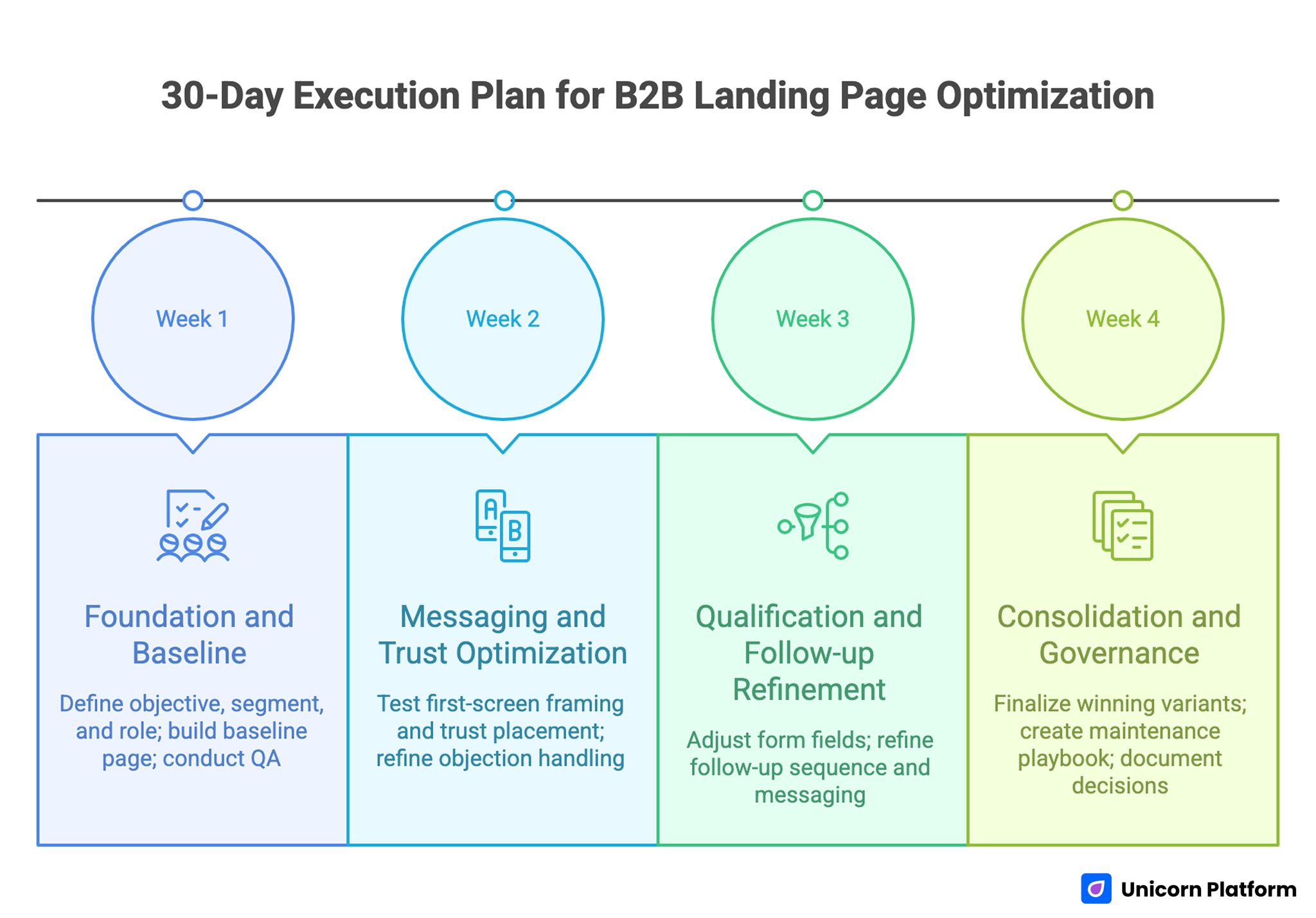
30-Day Execution Plan for B2B Landing Page Optimization
A structured monthly cycle helps improve performance without uncontrolled change. It also creates clear ownership across content, growth, and sales teams.
Week 1: Foundation and baseline
Define objective, primary segment, and page role. Build baseline page in Unicorn Platform with stable section jobs, clear form logic, and confirmation continuity.
Run full device and browser QA before scaling traffic. Fixing usability and routing issues early prevents expensive correction cycles later.
Week 2: Messaging and trust optimization
Test one first-screen framing variant and one trust-placement variant while keeping structure stable. Controlled testing is the fastest way to learn without producing noisy data.
Review source-level completion quality and refine objection handling near commitment zones. Focus edits on the highest-friction sections first.
Week 3: Qualification and follow-up refinement
Adjust first-touch form fields based on routing performance and downstream lead quality. Keep field changes limited so performance shifts remain attributable.
Refine follow-up sequence timing and role-specific messaging using response behavior. Prioritize clarity over promotional tone in every touchpoint.
Week 4: Consolidation and governance
Keep winning variants, remove weak versions, and finalize maintenance playbook for the next cycle. Archive key decisions so future cycles start from proven baselines.
Document rollback conditions and assign clear ownership for live edits. Clear decision authority reduces error risk during high-pressure updates.
Common Failure Modes and Direct Fixes
Failure mode 1: Generic value proposition
Buyers cannot quickly assess relevance. Rewrite first-screen messaging around role context, concrete outcome, and practical next-step expectations.
Failure mode 2: Proof exists but does not resolve objections
Page includes testimonials but not decision-relevant evidence. Replace generic proof with contextual trust elements tied to likely concerns.
Failure mode 3: Overloaded first-step form
Completion drops before trust is established. Reduce required fields and move deeper qualification into staged follow-up.
Failure mode 4: Competing conversion actions
Multiple equal-priority CTAs weaken momentum and data quality. Keep one dominant CTA and route secondary intent to separate flows.
Failure mode 5: Weak post-submit continuity
Conversion occurs, but buyer confidence declines after submit. Improve confirmation clarity and role-aware follow-up cadence.
Failure mode 6: Optimization decisions based on vanity metrics
Form volume increases while qualified outcomes remain flat. Pair volume metrics with quality guardrails and segment-level outcome review.
FAQ: B2B-Landing Pages
How are B2B-landing pages different from B2C conversion pages?
B2B pages usually support longer decision cycles, more stakeholders, and higher perceived risk. They require stronger trust structure, clearer process expectations, and more role-specific relevance.
What should B2B-landing pages include at minimum?
At minimum, include audience fit, concrete value proposition, trust and proof near commitment points, a clear CTA path, and explicit post-submit expectations. This baseline usually supports confident first-stage decisions.
Should I hide navigation on a B2B conversion page?
In many cases, reduced navigation helps maintain focus on the primary action. Use this intentionally and test against your audience behavior and page objective.
How many form fields should a B2B first-step form include?
Use only fields required for immediate routing decisions. Collect deeper qualification later unless your sales process requires early strict screening.
Where should proof elements be placed on the page?
Place proof near high-friction decision moments, especially around CTA and form sections. Proof works best when it answers objections at the point they appear.
How often should I test page variants?
A weekly cadence with one major variable per cycle is usually effective. High-frequency multi-variable changes often reduce learning quality.
Can one page serve both paid and organic acquisition?
Yes, if one dominant intent is preserved and message continuity is maintained from source click to confirmation state. If channel intent diverges significantly, separate variants are usually safer.
What metrics best indicate B2B page health?
Use a balanced set: source intent quality, conversion quality, and downstream progression signals such as accepted opportunities or qualified pipeline movement. This combination gives a more reliable view than top-line volume alone.
How do I improve lead quality without killing conversion rate?
Use staged qualification, clearer value messaging, and trust placement near commitment points. Quality improves when users understand fit and next steps before submitting.
Can Unicorn Platform support a full B2B conversion workflow?
Yes. Unicorn Platform supports fast iteration, and outcomes improve when teams combine that speed with strict structure, QA discipline, and quality-focused measurement.
Final Takeaway
Strong B2B conversion performance comes from system design, not isolated page edits. Teams that align objective clarity, decision architecture, trust placement, qualification logic, and follow-up operations consistently generate better pipeline outcomes.
When B2B-focused pages are treated as full decision systems, they become durable growth assets instead of short-lived campaign experiments. That system-level discipline is what compounds results across multiple campaign cycles.