Will AI replace programmers in 2026? Not fully. But it is already replacing some tasks that programmers used to do manually, especially repetitive drafting, code explanation, test scaffolding, debugging support, and parts of documentation work.
That is why the real question is no longer whether AI writes code at all. It does. The better question is which parts of software work become faster with AI, which parts still need engineers, and how teams should adapt without falling for hype or panic.
This guide gives a direct answer, explains what AI can automate already, shows what still needs human judgment, and breaks down what this shift means for developers, software engineers, and no-code teams building products in 2026.
Quick Answer
No, AI is not replacing programmers as a whole job in 2026. It is replacing some narrow programming tasks, speeding up many others, and changing what strong developers are expected to do. Teams still need people to define systems, review tradeoffs, debug edge cases, protect quality, and make product decisions.
sbb-itb-bf47c9b
Key Takeaways
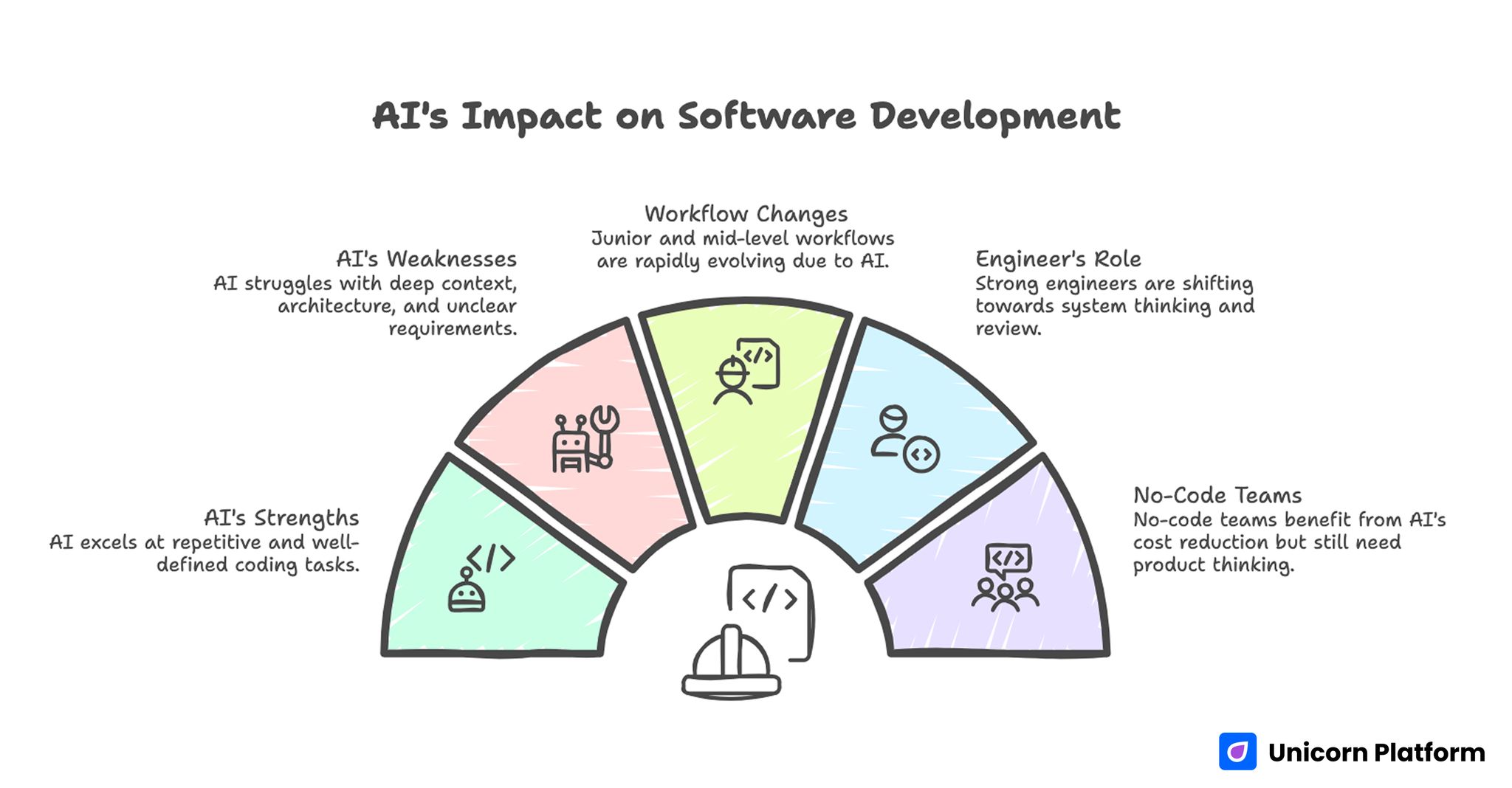
- AI is good at accelerating repetitive and well-bounded coding tasks.
- AI is weak when the work depends on deep context, architecture, product tradeoffs, or unclear requirements.
- Junior and mid-level workflows are changing the fastest because AI can handle more first-draft work.
- Strong engineers are still needed, but their value shifts more toward system thinking, review, integration, and judgment.
-
No-code teams also feel this change because AI lowers the cost of shipping, but it does not remove the need for product thinking and quality control.
AI’s Impact on Software Development
Why People Think AI Will Replace Programmers
People believe AI will replace programmers for a few understandable reasons.
First, the demos are real enough to be convincing. Modern AI tools can already write components, explain errors, suggest fixes, generate tests, and refactor predictable code. That makes the jump from “AI helps programmers” to “AI replaces programmers” feel smaller than it used to.
Second, companies are under pressure to ship faster with leaner teams. When leaders see AI complete work that used to take hours, some assume fewer developers will be needed.
Third, the online conversation is heavily skewed toward extreme claims. Search results, videos, Reddit threads, and AI Overview summaries often amplify the most dramatic interpretations because they attract more attention.
The problem is that software work is not one task. It is a stack of tasks, and AI is strong on some layers but still unreliable on others.
What AI Can Automate Already
AI is already useful for a meaningful part of programming work, especially when the task is well-defined and easy to evaluate.
Tasks AI can often accelerate well
- code scaffolding for common patterns
- unit test drafts
- boilerplate components
- documentation drafts
- code explanation and summarization
- simple bug-hunting support
- SQL and regex suggestions
- migration checklists and refactor suggestions
Why these tasks are vulnerable
These tasks are easier to automate because they usually have:
- clearer inputs
- known patterns
- reusable syntax
- lower strategic ambiguity
That does not mean AI gets them right every time. It means AI can reduce the amount of human effort needed for the first draft.
What Still Needs Engineers and Developers
This is the part that gets lost in the “AI will replace programmers” headline.
AI is still weak when the problem is messy, ambiguous, or costly to get wrong.
Work that still needs strong human ownership
- architecture and system design
- tradeoff decisions across performance, security, cost, and maintainability
- debugging edge cases in real production systems
- product requirement interpretation
- reviewing whether generated code should exist at all
- coordinating work across design, product, infrastructure, and stakeholders
- protecting security, privacy, and compliance
- making judgment calls when the best answer is not obvious
In other words, AI can generate solutions faster than ever, but it still struggles to decide which solution is actually right in context.
Task Split: What AI Replaces vs What Humans Still Own
| Work area | AI can help with | Humans still own |
|---|---|---|
| First-draft coding | boilerplate, repetitive patterns, component drafts | deciding what should be built and how it fits the system |
| Debugging | log interpretation, hypothesis generation, common fixes | root-cause analysis in messy real environments |
| Testing | test case drafts, edge-case suggestions | deciding what actually matters to test and what risk level is acceptable |
| Documentation | summaries, changelog drafts, docs formatting | accuracy, completeness, audience fit, and product truth |
| Architecture | pattern suggestions and tradeoff comparisons | real system design, constraints, and long-term maintainability |
| Product delivery | implementation ideas and copy support | prioritization, sequencing, quality control, and accountability |
This is the core nuance the article needs to make visible early: AI is not replacing the full role. It is compressing some of the lower-level or first-pass work inside the role.
Which Programming Roles Are Most Exposed
Not every role is affected equally.
More exposed roles and tasks
- highly repetitive implementation work
- narrow CRUD-heavy internal tools
- low-context code drafting
- basic test generation
- simple transformation or glue-code tasks
Less exposed roles and tasks
- staff-level architecture work
- security-sensitive systems
- infrastructure with complex failure modes
- product engineering where tradeoffs matter more than syntax
- leadership roles that connect technical work to business outcomes
This is one reason why the future is unlikely to be “AI replaces all programmers.” It is much more likely to be “AI reduces the value of some narrow tasks and increases the value of judgment-heavy work.”
How the Job Changes Instead of Disappearing
The strongest programmers in 2026 do not just write code. They:
- shape the problem
- evaluate the output
- combine multiple tools
- review the system impact
- catch subtle failure modes
- protect trust and quality
That means the job shifts from:
- manual production of every line
toward:
- directing systems
- reviewing output
- integrating components
- deciding what good looks like
This is why many engineers feel both pressure and leverage at the same time. AI makes parts of the job easier, but it also raises expectations around speed, judgment, and decision quality.
Will AI Replace Software Engineers or Junior Developers First?
If any part of the market feels the pressure first, it is usually work that depends heavily on first-draft implementation rather than deeper ownership.
That can create more pressure on:
- junior coding tasks
- task executors with narrow scopes
- teams that mainly add standard features without much product or architectural complexity
But even there, the outcome is not simple replacement. Companies still need people who can:
- validate the output
- connect requirements to systems
- catch mistakes before they become expensive
- understand where AI is confidently wrong
So the more accurate answer is:
- AI may reduce the amount of purely mechanical coding work
- but it does not eliminate the need for capable people who understand how software actually works
What This Means for No-Code Teams and Technical Teams
This topic matters beyond traditional engineers.
For no-code teams, AI lowers the cost of moving from idea to first draft. Teams can generate copy, page structures, feature outlines, basic automations, and even pieces of functional logic much faster than before.
That is useful, but it creates a second challenge: if more teams can ship faster, then weak positioning, weak UX, and weak quality become more visible. AI lowers the cost of producing output. It does not lower the need for good judgment.
For technical teams
The win is speed, but the risk is false confidence.
For no-code teams
The win is leverage, but the risk is publishing work that feels complete while still missing product clarity or quality controls.
That is why the better question is not “Will AI replace us?” It is:
- which parts of our workflow should AI accelerate
- which parts still need careful human review
Common Mistakes in the AI Replacement Debate
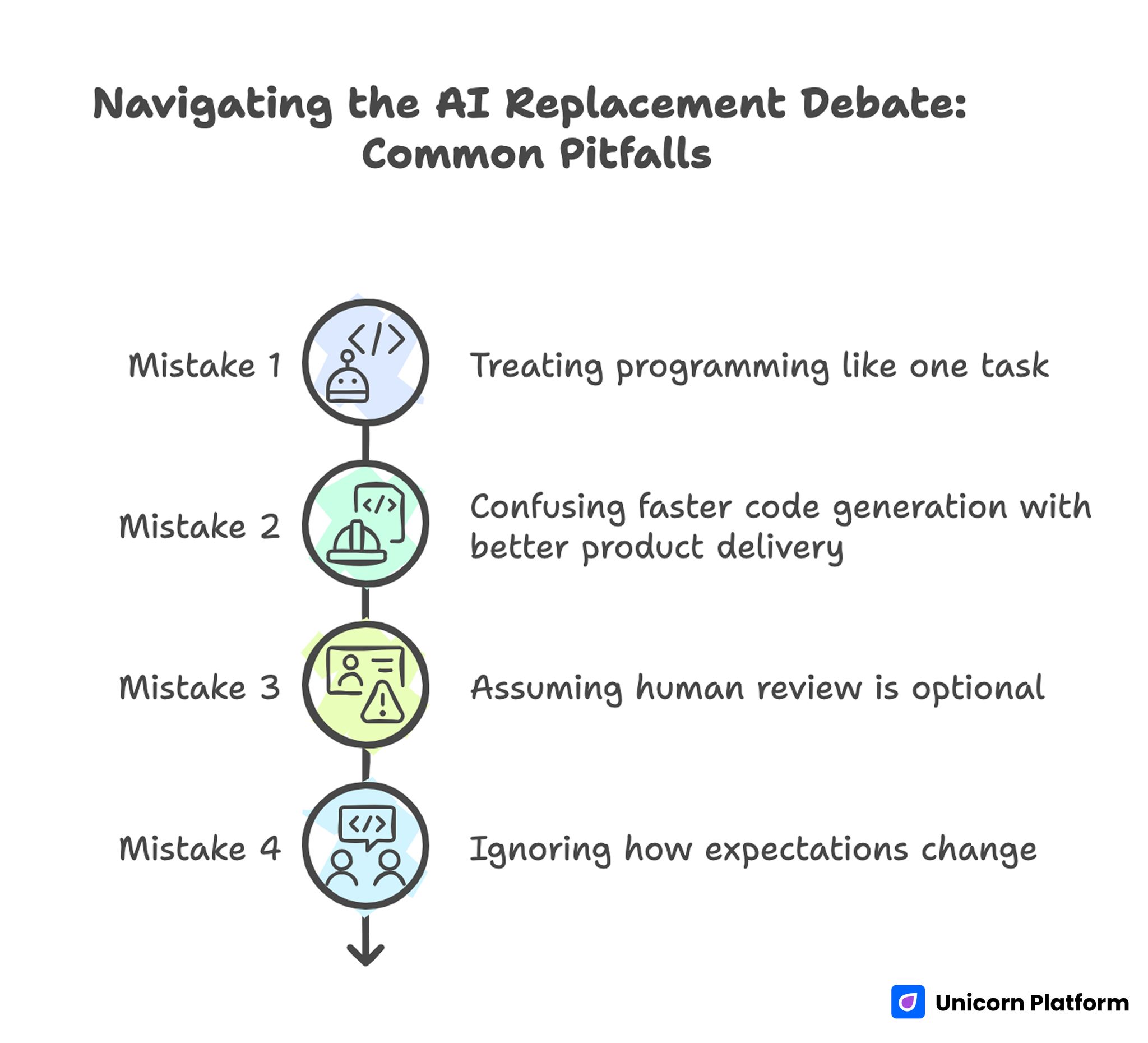
Mistake 1: treating programming like one task
Programming is many tasks. AI can automate some of them much better than others.
Mistake 2: confusing faster code generation with better product delivery
Generating code faster does not automatically mean building the right thing or reducing long-term complexity.
Mistake 3: assuming human review is optional
This is where many teams get burned. AI can draft quickly, but review, prioritization, and system judgment still matter.
Mistake 4: ignoring how expectations change
Even if AI does not replace programmers, it changes what strong programmers are expected to do. Speed alone is no longer the only differentiator.
A More Useful Way to Think About the Future
If you are asking whether AI will replace programmers, the strongest practical answer is this:
AI will replace some low-context programming tasks, compress some teams, and change how software gets built. But it will not remove the need for people who can define problems, evaluate tradeoffs, and own the quality of real systems.
That means the safest long-term strategy is not denial and not hype. It is learning how to work with AI while getting better at the parts of the job AI still handles poorly.
Navigating the AI Replacement Debate: Common Pitfalls
FAQ
Will AI replace programmers in 2026?
No, not as a whole job. AI replaces some tasks and accelerates many others, but programmers are still needed for architecture, review, debugging, product judgment, and system-level decisions.
Will AI replace software engineers?
Not fully. The role changes, especially in how much first-draft implementation AI can handle, but software engineers still own context-heavy and judgment-heavy work.
Which programming tasks are most at risk from AI?
The most exposed tasks are repetitive implementation work, boilerplate generation, simple test drafting, and other well-bounded tasks that are easy to pattern-match.
Will junior developers be affected more than senior developers?
Often yes, because junior work can include more first-draft implementation tasks. But companies still need people at every level who can evaluate output, learn fast, and build with good judgment.
Is AI bad news for no-code teams?
Not necessarily. AI can make no-code teams much faster. The real challenge is using that leverage without lowering quality, clarity, or trust.
What is the best response for teams right now?
Use AI to accelerate drafting and repetitive work, but keep human review on architecture, quality control, positioning, and user-facing decisions.
Final Takeaway
Will AI replace programmers? No, not in the simple way the headline suggests.
What is happening instead is more important: AI is reshaping the task mix inside programming, changing how teams ship software, and increasing the value of people who can judge output instead of just produce it.
The teams that adapt best will not be the ones that ignore AI or the ones that blindly trust it. They will be the ones that learn where AI is useful, where it is risky, and where human ownership still matters most.