Table of Contents
- The Main Psychological Drivers Behind NFT Rejection
- How Unicorn Platform Users Can Apply This
- Practical Content Plan for Web3 Founders
- FAQ
NFTs created one of the strongest public reactions in recent tech history. Some communities saw them as a breakthrough for ownership and digital economics. Others saw them as speculative noise, environmental harm, and low-quality hype. Both views spread fast, and the conflict became cultural, not only technical.
For founders and creators, this backlash still matters. Even when your product is not an NFT marketplace, users often carry skepticism from that era into any Web3-adjacent idea. If your messaging is vague or overpromising, trust drops immediately.
This guide explains the core reasons people pushed back against NFTs and how you can communicate Web3 products more effectively today. It is written for Unicorn Platform users who need practical guidance for positioning, landing page clarity, and trust-building in skeptical markets.
sbb-itb-bf47c9b
Key Takeaways
NFT Backlash Drivers and Solutions
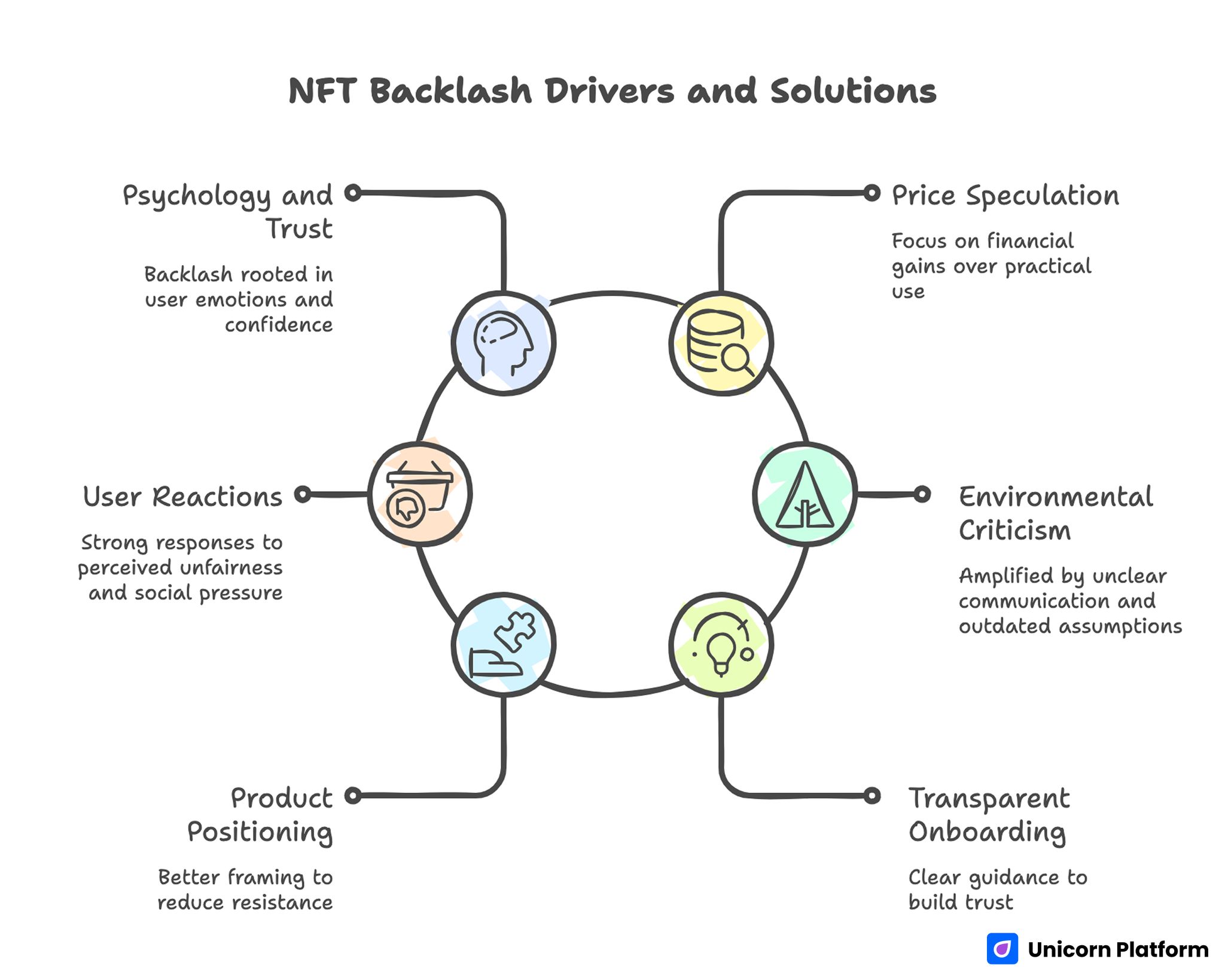
- NFT backlash was driven by psychology and trust issues as much as by technology.
- Price speculation overshadowed most real utility use cases.
- Users reacted strongly to perceived unfairness, confusion, and social signaling pressure.
- Environmental criticism was amplified by unclear communication and outdated assumptions.
- Better product positioning and transparent onboarding can reduce resistance.
- Unicorn Platform users can build calmer, trust-first pages that explain value without hype language.
Why Backlash Became So Intense
Most technology trends face criticism. NFTs triggered something stronger because multiple frustrations arrived at the same time: economic inequality concerns, scam headlines, low usability, and social-media-driven status behavior.
Many people first encountered NFTs through extreme price stories, celebrity promotions, and scams rather than through useful everyday applications. That first impression shaped long-term perception. Once users classify a category as “mostly hype,” every legitimate use case has to fight extra skepticism.
This is why communication strategy matters. In trust-sensitive categories, the story users hear first becomes the filter for everything else.
The Main Psychological Drivers Behind NFT Rejection
1. Perceived lack of intrinsic value
Many users asked a simple question: why pay significant money for a token linked to digital media that can be copied visually? The technical answer about ownership and provenance did not feel persuasive to everyone, especially outside crypto-native communities.
When perceived value is unclear, people default to suspicion. They assume the market is driven by speculation rather than utility.
2. Status anxiety and social signaling
NFT culture often looked performative from the outside. Profile-picture collections, public price bragging, and exclusivity language created a social divide. Some users saw this as community building, while others saw it as status theater.
When technology appears to reward social signaling more than practical outcomes, mainstream trust declines quickly.
3. Fear of manipulation
Market behavior looked volatile and difficult to interpret. Rapid pumps, influencer endorsements, and sudden collapses reinforced the idea that average participants were at a disadvantage.
Even users open to innovation became cautious when price movement seemed disconnected from understandable fundamentals.
4. Cognitive overload
Wallets, chains, gas fees, bridges, and contract risks created onboarding friction. For non-technical users, the learning curve felt too steep compared to perceived benefit.
If the first interaction with a product feels confusing, users often conclude the category is not ready.
The Role of Scams and Low-Quality Projects
Backlash intensified because the market had many opportunistic launches with weak product substance. Rug pulls and copycat projects received disproportionate attention in mainstream media, and that attention shaped public narrative.
The problem was not only fraud. It was also low execution quality. Many projects marketed “community” and “future utility” without clear delivery plans. Users learned to expect vague promises and delayed outcomes.
For founders today, this lesson is critical: clarity and operational proof beat hype every time.
Environmental Criticism and Narrative Gaps
Environmental concerns became one of the biggest public objections. Many people associated NFTs with high energy consumption based on proof-of-work era discussions. Even after major infrastructure changes reduced energy intensity in some ecosystems, public perception changed more slowly.
The gap between technical reality and public understanding created communication failure. Founders who ignored this concern lost trust quickly. Founders who addressed it transparently were more likely to keep user attention.
The practical lesson is straightforward: explain tradeoffs clearly, use current facts, and avoid defensive tone.
Cultural Clash: Web3 Values vs Mainstream Expectations
NFT culture often promoted decentralization, ownership autonomy, and permissionless participation. Mainstream users often prioritized convenience, consumer protection, and predictable pricing.
Neither side is inherently wrong. The conflict came from value mismatch. Products built for early adopters were marketed to mainstream audiences without adapting messaging or risk framing.
When audience values are misread, even strong technology can fail in communication.
Media Dynamics and the Backlash Loop
Media cycles amplified extreme outcomes: largest sales, biggest collapses, highest-profile scams. This made the entire category feel unstable and polarized.
At the same time, slower utility stories received less attention. Scientific publishing experiments, licensing models, and provenance use cases existed, but they rarely shaped mainstream perception.
For builders, this means one thing: you cannot rely on category reputation. Your product narrative must stand on its own with concrete user value.
What Actually Works: Utility-First Positioning
The strongest projects moved away from speculative language and focused on practical use cases:
- verifiable ownership records
- digital provenance for creators
- access and membership models tied to clear benefits
- funding mechanisms with transparent rules
- programmable licensing and rights management
Utility-first positioning does not eliminate skepticism, but it makes evaluation easier for serious users.
How Unicorn Platform Users Can Apply This
Building Trust in Web3 and NFT Project
This section is the practical core for teams building Web3 or NFT-adjacent pages.
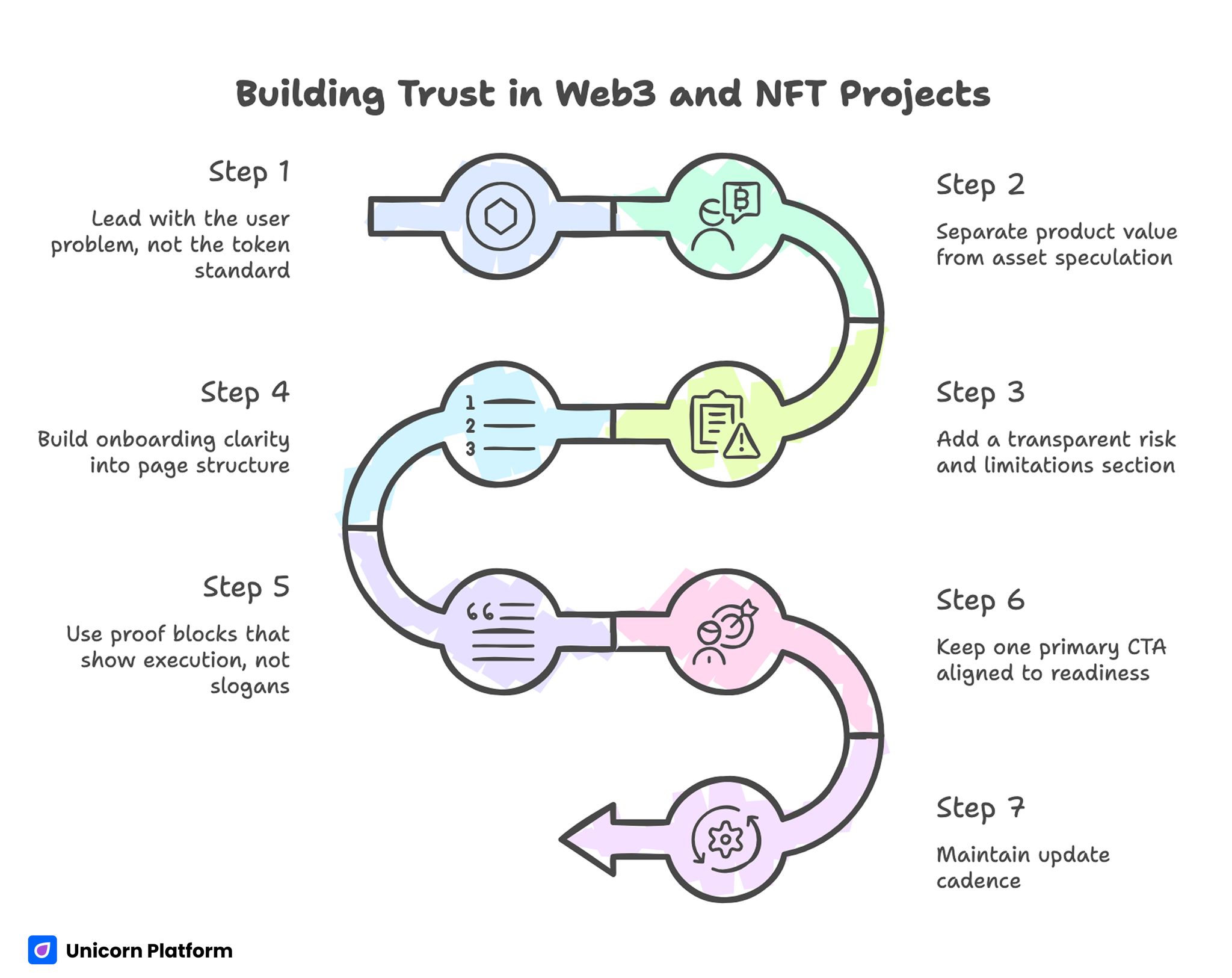
Step 1: Lead with the user problem, not the token standard
Your first screen should describe what user pain is solved. Do not open with technical jargon. Explain the outcome in plain language before introducing architecture details.
Step 2: Separate product value from asset speculation
If your offer includes NFTs, define what the token enables functionally. Avoid messaging that centers on price appreciation or market timing. Trust grows when utility is explicit.
Step 3: Add a transparent risk and limitations section
Include a concise block explaining constraints, risks, and what your product does not promise. This reduces fear and differentiates you from hype-driven projects.
Step 4: Build onboarding clarity into page structure
Use a step-by-step section: create wallet, connect account, complete action, understand fees. Lowering cognitive load improves conversion quality.
Step 5: Use proof blocks that show execution, not slogans
Show product milestones, real workflows, and support standards. Avoid generic “next-gen” claims.
Step 6: Keep one primary CTA aligned to readiness
If your audience is skeptical, “Learn how it works” may convert better than “Mint now.” Match CTA to trust stage.
Step 7: Maintain update cadence
Web3 messaging ages quickly. Review pages monthly and update onboarding, risk framing, and feature details as infrastructure changes.
Landing Page Framework for Skeptical Audiences
Use this structure in Unicorn Platform for better clarity:
- Outcome headline in plain language.
- Problem explanation with audience relevance.
- How it works in three to five steps.
- Risk and transparency block.
- Practical benefits list.
- Credibility and delivery proof.
- FAQ focused on trust objections.
- One clear next action.
This framework improves comprehension and reduces drop-off from uncertainty.
Messaging Patterns to Avoid
Avoid these patterns if you want mainstream trust:
- vague promises about future utility
- aggressive scarcity language without context
- investment-like framing for non-investment products
- unexplained technical terminology
- excessive insider tone
Users do not reject complexity when it is explained well. They reject ambiguity disguised as certainty.
Rebuilding Trust After Category-Level Hype
If your audience already associates NFTs with scams or speculation, you need a trust-recovery approach.
Use this sequence:
- acknowledge skepticism directly
- explain your specific use case
- clarify what is and is not being sold
- show real process and support flow
- offer low-commitment entry path
This approach lowers defensiveness and gives users control over evaluation.
Practical Content Plan for Web3 Founders
A strong content plan can shift perception over time.
Monthly content mix:
- one educational article on product mechanics
- one real workflow case example
- one transparency update on roadmap and limitations
- one FAQ update based on support questions
The goal is progressive trust, not one-time persuasion.
FAQ: Why So Many People Rejected NFTs
1. Why did public opinion around NFTs become so negative?
Because many people first saw speculation, scams, and confusing onboarding instead of clear utility.
2. Are NFTs still useful in 2026?
They can be useful when tied to concrete outcomes like provenance, access logic, licensing, or verifiable ownership workflows.
3. How should startups explain NFT features to non-technical users?
Start with the user problem and outcome, then explain technical components only as needed for understanding.
4. Should NFT products mention price upside on landing pages?
For most products, no. Utility and trust messaging usually perform better and reduce skepticism.
5. What is the biggest conversion blocker for Web3 pages?
Unclear value combined with confusing onboarding steps.
6. How can Unicorn Platform users reduce NFT skepticism on their pages?
Use clear structure, transparent risk communication, practical examples, and readiness-aligned CTAs.
7. Is environmental criticism still relevant for NFT communication?
Yes. You should address it clearly with current context and avoid dismissive language.
8. What kind of proof works best for skeptical audiences?
Execution proof: product milestones, support standards, and practical usage outcomes.
9. Can a project recover from early hype-driven messaging?
Yes, but recovery requires consistent utility-first communication and transparent delivery updates.
10. What should founders optimize first on existing NFT pages?
Headline clarity, onboarding simplicity, and trust sections that explain risks and process.
Final Takeaway
NFT backlash happened because trust was broken at the intersection of speculation, complexity, and communication failure. Founders who want long-term adoption should build pages and products around clarity, transparency, and practical user value. For Unicorn Platform users, a structured trust-first content workflow is the most reliable way to convert skeptical audiences into informed participants.