Table of Contents
- The Decision Sequence That Improves Registration Quality
- 30-Day Implementation Plan
- Common Failure Modes and Practical Fixes
- FAQ
Most event teams do not struggle to get initial attention. They struggle to convert that attention into qualified registrations and real attendance. A campaign can generate clicks and still fail commercially when the registration flow does not explain value, trust, and logistics with enough clarity.
That gap appears in predictable ways. People open the page, skim a few lines, hesitate on whether the session is relevant, and leave. Others register with low intent and never show up. In both cases, the page is not guiding decisions effectively.
High-performing event signup pages work as structured decision systems, not announcement posters. They help visitors answer five questions quickly: is this relevant, what will I gain, who is speaking, how does attendance work, and what happens after I register.
Unicorn Platform is useful because teams can iterate quickly while keeping one stable page architecture. Launch schedules move fast, and messaging changes often. Speed helps only when structure remains consistent enough for clean testing and reliable performance.
sbb-itb-bf47c9b
Quick Takeaways
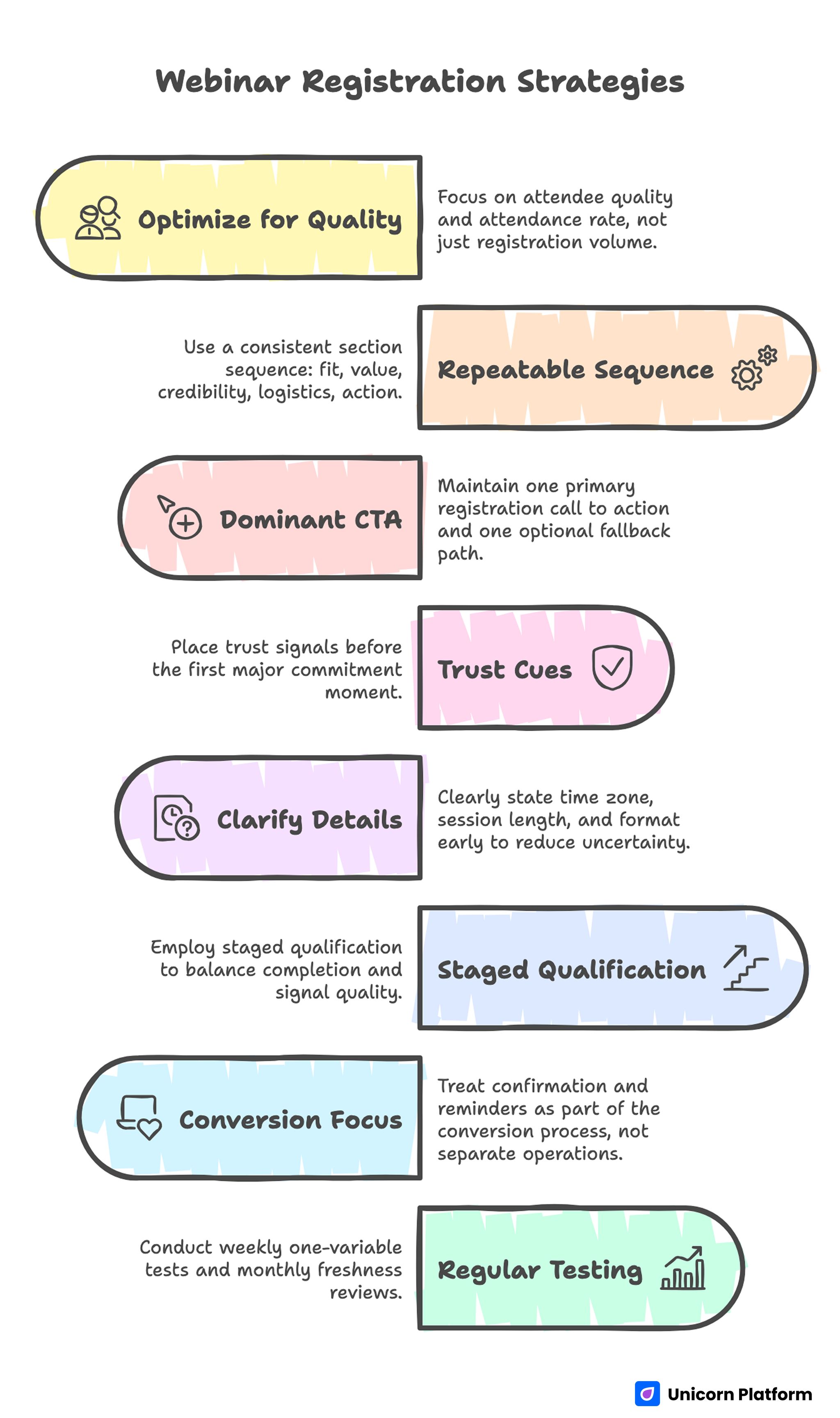
Webinar Registration Strategies
- Optimize for attendee quality and attendance rate, not registration volume alone.
- Use a repeatable section sequence: fit, value, credibility, logistics, action.
- Keep one dominant registration CTA and one optional fallback path.
- Place trust cues before the first major commitment moment.
- Clarify time zone, session length, and format early to reduce uncertainty.
- Use staged qualification to balance completion and signal quality.
- Treat confirmation and reminders as part of conversion, not separate operations.
- Run weekly one-variable tests and monthly freshness reviews.
Why Event Signup Funnels Underperform
Underperformance often starts with mixed priority messaging. Pages try to explain every event detail at once, with no clear hierarchy. Visitors face too much information and too little direction.
The second issue is vague outcomes. Teams describe sessions as "insightful" or "valuable" without stating concrete participant takeaways. Without clear outcomes, potential attendees cannot justify time investment.
The third issue is delayed trust. Speaker credibility, event reliability, and delivery confidence appear too late in the page. Visitors reach commitment moments before they feel confident enough to register.
The fourth issue is operational mismatch. The page promise and post-registration communication are disconnected. Users sign up expecting one experience and receive another, which lowers show-up intent and brand trust.
Finally, measurement is often too shallow. Teams track form submissions but do not evaluate confirmation completion, reminder engagement, attendance quality, or post-event conversion behavior.
The Decision Sequence That Improves Registration Quality
Effective event pages typically follow one sequence: fit, outcome, proof, logistics, and action.
Fit defines who the session is for. Outcome explains what participants will learn or accomplish. Proof validates speaker expertise and event reliability. Logistics removes uncertainty around scheduling and access. Action makes commitment simple and immediate.
When this order breaks, conversion quality drops. Asking for registration before communicating relevance invites low-intent submissions. Presenting logistics without value context reduces motivation. Showing proof after the form weakens confidence at the wrong time.
Teams refining structure can use this event registration page guide as a practical reference for sequencing decisions.
First-Screen Clarity: The Highest-Leverage Block
The first screen should resolve three questions in seconds: who should attend, what practical outcome they get, and what to do next.
Strong first-screen copy is outcome-led and specific. Weak first-screen copy relies on broad claims about innovation, trends, or thought leadership without operational value.
A useful first-screen pattern includes audience signal, one concrete session outcome, one credibility cue, and one clear action. This creates confidence without overwhelming users.
A Simple Drafting Formula for Event Openers
- Audience context: who this session is designed for.
- Outcome statement: what participants will leave with.
- Session format: how value will be delivered.
- Action cue: what to click now.
If the opener cannot answer these four elements clearly, registration quality will likely suffer.
Outcome Architecture: Make Value Concrete
Event value should be framed as practical outcomes, not promotional language. Visitors commit time when they can predict what the session will help them do.
A strong outcome block typically includes one strategic takeaway, one tactical framework, and one real implementation angle. This balance appeals to both decision-makers and operators.
Outcome architecture also improves internal alignment. Marketing, speaker prep, and follow-up content can align around shared value promises, reducing messaging drift across the funnel.
Speaker and Credibility Design
Speaker information should reduce risk, not consume attention. Long biographies with little relevance can dilute conversion. Visitors need concise credibility context tied directly to session outcomes.
Use a compact format: expertise signal, domain relevance, and practical contribution to this specific session. This helps visitors quickly understand why the speaker is qualified to deliver value.
Credibility can also include operational trust elements such as prior event execution quality, support responsiveness, or session resource availability.
Logistics Clarity as a Conversion Lever
Logistics friction is a major cause of abandoned registrations. Unclear time zones, uncertain platform details, and missing session length information all increase hesitation.
Logistics should be explicit and easy to scan. Include date, time zone, duration, access method, and replay policy in one concise section.
If the campaign includes limited seats, waiting lists, or multiple sessions, explain selection and access logic clearly. Hidden constraints reduce trust and increase support burden.
For teams that manage booking-style flows alongside events, this reservation funnel blueprint can help tighten schedule and action clarity.
Form Strategy: Balance Completion and Qualification
Registration forms should collect data needed for routing decisions while preserving completion rate. Overly long forms reduce volume and frustrate mobile users.
A strong first-step form usually includes name, email, and one intent field such as role or key challenge. This provides enough segmentation signal without heavy friction.
Additional qualification can happen post-registration through confirmation flows and short preference prompts. This staged approach protects conversion and improves downstream personalization.
Field Audit Checklist
- Does each field serve a specific follow-up action?
- Can the same signal be collected later without losing quality?
- Does the field increase friction more than it increases value?
- Is the field mobile-friendly and clear?
If a field fails this audit, remove or defer it.
CTA Hierarchy and Decision Flow
Multiple equal CTAs create uncertainty. Visitors should see one dominant registration path and one secondary route for adjacent intent, such as agenda preview or speaker details.
CTA wording should reflect user value, not internal process. Action language tied to outcome generally performs better than generic submission labels.
CTA placement should match page sequence. Primary action should appear after value and trust are clear, then repeat at logical intervals for scannable behavior.
Mobile Registration Experience
A significant share of event traffic comes from mobile channels, especially social and community campaigns. Small UI issues can materially reduce quality registrations.
Mobile QA should cover first-screen readability, CTA visibility, field interaction comfort, keyboard behavior, and confirmation flow continuity. Testing on real devices is mandatory.
Teams should also evaluate drop-off by source on mobile. A channel-specific friction point can hide inside blended performance metrics.
Attendance Is the True Conversion Goal
Registration is an intermediate step, not final success. High-performing funnels optimize for attended sessions and meaningful participation quality. his focus is supported by industry benchmarks. This focus is supported by industry benchmarks. Data shows that average webinar attendance rates typically range between 40% and 50% of total registrations, meaning a large share of signups never convert into real participation without strong pre-event communication and expectation alignment.
That requires continuity between page messaging and post-registration communication. Confirmation pages, reminder emails, and calendar prompts should reinforce the same value narrative established on the page.
When this continuity is weak, no-show rates rise even with high registration counts. Strong attendance outcomes come from expectation stability across the full pre-event journey.
Confirmation and Reminder Operations
Confirmation should happen immediately with clear next steps. Users should know what they registered for, when it happens, and how access will work.
Reminder sequencing should be predictable and concise. Include session value refresher, time confirmation, and one-click access instructions. Avoid excessive messaging that feels repetitive.
Reminder design can also include light re-engagement prompts, such as one question attendees want answered. This increases commitment and helps speakers tailor delivery.
Channel-Aware Message Variants Without Chaos
Traffic from email, paid social, partnerships, and communities carries different context. One universal message often underperforms across these channels.
The strongest approach is one canonical template with controlled message variations by source. Adjust headline emphasis, proof order, and CTA wording while preserving core structure.
This improves relevance while keeping operations manageable. Teams can compare results cleanly because architecture remains stable.
Post-Event Conversion Bridge
Event funnels should not end at attendance. High-value sessions should connect to a defined post-event action path: replay access, resource delivery, consultation route, or product trial.
The page should set expectations for this continuation before registration. Doing so increases both attendance intent and downstream conversion readiness.
Post-event continuity also strengthens attribution. Teams can connect pre-event messaging choices to later pipeline outcomes with higher confidence.
Analytics Model for Event Program Quality
A reliable measurement framework has three layers. Layer one tracks registration mechanics: form starts, submissions, and confirmation completion. Layer two tracks attendance behavior: show-up rate, watch duration, and engagement signals. Layer three tracks business outcomes: post-event conversion, qualified follow-up, and revenue contribution.
Each campaign should define one primary metric and one guardrail metric. For example, primary might be qualified attendance rate, while guardrail could be unsubscribe or drop-off behavior in reminder sequences.
This prevents teams from optimizing toward vanity gains that reduce long-term program value.
Practical Metric Pair Examples
- Top-of-funnel campaign: primary is completed registrations, guardrail is confirmation engagement quality.
- Mid-funnel campaign: primary is attended sessions, guardrail is early-session drop-off rate.
- Pipeline campaign: primary is post-event qualified actions, guardrail is no-show trend.
Metric discipline improves decision quality and protects program health.
Weekly Operating Rhythm for Event Teams
A repeatable cadence keeps launch execution focused under schedule pressure. Without one, teams make too many simultaneous changes and lose attribution clarity.
A practical cycle: Monday performance review, Tuesday hypothesis selection, Wednesday controlled update, Thursday QA pass, Friday decision and documentation.
One major variable per cycle is usually sufficient. If headline, form length, and speaker block all change at once, insights become noisy and hard to operationalize.
Scenario: Fixing High Registrations and Low Attendance
A B2B team generated solid registration volume but poor attendance consistency. Page analytics looked healthy, yet reminder engagement and live participation were weak.
Audit revealed three issues. First, the page opener was broad and did not state concrete participant outcomes. Second, time-zone clarity was weak for international traffic. Third, reminders repeated logistics but did not reinforce session value.
The team rebuilt the page in Unicorn Platform using a fit-outcome-proof-logistics-action sequence, simplified form fields, and added clear expectation messaging at registration and confirmation stages.
Within two campaign cycles, attendance quality improved with stable registration volume. The largest gains came from clearer outcomes and better pre-event continuity.
30-Day Implementation Plan
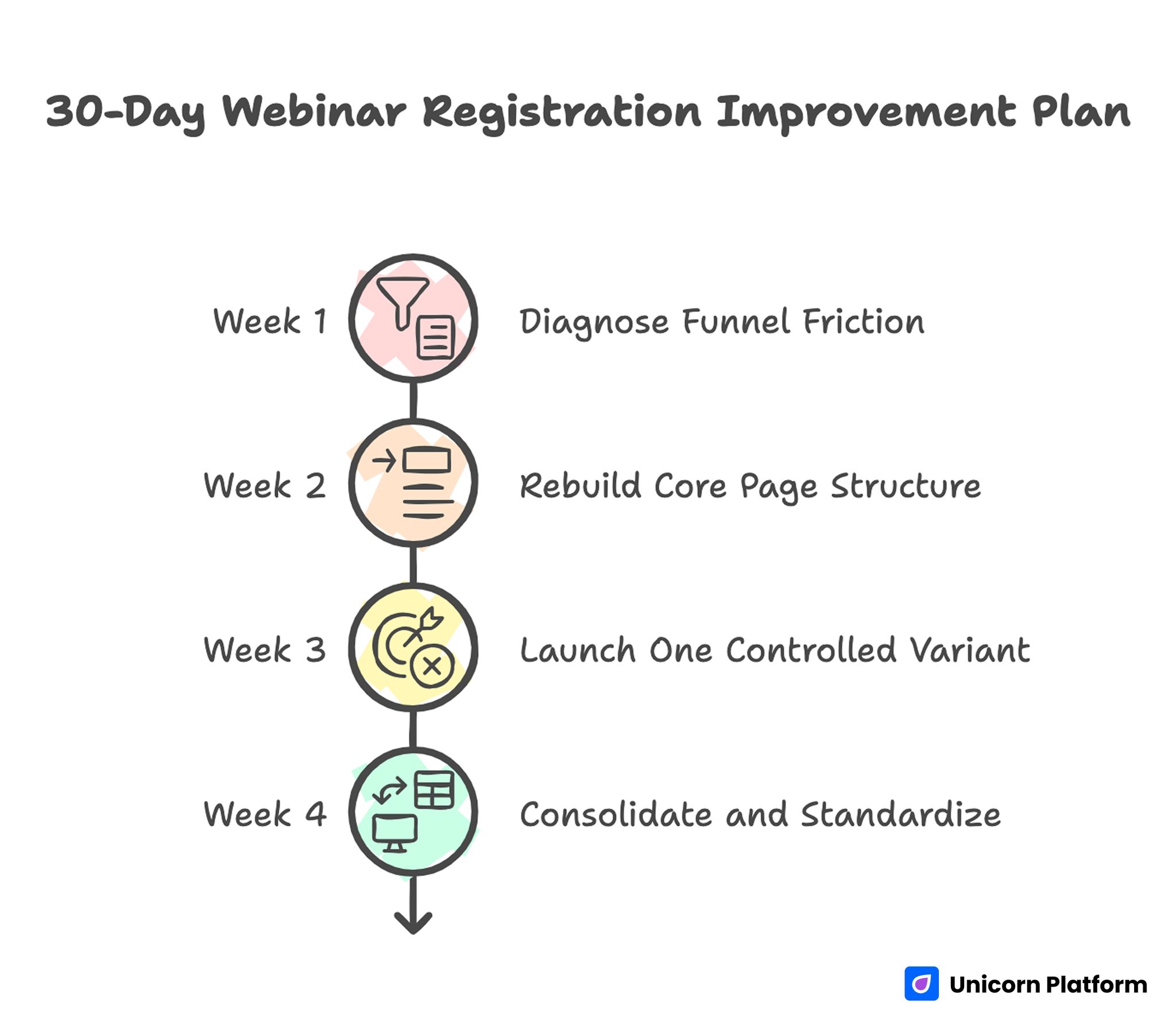
30-Day Webinar Registration Improvement Plan
Week 1: Diagnose Funnel Friction
Audit the current page against decision stages and identify the highest-leak section. Review confirmation and reminder performance to locate continuity breaks.
Define one primary and one guardrail metric before any changes. Remove conflicting CTAs and outdated logistics blocks.
Week 2: Rebuild Core Page Structure
Rewrite first-screen copy for audience fit and tangible outcomes. Tighten speaker proof and add clear logistics visibility above major commitment points.
Streamline form fields and ensure mobile interaction quality through real-device testing.
Week 3: Launch One Controlled Variant
Create one source-specific message variant from the same template. Change only high-impact copy surfaces and keep architecture stable.
Run one test with predefined success and rollback criteria. Track both registration quality and attendance guardrails.
Week 4: Consolidate and Standardize
Promote validated improvements to the base template. Archive losing variants and record decisions in a campaign log.
Schedule monthly freshness updates for speaker proof, logistics clarity, and CTA messaging.
90-Day Scale Plan
Month 2: Expand by Session Type
Extend the base template for workshop sessions, expert panels, and product demos while preserving the same conversion sequence.
Build reusable modules for agenda previews, speaker proofs, and expectation blocks to accelerate launches without quality loss.
Month 3: Operationalize Reliability
Formalize release gates for route integrity, mobile behavior, reminder timing, and measurement validation.
Define ownership lanes for messaging, speaker content, logistics, and final QA so accountability stays clear under fast cycles.
Common Failure Modes and Practical Fixes
1) Vague Opening Message
The opener explains the event theme but not attendee outcomes. Replace broad positioning with specific value and audience fit.
2) Overloaded Page Structure
Too many equal-priority sections weaken decision flow. Rebuild around one clear sequence and remove low-value content blocks.
3) Late Credibility Signals
Speaker proof appears after commitment asks. Move trust cues earlier and tie them to attendee outcomes.
4) Unclear Logistics
Time, duration, or access details are hard to find. Consolidate logistics into one prominent, scannable block.
5) Form Friction
Excessive fields reduce completion quality on mobile and desktop. Use staged qualification and keep first-step capture lean.
6) CTA Competition
Multiple primary actions fragment intent. Keep one dominant path and a controlled secondary option.
7) Weak Confirmation Continuity
Post-signup communication does not reinforce value. Add immediate confirmation with clear next steps and expectations.
8) Reminder Fatigue
Reminder messages repeat logistics without renewing motivation. Include concise value context and relevance cues.
9) Volume-Only Measurement
Registrations rise while attendance quality declines. Use layered metrics tied to show-up and downstream outcomes.
10) No Freshness Cadence
Speaker info, logistics, or promises become outdated. Run scheduled updates and retire stale copy proactively.
Pre-Launch QA Checklist
Confirm first-screen fit, outcome clarity, and clear primary action. Verify that each section has one job in the decision sequence.
Check speaker proof quality, logistics visibility, form simplicity, and route integrity. Validate mobile behavior on real devices before scaling traffic.
Ensure confirmation and reminder flows align with page promise. Confirm tracking for primary and guardrail metrics and require final owner sign-off.
FAQ: Webinar Registration Strategy
What should event teams optimize first?
Start with first-screen value clarity and logistics visibility. These two changes usually move registration quality fastest.
Should every campaign use the same page structure?
Use one base structure and adapt message emphasis by session type or source. Consistent architecture improves testing quality.
How many form fields are ideal?
Collect only routing-critical data at first touch. Additional context can be captured after confirmation.
What matters more, registrations or attendance?
Attendance quality matters more for program value. Registration volume is useful only when participants actually engage.
How do teams reduce no-show rates?
Strengthen expectation clarity at signup and use reminders that combine logistics with value reinforcement.
Where should speaker information appear?
Place concise credibility context before or near the first major CTA so trust is available at decision time.
How often should event pages be updated?
Run monthly freshness checks and additional updates whenever session goals, speakers, or logistics change.
What is the biggest mobile mistake?
Assuming desktop clarity translates automatically. Real-device testing reveals interaction issues that emulators miss.
When should a page variant be rolled back?
Rollback is appropriate when guardrail metrics decline materially and targeted fixes fail to recover quality in the test window.
What creates compounding event funnel performance?
Stable structure, disciplined experimentation, strong communication continuity, and quality-focused measurement.
Final Takeaway
High-performing event registration funnels are built on clarity, trust, and operational discipline. Teams that optimize only for submissions often create unstable attendance and weak downstream outcomes.
Unicorn Platform enables a stronger model: rapid iteration on stable architecture with clean measurement loops. Keep decision flow clear, logistics explicit, and follow-up continuity strong so campaign interest turns into engaged participation.

