Table of Contents
- Why Travel Routes Underperform Even With Good Traffic
- 30-60-90 Day Execution Plan
- Common Failure Patterns and Fixes
- FAQ
Travel traffic is often high-intent but fragile. Visitors may arrive inspired, yet booking decisions happen only when a page answers practical concerns quickly: offer fit, total cost logic, flexibility, trust, and what happens after payment.
Many travel brands lose this moment by prioritizing visual appeal over decision clarity. Beautiful pages can still underperform when policy terms are hidden, package details are vague, or next steps feel uncertain.
A durable approach combines emotional appeal with operational transparency. Teams that build this balance consistently convert more direct demand and reduce dependency on high-fee intermediaries.
Unicorn Platform helps because teams can launch and adjust campaign routes quickly as seasonality, pricing, and package structure change. That speed is most valuable when route updates are tied to clear conversion priorities.
sbb-itb-bf47c9b
Quick Takeaways
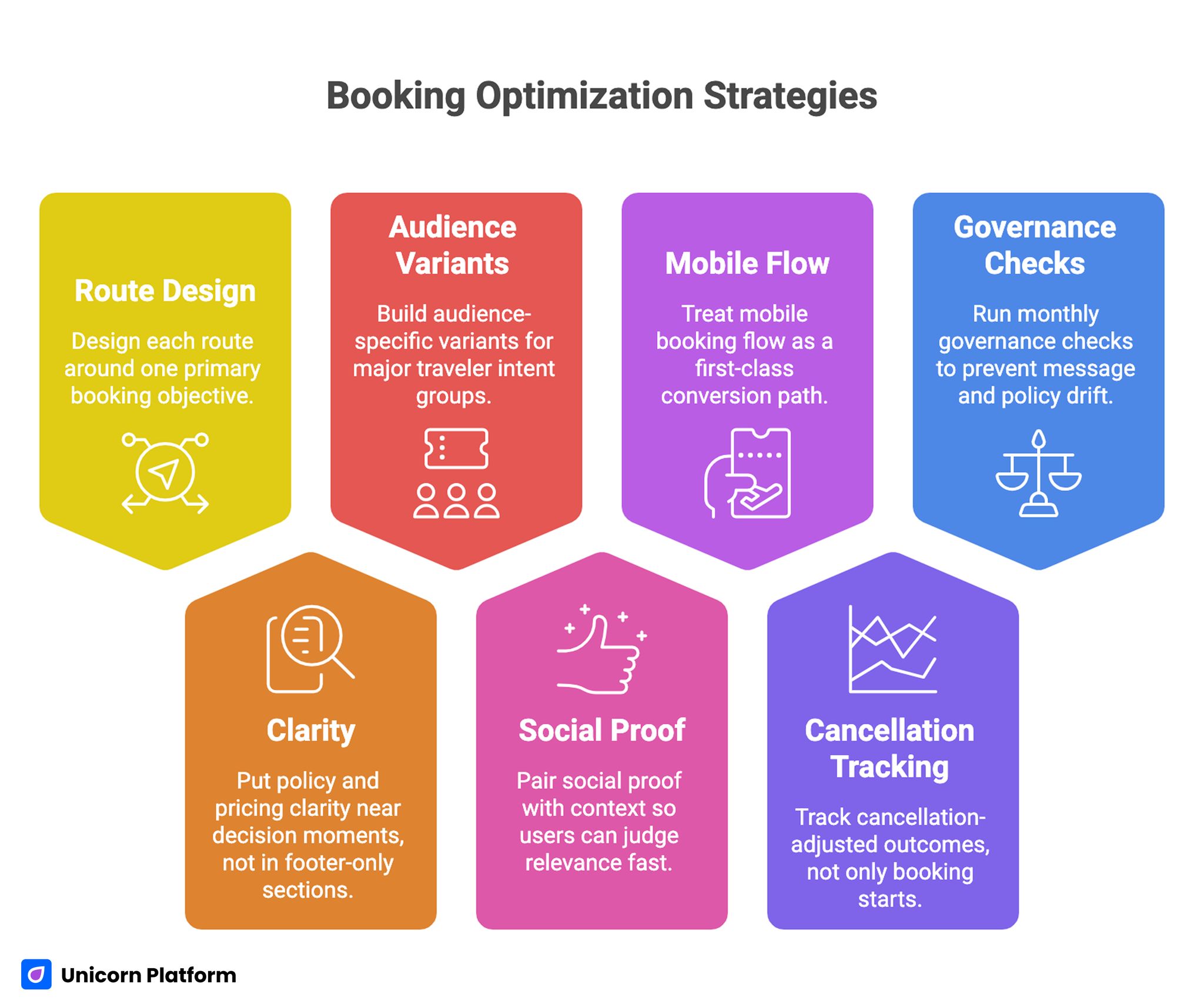
Booking Optimization Strategies
- Design each route around one primary booking objective.
- Put policy and pricing clarity near decision moments, not in footer-only sections.
- Build audience-specific variants for major traveler intent groups.
- Pair social proof with context so users can judge relevance fast.
- Treat mobile booking flow as a first-class conversion path.
- Track cancellation-adjusted outcomes, not only booking starts.
- Run monthly governance checks to prevent message and policy drift.
Why Travel Routes Underperform Even With Good Traffic
The most common issue is inspiration-heavy structure. Pages show locations and amenities but delay practical decision information, so users return to comparison platforms that feel clearer.
The second issue is audience mixing. Business travelers, family planners, and experience-first travelers evaluate different risks. One broad message can attract clicks and still fail to convert quality demand.
The third issue is trust ambiguity. Cancellation rules, support channels, and inclusions are often underexplained, which increases hesitation at the final step.
Set One Objective Per Route
A single page cannot optimize equally for direct booking, itinerary consultation, newsletter signup, and insurance inquiry. Multiple competing goals dilute hierarchy and reduce completion quality.
Define one primary action and one secondary support action. The primary action should match campaign intent and booking readiness. The secondary action should help uncertain users continue without breaking decision flow.
This discipline also improves analytics quality because page performance can be interpreted against one clear commercial objective. Cleaner attribution makes monthly optimization decisions easier and faster.
First-Screen Architecture for Travel Decisions
The first screen should answer four questions fast: who this offer is for, what outcome it enables, why it is credible, and how to proceed now. If one of these is missing, users typically return to comparison channels.
A strong first-screen stack includes traveler-fit headline, concrete offer framing, one trust cue, and one dominant action. When these elements are explicit, users can commit sooner with lower uncertainty.
Creative visuals remain important, but they should support decision clarity rather than replace it. High-performing routes use imagery to reinforce, not obscure, practical booking information.
Route Variants by Traveler Intent
Intent segmentation is one of the highest-leverage improvements for travel conversion. Different traveler groups care about different tradeoffs and policy details.
Business-focused visitors usually prioritize schedule reliability, location efficiency, and response speed. Family planners often prioritize flexibility and predictability. Leisure and adventure segments often prioritize experience uniqueness and practical inclusions.
Variant routes can share one structural backbone while adjusting value framing, proof emphasis, and CTA language by segment. This keeps production efficient while preserving traveler-level relevance.
Offer Framing and Package Clarity
Travel offers should be framed as decision-ready bundles, not only feature lists. Users need to understand what is included, what is optional, and what variables can change final cost.
Package clarity reduces pre-booking hesitation and lowers support demand caused by expectation mismatch. It also protects trust after booking because customers feel informed before payment.
For route planning and structure depth, the framework in a step-by-step guide to a high-converting landing page structure is useful when refining section sequence. Structured section order usually improves both comprehension and booking confidence.
Pricing Logic Without Surprise Friction
Users do not always need every detailed breakdown at first glance, but they do need transparent pricing logic. Hidden fees and vague mandatory charges are major abandonment triggers.
Explain base rate boundaries, common add-ons, and scenario-based examples where totals may vary. This approach keeps pricing honest without overloading early decision stages.
When prices change dynamically, clarify update timing and inventory sensitivity so users understand why totals may shift. Transparent timing language reduces frustration during final-step comparisons.
Policy Visibility as a Conversion Lever
Policy clarity often has more influence on booking confidence than incremental discount messaging. Cancellation windows, modification options, and support escalation channels should be visible before final action. Studies from Skift highlight that modern travelers increasingly prioritize flexible cancellation policies, transparent pricing, and clear support access when selecting booking platforms. These trust signals often have a stronger impact on final booking decisions than promotional discounts or visual presentation.
Policy sections should be concise and plain-language. Legal precision can remain available in deeper documentation, but decision-stage clarity must stay readable.
Trust improves when policy promises and support behavior match during real service events. Consistency between page copy and support outcomes is a major retention signal.
Social Proof With Relevance Context
Generic testimonial blocks add familiarity but not necessarily confidence. Strong proof includes traveler type, trip context, and outcome detail so users can assess applicability quickly.
Context-rich proof works better in travel because decision anxiety is tied to specific risks such as timing, group logistics, and flexibility. Proof snippets should mirror the exact use case targeted by each route.
Rotate proof by route intent where possible. Family-focused routes should not rely only on business-travel narratives.
Mobile Booking Flow as Primary Channel
Mobile behavior drives discovery and often early booking intent. If key details are buried, CTA controls are hard to use, or date selection is unstable, direct demand drops quickly.
Mobile execution should prioritize scannable sections, clear spacing, and persistent action visibility through decision-heavy blocks. Critical policy and cost information should remain readable without extra taps.
Real-device testing is required for date pickers, package selectors, and form recovery states. Emulator checks are not enough for high-impact booking paths.
Form and Inquiry Design for Qualified Leads
Inquiry forms should capture enough context for useful follow-up without creating unnecessary friction. Overlong forms reduce completion, while underspecified forms increase low-quality leads.
A practical model uses staged capture: essential routing fields first, optional planning detail second. This preserves momentum while improving handoff quality.
Confirmation states should set realistic next-step expectations with response timing and channel clarity. This reduces follow-up uncertainty and support pressure after submission.
Visual Direction and Performance Balance
Travel pages benefit from strong imagery and short video moments, but heavy media should never block decision-critical content. Performance degradation at booking moments costs revenue.
Media strategy should prioritize compressed assets, optional playback, and fallback clarity for slower connections. Performance budgets should be reviewed before each seasonal campaign launch.
Every visual element should support a specific decision function. Decorative media without utility should be reduced or repositioned.
Campaign Routing and Message Continuity
Post-click continuity is essential for paid and email traffic. If campaign promise and route framing diverge, trust weakens before interaction depth builds.
Maintain message match from ad or email through first screen and CTA language. Continuity improves both conversion rate and downstream lead quality.
For teams refining travel content systems, create an amazing travel blog website design without code is useful when aligning educational and booking paths. This alignment helps discovery content feed direct-demand routes more effectively.
Direct Booking Strategy vs Platform Dependence
Marketplace channels can provide reach, but heavy dependence compresses margins and reduces first-party relationship ownership. Direct routes should emphasize value that intermediaries cannot present as clearly.
Examples include flexible handling, support responsiveness, or package configurations tailored to specific traveler priorities. These differentiators are easier to trust when explained with concrete scenarios.
Direct strategy performs best when trust messaging and operational reliability are stronger than price-only competition. Brands that communicate these advantages clearly retain more first-party demand.
Seasonal Campaign Architecture
Travel demand changes across seasons, events, and route availability. Pages that remain static across shifts usually lose relevance even if baseline design is strong.
Build a repeatable seasonal update model: adjust headline framing, offer stack, proof ordering, and policy emphasis while preserving core conversion architecture. This keeps campaign pages relevant without resetting process quality each cycle.
This model keeps launch speed high without reintroducing structural inconsistency each cycle. Teams can then compare seasonal performance with cleaner attribution.
Operational Handoff After Booking or Inquiry
Conversion value drops when handoff quality is weak. Sales and service teams need context from the route, user intent, and selected package path to respond effectively.
Define handoff data requirements and response standards in advance. Better handoff quality improves confirmation confidence and reduces drop-off after initial intent.
Operational alignment should be reviewed alongside page metrics, not in a separate silo.
Metrics That Reflect Real Travel Performance
Surface conversion rates are not enough. Travel teams should monitor cancellation-adjusted outcomes, policy-related abandonment, support-contact spikes, and repeat booking patterns by route.
Device-level split is critical because mobile and desktop users behave differently across discovery and commitment stages.
Metric reviews should end with one prioritized change per route so optimization remains focused and attributable.
Governance Model for Multi-Offer Teams
Teams running accommodation, tours, and protection offers in parallel need shared standards to prevent voice and policy drift. Without governance, each campaign becomes a separate system with inconsistent trust signaling.
A lightweight governance model includes shared copy standards, policy review ownership, and release QA gates by route type.
Consistency across offers strengthens brand reliability and makes seasonal scaling safer.
30-60-90 Day Execution Plan
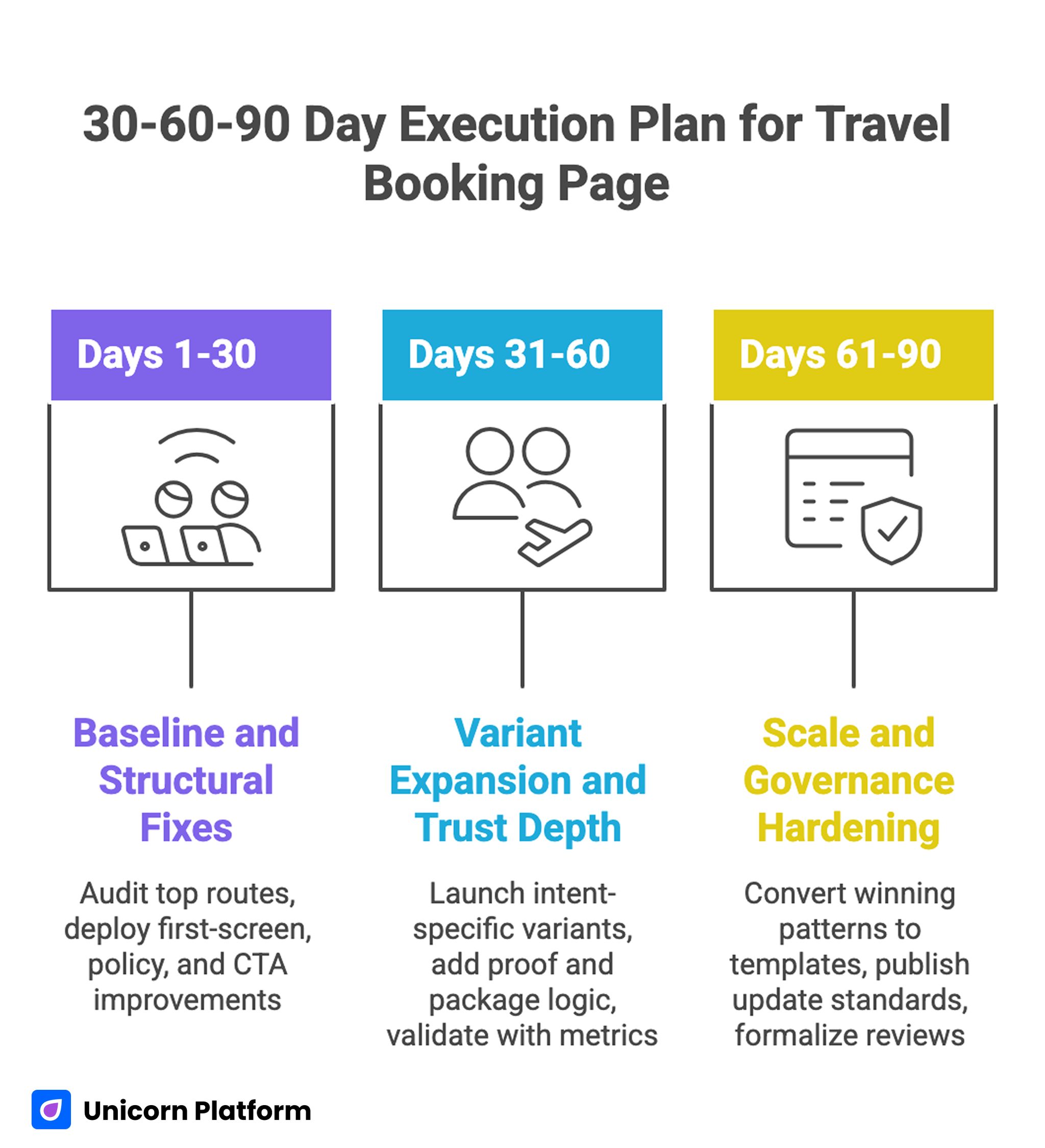
Execution Plan for Travel Booking Page
Days 1-30: Baseline and Structural Fixes
Audit top routes for offer ambiguity, policy visibility, and mobile friction. Prioritize by business impact and current traffic quality.
Deploy first-screen, policy, and CTA improvements on highest-value routes.
Days 31-60: Variant Expansion and Trust Depth
Launch intent-specific variants for major traveler segments. Add context-rich proof and clearer package logic where abandonment is highest.
Validate improvements using cancellation-adjusted and support-burden metrics, not only raw starts.
Days 61-90: Scale and Governance Hardening
Convert winning patterns into reusable templates and publish update standards for seasonal cycles.
Formalize monthly route reviews and quarterly strategy checks to keep messaging and operations aligned.
Common Failure Patterns and Fixes
Failure: Visual-Only Optimization
Pages look attractive but fail decision clarity. Fix this by moving policy, pricing logic, and trust cues closer to action points. Travelers should not need deep scrolling to confirm practical booking conditions.
Failure: One Message for All Traveler Types
Mixed intent reduces relevance. Fix this by introducing segmented routes with shared architecture. This keeps production efficient while preserving route-level message precision.
Failure: Hidden Cost and Policy Surprises
Users hesitate or abandon late. Fix this with transparent inclusion logic and plain-language policy summaries. Unexpected costs should be explained before users reach payment intent.
Failure: Weak Mobile Completion
High-intent mobile users drop before final step. Fix this with real-device QA and simplified critical-path interactions. Date, guest, and room-selection controls should remain stable under common touch patterns.
Failure: Channel Mismatch
Campaign promise differs from route reality. Fix this with strict message continuity from click to conversion. The first screen should mirror the same offer logic users saw in ads or email.
Failure: No Governance Loop
Short-term wins fade across seasons. Fix this with repeatable review cadence and explicit ownership. Monthly reviews should include one decision owner for pricing, policy, and route messaging updates.
FAQ: Travel Booking Page Strategy in 2026
1) How much detail should appear before booking action?
Enough detail to reduce uncertainty about offer fit, total cost logic, and flexibility rules. Deep legal language can remain in secondary resources. Decision-stage summaries should always stay visible near booking actions.
2) Should every travel route show full cancellation terms?
Decision-stage routes should show clear summary terms and direct links to full policy detail. Hidden terms reduce trust. A short policy block near CTA usually prevents avoidable abandonment.
3) What is the fastest way to improve direct booking quality?
Clarify package scope and policy expectations early in the page, then align CTA flow to traveler readiness. This combination improves both booking confidence and lead quality.
4) How many route variants should a small team run?
Run only the number you can maintain with consistent QA. A small set of high-quality variants usually outperforms broad fragmentation. Consistent updates on fewer routes produce cleaner learning signals.
5) Why do mobile routes convert worse in travel?
Critical information is often buried and booking controls are harder to complete on smaller screens. Structural mobile QA usually resolves this. Touch-target spacing and stable selector behavior are frequent improvement points.
6) Are testimonials enough for travel trust?
Not by themselves. Context-rich proof and policy transparency usually matter more at decision moments. Users trust examples more when traveler type and trip context are explicit.
7) How often should travel routes be updated?
Monthly tactical updates are practical, with quarterly strategic reviews and immediate changes for major policy or pricing shifts. Seasonal campaigns should also trigger a fast route relevance check before launch.
8) What metric is most useful beyond booking starts?
Cancellation-adjusted conversion quality is a strong indicator because it captures expectation accuracy after commitment. This metric is often more reliable than raw booking starts alone.
9) How can teams reduce support load from booking confusion?
Improve package clarity and policy visibility before action, and provide stronger confirmation expectations after submission. Support prompts should reference the same wording used on the booking route.
10) What signals indicate route strategy is improving long term?
Higher qualified direct demand, lower policy-related abandonment, and better repeat behavior across seasonal cycles. Stability across multiple seasonal windows is a strong sign of durable route quality.
Final Takeaway
Travel conversion performance improves when inspiration and operational clarity are built together. Teams that align offer logic, trust visibility, mobile usability, and governance discipline generate stronger direct demand with lower friction.
With Unicorn Platform, this model can be deployed quickly and improved continuously as campaigns and traveler behavior evolve.

