Table of Contents
Travel content attracts attention quickly, but attention is not the same as business growth. Many travel blogs publish beautiful destination stories and still struggle to generate reliable inquiries, affiliate revenue, or product sales. The gap is usually structural, not creative.
A strong travel blog is more than a content feed. It is a conversion system where each article helps readers move from discovery to planning confidence and then to a relevant action. Without that system, content performs as entertainment while commercial outcomes stay inconsistent.
The teams that win in 2026 combine narrative quality with practical decision support. They publish useful destination guidance, keep trust signals visible, and connect educational pages to clear next steps without forcing aggressive sales language.
This guide explains how to design that system using repeatable architecture, intent-based content clusters, and continuous optimization workflows. It focuses on practical execution choices that small and mid-size teams can sustain.
sbb-itb-bf47c9b
Quick Strategic Takeaways
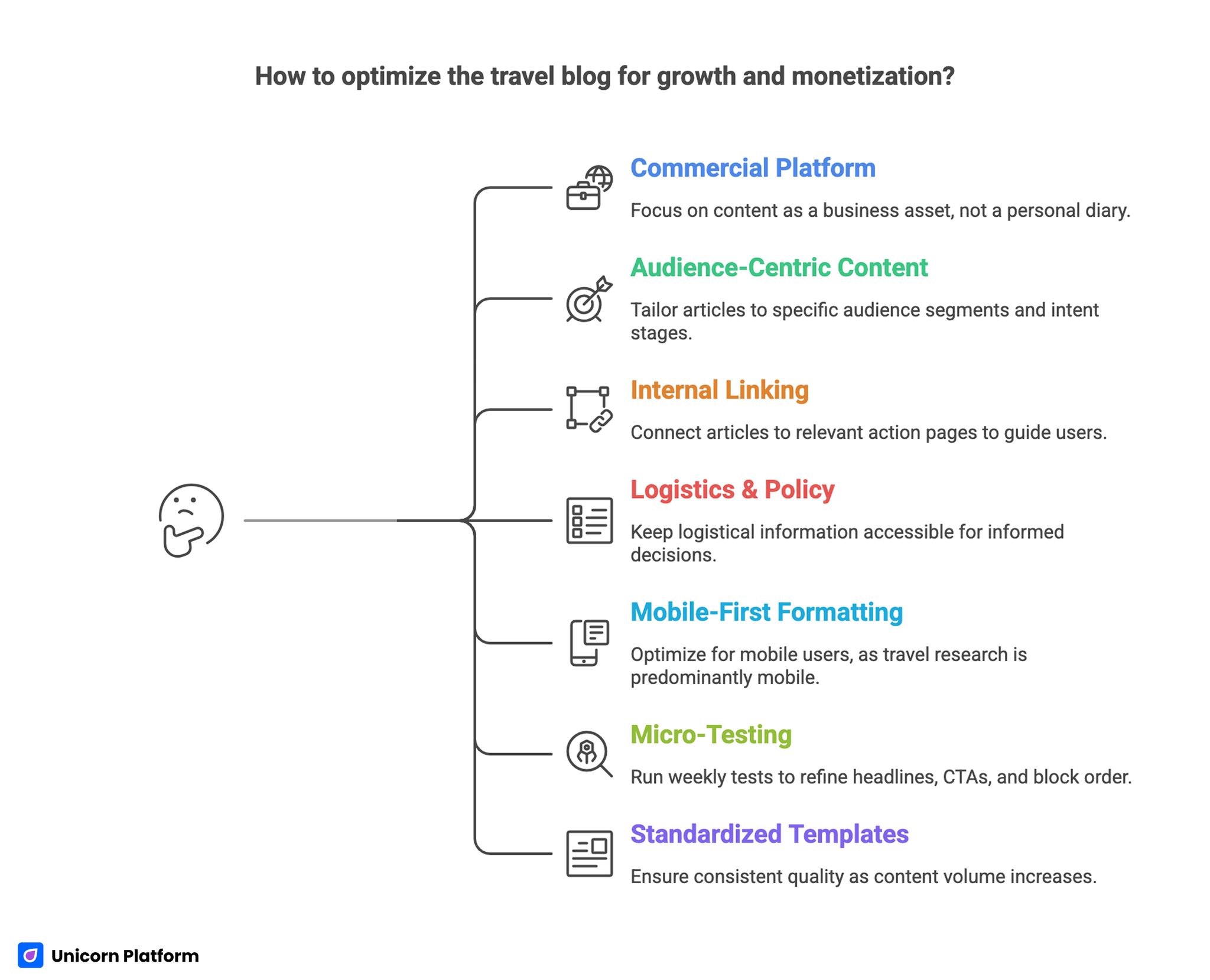
Quick Strategic Takeaways for Travel Blog Optimization
- Treat your blog as a commercial content platform, not a publishing diary.
- Build every article with one audience segment and one primary intent stage.
- Connect planning content to relevant action pages through deliberate internal links.
- Keep logistics, cost context, and policy guidance close to decision points.
- Use mobile-first formatting because travel research is heavily mobile.
- Run weekly micro-tests on headline framing, CTA language, and block order.
- Standardize templates so quality improves as output volume grows.
Why Most Travel Blogs Underperform Commercially
Underperformance usually starts with intent mismatch. Articles are written for broad inspiration, while readers need concrete planning details to move forward. When practical questions stay unanswered, users exit after reading instead of engaging deeper.
A second problem is fragmented structure. Blog pages, itinerary pages, and booking pages often feel disconnected, which creates navigation friction. Readers who are ready to act cannot find the right next step quickly, so momentum is lost.
The third issue is weak trust communication. Travel decisions include financial, safety, and logistics risk, and users expect transparent guidance before commitment. If trust and policy details are hidden or inconsistent, conversion quality drops even when traffic volume is high.
Define Your Commercial Model Before Expanding Content
Growth is faster when monetization logic is clear early. Without that clarity, teams publish heavily and then discover that traffic does not align with revenue goals.
Start by defining which outcomes your blog should drive. Common models include affiliate revenue, inquiry generation for tour services, itinerary downloads, newsletter growth, premium content products, or partner-led package sales.
Each model needs a different conversion path. An affiliate-first model requires product comparison clarity and trust disclosures, while a tour-inquiry model needs stronger route guidance, policy transparency, and response expectation messaging.
Clear commercial goals improve editorial quality because writers know which user questions matter most for each page type. That clarity also reduces content drift during fast publishing periods.
Build Around Reader Intent Stages
Travel readers usually move through three decision stages: inspiration, planning, and action. Content should be mapped to those stages so users can progress naturally without confusion.
Inspiration pages should focus on destination context, story value, and high-level possibilities. Planning pages should prioritize route logic, timing guidance, budget ranges, and logistics basics. Action pages should emphasize package fit, policy terms, and low-friction inquiry paths.
When stage mapping is explicit, internal linking becomes strategic rather than random. Readers get the right depth at the right moment, and conversion intent increases as uncertainty decreases.
Content Architecture That Scales
A scalable travel blog needs a predictable architecture instead of ad hoc publishing. The easiest model is destination clusters with one pillar page and several supporting practical pages.
A strong destination cluster often includes the components below. Keeping this structure consistent makes performance analysis easier month over month.
- One primary destination guide
- One seasonality and best-time page
- One budget and cost-planning page
- One logistics FAQ page
- One comparison page versus alternatives
- One action-oriented itinerary or inquiry page
This structure supports search discoverability and conversion progression at the same time. It also makes editorial planning easier because each new article has a defined role in the funnel.
For broader design benchmarking in this category, these travel agency website examples for tourism brands are useful for comparing how strong operators structure informational and commercial content together. Reviewing multiple operators side by side helps teams identify reusable structural patterns instead of copying surface aesthetics.
Article Template for High-Performing Travel Posts
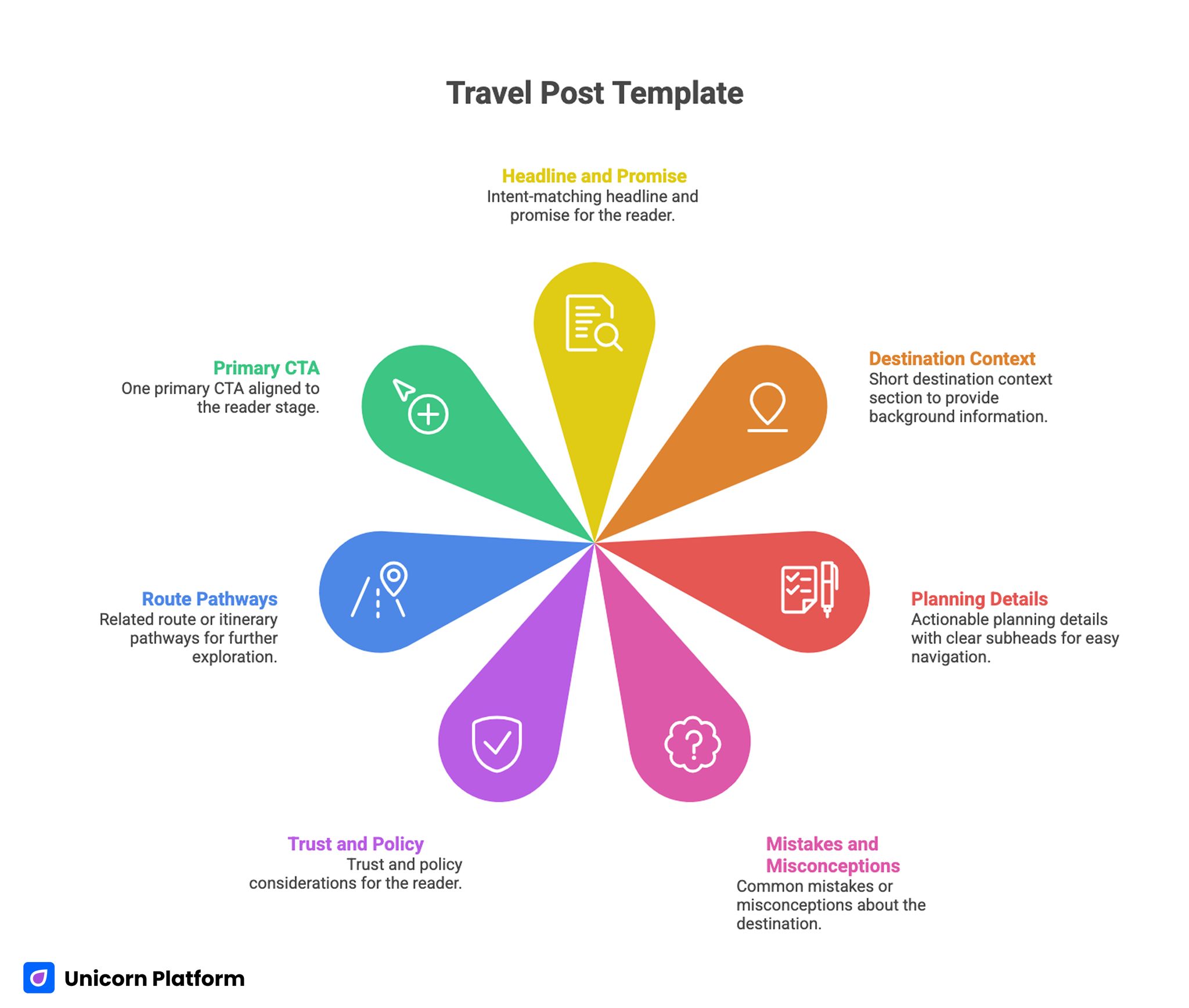
Travel Post Template
A reusable article template keeps quality consistent across contributors and publication cycles. It also reduces time spent reinventing layout decisions for every post.
A practical template sequence is listed below. Writers should keep the sequence stable and adapt only destination-specific details.
- Intent-matching headline and promise
- Short destination context section
- Actionable planning details with clear subheads
- Common mistakes or misconceptions
- Trust and policy considerations
- Related route or itinerary pathways
- One primary CTA aligned to reader stage
The template should be strict enough to preserve conversion logic but flexible enough to maintain voice and storytelling quality. This balance keeps pages useful without making them feel formulaic.
Storytelling + Utility: The Winning Content Mix
Travel blogs perform best when emotional storytelling and practical utility are balanced. Story alone can increase time on page, but utility drives action confidence.
High-value utility blocks include day-by-day pacing samples, transport tips, budget anchors, weather expectations, and realistic packing or preparation guidance. These blocks reduce planning anxiety and help users evaluate fit faster.
When storytelling and utility are connected well, readers feel inspired and informed at the same time. That combination is what increases progression into deeper pages and inquiry actions.
Internal Linking as a Decision System
Internal links should help users answer their next question, not simply increase page views. Link placement should follow decision logic across the reader journey.
Useful linking patterns include moving from destination inspiration to route-specific planning, from planning to policy details, and from policy reassurance to inquiry or booking options. Each jump should feel natural and context-driven.
For teams refining site architecture, this practical guide with travel site design ideas and layouts can help align navigation, section order, and conversion flow. It is most valuable when architecture decisions are reviewed alongside actual progression metrics.
Link quality matters more than link volume. A smaller number of well-placed links usually outperforms dense linking that interrupts reading flow.
Trust and Transparency Blocks That Increase Action
Travel decisions involve uncertainty, so trust communication should appear early and repeatedly. Users should not have to dig through policy pages to understand risk and support expectations.
Strong trust blocks can include cancellation summaries, support timelines, local partner details, traveler review context, and clear disclosure for affiliate or sponsored recommendations. Transparency improves credibility and lowers hesitation.
Trust communication should be written in plain language. Legal completeness matters, but operational clarity is what supports conversion behavior.
Mobile UX for Travel Blogs
Mobile behavior dominates travel research, especially during commute-time browsing and social-driven discovery sessions. If formatting is dense or interactions are clumsy, users leave before reading high-value sections.
Mobile-ready content should use concise subheads, predictable section spacing, and clear visual hierarchy. Action modules should be tap-friendly and positioned where reader momentum is highest.
Form fields and download actions should stay minimal on first touch. Asking for too much too early reduces completion and often lowers lead quality by introducing unnecessary friction.
Operators that pair editorial content with accommodation offers can borrow conversion patterns from this hotel landing page workflow to improve action clarity on mobile-focused pages. The main benefit is clearer action hierarchy across mixed content and booking surfaces.
Monetization Paths and Placement Strategy
Monetization works best when placement supports user intent rather than interrupting it. Readers accept commercial elements when recommendations are relevant and clearly explained.
Affiliate modules should appear after practical context, not before it. Lead-gen CTAs should connect to specific planning milestones, and premium offers should be introduced where readers already show commitment through deeper engagement.
A useful operating rule is to map each monetization block to one reader question. If a block does not answer a real question, it usually reduces trust and should be removed.
SEO Strategy for Sustainable Growth
Travel SEO is highly competitive, so depth and structure matter more than publishing volume alone. Articles need clear intent match, useful specificity, and strong topical connections.
Prioritize long-tail planning queries where your team can provide practical depth. Examples include seasonal timing, route logistics, budget comparisons, and traveler-type constraints.
Then connect those pages to high-intent commercial pages through relevant internal paths. This approach supports both rankings and conversion readiness over time.
For teams scaling no-code travel content operations, this framework on travel blog design without code is useful for maintaining speed while preserving page quality. It helps teams launch faster without sacrificing structural consistency.
Content marketing plays a critical role in travel website growth. Research shows that 82% of tourism organizations use blogs to drive organic traffic, and well-structured travel guides significantly increase engagement and time on site.
Analytics Framework That Reveals Commercial Impact
Surface-level traffic metrics do not explain whether a travel blog is improving revenue outcomes. Teams need a metric set that connects content behavior with downstream actions.
Track these core indicators to understand whether content is driving meaningful progression. These signals are more actionable than raw traffic alone.
- Reader progression from inspiration pages to planning pages
- Click-through from planning pages to action pages
- Inquiry or affiliate click conversion by content cluster
- Mobile versus desktop action-rate differences
- Return visitor behavior by destination topic
- Revenue contribution by entry-page type
This framework helps teams identify which topics create commercial momentum and which topics generate only low-intent traffic. It also clarifies where editorial investment should increase or decrease.
30-Day Improvement Plan
Week 1: content and intent audit
Map existing pages to inspiration, planning, and action stages. Identify missing links between high-traffic guides and relevant conversion pages.
Week 2: template and trust upgrades
Apply one shared article template across top destination pages and add transparency blocks for policy, disclosures, and support expectations. This improves clarity quickly without requiring a full redesign.
Week 3: conversion flow optimization
Refine CTA placement, simplify first-touch forms or download prompts, and test one headline or section-order variable. Keeping the test scope narrow produces cleaner learning.
Week 4: consolidation and documentation
Keep winning changes, remove weak modules, and update editorial standards so future content starts from a stronger baseline. This turns short-term gains into repeatable operating improvements.
This cycle produces measurable progress without forcing a full redesign. Teams can keep momentum high while limiting execution risk.
90-Day Scale Plan
Month one should stabilize architecture and QA standards. Month two should expand destination clusters and strengthen internal link pathways. Month three should formalize weekly testing cadence and monthly proof refresh routines.
Scaling should follow system maturity. Publishing more content without structural discipline usually increases maintenance load and dilutes conversion quality.
Cross-functional alignment is important at this stage. Editorial, growth, and support teams should align on disclosure language, policy accuracy, and conversion goals for each cluster.
Example Scenario: Mid-Size Travel Publisher
Imagine a travel publisher with strong organic traffic but weak commercial performance. Most traffic lands on inspirational destination posts, while monetization pages receive limited qualified visits.
The team introduces stage-based architecture and rewrites top pages using a shared template. They add logistics depth, policy summaries, and deliberate links into itinerary and offer pages tied to user intent.
Within two cycles, readers move deeper into planning content, action-page engagement rises, and conversion outcomes improve because the site answers practical decision questions earlier in the journey. This pattern appears consistently when stage-based linking and utility blocks are implemented together.
The key improvement is structural consistency, not content volume. Better architecture often outperforms higher publishing frequency.
Common Mistakes and Fast Fixes
Mistake 1: publishing inspiration without planning depth
Fix by adding practical logistics, timing, and budget context within top-performing destination posts. These details help readers evaluate fit before they click away.
Mistake 2: unclear disclosure and policy language
Fix by inserting concise trust and disclosure blocks near recommendations and CTA sections. Trust language is most useful when it appears near commitment points.
Mistake 3: random internal linking
Fix by mapping links to reader-stage progression from inspiration to planning to action. This keeps navigation aligned with decision flow.
Mistake 4: mobile readability ignored during editing
Fix by reviewing spacing, hierarchy, and interaction behavior on real devices before publish. Emulator checks alone often miss friction points.
Mistake 5: monetization modules disconnected from reader intent
Fix by aligning each commercial block with one clear user question and stage-specific need. Relevance improves when offers appear only where users expect them.
Mistake 6: no fixed optimization cadence
Fix by running weekly micro-tests and monthly cluster-level performance reviews. Combined cadence prevents drift while keeping iteration practical.
FAQ: How to Build a Travel Blog Website
What makes a travel blog commercially effective?
Commercial effectiveness comes from combining storytelling with practical planning depth and clear next actions. Traffic alone is not enough if users cannot progress confidently toward value.
Should every article include a CTA?
Yes, but the CTA should match reader stage. Early-stage pages can use low-friction actions, while planning-stage pages can introduce stronger conversion paths.
How much detail is too much in travel content?
Detail is valuable when it reduces uncertainty. Content becomes excessive when it repeats generic points without helping decisions.
Do travel blogs need separate planning pages?
Separate planning pages usually improve both UX and conversion. They let readers find specific guidance faster and reduce overload in general destination posts.
How often should trust and policy blocks be updated?
Monthly is a strong baseline, and high-season periods may require more frequent updates. Fresh trust information supports confidence and lowers support friction.
What is the most important mobile improvement?
Clear hierarchy and low-friction action flow are the most important. Fast load helps, but structure determines whether users continue.
Can small teams run this system consistently?
Yes, if templates and workflow standards are documented. Consistency matters more than team size for this model.
Which metric should leadership prioritize first?
Track progression from planning pages to action pages first. That metric reveals whether content is moving readers toward commercial intent.
Should monetization modules appear near the top?
Only when they match immediate user intent. In most cases, practical context should come first so commercial actions feel relevant.
How do we prevent quality drift as output grows?
Use shared templates, editorial QA gates, and fixed review cadence. Structured governance is the best protection against drift.
Final Takeaway
A strong travel blog is not just a collection of stories. It is a structured content system that helps readers move from inspiration to confident decisions.
When architecture, trust communication, and conversion flow are designed deliberately, blog content becomes a measurable growth engine rather than a traffic-only channel. That shift is what makes long-term editorial investment commercially sustainable.
With Unicorn Platform, teams can run this system quickly by reusing proven structures, publishing updates without heavy technical overhead, and improving performance through continuous iteration. This operating speed is especially valuable during seasonal peaks and campaign-heavy periods.