Table of Contents
- Why Software Vendor Pages Underperform
- Information Architecture for Multi-Product Companies
- 30-60-90 Day Rollout Plan
- Common Failure Patterns and Fixes
- FAQ
Software buyers are overloaded with options, and most pages fail at the same moment. They ask for commitment before they resolve risk, so visitors leave with unresolved questions about fit, implementation effort, and credibility.
A modern page for a software vendor has to do more than describe product features. It has to guide multiple stakeholders through a clear decision sequence that builds confidence without forcing readers to decode marketing language.
In practice, performance depends on architecture. Section order, proof timing, onboarding clarity, and CTA logic have a bigger effect on qualified outcomes than decorative design updates.
Unicorn Platform is effective for this work because teams can ship page improvements quickly while keeping a consistent structural model. That speed only creates advantage when changes are tied to explicit decision goals.
When teams need broader conversion benchmarks, the patterns in 7 best SaaS landing page examples to boost your conversion rates are useful for comparing section flow and commitment pacing.
sbb-itb-bf47c9b
Quick Takeaways
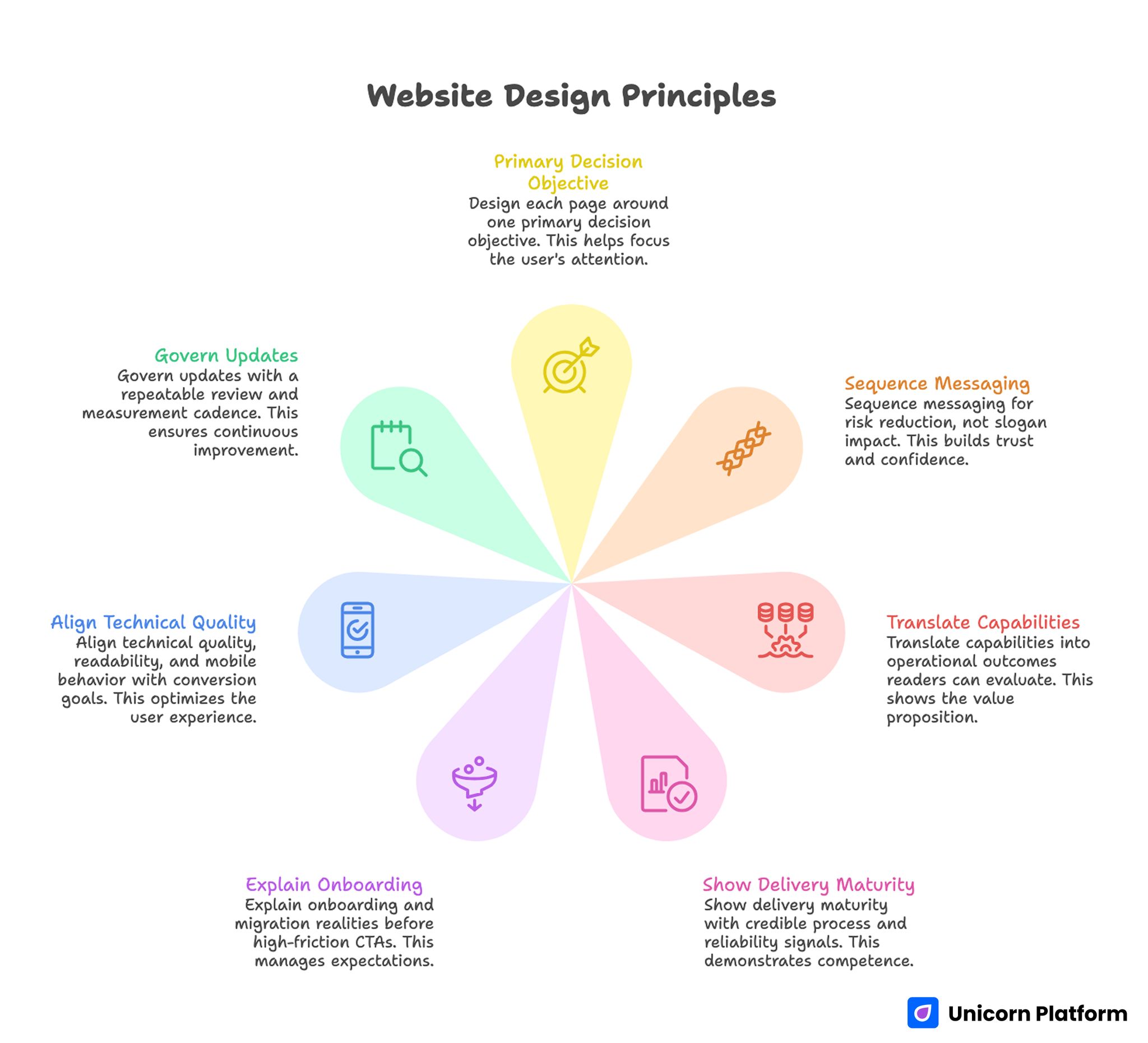
Website Design Principles
- Design each page around one primary decision objective.
- Sequence messaging for risk reduction, not slogan impact.
- Translate capabilities into operational outcomes readers can evaluate.
- Show delivery maturity with credible process and reliability signals.
- Explain onboarding and migration realities before high-friction CTAs.
- Align technical quality, readability, and mobile behavior with conversion goals.
- Govern updates with a repeatable review and measurement cadence.
Why Software Vendor Pages Underperform
Many pages underperform because they are written as product catalogs. Feature blocks can describe what exists, but they rarely explain why a buyer should trust the team to deliver results in real operating conditions.
Another common issue is message inflation. Pages use broad claims about transformation or innovation while avoiding specifics about where the product fits, where it does not fit, and how implementation works in practice.
A third issue is sequencing failure. Proof arrives late, implementation details are vague, and calls to action appear before readers can make informed judgments. This produces unqualified submissions and longer sales cycles.
Decision Flow for Multi-Stakeholder Buying
Software purchases usually involve at least three audiences: business sponsors, technical evaluators, and operational users. Each audience evaluates risk differently, which means one generic narrative cannot serve all of them equally.
Business sponsors need commercial clarity and adoption confidence. Technical evaluators need architecture fit, security posture, and integration reliability. Operational users need workflow relevance and ease of day-to-day execution.
A strong page keeps one core value narrative while presenting targeted proof and implementation detail for each role. This approach increases clarity without fragmenting brand voice.
Primary Objective and CTA Discipline
One page cannot maximize all outcomes at once. If a route tries to optimize for trial starts, enterprise demos, partner applications, and newsletter growth simultaneously, hierarchy becomes ambiguous and conversion quality drops.
Set one primary objective and one secondary support action. The primary objective should match traffic intent and buying stage. Secondary actions should reduce friction for visitors who need one additional validation step before committing.
CTA discipline improves measurement quality. Teams can attribute outcomes to specific messaging changes instead of interpreting mixed results from competing action paths.
First-Screen Architecture That Builds Momentum
The first screen should resolve four questions quickly: who this product is for, what problem it solves, why the claim is credible, and what action is expected next. Missing any of these creates early drop-off from high-intent visitors.
A dependable first-screen stack includes focused headline, clarifying subheadline, one contextual trust cue, and a dominant CTA. This stack is simple, but it works because it reduces cognitive load.
Headline creativity should not compromise clarity. In software categories, precision generally outperforms abstraction because buyers are evaluating risk as much as opportunity.
Positioning Model for Software Pages
Positioning should define scope, not only aspiration. Readers should understand where the product performs best, which use cases are prioritized, and what operational outcomes are realistic in a defined time horizon.
Scope clarity improves lead quality by helping poor-fit traffic self-filter early. This protects sales capacity and improves conversion quality for the visitors who continue.
If positioning and acquisition strategy need tighter alignment, the system in effective SaaS lead generation strategies is useful for mapping page narrative to channel intent.
Product-to-Outcome Translation
Feature lists are useful for completeness, but decisions are made on expected outcomes. Each major capability should be translated into practical effect on process speed, reliability, cost, or risk.
Outcome translation should include context. Who gets the value, in which workflow, and under what conditions. Generic outcome claims without context look impressive and convert poorly.
A concise scenario format works well: starting condition, product action, measurable result, and timeframe. This gives readers enough specificity to estimate fit.
Delivery Maturity as a Trust Layer
Buyers increasingly evaluate whether a vendor can execute consistently after contract signature. Trust signals should therefore include operational maturity indicators, not only brand logos and broad testimonials.
Useful trust components include release cadence discipline, support-response standards, incident communication maturity, and onboarding success pattern visibility. These elements reduce perceived execution risk.
Trust content should be plain-language and auditable. Overstated claims create short-term interest and long-term credibility damage.
Translating Engineering Signals Into Buyer Language
Internal software delivery metrics can strengthen buyer confidence when expressed clearly. Reliability and delivery signals should explain business impact, not only technical sophistication.
For example, release stability can be framed as reduced disruption risk for customer teams. Support resolution cadence can be framed as predictable issue recovery under real operating pressure.
Translation quality matters. Technical depth should be available for evaluators while summary language remains understandable for non-technical decision makers.
Implementation and Onboarding Clarity
Implementation uncertainty is one of the most common reasons prospects delay action. Company pages should explain onboarding sequence, expected internal effort, typical timelines, and available support models.
When implementation scope varies by company size, provide path-specific guidance. Startup teams, mid-market teams, and enterprise teams often face different rollout constraints.
Clarity here improves both conversion and handoff quality. Prospects arrive in sales conversations with realistic expectations, which reduces cycle friction.
Integration and Migration Messaging
Integration confidence strongly influences software purchase decisions. Pages should explain integration categories, typical data flow patterns, and migration support boundaries without overwhelming readers with technical noise.
Migration sections are especially important for buyers replacing existing systems. They need to understand transition effort, overlap period options, and rollback or contingency posture.
Practical migration framing can reduce perceived switching cost and improve qualified conversation rates.
Security and Procurement Readiness Blocks
Enterprise and regulated buyers often gate progress on security and procurement confidence. Company pages should provide concise summaries of access controls, data handling principles, escalation pathways, and governance posture.
These summaries should be readable and concrete. Dense compliance language can obscure the practical reassurance buyers need at early evaluation stages.
Teams working on conversion routes for complex evaluations can borrow structural patterns from build high-converting Salesforce landing pages in minutes when adding role-specific confidence blocks.
Commercial Clarity and Packaging Logic
Commercial uncertainty can stall even highly interested buyers. A page does not always need full pricing disclosure, but it should reduce ambiguity about packaging logic, intended team profiles, and likely onboarding pathway.
Clear packaging language helps buyers self-assess fit before sales contact. This improves lead quality and reduces time spent on misaligned opportunities.
Offer framing should align with complexity level. Low-friction products can emphasize rapid start, while higher-complexity products should emphasize fit assessment and guided rollout.
CTA System by Commitment Stage
Calls to action should reflect readiness. For early evaluation traffic, education-oriented actions can maintain momentum while visitors gather confidence. For late-stage traffic, direct consultation or demo actions are appropriate.
A two-tier CTA model often works best: one primary route action and one secondary supporting action. Secondary actions should assist the same decision path, not distract with unrelated destinations.
CTA placement should be repeated strategically near decision-heavy sections, not sprayed uniformly across the page.
Information Architecture for Multi-Product Companies
Multi-product companies often collapse distinct value stories into one broad page, which dilutes relevance. A better model uses one company narrative plus clear product pathways with shared trust modules.
Each pathway should preserve consistent design language while adapting proof and outcome framing to the specific audience and use case.
Modular architecture keeps maintenance practical. Teams can update shared trust and implementation blocks once and distribute improvements across related routes.
Mobile-First Execution Standards
A large share of software research starts on mobile. If first-screen clarity, proof readability, or CTA accessibility fails on smaller screens, qualified intent is lost early.
Mobile standards should cover typography rhythm, tap target spacing, form interaction flow, and load performance under realistic network conditions.
Real-device testing is required. Emulator-only checks often miss interaction friction that affects completion quality.
Readability and Narrative Control
Readability affects both comprehension and trust. Dense paragraphs, abstract jargon, and inconsistent heading logic increase abandonment, especially when buyers are comparing several vendors quickly.
Good narrative control means each section has a single job, each paragraph advances one idea, and transitions help readers move through the decision flow with minimal effort.
This approach also strengthens AI retrieval and summarization quality because the page structure is explicit and semantically coherent.
SEO and Retrieval Utility for Company Pages
Company pages can contribute strongly to organic growth when they resolve specific intent with practical depth. Thin overview pages rarely rank well for decision-oriented queries.
Semantic coverage should include role-based concerns, implementation language, operational outcomes, and trust signals tied to real buying questions.
Internal links should route readers from overview pages to deeper comparison, integration, and implementation content so intent can progress naturally.
Internal Link Strategy by Decision Stage
Internal linking should follow user decision progression. Early-stage readers may need educational context, while evaluation-stage readers may need implementation depth and proof.
Anchor language should communicate expected value clearly. Action-oriented anchors generally outperform vague navigation language in high-intent environments.
When teams need a wider format map for supporting assets, what is content marketing nowadays and what types work the best can help define content roles across stages.
Visual Proof and System Diagrams
Visuals are most useful when they clarify complexity. Architecture snapshots, process diagrams, and onboarding flow visuals can reduce uncertainty faster than text alone.
Visual proof should be functional and concise. Oversized decorative graphics can increase load time and distract from key decisions.
Every visual element should support a nearby claim or action. If it does not improve clarity, it should be simplified or removed.
Customer Success Narratives Beyond Testimonials
Logo walls and one-line quotes create familiarity but often fail to explain why customers succeeded. Richer narratives should show initial challenge, implementation approach, and measurable outcome.
Short case capsules are effective when structured clearly. Include role context, adoption path, and one concrete result tied to timeframe.
These narratives improve self-qualification because prospects can compare their own operating context with realistic success patterns.
Change Management Messaging for Adoption Confidence
Software value depends on adoption behavior, not only product capability. Pages should acknowledge rollout and change-management realities, especially for tools that alter team processes.
Brief sections on enablement support, admin training, and adoption checkpoints can reduce post-sale anxiety during evaluation.
Adoption messaging also helps procurement stakeholders assess whether the vendor can support sustained usage, not just initial deployment.
Editorial QA Workflow Before Publishing
Pre-publish QA should validate clarity, factual integrity, trust-proof consistency, and CTA alignment. Without this layer, fast publishing can produce inconsistent narratives across related pages.
A practical QA pass checks section purpose, claim support, link relevance, readability, and mobile behavior in one workflow.
This discipline is especially important when multiple contributors edit the same route over time.
Measurement Model for Qualified Outcomes
Performance measurement should go beyond pageviews and form count. High-value metrics include qualified inquiry ratio, meeting quality, technical-fit acceptance, and onboarding readiness signals.
Behavior diagnostics should include section engagement, proof interaction depth, CTA distribution, and form-step completion quality. These signals reveal where confidence is built or lost.
Review cadence should include both weekly tactical checks and monthly strategic interpretation with cross-functional stakeholders.
Operating Governance for Continuous Improvement
Governance keeps optimization from becoming random. Define owners for positioning, technical accuracy, trust proof, and analytics interpretation.
Decision rights should be explicit. Slow approval chains reduce the value of evidence and encourage low-impact edits.
Documentation should capture hypothesis, changes shipped, outcome observed, and next action. This creates durable learning across cycles.
30-60-90 Day Rollout Plan
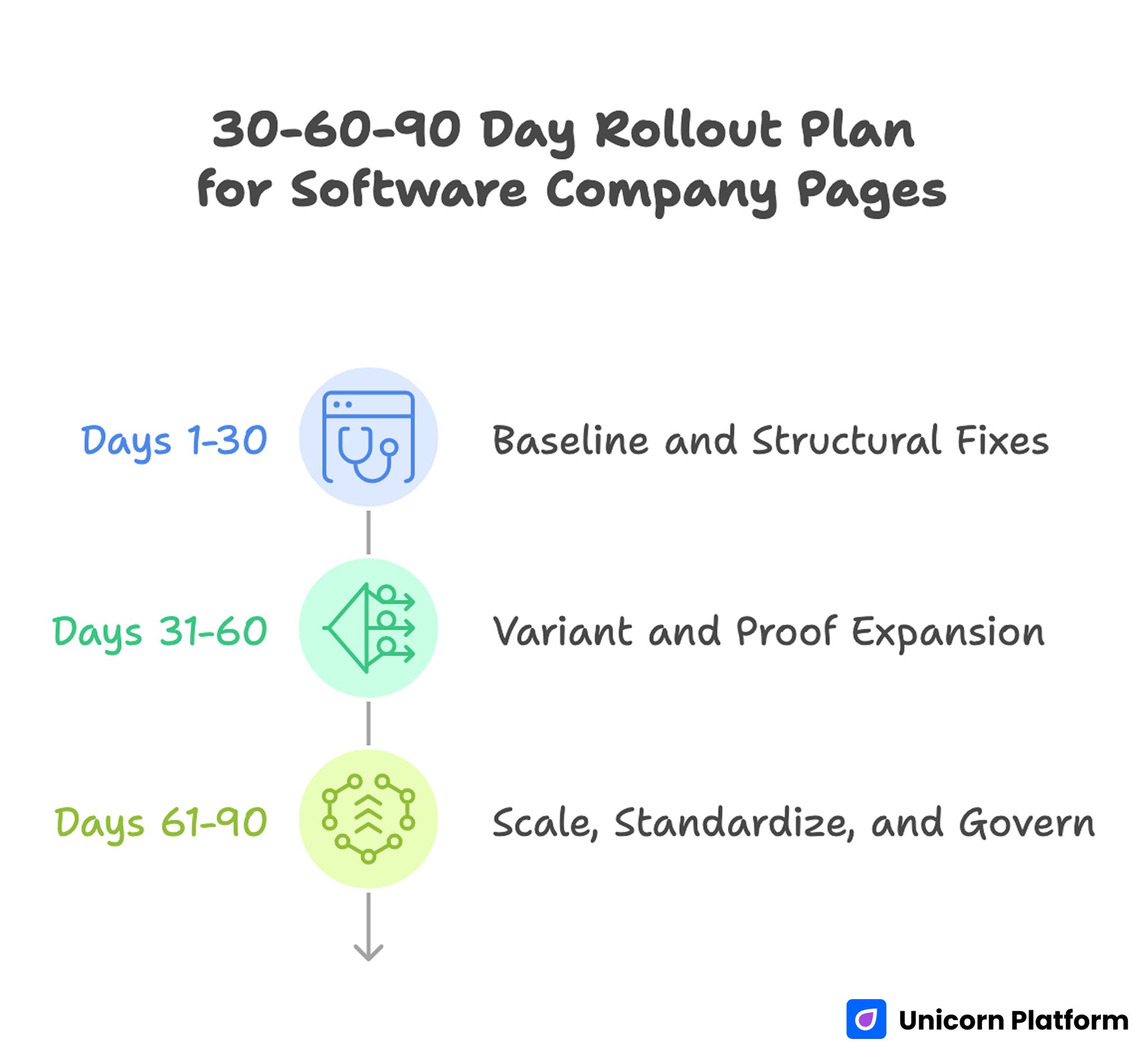
30-60-90 Day Rollout Plan for Software Company Pages
Days 1-30: Baseline and Structural Fixes
Audit current company pages for scope ambiguity, trust gaps, and CTA mismatch. Prioritize routes with highest traffic and strongest business proximity.
Implement first-screen improvements, proof placement updates, and onboarding clarity blocks on top-priority routes. Establish weekly quality review rhythm with defined owners.
Days 31-60: Variant and Proof Expansion
Launch role-aware variants for executive, technical, and operational audiences using shared architectural backbone.
Expand trust layers with concise reliability, security, and implementation proof where decision friction is highest. Measure changes against qualified outcome indicators, not only submission volume.
Days 61-90: Scale, Standardize, and Govern
Promote winning patterns into reusable templates and retire low-signal sections. Standardize QA gates across all major company and product routes.
At this stage, governance quality determines future performance. Keep update cadence disciplined so message quality remains aligned with product reality.
Common Failure Patterns and Fixes
Failure: Broad Positioning With No Scope
Visitors cannot determine fit quickly. Fix this by defining audience, use-case boundaries, and operational outcome in the first screen and early sections.
Failure: Proof Detached From Claims
Evidence appears late and lacks context. Fix this by pairing each major claim with nearby, scenario-based validation.
Failure: Implementation Ambiguity
Prospects fear hidden effort and postpone action. Fix this with clear onboarding sequence, timeline guidance, and role expectations.
Failure: CTA Timing Mismatch
Pages ask for high commitment before confidence is built. Fix this with stage-aligned CTA hierarchy and supporting low-friction actions.
Failure: Mobile Friction in Decision Sections
High-intent readers abandon due to poor usability. Fix this with real-device testing, clearer typography, and consistent CTA accessibility.
Failure: Fragmented Ownership
Updates are inconsistent and hard to evaluate. Fix this with explicit owners, decision rights, and documented experiment loops.
Executive Scorecard for Leadership Decisions
Leadership reviews are useful only when they support decisions, not when they summarize activity. A page program should therefore include a scorecard that links changes on key routes to commercial impact and operational risk.
A practical scorecard has four layers. The first layer tracks visibility and query relevance, the second layer tracks behavior quality, the third layer tracks qualified pipeline indicators, and the fourth layer tracks execution health such as release speed and QA stability.
Decision triggers should be explicit before campaigns scale. If visibility rises while qualified outcomes decline, teams should pause expansion and address intent mismatch. If qualified outcomes improve but technical quality deteriorates, teams should prioritize performance remediation to protect sustainability.
This scorecard also reduces internal disagreement about next steps. Marketing, product, and revenue teams can evaluate one shared evidence set instead of defending separate dashboards.
Pipeline Attribution and Source-Quality Analysis
Attribution should separate traffic growth from quality growth. A route can attract more sessions and still lower business value if those sessions are weak-fit visitors who do not progress after initial contact.
Source-quality analysis should map outcomes by channel, campaign promise, and route variant. This reveals whether the message buyers saw before arrival matches what the page delivers in the first decision moments.
Good attribution includes assisted progression signals. If the page improves technical-fit conversations or shortens onboarding alignment time, that value should be visible even when last-click conversion appears unchanged.
Teams should review attribution in monthly cross-functional sessions. Fast tactical fixes can happen weekly, but source-quality patterns usually need broader interpretation before major resource changes are made.
Sales Handoff Standards After Form Submission
Conversion quality is lost when post-submit handoff is inconsistent. A strong page should be paired with routing rules, response standards, and context transfer so prospects do not repeat basic discovery details in the first call.
Handoff design starts with form architecture. Fields should capture enough information to route inquiries by role, urgency, and use-case context without adding unnecessary friction during submission.
Response teams need a short handoff brief that includes source context, page variant, claimed problem, and expected next-step action. This structure improves first-call relevance and reduces meeting drop-off caused by generic follow-up.
Operationally, handoff quality should be measured like page quality. Useful signals include first-response speed, meeting acceptance quality, and percentage of conversations that confirm expected fit from page messaging.
Procurement and Legal Readiness Workflow
For larger buyers, momentum often slows at procurement and legal stages. Company routes that ignore these realities can generate top-of-funnel activity while failing to support downstream deal progression.
A readiness workflow should define what information can be shared early, what requires deeper validation, and who owns each response path. This avoids delays caused by unclear internal escalation.
Legal and compliance stakeholders should be included in quarterly messaging reviews. Trust sections can then remain accurate when policies, certifications, or data-processing boundaries evolve over time.
Early procurement clarity does not mean publishing sensitive detail. It means publishing enough structured information so decision makers know that governance concerns are recognized and managed intentionally.
Narrative Version Control and Message Consistency
Page programs become inconsistent when teams edit without controlled version logic. Over time, sections drift, claims contradict each other, and trust language becomes outdated across routes.
A version-control model for messaging should include change owner, reason for change, expected effect, and rollback conditions. This gives teams a practical history for evaluating whether edits improved or weakened outcomes.
Consistency checks should compare shared modules across product and company routes. If one page updates reliability language and another keeps older wording, buyer confidence can drop during cross-page evaluation.
Version discipline improves speed because teams stop debating past decisions repeatedly. They can reference documented rationale and focus on current evidence.
Experimentation Backlog and Priority Rules
Testing programs fail when every idea enters production at once. A disciplined backlog ranks experiments by expected impact, evidence strength, and implementation cost so attribution remains clean.
Priority rules should favor experiments that address major decision friction first. First-screen clarity, trust positioning, onboarding scope, and CTA commitment level usually create larger quality shifts than cosmetic adjustments.
Each experiment needs explicit success criteria and a stop condition. Without these constraints, teams keep running low-value tests because activity feels productive even when insight quality is weak.
Backlog governance should include a cap on concurrent high-impact tests. Limiting experiment volume protects interpretation quality and prevents contradictory updates from masking real winners.
Template Library Governance for Fast Teams
Reusable templates speed execution, but uncontrolled template growth creates confusion. Teams need a governed library with clear usage rules, ownership, and retirement criteria.
Template entries should document intended audience stage, required trust components, CTA model, and QA checklist dependencies. This ensures contributors choose templates by purpose, not by familiarity.
Retirement rules are as important as creation rules. Templates that consistently underperform or conflict with updated strategy should be removed to prevent accidental reuse.
Library governance improves onboarding for new contributors. They can launch quality routes faster because decisions about structure and proof expectations are already codified.
Quarterly Maturity Review for Page Operations
Monthly checks keep tactics moving, but quarterly reviews reveal whether the operating model itself is improving. These reviews should assess recurring friction, control effectiveness, and strategic alignment with business goals.
A maturity review can score five dimensions: positioning clarity, trust reliability, implementation transparency, measurement integrity, and execution discipline. Trend lines across these dimensions show whether optimization is compounding or stalling.
Quarterly sessions should finish with explicit capability upgrades. Examples include better handoff instrumentation, stricter module consistency checks, faster legal-content refresh workflows, or improved mobile QA automation.
When maturity reviews produce concrete upgrades, page quality improves predictably over time. Without that layer, teams often repeat tactical cycles without strengthening the underlying system.
Partner Ecosystem Messaging and Co-Sell Readiness
Many software organizations rely on integration partners, implementation partners, or channel partners to expand adoption. When partner value is absent from company routes, buyers may underestimate delivery support and delay commitment.
Partner messaging should explain where partners add value, how responsibilities are divided, and how customers are supported across the lifecycle. This reduces uncertainty about accountability when multiple organizations are involved.
Co-sell readiness also benefits from clear route design. Partner referrals should land on pages that preserve message continuity between partner promise and vendor delivery model. If continuity breaks, trust drops before discovery even begins.
A practical governance step is to review partner-facing sections quarterly with partner success teams. This keeps references current as partner capabilities, certifications, and service coverage evolve over time.
AI Retrieval Optimization for Company Routes
AI-assisted discovery increasingly influences shortlist formation before direct site navigation happens. Company routes should therefore be structured to support reliable extraction of role fit, product scope, implementation model, and trust signals.
Retrieval utility improves when sections are explicit and answers are direct. Ambiguous claims, dense jargon blocks, and inconsistent heading logic make extraction harder for both AI systems and human readers.
A robust pattern is to place concise answer-first statements near section starts, then add detailed explanation and examples below. This helps retrieval systems capture key facts while giving evaluators deeper context when they continue reading.
Quality control should include periodic answer-surface checks. Teams can review whether core claims, scope boundaries, and implementation expectations are represented clearly enough to be cited accurately in assistant-style responses.
Annual Strategy Reset for Long-Term Relevance
Monthly and quarterly cycles keep operations healthy, but annual resets are needed to reassess fundamental positioning assumptions. Market language changes, buyer priorities shift, and competitive narratives evolve faster than many teams expect.
An annual reset should evaluate whether current page architecture still matches the highest-value buying paths. It should also review whether trust modules emphasize the risks buyers care about now rather than the risks they cared about a year ago.
This reset is also the right time to retire outdated sections and consolidate overlapping content. Accumulated legacy messaging can create confusion even when each section appears valid in isolation.
Annual reviews should end with a prioritized architecture roadmap for the next year. When major changes are planned intentionally, day-to-day optimization can remain tactical without losing strategic direction.
FAQ: Software Vendor Pages in 2026
1) How long should a software business page be?
Length should match decision complexity, not arbitrary word goals. A strong page includes enough depth to resolve fit, trust, and implementation concerns for target audiences.
2) Should pricing always be visible on the page?
Not always, but commercial clarity is required. Buyers should still understand who the offer is for and what commitment path comes next.
3) What proof format works best for B2B buyers?
Context-rich proof usually performs best. Buyers trust evidence more when it includes use case, conditions, timeline, and measurable result.
4) How often should company pages be updated?
Monthly structural reviews are practical for most teams, with immediate updates when product scope or trust claims change materially.
5) Can one page serve all stakeholders equally?
One page can hold a shared narrative, but role-aware sections or variants are usually needed for clarity. Different stakeholders evaluate different types of risk.
6) What is the fastest way to improve lead quality?
Clarify scope and implementation expectations early. Those two changes often improve self-qualification before larger redesign work.
7) How do we keep messaging aligned with engineering reality?
Map trust claims to owned internal metrics and update cadence. Messaging should be reviewed with product and engineering inputs before major campaigns.
8) What should we test first?
Start with first-screen framing, proof placement, and CTA sequence. These areas usually drive the largest quality shifts in early optimization cycles.
9) How do we avoid overloading the page with detail?
Use layered structure. Keep core decisions clear on the main route and link deeper resources for readers who need implementation depth.
10) What indicates that the page is improving business outcomes?
Rising qualified inquiry ratio, stronger meeting quality, and better onboarding readiness are reliable indicators. These signals matter more than raw traffic growth alone.
Long-term progress is also visible in operational consistency. When release cadence remains stable, trust claims stay current, and handoff quality improves across quarters, teams usually see compounding gains that are harder to fake with short-term campaign spikes.
Another strong indicator is reduced decision friction during first sales interactions. When prospects arrive with clearer expectations about scope, effort, and likely outcomes, teams spend less time correcting assumptions and more time validating genuine fit.
Final Takeaway
High-performing software vendor pages win when they reduce uncertainty faster than competing options. The strongest routes combine scope clarity, operational trust, implementation realism, and commitment paths aligned to buyer readiness.
With disciplined structure and governance in Unicorn Platform, teams can publish quickly while improving qualified pipeline quality over time.