Table of Contents
- The Four-Layer Model for Predictable Pipeline
- 30-Day Execution Plan
- Common Failure Modes and Fixes
- FAQ
Most SaaS companies can increase traffic. The real constraint is conversion quality. Teams launch campaigns, collect form fills, and celebrate top-funnel growth, but sales still reports weak fit, slow progression, and low meeting-to-opportunity conversion. When this pattern repeats, the issue is rarely one broken channel. It is usually a system design problem.
A predictable demand engine requires alignment across message, page structure, qualification logic, and follow-up operations. If any one layer drifts, volume can rise while pipeline quality declines. That is why high-performing teams focus on end-to-end reliability rather than isolated campaign wins.
In Unicorn Platform, this model becomes practical because teams can ship and refine conversion pages quickly without losing structural consistency. Speed matters, but speed without governance creates noise. The goal is fast iteration with stable quality signals.
sbb-itb-bf47c9b
Quick Takeaways
Optimizing SaaS Conversion Funnel
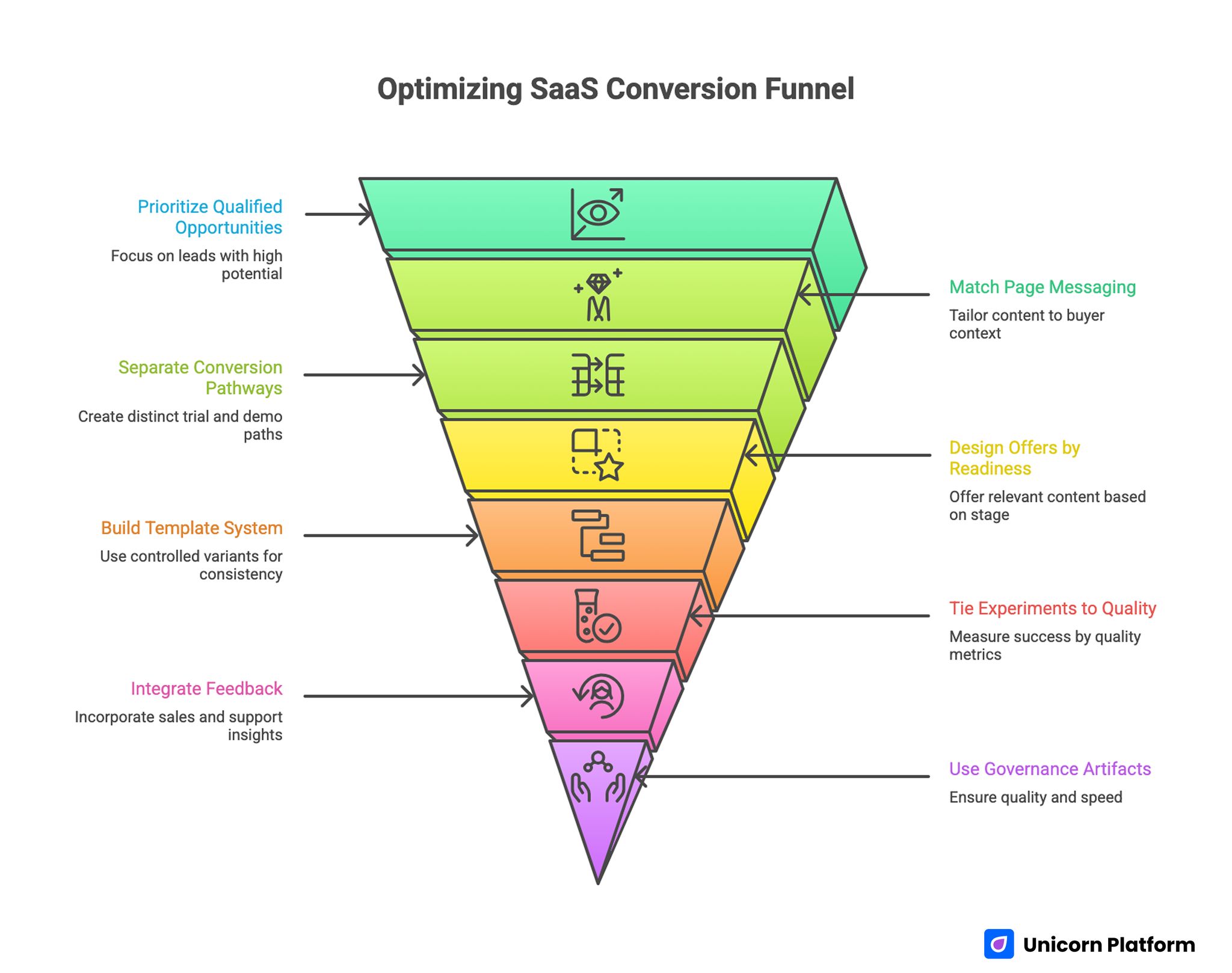
- Prioritize qualified opportunities over raw lead volume.
- Match page messaging to buyer role, intent stage, and source context.
- Separate trial-driven and demo-driven conversion pathways.
- Use offer design by readiness stage, not one CTA for every visitor.
- Build one template system with controlled variant logic.
- Tie experiments to quality metrics and guardrails, not clicks alone.
- Integrate sales and support feedback into weekly page decisions.
- Use governance artifacts so launch speed scales without quality drift.
Why SaaS Demand Engines Stall
Most demand engines stall because teams optimize channels in isolation. SEO brings one promise, paid media brings another, and landing pages attempt to satisfy everyone with broad messaging. Visitors arrive, but they do not feel clearly addressed. The result is lower conversion confidence and weaker qualification.
This complexity is consistent with broader B2B buying research. According to HubSpot, modern B2B buyers typically review multiple vendors and interact with numerous pieces of content before making a purchase decision. This means that inconsistent messaging between acquisition channels and landing pages can quickly reduce buyer confidence and slow pipeline progression.
Another common cause is stage mismatch. Early-stage visitors receive high-commitment CTAs too soon, while high-intent visitors are forced through educational flows that delay action. This mismatch increases bounce for some segments and friction for others.
Operational drift also compounds over time. As campaigns multiply, page modules are copied and edited without consistent standards. Pricing language, proof quality, form logic, and CTA hierarchy become inconsistent. Sales then sees unpredictable lead quality even when traffic appears healthy.
The Four-Layer Model for Predictable Pipeline
A reliable SaaS demand system can be managed through four layers: demand capture, conversion architecture, qualification routing, and feedback optimization. Each layer has distinct responsibilities, metrics, and owners.
Demand capture answers who you attract and why they click. Conversion architecture answers what they see and how they decide. Qualification routing answers how leads are prioritized and passed to the right path. Feedback optimization answers how real outcomes improve the next cycle.
The model works because each layer can be audited independently while remaining connected to one shared business outcome: high-quality pipeline that advances to opportunity.
Layer 1: Demand Capture by Intent and Buying Stage
Demand capture should be built on intent clusters, not content volume targets. A page should exist because it resolves a specific buying question for a specific segment, not because publishing cadence requires another asset.
Map demand into stage groups. Problem-aware audiences need framing and clarity. Solution-aware audiences need differentiation and trust. Decision-ready audiences need frictionless action with confidence cues. These groups should not be sent to identical pages.
In practice, teams should define one primary query intent or campaign promise per page variant. Mixed-intent pages usually attract mixed-quality leads and complicate follow-up.
For teams scaling organic discovery, this data-driven content opportunity framework is useful for prioritizing high-value intent clusters over low-yield publishing.
Layer 2: Conversion Architecture That Matches Buyer Decisions
Conversion architecture should follow decision order: relevance, trust, feasibility, and commitment. If a page asks for commitment before trust is established, conversion quality drops regardless of traffic source.
A practical structure starts with role-fit clarity and concrete value outcome. Then it moves into workflow evidence and objection handling. Only after that should high-friction actions like demo requests dominate the page.
This sequence supports both user experience and sales outcomes. Visitors self-qualify earlier, and sales receives leads with clearer intent and better expectation alignment.
For section-level planning, this SaaS content hierarchy guide helps assign a clear job to each block before writing or design begins.
Layer 3: Qualification Routing and Handoff Design
Lead capture should route users according to readiness, not only according to channel. A visitor who wants quick product access should not be forced into a heavy sales process. A visitor evaluating multi-team rollout should not be pushed into generic self-serve flow without context.
Define at least two primary routes: self-serve activation and sales-assisted evaluation. Each route should have tailored messaging, form depth, and follow-up expectations. This reduces unnecessary friction and improves downstream conversion quality.
Routing logic should be explicit in page design. If users cannot tell what happens after they submit, completion rates may look acceptable while trust and response satisfaction decline.
Layer 4: Feedback Loops That Improve Signal Quality
Strong programs treat feedback as a structured input, not occasional anecdote. Sales objections, onboarding friction, support questions, and early churn signals all reveal where pre-conversion messaging is incomplete.
Create a weekly loop where top recurring patterns are mapped to one page-stage improvement. If users repeatedly ask implementation questions after converting, implementation clarity belongs earlier in the page journey.
This loop improves both acquisition efficiency and retention quality because expectations are aligned before conversion, not repaired after handoff.
Role-Based Messaging Architecture
SaaS buyers do not evaluate with one shared lens. A founder, operations manager, and IT stakeholder can read the same page and leave with different confidence levels. Role-based messaging is essential, but it should be implemented with bounded variation.
The need for role-based messaging is reinforced by broader B2B decision-making research. A report from McKinsey highlights that modern B2B purchase decisions often involve larger, cross-functional buying groups, with stakeholders evaluating solutions from operational, financial, and technical perspectives. Because of this, landing pages must help different evaluators quickly locate the information relevant to their role in the decision process.
Use one core template and adapt high-impact surfaces by role: headline emphasis, workflow proof examples, and CTA framing. Keep trust modules and structural sequence stable to preserve QA quality and attribution clarity.
Role logic should also influence objection handling. Operations leads may worry about process overhead. Technical evaluators may focus on integration risk. Budget owners may prioritize time-to-value and predictable cost progression.
Offer Design by Readiness Stage
Offer strategy is often under-optimized compared with copy and layout. Yet offer design can significantly influence lead quality because it signals expected commitment and value path.
Early-stage visitors respond to practical orientation assets, lightweight templates, and clear problem framing. Mid-stage visitors need implementation detail, case context, and comparative confidence. Late-stage visitors need direct access to high-value conversation or guided activation.
If every stage receives the same CTA, quality suffers. Some visitors convert too early and stall later. Others are asked for too much too soon and bounce.
Offer modules should therefore be stage-tagged and mapped to qualification expectations. This keeps marketing and sales aligned on what each conversion action implies.
Trial Pathway Design for Product-Led Motions
Trial pathways should optimize for activation quality, not account volume. Raw signup growth can hide poor first-value realization and low retention potential.
A high-quality trial path clarifies who trial is for, what first success looks like, and how quickly that success can be achieved. It should also define the support available during setup so users can assess effort realistically.
The first post-signup step should mirror the pre-signup promise. If the page promises rapid setup but the product journey is confusing, trust degrades immediately and activation suffers.
Demo Pathway Design for Sales-Led Motions
Demo pathways should maximize qualification clarity while minimizing unnecessary form friction. Buyers request demos when they expect practical value, not generic walkthroughs.
Pages should state what the session covers, who should attend, and which decision the session helps resolve. This framing improves fit and reduces no-show or low-context meetings.
Form fields should be tied to routing value. Collect what materially helps prep and prioritization, then defer the rest to follow-up. Over-collection at first touch often reduces conversion without meaningful qualification gain.
Navigation as a Qualification Tool
Navigation determines how quickly buyers reach confidence-critical information. Poor navigation can make strong content effectively invisible.
Top-level routes should reflect buyer decisions: product fit, implementation, trust, pricing clarity, and next-step options. Routes based on internal org structure are usually less effective for conversion.
Keep navigation depth intentional. Too few routes can hide important context, while too many routes fragment attention. The target is decision support, not content exhaustiveness.
For teams improving user flow behavior, these landing-page behavior optimization tactics can help identify where visitors lose momentum.
Trust Design for B2B SaaS Decisions
Trust is not a single section. It is a layered experience across the page. Early trust comes from role-fit clarity and credible framing. Mid trust comes from proof and implementation transparency. Late trust comes from policy and support confidence near action points.
Logo walls and testimonials are useful, but they are insufficient alone. Buyers need proof tied to real use contexts, realistic timelines, and operational outcomes they can map to their own environment.
Trust language should also stay consistent across page, form, and follow-up. If confidence cues disappear during handoff, users question commitment and progression slows.
Integration and Implementation Clarity
Implementation risk is a major hidden blocker in SaaS conversion. Buyers may like value messaging but hesitate because rollout effort feels uncertain.
Address this directly with practical guidance: expected setup path, key stakeholders, timeline windows, and support checkpoints. This reframes adoption as manageable process rather than risky unknown.
Integration content should explain continuity. Buyers need to know existing workflows will remain stable while new capabilities are introduced.
SEO and Paid Coordination Model
Organic and paid channels should work as one system. Organic pages establish durable demand capture. Paid pages accelerate high-intent opportunities. Both should use consistent conversion architecture and trust language.
A shared template system allows channel-specific emphasis without fragmenting brand logic. Paid variants may prioritize urgency and qualification clarity. Organic variants may add richer context and educational scaffolding.
When teams coordinate this way, insights from one channel improve the other. That compounding learning is a major advantage over channel silos.
For practical conversion pattern benchmarking, this SaaS landing page examples guide can support planning without forcing copy-level imitation.
Content Cluster Engine for Compounding Demand
Single pages rarely sustain growth alone. Cluster design builds momentum by connecting related intent paths into a progression toward qualified action.
A simple cluster sequence can be problem framing, implementation guidance, comparison context, and conversion page. Each stage should have one clear next step and one role-specific value proposition.
Cluster governance matters. Use shared CTA standards, consistent proof logic, and clear ownership for refresh cycles. Without governance, clusters grow but quality decays.
Form Strategy and Data Hygiene
Forms should capture enough information to route effectively without creating unnecessary friction. Teams often over-index on field count rather than field utility.
Classify fields into critical, helpful, and optional. Critical fields remain in first touch. Helpful fields can appear conditionally. Optional fields should usually be deferred.
Data hygiene is part of conversion quality. Inconsistent field definitions and poor standardization create downstream routing errors and reduce sales velocity.
Nurture Architecture for Mid-Funnel Progression
Not every visitor is ready for immediate sales interaction. Nurture pathways should build confidence and readiness with purposeful sequencing.
Good nurture design uses short content arcs: workflow clarity, proof depth, objection resolution, and action invitation. Each step should reduce one decision barrier and make the next step obvious.
Nurture pages should maintain narrative continuity with acquisition promise. If tone and claims shift sharply, trust declines and progression stalls.
Sales Handoff SLA Design
Lead quality is not just a marketing output. It is a joint marketing-sales process outcome. Without defined handoff standards, high-intent leads can cool before follow-up.
Set service-level agreements for response windows, ownership, and minimum context delivery. Leads should arrive with enough intent metadata for productive first contact.
Review SLA adherence weekly. If delays or context gaps are common, adjust routing logic or form design before increasing campaign volume.
Analytics Framework for Pipeline Quality
Dashboards should prioritize quality outcomes over activity metrics. Track progression from conversion event to accepted opportunity and early pipeline velocity.
A practical metrics tree includes top metrics (qualified trials or accepted demos), supporting metrics (stage progression and activation quality), and diagnostic metrics (section interactions, form abandonment, device-specific behavior).
Define guardrail thresholds. A rise in lead volume is not a success if qualification ratio or sales acceptance drops beyond acceptable range.
Experimentation Cadence and Governance
High-velocity teams win when experiments are disciplined. Each test should have one clear hypothesis, one primary metric, and one quality guardrail.
Avoid multi-variable launches that obscure attribution. Smaller, cleaner tests produce faster reliable learning and safer rollouts.
Maintain an experiment register with hypothesis, audience, change, metric pair, confidence score, and decision. This prevents repeated low-value tests and preserves team memory.
Weekly Operating Rhythm
A repeatable weekly rhythm keeps optimization compounding. Monday: review quality metrics and feedback patterns. Tuesday: prioritize one high-impact test and one maintenance fix. Wednesday: implement and QA in Unicorn Platform. Thursday: launch. Friday: assess early signals and log decisions.
This cadence balances speed with control. Teams avoid reactive redesigns and focus on measurable improvements.
Weekly rhythm should include cross-functional participants. Growth, product marketing, sales feedback, and QA each contribute different signal types needed for good decisions.
Monthly and Quarterly Governance
Weekly cycles need strategic anchoring. Monthly governance should review template integrity, proof freshness, and ownership adherence. Quarterly governance should reassess segment priorities, risk posture, and capacity assumptions.
Quarterly reviews should produce an explicit risk map by funnel stage with owner and mitigation plan. This ensures strategic risks are addressed proactively rather than after performance declines.
Governance is not bureaucracy when it removes ambiguity. It is a speed multiplier because teams know what can change, who approves, and how success is judged.
International and Regional Adaptation
Global programs require more than language translation. Regional buyers may differ in procurement behavior, trust priorities, and adoption constraints.
Keep a shared structural template and adapt only bounded surfaces regionally: examples, proof ordering, and CTA phrasing. This balances local relevance with global consistency.
Regional variants should maintain comparable measurement so insights can be transferred without losing context.
Partner and Co-Marketing Flows
Partner-sourced traffic often has different trust assumptions and conversion intent. Sending partner audiences to generic pages can reduce qualification quality.
Create partner-aware variants that explain joint value, expected implementation path, and next-step ownership. Keep this concise and aligned with partner promise.
Track partner pathways separately in analytics. A channel may look healthy on click metrics while underperforming on accepted pipeline if narrative continuity is weak.
Revenue Model Alignment for Demand Programs
Demand programs convert best when page logic matches revenue model reality. Teams often design pages around messaging trends while ignoring contract structure, sales cycle length, and onboarding intensity. This disconnect creates impressive front-end movement with weak downstream economics.
Start by mapping conversion actions to revenue pathways. A low-friction trial may fit products with rapid activation and short time-to-value. A guided evaluation route may fit products requiring integration planning or stakeholder alignment. If path and model are misaligned, lead quality suffers and sales cycles slow.
Pricing structure also shapes conversion design. Usage-based models usually need stronger education around adoption trajectory and scaling implications. Seat-based models often require clearer role-fit and team rollout framing. Enterprise contracts need confidence around governance and procurement readiness earlier in the journey.
The practical rule is simple: conversion pathways should reflect how value is actually delivered and monetized. When page architecture matches commercial reality, qualification quality improves and pipeline becomes more predictable.
ABM and PLG Coexistence Without Funnel Conflict
Many SaaS teams run account-focused programs and self-serve programs in parallel. The challenge is preventing those motions from competing for the same traffic with conflicting page goals. A unified demand system should support both without creating confusion.
A workable model uses shared structure with route-specific branch points. Visitors with clear enterprise signals can move into high-context evaluation flows. Visitors with exploratory intent can move into self-serve discovery and activation. Both routes should preserve message continuity and trust consistency.
Account-focused variants should emphasize business case, rollout confidence, and stakeholder alignment. Self-serve variants should emphasize fast value realization and low setup friction. The difference is not just CTA text. It is the depth and sequence of confidence content before action.
Measurement should reflect route purpose. ABM routes should track account progression and meeting quality. Self-serve routes should track activation quality and expansion potential. Aggregating these into one undifferentiated conversion metric hides important tradeoffs and leads to poor optimization decisions.
Intent Scoring and Qualification Signals
Lead scoring becomes useful only when it is behavior-aware and tied to real outcomes. Static demographic scoring often misses true readiness, while behavior-only scoring can overvalue curiosity without buying intent. Effective systems combine both and calibrate continuously.
Define signal classes by stage. Early signals include problem-content depth and role-fit interactions. Mid-stage signals include workflow exploration, integration interest, and trust-content consumption. Late-stage signals include pricing engagement, implementation detail review, and high-intent action patterns.
Assign scores cautiously and review them monthly against sales outcomes. If high-scoring leads repeatedly fail sales acceptance, your model is overvaluing the wrong behavior. If low-scoring leads convert well, your model may be missing segment-specific intent cues.
Scoring should guide routing, not replace judgment. Sales teams still need context summaries that explain why a lead scored high, not just a numeric label. Transparent signal logic improves handoff quality and helps teams refine models faster.
SDR and AE Handoff Orchestration
Even strong pages lose value when post-conversion orchestration is weak. Leads that match ideal profile can decay quickly if handoff timing, context, and ownership are unclear. Handoff quality should therefore be treated as a conversion-stage extension, not a separate function.
Use structured routing rules that align lead source, intent stage, and segment characteristics to the right owner. Include fallback logic for edge cases so leads do not stall in unassigned queues. Clear ownership windows reduce delay and improve first-touch relevance.
Provide concise context packets for every routed lead: conversion pathway, key content interactions, declared pain points, and relevant trust concerns. This allows first outreach to feel informed rather than generic, which improves response quality and meeting progression.
Track orchestration metrics alongside front-end metrics. Response-time compliance, contact-attempt quality, and meeting conversion by route reveal whether handoff design is helping or hurting pipeline outcomes. When these metrics degrade, page and routing logic should be reviewed together.
Capacity Planning and Pipeline Forecasting
Demand optimization should account for team capacity, not just conversion potential. If page improvements produce more qualified interest than sales and onboarding teams can absorb, user experience and win rates can decline despite better top-funnel metrics.
Create a capacity-aware forecast model that combines expected conversion lift with response bandwidth and onboarding throughput. Forecasts should include conservative, expected, and upside scenarios so planning does not depend on one optimistic assumption set.
Use forecast outputs to prioritize backlog items. High-lift experiments with low operational strain should move first. High-lift experiments that would overload sales queues may need phased rollout or route balancing before full deployment.
Review forecast assumptions quarterly with leadership and operating teams. Aligning conversion plans to delivery capacity prevents quality erosion during growth periods and supports steadier revenue expansion.
Compliance and Privacy Clarity in Lead Capture
Trust in SaaS conversion is increasingly tied to privacy and compliance confidence, especially in regulated or enterprise-influenced segments. If lead-capture processes feel opaque or risky, high-intent evaluators may exit before converting.
Pages should communicate data-handling intent in plain language near capture points. Visitors should understand what information is collected, why it is needed, and how it supports their requested next step. Ambiguous legal wording can reduce confidence even when compliance is strong.
For international or multi-region programs, ensure regional expectations are reflected in capture flow and consent language where needed. Consistency matters, but regional relevance matters too. Teams should avoid a one-size policy block that ignores local trust norms.
Compliance clarity should also carry into follow-up. If page promises and outreach behavior diverge, confidence drops quickly. Keeping capture, routing, and communication aligned strengthens conversion quality and long-term brand trust.
Scenario: Mid-Market SaaS Pipeline Recovery
A mid-market SaaS firm saw growing traffic but flat accepted opportunities. Analysis identified three recurring problems: broad first-screen messaging, delayed trust content, and inconsistent handoff details.
The team rebuilt core variants in Unicorn Platform using one stable architecture and role-focused emphasis blocks. They simplified trial and demo pathways, updated offer-stage mapping, and introduced weekly sales-feedback integration.
Within eight weeks, lead volume grew modestly, but accepted pipeline increased significantly. Meeting quality improved, and sales response efficiency rose because form and page context aligned better.
The primary gain came from system consistency, not dramatic design changes. Structured operations made outcomes more predictable.
30-Day Execution Plan
30-Day SaaS Pipeline Growth Execution Plan
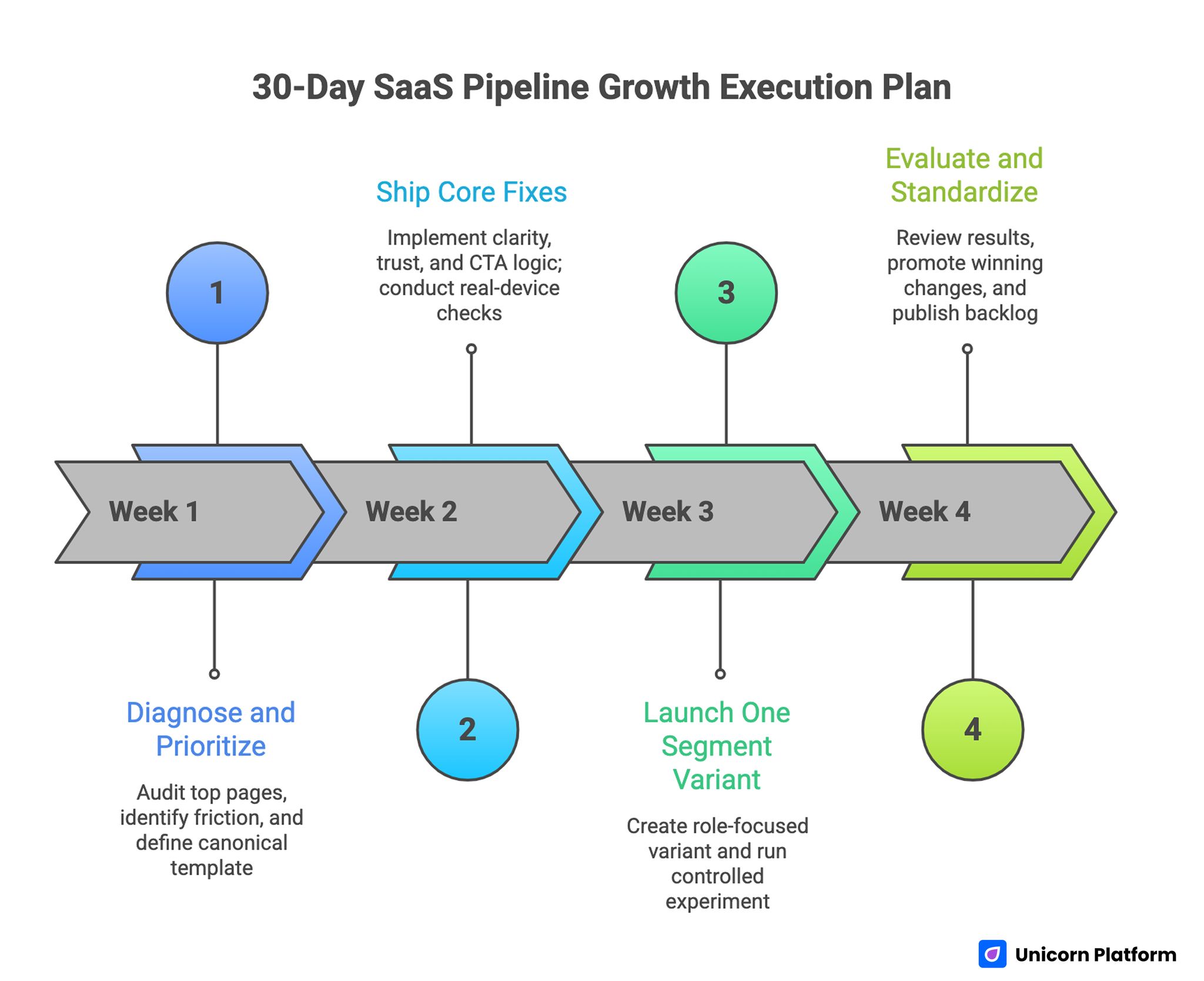
Week 1: Diagnose and Prioritize
Audit top traffic pages by stage leakage: relevance, trust, or commitment. Identify one major friction point per high-impact page.
Define one canonical template in Unicorn Platform with required sections, trust modules, and CTA hierarchy.
Week 2: Ship Core Fixes
Implement first-screen clarity updates, trust placement improvements, and route-specific CTA logic for trial versus demo intent.
Run real-device checks for mobile readability, action visibility, and form usability.
Week 3: Launch One Segment Variant
Create one role-focused variant from the canonical template. Keep structure stable and adjust only high-impact message surfaces.
Run one controlled experiment with primary quality metric and one guardrail.
Week 4: Evaluate and Standardize
Review results by source cohort and conversion pathway. Promote winning changes into template defaults and archive weak changes with rationale.
Publish next-cycle backlog with ownership and expected impact range.
90-Day Scale Plan
Month 2: Expand Controlled Coverage
Add source-aware and role-aware variants while preserving template governance. Continue weekly test cadence and feedback mapping from sales and support.
Prioritize changes that improve accepted pipeline and early opportunity velocity.
Month 3: Institutionalize Reliability
Formalize governance artifacts: template standards, metrics thresholds, experiment register protocol, and escalation rules for rollbacks.
At this stage, success means teams can launch faster without introducing quality volatility.
Common Failure Modes and Fixes
1) Broad Messaging for Every Audience
Problem: relevance dilution and weak self-qualification. Fix: stable template with role-specific emphasis variants.
2) One CTA for All Readiness Levels
Problem: stage mismatch and lower quality conversion. Fix: distinct trial and demo pathways with clear intent fit.
3) Trust Content Buried Too Late
Problem: visitors hesitate before seeing confidence signals. Fix: move practical proof and policy clarity earlier.
4) Form Over-Collection
Problem: unnecessary friction and lower completion. Fix: keep only routing-critical fields at first touch.
5) Navigation Built for Internal Teams
Problem: buyers cannot find decision-critical information quickly. Fix: prioritize routes aligned to buyer questions.
6) Multi-Variable Test Chaos
Problem: attribution is unreliable. Fix: one meaningful variable per cycle with guardrail metric.
7) Weak Handoff Standards
Problem: quality leads cool before response. Fix: clear SLA for timing, ownership, and context delivery.
8) Metric Tunnel Vision
Problem: activity metrics rise while pipeline quality declines. Fix: measure accepted opportunities and early velocity outcomes.
9) Stale Proof and Outdated Screens
Problem: trust erosion from asset mismatch. Fix: monthly freshness audit and decay-priority updates.
10) No Feedback Integration Loop
Problem: recurring objections remain unresolved. Fix: weekly mapping of sales and support insights to page tests.
Pre-Launch QA Checklist
Before each release, validate intent-message match, stage-appropriate offer clarity, trust recency, form logic, and CTA hierarchy. Confirm that confidence cues appear before major commitment actions.
Run mobile validation on real devices for first-screen clarity, proof readability, navigation usability, and form completion flow. Confirm performance readiness on conversion-critical templates.
Verify measurement integrity: source segmentation, variant tracking, and stage-level progression signals should be accurate before traffic scaling.
Require sign-off from growth, product marketing, and QA, with sales feedback review for high-impact variants.
FAQ: SaaS Pipeline Growth in 2026
1) What should we optimize first?
Start with first-screen relevance and trust placement. These usually deliver the fastest quality improvements.
2) Trial or demo as primary action?
Choose based on audience readiness and GTM motion. Do not force both equally on one page.
3) How many experiments per week are ideal?
Fewer, cleaner tests are better. One major variable per page cycle is typically best.
4) Should every segment have a unique template?
No. Keep one core structure and vary high-impact emphasis blocks only.
5) Which metric matters most?
Use a qualified pipeline metric tied to sales acceptance or opportunity creation.
6) How often should proof and screenshots be refreshed?
Review high-visibility assets monthly and prioritize updates by decay impact.
7) Can SEO-driven pages produce high-quality B2B pipeline?
Yes, when intent mapping, proof depth, and routing logic are aligned to readiness.
8) What is the biggest qualification mistake?
Optimizing for submission volume without measuring downstream quality.
9) How do we reduce low-fit leads quickly?
Tighten role-fit messaging, clarify not-fit conditions, and improve stage-specific offers.
10) What creates compounding gains over time?
Stage-based diagnosis, disciplined testing, clear ownership, and consistent feedback loops.
Final Takeaway
Predictable SaaS pipeline growth comes from system design, not isolated tactics. Teams win when intent capture, page architecture, qualification routing, and feedback optimization operate as one coherent engine.
Unicorn Platform supports this model by enabling fast iteration on stable templates. Keep structure disciplined, vary messaging intentionally, and judge success by quality outcomes so growth compounds instead of fluctuating.
Related Blog Posts
- Dashboard Landing Pages for Startups: How to Simplify Complex Products and Improve Conversion
- SaaS Landing Page Conversion System in 2026: How Product Teams Turn Traffic Into Qualified Pipeline
- B2B Landing Page Conversion System in 2026: How Teams Build Qualified Pipeline at Scale
- Waitlist Page Strategy in 2026: How Teams Build Qualified Launch Demand, Not Vanity Signups


