Table of Contents
- Why Many Link Programs Underperform Despite Budget
- Selective Directory Strategy in 2026
- 30-60-90 Day Rollout Plan
- Common Failure Patterns and Fixes
- FAQ
Link acquisition is still one of the strongest levers in organic growth, but the tactics that worked years ago now create volatility for many teams. Startups can spend heavily on outreach and placements while seeing only modest ranking gains because the program is built around volume metrics instead of strategic relevance and destination quality.
In 2026, successful teams run link acquisition as an integrated system. They define where links are needed, why those links matter for business outcomes, what destination pages must deliver after the click, and how quality will be measured over time. Without this structure, link work becomes an expensive activity stream with weak strategic effect.
Unicorn Platform helps because page updates can be shipped quickly when outreach intelligence reveals content gaps. That speed matters when acquisition signals show that your pages need deeper proof, clearer framing, or better decision flow before additional authority campaigns scale.
For teams aligning SEO investment with business-level outcomes, the framework in aligning website optimization with your business goals can improve prioritization discipline.
sbb-itb-bf47c9b
Quick Takeaways
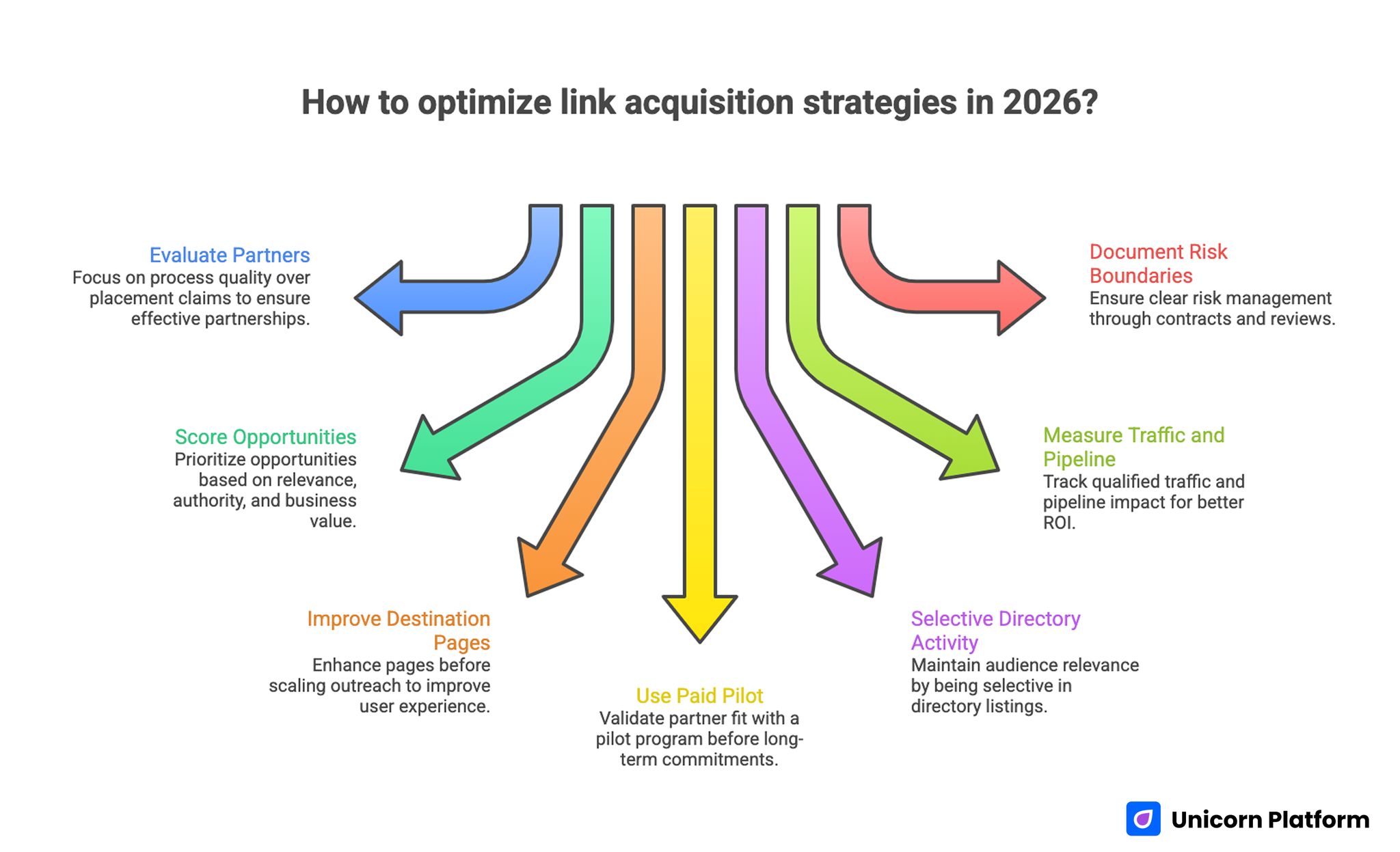
Quick Takeaways for Optimizing Link Acquisition Strategies in 2026
- Evaluate partners by process quality, not by placement count claims.
- Score opportunities by relevance, authority context, and expected business value.
- Improve destination pages before scaling outreach volume.
- Use a paid pilot to validate fit before long contracts.
- Keep directory activity selective and audience-relevant.
- Measure qualified traffic and pipeline impact, not only backlinks acquired.
- Document risk boundaries in contracts and review cycles.
Why Many Link Programs Underperform Despite Budget
The most common failure is objective confusion. Teams say they want stronger rankings and better pipeline quality, but campaign reporting focuses on link totals, domain metrics, and outreach volume. Those outputs can look positive while page-level performance stays flat.
A second issue is weak destination readiness. If target pages do not answer user intent with enough depth and credibility, additional links may lift visibility without improving qualified outcomes. Authority signals amplify page quality. They cannot replace it.
A third issue is misaligned process ownership. Outreach execution, content quality, and technical SEO are managed independently, so campaign insight never becomes coordinated page improvement. The program keeps moving, but learning does not compound.
Partner Selection Framework for Startup Teams
Choosing a partner should start with strategic fit. A strong partner can explain how they prioritize targets, how they define editorial quality, and how they connect placements to a clear page strategy. If the process is vague, risk rises quickly.
Assess candidate partners across five dimensions: topical relevance standards, outreach method transparency, editorial quality controls, destination-page collaboration, and reporting clarity. Each dimension should have observable evidence, not only claims in a proposal deck.
Startups often benefit from a weighted scorecard. This prevents persuasive sales narratives from overriding process fundamentals and makes internal approvals easier.
What High-Quality Outreach Process Looks Like
Process quality is visible in details. Strong teams show how prospects are researched, how message fit is defined, and how outreach is adapted to publication context instead of using broad templates.
Editorial fit is usually the decisive variable. Placements from publications that naturally cover your problem space outperform generic placements even when surface domain metrics look similar.
Communication discipline matters too. Partners should provide rationale for each placement target, expected value hypothesis, and follow-up logic when placements do not deliver the expected ranking movement.
Destination Readiness Before Authority Expansion
Before scaling outreach, audit the pages that will receive links. Check intent match, structural clarity, proof density, internal navigation, and conversion path readiness. If those elements are weak, link growth will not convert into durable gains.
A practical pre-campaign review can follow the structure in how to audit your website like an SEO pro so technical and editorial risk is addressed early.
Within Unicorn Platform, page updates can be deployed quickly once readiness gaps are identified. Teams that combine rapid publishing with strict QA usually get more value from each placement.
Opportunity Mapping With Gap Intelligence
Authority opportunities should come from structured gap analysis, not from generic prospect lists. Compare your citation profile to strong market peers and identify where authoritative mentions are repeatedly earned in your category.
Classify opportunity gaps by intent type. Some gaps indicate missing reference content, others indicate weak comparison coverage, and others indicate incomplete implementation guidance. Different gap types require different asset responses.
Gap mapping should end with execution tickets. Each high-priority gap should map to page updates, outreach targets, owner assignment, and expected business effect.
Content Assets That Earn Better Placements
Outreach performs better when teams promote assets worth citing. Useful asset classes include benchmark pages, implementation frameworks, migration guides, structured comparisons, and role-specific playbooks.
Asset quality is determined by utility and credibility. Readers and editors both respond to clear reasoning, concrete examples, and transparent scope boundaries.
Build asset planning around strategic themes rather than isolated keywords. This creates a stronger internal network of pages that support each other and improve authority transfer over time.
Selective Directory Strategy in 2026
Directory work still has a role when applied with precision. The value now comes from relevant discovery environments where real buyers, evaluators, and researchers look for options.
Selection criteria should include editorial moderation, topical alignment, referral quality history, indexing reliability, and brand-fit standards. Mass-submission behavior usually creates noise rather than sustainable outcomes.
When teams need a clear baseline for this channel, the method in no-code guide to web directory submission for improved SEO can help structure decisions around quality and relevance.
Outreach Message Architecture for Higher Acceptance
Effective outreach messages show publication fit quickly, explain why the proposed resource helps the audience, and minimize promotional tone. Editors respond to relevance, not to scale claims.
Message architecture should include three parts: context alignment, specific value proposition, and low-friction next step. Generic intros and broad claims reduce response quality.
Personalization should be practical, not performative. Referencing a publication's recent angle is useful when it clarifies alignment, not when it adds unnecessary length.
Pilot Design Before Long-Term Commitments
A controlled pilot reduces financial and strategic risk. Instead of committing to large retainers immediately, run a defined test period with explicit quality standards and outcome expectations.
Pilot scope should include target page set, placement quality criteria, outreach transparency requirements, and reporting structure. Outcomes should be reviewed against both acquisition metrics and page-level performance signals.
A good pilot decision is binary: scale, revise, or stop. Ambiguous pilot conclusions usually lead to slow budget leakage.
Measurement Model Beyond Link Count
Link count is a production metric, not a business result. A stronger model tracks four layers: acquisition quality, visibility movement, behavioral quality, and business contribution.
Acquisition quality includes topical fit and editorial relevance. Visibility movement includes cluster-level ranking and impression shifts. Behavioral quality includes engaged visits and internal pathway progression. Business contribution includes qualified leads and pipeline influence from organic sessions.
If placements rise while qualified outcomes stall, the likely issue is destination mismatch or intent misalignment. In that case, content architecture needs adjustment before additional outreach expansion.
Contract Terms and Risk Boundaries
Contracts should define allowed methods, prohibited tactics, quality thresholds, and escalation rules. Without these boundaries, quality drift is likely when campaign pressure rises.
Include clear language on transparency requirements: target rationale disclosure, placement context reporting, and replacement policy for low-quality outcomes. Clear terms reduce dispute friction and protect long-term brand integrity.
Risk governance should also include pause rights. If quality standards are not met, teams need a fast mechanism to stop spend and run corrective review.
Cross-Functional Ownership Model
Link acquisition quality improves when SEO, content, and growth teams share one operating loop. Outreach insight should feed page updates, and page performance should guide future target selection.
Define explicit owners for opportunity mapping, destination quality, outreach execution, and performance analysis. Shared accountability reduces lag between insight and action.
Weekly operating reviews should focus on decisions, not status recaps. Each review should close with one priority update, one experiment, and one risk action.
Executive Scorecard and Budget Decision Triggers
Link acquisition programs become unstable when reporting and budgeting are separated. Teams receive activity updates while spending decisions happen on intuition. A better model uses one executive scorecard with predefined triggers tied to quality and business impact.
A useful scorecard includes four blocks. The first block covers placement quality and topical relevance. The second block covers visibility movement in target clusters. The third block covers behavior quality on destination pages, including engaged sessions and pathway progression. The fourth block covers commercial outcomes such as qualified inquiries and influenced pipeline.
Decision triggers should be explicit before campaigns scale. If placement quality declines for two review cycles, spending should pause until target selection and outreach logic are corrected. If visibility increases without qualified outcome growth, budget should shift to destination-page improvements before expanding outreach. If both quality and business signals improve, controlled scale can continue with the same standards.
This structure helps leadership allocate resources without overreacting to short-term variance. It also gives campaign owners clear expectations for what counts as progress and what requires intervention.
Agency Onboarding and Operational Integration
The first month after partner selection is where many programs drift. Strategy alignment often looks clear in proposals, then execution diverges once outreach production begins. Onboarding should close that gap with operational detail.
A strong onboarding phase should define target page priorities, content refresh dependencies, approval SLAs, and weekly reporting format. It should also define who can approve outreach exceptions and how quality disputes are escalated.
Integration quality improves when partners can see destination-page timelines. If outreach references a page that is still being rewritten, acceptance and performance both decline. Shared planning prevents this mismatch and keeps campaigns credible in live publishing environments.
For teams running mixed SEO and content operations, onboarding should include a short operating charter. The charter can specify communication cadence, risk boundaries, and the exact metrics used for scale decisions. That small document reduces ambiguity throughout the engagement.
30-60-90 Day Rollout Plan
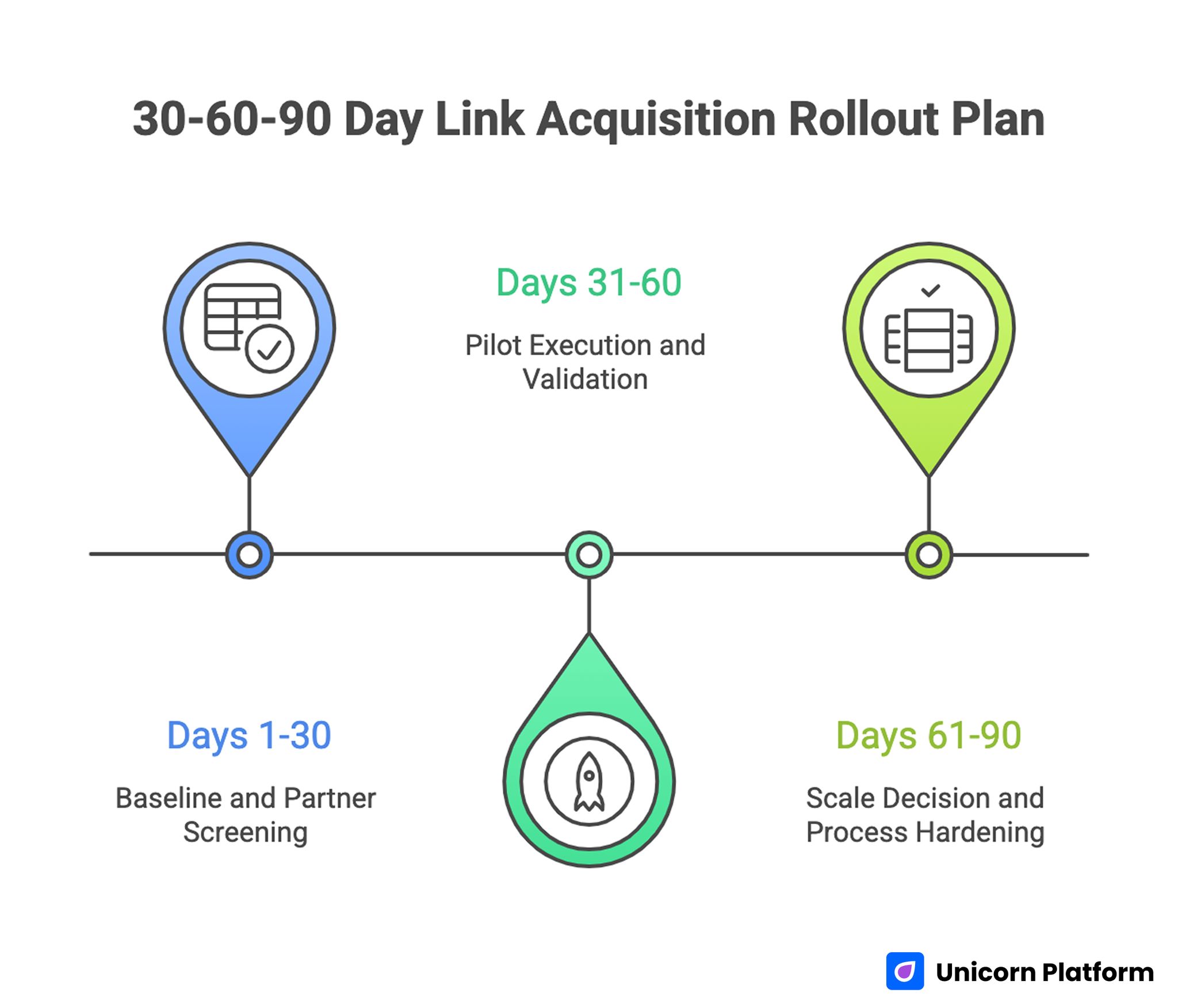
30-60-90 Day Link Acquisition Rollout Plan
Days 1-30: Baseline and Partner Screening
Audit current backlink profile quality, page readiness, and cluster-level visibility trends. Build partner scorecard and shortlist candidates using structured criteria.
Run destination-page fixes on the highest-value routes so pilot placements have strong landing targets.
Days 31-60: Pilot Execution and Validation
Launch a controlled pilot with explicit quality boundaries and reporting expectations. Track placement quality, visibility movement, and early behavior signals on target pages.
Document campaign learning weekly and adjust outreach targets based on observed relevance.
Days 61-90: Scale Decision and Process Hardening
Scale only if pilot results meet both quality and business thresholds. Expand successful patterns into a repeatable operating workflow with clear ownership.
At this stage, codify contract guardrails, reporting templates, and risk-response procedures so growth does not degrade quality.
Common Failure Patterns and Fixes
Failure: Volume-Led Prioritization
Teams optimize for placement count and miss strategic relevance. Fix this with weighted scoring tied to intent value and business proximity.
Failure: Weak Target Pages
Authority signals point to pages that cannot convert trust into action. Fix this with mandatory destination-readiness review before campaign launch.
Failure: Outreach Without Editorial Fit
Messages are generic and acceptance quality drops. Fix this by requiring target-specific context and publication alignment logic.
Failure: Ambiguous Contract Rules
Quality drift appears and resolution becomes slow. Fix this with explicit standards, prohibited methods, and fast pause rights.
Failure: Reporting Without Decision Triggers
Teams receive metrics but no action guidance. Fix this by defining threshold-based triggers for scale, revise, or stop decisions.
Failure: Siloed Team Execution
Outreach insights do not improve content strategy. Fix this with cross-functional weekly loops and clear owner roles.
FAQ: Link Acquisition Partnerships in 2026
1) How long should a pilot run before scaling?
Most teams can evaluate early quality signals within 6 to 8 weeks. Final scale decisions should include both placement quality and downstream page impact.
2) Are directories still worth using?
Yes, when they are selective, relevant, and moderated. Broad volume submissions usually do not produce durable strategic value.
3) What is the first quality signal to review?
Editorial relevance of placements is the fastest signal. If fit is weak, later performance usually remains weak regardless of volume.
4) Should startups work with one partner or several?
One partner is often easier for governance early on. Multiple partners can work later when standards and attribution processes are mature.
5) How do we reduce link-related risk quickly?
Set written boundaries for methods, anchor governance, and quality criteria before campaigns launch. Enforce pause rules when standards slip.
6) What if rankings rise but qualified leads do not?
Review target-page intent alignment and conversion pathways. Visibility gains without qualified outcomes usually indicate destination quality gaps.
7) Which internal role should own final decisions?
Final decision ownership should sit with the function accountable for business outcomes, supported by SEO and content leads for technical and editorial input.
8) How often should we refresh authority assets?
Quarterly refresh is practical for most teams, with faster updates for pages tied to volatile market topics.
9) Can AI help in outreach workflows?
AI can speed research and drafting, but human review is required for publication fit, tone precision, and quality control.
10) What makes link acquisition durable over time?
Durability comes from consistent relevance standards, strong destination assets, and measurement tied to business impact rather than activity volume.
Final Takeaway
Authority growth in 2026 rewards teams that combine selective outreach with high-quality destination pages and disciplined measurement. The winning model is not the fastest placement engine. It is the most reliable decision system.
When partner selection, gap intelligence, page readiness, and governance are aligned, link acquisition becomes a predictable growth channel instead of a risky experiment cycle. That consistency compounds strategic value over time.
Related Blog Posts
- No-Code Guide to Web Directory Submission for Improved SEO in 2026
- How to Build a Profitable Affiliate Niche System in 2026, Not Just Another Niche List
- Evidence-Led SEO Operations in 2026: A Practical System for Better Content Decisions
- Landing-Page SEO in 2026: A Practical System to Rank and Convert With High-Intent Pages