Table of Contents
- Why Lead Programs Underperform Even With Strong Traffic
- Form Design: Capture Useful Context Without Killing Completion
- 30-Day Implementation Plan
- Common Failure Modes and Practical Fixes
- FAQ
Most teams do not have a traffic problem. They have a conversion-quality problem. Campaigns drive clicks, pages collect submissions, dashboards look active, and yet sales teams still report weak fit, low response quality, and inconsistent opportunity creation.
This gap appears when a page is designed only to maximize form completions rather than to qualify intent and set clear expectations. A short form can inflate volume while decreasing downstream efficiency. A longer form can over-filter and suppress valuable demand. Both outcomes are expensive when they are not intentional.
A high-performing demand-capture page is not a design artifact. It is a routing system that connects the right visitor to the right next step with minimal ambiguity. When this system is structured well, marketing efficiency improves, sales conversations start with better context, and pipeline forecasting becomes more reliable.
Unicorn Platform is valuable in this environment because teams can ship fast without destroying structure. Fast iteration is only useful when each change can be evaluated cleanly. That requires stable architecture, clear page ownership, and repeatable QA.
sbb-itb-bf47c9b
Quick Takeaways
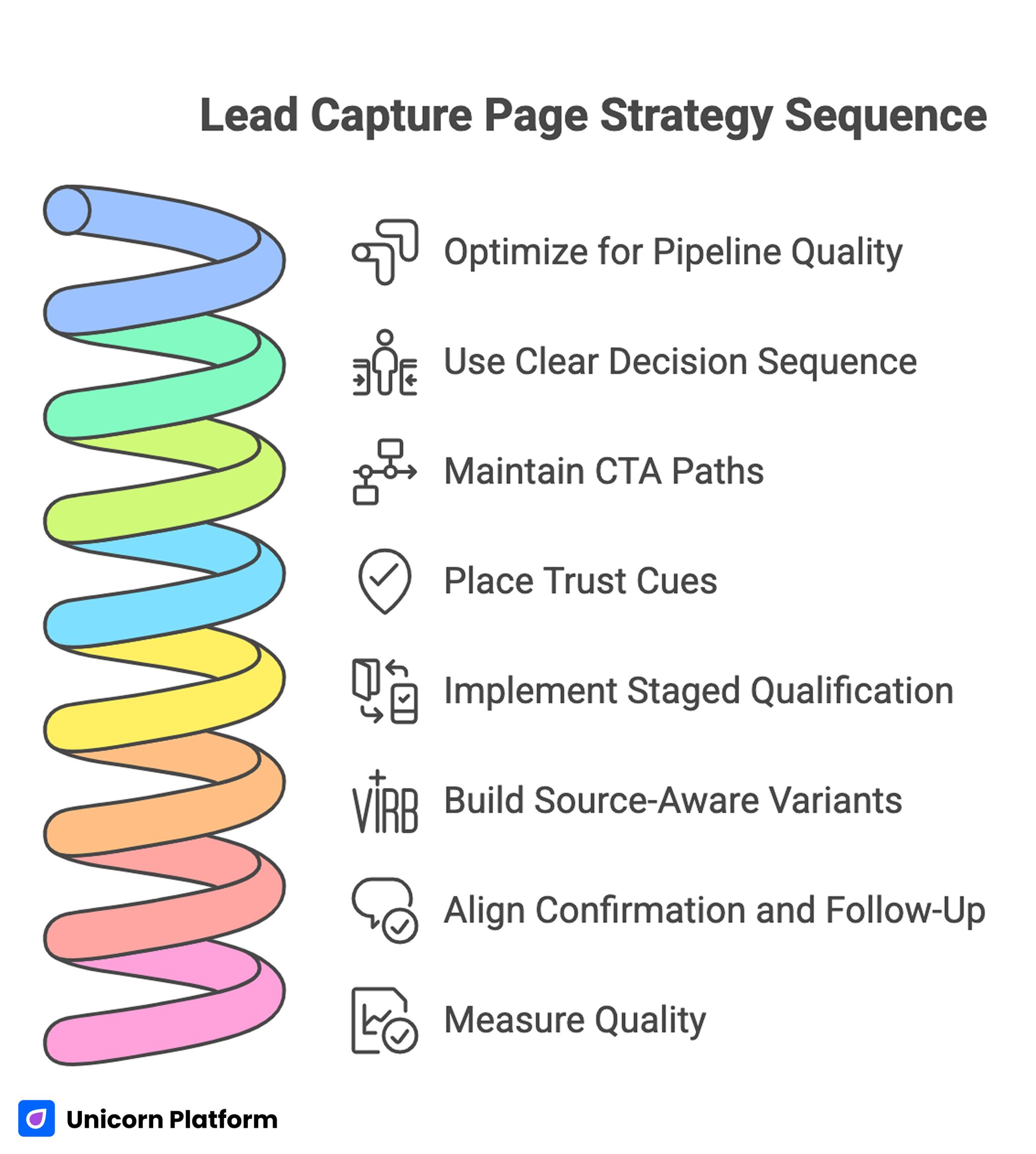
Lead Capture Page Strategy Sequence
- Optimize for pipeline quality first, then scale volume with evidence.
- Use one clear decision sequence from audience fit to next-step clarity.
- Keep one dominant CTA path and one deliberate secondary path.
- Place trust cues where hesitation occurs, not at the bottom by default.
- Use staged qualification to balance completion rate and routing quality.
- Build source-aware variants from one stable template.
- Align confirmation and follow-up flows with page promise.
- Measure quality using sales acceptance, opportunity progression, and early velocity.
Why Lead Programs Underperform Even With Strong Traffic
Underperformance usually starts with unclear relevance. Visitors land on the page and cannot quickly identify whether the offer matches their role, problem stage, or business context. When fit is vague, low-intent users submit and high-intent users hesitate.
The second issue is weak value articulation. Many pages describe services or features, but they do not explain what concrete change the visitor should expect after converting. Without practical outcomes, form completion becomes a speculative action.
The third issue is trust timing. Credibility evidence often appears after the first major CTA, which means visitors are asked to commit before uncertainty is reduced. This creates preventable drop-off among qualified users.
The fourth issue is handoff mismatch. Marketing promises one experience while sales follow-up delivers another. Even with healthy submission counts, this mismatch reduces conversion to meetings, opportunities, and revenue.
Finally, teams frequently track the wrong metrics. Submission volume rises while acceptance quality falls, yet optimization continues in the same direction because top-funnel indicators look positive.
The Conversion Sequence That Improves Pipeline Quality
Strong pages follow a predictable sequence: fit, value, confidence, qualification, and action. This sequence mirrors how business buyers evaluate risk under limited time.
Fit tells the visitor whether this offer is for them right now. Value explains what measurable outcome or decision support they will receive. Confidence reduces uncertainty through relevant proof and process transparency. Qualification captures minimal routing context. Action presents the right next step without distraction.
If this sequence breaks, quality declines quickly. Asking for submission before fit is clear increases noise. Showing proof before value can feel disconnected. Adding too many action options at once increases hesitation.
Teams refining architecture can borrow structure discipline from this high-converting landing page framework when standardizing section order across campaigns.
Audience Fit: Start With the Right People
Fit is the highest-leverage filter in any acquisition flow. If the page cannot communicate clear audience boundaries, no form strategy can fully correct quality downstream.
A strong fit block names role context, use-case context, and problem stage. It does not need to exclude everyone else aggressively. It needs to make relevance obvious for the right segment.
Fit language should avoid broad identity claims. Statements like "built for modern teams" are too ambiguous to guide decision behavior. More precise framing such as "for growth teams managing multi-channel acquisition with limited conversion ops capacity" provides immediate direction.
Practical Fit Signals to Include
- Role scope: who typically owns this problem.
- Operational context: what environment this applies to.
- Timing context: when this offer is most useful.
- Non-fit note: who might need a different path.
This set of signals improves both conversion quality and sales conversation efficiency.
Value Design: Make the Next Step Worth Taking
Visitors submit when they see practical value, not when they see polished copy. Value should be framed as a concrete output, not a generic promise.
High-performing offers usually answer three questions. What will I get? How quickly will I get it? Why does it matter to my current priorities?
For example, "request a tailored channel-opportunity breakdown with prioritized actions for the next 30 days" creates stronger intent than "talk to our team about growth." Specificity lowers interpretation burden and attracts better-fit submissions.
Value design should also align with sales readiness. If the page promises deep strategic consultation, follow-up must deliver that level of depth. Misaligned promises create distrust and lower progression rates.
Confidence Architecture: Reduce Risk Before Asking for Commitment
Business buyers evaluate risk at every step. Confidence elements should resolve uncertainty around credibility, process, effort, and expected outcomes.
Useful confidence components include context-rich client results, concise methodology visibility, implementation expectations, and timeline transparency. Generic praise is less effective than scenario-based evidence.
Confidence should be placed near decision moments. If proof appears only in lower sections, high-intent visitors may abandon before seeing it. The goal is to answer hesitation where it occurs.
For teams targeting complex sales motions, this B2B conversion page guide can help calibrate trust depth and objection handling.
Offer Architecture by Buyer Readiness
Structure Lead Capture Page
Not every visitor should be routed to the same action. Some need diagnostic clarity, others need tactical guidance, and some are ready for direct consultation.
Offer architecture should reflect these readiness levels while keeping one primary objective for the campaign window. A common pattern is one dominant CTA for the desired route and one secondary CTA for adjacent readiness.
The mistake is presenting too many equal options. Equal-weight choices increase cognitive load and reduce conversion confidence. Clear hierarchy performs better than broad optionality.
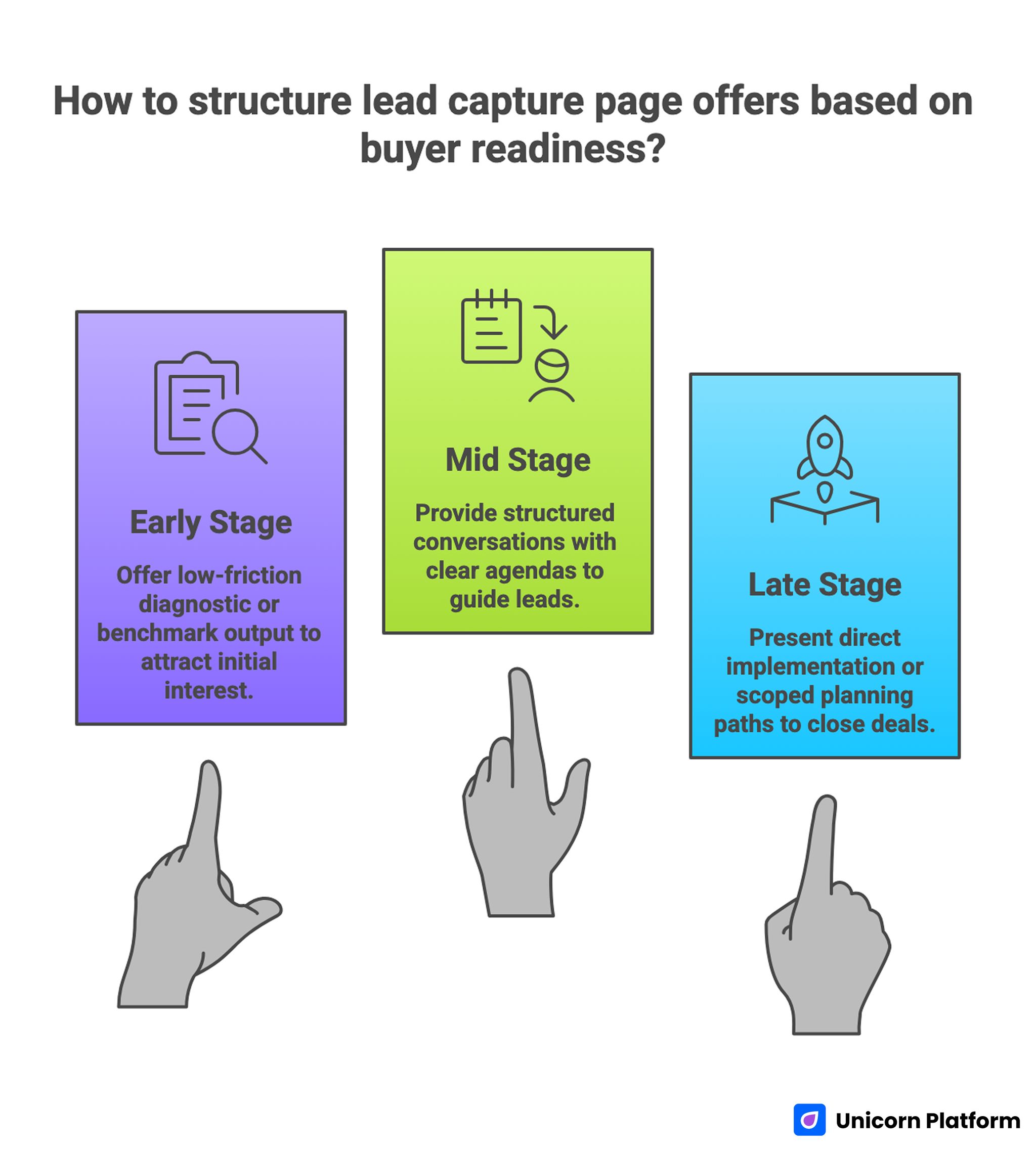
Readiness-Based Offer Ladder
- Early stage: low-friction diagnostic or benchmark output.
- Mid stage: structured conversation with clear agenda.
- Late stage: direct implementation or scoped planning path.
When this ladder is explicit, routing quality and meeting preparedness usually improve.
Form Design: Capture Useful Context Without Killing Completion
Form strategy should be driven by routing value, not tradition. Every field should map to a real post-submission action.
Fields that do not influence prioritization, personalization, or handoff quality are usually friction without value. Removing these fields can improve both completion rate and data quality.
A strong first-step form often includes name, work email, and one high-signal qualifier such as role, priority challenge, or time horizon. Additional details can be gathered after intent is confirmed.
Field-Level Decision Audit
Ask these questions for each field:
- Does this field change what happens next?
- Can this signal be collected later without harming outcomes?
- Is the field easy to complete on mobile?
- Is the field likely to introduce privacy hesitation?
If the answer is weak on most questions, defer the field.
Progressive Qualification and Follow-Up Depth
Progressive qualification lets teams preserve top-of-funnel momentum while still collecting routing depth. The first conversion event captures minimal essentials. Follow-up interactions expand context intelligently.
This can include confirmation-step preference capture, short onboarding forms, or contextual questions before scheduling. The key is sequencing: ask for more detail only after clear value exchange.
Progressive flows often improve both completion and sales readiness because visitors experience less friction upfront and more relevant guidance afterward.
Teams running product-led acquisition can align this approach with broader demand workflows using this SaaS demand strategy guide.
CTA Hierarchy and Route Clarity
CTA strategy should direct behavior, not merely decorate sections. A page with multiple competing primary actions creates hesitation and weak routing quality.
Use one dominant action tied to campaign objective. Add one secondary action only if it serves a distinct readiness state. Tertiary actions should be visually subordinate.
CTA language should emphasize visitor outcome and next-step clarity. Avoid internal jargon such as "submit inquiry" when clearer alternatives communicate value and expectations.
CTA Placement Rules That Reduce Drop-Off
- Primary CTA appears after fit and value are established.
- Reinforcement CTA appears after major trust block.
- Final CTA appears after objections and process clarity.
This placement pattern supports scanning behavior while preserving decision sequence.
Message and Design Cohesion
Copy and layout should reinforce the same hierarchy. If message says one route is primary but visual treatment makes all routes equal, users receive mixed signals.
Strong cohesion means each section has one job, each visual element supports that job, and each CTA corresponds to the current decision stage.
Visual density should be controlled. Busy layouts can signal effort and complexity, which is especially harmful in acquisition flows aimed at reducing uncertainty.
Mobile Experience and Interaction Quality
A large share of demand capture starts on mobile, even in high-consideration categories. Mobile friction can quietly degrade quality before teams notice it in aggregate reports.
Mobile QA should include first-screen readability, input comfort, field labeling clarity, keyboard interactions, and confirmation continuity. Real-device testing is mandatory for reliable validation.
Track mobile performance by channel and by form step. Blended averages can hide source-specific issues that materially affect pipeline quality.
Source-Aware Variants Without Operational Chaos
Search, paid social, outbound, partner referrals, and email traffic enter with different intent context. One static page for all sources usually underperforms.
The best approach is one canonical template with controlled source-level message variants. Adjust headline emphasis, proof order, and CTA framing while keeping section architecture stable.
This creates relevance without sacrificing governance. It also improves experimentation quality because structural variables remain constant.
Variant Governance Rules
- Do not modify more than one major structural block per test.
- Maintain shared section order across all source variants.
- Document variant purpose and expected behavior before launch.
- Archive losing variants quickly to avoid accidental reuse.
These rules protect learning quality and reduce rework.
Sales Handoff Design: Where Pipeline Value Is Won or Lost
Acquisition quality depends on handoff quality. If post-submission routing is vague or slow, even well-qualified interest can decay.
A strong handoff model includes clear ownership, response windows, context transfer, and follow-up templates aligned with page promise. Marketing and sales should share definitions for priority tiers and readiness signals.
Submission data should route to the right team and the right sequence. Generic queues reduce speed and personalization, which lowers meeting conversion rates.
Handoff Essentials to Standardize
- Priority logic based on qualification signals.
- SLA for first response by priority tier.
- Context summary visible to first responder.
- Clear branch logic for non-fit or low-readiness submissions.
When these elements are defined, conversion from submission to meaningful conversation improves consistently.
Confirmation Experience: Reinforce Intent Immediately
Confirmation pages and first messages are part of conversion, not administrative afterthoughts. They should reassure the visitor that submission was successful and clarify what happens next.
A strong confirmation moment includes acknowledgment, expected timeline, and one purposeful next action. That action might be scheduling, resource access, or readiness clarification.
Without this reinforcement, intent fades and response rates decline. Continuity between page promise and confirmation experience is one of the fastest ways to improve pipeline quality.
Objection Mapping for Pre-Conversion Clarity
Most objections repeat across campaigns: uncertainty about fit, concern about effort, skepticism about outcomes, and fear of being pushed too fast into sales conversations.
Map objections to sections where they should be resolved. Fit concerns belong in the opening. Effort concerns belong in process explanation. Outcome concerns belong in proof blocks. Sales-pressure concerns belong near CTA clarity and confirmation expectations.
This mapping prevents pages from becoming generic persuasion attempts. Each section addresses a concrete hesitation with relevant context.
Common Objections and Response Patterns
- "Not sure this is for us": add role and scenario fit signals.
- "Not sure it will work": add contextual proof with constraints.
- "Not sure how much effort this takes": add timeline and process clarity.
- "Not ready for a sales call": add a lower-friction secondary route.
Structured objection handling improves both conversion and lead quality.
Measurement Framework for Pipeline-Grade Optimization
Submission counts are insufficient for strategic decisions. Teams need layered measurement that captures both conversion mechanics and commercial outcomes.
Layer one tracks page behavior: click-through, form starts, submissions, and confirmation completion. Layer two tracks qualification quality: priority distribution, accepted leads, and follow-up responsiveness. Layer three tracks commercial progression: opportunity rate, cycle speed, and early revenue influence.
Each campaign should define one primary metric and one guardrail metric. Guardrails prevent optimization choices that improve one stage while harming another.
Practical Metric Pairs
- Demand capture push: primary is qualified submissions, guardrail is acceptance-to-rejection ratio.
- Meeting push: primary is scheduled conversations, guardrail is show-up rate.
- Pipeline push: primary is opportunity creation, guardrail is early-stage drop-off.
Metric discipline turns experimentation into a reliable operating system.
Weekly Operating Rhythm for Conversion Teams
A fixed operating rhythm prevents random edits and preserves attribution clarity. Without cadence, teams change too many variables and lose insight quality.
A practical weekly cycle is straightforward. Monday reviews quality signals and friction points. Tuesday selects one hypothesis. Wednesday ships one focused change in Unicorn Platform. Thursday validates QA and early signals. Friday decides rollout, rollback, or iteration.
One major variable per cycle is usually enough for clear learning. Faster progress comes from consistency over time, not from high-volume unstructured edits.
Monthly Freshness and Template Maintenance
Even good pages decay when proof, offers, and process details go stale. Freshness operations keep conversion assets aligned with current market conditions.
Use a monthly refresh cycle for high-traffic variants. Review proof relevance, offer clarity, qualification logic, and route performance. Remove stale claims and update context where priorities have changed.
Quarterly, run a deeper template review. Promote winning patterns into the canonical build and retire low-value sections. This keeps the system adaptive without creating template chaos.
Attribution and Forecasting for Pipeline Confidence
Many teams can explain what happened in campaigns but cannot explain why it happened in a way that supports planning. Attribution quality is often weak because page changes, targeting changes, and follow-up changes happen at the same time.
Better forecasting starts with cleaner attribution rules. Keep one major page variable per experiment cycle, preserve stable routing logic, and document downstream effects beyond submission volume. This makes it easier to connect page decisions to business outcomes.
A practical attribution model should separate influence from ownership. The page may influence a meeting outcome even if the final conversion credit is assigned to another touchpoint. Teams that capture both views make better budget and effort decisions.
Forecasting also improves when qualification tiers are explicit. If teams define what high, medium, and low readiness looks like, they can model likely progression rates more accurately and detect quality drift earlier.
Forecasting Inputs That Matter Most
- Traffic mix by source and intent quality.
- Submission-to-acceptance ratio by variant.
- Time-to-first-response by priority tier.
- Meeting conversion and show-up stability.
- Early opportunity progression by cohort.
When these inputs are reviewed together, pipeline forecasts become more resilient than forecasts based on submission volume alone.
Practical Reporting Cadence
Use a weekly report for tactical decisions and a monthly report for strategic allocation. Weekly reporting should focus on current friction points and short-cycle tests. Monthly reporting should focus on trend stability, segment performance, and template-level changes.
Keep the reporting format stable so teams can compare periods without reinterpreting definitions each cycle. Consistency in reporting language is an underrated performance lever.
Team Operating Model for Fast, Safe Iteration
No-code speed can create quality regressions when ownership is unclear. The fix is a lightweight operating model with explicit roles and release gates.
A practical model uses four owners. Messaging owner controls fit and value clarity. Proof owner controls trust relevance and freshness. Routing owner controls form logic and handoff paths. QA owner controls release readiness and measurement checks.
Each owner should have a short checklist and clear escalation rules. This reduces ambiguity during fast campaign windows and prevents silent regressions caused by partial edits.
Release Gate Before Traffic Scale
Before scaling spend or outbound volume, run a gate with five checks:
- Messaging check: fit and offer clarity are aligned with campaign objective.
- Trust check: proof is current, relevant, and placed near decision moments.
- Routing check: forms, CTA paths, and confirmation logic are functioning.
- Measurement check: primary and guardrail metrics are firing correctly.
- Handoff check: response SLA and ownership are confirmed.
If one gate fails, launch should be delayed until the issue is resolved. This discipline protects downstream pipeline quality and prevents expensive false positives.
Decision Log Standard
Every meaningful change should be recorded in a short decision log entry. Include hypothesis, change scope, expected impact, guardrail risk, and next review date.
Decision logs prevent repeated low-value tests and improve onboarding for new team members. They also create historical context that improves future planning quality.
For teams that need faster draft velocity while keeping this governance intact, controlled use of AI page drafting workflows can accelerate ideation without replacing review discipline.
Escalation Rules for Quality Drops
When guardrails decline materially, teams should not debate process in real time. Use predefined escalation rules: freeze new experiments on the affected page, revert the latest high-impact change, and run a focused root-cause review within one cycle.
Escalation rules reduce decision latency and prevent emotional reactions during performance dips. That makes recovery faster and more measurable.
Scenario: Improving Accepted Lead Rate Without Losing Volume
A growth team had strong acquisition volume but weak accepted-lead rate. Sales reported high mismatch between page promise and conversation readiness.
Audit identified three root issues. First, opening copy targeted too broad an audience. Second, trust evidence was generic and disconnected from buyer concerns. Third, the form collected too many fields that did not improve routing decisions.
The team rebuilt the page in Unicorn Platform with a fit-value-confidence-action sequence, simplified first-step qualification, and clearer confirmation expectations. They also introduced source-aware variants while keeping structure stable.
Within two months, accepted-lead rate improved and opportunity progression became more consistent. Submission volume stayed healthy because friction was reduced where it did not add value.
30-Day Implementation Plan
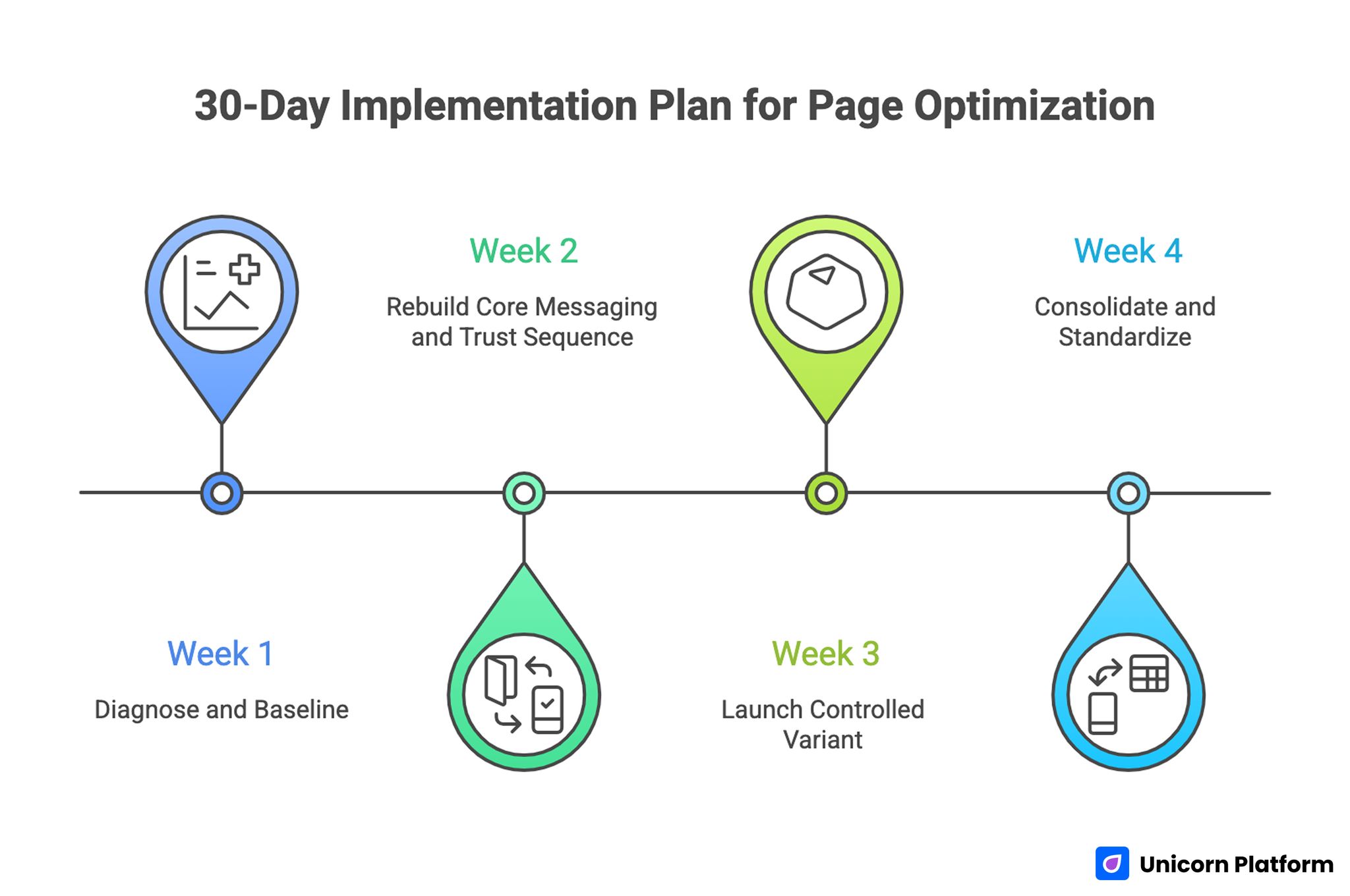
30-Day Implementation Plan for Page Optimization
Week 1: Diagnose and Baseline
Audit the current page against the decision sequence. Identify the highest-leak stage by reviewing form analytics, acceptance data, and sales feedback.
Define one primary metric and one guardrail metric. Document current baseline before making structural changes.
Map existing form fields to routing value and flag low-impact fields for removal or deferral.
Week 2: Rebuild Core Messaging and Trust Sequence
Rewrite first-screen copy for clear audience fit and outcome value. Reposition trust signals closer to first commitment points.
Simplify page hierarchy so one CTA route is dominant. Ensure visual and copy priorities match.
Validate mobile behavior and confirmation continuity before launch.
Week 3: Launch Controlled Variant
Create one source-aware variant from the same template. Change only high-impact messaging surfaces and keep architecture fixed.
Run one experiment with explicit success and rollback criteria. Monitor both primary and guardrail metrics daily.
Document observed behavior, including qualitative sales feedback.
Week 4: Consolidate and Standardize
Promote winning changes into the base template. Archive losing variants and remove unsupported assumptions.
Schedule monthly freshness reviews and assign section ownership for messaging, proof, form logic, and QA.
Prepare next test hypothesis based on measured friction, not intuition.
90-Day Scale Plan
Month 2: Expand Coverage by Intent Segment
Extend the canonical template into controlled variants for discovery-stage users, evaluation-stage users, and high-readiness users.
Develop reusable modules for outcome framing, proof layouts, qualification prompts, and confirmation messaging. This reduces production time while preserving quality standards.
Month 3: Operationalize Reliability
Formalize release gates for route integrity, measurement validation, mobile QA, and handoff readiness.
Define rollback triggers tied to guardrail deterioration. Ensure every campaign decision is logged with hypothesis, change details, and outcome.
At this point, scale should come from repeatable execution quality, not from adding complexity.
Common Failure Modes and Practical Fixes
1) Broad Positioning With No Fit Clarity
Visitors cannot tell whether the offer is relevant to their context. Fix by adding explicit role, use-case, and timing cues in the opening section. This makes self-selection easier and reduces low-fit submissions before they enter follow-up workflows.
2) Generic Value Claims
The page promises benefit without measurable outputs. Fix by defining concrete deliverables and expected timeline. Clear deliverables also improve meeting readiness because buyers know what to expect from the first conversation.
3) Late Trust Signals
Evidence appears after major commitment points. Fix by moving proof blocks closer to first CTA moments. Trust should be visible before key decisions, not after conversion friction has already increased.
4) Over-Qualified First Form
Too many fields reduce completion and increase abandonment. Fix with staged qualification and field audits tied to routing value. Collect deeper context later in the sequence when the value exchange is already established.
5) CTA Overload
Multiple competing actions fragment intent. Fix with one dominant route and one deliberate secondary route. Consistent hierarchy lowers cognitive load and improves conversion confidence across traffic sources.
6) Channel Message Mismatch
Different traffic sources see one unadapted message. Fix by using source-aware variants with stable structure. Keep structural consistency so performance differences reflect messaging, not hidden layout changes.
7) Weak Confirmation Flow
Post-submission next steps are unclear. Fix with immediate acknowledgment, timeline expectations, and purposeful next action. This continuity prevents intent decay and increases response quality in the first follow-up touch.
8) Sales Handoff Gaps
Context is lost between submission and response. Fix with priority tiers, SLA ownership, and structured context transfer. Shared handoff standards between marketing and sales reduce delays and improve conversation quality.
9) Volume-Only Optimization
Submission counts rise while acceptance quality drops. Fix by optimizing with layered metrics and guardrails. Guardrails help teams avoid local wins that damage downstream pipeline performance.
10) No Freshness Cadence
Proof and offers go stale, reducing trust. Fix with monthly updates and quarterly template reviews. Freshness routines keep messaging aligned with current priorities and real buyer expectations.
Pre-Launch QA Checklist
Confirm first-screen fit clarity, value specificity, and one dominant action route. Verify that each major section has a clear job in the decision sequence.
Check trust relevance, form friction, route integrity, and confirmation continuity. Ensure all qualification fields map to routing decisions.
Validate mobile interaction on real devices and confirm analytics instrumentation for primary and guardrail metrics.
Require final sign-off from messaging owner and QA owner before scaling traffic.
FAQ: Lead Capture Page Strategy
What should teams optimize first?
Start with fit clarity and value specificity in the opening section. These changes usually have the fastest impact because they shape who converts before form friction even matters.
Should forms always be short?
Forms should be as short as possible while still supporting useful routing decisions. Staged qualification is usually the best balance because it preserves completion while improving downstream context.
How many CTAs should a page have?
Use one dominant CTA and one clear secondary option at most. More equal-priority actions usually reduce confidence and fragment conversion intent.
What is the best trust element to add first?
Add contextual proof tied to the visitor's likely objection. Relevance matters more than quantity because a single precise proof point can reduce risk better than a long generic list.
How do teams improve accepted-lead rate?
Improve audience fit signals, strengthen value clarity, and align form data with real handoff decisions. Teams should also enforce response SLAs so qualified intent is not lost after submission.
Should source-specific variants use different layouts?
Keep layout stable and adjust message emphasis first. Structural stability improves experimentation quality because attribution becomes cleaner across traffic sources.
How often should teams refresh page content?
Run monthly freshness checks for high-traffic pages and quarterly template-level reviews. Refresh cadence should be tied to proof decay, offer changes, and measured friction signals.
What is the most common mobile conversion mistake?
Assuming desktop-form behavior translates directly. Real-device testing often reveals hidden friction in field interaction, keyboard behavior, and confirmation flow.
Which metric is most important?
The primary metric depends on campaign objective, but it should always be paired with a guardrail to protect quality. Without guardrails, teams can optimize one stage while quietly damaging downstream outcomes.
What creates compounding pipeline performance?
Stable structure, disciplined testing, clean handoff operations, and evidence-based iteration over time. Compounding performance comes from operational consistency, not isolated creative spikes.
Implementation Worksheet for the Next Sprint
If a team needs to move quickly, a short worksheet can keep execution focused. Start by writing one sentence for audience fit, one sentence for expected outcome, and one sentence for next-step promise. If these statements are unclear, the page is not ready for scaling traffic.
Then list the three highest-risk objections and map each one to a section. Add one specific proof element for each objection, and confirm that proof appears before the first major commitment request. This process usually improves both confidence and completion behavior without adding unnecessary copy.
Finally, define one primary metric, one guardrail metric, and one rollback threshold before launch. Teams that publish with these decisions already documented learn faster and avoid expensive guesswork during performance swings.
Final Takeaway
Pipeline performance improves when acquisition pages are designed for decision quality, not just form volume. The strongest systems align fit, value, trust, qualification, and handoff into one coherent flow.
Unicorn Platform enables this by combining rapid publishing with reusable structure. Keep hierarchy clear, keep routing intentional, and measure what matters to downstream outcomes so growth is durable, not noisy.


