Table of Contents
- Why Free Plans Are Still a Strategic Advantage
- Scenario Playbooks
- Deep Implementation Library for Free-Plan Teams
- Common Mistakes and Corrective Actions
- FAQ
Most teams think the biggest risk in early website work is choosing the wrong platform. In practice, the bigger risk is launching with unclear page intent, weak trust structure, and no optimization rhythm.
Free plans are powerful in 2026 because they reduce cost pressure while increasing learning speed. When used correctly, they let teams validate positioning, test offers, and build conversion discipline before committing budget to advanced tooling.
That strategy matters for founders, consultants, product startups, agencies, creators, and local businesses. All of these teams need the same thing at launch: a page that helps the right visitor make a decision quickly.
What separates strong free-plan outcomes from weak outcomes is not visual polish. The difference is whether the team treats the site as an operating system with clear goals, section roles, and measurement loops.
This guide gives you that system in full detail. It covers builder selection, page structure, copy logic, trust signals, channel variants, SEO foundations, performance checks, experimentation, governance, and upgrade timing.
sbb-itb-bf47c9b
Key Takeaways
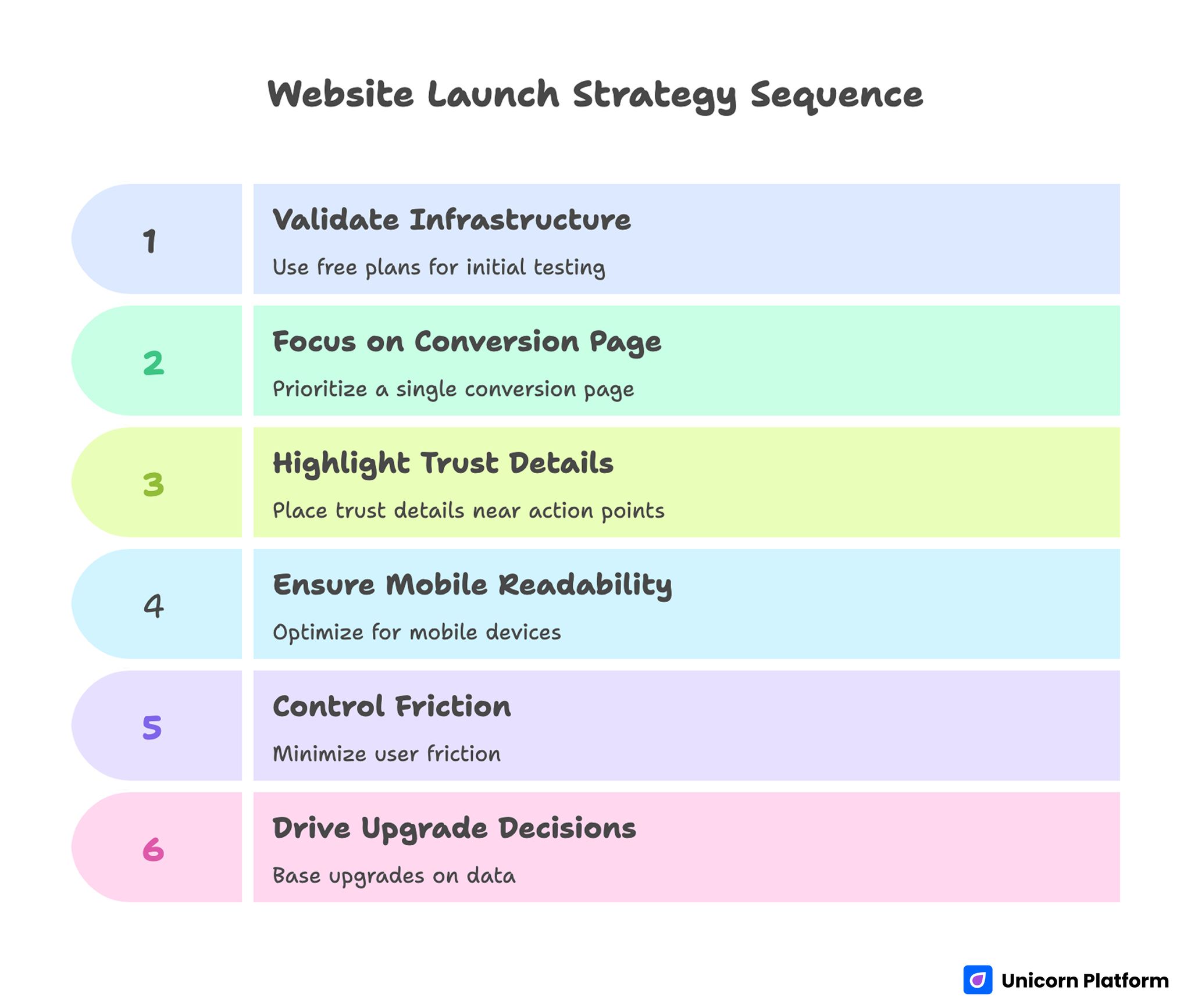
Website Launch Strategy Sequence
- Free plans work best as validation infrastructure, not as a temporary workaround.
- One focused conversion page usually beats a broad multi-page launch in the first phase.
- Trust details close to action points outperform generic credibility claims.
- Mobile-first readability and friction control are critical from day one.
- Upgrade decisions should be driven by measured constraints, not assumptions.
Why Free Plans Are Still a Strategic Advantage
Early-stage teams usually face three constraints at once: limited budget, limited time, and uncertain demand. A free setup reduces the first two constraints and helps you resolve the third through faster iteration.
In many categories, initial growth depends less on advanced functionality and more on message clarity. If your page explains who you help, what result you deliver, and why users should trust you, you can generate meaningful traction before paying for premium tools.
Free plans also improve decision quality because they force prioritization. Teams that cannot hide behind feature complexity often focus faster on what actually moves conversion.
The strongest operators use this phase to build repeatable habits. They learn how to write clearer headlines, place proof correctly, and run controlled tests instead of random edits.
For teams that need a fast baseline launch sequence, launch your site in three steps is a practical operational reference. Use it as a starting point, then adapt the structure to your specific conversion goal.
Speed alone is not the goal, though. The goal is faster learning tied to measurable outcomes, and that requires disciplined structure from the first version.
What High-Performing Teams Do Before They Publish
Most poor launches begin with template browsing. High-performing launches begin with decision mapping.
Before choosing blocks or colors, define the primary visitor type, the specific problem they want solved now, and the single action you want after they finish reading. This first alignment step prevents most conversion confusion later.
Next, define a page-level promise that can be supported by real proof. If your promise cannot be demonstrated on-page, rewrite it before launch.
Then define a review cadence before publishing, not after. Teams that wait to "figure out analytics later" usually make noisy edits that erase interpretability.
Finally, identify two guardrails that protect quality. For example, you can optimize inquiry volume while guarding lead relevance, or optimize CTA clicks while guarding completion quality.
This preparation takes less time than one redesign cycle, and it saves weeks of reactive rework. Teams that skip this step usually pay the cost later in confused traffic and low-quality leads.
Builder Selection Framework That Prevents Migration Debt
Aesthetics are easy to compare but rarely the limiting factor in production. Operational constraints are harder to see, yet they drive long-term success.
Evaluate free builders against workflow reality using a weighted framework. If a platform scores high on visual templates but low on iteration speed, it will become expensive in team time.
Use the following five dimensions with explicit scoring. A simple weighted rubric makes tradeoffs visible and keeps selection decisions objective.
- Editing velocity for non-technical contributors.
- CTA and form control for conversion tuning.
- Baseline SEO control and structural clarity.
- Collaboration ease across content and growth roles.
- Scalability path from one page to a mini-site system.
A structured comparison such as best free website platforms for startups helps teams apply this framework with less bias. Structured comparisons also shorten decision cycles when multiple stakeholders are involved.
Once a platform passes your minimum threshold, commit and ship. Endless comparison loops often cost more than imperfect first choices.
Launch Objective Design: One Page, One Primary Outcome
Many first websites fail because they try to serve every audience and every action at once. Mixed intent creates mixed messaging, and mixed messaging reduces conversion confidence.
Set one primary conversion outcome for version one. That outcome can be a booking request, trial start, newsletter signup, waitlist form, or consultation inquiry.
Make sure every major section supports that action path. Secondary outcomes can exist, but they must not compete with the primary CTA.
When this rule is followed, even simple pages often outperform larger sites with diffuse priorities. Focus improves user decisions and protects analytics clarity during early tests.
The rule also improves analytics clarity, because result interpretation becomes straightforward. Cleaner data leads to better iteration choices in later cycles.
A Practical Launch Sequence for Free-Plan Teams
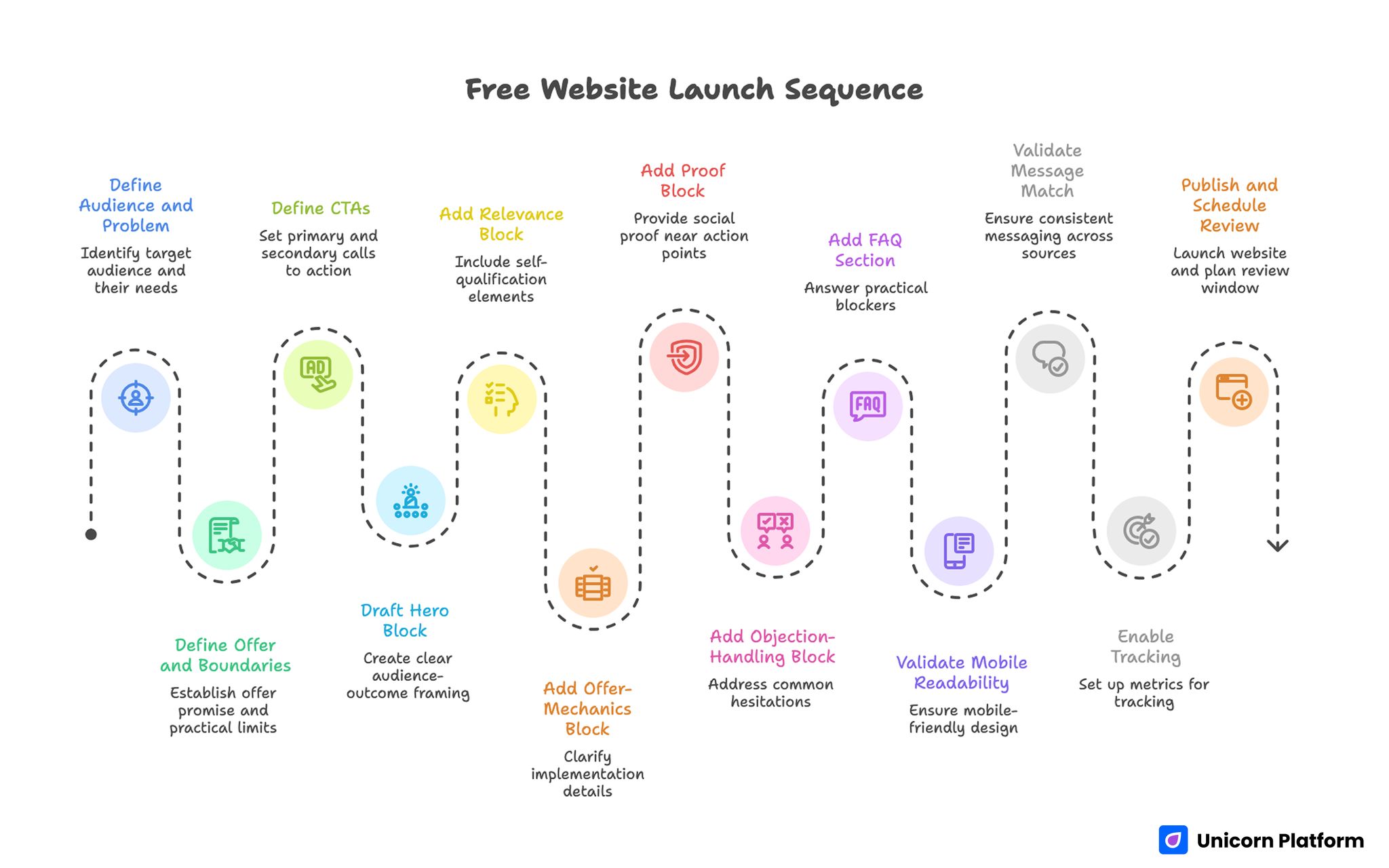
Free Website Launch Sequence
A reliable launch sequence balances speed with control. You should be able to publish quickly without sacrificing interpretability.
Use this sequence. The steps are designed to preserve speed while reducing avoidable conversion errors.
- Define audience and immediate problem intent.
- Define offer promise and practical boundary conditions.
- Define one primary CTA and one optional secondary CTA.
- Draft hero block with clear audience-outcome framing.
- Add relevance block for self-qualification.
- Add offer-mechanics block for implementation clarity.
- Add proof block near action points.
- Add objection-handling block for common hesitation.
- Add FAQ section for practical blockers.
- Validate mobile readability and interaction flow.
- Validate message match by source.
- Enable tracking for action and quality metrics.
- Publish and schedule first review window.
This sequence becomes more useful when repeated with consistency. It turns launch from a one-time event into a reusable operating process.
If you are planning a broader startup website system after baseline validation, evaluate builders for startup simplicity can help with stage-two decisions. That planning becomes more accurate once your baseline page has real behavior data.
The core principle is simple: sequence discipline creates faster learning than design improvisation. Execution speed and decision rigor should reinforce each other, not compete.
Conversion-Focused Page Architecture
A high-performing page should follow user decision order, not internal company storytelling order. People decide in stages, and each stage needs specific information.
Stage one is relevance. Visitors must quickly understand whether the offer fits their context.
Stage two is mechanism clarity. They need to know how your solution works and what effort it requires.
Stage three is trust and risk reduction. They need credible evidence, transparent boundaries, and realistic expectations.
Stage four is action clarity. They need one obvious next step with low friction and clear post-submit expectations.
When these stages are mapped to sections, conversion quality rises because uncertainty is addressed before commitment. Visitors convert more confidently when the page answers questions in decision order.
Hero Section Standards That Improve Qualified Conversion
The hero should not attempt to explain everything. Its job is to establish fit and move users into deeper evaluation.
Use a headline that combines audience and practical outcome. Add support copy that clarifies how the result is achieved or what context it applies to.
Place one primary action that matches readiness level. If needed, add one lower-friction secondary action for uncertain users.
Do not overload the hero with multiple equal-priority buttons, dense feature lists, or broad brand statements. Those elements increase scan friction when users need fast clarity.
A hero succeeds when visitors can answer three questions in under ten seconds: is this for me, what do I get, and what do I do next. If those answers are unclear, users will usually leave before reaching deeper proof sections.
Offer Explanation Blocks That Reduce Drop-Off
After the hero, explain your offer using implementation language, not vague promise language. Users should understand what happens after action, not just what you claim.
A useful pattern is "what you get, how it works, and what to expect in week one." This structure converts better than broad feature lists because it resolves uncertainty directly. It also helps support teams align onboarding expectations with pre-conversion messaging.
If your offer has constraints, state them clearly. Scope boundaries often increase trust and improve lead quality.
Avoid dense jargon and internal process terminology. Clarity should serve first-time visitors, not internal stakeholders.
When this section is strong, users self-qualify faster and support teams receive fewer mismatch inquiries. Better qualification usually improves both conversion efficiency and customer satisfaction.
Proof System Design for Credibility and Quality
Proof should answer objections, not fill space. Generic testimonial quotes with no context rarely influence decisions in high-noise categories.
Use context-rich proof with brief qualifiers such as use case, timeframe, and outcome condition. Context makes evidence actionable.
Place proof near points where users hesitate, such as pricing context, form sections, or high-commitment actions. Proof buried at the bottom has weaker impact.
Balance social proof with process proof. Users trust outcomes more when they understand the mechanism that produced those outcomes.
When possible, include a short reliability statement about delivery process, response expectations, or support boundaries. Reliability often matters as much as outcome claims.
Objection Handling That Prevents Silent Exits
Most visitors who leave without converting do not announce why. Objection handling sections help resolve silent hesitation before users bounce.
Common objections include fit uncertainty, timing uncertainty, pricing uncertainty, and trust uncertainty. Address these directly with concise and concrete language.
A strong objection block is not defensive. It is practical and user-centered, showing you understand decision risk.
If your offer is not ideal for everyone, say so. Qualification transparency increases conversion quality and reduces downstream churn.
Objection handling should appear before the final CTA reinforcement so users can act immediately after uncertainty is reduced. Good timing here can lift qualified conversions without changing traffic volume.
FAQ as a Decision-Support Layer
FAQ works best when it addresses real blockers from user conversations, support logs, and sales calls. Invented or trivial FAQs usually waste space.
Each FAQ answer should reduce one concrete uncertainty in one short paragraph. Long theoretical responses reduce scan speed and weaken usefulness.
A good FAQ can serve both conversion and SEO when questions align with real search behavior. The section should still prioritize user decisions over keyword repetition.
Keep answers specific enough to be useful and short enough to maintain rhythm. FAQ is most effective when integrated into the broader conversion flow.
Review FAQ monthly to keep it aligned with new objections and offer changes. Stale answers often create trust drag that is difficult to diagnose from analytics alone.
Design System Rules for Free-Plan Execution
Design decisions should reinforce comprehension and action flow. A visually modern page can still underperform if hierarchy is weak.
Use a tight typography scale with clear contrast between headings and body text. Readability should remain strong across desktop and mobile.
Use spacing to separate decision stages. When sections blur into each other, users lose orientation and skip key context.
Use imagery that supports relevance and trust. Real product or process visuals generally outperform generic stock scenes.
Limit decorative motion. Animation should clarify transitions or focus attention, not compete with content.
For teams refining visual quality while staying practical, design your site with easy free tools can be applied effectively when paired with conversion-first hierarchy rules. Visual updates should always preserve scan speed and action clarity.
A useful design check is this: can a new user understand the offer path in one fast scroll. If the answer is no, reduce decorative noise before adding new sections.
Mobile-First Usability and Performance Standards
Many teams validate desktop first and patch mobile later. That sequence usually harms conversion because early traffic often arrives on phones.
Mobile pages need concise section intros, strong contrast, and touch-friendly controls. Small usability issues compound quickly in short attention sessions.
Performance is a trust signal. Slow first paint, layout shifts, and heavy media can reduce confidence before users evaluate your offer.
Build a lightweight performance checklist into your launch process. Teams that do this avoid chasing false conversion problems caused by speed instability.
Test on at least two real devices and average network conditions before publishing major updates. Real-device validation catches friction that desktop previews rarely reveal.
SEO Strategy for Free-Plan Sites
Free-plan constraints do not remove the value of strong information architecture. Search visibility still rewards clarity, usefulness, and internal coherence.
Start with one primary intent page supported by two to four contextual pages. This creates enough depth to support both ranking relevance and user navigation.
Use meaningful headings, clear titles, and descriptive section language. Avoid repeated template phrasing across pages.
Publish supporting content that addresses practical buyer questions rather than generic industry commentary. Useful specificity beats volume in early phases.
Internal linking should help users move from learning to action naturally. Place links where deeper context is genuinely needed, not in standalone link dumps.
For teams that want a no-friction content launch baseline, free site creation walkthrough can help align publishing speed with structural quality. Use it to maintain consistency as you add supporting pages.
Channel-Specific Messaging for Better Conversion Quality
Different channels produce different intent states. Treating all traffic the same usually lowers qualified conversion.
Search visitors are often problem-aware and action-oriented. They respond to direct utility and implementation detail.
Social visitors are often curiosity-driven and may need faster trust reinforcement. They respond better when credibility appears early.
Referral visitors may arrive with partial trust from the source but still need fit confirmation. They respond well to concise proof and clear boundaries.
A practical model uses one shared page structure and source-specific opening variants. This keeps production manageable while improving message match.
When adapting quick-launch workflows for channel variants, build your own site quickly is useful as a baseline approach. Keep the page backbone stable while adapting opening emphasis by source.
Variant strategy should stay simple at first. Start with one control and one variant per major source.
Analytics and Experimentation Model
Early analytics should answer decisions, not generate dashboards for their own sake. The right metric set helps you improve faster with less noise.
Track a primary outcome metric and one quality guardrail metric for each test cycle. This prevents short-term lifts that damage downstream quality.
A practical baseline includes. This set gives teams enough signal to improve without overwhelming reporting complexity:
- qualified sessions by source,
- primary CTA click-through,
- conversion completion,
- source-level quality indicators,
- post-conversion friction signals.
Run one major test at a time when possible. Multiple simultaneous structural changes reduce interpretability.
Document hypotheses explicitly. "Improve conversion" is not specific enough; "raise qualified form completion by clarifying fit criteria" is specific and testable.
When a test wins primary metric but fails guardrail, treat it as a partial signal and iterate. Sustainable wins protect both volume and quality.
Governance Model for Small Teams
High iteration speed without clear ownership creates drift. Governance is what turns fast editing into compounding performance.
Assign explicit ownership for four roles: positioning, proof integrity, analytics interpretation, and final QA. One person can hold multiple roles, but role boundaries should stay clear.
Use short review cycles with checklists. Long review meetings often produce vague feedback and delayed decisions.
Keep a simple changelog with date, hypothesis, change summary, and observed result. This saves future teams from repeating failed experiments.
When governance is consistent, even very small teams can operate with enterprise-level learning discipline. Consistency is often a bigger advantage than raw headcount.
Upgrade Decision Framework
Upgrades should be triggered by measurable constraints, not by the assumption that paid always means better outcomes. Evidence-based timing protects both budget efficiency and team focus.
Common valid upgrade triggers include. These conditions signal that free-plan constraints are now limiting growth:
- hard branding limits affecting trust,
- integration needs tied to funnel quality,
- collaboration constraints across contributors,
- scale limits affecting performance or workflow,
- reporting needs tied to channel investment decisions.
If those constraints are not limiting outcomes, keep optimizing the free setup. Premature upgrades often increase cost without improving performance.
If constraints are clearly blocking growth, upgrade with a migration plan that preserves your best-performing structure and messaging. Migration should protect proven page logic rather than restart from a blank canvas.
Approach upgrades as operational expansion, not a reset. This framing helps teams preserve momentum while expanding capability.
Scenario Playbooks
Scenario A: Traffic Is Growing, Conversion Is Flat
This usually indicates relevance or trust gaps in the first half of the page. Visitors are curious enough to click but not confident enough to act.
A practical response is to rewrite hero and offer sections around clearer fit, then reposition proof closer to action points. This usually improves confidence without requiring a complete page redesign.
Scenario B: CTA Clicks Improve, Completion Does Not
This often means your promise is strong but your action path introduces friction. Form complexity and uncertainty about "what happens next" are common causes.
A practical response is to simplify action steps, add post-submit clarity, and reduce nonessential fields. Lowering uncertainty at this stage often unlocks immediate completion gains.
Scenario C: Completion Rises, Lead Quality Drops
Your page may now attract broader traffic than intended. Messaging likely prioritizes volume over qualification.
A practical response is to tighten fit criteria, add scope boundaries, and clarify who should not proceed. Better filtering improves downstream outcomes even if top-line volume decreases slightly.
Scenario D: Search Performs Better Than Social
Search users often arrive with clearer intent while social users may need more context. One shared opening narrative may not satisfy both.
A practical response is to keep structure fixed and adjust opening emphasis by channel intent. This keeps experiments interpretable while improving message match.
Scenario E: Strong First Month, Then Plateau
Early gains often flatten when objections shift and page content stays static. Without updates, message relevance decays.
A practical response is to refresh proof and objection handling from recent support and sales signals. Updated trust cues often restore momentum without changing acquisition spend.
Scenario F: Teams Edit Frequently but Learn Slowly
High edit volume without controlled tests produces confusion. You may be shipping changes faster than you can interpret outcomes.
A practical response is to reduce simultaneous edits and run one hypothesis-driven test per cycle. Controlled cadence is what turns activity into learning.
90-Day Operating Roadmap
A 90-day cycle helps teams move from launch to stable conversion operations without unnecessary complexity. It also gives teams a clear cadence for resource planning and accountability.
Days 1-15: Publish Baseline
Define audience, offer, and primary action. Launch one focused conversion page with clean structure and tracking.
The objective in this phase is not perfection. The objective is a reliable baseline for measurement.
Days 16-30: Improve Relevance and Trust
Refine first-screen framing, strengthen offer clarity, and improve proof placement. Run one controlled test on headline or CTA logic.
Use source-level data to confirm whether traffic intent matches your opening narrative. Source mismatch is a common hidden cause of conversion volatility.
Days 31-45: Reduce Friction
Audit interaction flow and identify where users hesitate. Simplify forms, clarify next steps, and strengthen objection handling.
This phase usually produces the fastest quality gains when earlier messaging is already stable. Friction fixes are most effective after relevance and trust are in place.
Days 46-60: Add One Support Page
Publish one supporting page that deepens trust or implementation clarity. Connect it to your main page with purposeful internal linking.
Avoid adding many pages at once. Controlled expansion preserves clarity.
Days 61-75: Channel Variant Test
Create one source-specific opening variant and test message match. Keep the rest of the page consistent to isolate impact.
Document results with guardrail metrics so volume gains do not hide quality losses. Guardrails keep short-term optimization from creating long-term drag.
Days 76-90: Evaluate Upgrade Need
Review growth constraints against your upgrade framework. If free limits are now blocking outcomes, prepare a controlled expansion.
If free setup still supports your goals, continue compounding improvements with the same disciplined cycle. Continuity often outperforms tool switching during this stage.
Deep Implementation Library for Free-Plan Teams
The fastest way to improve outcomes is to reuse strong operational patterns instead of starting from scratch each cycle. A practical implementation library gives teams repeatable building blocks for copy, proof, structure, and review routines.
This section provides ready-to-apply patterns that work across founders, agencies, consultants, creators, and local operators. You can apply them without adding technical complexity or increasing tool costs.
Offer Specificity Matrix
Most weak pages fail because the offer is stated too broadly. Teams describe value in abstract language, which makes it hard for visitors to self-qualify quickly.
Use an offer specificity matrix with three columns: audience context, practical result, and boundary condition. Audience context identifies who the page is for, practical result explains what changes after action, and boundary condition clarifies where the offer is less relevant.
A simple example looks like this. Audience context: early-stage B2B founders with no internal design team. Practical result: a conversion-ready launch page within one week. Boundary condition: not ideal for teams seeking custom enterprise workflows in the first release.
Matrix thinking improves conversion quality because it forces precision before publishing. It also improves team alignment because everyone can evaluate copy decisions against one shared framework.
Message Rewrite Workflow
Message rewrites should follow sequence, not taste. When copy changes are driven by preference, teams often replace one ambiguous statement with another.
Use a four-pass rewrite system. Pass one clarifies the problem statement, pass two clarifies mechanism, pass three clarifies proof, and pass four clarifies next action.
In pass one, remove non-specific verbs and nouns. Replace "improve growth" with a concrete outcome statement that references timeframe, workflow, or decision quality.
In pass two, describe how the offer works in operational terms. If users cannot picture what happens after submission, the page may attract clicks but lose completions.
In pass three, convert generic claims into context-rich proof. A claim like "customers love it" should be replaced by a practical result tied to a use case.
In pass four, confirm that the CTA matches the commitment level implied by earlier sections. If the page asks for high commitment before trust is established, conversion quality drops.
Proof Rotation and Freshness Rules
Proof quality degrades over time when examples become stale or repetitive. Teams often keep the same testimonials for months even when user questions have shifted.
Use a proof rotation rule every 30 days. Keep one stable anchor proof for continuity, rotate one proof that addresses the newest objection pattern, and add one proof that reflects the current audience segment.
Proof rotation should be tied to support and sales signals. If users repeatedly ask about onboarding effort, rotate in evidence that explains onboarding clearly.
Keep proof concise and specific. Long generic stories create reading fatigue, while short context-rich proof blocks maintain trust and scan speed.
Pricing and Policy Clarity Templates
Pricing confusion is a common cause of late-stage abandonment. Teams often delay pricing context to avoid friction, but delayed clarity usually creates more friction.
Use a pricing clarity template with three layers. Layer one states the core pricing model, layer two states common variation drivers, and layer three states where users can confirm final details.
Policy language should follow the same structure. State what happens normally, what happens when exceptions occur, and how users can get support quickly.
Keep policy copy close to decision points. Policies hidden in isolated pages can satisfy compliance requirements but still fail conversion needs.
CTA Calibration by Traffic Temperature
A single CTA can work across channels, but CTA wording and surrounding context should reflect user readiness. Cold traffic usually needs lower-friction language than high-intent referral traffic.
Use three CTA levels in your internal playbook: exploratory, evaluative, and commitment. Exploratory language invites low-risk engagement, evaluative language invites practical review, and commitment language invites direct conversion.
Examples help teams calibrate faster. Exploratory: "See how this works." Evaluative: "Review the launch workflow." Commitment: "Start your launch setup."
Keep one dominant CTA on each page version. If multiple CTA levels appear with equal weight, users lose orientation and decision speed declines.
Objection Mapping From Real Conversations
Many pages underperform because objection handling reflects assumptions instead of real user friction. The fix is to map objections directly from recurring conversations.
Create an objection board with three sources: support logs, sales conversations, and form drop-off notes. Group objections by theme and frequency to prioritize updates.
High-frequency objections should be addressed in core sections, not only in FAQ. Lower-frequency objections can remain in FAQ until they become more common.
Each objection response should include two elements: clarification and confidence cue. Clarification explains the fact, and confidence cue explains why users can trust the fact.
Conversion Micro-UX Checklist
Micro-UX details often determine whether users complete a form after reading the whole page. Teams that focus only on macro sections miss these high-leverage points.
Use a short micro-UX checklist before every publish. Confirm field labels are explicit, error states are clear, buttons are visible at natural decision moments, and post-submit expectations are explicit.
Validate scroll rhythm as well as interaction controls. If sections are too dense or transitions are abrupt, users may lose context even when copy quality is strong.
Check link behavior and context. Supplemental links should deepen decisions, not interrupt the primary conversion path.
Weekly Review Ritual That Produces Learning
A weekly review should be structured enough to generate decisions and short enough to maintain speed. Unstructured reviews usually end in broad feedback and unclear next steps.
Use a fixed agenda: primary metric review, guardrail review, one bottleneck diagnosis, one update decision, and one ownership assignment. Keep the meeting focused on evidence, not preferences.
Close each review with one written hypothesis for the next cycle. This protects interpretability and prevents random change accumulation.
After each cycle, record what changed and what moved. Over time, this creates a team knowledge base that increases improvement velocity.
Cross-Functional Handoff Protocol
Even small teams need clean handoffs between content, growth, and operations. Without handoff protocol, page updates can break message continuity or measurement consistency.
Use a pre-publish handoff checklist with four confirmations: message intent, factual accuracy, tracking integrity, and final QA approval. A short checklist prevents costly cross-functional misalignment.
Add a post-publish note with timestamp and expected metric movement. This makes future analysis easier when multiple changes occur in one month.
When handoffs are reliable, team confidence rises and iteration speed increases without sacrificing quality controls.
Evergreen and Campaign Page Strategy
Teams often mix evergreen messaging and campaign messaging in one page, then struggle to interpret results. Separating page roles improves both clarity and reporting accuracy.
Evergreen pages should focus on stable positioning and foundational trust elements. Campaign pages should focus on specific intent windows, offer angle, and action urgency.
Keep a shared structural backbone across both page types. Consistent architecture reduces production effort and makes performance comparisons more reliable.
Use campaign pages to test angle changes, then promote winning patterns back into evergreen pages. This loop helps teams evolve messaging while preserving brand coherence.
Quality Assurance Gate Before Traffic Scale
Traffic scaling should happen only after a quality gate confirms readiness. Scaling early magnifies unresolved friction and increases acquisition waste.
A practical quality gate checks five factors: first-screen clarity, trust placement, action flow, mobile reliability, and tracking integrity. If any factor fails, scale should be delayed until fixes are verified.
Use quality gates as risk control rather than bureaucracy. Teams that use them consistently usually spend less while improving faster.
Quality gates also improve stakeholder alignment because launch decisions are based on explicit standards rather than optimistic assumptions.
Common Mistakes and Corrective Actions
- Mistake: Launching without one primary conversion goal. Correction: Define one page objective and align every major section to that action path.
- Mistake: Keeping template copy with generic claims. Correction: Rewrite every section with audience-specific language and practical outcomes.
- Mistake: Treating proof as decorative content. Correction: Place context-rich proof near high-friction decision points.
- Mistake: Hiding scope boundaries to avoid excluding users. Correction: Add concise fit and non-fit criteria to improve lead quality.
- Mistake: Testing desktop flow only. Correction: Validate mobile readability and interaction on real devices before release.
- Mistake: Running many changes at once. Correction: Isolate one major variable per test cycle.
- Mistake: Optimizing clicks without quality guardrails. Correction: Pair every primary metric with one quality-protection metric.
- Mistake: Expanding site architecture too early. Correction: Stabilize the main conversion page before adding support pages.
- Mistake: Upgrading out of status pressure. Correction: Upgrade only when measured constraints block outcomes.
- Mistake: Ignoring source-level intent differences. Correction: Adapt opening blocks by channel while preserving structural consistency.
- Mistake: Inconsistent review cadence. Correction: Use weekly micro-updates and monthly structured reviews.
- Mistake: No decision log. Correction: Keep a simple change history for every major update.
FAQ: Free Website Platforms
1) Can a free-plan site look professional enough for paying customers?
Yes, if structure and trust cues are strong. Professional perception usually comes from clarity, reliability, and coherence more than from expensive tooling.
2) Should I launch one page or several pages first?
Start with one focused conversion page. Expand to supporting pages only after your primary path is stable and measurable.
3) How much content is enough for the first version?
You need enough detail to resolve key objections, not enough to explain everything about your business. Most early pages perform best with clear depth and disciplined scope.
4) Do I need advanced design skills to convert well?
No. Strong hierarchy, readable layout, and practical messaging usually outperform decorative complexity.
5) Which metric should I watch first?
Track qualified conversion completion first. It gives a stronger signal than raw traffic or click metrics alone.
6) How often should I update a free-plan page?
A weekly refinement rhythm plus a monthly structured review is usually sufficient. Consistency matters more than high edit volume.
7) Is one CTA always better than multiple CTAs?
For early-stage conversion pages, one dominant CTA is usually best. A secondary CTA can help when readiness levels differ, but hierarchy must remain clear.
8) Can I grow search traffic without paid SEO tools?
Yes. Clear intent mapping, useful supporting content, and clean page structure can produce strong outcomes without enterprise software.
9) How do I improve low-quality leads?
Tighten audience-fit language, add boundary conditions, and move proof closer to form sections. Qualification clarity usually lifts quality quickly.
10) When should I create channel-specific variants?
When one channel consistently underperforms despite stable traffic quality. Start with one source-specific opening variant before broader expansion.
11) When is the right time to upgrade from free?
Upgrade when measurable constraints block growth or workflow reliability. Do not upgrade early without clear evidence that limitations are harming outcomes.
12) What is the fastest high-impact improvement?
Rewrite the first screen for clearer audience-outcome fit and add stronger trust cues near the primary action. This change usually delivers fast wins with limited implementation effort.
Final Takeaway
Free website platforms are a strategic advantage when treated as an operating model, not a temporary compromise. Teams that pair fast launch capability with clear decision structure usually learn and improve faster than teams that spend months overbuilding.
The durable formula is straightforward: one page objective, strong section roles, measurable review loops, and disciplined iteration. Run that system consistently and free plans can produce serious, scalable outcomes before premium upgrades are necessary.