Table of Contents
- Main Smart Contract Income Models
- Step-by-Step: Getting Started With Controlled Risk
- How to Apply This in Unicorn Platform
- Common Mistakes and Fixes
- Scenario Planning: What to Do Before Markets Move
- FAQ
Smart contracts made it possible to automate financial and commercial agreements without relying on manual execution every time value moves. For people and teams building in web3, this creates new ways to design recurring revenue workflows that are transparent, programmable, and scalable.
The opportunity is real, but so are the risks. Passive income in smart contract systems is not "set it and forget it." It depends on protocol quality, risk controls, legal awareness, and disciplined monitoring. Teams that ignore those parts usually learn expensive lessons.
This guide updates the original concept into a practical, risk-aware framework. You will learn the main smart contract income models, how to evaluate them, how to start with controlled exposure, and how Unicorn Platform users can package this knowledge into high-trust landing pages and education funnels.
Key Takeaways
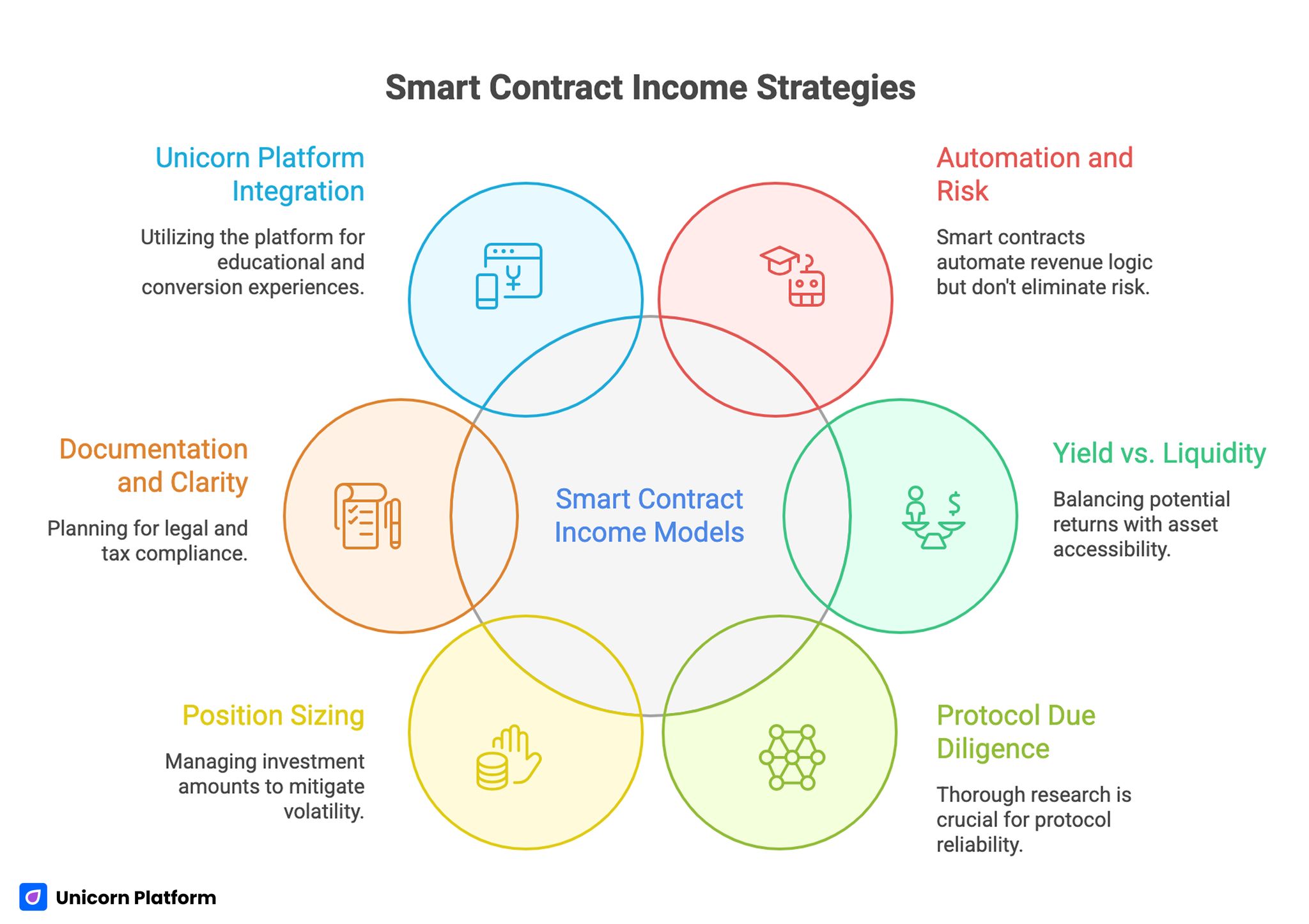
Smart Contract Income Strategies
- Smart contracts can automate repeatable revenue logic, but automation does not remove risk.
- The strongest income models balance yield potential with liquidity, security, and operational simplicity.
- Protocol due diligence matters more than headline returns.
- Position sizing and diversification are essential for volatility-heavy assets.
- Documentation, tax tracking, and legal clarity should be planned before scaling.
- Unicorn Platform users can turn this topic into trustworthy content experiences by combining clear education, transparent risk framing, and conversion-focused page architecture.
sbb-itb-bf47c9b
Smart Contract Basics in Practical Terms
A smart contract is code deployed on a blockchain that executes predefined rules automatically when conditions are met. Instead of manual settlement, logic and execution are embedded in the protocol.
For passive income strategies, this matters because recurring actions can be automated:
- Interest distribution.
- Reward emission.
- Fee sharing.
- Royalty routing.
- Revenue split execution.
This automation reduces operational overhead, but it introduces new failure modes such as contract bugs, oracle errors, governance changes, and liquidity shocks.
Why this model attracts income-seeking users
Compared with traditional manual systems, smart contracts can provide:
- Continuous settlement.
- Public transaction auditability.
- Programmable distribution logic.
- Fast composability across protocols.
These features enable revenue models that are difficult to implement at the same speed in legacy infrastructure.
Main Smart Contract Income Models
Not all models have the same risk profile. Understanding model mechanics is the first layer of defense.
1. Lending and borrowing markets
In decentralized lending protocols, users supply assets to liquidity pools and earn interest paid by borrowers. Returns vary based on demand, collateral conditions, and protocol incentives.
Why people use it:
- Relatively straightforward entry model.
- Potential for steady yield in active markets.
- Clear on-chain accounting of positions.
Primary risks:
- Smart contract vulnerabilities.
- Collateral stress events.
- Interest rate volatility.
- Liquidity constraints during market stress.
2. Staking on proof-of-stake networks
Staking typically involves locking tokens to support network validation and receiving rewards. This is often one of the first smart contract income models users explore.
Why people use it:
- Generally simpler than multi-protocol yield stacks.
- Protocol-native reward structure.
- Strong alignment with network participation.
Primary risks:
- Token price volatility.
- Lockup and unbonding delays.
- Validator slashing or downtime penalties.
3. Liquidity provision and fee capture
Liquidity providers deposit asset pairs into pools and earn a share of trading fees. In some systems, providers also receive incentive tokens.
Why people use it:
- Fee-based earnings can scale with trading activity.
- Flexible participation across many pools.
Primary risks:
- Impermanent loss.
- Pool-specific volatility.
- Incentive decline after early emissions.
4. NFT royalties and programmable creator income
Smart contracts can route royalties from secondary sales automatically to creators or rights holders. For teams with strong distribution and demand, this can create recurring revenue.
Why people use it:
- Automated creator compensation.
- Transparent distribution logic.
- Programmable split rules for collaborators.
Primary risks:
- Weak marketplace demand.
- Policy changes on royalty enforcement.
- Collection relevance decay.
5. Automated on-chain services and subscriptions
Teams can build contract-driven services where payments, access rights, and renewal logic are handled programmatically. This model is closer to SaaS economics but with on-chain settlement.
Why people use it:
- Recurring revenue logic can be transparent and auditable.
- Strong fit for web3-native products.
Primary risks:
- Contract upgrade complexity.
- User experience friction in wallet flows.
- Regulatory interpretation uncertainty.
How to Evaluate Opportunities Before Allocating Capital
Yield numbers alone are a poor decision metric. A stronger framework evaluates protocol quality, liquidity, downside scenarios, and operational overhead.
1. Protocol reliability review
Look at:
- Security audit history.
- Incident record.
- Team and governance transparency.
- Upgrade and pause controls.
No protocol is risk-free, but governance clarity and response history matter.
2. Economic sustainability
Understand where rewards come from. If returns depend mainly on temporary emissions, long-term sustainability may be weak.
Prioritize models with real usage-based cashflow logic where possible.
3. Liquidity and exit conditions
Your ability to exit a position matters as much as entry yield.
Review:
- Pool depth.
- Lockup periods.
- Withdrawal limits.
- Network congestion behavior.
4. Operational complexity
Complex strategies can produce hidden execution risk. If a strategy requires constant manual rebalance, higher gas spend, and multi-chain bridging, the operational burden may erase expected gains.
5. Downside scenario planning
Define stress scenarios before entry:
- What if token price drops 30 to 50 percent?
- What if protocol incentives decline sharply?
- What if liquidity disappears during volatility?
Predefined responses reduce emotional decision-making under pressure.
Step-by-Step: Getting Started With Controlled Risk
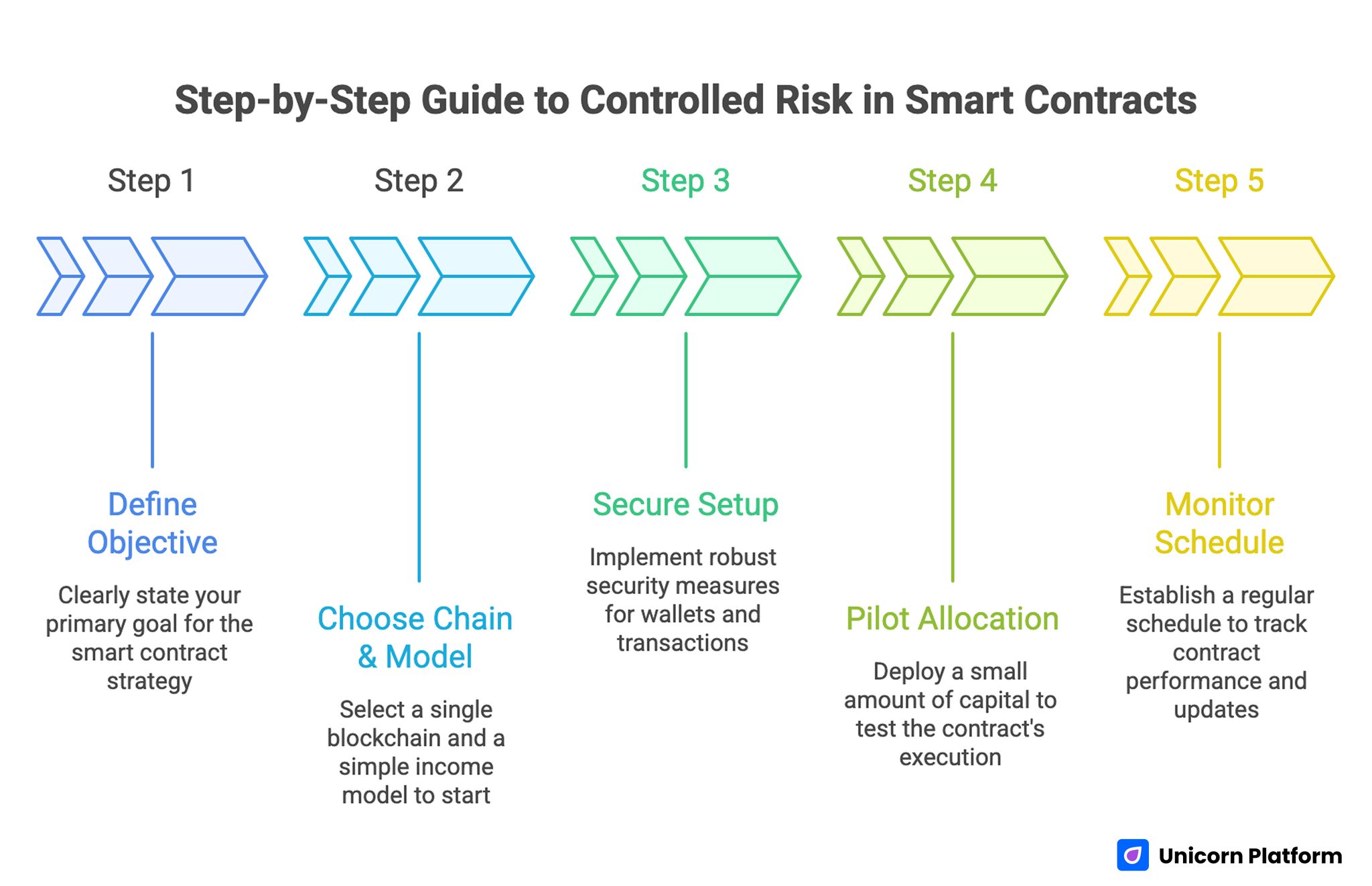
Step-by-Step Guide to Controlled Risk in Smart Contracts
This section is educational and process-oriented. It is not individualized financial advice.
Step 1: Define your objective clearly
Choose one objective per strategy:
- Stable yield on core holdings.
- Growth-oriented high-volatility exposure.
- Creator royalty model.
- Service-based recurring contract revenue.
Mixed objectives often produce mixed execution quality.
Step 2: Choose one chain and one model first
Start narrow. Initial complexity should be low enough that you can monitor risk events without tool overload.
A single chain and single model pilot is usually enough for first-cycle learning.
Step 3: Use secure operational setup
Set up wallet segmentation, hardware security practices, backup methods, and transaction verification habits before deploying capital.
Operational mistakes are one of the most common causes of avoidable loss.
Step 4: Start with a pilot allocation
Use a small pilot position first. Validate execution flow, reward behavior, fee impact, and withdrawal mechanics.
Scale only after confirming the full lifecycle works as expected.
Step 5: Build a monitoring schedule
Track position health weekly at minimum. Include protocol updates, reward trend shifts, liquidity changes, and relevant governance proposals.
Passive models still require active review.
Risk Management Framework for Smart Contract Income
A practical risk framework has four layers.
Layer 1: Exposure limits
Set caps by strategy and by protocol. No single protocol should dominate total exposure unless your risk tolerance and research depth clearly justify it.
Layer 2: Strategy diversification
Diversify by mechanism, not just by token. For example, combining staking with service-based contract income can reduce overdependence on one reward structure.
Layer 3: Liquidity planning
Keep a liquid reserve for volatility events. Illiquid portfolios can force poor exits when market conditions deteriorate.
Layer 4: Governance awareness
Protocol parameters can change. Track governance channels and proposal timelines so you are not surprised by shifts in emissions, collateral rules, or fee structures.
Building Sustainable Income Instead of Chasing Peak Yield
The highest displayed yield is often not the best long-term option. Sustainable execution prioritizes consistency and survivability.
Focus on risk-adjusted returns
A lower but more stable return profile may outperform high-yield strategies that carry high drawdown risk and operational fragility.
Track net outcomes, not only gross rewards
Calculate net results after:
- Gas and transaction costs.
- Slippage and spread.
- Token volatility impact.
- Tax obligations.
Net reality is what matters for decision quality.
Use periodic review and rebalance rules
Define rebalance triggers in advance. Rules-based adjustments are better than reactive changes driven by short-term emotion.
Real-World Revenue Design Patterns
Beyond personal yield strategies, teams can create products and services powered by smart contract automation.
Pattern 1: Revenue-sharing community products
Creators and operators can distribute proceeds automatically through contract splits. This reduces manual settlement friction and improves transparency for participants.
Pattern 2: Tokenized access with recurring logic
Access passes, membership rights, or gated tools can use automated renewal and payment routing.
Pattern 3: On-chain affiliate and referral payouts
Smart contracts can automate partner distribution and reduce disputes around payout timing.
Pattern 4: Multi-party settlement workflows
Collaborative projects can split proceeds transparently across contributors, service providers, and treasury wallets.
In enterprise-adjacent workflows, teams may also evaluate integration paths similar to Calypso consulting services when bridging traditional finance processes and programmable execution stacks.
Legal, Documentation, and Tax Practicalities
Operational discipline in this area protects long-term viability.
Keep transaction records structured
Maintain logs for:
- Entry and exit timestamps.
- Cost basis assumptions.
- Reward receipts.
- Fee spend.
- Contract addresses and protocols used.
Structured records reduce audit and reporting stress later.
Clarify agreement templates for team projects
If income flows involve collaborators, define responsibilities and distribution logic clearly. Standardized legal contracts workflows can reduce friction around rights, obligations, and payout expectations.
Review jurisdiction-specific obligations
Rules vary across regions. Before scaling activity, verify reporting and compliance requirements relevant to your location and use case.
How to Apply This in Unicorn Platform
For Unicorn Platform users, this topic performs best when it is presented as a trust-first educational journey, not a hype page.
Create a three-page structure:
- Core guide page explaining models and risks.
- Strategy comparison page showing mechanism differences.
- Conversion page for newsletter, consultation, or product trial.
This structure separates education from conversion pressure and improves lead quality.
Build reusable content blocks
Use reusable sections for:
- Model definitions.
- Risk checklists.
- Scenario planning examples.
- FAQ updates.
- CTA blocks by readiness level.
Reusable blocks keep content consistent as protocols and market conditions change.
Add transparent risk framing near CTAs
High-intent readers should see risk context before conversion prompts. This builds trust and filters for more serious leads.
For audience discovery and segment research, niche communities like trading groups can help identify recurring questions that should feed your page updates.
Run a monthly update cadence
Set one owner for monthly updates to:
- Revise outdated protocol references.
- Refresh risk notes.
- Update FAQs based on support questions.
Consistency matters more than frequent cosmetic rewrites.
Keep one primary action per page
Avoid overwhelming users with multiple equal-weight actions. Choose one primary conversion goal per page state and support it with one secondary option only.
This improves clarity and reduces drop-off.
Common Mistakes and Fixes
Mistake 1: Leading with returns and hiding risks
Fix: pair every opportunity section with explicit downside conditions and mitigation steps.
Mistake 2: Protocol hopping without framework
Fix: use a repeatable evaluation scorecard before entering new strategies.
Mistake 3: Overcomplex stacks too early
Fix: start with one chain and one model, then expand after controlled validation.
Mistake 4: Ignoring fee and volatility drag
Fix: track net outcomes with complete cost accounting.
Mistake 5: No documentation discipline
Fix: implement structured logs and update them continuously.
Mistake 6: Conversion pages with weak educational context
Fix: publish trust-first content before pushing high-commitment actions.
Mistake 7: No operational owner
Fix: assign a single owner for content accuracy and update cadence.
30-Day Smart Contract Income Execution Plan
Days 1-5: Strategy setup
Choose one income model, define objective, and set exposure limits. Prepare wallet security and record-keeping setup.
Days 6-10: Research and scoring
Evaluate two to three protocols with a standardized reliability and liquidity scorecard. Pick one pilot candidate.
Days 11-17: Pilot deployment
Deploy a small test allocation. Validate reward flows, transaction costs, and withdrawal mechanics.
Days 18-24: Monitoring and adjustment
Track outcomes, identify operational friction, and refine position management rules.
Days 25-30: Documentation and scale decision
Review net results and risk events. Decide whether to scale, hold, or exit based on predefined criteria.
Practical Due Diligence Scorecard Before Entry
A short scorecard can improve decision quality and reduce impulsive entries. Use a 1-to-5 rating for each category and require a minimum average score before allocating capital.
Category 1: Security and code confidence
Check whether the protocol has recent audits, active maintenance, and clear response patterns after incidents. A protocol with unclear maintenance history should score low even if current yields are high.
Category 2: Economic sustainability
Identify whether returns come from real usage or temporary emissions. Sustainable models usually show stable participation and coherent fee logic over time.
Category 3: Liquidity and exit flexibility
Review how fast you can reduce or close positions under stress. Low liquidity and long lockups increase downside severity during volatile periods.
Category 4: Governance and transparency
Assess proposal process clarity, communication quality, and historical change behavior. Governance surprises can materially alter reward assumptions.
Category 5: Operational complexity
Estimate monitoring burden, bridging requirements, and transaction frequency. High complexity should require higher expected risk-adjusted reward to justify entry.
If the average score is weak, delay deployment and re-evaluate later. Waiting is often cheaper than repairing avoidable losses.
Scenario Planning: What to Do Before Markets Move
Most strategy failures happen when users improvise under pressure. Scenario planning creates predefined responses that reduce emotional decisions.
Scenario A: Sharp token drawdown
Define thresholds for reducing exposure if asset values fall rapidly. Include a rule for whether to hold, rebalance, or de-risk based on liquidity and conviction levels.
Scenario B: Reward compression
Yield can compress quickly when participation increases or incentives change. Plan a minimum acceptable net return and define what happens if returns fall below that level.
Scenario C: Smart contract incident news
Prepare a response tree:
- Confirm source quality.
- Check direct exposure.
- Evaluate withdrawal feasibility.
- Execute predefined risk reduction if needed.
A response tree is especially useful when social media narratives become noisy during incidents.
Scenario D: Network congestion and fee spikes
High fees can erase earnings in smaller positions. Define transaction-size thresholds and timing rules so execution remains economical.
Scenario E: Governance proposal risk
Track major proposals and identify changes that affect emissions, collateral parameters, or treasury logic. Decide in advance which proposal outcomes trigger re-evaluation.
Content-to-Conversion Blueprint for Unicorn Platform Users
If your goal is to grow qualified pipeline around smart contract products, page architecture matters as much as technical knowledge.
Stage 1: Educational entry content
Start with trust-building content that explains models and risks in plain language. This attracts users with genuine intent and filters out short-term hype traffic.
Stage 2: Decision support content
Publish comparison pages, risk checklists, and setup frameworks. These pages serve users who are evaluating execution options and improve conversion readiness.
Stage 3: Action pages
Use focused landing pages for one specific action:
- Book consultation.
- Join private community.
- Request implementation demo.
- Subscribe to update brief.
Each action page should reference the educational framework so conversion pressure does not break trust.
Stage 4: Post-conversion nurture
After lead capture, continue with structured follow-up:
- Risk framework recap.
- Strategy setup checklist.
- Monitoring template.
- Next-step consultation or product trial.
This progression improves lead quality and reduces churn from poorly qualified signups.
Team Workflow for Ongoing Smart Contract Content Quality
For teams publishing regularly, define ownership and cadence explicitly.
Role split
- Research owner: tracks protocol and market changes.
- Editorial owner: maintains clarity and risk framing quality.
- Growth owner: evaluates page performance and conversion outcomes.
- Compliance owner: reviews policy-sensitive claims when required.
One person can handle multiple roles in small teams, but responsibilities should remain explicit.
Monthly update checklist
- Refresh protocol references and outdated examples.
- Review all risk statements for current relevance.
- Update FAQs based on user questions and support patterns.
- Confirm CTA pathways still match audience intent.
This routine keeps pages trustworthy and useful over longer cycles.
FAQ: Earn Passive Income with Smart Contracts
1. Are smart contracts truly passive income?
They can automate many actions, but monitoring and risk management are still required.
2. Which model is best for beginners?
Simpler models such as staking or basic lending are often easier to understand than multi-protocol yield stacks.
3. How much capital should I start with?
Start with an amount you can monitor responsibly and scale only after full-cycle validation.
4. What is the biggest risk in these systems?
Protocol or operational risk combined with market volatility is usually the biggest threat.
5. How often should I review positions?
Weekly review is a practical minimum, with faster response when markets or governance conditions shift.
6. Do high APY values mean better opportunities?
Not always. Sustainability, liquidity, and downside behavior matter more than headline numbers.
7. Can smart contracts support business revenue models too?
Yes. They can automate revenue splits, subscription logic, and transparent payout workflows.
8. What should I track for accurate performance?
Track net results including fees, slippage, volatility effects, and tax obligations.
9. Is diversification necessary for smart contract income?
Yes. Diversifying by mechanism and protocol can reduce concentration risk.
10. What makes education content on this topic trustworthy?
Clear risk framing, realistic claims, practical steps, and frequent updates based on real market and protocol changes.
Final Takeaway
Smart contracts can create meaningful recurring income workflows when execution is disciplined. The edge is not in chasing the highest displayed yield. The edge is in building a repeatable system: clear objective, controlled exposure, rigorous monitoring, and honest communication.
For Unicorn Platform users, the strongest path is to combine practical education with conversion clarity. Build pages that help people make informed decisions, update them consistently, and scale only what proves durable over time.