Table of Contents
- The Booking Decision Framework
- 30-Day Rollout Plan
- Scenario Playbooks
- Common Mistakes and Practical Fixes
- Advanced Revenue and Retention Levers
- FAQ
Rental operators live in a fast decision market. Travelers, local commuters, and business renters compare options quickly, often on mobile, often under time pressure, and usually with very little patience for unclear pricing or hidden policy details. The window to earn trust is short, which means the structure of your booking page matters as much as the quality of your fleet.
Many teams assume weak conversion comes from traffic quality alone. Sometimes that is true, but more often the page itself creates drop-off. Users cannot tell what is included, where pickup happens, how deposits work, or whether support will be available if something goes wrong. Even when vehicles are competitive, hesitation grows when critical answers arrive too late.
That is why execution discipline beats surface polish. A clean page design helps, but conversion quality usually comes from message sequencing, risk reduction, and next-step clarity. When those pieces work together, the same traffic source can produce better booking starts, higher completion rates, and fewer support tickets before checkout.
This guide lays out a complete operating model for rental brands that want measurable gains. It focuses on the practical decisions that improve performance: offer framing, trust architecture, mobile interaction, booking-flow structure, content strategy, and experimentation cadence.
sbb-itb-bf47c9b
What High-Performing Rental Pages Do Differently
Strong rental pages do not try to "say everything." They prioritize what users need to decide right now, then progressively reveal deeper detail for users who need more certainty. This keeps first-screen clarity high while still supporting complex purchase behavior.
Top-performing pages also separate audience intent instead of treating all visitors the same. Airport users, weekend leisure renters, long-term local renters, and corporate travel coordinators compare differently. When one page tries to serve every mindset equally, relevance drops for all of them.
Finally, effective teams measure the full booking chain, not one vanity metric. They care about whether users begin reservation flow, complete it, show up, and return. That broader lens is how teams avoid optimizing for cheap clicks that never become profitable demand.
Quick Takeaways
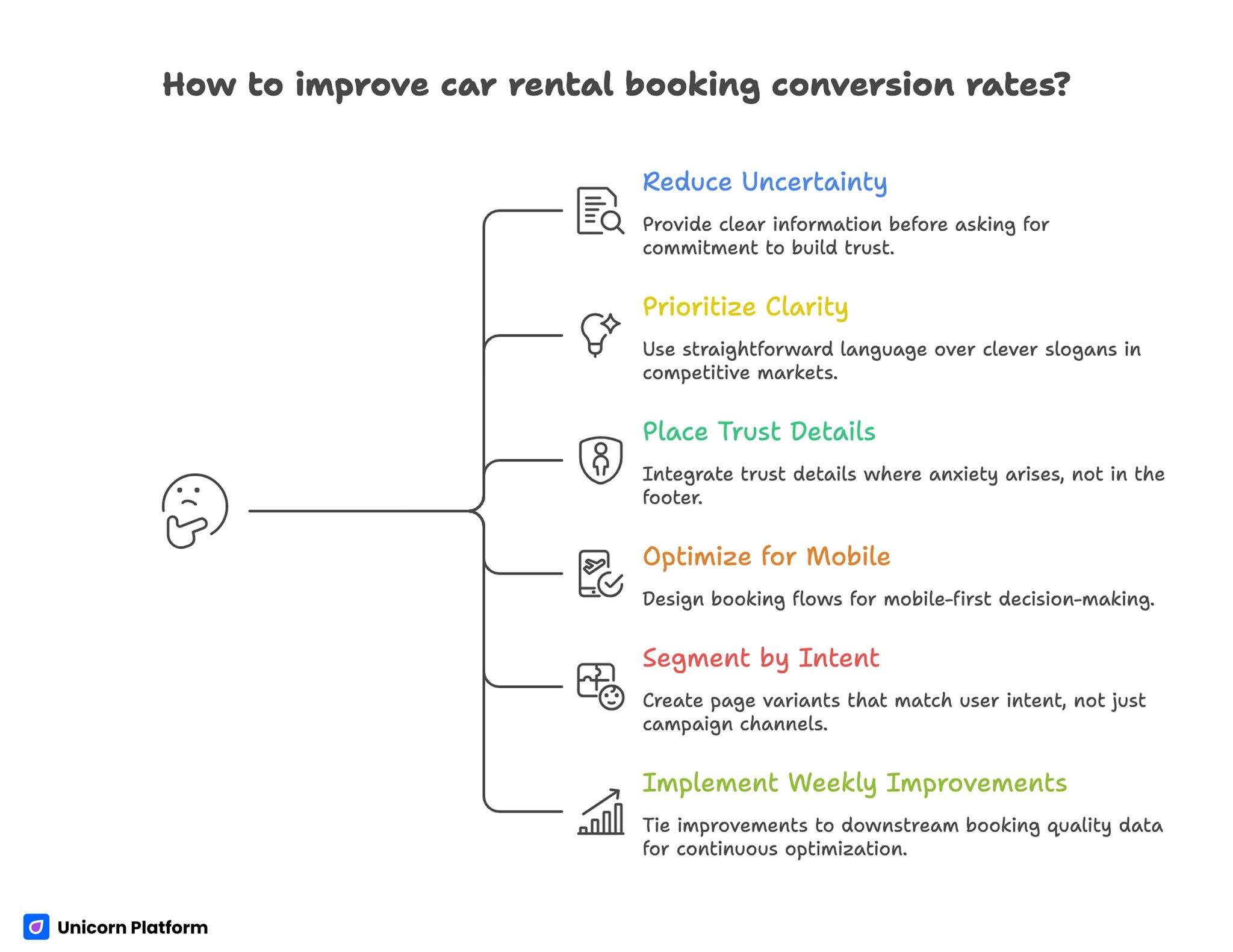
Quick Takeaways to Improve Conversion Rates for Car Rental Websites
- Conversion improves when pages remove uncertainty before asking for commitment.
- Offer clarity beats clever slogans in high-comparison rental markets.
- Trust details should appear where anxiety appears, not in isolated footer blocks.
- Booking flows should be built for mobile decision behavior first.
- Page variants should map to intent segments, not just campaign channels.
- Weekly improvements work best when tied to downstream booking quality data.
Why Rental Pages Underperform
Most underperforming pages fail in predictable ways. They delay practical details, overload users with generic value statements, and use forms that demand too much too early. None of these issues look dramatic in a design review, but each one increases abandonment in live traffic.
The first failure mode is unclear scope. Visitors cannot tell whether pricing includes insurance, how mileage limits work, what the cancellation window is, or whether a valid driver profile is likely to qualify. When policy context is hidden, users hesitate to start a reservation.
The second failure mode is weak intent matching. A user searching for airport pickup may land on a page centered on city-center convenience. A corporate renter may land on consumer-heavy messaging. That mismatch reduces trust because users feel the page was not designed for their need.
The third failure mode is action friction. Date selectors are awkward on small screens, pickup fields are confusing, and confirmation states fail to explain what happens next. These usability breaks are often enough to push a user back to aggregator sites.
The fourth failure mode is measurement blindness. Teams celebrate traffic increases while ignoring completion quality, support escalation before booking, or cancellation spikes by page source. Without these signals, optimization decisions drift toward volume and away from profitability.
The Booking Decision Framework
Rental users typically move through four questions in order: does this fit my trip, can I trust the provider, can I estimate total cost, and can I complete this quickly. Your page should answer those questions in that order.
1. Fit Clarity
Start with concrete fit language. Specify pickup context, vehicle classes, and typical trip use case. A user should understand within seconds whether this page matches their intent, without needing to scroll through promotional copy.
2. Trust and Risk Clarity
Once fit is clear, users evaluate risk. They want to know what happens if plans change, what documentation is required, how support works, and whether policy boundaries are reasonable. Trust content should appear before the first high-commitment action.
3. Cost Orientation
Users do not always need final totals immediately, but they need pricing logic that feels honest. Show what base rates usually include, what common add-ons affect cost, and which variables can change the final figure.
4. Action Clarity
When users are ready, the action path must be obvious. The primary CTA should be visually dominant, phrased in plain language, and backed by clear expectations for what comes next.
Offer Design: Move From Generic Value to Trip-Specific Relevance
Rental offers often fail because they stay abstract. "Best rates" and "premium experience" do not help users decide under real constraints. Better offers combine audience context, service scope, and expected outcome in one concise message.
A practical offer block usually includes three elements: who this option is for, what makes it useful, and what to expect operationally. For example, a city-weekend package can emphasize compact parking convenience, same-day pickup window, and transparent daily pricing logic.
Offer clarity also improves self-selection. Some users are price-led, some convenience-led, and some reliability-led. When pages present clear pathways, users select into the right option with less friction, and support teams spend less time correcting mismatched expectations.
To keep offer structure consistent across campaigns, teams can start with a reusable design system and adapt copy by intent. This framework in automotive website design made simple with Unicorn Platform is helpful when building that operational baseline.
Pricing Communication That Builds Confidence
Transparent pricing communication is one of the strongest conversion levers in rental marketing. Users can tolerate complexity when it is explained clearly, but they abandon quickly when they feel important costs are being withheld until late checkout.
Effective pricing blocks typically cover three levels. First, they explain what the base rate includes. Second, they show common cost modifiers such as insurance type, pickup location, and duration. Third, they explain where final confirmation happens and what remains adjustable.
Scenario framing works better than raw disclaimers. A short example like "two-day city booking with standard coverage" helps users build a realistic expectation faster than a long policy paragraph.
This approach also improves lead quality for quote-request flows. Users who understand cost logic before form submission provide cleaner intent signals and require fewer clarification calls from operations teams.
Trust Architecture for Reservation Confidence
In rental markets, trust is operational. Users judge whether the service will be predictable under pressure, especially when flights are delayed, pickup schedules shift, or policy exceptions are needed. Your page should prove that the process is stable, not merely claim that service is excellent.
Policy clarity should be surfaced in digestible sections: deposit logic, age requirements, cancellation windows, late-return handling, and damage process. When these points are discoverable before checkout, completion quality improves and post-booking conflict declines.
Support visibility is equally important. If users can see response channels, expected response windows, and escalation routes, they are more likely to continue. Uncertainty about support quality often blocks conversion even when pricing is competitive.
Social proof should align with objections. Testimonials that mention smooth pickup, fast issue resolution, or transparent billing are stronger than generic statements. The closer proof is to the decision point, the more useful it becomes.
Booking Flow Design: Reduce Cognitive Load, Not Just Clicks
The reservation flow should feel simple even when business rules are complex. That usually means progressive disclosure: ask for minimal inputs first, then request deeper details only after users see clear value and next-step context.
Date and location inputs should be easy to edit without resetting progress. Users frequently compare nearby options before committing. If each adjustment feels costly, drop-off rises.
Vehicle-selection steps should preserve critical context. Users need quick access to inclusion details, estimated pricing logic, and policy summaries without leaving the flow. Sending users to separate pages for each detail often fragments intent.
Confirmation states should reduce anxiety. After users submit or reserve, show clear timelines, contact expectations, and what information to prepare. This improves completion confidence and lowers support load.
Where reservation friction is a recurring issue, teams can apply this reservation page blueprint to tighten flow sequence and reduce abandonment.
Mobile-First Interaction Standards
Mobile traffic is frequently first-touch traffic in rental acquisition, especially for location-driven and urgency-driven searches. Desktop previews can hide the real friction points users face on weaker networks and smaller screens.
Start with first-screen discipline. Show trip-relevant offer context, one dominant action, and one confidence signal without forcing long scroll behavior. Users in transit rarely read dense blocks before deciding whether to continue.
Form controls should support thumb-driven interaction. Large tap targets, predictable keyboard behavior, and minimal field switching reduce completion fatigue. Date and location components deserve special attention because they drive the rest of the flow.
Performance must support intent speed. Compress media, defer non-critical assets, and prioritize content that helps users decide. A visually rich experience can still underperform if key decision content loads too late.
For teams expanding both rental and dealer service lines, this responsive automotive site guide can help maintain cross-channel mobile quality standards.
Segment-Specific Page Strategy
One template can support many campaigns, but one message cannot serve all intents equally. Segment strategy should be built into the page system from the start.
Airport travelers usually prioritize pickup reliability, after-hours support, and luggage-fit vehicle categories. City renters often prioritize parking practicality, short-term flexibility, and convenient return options. Corporate renters evaluate billing logic, support SLAs, and contract clarity.
Segment pages should share structural consistency while adapting the relevance layer and supporting proof. This protects brand coherence while improving conversion relevance.
A good rule is to vary message framing, proof order, and CTA copy while keeping measurement architecture stable. That makes test interpretation cleaner and allows insights to compound across segments.
SEO and Content Clusters for Booking Intent
Rental SEO performance improves when educational and transactional content are connected by decision logic. Users researching policy or cost questions should be able to move naturally into booking pathways once uncertainty is resolved.
Useful educational topics include deposit requirements, insurance tradeoffs, age restrictions, cancellation timing, and pickup preparation checklists. These themes attract qualified research traffic and reduce pre-booking anxiety.
Transactional pages should then carry users forward with clear trip-fit pathways. Internal linking should reflect likely next decisions, not arbitrary navigation rules.
Teams that connect research and action paths well often see better assisted conversion behavior. Users may not book in the first session, but they return with higher readiness because trust and clarity were established early.
When top-funnel capture is part of your mix, this lead generation page guide can help align educational paths with inquiry quality.
Campaign Execution Model for High-Tempo Teams
Rental demand changes quickly with seasonality, events, and regional conditions. Teams need an execution model that allows rapid updates without sacrificing consistency.
A practical model has four layers: base template, segment variant, campaign overlay, and measurement wrapper. The base template preserves structure. The segment variant adjusts relevance. The campaign overlay reflects temporary offers. The measurement wrapper ensures comparability.
This layered approach reduces production bottlenecks. Marketers can launch campaign variants quickly while preserving trust standards, policy modules, and core interaction quality.
It also improves post-campaign learning. Because core structure stays stable, teams can isolate which message or offer adjustments influenced booking quality.
Seasonal and Fleet-Sync Operations
Seasonal alignment is often overlooked in page strategy. Fleet availability, average trip duration, and demand mix change throughout the year, so static messaging quickly becomes outdated.
A practical seasonal rhythm starts with monthly inventory and demand reviews. Update headline emphasis, vehicle-category ordering, and offer examples to reflect real supply and actual user priorities.
Campaign promises should never outrun operational reality. If ads highlight weekend family vehicles but inventory is constrained, page trust erodes quickly. Alignment between paid messaging and actual availability is essential for sustainable conversion.
Policy modules should be reviewed seasonally as well. Holiday periods, event windows, and weather conditions can affect support expectations, cancellation behavior, and pickup logistics.
Measurement: Optimize for Booking Quality, Not Just Starts
A mature rental analytics model tracks the chain from first interaction to post-booking stability. Single-metric optimization usually leads to superficial gains and operational stress.
Core metrics to track include booking-start rate, booking-completion rate, support-contact rate before completion, cancellation rate by page source, and repeat-booking rate by segment.
Segment your analytics by intent and campaign type. A headline that improves airport conversion may weaken city-renter quality. Without segmented analysis, teams can scale changes that hurt profitable cohorts.
Use section-level events to diagnose friction location. If users consistently pause on policy content, the issue may be clarity, not policy itself. If users abandon at date/location input, interaction design may be the bottleneck.
This measurement discipline gives teams the confidence to make fewer, higher-impact changes rather than constant broad edits.
Experimentation Discipline
Testing works best when scope is controlled. Each cycle should focus on one structural change and one message change, with clear hypotheses tied to expected behavior signals.
Examples of high-impact structural tests include moving policy clarity earlier, simplifying vehicle comparison layout, or changing reservation-step sequencing. Message tests can target value framing, trip-fit specificity, or trust proof wording.
Avoid overlapping tests that alter multiple critical sections simultaneously. When too many variables change, results become difficult to interpret and teams lose learning speed.
Every experiment should be documented with objective, variant description, launch date, audience segment, and observed outcome. This simple practice prevents repeated mistakes and creates reusable playbooks.
Governance and Cross-Functional Ownership
Booking performance is not purely a marketing output. Operations, support, and fleet teams shape user outcomes after the first click. Page strategy should therefore include cross-functional governance from the beginning.
A practical ownership model assigns one lead for offer positioning, one for policy accuracy, one for support readiness, and one for analytics interpretation. Clear accountability speeds decision-making and reduces contradictory edits.
Weekly review meetings should include both conversion metrics and operational feedback. If booking starts rise while support complaints rise faster, the page may be overpromising convenience or hiding constraints.
Monthly governance reviews should decide what to standardize, what to retire, and what to test next. This keeps the system adaptive without becoming chaotic.
30-Day Rollout Plan
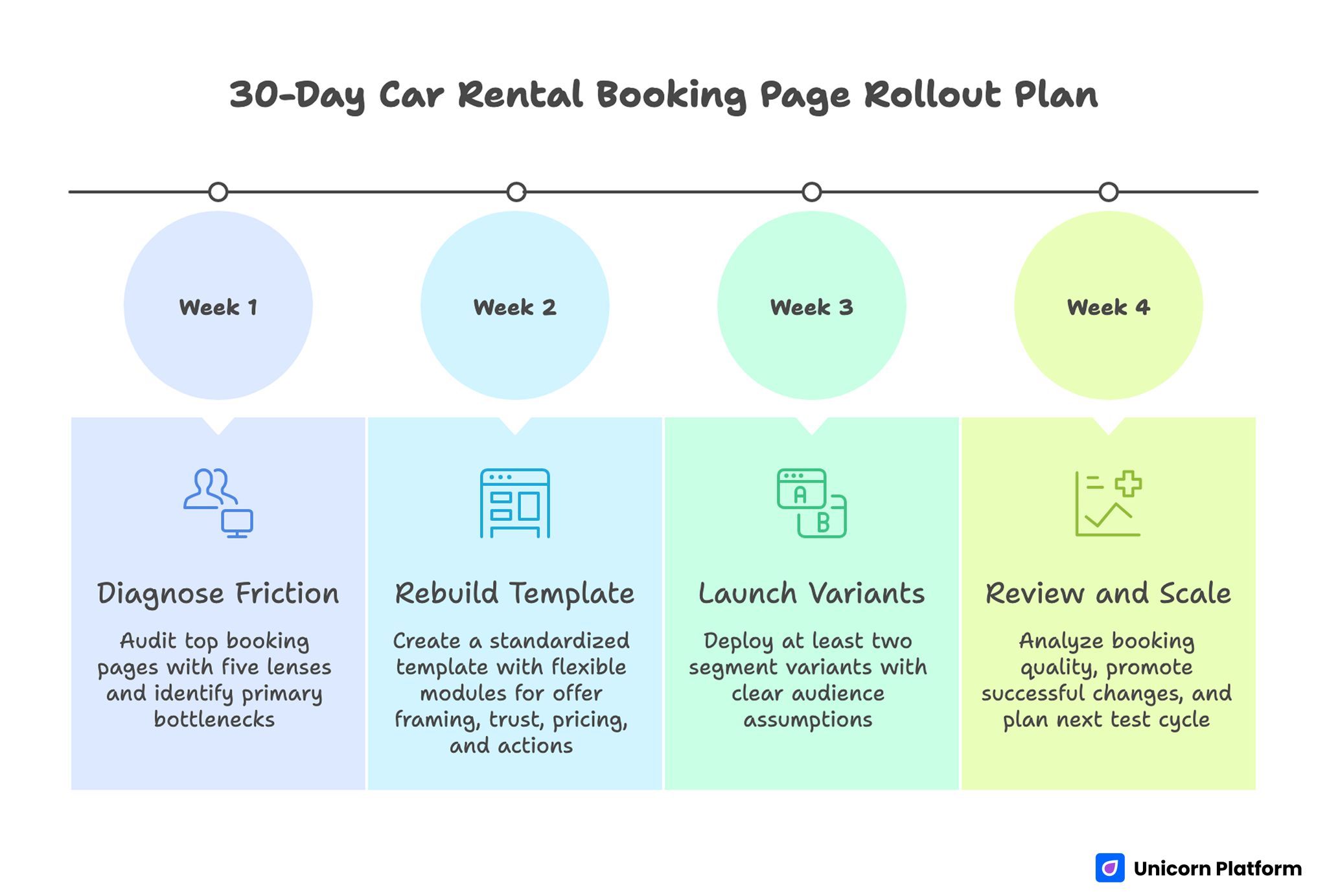
30-Day Car Rental Booking Page Rollout Plan
Week 1: Diagnose Current Friction
Audit your top booking pages with five lenses: relevance clarity, pricing orientation, policy visibility, mobile interaction quality, and confirmation-state confidence. Select one primary bottleneck per segment instead of trying to fix everything at once.
Week 2: Rebuild Core Template Modules
Create a standardized template with flexible modules for offer framing, trust detail, pricing context, and action pathways. Ensure the template supports segment variants without breaking measurement continuity.
Week 3: Launch Intent-Based Variants
Deploy at least two segment variants with clear audience assumptions, such as airport travelers and city renters. Keep the structural backbone consistent so results can be compared cleanly.
Week 4: Review, Consolidate, and Scale
Analyze booking quality metrics, support feedback, and cancellation behavior by source. Promote successful changes into your default template and plan the next focused test cycle.
Running this cadence monthly creates compounding gains because each launch improves both content quality and operational clarity.
Scenario Playbooks
Scenario 1: Strong Traffic, Weak Completion
A regional operator sees healthy paid traffic and good booking starts, but completion rates remain below target. Investigation shows users dropping off after entering dates, often when policy and cost details become visible late in the flow. The page looked polished, yet key decision details arrived too late for confidence.
The fix is to move essential policy and pricing context earlier, simplify date/location interactions, and add a short expectation summary before users commit. This reduces surprise friction and helps users self-qualify before entering deep flow steps. In many cases, completion improves even if total traffic volume does not change.
Scenario 2: High Booking Starts, Rising Cancellations
A city-focused brand improves booking starts with aggressive promotional messaging, but cancellation rates increase sharply within 24 hours. Support logs reveal repeated confusion about deposit conditions and after-hours return rules. The growth signal looked positive at first, but profitability declined due to unstable booking quality.
A better approach is to tighten promotional copy, clarify policy boundaries near the first CTA, and include brief scenario-based pricing context. This lowers impulsive starts and increases reservations from users with realistic expectations. The result is usually lower short-term vanity metrics but stronger net revenue outcomes.
Scenario 3: Multi-Location Operator With Inconsistent Performance
One location converts efficiently while another struggles despite similar fleet composition. The pages share brand styling but differ in trust detail depth, pickup process explanation, and confirmation messaging. Operationally, response timing also varies by location.
Standardizing page modules and follow-up expectations across locations usually narrows this gap quickly. Teams should align first-response standards, policy visibility, and confirmation copy while preserving local relevance where necessary. Consistency across digital experience and post-booking process is what stabilizes performance.
Common Mistakes and Practical Fixes
Mistake 1: Prioritizing slogan copy over practical detail
Fix: Lead with concrete fit and process information before brand-level messaging. Users can appreciate brand tone once they know the offer is usable for their trip.
Mistake 2: Treating policy text as legal-only content
Fix: Translate critical policy points into decision-friendly language near action steps. Legal detail can still exist in full documents, but users need plain-language summaries early.
Mistake 3: Mixing segment goals on one page
Fix: Build intent-specific variants that keep one dominant decision path. Shared templates can preserve efficiency without diluting relevance.
Mistake 4: Hiding cost logic until checkout
Fix: Provide transparent pricing orientation and realistic examples before deep flow steps. This reduces abandonment and support friction.
Mistake 5: Designing flows for desktop first
Fix: Validate every critical interaction on real mobile devices and variable network conditions. Mobile friction compounds quickly in travel-related use cases.
Mistake 6: Measuring success by click volume only
Fix: Tie optimization decisions to completion quality, cancellations, and repeat behavior. Volume without quality often increases operational burden.
Mistake 7: Launching frequently without experiment logs
Fix: Document every major change with hypothesis and observed impact. Reliable documentation is what turns activity into institutional learning.
Advanced Revenue and Retention Levers
Teams that have already improved booking starts often reach a second challenge: protecting margin while maintaining conversion quality. At that stage, the objective shifts from "more reservations" to "better reservations" that balance profitability, operational load, and repeat demand. Page strategy can support this directly when revenue levers are presented with clarity instead of pressure.
Ancillary options such as insurance upgrades, child seats, additional driver access, and flexible return windows should be introduced as practical trip enablers. Users respond better when add-ons are framed as context-based decisions rather than generic upsell prompts. If the page helps users understand when each option is useful, attachment rates can improve without harming trust.
Margin protection also depends on expectation management. Aggressive promotional headlines can produce immediate booking starts, but they often increase support friction and post-booking edits if terms are not obvious. It is usually better to convert slightly fewer users with clearer expectations than to scale low-margin demand that strains operations.
Cancellation and No-Show Prevention by Page Design
Many rental teams treat cancellations as purely operational, but page copy strongly influences cancellation behavior. When confirmation pathways, policy summaries, and reminder expectations are vague, users are more likely to abandon, reschedule late, or treat reservations as tentative placeholders.
A practical prevention model starts before checkout. Include concise policy summaries and realistic time windows at the exact point where users make commitment decisions. Pair this with clear post-booking communication promises so users know what reminders and support messages to expect.
Confirmation pages should also reinforce confidence. If users can quickly find pickup instructions, required documents, and support channels, they are less likely to cancel from uncertainty. This reduces avoidable churn and lowers inbound support pressure during high-demand periods.
Localization and Multilingual Conversion Quality
Rental demand is highly local, even for global brands. Page language, examples, and policy framing should reflect regional expectations around insurance, documentation, and payment methods. Generic global copy often sounds polished but fails to answer location-specific concerns that influence booking confidence.
Localization should go beyond translation. It should adapt practical details such as pickup norms, fuel policies, age requirements, and customer support availability by market. Users trust localized pages more because they signal operational readiness for their context, not just brand visibility.
When teams run multilingual variants, governance matters. Keep one source-of-truth module for policy logic and update localized pages through controlled workflows. This protects consistency and prevents conflicting terms across markets that can create legal and trust risk.
Corporate and Long-Term Pathways
Business renters evaluate different criteria from leisure users. They care about billing workflows, contract flexibility, support escalation, and driver-management rules. Sending them through consumer-first pages increases friction because the page does not reflect procurement and compliance realities.
A dedicated corporate pathway should explain account onboarding, invoicing options, service boundaries, and expected response timelines. Even if the final contract happens offline, this clarity improves lead quality and shortens qualification time for sales teams.
Long-term rental prospects also need a separate path. They compare total ownership alternatives, maintenance expectations, and contract terms over longer horizons. A focused long-term variant can reduce confusion and increase conversion confidence for this higher-value segment.
Post-Booking Experience as a Conversion Multiplier
Many teams stop optimization at booking completion, but post-booking experience heavily influences repeat demand and referral behavior. Confirmation communication, pickup preparedness, and issue resolution quality all shape whether the user returns directly or chooses an aggregator next time.
Landing-page strategy should therefore connect to post-booking workflows. If the page promises quick pickup and transparent support, confirmation messaging and on-site processes must reinforce that promise. Consistency across these stages builds trust equity that lowers future acquisition costs.
Repeat demand programs work best when value is practical. Priority support, simplified rebooking, and clear benefit communication usually outperform broad loyalty slogans. The page should make repeat advantages visible without distracting first-time users from core booking decisions.
Attribution and Data Hygiene
Advanced optimization fails when attribution quality is weak. Duplicate event definitions, inconsistent UTM practices, and mixed source labeling make it difficult to understand which page changes truly improved outcomes. Teams can spend months testing without gaining reliable insight if data hygiene is poor.
Establish one analytics taxonomy for booking pages and enforce it across all variants. Define naming standards for segments, campaigns, and page modules so comparisons remain meaningful over time. This creates continuity even as offer details and creative assets change. Data quality checks should be part of release QA. Before launching major updates, verify that key events fire correctly, source parameters persist through flow steps, and completion signals map to real booking outcomes. Accurate measurement is what turns page iteration into revenue learning.
90-Day Maturity Roadmap
Once the 30-day rollout is stable, teams should plan a longer horizon for operational maturity. A 90-day roadmap helps prevent reactive editing and creates room for compounding improvement across content, UX, and cross-functional coordination.
In days 1-30, focus on structural clarity: fit messaging, trust placement, booking-flow usability, and baseline analytics reliability. In days 31-60, shift toward segment refinement and controlled experimentation across high-impact modules. In days 61-90, institutionalize learnings by updating default templates, governance standards, and post-booking coordination rules.
This phased approach keeps progress practical. Teams avoid overbuilding early while still creating a path toward advanced performance. The goal is not complexity for its own sake, but a repeatable system that supports both growth and service quality.
Release QA Checklist for Rental Teams
Before any major page update goes live, run a release checklist that combines conversion, policy, and technical validation. Confirm that pricing orientation text matches current operational rules, policy summaries reflect current terms, and segment-specific claims are still accurate. Small mismatches here can create costly support friction even when conversion looks strong on day one.
Next, validate interaction quality end to end on real devices. Test date and location changes, vehicle selection transitions, policy visibility, and form submission paths under normal and weak network conditions. A flow that works on a fast office connection can still fail for travelers browsing in transit environments.
Finally, align marketing and support teams on launch expectations. Support leads should know which campaigns are live, what promises are being emphasized, and where users are likely to ask clarifying questions. This cross-team readiness improves the customer experience immediately after launch and gives optimization teams cleaner feedback for the next iteration cycle.
FAQ: Car Rental Booking Pages in 2026
1. How much detail should a rental booking page include?
Include enough detail to resolve core objections before the user commits to reservation steps. The page should feel concise but complete, especially around policy and cost orientation.
2. Should pricing be fully visible on first screen?
Not always, but pricing logic should be clear early. Users need to understand what drives cost and what is included before they invest effort in form steps.
3. What is the best CTA for first-time visitors?
Use a clear action tied to immediate intent, such as checking availability or starting reservation. CTA language should match the stage of confidence your page has built.
4. How do I reduce abandonment in date/location steps?
Simplify interaction design, preserve entered data during edits, and provide context for why each field is needed. Users abandon less when steps feel predictable.
5. How often should pages be updated?
High-traffic pages should be reviewed monthly, with faster updates during seasonal changes and major campaign shifts. Operational changes should trigger immediate content checks.
6. Which trust signals matter most in rental journeys?
Policy transparency, support responsiveness, pickup reliability, and realistic pricing communication usually matter more than generic brand claims.
7. Is one template enough for all rental segments?
One structural template can work, but message framing and proof order should vary by segment. Segment relevance is a major conversion driver.
8. What metrics should guide optimization priorities?
Track booking starts, completion quality, support contacts before booking, cancellation behavior, and repeat bookings by source. These signals reveal true performance.
9. Can no-code workflows support serious rental operations?
Yes, when teams combine speed with strict content standards, operational governance, and disciplined analytics. Speed alone does not create reliable conversion growth.
10. What is the first improvement most teams should test?
Start with first-screen fit clarity and early trust detail placement. That combination often improves both booking starts and completion quality quickly.
Final Takeaway
Rental conversion performance improves when pages help users decide with confidence, not when pages merely look modern. Clear fit messaging, transparent policy communication, mobile-first interaction quality, and disciplined testing create the foundation for sustainable growth.
Teams that run this system consistently launch faster, learn faster, and produce better booking outcomes without relying on aggressive discounting or unstable tactics. Over time, that operational consistency becomes the competitive edge.
Related Blog Posts
- Booking Landing Page Examples in 2026: How to Turn Scheduling Intent Into Reliable Conversions
- Travel Agency Website Examples Only Work When You Turn Inspiration Into a Booking System
- Travel Agency Website Strategy That Turns Visits Into Qualified Bookings
- Resort Booking Page Playbook: How to Turn Resort Traffic Into Qualified Direct Revenue